POLYPHASE CIRCUITS
LEARNING GOALS
Three Phase Circuits
Advantages of polyphase circuits
Three Phase Connections
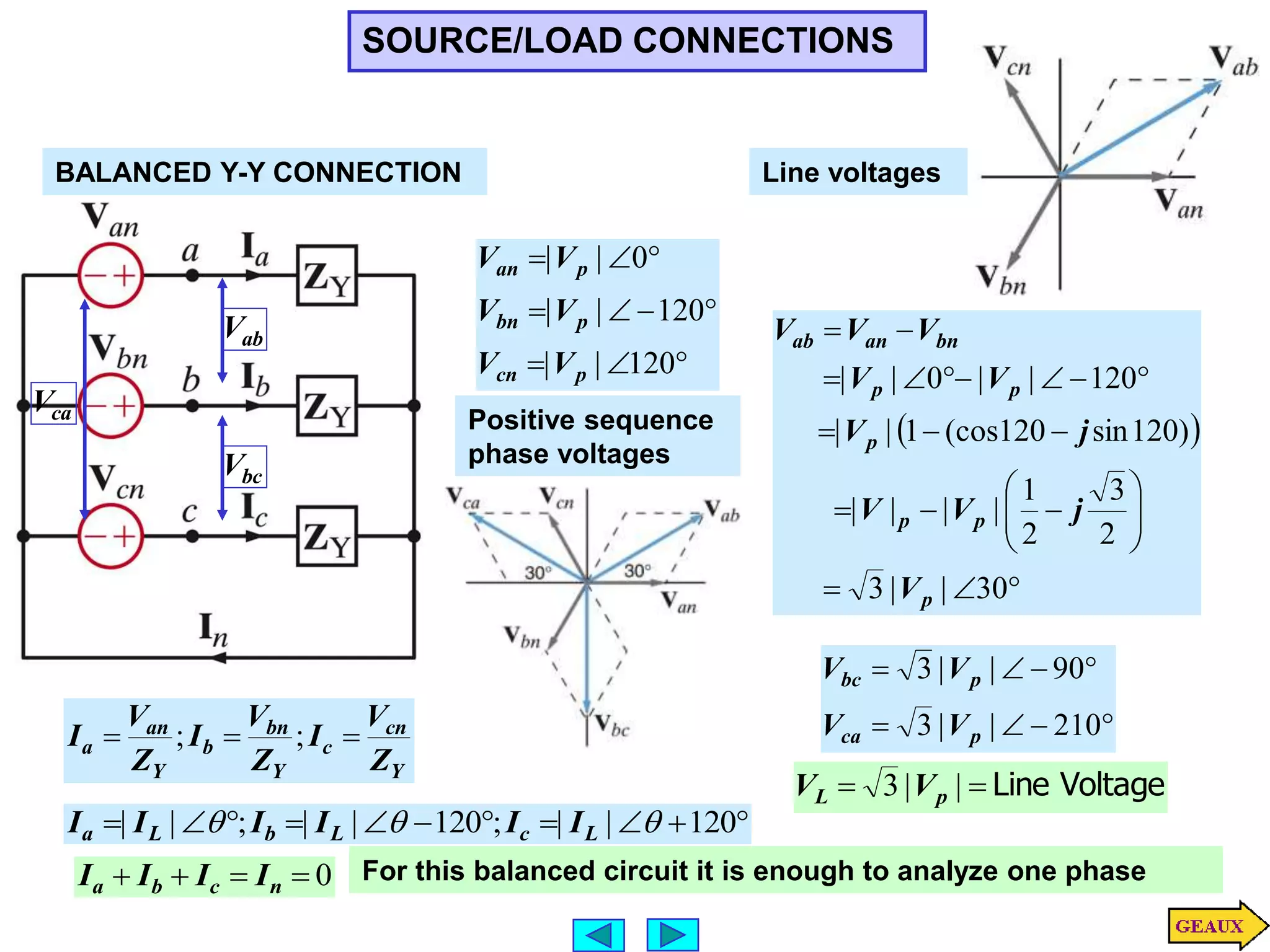
Basic configurations for three phase circuits
Source/Load Connections
Delta-Wye connections
Power Relationships
Study power delivered by three phase circuits
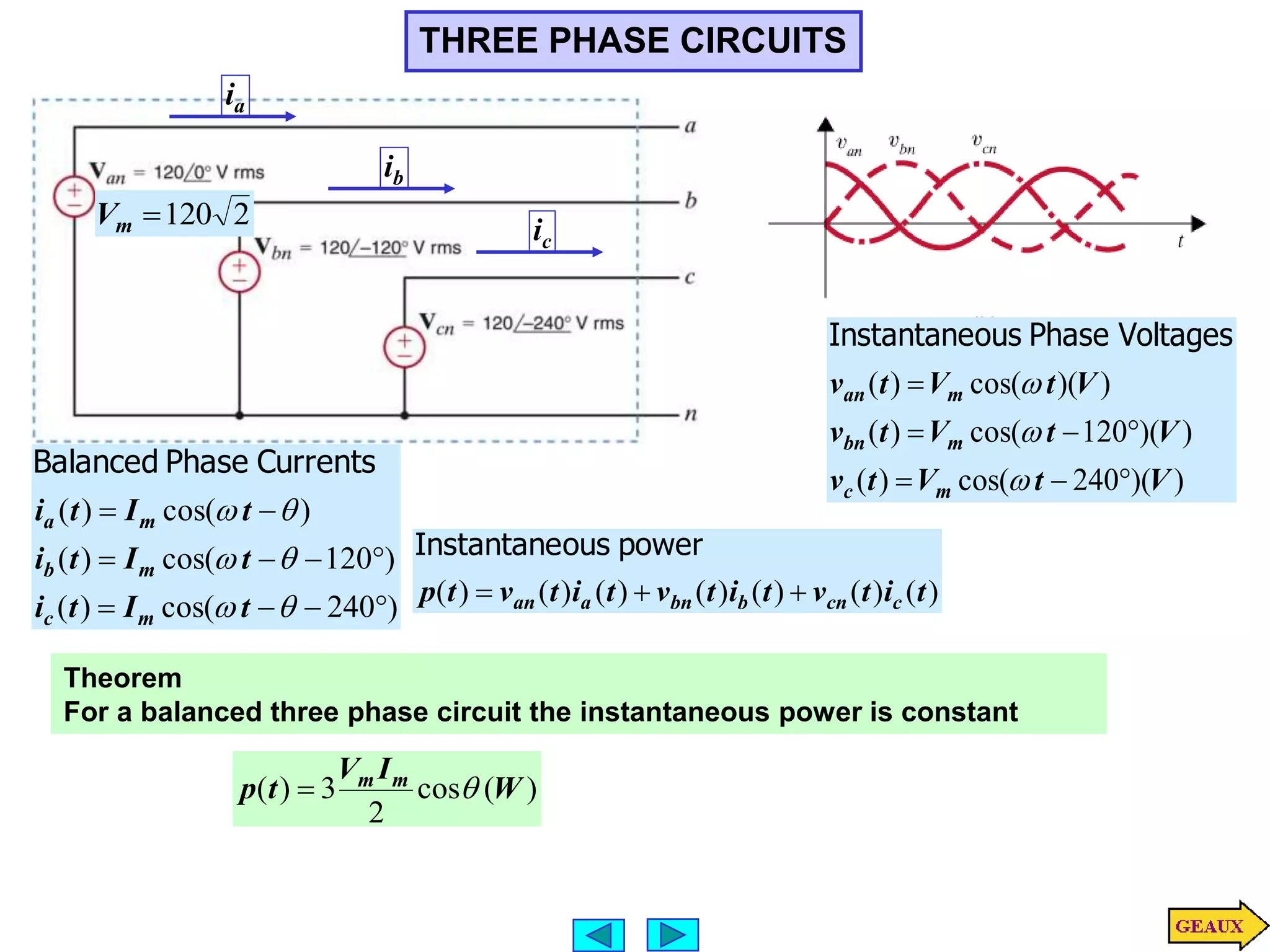
THREE PHASE CIRCUITS
)
)(
240
cos(
)
(
)
)(
120
cos(
)
(
)
)(
cos(
)
(
V
t
V
t
v
V
t
V
t
v
V
t
V
t
v
m
c
m
bn
m
an










Voltages
Phase
ous
Instantane
a
i
b
i
c
i
)
240
cos(
)
(
)
120
cos(
)
(
)
cos(
)
(
















t
I
t
i
t
I
t
i
t
I
t
i
m
c
m
b
m
a
Currents
Phase
Balanced
2
120

m
V
)
(
)
(
)
(
)
(
)
(
)
(
)
( t
i
t
v
t
i
t
v
t
i
t
v
t
p c
cn
b
bn
a
an 


power
ous
Instantane
Theorem
For a balanced three phase circuit the instantaneous power is constant
)
(
cos
2
3
)
( W
I
V
t
p m
m


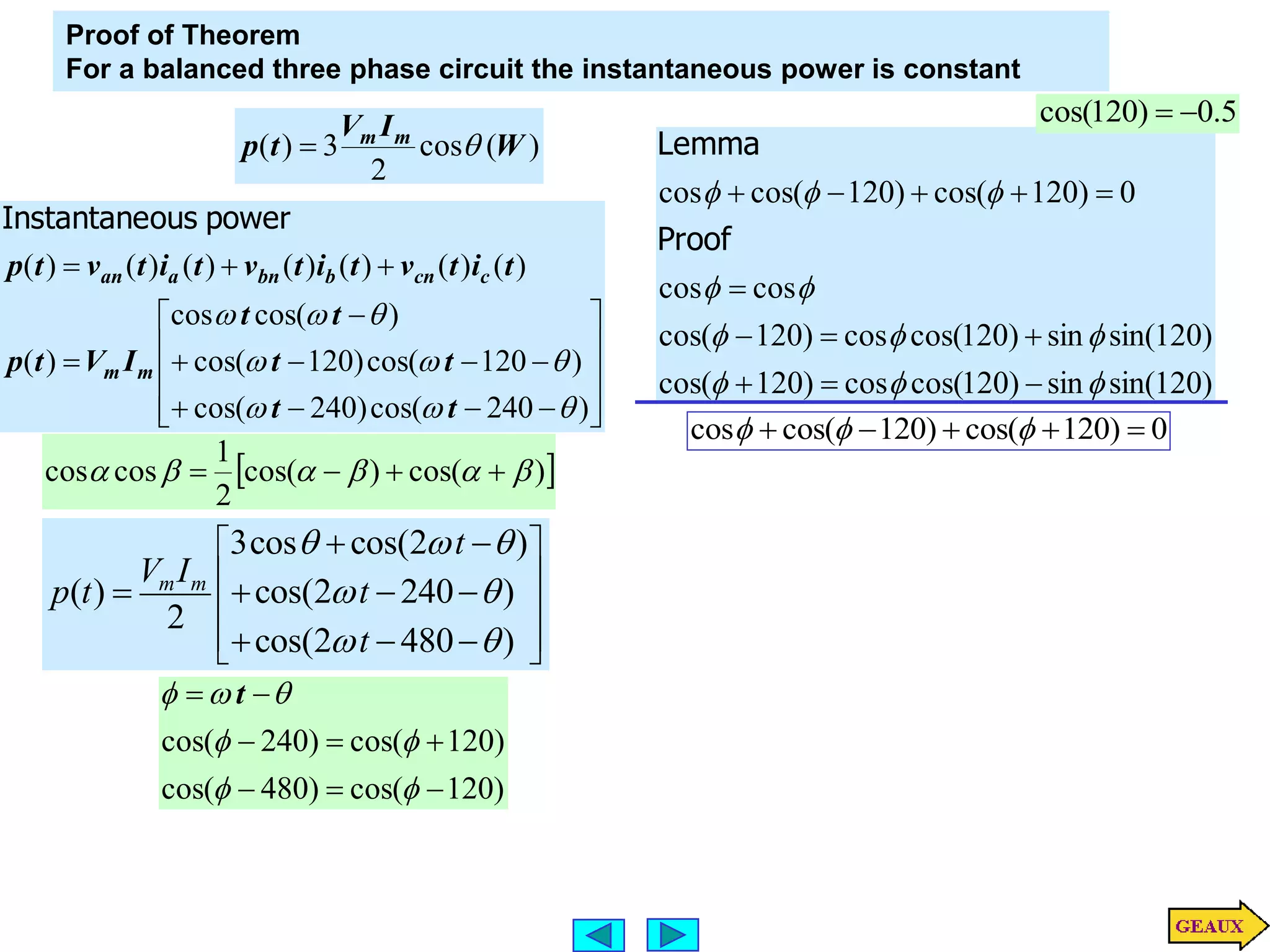
Proof of Theorem
For a balanced three phase circuit the instantaneous power is constant
)
(
cos
2
3
)
( W
I
V
t
p m
m

























)
240
cos(
)
240
cos(
)
120
cos(
)
120
cos(
)
cos(
cos
)
(
)
(
)
(
)
(
)
(
)
(
)
(
)
(









t
t
t
t
t
t
I
V
t
p
t
i
t
v
t
i
t
v
t
i
t
v
t
p
m
m
c
cn
b
bn
a
an
power
ous
Instantane
 
)
cos(
)
cos(
2
1
cos
cos 




 



3cos cos(2 )
( ) cos(2 240 )
2
cos(2 480 )
m m
t
V I
p t t
t
  
 
 
 
 
 
 
 
 
   
  
)
120
sin(
sin
)
120
cos(
cos
)
120
cos(
)
120
sin(
sin
)
120
cos(
cos
)
120
cos(
cos
cos
0
)
120
cos(
)
120
cos(
cos























Proof
Lemma
5
.
0
)
120
cos( 

0
)
120
cos(
)
120
cos(
cos 



 


)
120
cos(
)
480
cos(
)
120
cos(
)
240
cos(














 t
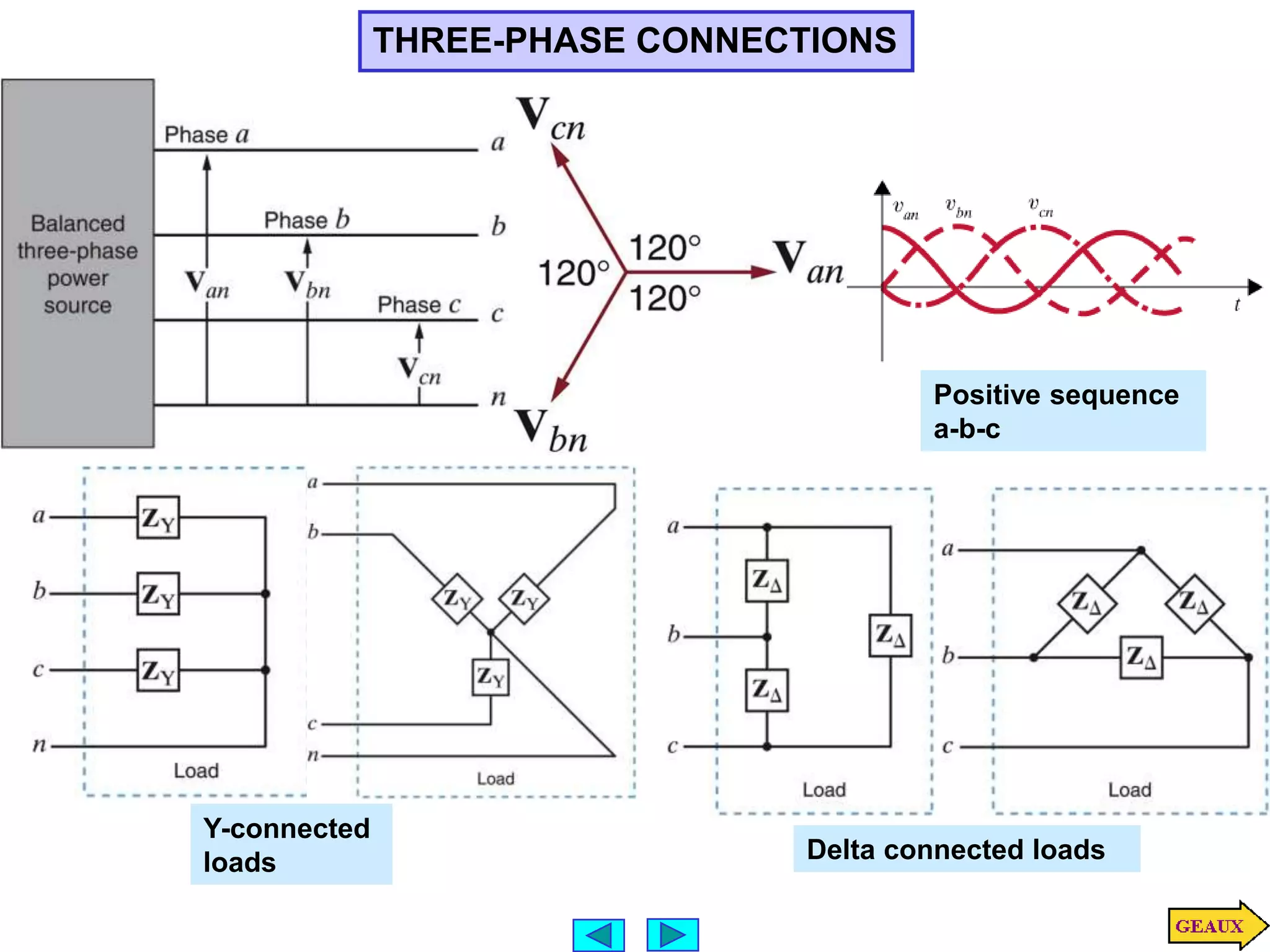
THREE-PHASE CONNECTIONS
Positive sequence
a-b-c
Y-connected
loads Delta connected loads
SOURCE/LOAD CONNECTIONS
BALANCED Y-Y CONNECTION










120
|
|
120
|
|
0
|
|
p
cn
p
bn
p
an
V
V
V
V
V
V
Positive sequence
phase voltages
ab
V
bc
V
ca
V
Line voltages
 

























30
|
|
3
2
3
2
1
|
|
|
|
)
120
sin
120
(cos
1
|
|
120
|
|
0
|
|
p
p
p
p
p
p
bn
an
ab
V
j
V
V
j
V
V
V
V
V
V








210
|
|
3
90
|
|
3
p
ca
p
bc
V
V
V
V
Voltage
Line

 |
|
3 p
L V
V
Y
cn
c
Y
bn
b
Y
an
a
Z
V
I
Z
V
I
Z
V
I 

 ;
;










 120
|
|
;
120
|
|
;
|
| 

 L
c
L
b
L
a I
I
I
I
I
I
0



 n
c
b
a I
I
I
I For this balanced circuit it is enough to analyze one phase
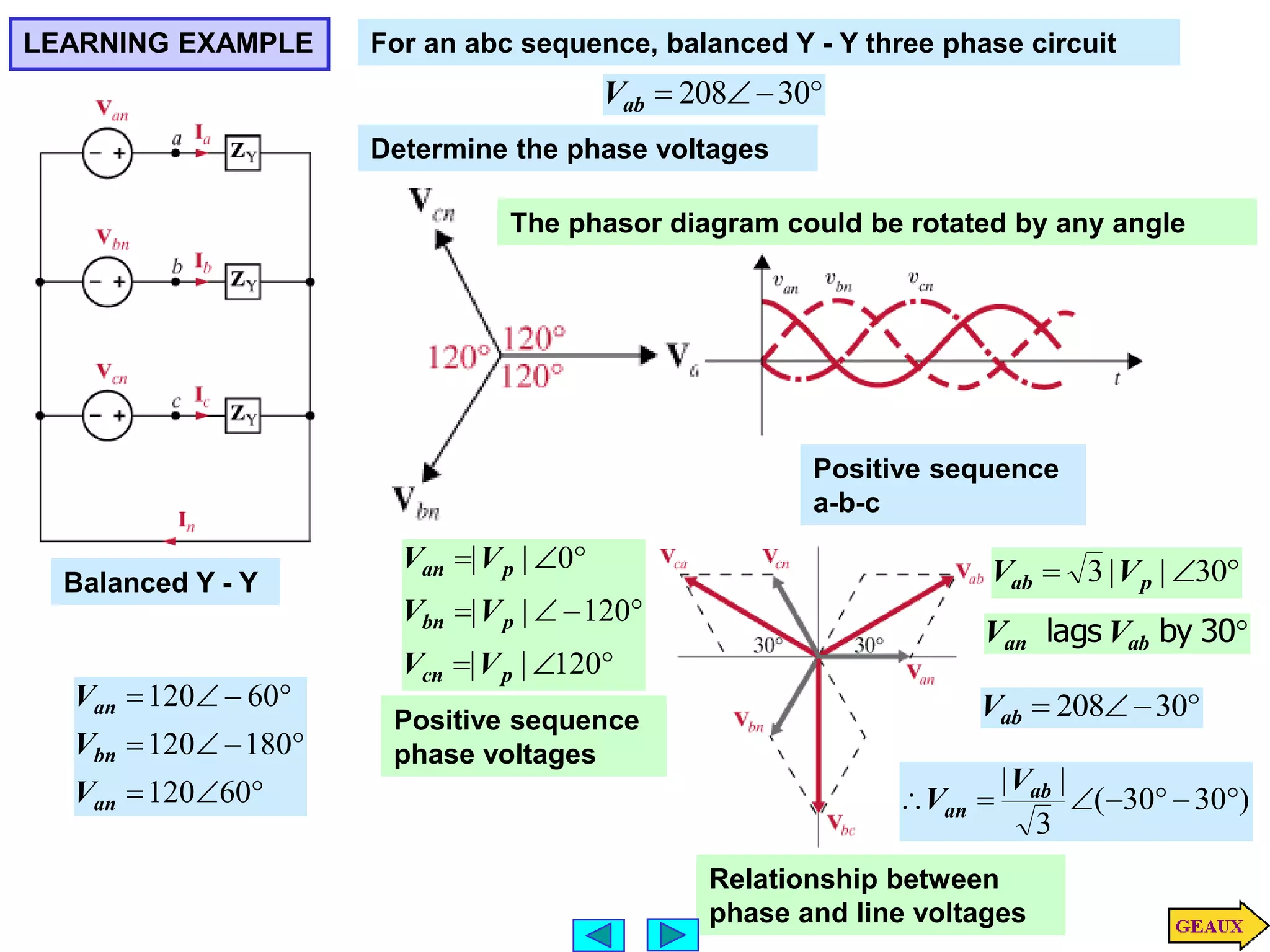
Relationship between
phase and line voltages
LEARNING EXAMPLE For an abc sequence, balanced Y - Y three phase circuit



 30
208
ab
V
Determine the phase voltages
Balanced Y - Y
Positive sequence
a-b-c


 30
|
|
3 p
ab V
V










120
|
|
120
|
|
0
|
|
p
cn
p
bn
p
an
V
V
V
V
V
V
Positive sequence
phase voltages
)
30
30
(
3
|
|






 ab
an
V
V

30
by
lags ab
an V
V



 30
208
ab
V











60
120
180
120
60
120
an
bn
an
V
V
V
The phasor diagram could be rotated by any angle
LEARNING EXAMPLE For an abc sequence, balanced Y - Y three phase circuit
source 120( ) , 1 1 , 20 10
rms
phase line phase
V V Z j Z j
      
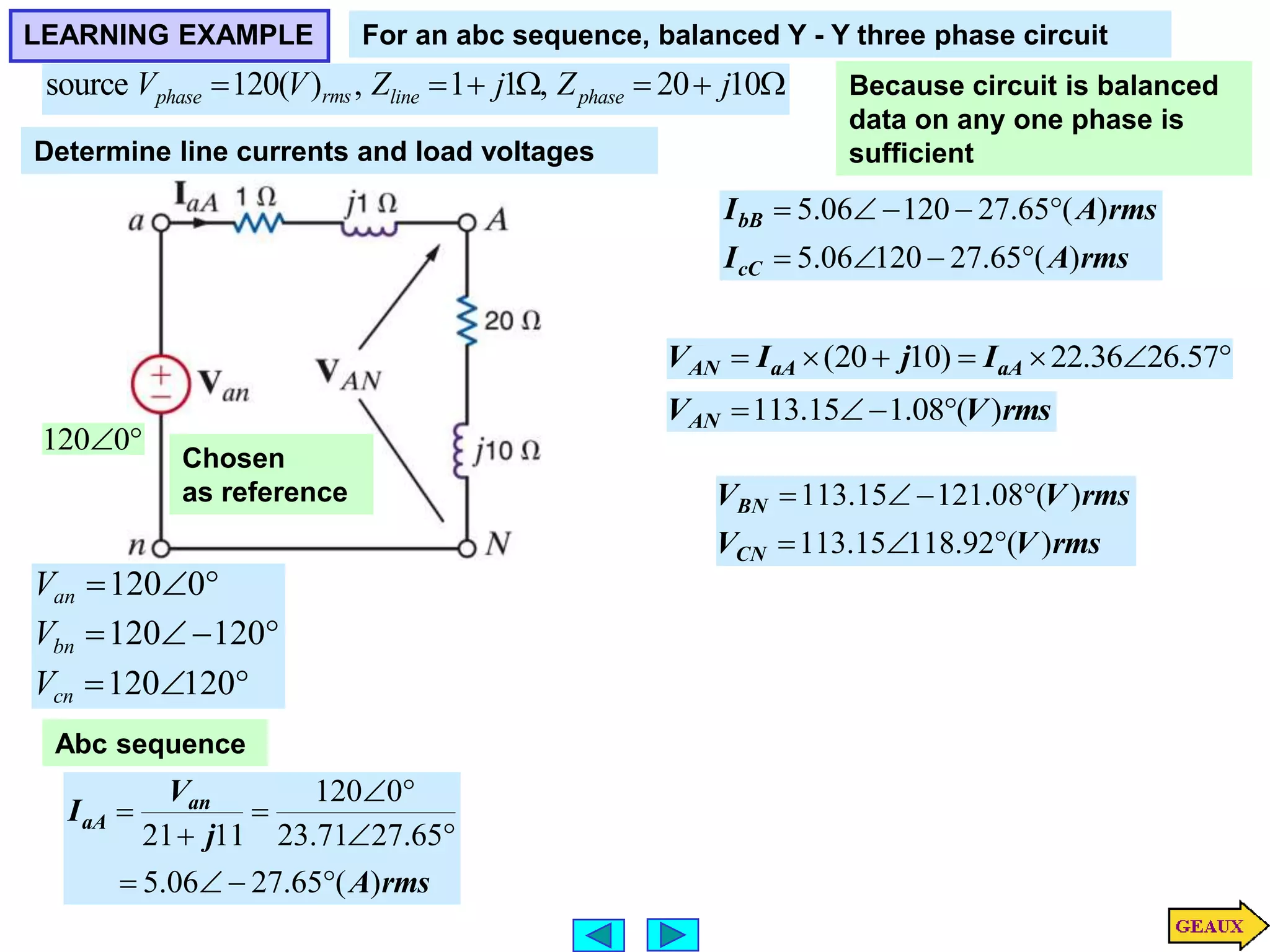
Determine line currents and load voltages
Because circuit is balanced
data on any one phase is
sufficient

0
120
Chosen
as reference
120 0
120 120
120 120
an
bn
cn
V
V
V
  
  
  
Abc sequence
rms
A
j
V
I an
aA
)
(
65
.
27
06
.
5
65
.
27
71
.
23
0
120
11
21











rms
A
I
rms
A
I
cC
bB
)
(
65
.
27
120
06
.
5
)
(
65
.
27
120
06
.
5















 57
.
26
36
.
22
)
10
20
( aA
aA
AN I
j
I
V
rms
V
VAN )
(
08
.
1
15
.
113 



rms
V
V
rms
V
V
CN
BN
)
(
92
.
118
15
.
113
)
(
08
.
121
15
.
113







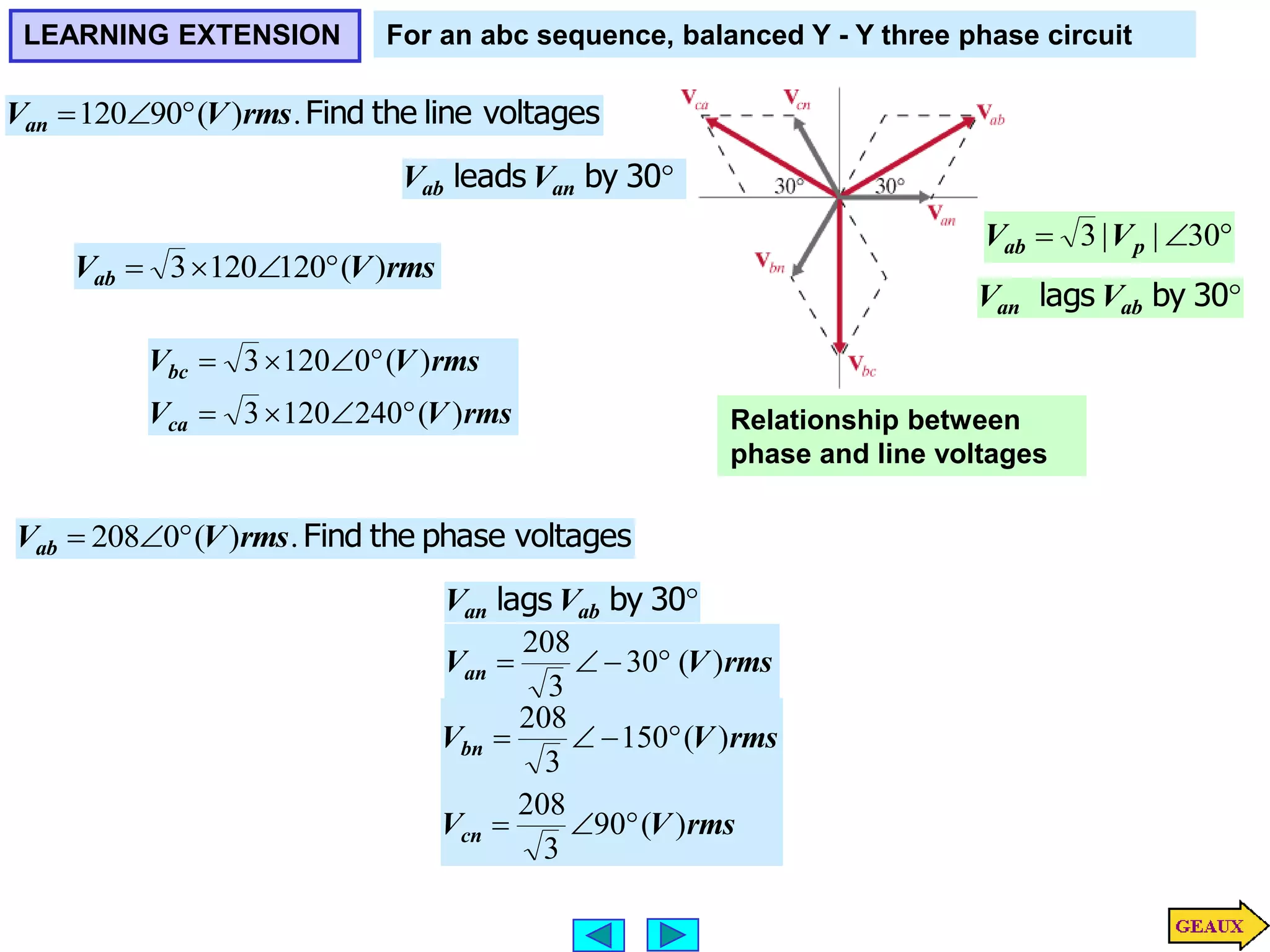
LEARNING EXTENSION For an abc sequence, balanced Y - Y three phase circuit
voltages
line
the
Find
.
)
(
90
120 rms
V
Van 


Relationship between
phase and line voltages


 30
|
|
3 p
ab V
V

30
by
lags ab
an V
V
30
by
leads 
an
ab V
V
rms
V
Vab )
(
120
120
3 



rms
V
V
rms
V
V
ca
bc
)
(
240
120
3
)
(
0
120
3








voltages
phase
the
Find
.
)
(
0
208 rms
V
Vab 



30
by
lags ab
an V
V
rms
V
Van )
(
30
3
208




rms
V
V
rms
V
V
cn
bn
)
(
90
3
208
)
(
150
3
208







LEARNING EXTENSION For an abc sequence, balanced Y - Y three phase circuit
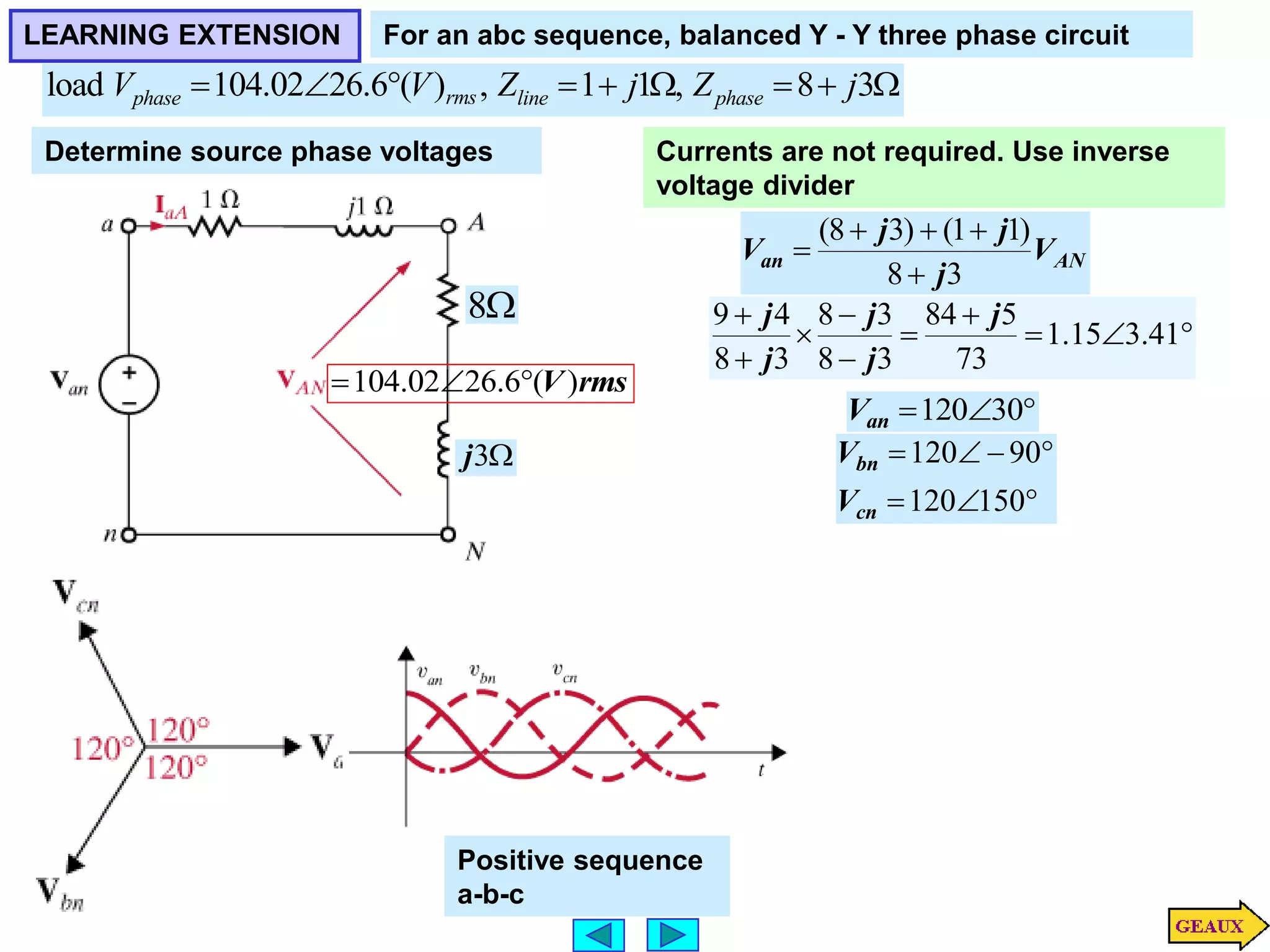
load 104.02 26.6 ( ) , 1 1 , 8 3
rms
phase line phase
V V Z j Z j
        
Determine source phase voltages
rms
V)
(
6
.
26
02
.
104 



8

3
j
Currents are not required. Use inverse
voltage divider
AN
an V
j
j
j
V
3
8
)
1
1
(
)
3
8
(















41
.
3
15
.
1
73
5
84
3
8
3
8
3
8
4
9 j
j
j
j
j


 30
120
an
V
Positive sequence
a-b-c







150
120
90
120
cn
bn
V
V
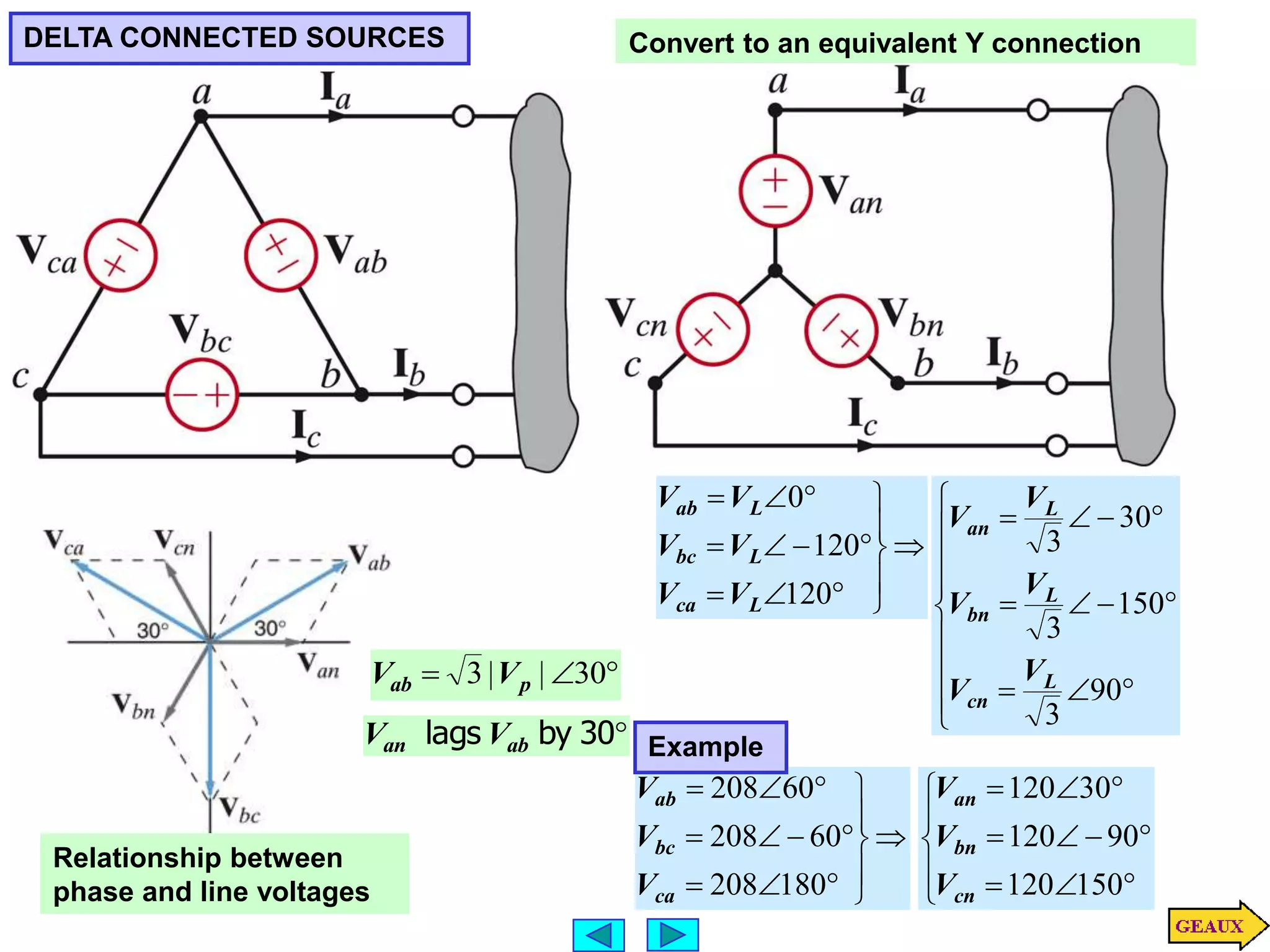
DELTA CONNECTED SOURCES
Relationship between
phase and line voltages


 30
|
|
3 p
ab V
V

30
by
lags ab
an V
V
















120
120
0
L
ca
L
bc
L
ab
V
V
V
V
V
V




















90
3
150
3
30
3
L
cn
L
bn
L
an
V
V
V
V
V
V















150
120
90
120
30
120
cn
bn
an
V
V
V
















180
208
60
208
60
208
ca
bc
ab
V
V
V
Example
Convert to an equivalent Y connection
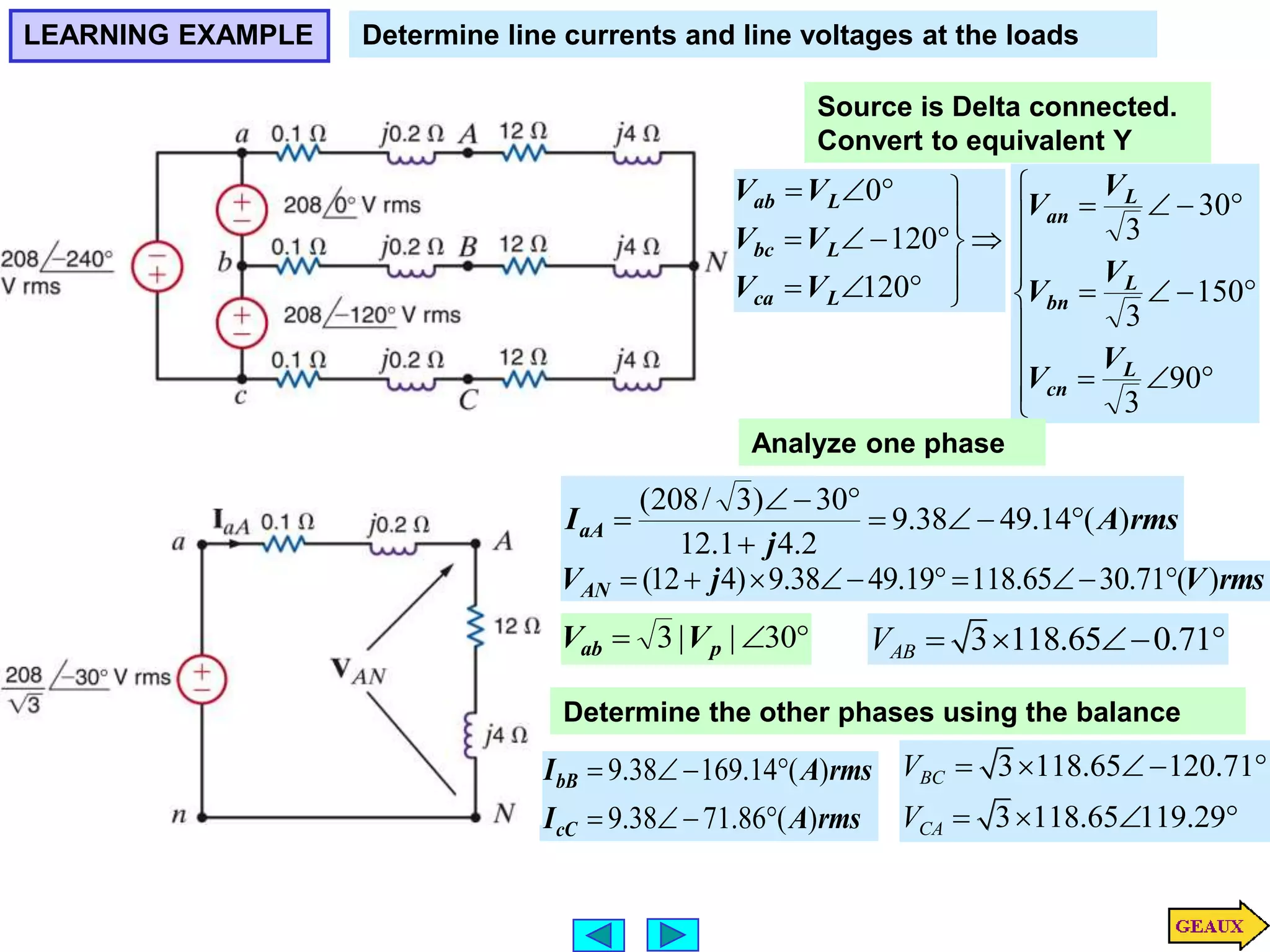
LEARNING EXAMPLE Determine line currents and line voltages at the loads
Source is Delta connected.
Convert to equivalent Y
















120
120
0
L
ca
L
bc
L
ab
V
V
V
V
V
V




















90
3
150
3
30
3
L
cn
L
bn
L
an
V
V
V
V
V
V
Analyze one phase
rms
A
j
IaA )
(
14
.
49
38
.
9
2
.
4
1
.
12
30
)
3
/
208
(









rms
V
j
VAN )
(
71
.
30
65
.
118
19
.
49
38
.
9
)
4
12
( 









Determine the other phases using the balance
rms
A
I
rms
A
I
cC
bB
)
(
86
.
71
38
.
9
)
(
14
.
169
38
.
9










 30
|
|
3 p
ab V
V 3 118.65 0.71
AB
V    
3 118.65 120.71
3 118.65 119.29
BC
CA
V
V
   
   
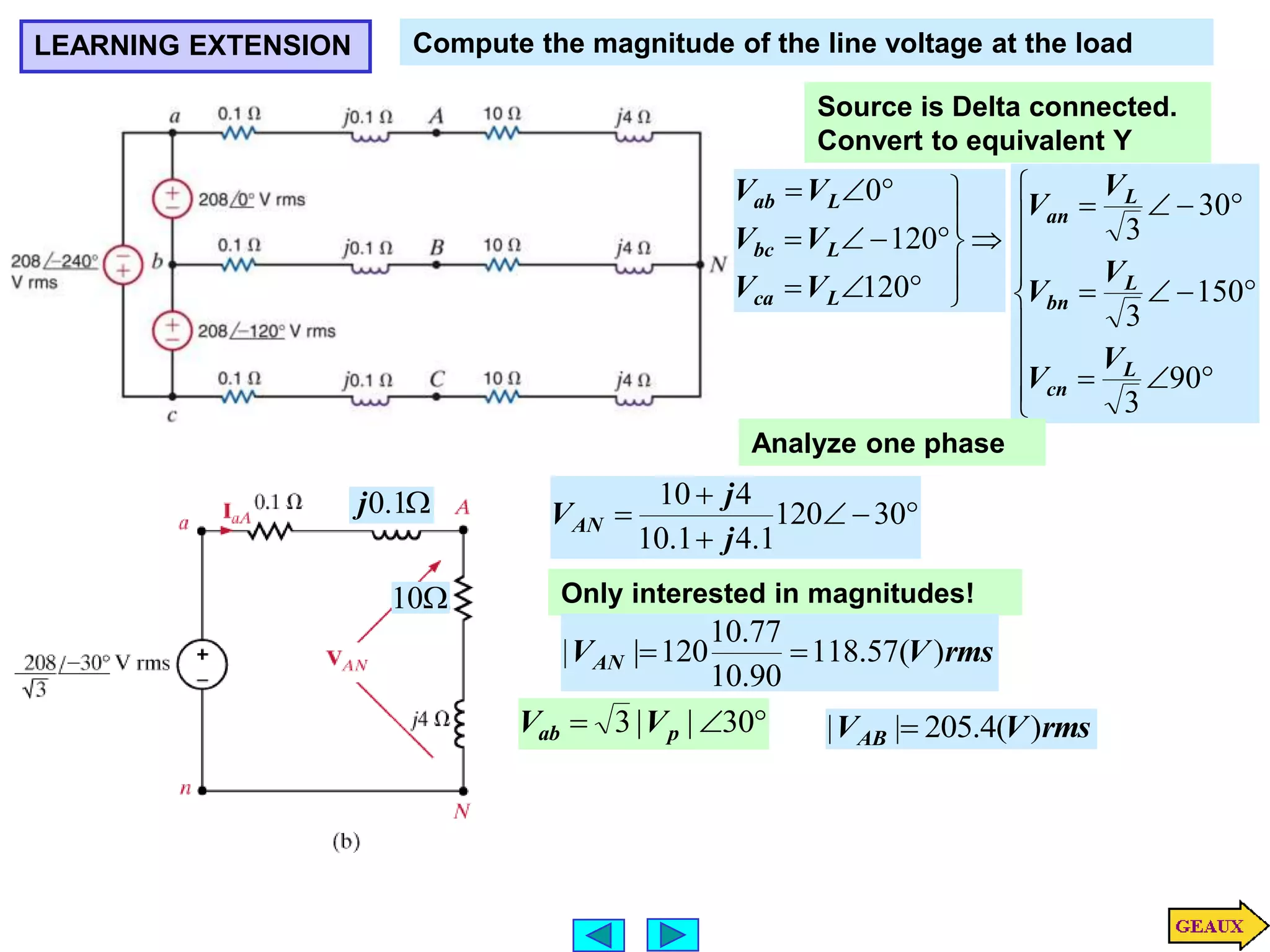
LEARNING EXTENSION Compute the magnitude of the line voltage at the load
Source is Delta connected.
Convert to equivalent Y
















120
120
0
L
ca
L
bc
L
ab
V
V
V
V
V
V




















90
3
150
3
30
3
L
cn
L
bn
L
an
V
V
V
V
V
V
Analyze one phase





 30
120
1
.
4
1
.
10
4
10
j
j
VAN

10

1
.
0
j
Only interested in magnitudes!
rms
V
VAN )
(
57
.
118
90
.
10
77
.
10
120
|
| 



 30
|
|
3 p
ab V
V rms
V
VAB )
(
4
.
205
|
| 
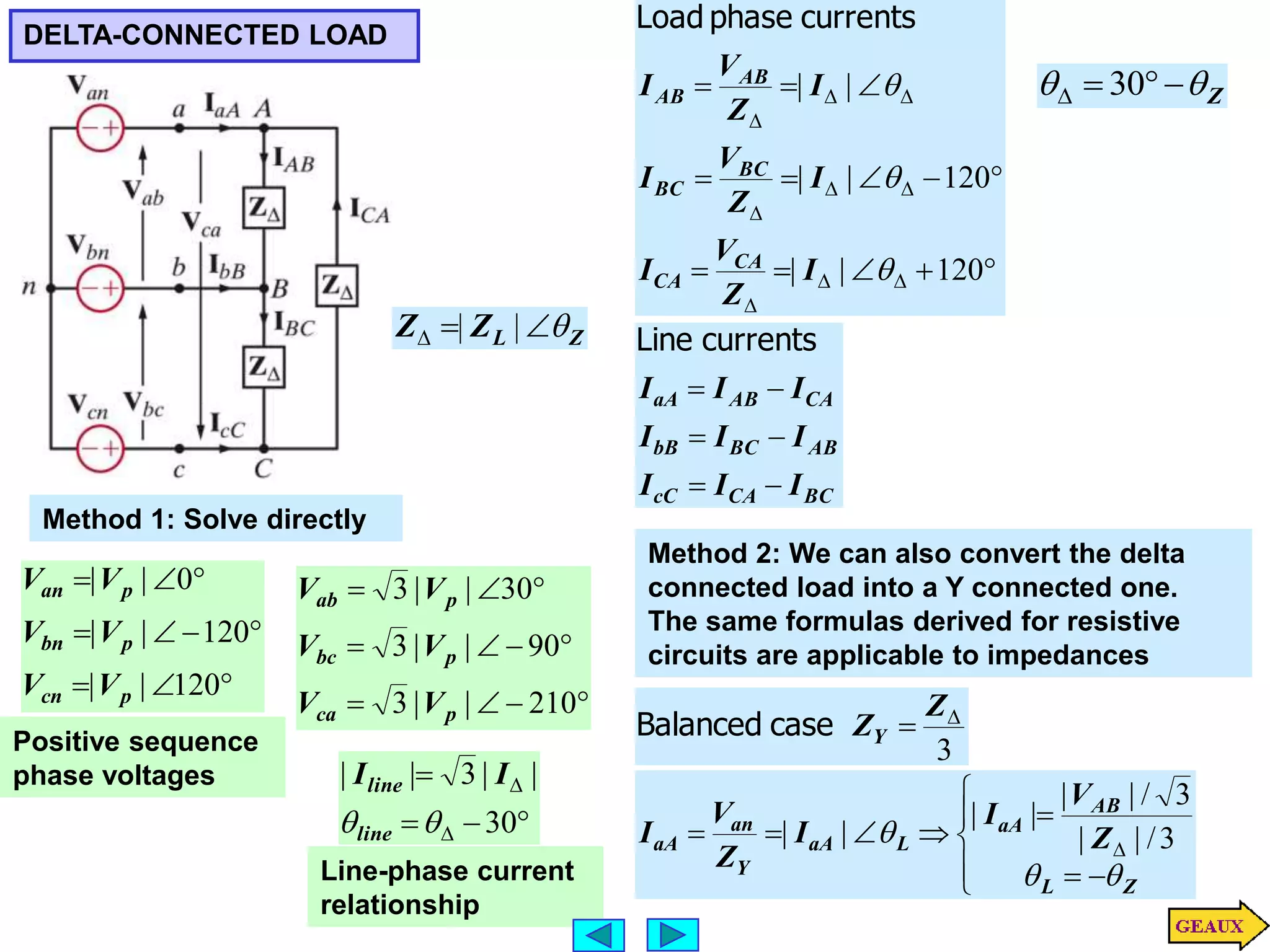
DELTA-CONNECTED LOAD
Method 1: Solve directly










120
|
|
120
|
|
0
|
|
p
cn
p
bn
p
an
V
V
V
V
V
V
Positive sequence
phase voltages











210
|
|
3
90
|
|
3
30
|
|
3
p
ca
p
bc
p
ab
V
V
V
V
V
V






















120
|
|
120
|
|
|
|



I
Z
V
I
I
Z
V
I
I
Z
V
I
CA
CA
BC
BC
AB
AB
currents
phase
Load
BC
CA
cC
AB
BC
bB
CA
AB
aA
I
I
I
I
I
I
I
I
I






currents
Line
Method 2: We can also convert the delta
connected load into a Y connected one.
The same formulas derived for resistive
circuits are applicable to impedances
3


Z
ZY
case
Balanced











 
Z
L
AB
aA
L
aA
Y
an
aA Z
V
I
I
Z
V
I


 3
/
|
|
3
/
|
|
|
|
|
|
Z
L
Z
Z 


 |
|
Z

 


 30






30
|
|
3
|
|

line
line I
I
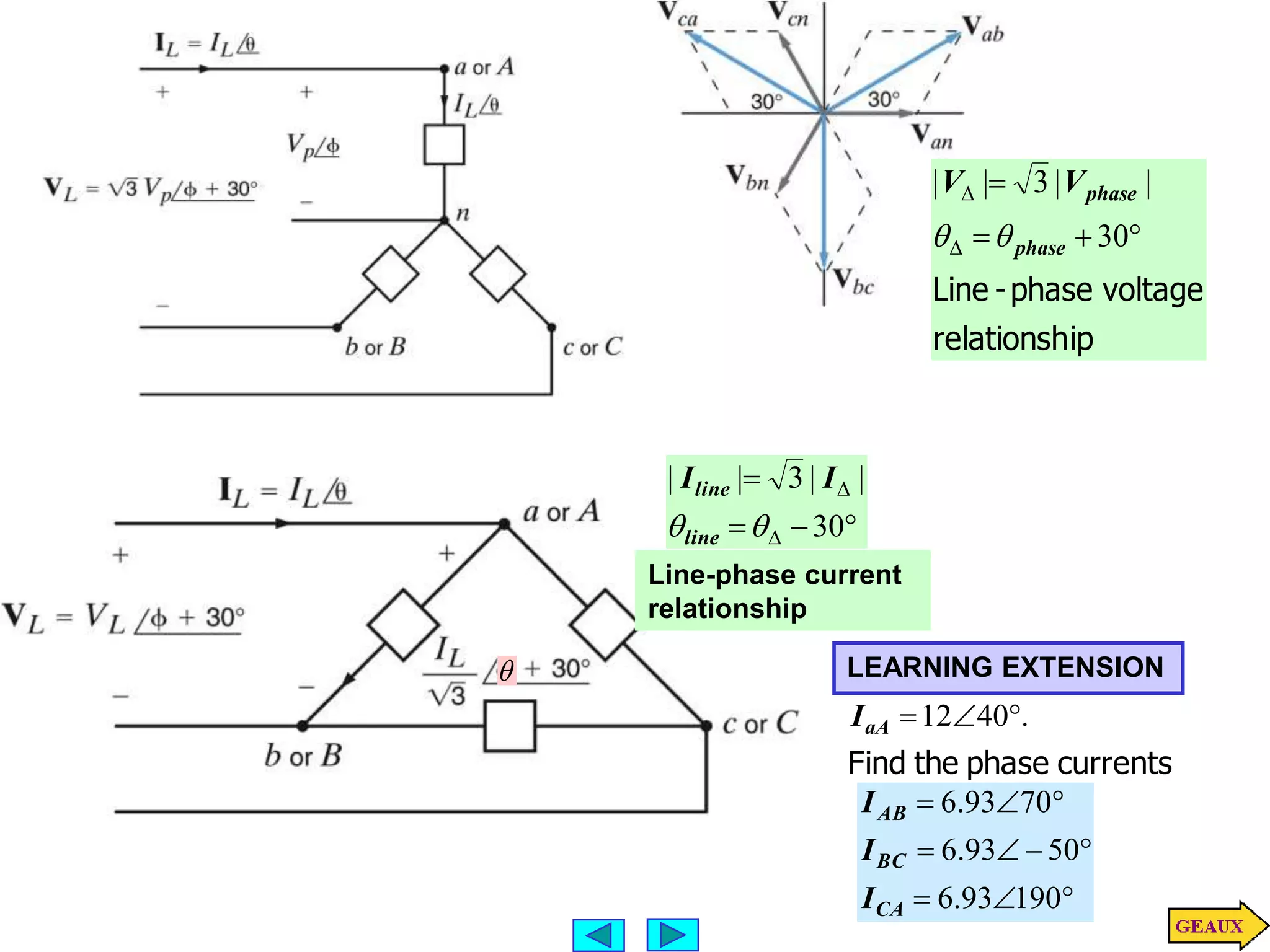
Line-phase current
relationship







30
|
|
3
|
|

line
line I
I
Line-phase current
relationship
ip
relationsh
voltage
phase
-
Line






30
|
|
3
|
|
phase
phase
V
V


LEARNING EXTENSION
currents
phase
the
Find
.
40
12 


aA
I










190
93
.
6
50
93
.
6
70
93
.
6
CA
BC
AB
I
I
I
Y


b
a
ab R
R
R 

)
(
|| 3
1
2 R
R
R
Rab 

3
2
1
3
1
2 )
(
R
R
R
R
R
R
R
R b
a





3
2
1
2
1
3 )
(
R
R
R
R
R
R
R
R c
b





3
2
1
3
2
1 )
(
R
R
R
R
R
R
R
R a
c





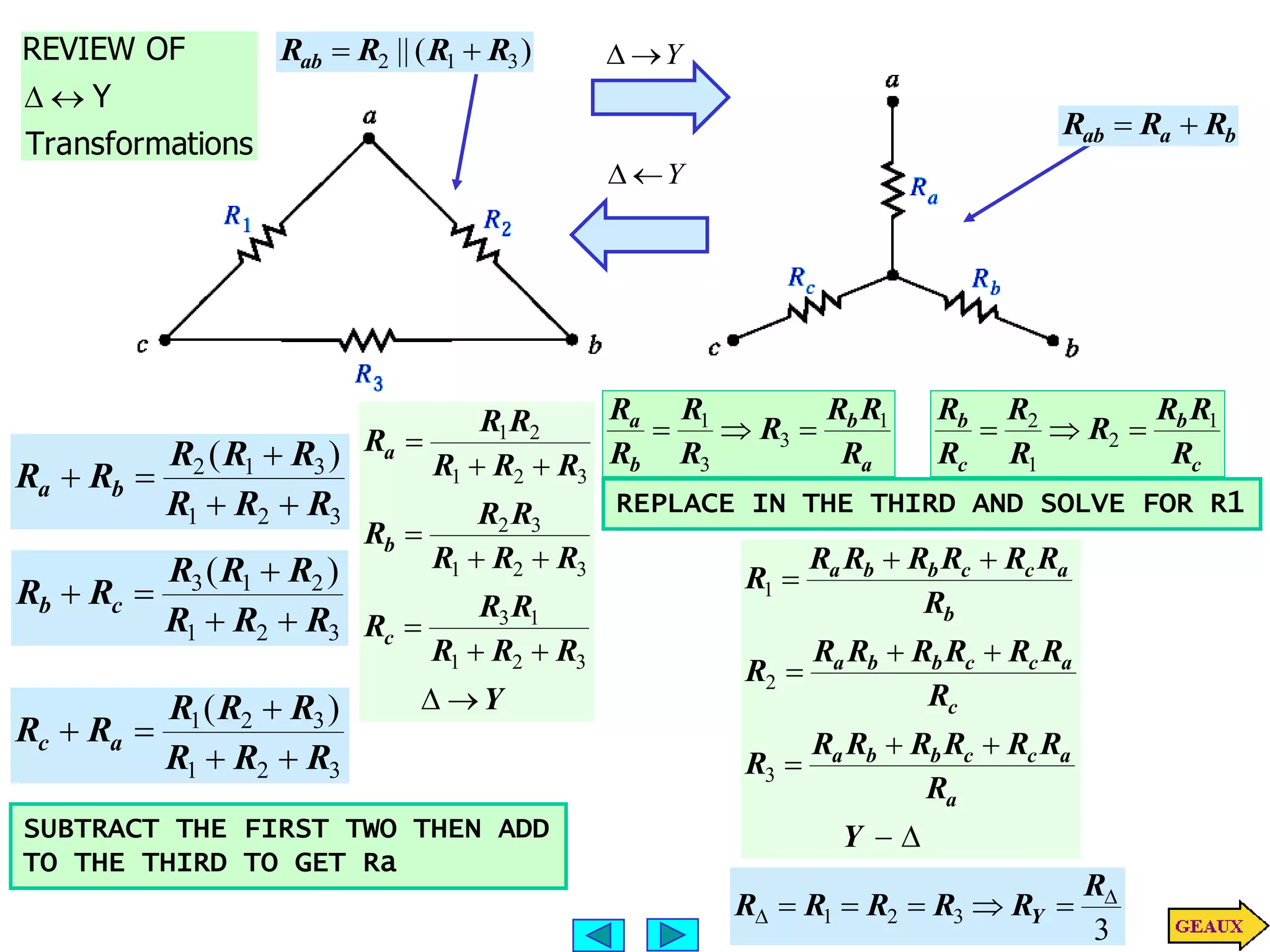
SUBTRACT THE FIRST TWO THEN ADD
TO THE THIRD TO GET Ra
a
b
b
a
R
R
R
R
R
R
R
R 1
3
3
1



c
b
c
b
R
R
R
R
R
R
R
R 1
2
1
2



REPLACE IN THE THIRD AND SOLVE FOR R1
Y
R
R
R
R
R
R
R
R
R
R
R
R
R
R
R
R
R
R
c
b
a











3
2
1
1
3
3
2
1
3
2
3
2
1
2
1











Y
R
R
R
R
R
R
R
R
R
R
R
R
R
R
R
R
R
R
R
R
R
R
R
R
a
a
c
c
b
b
a
c
a
c
c
b
b
a
b
a
c
c
b
b
a
3
2
1
tions
Transforma
Y
OF
REVIEW


3
3
2
1

 




R
R
R
R
R
R Y
Y


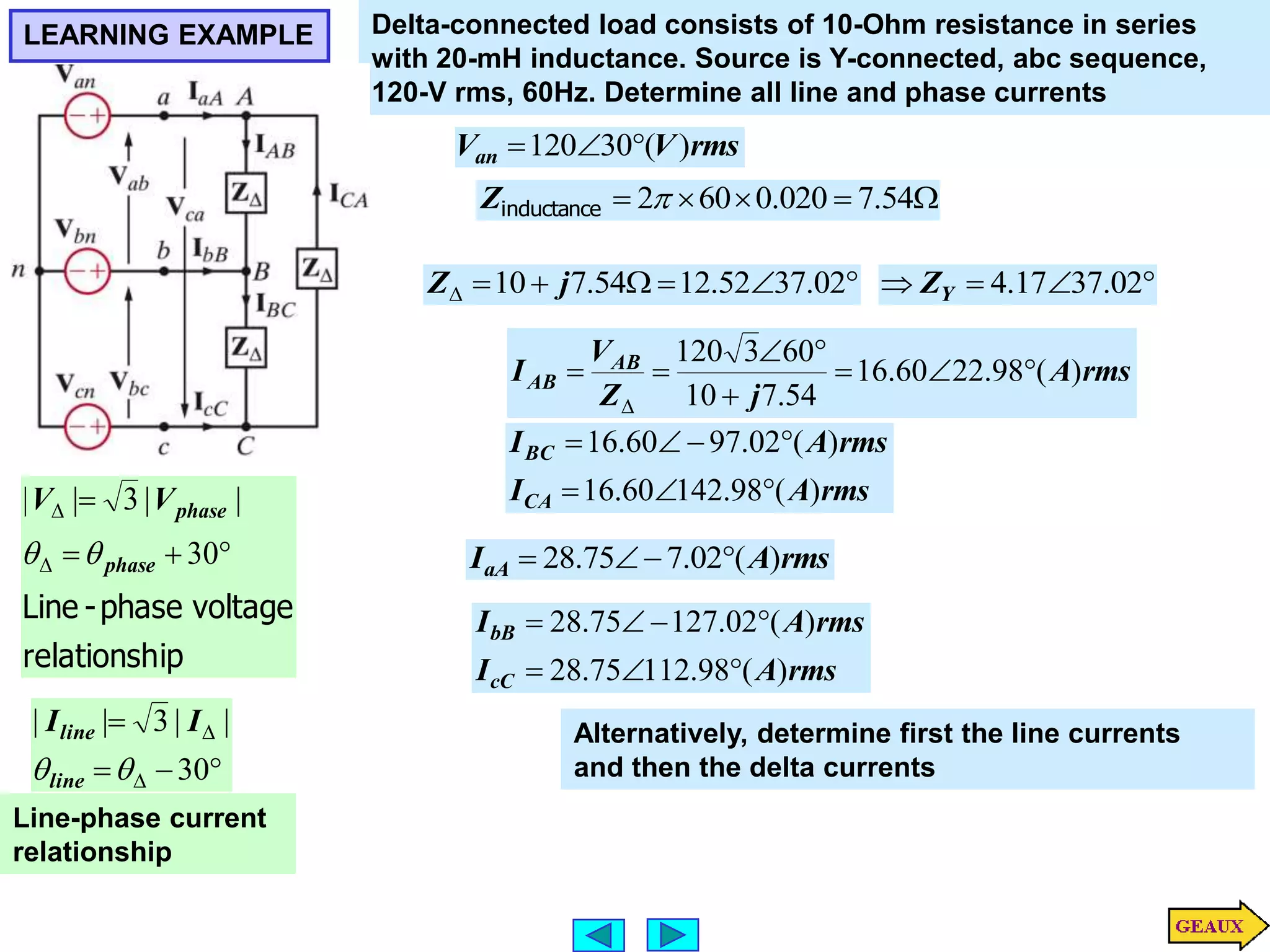
LEARNING EXAMPLE






 02
.
37
52
.
12
54
.
7
10 j
Z
Delta-connected load consists of 10-Ohm resistance in series
with 20-mH inductance. Source is Y-connected, abc sequence,
120-V rms, 60Hz. Determine all line and phase currents
rms
V
Van )
(
30
120 






 54
.
7
020
.
0
60
2
inductance
Z
rms
A
j
Z
V
I AB
AB )
(
98
.
22
60
.
16
54
.
7
10
60
3
120















30
|
|
3
|
|

line
line I
I
Line-phase current
relationship
ip
relationsh
voltage
phase
-
Line






30
|
|
3
|
|
phase
phase
V
V

 rms
A
IaA )
(
02
.
7
75
.
28 



rms
A
I
rms
A
I
CA
BC
)
(
98
.
142
60
.
16
)
(
02
.
97
60
.
16







rms
A
I
rms
A
I
cC
bB
)
(
98
.
112
75
.
28
)
(
02
.
127
75
.
28










 02
.
37
17
.
4
Y
Z
Alternatively, determine first the line currents
and then the delta currents
POWER RELATIONSHIPS

ip
relationsh
voltage
phase
-
Line






30
|
|
3
|
|
phase
phase
V
V








30
|
|
3
|
|

line
line I
I
Line-phase current
relationship
*
3
Total phase line
S V I

*
3 line
line
Total I
V
S 
*
3 

 I
V
S line
total
*
3 line
line
Total I
V
S 
line
V
line
I
Power factor angle
f 
f
line
line
total
f
line
line
total
I
V
Q
I
V
P


sin
|
||
|
3
cos
|
||
|
3


- Impedance angle
LEARNING EXAMPLE
lagging
20
angle
factor
power 



W
P
rms
V
V
total
line
1200
)
(
208
|
|
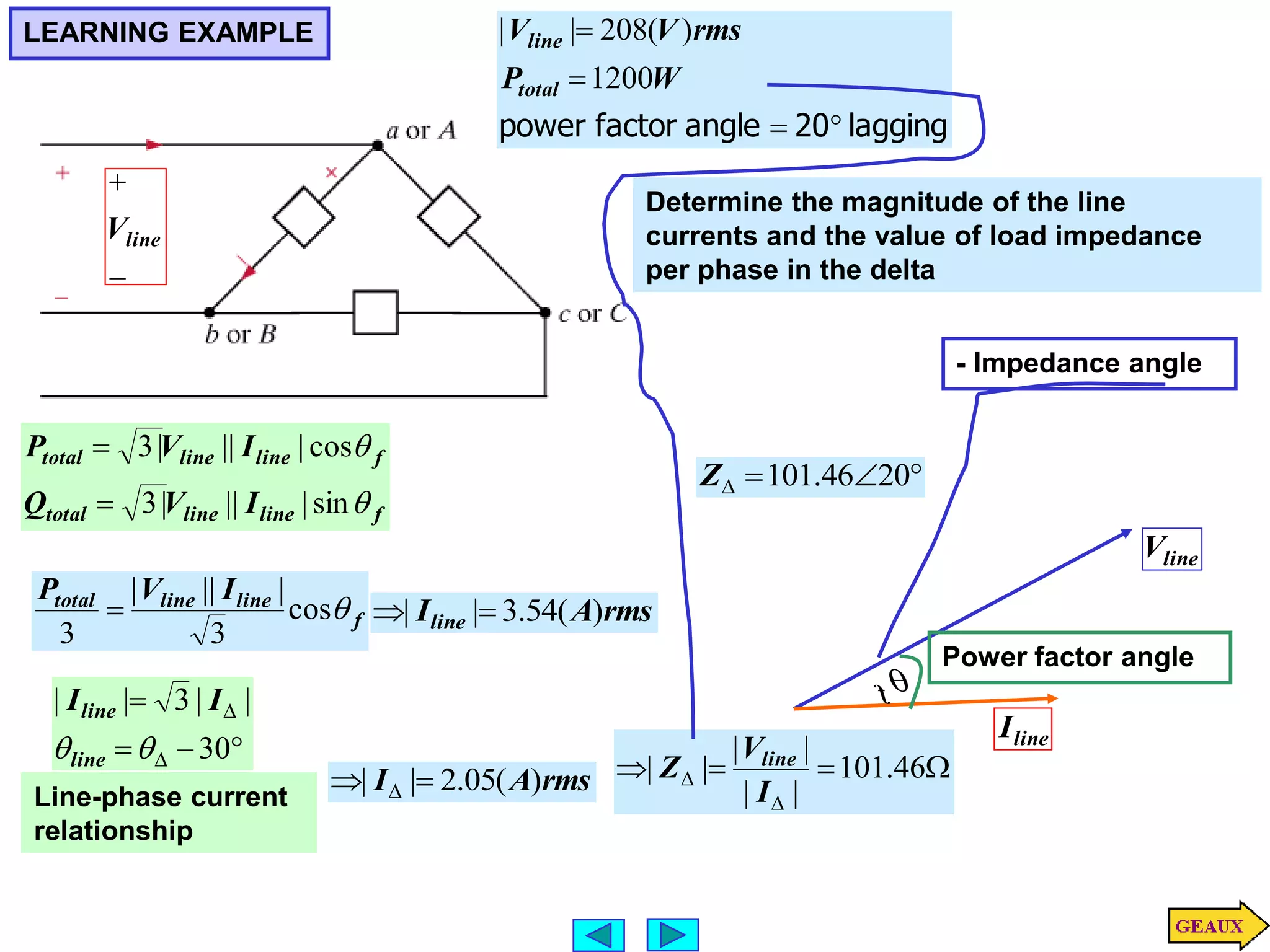
Determine the magnitude of the line
currents and the value of load impedance
per phase in the delta
f
line
line
total
f
line
line
total
I
V
Q
I
V
P


sin
|
||
|
3
cos
|
||
|
3


f
line
line
total I
V
P

cos
3
|
||
|
3
 rms
A
Iline )
(
54
.
3
|
| 







30
|
|
3
|
|

line
line I
I
Line-phase current
relationship
rms
A
I )
(
05
.
2
|
| 
 





 46
.
101
|
|
|
|
|
|
I
V
Z line



 20
46
.
101
Z
line
V
line
I
Power factor angle
f 
- Impedance angle


line
V
LEARNING EXAMPLE For an abc sequence, balanced Y - Y three phase circuit






 10
20
,
1
1
,
)
(
120
|
| j
Z
j
Z
V
V phase
line
rms
phase
source
Because circuit is balanced
data on any one phase is
sufficient

0
120
Chosen
as reference










120
120
120
120
0
120
an
bn
an
V
V
V
Abc sequence
rms
A
j
V
I an
aA
)
(
65
.
27
06
.
5
65
.
27
71
.
23
0
120
11
21











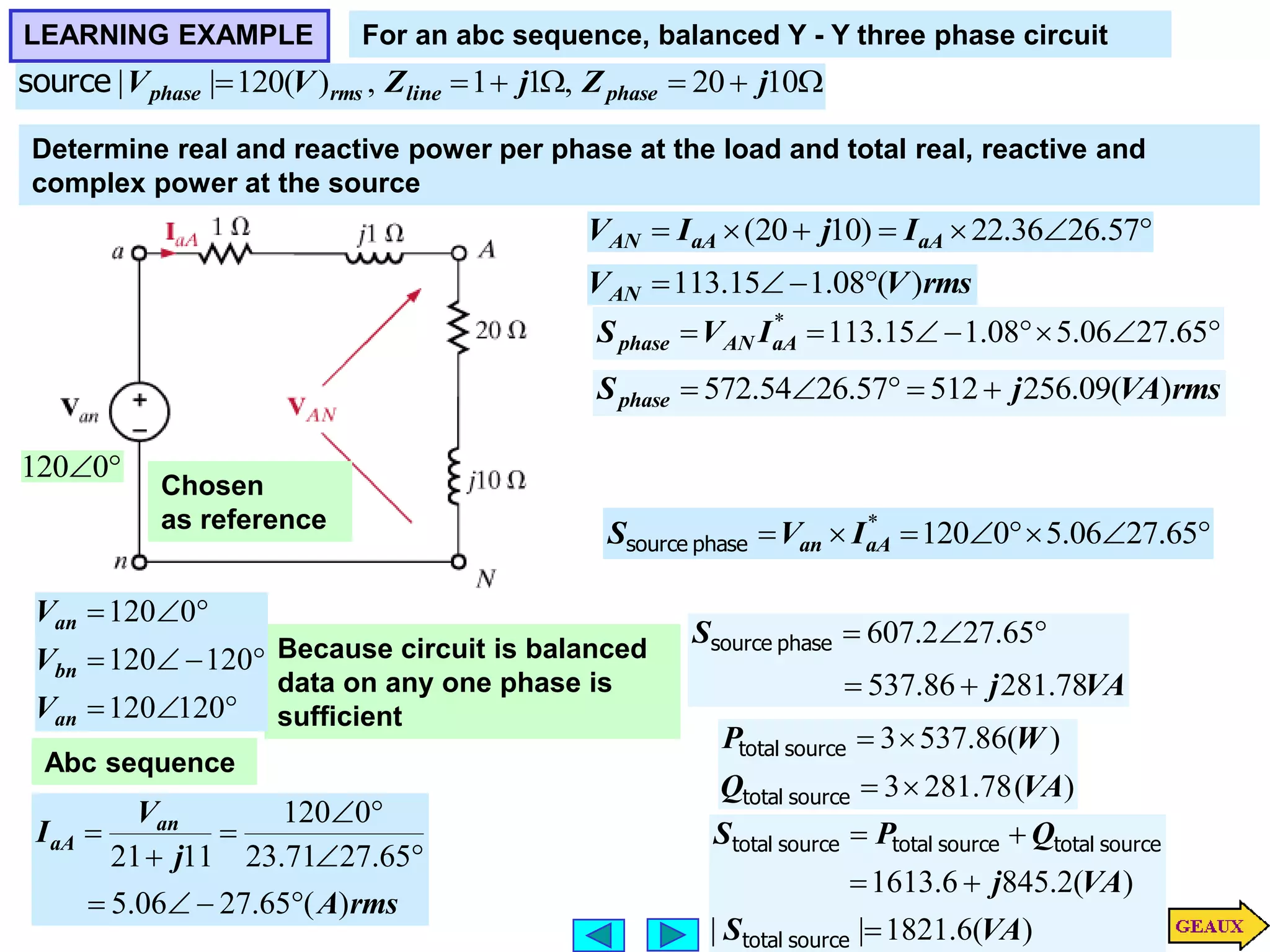
Determine real and reactive power per phase at the load and total real, reactive and
complex power at the source






 57
.
26
36
.
22
)
10
20
( aA
aA
AN I
j
I
V
rms
V
VAN )
(
08
.
1
15
.
113 










 65
.
27
06
.
5
08
.
1
15
.
113
*
aA
AN
phase I
V
S
rms
VA
j
Sphase )
(
09
.
256
512
57
.
26
54
.
572 











 65
.
27
06
.
5
0
120
*
aA
an I
V
S phase
source
VA
j
S
78
.
281
86
.
537
65
.
27
2
.
607





phase
source
)
(
78
.
281
3
)
(
86
.
537
3
VA
Q
W
P




source
total
source
total
)
(
6
.
1821
|
|
)
(
2
.
845
6
.
1613
VA
S
VA
j
Q
P
S





source
total
source
total
source
total
source
total
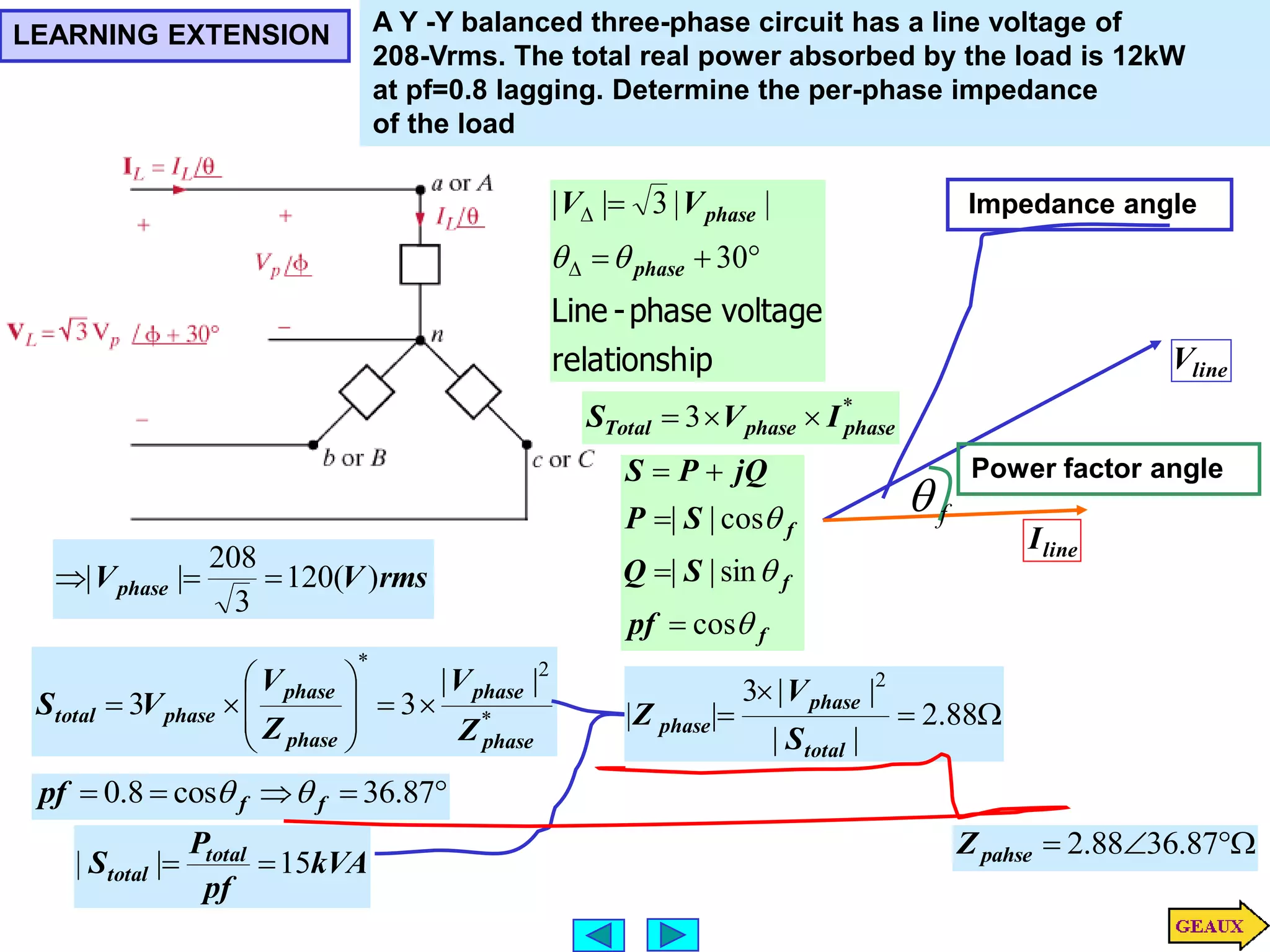
LEARNING EXTENSION A Y -Y balanced three-phase circuit has a line voltage of
208-Vrms. The total real power absorbed by the load is 12kW
at pf=0.8 lagging. Determine the per-phase impedance
of the load
ip
relationsh
voltage
phase
-
Line






30
|
|
3
|
|
phase
phase
V
V


*
3 phase
phase
Total I
V
S 


rms
V
Vphase )
(
120
3
208
|
| 


*
2
*
|
|
3
3
phase
phase
phase
phase
phase
total
Z
V
Z
V
V
S 











line
V
line
I
Power factor angle
Impedance angle




 87
.
36
cos
8
.
0 f
f
pf 

f
f
f
pf
S
Q
S
P
jQ
P
S



cos
sin
|
|
cos
|
|





kVA
pf
P
S total
total 15
|
| 




 88
.
2
|
|
|
|
3
|
|
2
total
phase
phase
S
V
Z



 87
.
36
88
.
2
pahse
Z
f






 30
120
1
.
4
1
.
10
4
10
j
j
VAN
Source is Delta connected.
Convert to equivalent Y
Analyze one phase

10

1
.
0
j
rms
V
VAN )
(
57
.
118
90
.
10
77
.
10
120
|
| 

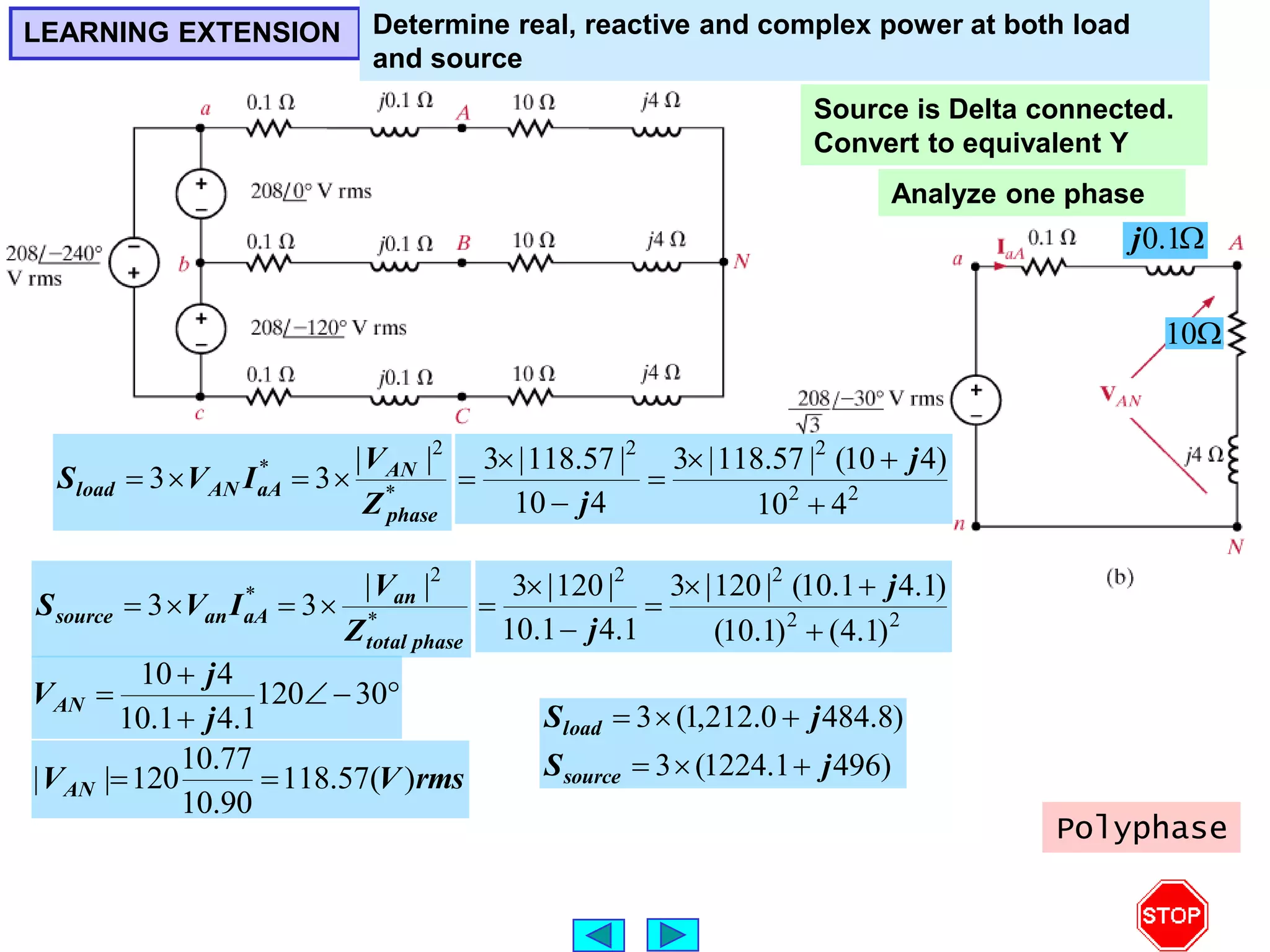
LEARNING EXTENSION Determine real, reactive and complex power at both load
and source
*
2
* |
|
3
3
phase
AN
aA
AN
load
Z
V
I
V
S 



*
2
* |
|
3
3
phase
total
an
aA
an
source
Z
V
I
V
S 



2
2
2
2
4
10
)
4
10
(
|
57
.
118
|
3
4
10
|
57
.
118
|
3







j
j
2
2
2
2
)
1
.
4
(
)
1
.
10
(
)
1
.
4
1
.
10
(
|
120
|
3
1
.
4
1
.
10
|
120
|
3







j
j
)
496
1
.
1224
(
3
)
8
.
484
0
.
212
,
1
(
3
j
S
j
S
source
load






Polyphase

Chapter 2 ( A) - Polyphase Circuits .ppt

  • 1.
    POLYPHASE CIRCUITS LEARNING GOALS ThreePhase Circuits Advantages of polyphase circuits Three Phase Connections Basic configurations for three phase circuits Source/Load Connections Delta-Wye connections Power Relationships Study power delivered by three phase circuits
  • 2.
  • 3.
    Proof of Theorem Fora balanced three phase circuit the instantaneous power is constant ) ( cos 2 3 ) ( W I V t p m m                          ) 240 cos( ) 240 cos( ) 120 cos( ) 120 cos( ) cos( cos ) ( ) ( ) ( ) ( ) ( ) ( ) ( ) (          t t t t t t I V t p t i t v t i t v t i t v t p m m c cn b bn a an power ous Instantane   ) cos( ) cos( 2 1 cos cos           3cos cos(2 ) ( ) cos(2 240 ) 2 cos(2 480 ) m m t V I p t t t                           ) 120 sin( sin ) 120 cos( cos ) 120 cos( ) 120 sin( sin ) 120 cos( cos ) 120 cos( cos cos 0 ) 120 cos( ) 120 cos( cos                        Proof Lemma 5 . 0 ) 120 cos(   0 ) 120 cos( ) 120 cos( cos         ) 120 cos( ) 480 cos( ) 120 cos( ) 240 cos(                t
  • 4.
  • 5.
    SOURCE/LOAD CONNECTIONS BALANCED Y-YCONNECTION           120 | | 120 | | 0 | | p cn p bn p an V V V V V V Positive sequence phase voltages ab V bc V ca V Line voltages                            30 | | 3 2 3 2 1 | | | | ) 120 sin 120 (cos 1 | | 120 | | 0 | | p p p p p p bn an ab V j V V j V V V V V V         210 | | 3 90 | | 3 p ca p bc V V V V Voltage Line   | | 3 p L V V Y cn c Y bn b Y an a Z V I Z V I Z V I    ; ;            120 | | ; 120 | | ; | |    L c L b L a I I I I I I 0     n c b a I I I I For this balanced circuit it is enough to analyze one phase
  • 6.
    Relationship between phase andline voltages LEARNING EXAMPLE For an abc sequence, balanced Y - Y three phase circuit     30 208 ab V Determine the phase voltages Balanced Y - Y Positive sequence a-b-c    30 | | 3 p ab V V           120 | | 120 | | 0 | | p cn p bn p an V V V V V V Positive sequence phase voltages ) 30 30 ( 3 | |        ab an V V  30 by lags ab an V V     30 208 ab V            60 120 180 120 60 120 an bn an V V V The phasor diagram could be rotated by any angle
  • 7.
    LEARNING EXAMPLE Foran abc sequence, balanced Y - Y three phase circuit source 120( ) , 1 1 , 20 10 rms phase line phase V V Z j Z j        Determine line currents and load voltages Because circuit is balanced data on any one phase is sufficient  0 120 Chosen as reference 120 0 120 120 120 120 an bn cn V V V          Abc sequence rms A j V I an aA ) ( 65 . 27 06 . 5 65 . 27 71 . 23 0 120 11 21            rms A I rms A I cC bB ) ( 65 . 27 120 06 . 5 ) ( 65 . 27 120 06 . 5                 57 . 26 36 . 22 ) 10 20 ( aA aA AN I j I V rms V VAN ) ( 08 . 1 15 . 113     rms V V rms V V CN BN ) ( 92 . 118 15 . 113 ) ( 08 . 121 15 . 113       
  • 8.
    LEARNING EXTENSION Foran abc sequence, balanced Y - Y three phase circuit voltages line the Find . ) ( 90 120 rms V Van    Relationship between phase and line voltages    30 | | 3 p ab V V  30 by lags ab an V V 30 by leads  an ab V V rms V Vab ) ( 120 120 3     rms V V rms V V ca bc ) ( 240 120 3 ) ( 0 120 3         voltages phase the Find . ) ( 0 208 rms V Vab     30 by lags ab an V V rms V Van ) ( 30 3 208     rms V V rms V V cn bn ) ( 90 3 208 ) ( 150 3 208       
  • 9.
    LEARNING EXTENSION Foran abc sequence, balanced Y - Y three phase circuit load 104.02 26.6 ( ) , 1 1 , 8 3 rms phase line phase V V Z j Z j          Determine source phase voltages rms V) ( 6 . 26 02 . 104     8  3 j Currents are not required. Use inverse voltage divider AN an V j j j V 3 8 ) 1 1 ( ) 3 8 (                41 . 3 15 . 1 73 5 84 3 8 3 8 3 8 4 9 j j j j j    30 120 an V Positive sequence a-b-c        150 120 90 120 cn bn V V
  • 10.
    DELTA CONNECTED SOURCES Relationshipbetween phase and line voltages    30 | | 3 p ab V V  30 by lags ab an V V                 120 120 0 L ca L bc L ab V V V V V V                     90 3 150 3 30 3 L cn L bn L an V V V V V V                150 120 90 120 30 120 cn bn an V V V                 180 208 60 208 60 208 ca bc ab V V V Example Convert to an equivalent Y connection
  • 11.
    LEARNING EXAMPLE Determineline currents and line voltages at the loads Source is Delta connected. Convert to equivalent Y                 120 120 0 L ca L bc L ab V V V V V V                     90 3 150 3 30 3 L cn L bn L an V V V V V V Analyze one phase rms A j IaA ) ( 14 . 49 38 . 9 2 . 4 1 . 12 30 ) 3 / 208 (          rms V j VAN ) ( 71 . 30 65 . 118 19 . 49 38 . 9 ) 4 12 (           Determine the other phases using the balance rms A I rms A I cC bB ) ( 86 . 71 38 . 9 ) ( 14 . 169 38 . 9            30 | | 3 p ab V V 3 118.65 0.71 AB V     3 118.65 120.71 3 118.65 119.29 BC CA V V        
  • 12.
    LEARNING EXTENSION Computethe magnitude of the line voltage at the load Source is Delta connected. Convert to equivalent Y                 120 120 0 L ca L bc L ab V V V V V V                     90 3 150 3 30 3 L cn L bn L an V V V V V V Analyze one phase       30 120 1 . 4 1 . 10 4 10 j j VAN  10  1 . 0 j Only interested in magnitudes! rms V VAN ) ( 57 . 118 90 . 10 77 . 10 120 | |      30 | | 3 p ab V V rms V VAB ) ( 4 . 205 | | 
  • 13.
    DELTA-CONNECTED LOAD Method 1:Solve directly           120 | | 120 | | 0 | | p cn p bn p an V V V V V V Positive sequence phase voltages            210 | | 3 90 | | 3 30 | | 3 p ca p bc p ab V V V V V V                       120 | | 120 | | | |    I Z V I I Z V I I Z V I CA CA BC BC AB AB currents phase Load BC CA cC AB BC bB CA AB aA I I I I I I I I I       currents Line Method 2: We can also convert the delta connected load into a Y connected one. The same formulas derived for resistive circuits are applicable to impedances 3   Z ZY case Balanced              Z L AB aA L aA Y an aA Z V I I Z V I    3 / | | 3 / | | | | | | Z L Z Z     | | Z       30       30 | | 3 | |  line line I I Line-phase current relationship
  • 14.
           30 | | 3 | |  line line I I Line-phase current relationship ip relationsh voltage phase - Line       30 | | 3 | | phase phase V V   LEARNINGEXTENSION currents phase the Find . 40 12    aA I           190 93 . 6 50 93 . 6 70 93 . 6 CA BC AB I I I
  • 15.
    Y   b a ab R R R   ) ( ||3 1 2 R R R Rab   3 2 1 3 1 2 ) ( R R R R R R R R b a      3 2 1 2 1 3 ) ( R R R R R R R R c b      3 2 1 3 2 1 ) ( R R R R R R R R a c      SUBTRACT THE FIRST TWO THEN ADD TO THE THIRD TO GET Ra a b b a R R R R R R R R 1 3 3 1    c b c b R R R R R R R R 1 2 1 2    REPLACE IN THE THIRD AND SOLVE FOR R1 Y R R R R R R R R R R R R R R R R R R c b a            3 2 1 1 3 3 2 1 3 2 3 2 1 2 1            Y R R R R R R R R R R R R R R R R R R R R R R R R a a c c b b a c a c c b b a b a c c b b a 3 2 1 tions Transforma Y OF REVIEW   3 3 2 1        R R R R R R Y Y  
  • 16.
    LEARNING EXAMPLE        02 . 37 52 . 12 54 . 7 10j Z Delta-connected load consists of 10-Ohm resistance in series with 20-mH inductance. Source is Y-connected, abc sequence, 120-V rms, 60Hz. Determine all line and phase currents rms V Van ) ( 30 120         54 . 7 020 . 0 60 2 inductance Z rms A j Z V I AB AB ) ( 98 . 22 60 . 16 54 . 7 10 60 3 120                30 | | 3 | |  line line I I Line-phase current relationship ip relationsh voltage phase - Line       30 | | 3 | | phase phase V V   rms A IaA ) ( 02 . 7 75 . 28     rms A I rms A I CA BC ) ( 98 . 142 60 . 16 ) ( 02 . 97 60 . 16        rms A I rms A I cC bB ) ( 98 . 112 75 . 28 ) ( 02 . 127 75 . 28            02 . 37 17 . 4 Y Z Alternatively, determine first the line currents and then the delta currents
  • 17.
    POWER RELATIONSHIPS  ip relationsh voltage phase - Line       30 | | 3 | | phase phase V V         30 | | 3 | |  line line I I Line-phasecurrent relationship * 3 Total phase line S V I  * 3 line line Total I V S  * 3    I V S line total * 3 line line Total I V S  line V line I Power factor angle f  f line line total f line line total I V Q I V P   sin | || | 3 cos | || | 3   - Impedance angle
  • 18.
    LEARNING EXAMPLE lagging 20 angle factor power     W P rms V V total line 1200 ) ( 208 | | Determinethe magnitude of the line currents and the value of load impedance per phase in the delta f line line total f line line total I V Q I V P   sin | || | 3 cos | || | 3   f line line total I V P  cos 3 | || | 3  rms A Iline ) ( 54 . 3 | |         30 | | 3 | |  line line I I Line-phase current relationship rms A I ) ( 05 . 2 | |          46 . 101 | | | | | | I V Z line     20 46 . 101 Z line V line I Power factor angle f  - Impedance angle   line V
  • 19.
    LEARNING EXAMPLE Foran abc sequence, balanced Y - Y three phase circuit        10 20 , 1 1 , ) ( 120 | | j Z j Z V V phase line rms phase source Because circuit is balanced data on any one phase is sufficient  0 120 Chosen as reference           120 120 120 120 0 120 an bn an V V V Abc sequence rms A j V I an aA ) ( 65 . 27 06 . 5 65 . 27 71 . 23 0 120 11 21            Determine real and reactive power per phase at the load and total real, reactive and complex power at the source        57 . 26 36 . 22 ) 10 20 ( aA aA AN I j I V rms V VAN ) ( 08 . 1 15 . 113             65 . 27 06 . 5 08 . 1 15 . 113 * aA AN phase I V S rms VA j Sphase ) ( 09 . 256 512 57 . 26 54 . 572              65 . 27 06 . 5 0 120 * aA an I V S phase source VA j S 78 . 281 86 . 537 65 . 27 2 . 607      phase source ) ( 78 . 281 3 ) ( 86 . 537 3 VA Q W P     source total source total ) ( 6 . 1821 | | ) ( 2 . 845 6 . 1613 VA S VA j Q P S      source total source total source total source total
  • 20.
    LEARNING EXTENSION AY -Y balanced three-phase circuit has a line voltage of 208-Vrms. The total real power absorbed by the load is 12kW at pf=0.8 lagging. Determine the per-phase impedance of the load ip relationsh voltage phase - Line       30 | | 3 | | phase phase V V   * 3 phase phase Total I V S    rms V Vphase ) ( 120 3 208 | |    * 2 * | | 3 3 phase phase phase phase phase total Z V Z V V S             line V line I Power factor angle Impedance angle      87 . 36 cos 8 . 0 f f pf   f f f pf S Q S P jQ P S    cos sin | | cos | |      kVA pf P S total total 15 | |       88 . 2 | | | | 3 | | 2 total phase phase S V Z     87 . 36 88 . 2 pahse Z f 
  • 21.
          30 120 1 . 4 1 . 10 4 10 j j VAN Source isDelta connected. Convert to equivalent Y Analyze one phase  10  1 . 0 j rms V VAN ) ( 57 . 118 90 . 10 77 . 10 120 | |   LEARNING EXTENSION Determine real, reactive and complex power at both load and source * 2 * | | 3 3 phase AN aA AN load Z V I V S     * 2 * | | 3 3 phase total an aA an source Z V I V S     2 2 2 2 4 10 ) 4 10 ( | 57 . 118 | 3 4 10 | 57 . 118 | 3        j j 2 2 2 2 ) 1 . 4 ( ) 1 . 10 ( ) 1 . 4 1 . 10 ( | 120 | 3 1 . 4 1 . 10 | 120 | 3        j j ) 496 1 . 1224 ( 3 ) 8 . 484 0 . 212 , 1 ( 3 j S j S source load       Polyphase