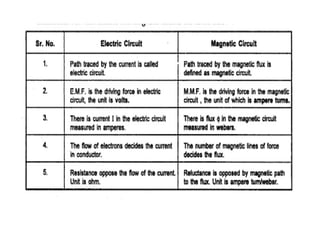
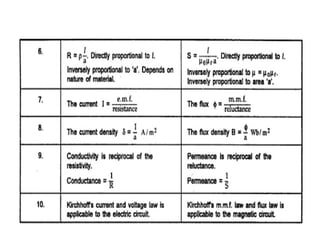
MAGNETIC CIRCUITS 
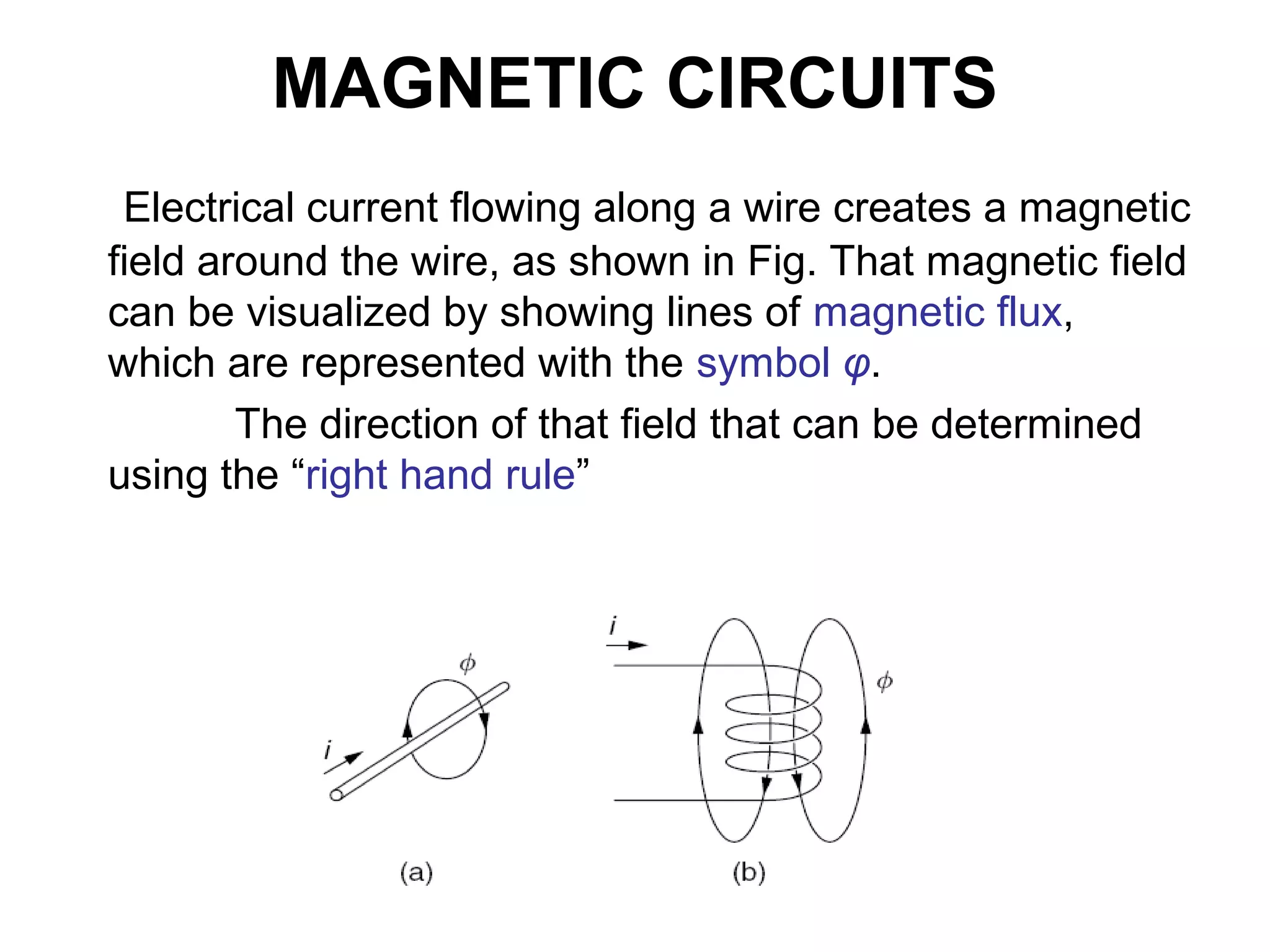
Electrical current flowing along a wire creates a magnetic 
field around the wire, as shown in Fig. That magnetic field 
can be visualized by showing lines of magnetic flux, 
which are represented with the symbol φ. 
The direction of that field that can be determined 
using the “right hand rule”
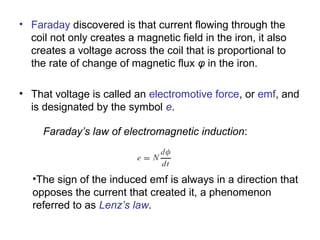
• Faraday discovered is that current flowing through the 
coil not only creates a magnetic field in the iron, it also 
creates a voltage across the coil that is proportional to 
the rate of change of magnetic flux φ in the iron. 
• That voltage is called an electromotive force, or emf, and 
is designated by the symbol e. 
Faraday’s law of electromagnetic induction: 
•The sign of the induced emf is always in a direction that 
opposes the current that created it, a phenomenon 
referred to as Lenz’s law.
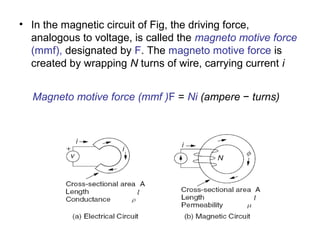
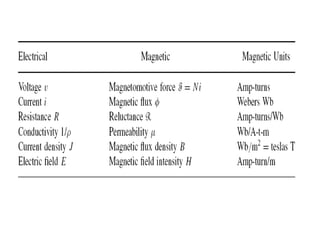
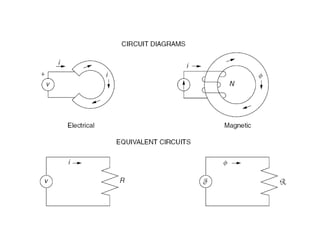
• In the magnetic circuit of Fig, the driving force, 
analogous to voltage, is called the magneto motive force 
(mmf), designated by F. The magneto motive force is 
created by wrapping N turns of wire, carrying current i 
Magneto motive force (mmf )F = Ni (ampere − turns)
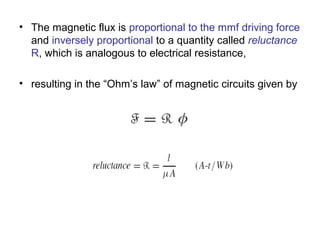
• The magnetic flux is proportional to the mmf driving force 
and inversely proportional to a quantity called reluctance 
R, which is analogous to electrical resistance, 
• resulting in the “Ohm’s law” of magnetic circuits given by
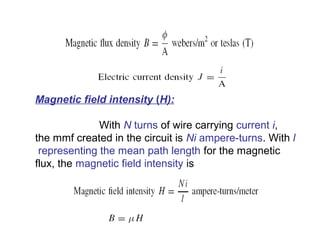
Magnetic field intensity (H): 
With N turns of wire carrying current i, 
the mmf created in the circuit is Ni ampere-turns. With l 
representing the mean path length for the magnetic 
flux, the magnetic field intensity is
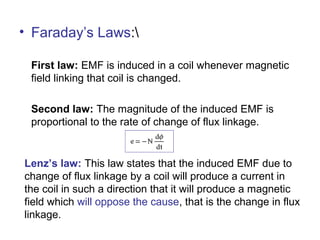
• Faraday’s Laws: 
First law: EMF is induced in a coil whenever magnetic 
field linking that coil is changed. 
Second law: The magnitude of the induced EMF is 
proportional to the rate of change of flux linkage. 
Lenz’s law: This law states that the induced EMF due to 
change of flux linkage by a coil will produce a current in 
the coil in such a direction that it will produce a magnetic 
field which will oppose the cause, that is the change in flux 
linkage.
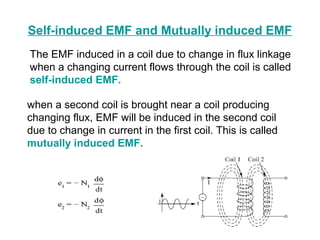
Self-induced EMF and Mutually induced EMF 
The EMF induced in a coil due to change in flux linkage 
when a changing current flows through the coil is called 
self-induced EMF. 
when a second coil is brought near a coil producing 
changing flux, EMF will be induced in the second coil 
due to change in current in the first coil. This is called 
mutually induced EMF.
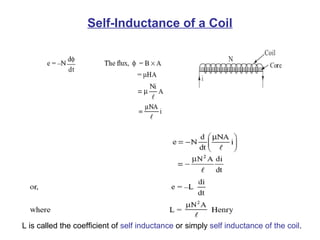
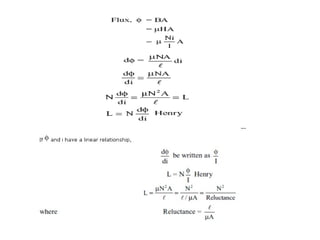
Self-Inductance of a Coil 
L is called the coefficient of self inductance or simply self inductance of the coil.
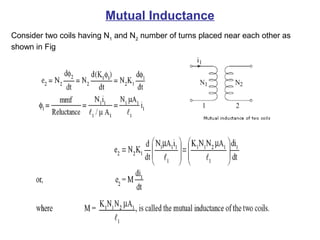
Mutual Inductance 
Consider two coils having N1 and N2 number of turns placed near each other as 
shown in Fig
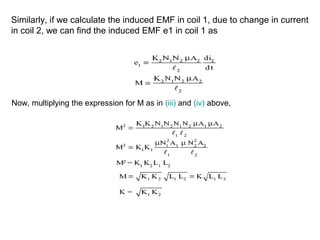
Similarly, if we calculate the induced EMF in coil 1, due to change in current 
in coil 2, we can find the induced EMF e1 in coil 1 as 
Now, multiplying the expression for M as in (iii) and (iv) above,
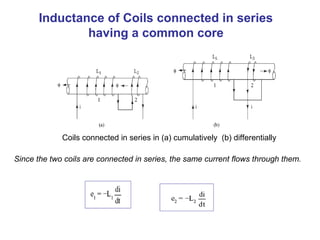
Inductance of Coils connected in series 
having a common core 
Coils connected in series in (a) cumulatively (b) differentially 
Since the two coils are connected in series, the same current flows through them.
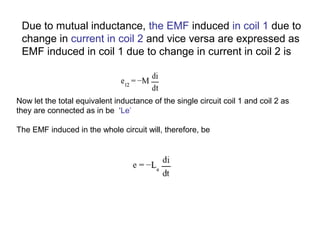
Due to mutual inductance, the EMF induced in coil 1 due to 
change in current in coil 2 and vice versa are expressed as 
EMF induced in coil 1 due to change in current in coil 2 is 
Now let the total equivalent inductance of the single circuit coil 1 and coil 2 as 
they are connected as in be ‘Le’ 
The EMF induced in the whole circuit will, therefore, be
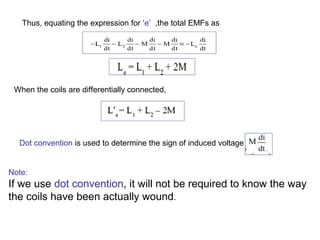
Thus, equating the expression for ‘e’ ,the total EMFs as 
When the coils are differentially connected, 
Dot convention is used to determine the sign of induced voltage 
Note: 
If we use dot convention, it will not be required to know the way 
the coils have been actually wound.
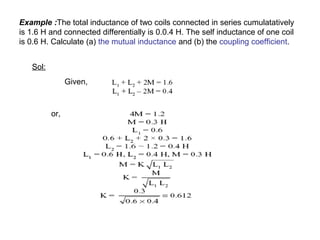
Example :The total inductance of two coils connected in series cumulatatively 
is 1.6 H and connected differentially is 0.0.4 H. The self inductance of one coil 
is 0.6 H. Calculate (a) the mutual inductance and (b) the coupling coefficient. 
Sol: 
Given, 
or,

Magnetic circuits

  • 1.
    MAGNETIC CIRCUITS Electricalcurrent flowing along a wire creates a magnetic field around the wire, as shown in Fig. That magnetic field can be visualized by showing lines of magnetic flux, which are represented with the symbol φ. The direction of that field that can be determined using the “right hand rule”
  • 2.
    • Faraday discoveredis that current flowing through the coil not only creates a magnetic field in the iron, it also creates a voltage across the coil that is proportional to the rate of change of magnetic flux φ in the iron. • That voltage is called an electromotive force, or emf, and is designated by the symbol e. Faraday’s law of electromagnetic induction: •The sign of the induced emf is always in a direction that opposes the current that created it, a phenomenon referred to as Lenz’s law.
  • 3.
    • In themagnetic circuit of Fig, the driving force, analogous to voltage, is called the magneto motive force (mmf), designated by F. The magneto motive force is created by wrapping N turns of wire, carrying current i Magneto motive force (mmf )F = Ni (ampere − turns)
  • 4.
    • The magneticflux is proportional to the mmf driving force and inversely proportional to a quantity called reluctance R, which is analogous to electrical resistance, • resulting in the “Ohm’s law” of magnetic circuits given by
  • 5.
    Magnetic field intensity(H): With N turns of wire carrying current i, the mmf created in the circuit is Ni ampere-turns. With l representing the mean path length for the magnetic flux, the magnetic field intensity is
  • 10.
    • Faraday’s Laws: First law: EMF is induced in a coil whenever magnetic field linking that coil is changed. Second law: The magnitude of the induced EMF is proportional to the rate of change of flux linkage. Lenz’s law: This law states that the induced EMF due to change of flux linkage by a coil will produce a current in the coil in such a direction that it will produce a magnetic field which will oppose the cause, that is the change in flux linkage.
  • 11.
    Self-induced EMF andMutually induced EMF The EMF induced in a coil due to change in flux linkage when a changing current flows through the coil is called self-induced EMF. when a second coil is brought near a coil producing changing flux, EMF will be induced in the second coil due to change in current in the first coil. This is called mutually induced EMF.
  • 12.
    Self-Inductance of aCoil L is called the coefficient of self inductance or simply self inductance of the coil.
  • 14.
    Mutual Inductance Considertwo coils having N1 and N2 number of turns placed near each other as shown in Fig
  • 15.
    Similarly, if wecalculate the induced EMF in coil 1, due to change in current in coil 2, we can find the induced EMF e1 in coil 1 as Now, multiplying the expression for M as in (iii) and (iv) above,
  • 16.
    Inductance of Coilsconnected in series having a common core Coils connected in series in (a) cumulatively (b) differentially Since the two coils are connected in series, the same current flows through them.
  • 17.
    Due to mutualinductance, the EMF induced in coil 1 due to change in current in coil 2 and vice versa are expressed as EMF induced in coil 1 due to change in current in coil 2 is Now let the total equivalent inductance of the single circuit coil 1 and coil 2 as they are connected as in be ‘Le’ The EMF induced in the whole circuit will, therefore, be
  • 18.
    Thus, equating theexpression for ‘e’ ,the total EMFs as When the coils are differentially connected, Dot convention is used to determine the sign of induced voltage Note: If we use dot convention, it will not be required to know the way the coils have been actually wound.
  • 19.
    Example :The totalinductance of two coils connected in series cumulatatively is 1.6 H and connected differentially is 0.0.4 H. The self inductance of one coil is 0.6 H. Calculate (a) the mutual inductance and (b) the coupling coefficient. Sol: Given, or,