NANOTECHNOLOGY
TOPICS
   INTRODUCTION
   COMMON TERMS
   CARBON NANO TUBES (CNT)
   STRUCTURES OF CNT
   MANUFACTURE OF CNT
   APPLICATIONS OF CNT
INTRODUCTION
 The term ‘Nanotechnology’ is derived from the
  Greek word ‘nanos’ and ‘dwarf’
 The prefix nano in the word ‘Nanotechnology’
  mean billionth (1 x 10⁻⁹ m)
 The design, characterization,      production and
  applications of structures, systems and devices by
  controlling size and shape at 10-9 m scale or the
  single –atomic level.
COMMON TERMS
 Nanoparticles: The size of the particles which
  ranges from 1-50 nm
 Nanomaterials: materials having size less than
  100 nm atleast in one dimension
 Nanotube: Nanometer scale tube like structure
 Nano manufacturing: methods for producing
  nanostructures in reliable and commercially
  viable ways
HOW DO WE SEE NANO PARTICLES ?

         Scanning electron microscope and
transmission electron microscope are used
to see the Nanoparticles
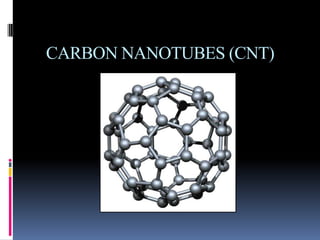
CARBON NANOTUBES (CNT)
Carbon nanotubes are allotropes of
carbon with a nanostructure having a
length-to-diameter ratio greater than
10,00,000. when graphite sheets are
rolled into a cylinder, their edges joined
and form carbon nanotubes i.e., carbon
nanotubes are extended tubes of rolled
graphite sheets.
STRUCTURES OF
CARBON NANOTUBES
 SINGLE WALLED NANOTUBES

 MULTI WALLED NANOTUBES
SINGLE WALLED NANOTUBES

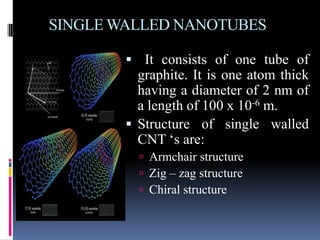
         It consists of one tube of
          graphite. It is one atom thick
          having a diameter of 2 nm of
          a length of 100 x 10-6 m.
         Structure of single walled
          CNT ‘s are:
           Armchair structure
           Zig – zag structure
           Chiral structure
MULTI WALLED CARBON
      NANOTUBES


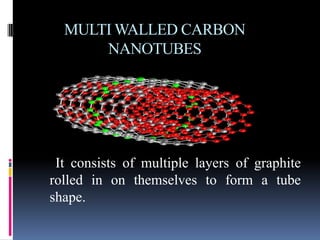
 It consists of multiple layers of graphite
rolled in on themselves to form a tube
shape.
MANUFACTURE OF CNT

 PYROLYSIS
 LASER EVAPORATION
 CARBON ARC METHOD
 CHEMICAL VAPOUR DEPOSITION
PROPERTIES OF CARBON
            NANOTUBES
 Carbon nanotubes are very strong and highly
    flexible
   Cnt’s withstand extreme strain and tension
   It has very high electrical conductivity
   It has very high thermal conductivity
   CNT atoms are continously vibrating back and
    forth
APPLICATIONS OF
CARBON NANOTUBES
 CNTs in storage devices
 Detection of gases using CNT
 CNT in integrated memory circuits
 CNT as protective shields
 Air and water filtration using CNT
 CNT in ultra capacitor
THANK YOU

Nanotechnology

  • 1.
  • 2.
    TOPICS  INTRODUCTION  COMMON TERMS  CARBON NANO TUBES (CNT)  STRUCTURES OF CNT  MANUFACTURE OF CNT  APPLICATIONS OF CNT
  • 3.
  • 4.
     The term‘Nanotechnology’ is derived from the Greek word ‘nanos’ and ‘dwarf’  The prefix nano in the word ‘Nanotechnology’ mean billionth (1 x 10⁻⁹ m)  The design, characterization, production and applications of structures, systems and devices by controlling size and shape at 10-9 m scale or the single –atomic level.
  • 5.
    COMMON TERMS  Nanoparticles:The size of the particles which ranges from 1-50 nm  Nanomaterials: materials having size less than 100 nm atleast in one dimension  Nanotube: Nanometer scale tube like structure  Nano manufacturing: methods for producing nanostructures in reliable and commercially viable ways
  • 6.
    HOW DO WESEE NANO PARTICLES ? Scanning electron microscope and transmission electron microscope are used to see the Nanoparticles
  • 7.
  • 8.
    Carbon nanotubes areallotropes of carbon with a nanostructure having a length-to-diameter ratio greater than 10,00,000. when graphite sheets are rolled into a cylinder, their edges joined and form carbon nanotubes i.e., carbon nanotubes are extended tubes of rolled graphite sheets.
  • 9.
  • 10.
     SINGLE WALLEDNANOTUBES  MULTI WALLED NANOTUBES
  • 11.
    SINGLE WALLED NANOTUBES  It consists of one tube of graphite. It is one atom thick having a diameter of 2 nm of a length of 100 x 10-6 m.  Structure of single walled CNT ‘s are:  Armchair structure  Zig – zag structure  Chiral structure
  • 12.
    MULTI WALLED CARBON NANOTUBES It consists of multiple layers of graphite rolled in on themselves to form a tube shape.
  • 13.
    MANUFACTURE OF CNT PYROLYSIS  LASER EVAPORATION  CARBON ARC METHOD  CHEMICAL VAPOUR DEPOSITION
  • 14.
    PROPERTIES OF CARBON NANOTUBES  Carbon nanotubes are very strong and highly flexible  Cnt’s withstand extreme strain and tension  It has very high electrical conductivity  It has very high thermal conductivity  CNT atoms are continously vibrating back and forth
  • 15.
  • 16.
     CNTs instorage devices  Detection of gases using CNT  CNT in integrated memory circuits  CNT as protective shields  Air and water filtration using CNT  CNT in ultra capacitor
  • 17.