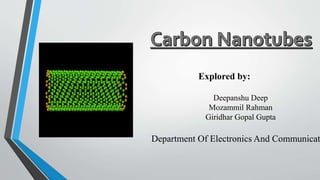
Explored by:
Deepanshu Deep
Mozammil Rahman
Giridhar Gopal Gupta
Department Of Electronics And Communicat
Outline
 Introduction
 Discovery of carbon nanotube
 Types of carbon nanotube
 Synthesis of carbon Nanotubes
 Mathematical References
 Properties of carbon Nanotubes
 Application and future aspects
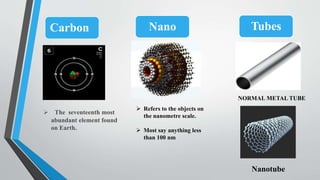
Carbon
 The seventeenth most
abundant element found
on Earth.
Nano
 Refers to the objects on
the nanometre scale.
 Most say anything less
than 100 nm
Tubes
NORMAL METAL TUBE
Nanotube
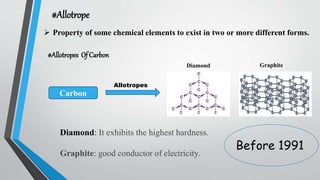
#Allotrope
 Property of some chemical elements to exist in two or more different forms.
#Allotropes Of Carbon
Carbon
Allotropes
Diamond Graphite
Diamond: It exhibits the highest hardness.
Graphite: good conductor of electricity.
Before 1991
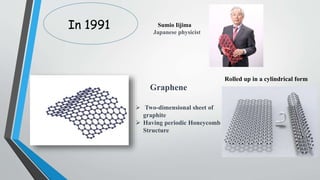
In 1991 Sumio Iijima
Japanese physicist
 Two-dimensional sheet of
graphite
 Having periodic Honeycomb
Structure
Graphene
Rolled up in a cylindrical form
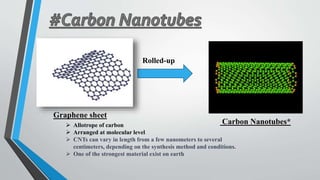
Rolled-up
 Allotrope of carbon
 Arranged at molecular level
 CNTs can vary in length from a few nanometers to several
centimeters, depending on the synthesis method and conditions.
 One of the strongest material exist on earth
Carbon Nanotubes*
Graphene sheet
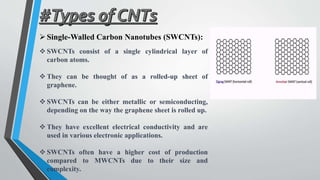
Single-Walled Carbon Nanotubes (SWCNTs):
 SWCNTs consist of a single cylindrical layer of
carbon atoms.
 They can be thought of as a rolled-up sheet of
graphene.
 SWCNTs can be either metallic or semiconducting,
depending on the way the graphene sheet is rolled up.
 They have excellent electrical conductivity and are
used in various electronic applications.
 SWCNTs often have a higher cost of production
compared to MWCNTs due to their size and
complexity.
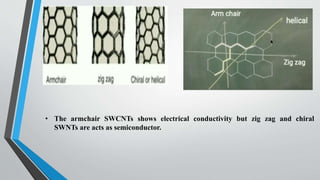
• The armchair SWCNTs shows electrical conductivity but zig zag and chiral
SWNTs are acts as semiconductor.
Multi-Walled Carbon Nanotubes
(MWCNTs):
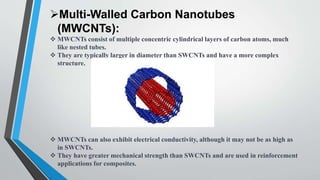
 MWCNTs consist of multiple concentric cylindrical layers of carbon atoms, much
like nested tubes.
 They are typically larger in diameter than SWCNTs and have a more complex
structure.
 MWCNTs can also exhibit electrical conductivity, although it may not be as high as
in SWCNTs.
 They have greater mechanical strength than SWCNTs and are used in reinforcement
applications for composites.
#Synthesis of CNTs:
 Laser ablation method
 Carbon arc method
 Chemical Vapour Deposition Method
Laser ablation method
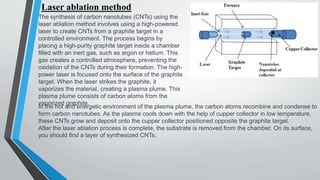
The synthesis of carbon nanotubes (CNTs) using the
laser ablation method involves using a high-powered
laser to create CNTs from a graphite target in a
controlled environment. The process begins by
placing a high-purity graphite target inside a chamber
filled with an inert gas, such as argon or helium. This
gas creates a controlled atmosphere, preventing the
oxidation of the CNTs during their formation. The high-
power laser is focused onto the surface of the graphite
target. When the laser strikes the graphite, it
vaporizes the material, creating a plasma plume. This
plasma plume consists of carbon atoms from the
vaporized graphite.
In the hot and energetic environment of the plasma plume, the carbon atoms recombine and condense to
form carbon nanotubes. As the plasma cools down with the help of cupper collector in low temperature,
these CNTs grow and deposit onto the cupper collector positioned opposite the graphite target.
After the laser ablation process is complete, the substrate is removed from the chamber. On its surface,
you should find a layer of synthesized CNTs.
Carbon Arc Method
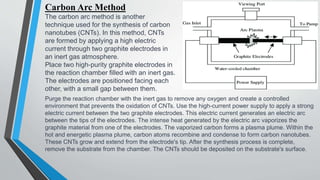
The carbon arc method is another
technique used for the synthesis of carbon
nanotubes (CNTs). In this method, CNTs
are formed by applying a high electric
current through two graphite electrodes in
an inert gas atmosphere.
Place two high-purity graphite electrodes in
the reaction chamber filled with an inert gas.
The electrodes are positioned facing each
other, with a small gap between them.
Purge the reaction chamber with the inert gas to remove any oxygen and create a controlled
environment that prevents the oxidation of CNTs. Use the high-current power supply to apply a strong
electric current between the two graphite electrodes. This electric current generates an electric arc
between the tips of the electrodes. The intense heat generated by the electric arc vaporizes the
graphite material from one of the electrodes. The vaporized carbon forms a plasma plume. Within the
hot and energetic plasma plume, carbon atoms recombine and condense to form carbon nanotubes.
These CNTs grow and extend from the electrode's tip. After the synthesis process is complete,
remove the substrate from the chamber. The CNTs should be deposited on the substrate's surface.
Chemical Vapour Deposition Method
Chemical Vapor Deposition (CVD) is a widely used method for the synthesis of various materials,
including carbon nanotubes (CNTs). CVD involves the chemical reaction of gaseous precursors to
deposit a solid material onto a substrate. Place the substrate inside the reaction chamber. Establish
a controlled atmosphere inside the chamber by purging it with an inert gas, such as hydrogen or
argon, to remove any oxygen and moisture. This prevents the oxidation of the catalyst and carbon
source. If the substrate does not already have a catalyst layer, you may need to deposit one using
techniques like physical vapor deposition (PVD) or sputtering. The catalyst nanoparticles serve as
nucleation sites for CNT growth. Introduce the carbon-containing precursor gas into the reaction
chamber, typically in a controlled flow rate. Heat the substrate to a specific temperature, usually in
the range of 600°C to 1000°C, depending on the specific CNT type you want to synthesize. The
carbon-containing precursor gas decomposes at the catalyst surface, and carbon atoms are
deposited onto the catalyst nanoparticles. Carbon nanotubes grow from these carbon atoms in a
process called chemical vapor deposition. Control the temperature and growth time to promote the
desired CNT growth. CNTs will grow vertically from the catalyst nanoparticles. Once the desired
growth is achieved, cool the substrate and remove it from the chamber.
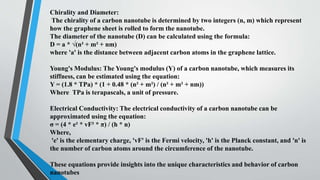
Chirality and Diameter:
The chirality of a carbon nanotube is determined by two integers (n, m) which represent
how the graphene sheet is rolled to form the nanotube.
The diameter of the nanotube (D) can be calculated using the formula:
D = a * √(n² + m² + nm)
where 'a' is the distance between adjacent carbon atoms in the graphene lattice.
Young's Modulus: The Young's modulus (Y) of a carbon nanotube, which measures its
stiffness, can be estimated using the equation:
Y = (1.8 * TPa) * (1 + 0.48 * (n² + m²) / (n² + m² + nm))
Where TPa is terapascals, a unit of pressure.
Electrical Conductivity: The electrical conductivity of a carbon nanotube can be
approximated using the equation:
σ = (4 * e² * vF² * π) / (h * n)
Where,
'e' is the elementary charge, 'vF' is the Fermi velocity, 'h' is the Planck constant, and 'n' is
the number of carbon atoms around the circumference of the nanotube.
These equations provide insights into the unique characteristics and behavior of carbon
nanotubes
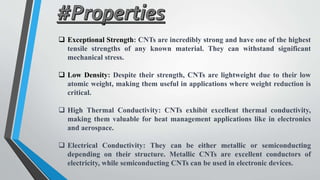
 Exceptional Strength: CNTs are incredibly strong and have one of the highest
tensile strengths of any known material. They can withstand significant
mechanical stress.
 Low Density: Despite their strength, CNTs are lightweight due to their low
atomic weight, making them useful in applications where weight reduction is
critical.
 High Thermal Conductivity: CNTs exhibit excellent thermal conductivity,
making them valuable for heat management applications like in electronics
and aerospace.
 Electrical Conductivity: They can be either metallic or semiconducting
depending on their structure. Metallic CNTs are excellent conductors of
electricity, while semiconducting CNTs can be used in electronic devices.
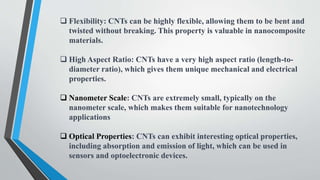
 Flexibility: CNTs can be highly flexible, allowing them to be bent and
twisted without breaking. This property is valuable in nanocomposite
materials.
 High Aspect Ratio: CNTs have a very high aspect ratio (length-to-
diameter ratio), which gives them unique mechanical and electrical
properties.
 Nanometer Scale: CNTs are extremely small, typically on the
nanometer scale, which makes them suitable for nanotechnology
applications
 Optical Properties: CNTs can exhibit interesting optical properties,
including absorption and emission of light, which can be used in
sensors and optoelectronic devices.
 CNTs have diverse applications in many fields, including electronics, materials
science, and nanotechnology.
 They are used in making transistors, batteries, energy storage devices, sensors,
and even medical devices. In materials science, they are used for strengthening
composite materials.
 Nanotubes are used to destroy breast cancer tumors.
 nano tubes are also used in the windmill blades because of their low weight
 Gas like H2, for energy, battery for vehicles can be safely stored inside the
carbon nanotubes and the problem of H2 storage hazards can be solved.
Carbon nanotubes have also been shown to absorb infrared light and may have
applications in the IR optics industry.
Nanotubes are also used in space and aircraft to reduce the weight and stress of
the various components working together.
They are also used in drug delivery systems and in applications related to
conductivity in electronics.
Due to their strong UV/Vis-NIR absorption characteristics, SWNTs are a
potential candidate for use in solar panels, Research has shown that they can
provide a sizable increase in efficiency, even at their current optimized state.
CNTs have been used to develop artificial muscles:
 The artificial muscles are yarns constructed from carbon nanotubes and
infused with paraffin wax
 They can lift more than 100,000 times their own weight.
#Refrences
 https://www.sciencedirect.com/topics/materials-
science/carbon-nanotubes
 http://nano.stanford.edu/publication.php?id=135
 By chrisc scolville,robin cole, Johnson Hog jUmar
Farooque, Archie Russal rEtreived from:
http://cubist.cs.washington.edu/wiki/index.php/Cse
p590a-c
Carbon nanotubes (2).pptx

Carbon nanotubes (2).pptx

  • 1.
    Explored by: Deepanshu Deep MozammilRahman Giridhar Gopal Gupta Department Of Electronics And Communicat
  • 2.
    Outline  Introduction  Discoveryof carbon nanotube  Types of carbon nanotube  Synthesis of carbon Nanotubes  Mathematical References  Properties of carbon Nanotubes  Application and future aspects
  • 3.
    Carbon  The seventeenthmost abundant element found on Earth. Nano  Refers to the objects on the nanometre scale.  Most say anything less than 100 nm Tubes NORMAL METAL TUBE Nanotube
  • 4.
    #Allotrope  Property ofsome chemical elements to exist in two or more different forms. #Allotropes Of Carbon Carbon Allotropes Diamond Graphite Diamond: It exhibits the highest hardness. Graphite: good conductor of electricity. Before 1991
  • 5.
    In 1991 SumioIijima Japanese physicist  Two-dimensional sheet of graphite  Having periodic Honeycomb Structure Graphene Rolled up in a cylindrical form
  • 6.
    Rolled-up  Allotrope ofcarbon  Arranged at molecular level  CNTs can vary in length from a few nanometers to several centimeters, depending on the synthesis method and conditions.  One of the strongest material exist on earth Carbon Nanotubes* Graphene sheet
  • 7.
    Single-Walled Carbon Nanotubes(SWCNTs):  SWCNTs consist of a single cylindrical layer of carbon atoms.  They can be thought of as a rolled-up sheet of graphene.  SWCNTs can be either metallic or semiconducting, depending on the way the graphene sheet is rolled up.  They have excellent electrical conductivity and are used in various electronic applications.  SWCNTs often have a higher cost of production compared to MWCNTs due to their size and complexity.
  • 8.
    • The armchairSWCNTs shows electrical conductivity but zig zag and chiral SWNTs are acts as semiconductor.
  • 9.
    Multi-Walled Carbon Nanotubes (MWCNTs): MWCNTs consist of multiple concentric cylindrical layers of carbon atoms, much like nested tubes.  They are typically larger in diameter than SWCNTs and have a more complex structure.  MWCNTs can also exhibit electrical conductivity, although it may not be as high as in SWCNTs.  They have greater mechanical strength than SWCNTs and are used in reinforcement applications for composites.
  • 10.
    #Synthesis of CNTs: Laser ablation method  Carbon arc method  Chemical Vapour Deposition Method
  • 11.
    Laser ablation method Thesynthesis of carbon nanotubes (CNTs) using the laser ablation method involves using a high-powered laser to create CNTs from a graphite target in a controlled environment. The process begins by placing a high-purity graphite target inside a chamber filled with an inert gas, such as argon or helium. This gas creates a controlled atmosphere, preventing the oxidation of the CNTs during their formation. The high- power laser is focused onto the surface of the graphite target. When the laser strikes the graphite, it vaporizes the material, creating a plasma plume. This plasma plume consists of carbon atoms from the vaporized graphite. In the hot and energetic environment of the plasma plume, the carbon atoms recombine and condense to form carbon nanotubes. As the plasma cools down with the help of cupper collector in low temperature, these CNTs grow and deposit onto the cupper collector positioned opposite the graphite target. After the laser ablation process is complete, the substrate is removed from the chamber. On its surface, you should find a layer of synthesized CNTs.
  • 12.
    Carbon Arc Method Thecarbon arc method is another technique used for the synthesis of carbon nanotubes (CNTs). In this method, CNTs are formed by applying a high electric current through two graphite electrodes in an inert gas atmosphere. Place two high-purity graphite electrodes in the reaction chamber filled with an inert gas. The electrodes are positioned facing each other, with a small gap between them. Purge the reaction chamber with the inert gas to remove any oxygen and create a controlled environment that prevents the oxidation of CNTs. Use the high-current power supply to apply a strong electric current between the two graphite electrodes. This electric current generates an electric arc between the tips of the electrodes. The intense heat generated by the electric arc vaporizes the graphite material from one of the electrodes. The vaporized carbon forms a plasma plume. Within the hot and energetic plasma plume, carbon atoms recombine and condense to form carbon nanotubes. These CNTs grow and extend from the electrode's tip. After the synthesis process is complete, remove the substrate from the chamber. The CNTs should be deposited on the substrate's surface.
  • 13.
    Chemical Vapour DepositionMethod Chemical Vapor Deposition (CVD) is a widely used method for the synthesis of various materials, including carbon nanotubes (CNTs). CVD involves the chemical reaction of gaseous precursors to deposit a solid material onto a substrate. Place the substrate inside the reaction chamber. Establish a controlled atmosphere inside the chamber by purging it with an inert gas, such as hydrogen or argon, to remove any oxygen and moisture. This prevents the oxidation of the catalyst and carbon source. If the substrate does not already have a catalyst layer, you may need to deposit one using techniques like physical vapor deposition (PVD) or sputtering. The catalyst nanoparticles serve as nucleation sites for CNT growth. Introduce the carbon-containing precursor gas into the reaction chamber, typically in a controlled flow rate. Heat the substrate to a specific temperature, usually in the range of 600°C to 1000°C, depending on the specific CNT type you want to synthesize. The carbon-containing precursor gas decomposes at the catalyst surface, and carbon atoms are deposited onto the catalyst nanoparticles. Carbon nanotubes grow from these carbon atoms in a process called chemical vapor deposition. Control the temperature and growth time to promote the desired CNT growth. CNTs will grow vertically from the catalyst nanoparticles. Once the desired growth is achieved, cool the substrate and remove it from the chamber.
  • 14.
    Chirality and Diameter: Thechirality of a carbon nanotube is determined by two integers (n, m) which represent how the graphene sheet is rolled to form the nanotube. The diameter of the nanotube (D) can be calculated using the formula: D = a * √(n² + m² + nm) where 'a' is the distance between adjacent carbon atoms in the graphene lattice. Young's Modulus: The Young's modulus (Y) of a carbon nanotube, which measures its stiffness, can be estimated using the equation: Y = (1.8 * TPa) * (1 + 0.48 * (n² + m²) / (n² + m² + nm)) Where TPa is terapascals, a unit of pressure. Electrical Conductivity: The electrical conductivity of a carbon nanotube can be approximated using the equation: σ = (4 * e² * vF² * π) / (h * n) Where, 'e' is the elementary charge, 'vF' is the Fermi velocity, 'h' is the Planck constant, and 'n' is the number of carbon atoms around the circumference of the nanotube. These equations provide insights into the unique characteristics and behavior of carbon nanotubes
  • 15.
     Exceptional Strength:CNTs are incredibly strong and have one of the highest tensile strengths of any known material. They can withstand significant mechanical stress.  Low Density: Despite their strength, CNTs are lightweight due to their low atomic weight, making them useful in applications where weight reduction is critical.  High Thermal Conductivity: CNTs exhibit excellent thermal conductivity, making them valuable for heat management applications like in electronics and aerospace.  Electrical Conductivity: They can be either metallic or semiconducting depending on their structure. Metallic CNTs are excellent conductors of electricity, while semiconducting CNTs can be used in electronic devices.
  • 16.
     Flexibility: CNTscan be highly flexible, allowing them to be bent and twisted without breaking. This property is valuable in nanocomposite materials.  High Aspect Ratio: CNTs have a very high aspect ratio (length-to- diameter ratio), which gives them unique mechanical and electrical properties.  Nanometer Scale: CNTs are extremely small, typically on the nanometer scale, which makes them suitable for nanotechnology applications  Optical Properties: CNTs can exhibit interesting optical properties, including absorption and emission of light, which can be used in sensors and optoelectronic devices.
  • 17.
     CNTs havediverse applications in many fields, including electronics, materials science, and nanotechnology.  They are used in making transistors, batteries, energy storage devices, sensors, and even medical devices. In materials science, they are used for strengthening composite materials.  Nanotubes are used to destroy breast cancer tumors.  nano tubes are also used in the windmill blades because of their low weight  Gas like H2, for energy, battery for vehicles can be safely stored inside the carbon nanotubes and the problem of H2 storage hazards can be solved.
  • 18.
    Carbon nanotubes havealso been shown to absorb infrared light and may have applications in the IR optics industry. Nanotubes are also used in space and aircraft to reduce the weight and stress of the various components working together. They are also used in drug delivery systems and in applications related to conductivity in electronics. Due to their strong UV/Vis-NIR absorption characteristics, SWNTs are a potential candidate for use in solar panels, Research has shown that they can provide a sizable increase in efficiency, even at their current optimized state. CNTs have been used to develop artificial muscles:  The artificial muscles are yarns constructed from carbon nanotubes and infused with paraffin wax  They can lift more than 100,000 times their own weight.
  • 19.
    #Refrences  https://www.sciencedirect.com/topics/materials- science/carbon-nanotubes  http://nano.stanford.edu/publication.php?id=135 By chrisc scolville,robin cole, Johnson Hog jUmar Farooque, Archie Russal rEtreived from: http://cubist.cs.washington.edu/wiki/index.php/Cse p590a-c