CARBON NANOTUBES AND
IT’S APPLICATION
Presented by :
Rabbi Md Rasel (15-29419-1)
Mohammad Tanjir Hossain (15-29521-2)
Rasel Md. (14-26884-2)
Moon Mehedi Hasan(14-28030-3)
Supervised By : Rethwan faiz
CONTENTS
Over Views of CARBON NANOTUBES
TYPES OF CARBON NANOTUBES
Applications of CARBON NANOTUBES
Summary
OVER VIEWS OF CNTS
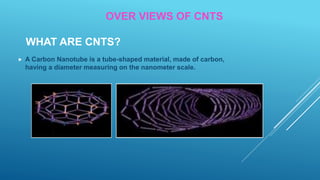
WHAT ARE CNTS?
 A Carbon Nanotube is a tube-shaped material, made of carbon,
having a diameter measuring on the nanometer scale.
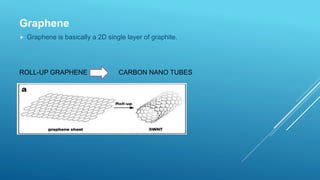
ROLL-UP GRAPHENE CARBON NANO TUBES
Graphene
 Graphene is basically a 2D single layer of graphite.
TYPES OF CARBON NANOTUBES
Classified mainly in two types:
 Single-walled Nanotubes(SWNTS)
 Multi-walled Nanotubes (MWNTs)
Other related structures:
 TORUS
 NANOBUD
 GRAPHENATED CARBON NANOTUBES (g-CNTS)
 NITROGEN DOPED CARBON NANOTUBES (N-CNTS)
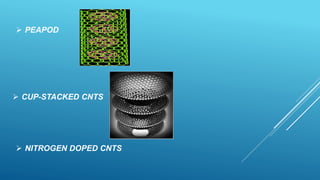
 PEAPOD
 CUP-STACKED CARBON NANOTUBES
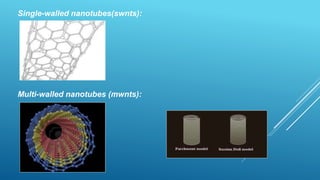
Single-walled nanotubes(swnts):
Multi-walled nanotubes (mwnts):
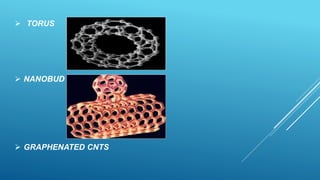
 TORUS
 GRAPHENATED CNTS
 NANOBUD
 PEAPOD
 NITROGEN DOPED CNTS
 CUP-STACKED CNTS
APPLICATION OF CARBON NANOTUBES
 Electronic Applications of CNTS
 CNTs in Mechanical Field
 CNT in Medicine
 Other applications of CNTs
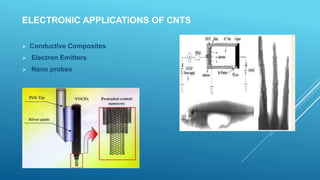
ELECTRONIC APPLICATIONS OF CNTS
 Conductive Composites
 Electron Emitters
 Nano probes
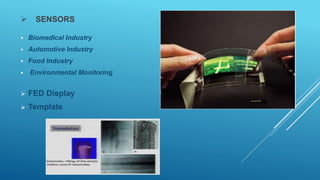
 SENSORS
 Biomedical Industry
 Automotive Industry
 Food Industry
 Environmental Monitoring
 FED Display
 Template
CNTS IN MECHANICAL FIELD
 CNT Based Actuator
 CNT Based Composites
CNT in Medical
 CNTs in Drug Delivery and Cancer Therapy
 CNTs as Biosensors
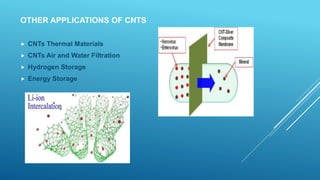
OTHER APPLICATIONS OF CNTS
 CNTs Thermal Materials
 CNTs Air and Water Filtration
 Hydrogen Storage
 Energy Storage
 Despite all the research, scientists still don't fully understand
exactly how they work.
 • Extremely small, so are difficult to work with.
 • Currently, the process is relatively expensive to produce the
nanotubes.
 • Level of purity is less in most of the synthesis techniques.
 • Challenge is in the manipulation of nanotubes
SOURCES
1. https://en.wikipedia.org/wiki/Carbon_nanotube
2. https://www.cheaptubes.com/carbon-nanotubes-applications/
3. www. nptel.ac.in/
4. “Carbon Nanotubes: Properties and Applications” Edited by
Michael J. O’Connell, Ph.D. Senior Research Scientist,Theranos, Inc. Menlo Park,
California.
5. “Electrical properties of Carbon Nanotubes” Kasper GroveRasmussen Thomas
Jorgensen, August 28, 2000.
6. "Mechanical properties of carbon nanotubes: theoretical
predictions and experimental measurements" Rodney S.
Ruoff a, Dong Qian , Wing Kam Liu.
7. “Carbon Nanotube-Based Sensors” Niraj Sinha, Jiazhi Ma,
and John T. W. Yeow.
Thanks

Carbon nanotubes

  • 1.
    CARBON NANOTUBES AND IT’SAPPLICATION Presented by : Rabbi Md Rasel (15-29419-1) Mohammad Tanjir Hossain (15-29521-2) Rasel Md. (14-26884-2) Moon Mehedi Hasan(14-28030-3) Supervised By : Rethwan faiz
  • 2.
    CONTENTS Over Views ofCARBON NANOTUBES TYPES OF CARBON NANOTUBES Applications of CARBON NANOTUBES Summary
  • 3.
    OVER VIEWS OFCNTS WHAT ARE CNTS?  A Carbon Nanotube is a tube-shaped material, made of carbon, having a diameter measuring on the nanometer scale.
  • 4.
    ROLL-UP GRAPHENE CARBONNANO TUBES Graphene  Graphene is basically a 2D single layer of graphite.
  • 5.
    TYPES OF CARBONNANOTUBES Classified mainly in two types:  Single-walled Nanotubes(SWNTS)  Multi-walled Nanotubes (MWNTs) Other related structures:  TORUS  NANOBUD  GRAPHENATED CARBON NANOTUBES (g-CNTS)  NITROGEN DOPED CARBON NANOTUBES (N-CNTS)  PEAPOD  CUP-STACKED CARBON NANOTUBES
  • 6.
  • 7.
     TORUS  GRAPHENATEDCNTS  NANOBUD
  • 8.
     PEAPOD  NITROGENDOPED CNTS  CUP-STACKED CNTS
  • 9.
    APPLICATION OF CARBONNANOTUBES  Electronic Applications of CNTS  CNTs in Mechanical Field  CNT in Medicine  Other applications of CNTs
  • 10.
    ELECTRONIC APPLICATIONS OFCNTS  Conductive Composites  Electron Emitters  Nano probes
  • 11.
     SENSORS  BiomedicalIndustry  Automotive Industry  Food Industry  Environmental Monitoring  FED Display  Template
  • 12.
    CNTS IN MECHANICALFIELD  CNT Based Actuator  CNT Based Composites CNT in Medical  CNTs in Drug Delivery and Cancer Therapy  CNTs as Biosensors
  • 13.
    OTHER APPLICATIONS OFCNTS  CNTs Thermal Materials  CNTs Air and Water Filtration  Hydrogen Storage  Energy Storage
  • 14.
     Despite allthe research, scientists still don't fully understand exactly how they work.  • Extremely small, so are difficult to work with.  • Currently, the process is relatively expensive to produce the nanotubes.  • Level of purity is less in most of the synthesis techniques.  • Challenge is in the manipulation of nanotubes
  • 15.
    SOURCES 1. https://en.wikipedia.org/wiki/Carbon_nanotube 2. https://www.cheaptubes.com/carbon-nanotubes-applications/ 3.www. nptel.ac.in/ 4. “Carbon Nanotubes: Properties and Applications” Edited by Michael J. O’Connell, Ph.D. Senior Research Scientist,Theranos, Inc. Menlo Park, California. 5. “Electrical properties of Carbon Nanotubes” Kasper GroveRasmussen Thomas Jorgensen, August 28, 2000. 6. "Mechanical properties of carbon nanotubes: theoretical predictions and experimental measurements" Rodney S. Ruoff a, Dong Qian , Wing Kam Liu. 7. “Carbon Nanotube-Based Sensors” Niraj Sinha, Jiazhi Ma, and John T. W. Yeow.
  • 16.