Downloaded 155 times





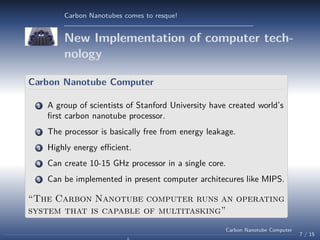
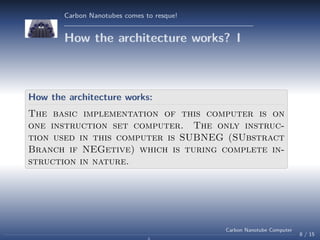
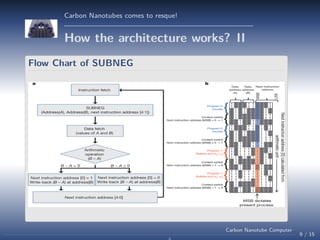
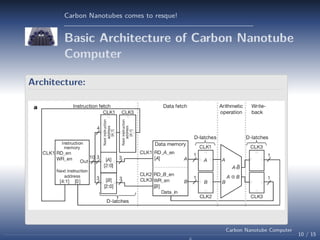
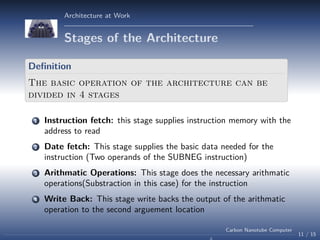
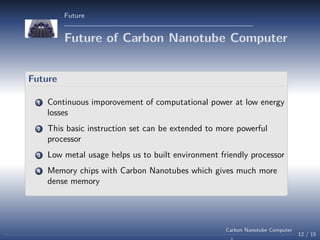


The document discusses the potential for carbon nanotube computers to replace silicon-based VLSI technology. It describes how carbon nanotubes have exceptional electrical and thermal properties and could be used to build transistors that do not suffer from energy leakage. The document outlines a prototype carbon nanotube computer that runs on a single instruction called SUBNEG and operates at much higher clock speeds with significantly lower energy usage than silicon processors. It envisions future improvements including more powerful instruction sets, denser memory, and the potential for carbon nanotubes to help extend Moore's Law. However, challenges remain in producing high purity metallic and semiconductor carbon nanotubes at scale.


