


Carbon Nanotubes
David McDermott
Jake Borrajo
PHYS43 Modern Physics, SRJC
Section 5756
Instructor: Dr. Younes Ataiiyan
Modern Physics Project
What are Carbon nanotubes.
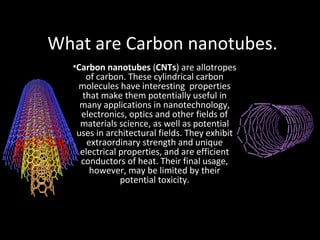
•Carbon nanotubes (CNTs) are allotropes
of carbon. These cylindrical carbon
molecules have interesting properties
that make them potentially useful in
many applications in nanotechnology,
electronics, optics and other fields of
materials science, as well as potential
uses in architectural fields. They exhibit
extraordinary strength and unique
electrical properties, and are efficient
conductors of heat. Their final usage,
however, may be limited by their
potential toxicity.
How CNTs are made
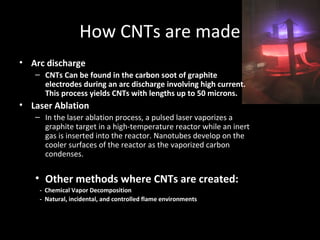
• Arc discharge
– CNTs Can be found in the carbon soot of graphite
electrodes during an arc discharge involving high current.
This process yields CNTs with lengths up to 50 microns.
• Laser Ablation
– In the laser ablation process, a pulsed laser vaporizes a
graphite target in a high-temperature reactor while an inert
gas is inserted into the reactor. Nanotubes develop on the
cooler surfaces of the reactor as the vaporized carbon
condenses.
• Other methods where CNTs are created:
- Chemical Vapor Decomposition
- Natural, incidental, and controlled flame environments
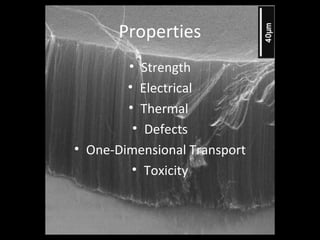
Properties
• Strength
• Electrical
• Thermal
• Defects
• One-Dimensional Transport
• Toxicity
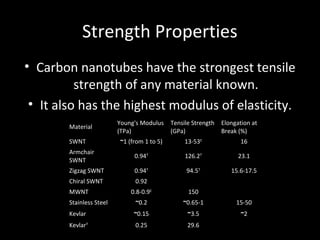
Strength Properties
• Carbon nanotubes have the strongest tensile
strength of any material known.
• It also has the highest modulus of elasticity.
Material
Young's Modulus
(TPa)
Tensile Strength
(GPa)
Elongation at
Break (%)
SWNT ~1 (from 1 to 5) 13-53E
16
Armchair
SWNT
0.94T
126.2T
23.1
Zigzag SWNT 0.94T
94.5T
15.6-17.5
Chiral SWNT 0.92
MWNT 0.8-0.9E
150
Stainless Steel ~0.2 ~0.65-1 15-50
Kevlar ~0.15 ~3.5 ~2
KevlarT
0.25 29.6
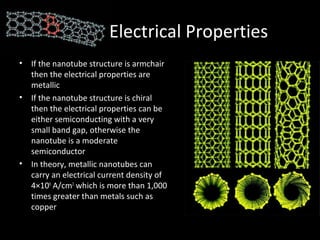
Electrical Properties
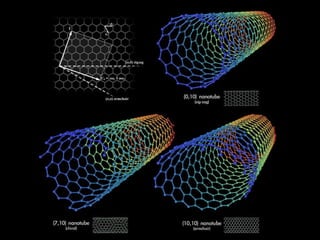
• If the nanotube structure is armchair
then the electrical properties are
metallic
• If the nanotube structure is chiral
then the electrical properties can be
either semiconducting with a very
small band gap, otherwise the
nanotube is a moderate
semiconductor
• In theory, metallic nanotubes can
carry an electrical current density of
4×10⁹
A/cm2
which is more than 1,000
times greater than metals such as
copper
Thermal Properties
• All nanotubes are expected to be very good thermal
conductors along the tube, but good insulators laterally to
the tube axis.
• It is predicted that carbon nanotubes will be able to
transmit up to 6000 watts per meter per Kelvin at room
temperature; compare this to copper, a metal well-known
for its good thermal conductivity, which transmits 385
watts per meter per K.
• The temperature stability of carbon nanotubes is estimated
to be up to 2800o
C in vacuum and about 750o
C in air.
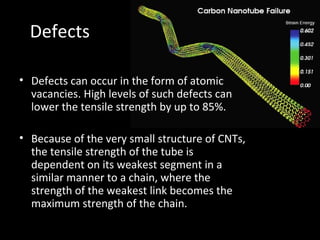
Defects
• Defects can occur in the form of atomic
vacancies. High levels of such defects can
lower the tensile strength by up to 85%.
• Because of the very small structure of CNTs,
the tensile strength of the tube is
dependent on its weakest segment in a
similar manner to a chain, where the
strength of the weakest link becomes the
maximum strength of the chain.
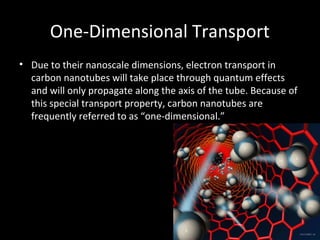
One-Dimensional Transport
• Due to their nanoscale dimensions, electron transport in
carbon nanotubes will take place through quantum effects
and will only propagate along the axis of the tube. Because of
this special transport property, carbon nanotubes are
frequently referred to as “one-dimensional.”
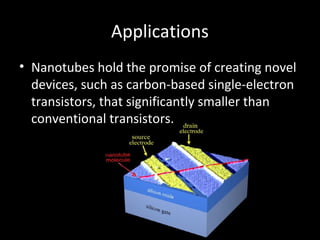
Applications
• Nanotubes hold the promise of creating novel
devices, such as carbon-based single-electron
transistors, that significantly smaller than
conventional transistors.
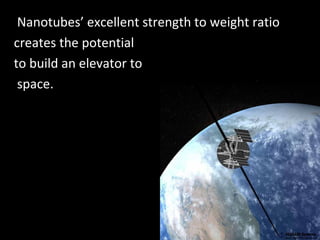
Nanotubes’ excellent strength to weight ratio
creates the potential
to build an elevator to
space.
Quantum Computing
• Nanotubes and other Fullerenes can be filled
with molecules that have either an electronic
or structural property which can be used to
represent the quantum bit (Qubit) of
information, and which can be associated with
other adjacent Qubits.
Health Hazards
• According to scientists at the National Institute
of Standards and Technology, carbon nanotubes
shorter than about 200 nanometers readily
enter into human lung cells similar to the way
asbestos does, and may pose an increased risk
to health.
• Carbon nanotubes along with the majority of
nanotechnology, are an unexplored matter, and
many of the possible health hazards are still
unknown.
References
• http://www.news-medical.net/news/22799.aspx
• Chae, H.G.; Kumar, S. (2006). "Rigid Rod Polymeric Fibers". Journal of
Applied Polymer Science 100:791-802: 791. doi:10.1002/app.22680.
• Hong, Seunghun; Sung Myung (2007). "Nanotube Electronics: A flexible
approach to mobility". Nature Nanotechnology 2: 207–208.
doi:10.1038/nnano.2007.89
• Meo, S.B.; Andrews R. (2001). "Carbon Nanotubes: Synthesis, Properties,
and Applications". Crit. Rev. Solid State Mater. Sci. 26(3):145-249: 145.
doi:10.1080/20014091104189.
• Kolosnjaj J, Szwarc H, Moussa F (2007). "Toxicity studies of carbon
nanotubes". Adv Exp Med Biol. 620: 181–204. PMID 18217344
• Ebbesen, T. W.; Ajayan, P. M. (1992). "Large-scale synthesis of carbon
nanotubes". Nature 358: 220–222. doi:10.1038/358220a0

Carbon nanotubes (1)

  • 1.
    Carbon Nanotubes David McDermott JakeBorrajo PHYS43 Modern Physics, SRJC Section 5756 Instructor: Dr. Younes Ataiiyan Modern Physics Project
  • 2.
    What are Carbonnanotubes. •Carbon nanotubes (CNTs) are allotropes of carbon. These cylindrical carbon molecules have interesting properties that make them potentially useful in many applications in nanotechnology, electronics, optics and other fields of materials science, as well as potential uses in architectural fields. They exhibit extraordinary strength and unique electrical properties, and are efficient conductors of heat. Their final usage, however, may be limited by their potential toxicity.
  • 3.
    How CNTs aremade • Arc discharge – CNTs Can be found in the carbon soot of graphite electrodes during an arc discharge involving high current. This process yields CNTs with lengths up to 50 microns. • Laser Ablation – In the laser ablation process, a pulsed laser vaporizes a graphite target in a high-temperature reactor while an inert gas is inserted into the reactor. Nanotubes develop on the cooler surfaces of the reactor as the vaporized carbon condenses. • Other methods where CNTs are created: - Chemical Vapor Decomposition - Natural, incidental, and controlled flame environments
  • 5.
    Properties • Strength • Electrical •Thermal • Defects • One-Dimensional Transport • Toxicity
  • 6.
    Strength Properties • Carbonnanotubes have the strongest tensile strength of any material known. • It also has the highest modulus of elasticity. Material Young's Modulus (TPa) Tensile Strength (GPa) Elongation at Break (%) SWNT ~1 (from 1 to 5) 13-53E 16 Armchair SWNT 0.94T 126.2T 23.1 Zigzag SWNT 0.94T 94.5T 15.6-17.5 Chiral SWNT 0.92 MWNT 0.8-0.9E 150 Stainless Steel ~0.2 ~0.65-1 15-50 Kevlar ~0.15 ~3.5 ~2 KevlarT 0.25 29.6
  • 7.
    Electrical Properties • Ifthe nanotube structure is armchair then the electrical properties are metallic • If the nanotube structure is chiral then the electrical properties can be either semiconducting with a very small band gap, otherwise the nanotube is a moderate semiconductor • In theory, metallic nanotubes can carry an electrical current density of 4×10⁹ A/cm2 which is more than 1,000 times greater than metals such as copper
  • 8.
    Thermal Properties • Allnanotubes are expected to be very good thermal conductors along the tube, but good insulators laterally to the tube axis. • It is predicted that carbon nanotubes will be able to transmit up to 6000 watts per meter per Kelvin at room temperature; compare this to copper, a metal well-known for its good thermal conductivity, which transmits 385 watts per meter per K. • The temperature stability of carbon nanotubes is estimated to be up to 2800o C in vacuum and about 750o C in air.
  • 9.
    Defects • Defects canoccur in the form of atomic vacancies. High levels of such defects can lower the tensile strength by up to 85%. • Because of the very small structure of CNTs, the tensile strength of the tube is dependent on its weakest segment in a similar manner to a chain, where the strength of the weakest link becomes the maximum strength of the chain.
  • 10.
    One-Dimensional Transport • Dueto their nanoscale dimensions, electron transport in carbon nanotubes will take place through quantum effects and will only propagate along the axis of the tube. Because of this special transport property, carbon nanotubes are frequently referred to as “one-dimensional.”
  • 11.
    Applications • Nanotubes holdthe promise of creating novel devices, such as carbon-based single-electron transistors, that significantly smaller than conventional transistors.
  • 12.
    Nanotubes’ excellent strengthto weight ratio creates the potential to build an elevator to space.
  • 13.
    Quantum Computing • Nanotubesand other Fullerenes can be filled with molecules that have either an electronic or structural property which can be used to represent the quantum bit (Qubit) of information, and which can be associated with other adjacent Qubits.
  • 14.
    Health Hazards • Accordingto scientists at the National Institute of Standards and Technology, carbon nanotubes shorter than about 200 nanometers readily enter into human lung cells similar to the way asbestos does, and may pose an increased risk to health. • Carbon nanotubes along with the majority of nanotechnology, are an unexplored matter, and many of the possible health hazards are still unknown.
  • 15.
    References • http://www.news-medical.net/news/22799.aspx • Chae,H.G.; Kumar, S. (2006). "Rigid Rod Polymeric Fibers". Journal of Applied Polymer Science 100:791-802: 791. doi:10.1002/app.22680. • Hong, Seunghun; Sung Myung (2007). "Nanotube Electronics: A flexible approach to mobility". Nature Nanotechnology 2: 207–208. doi:10.1038/nnano.2007.89 • Meo, S.B.; Andrews R. (2001). "Carbon Nanotubes: Synthesis, Properties, and Applications". Crit. Rev. Solid State Mater. Sci. 26(3):145-249: 145. doi:10.1080/20014091104189. • Kolosnjaj J, Szwarc H, Moussa F (2007). "Toxicity studies of carbon nanotubes". Adv Exp Med Biol. 620: 181–204. PMID 18217344 • Ebbesen, T. W.; Ajayan, P. M. (1992). "Large-scale synthesis of carbon nanotubes". Nature 358: 220–222. doi:10.1038/358220a0