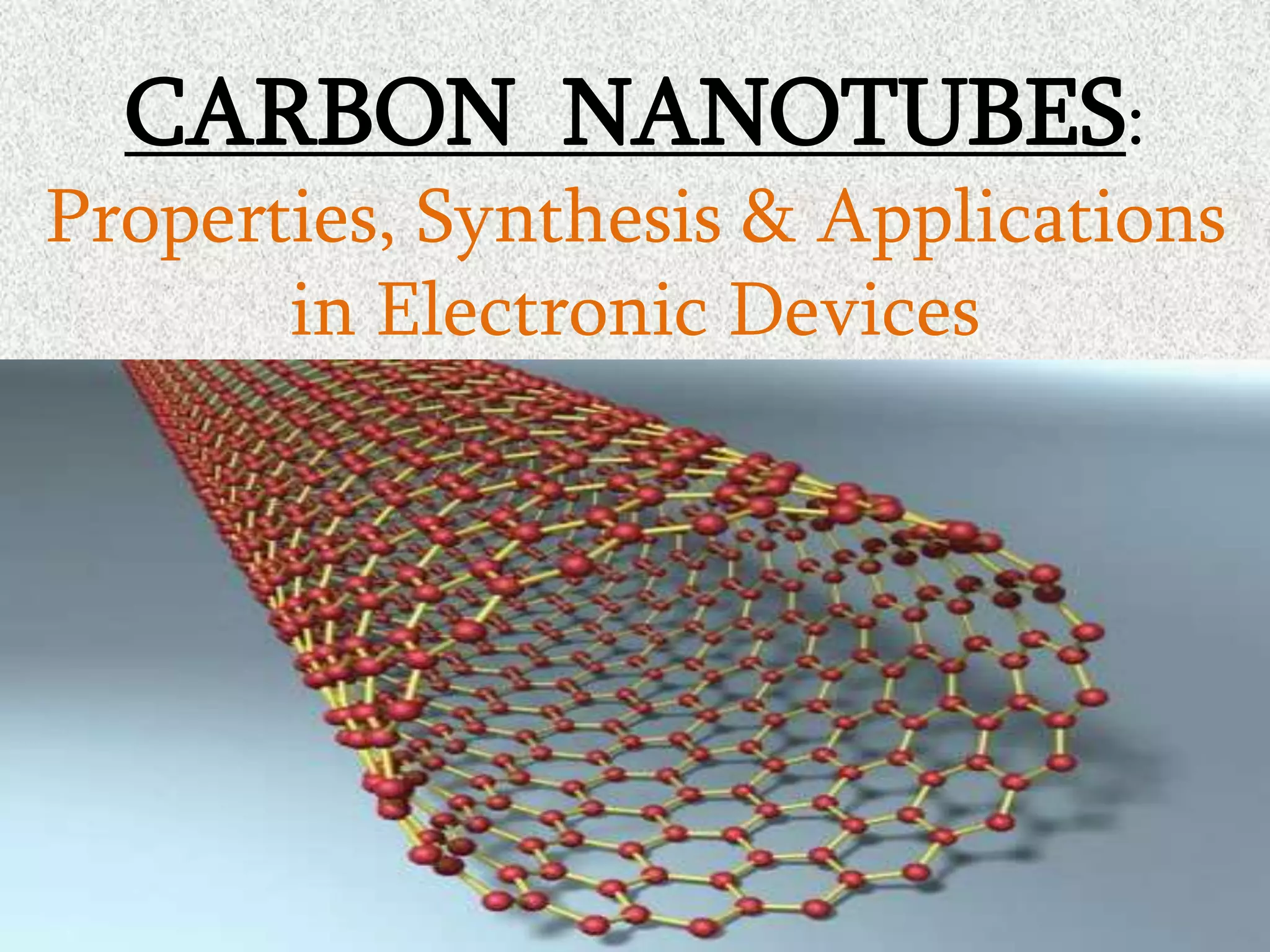
CARBON NANOTUBES:
Properties, Synthesis & Applications
in Electronic Devices
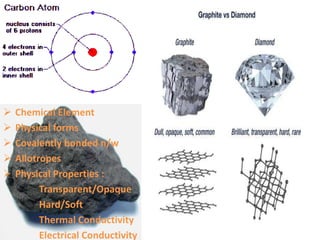
 Chemical Element
 Physical forms
 Covalently bonded n/w
 Allotropes
 Physical Properties :
Transparent/Opaque
Hard/Soft
Thermal Conductivity
Electrical Conductivity
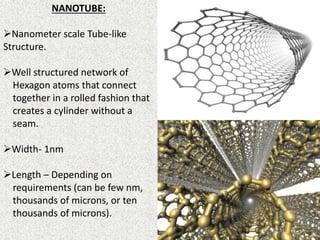
NANOTUBE:
Nanometer scale Tube-like
Structure.
Well structured network of
Hexagon atoms that connect
together in a rolled fashion that
creates a cylinder without a
seam.
Width- 1nm
Length – Depending on
requirements (can be few nm,
thousands of microns, or ten
thousands of microns).
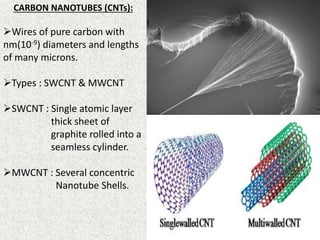
CARBON NANOTUBES (CNTs):
Wires of pure carbon with
nm(10-9) diameters and lengths
of many microns.
Types : SWCNT & MWCNT
SWCNT : Single atomic layer
thick sheet of
graphite rolled into a
seamless cylinder.
MWCNT : Several concentric
Nanotube Shells.
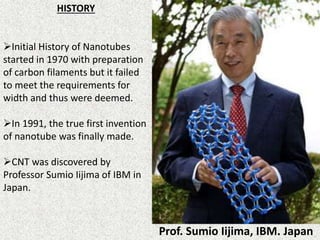
Prof. Sumio Iijima, IBM. Japan
HISTORY
Initial History of Nanotubes
started in 1970 with preparation
of carbon filaments but it failed
to meet the requirements for
width and thus were deemed.
In 1991, the true first invention
of nanotube was finally made.
CNT was discovered by
Professor Sumio Iijima of IBM in
Japan.
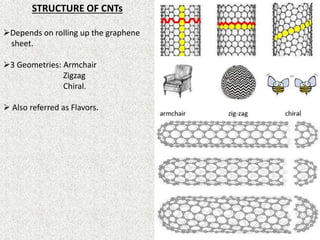
STRUCTURE OF CNTs
Depends on rolling up the graphene
sheet.
3 Geometries: Armchair
Zigzag
Chiral.
 Also referred as Flavors.
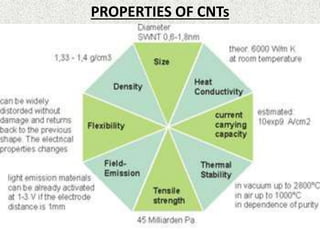
PROPERTIES OF CNTs
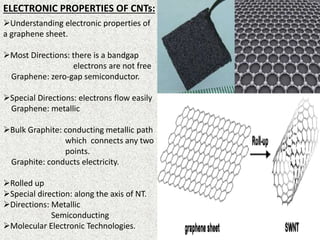
ELECTRONIC PROPERTIES OF CNTs:
Understanding electronic properties of
a graphene sheet.
Most Directions: there is a bandgap
electrons are not free
Graphene: zero-gap semiconductor.
Special Directions: electrons flow easily
Graphene: metallic
Bulk Graphite: conducting metallic path
which connects any two
points.
Graphite: conducts electricity.
Rolled up
Special direction: along the axis of NT.
Directions: Metallic
Semiconducting
Molecular Electronic Technologies.
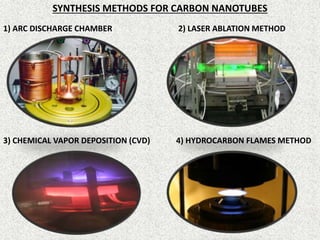
SYNTHESIS METHODS FOR CARBON NANOTUBES
1) ARC DISCHARGE CHAMBER 2) LASER ABLATION METHOD
3) CHEMICAL VAPOR DEPOSITION (CVD) 4) HYDROCARBON FLAMES METHOD
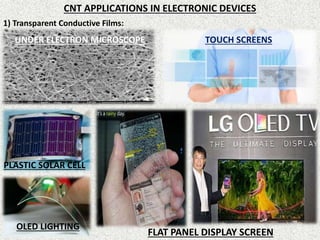
CNT APPLICATIONS IN ELECTRONIC DEVICES
1) Transparent Conductive Films:
UNDER ELECTRON MICROSCOPE TOUCH SCREENS
PLASTIC SOLAR CELL
OLED LIGHTING
FLAT PANEL DISPLAY SCREEN
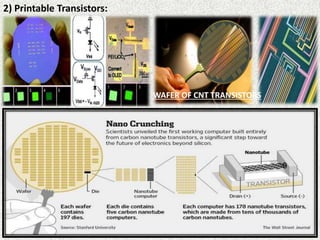
2) Printable Transistors:
WAFER OF CNT TRANSISTORS
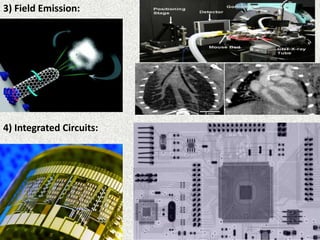
3) Field Emission:
4) Integrated Circuits:
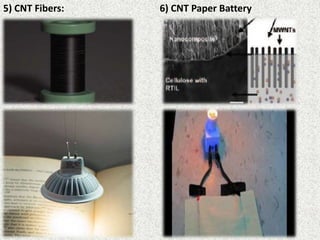
5) CNT Fibers: 6) CNT Paper Battery
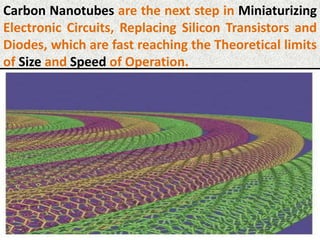
Carbon Nanotubes are the next step in Miniaturizing
Electronic Circuits, Replacing Silicon Transistors and
Diodes, which are fast reaching the Theoretical limits
of Size and Speed of Operation.
THANK YOU
-GARGI

Carbon Nanotubes - Seminar IETE

  • 1.
    CARBON NANOTUBES: Properties, Synthesis& Applications in Electronic Devices
  • 2.
     Chemical Element Physical forms  Covalently bonded n/w  Allotropes  Physical Properties : Transparent/Opaque Hard/Soft Thermal Conductivity Electrical Conductivity
  • 3.
    NANOTUBE: Nanometer scale Tube-like Structure. Wellstructured network of Hexagon atoms that connect together in a rolled fashion that creates a cylinder without a seam. Width- 1nm Length – Depending on requirements (can be few nm, thousands of microns, or ten thousands of microns).
  • 4.
    CARBON NANOTUBES (CNTs): Wiresof pure carbon with nm(10-9) diameters and lengths of many microns. Types : SWCNT & MWCNT SWCNT : Single atomic layer thick sheet of graphite rolled into a seamless cylinder. MWCNT : Several concentric Nanotube Shells.
  • 5.
    Prof. Sumio Iijima,IBM. Japan HISTORY Initial History of Nanotubes started in 1970 with preparation of carbon filaments but it failed to meet the requirements for width and thus were deemed. In 1991, the true first invention of nanotube was finally made. CNT was discovered by Professor Sumio Iijima of IBM in Japan.
  • 6.
    STRUCTURE OF CNTs Dependson rolling up the graphene sheet. 3 Geometries: Armchair Zigzag Chiral.  Also referred as Flavors.
  • 7.
  • 8.
    ELECTRONIC PROPERTIES OFCNTs: Understanding electronic properties of a graphene sheet. Most Directions: there is a bandgap electrons are not free Graphene: zero-gap semiconductor. Special Directions: electrons flow easily Graphene: metallic Bulk Graphite: conducting metallic path which connects any two points. Graphite: conducts electricity. Rolled up Special direction: along the axis of NT. Directions: Metallic Semiconducting Molecular Electronic Technologies.
  • 9.
    SYNTHESIS METHODS FORCARBON NANOTUBES 1) ARC DISCHARGE CHAMBER 2) LASER ABLATION METHOD 3) CHEMICAL VAPOR DEPOSITION (CVD) 4) HYDROCARBON FLAMES METHOD
  • 10.
    CNT APPLICATIONS INELECTRONIC DEVICES 1) Transparent Conductive Films: UNDER ELECTRON MICROSCOPE TOUCH SCREENS PLASTIC SOLAR CELL OLED LIGHTING FLAT PANEL DISPLAY SCREEN
  • 11.
  • 12.
    3) Field Emission: 4)Integrated Circuits:
  • 13.
    5) CNT Fibers:6) CNT Paper Battery
  • 14.
    Carbon Nanotubes arethe next step in Miniaturizing Electronic Circuits, Replacing Silicon Transistors and Diodes, which are fast reaching the Theoretical limits of Size and Speed of Operation.
  • 15.