Reverse Osmosis
Where do we stand today & where are we heading
Present and Future
Agenda
Introducing myself
1. Osmosis and reverse osmosis, facts and history
2. Reverse Osmosis units : how it works
3. Markets
4. Technical Evolutions and Trends
5. Future development
Olivier AMIOT
• Chemistry and Chemical Eng, 20 years of prof.experience
• Sales Manager and Service Equipment Manager with Nalco for 17 years,
Business developer on new markets (Institutional, Glass-manufacturing, Dairies, District
Utilities, Pulp & Paper Utilities, Middle market manufacturing)
 Leader in launching new technologies with new customers’ approaches (Coil-Flo, Value-
Added services, MetroModel, Legionella Pneumophilia)
Recognized as a Sales-Leader and Water consultant in 2005
• I set up Yret Solutions for helping my customers from industries and institutional
segments improve the performances and results of their water systems :
Increase availability of their assets (Productivity, Manage Costs),
Reduce their risks and environmental impact (S.H.& E),
Increase performance in Hygiene, Safety and Productivity,
Increase and Sustain life of equipment.
contact@yretsolutions.comOlivier AMIOT 3
1- Osmosis and Reverse Osmosis
• Discovered in 1748 by Jean-Antoine Nollet
• In 1854, Thomas Graham invented the term of Osmosis, from the Greek word
meaning push/pressure
• Osmosis is one of the mechanism explaining the degradation of polyesters
plastics (boats)
Facts and History
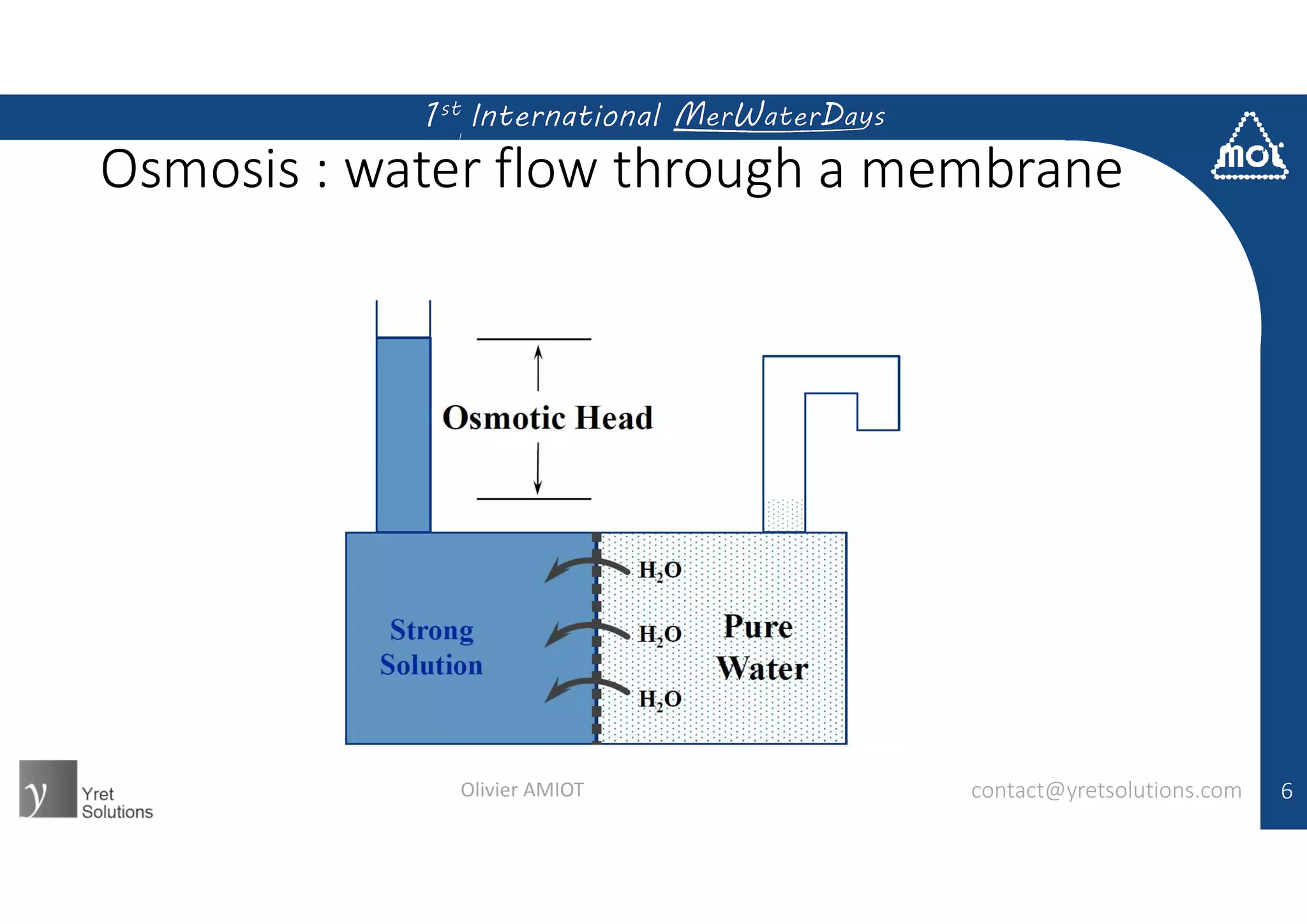
Osmosis : water flow through a membrane
contact@yretsolutions.comOlivier AMIOT 6
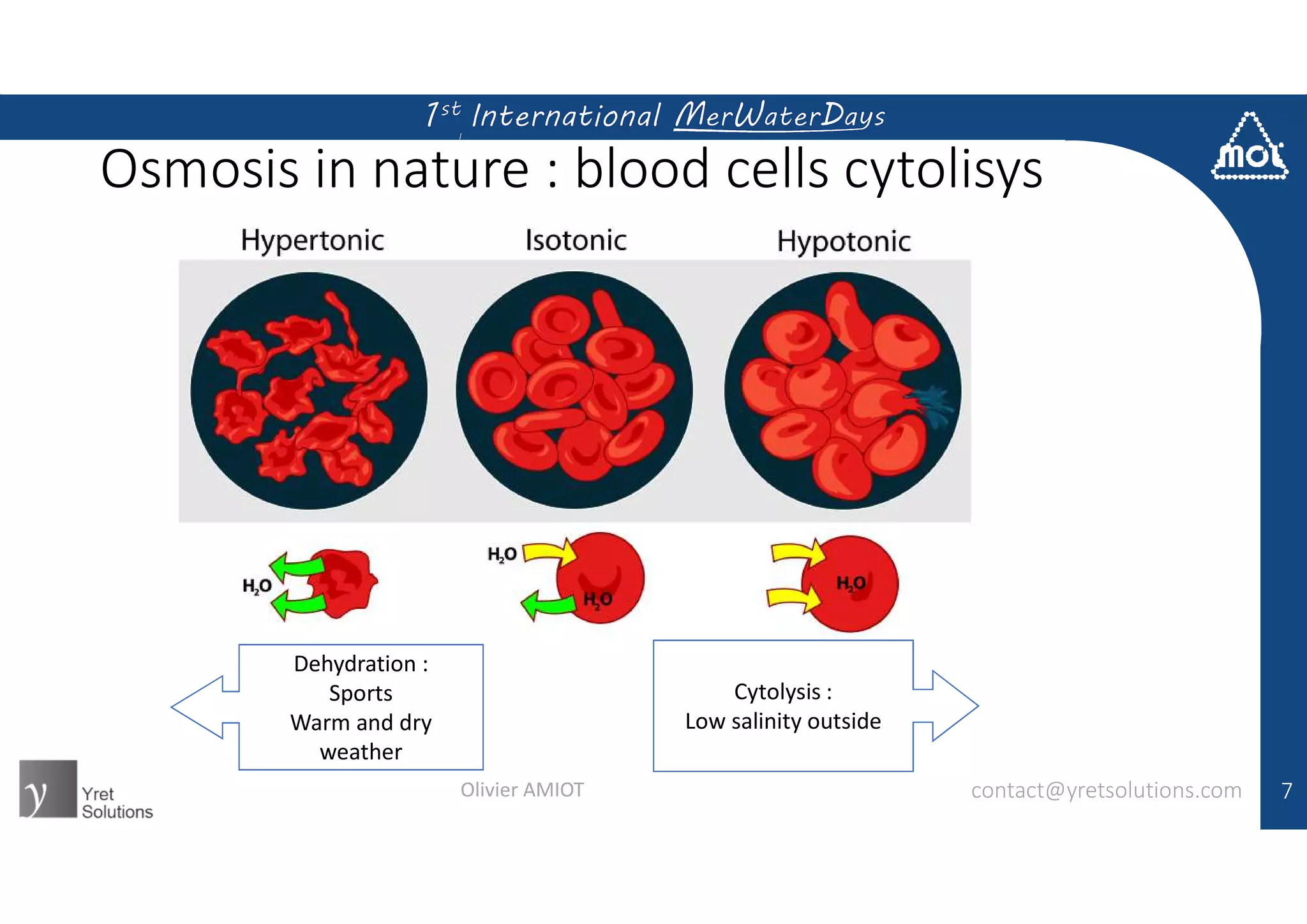
Osmosis in nature : blood cells cytolisys
contact@yretsolutions.comOlivier AMIOT 7
Dehydration :
Sports
Warm and dry
weather
Cytolysis :
Low salinity outside
• First research started during the 40’s
by request of the US Gov.
• First application in 1959 for water
desalination
• First customer : NASA
• Development for water desalination
started during the 70’s
8
Reverse Osmosis
Apply pressure on the strong solution : water will flow from strong solution to pure water
contact@yretsolutions.comOlivier AMIOT
2- Reverse Osmosis Technical Facts
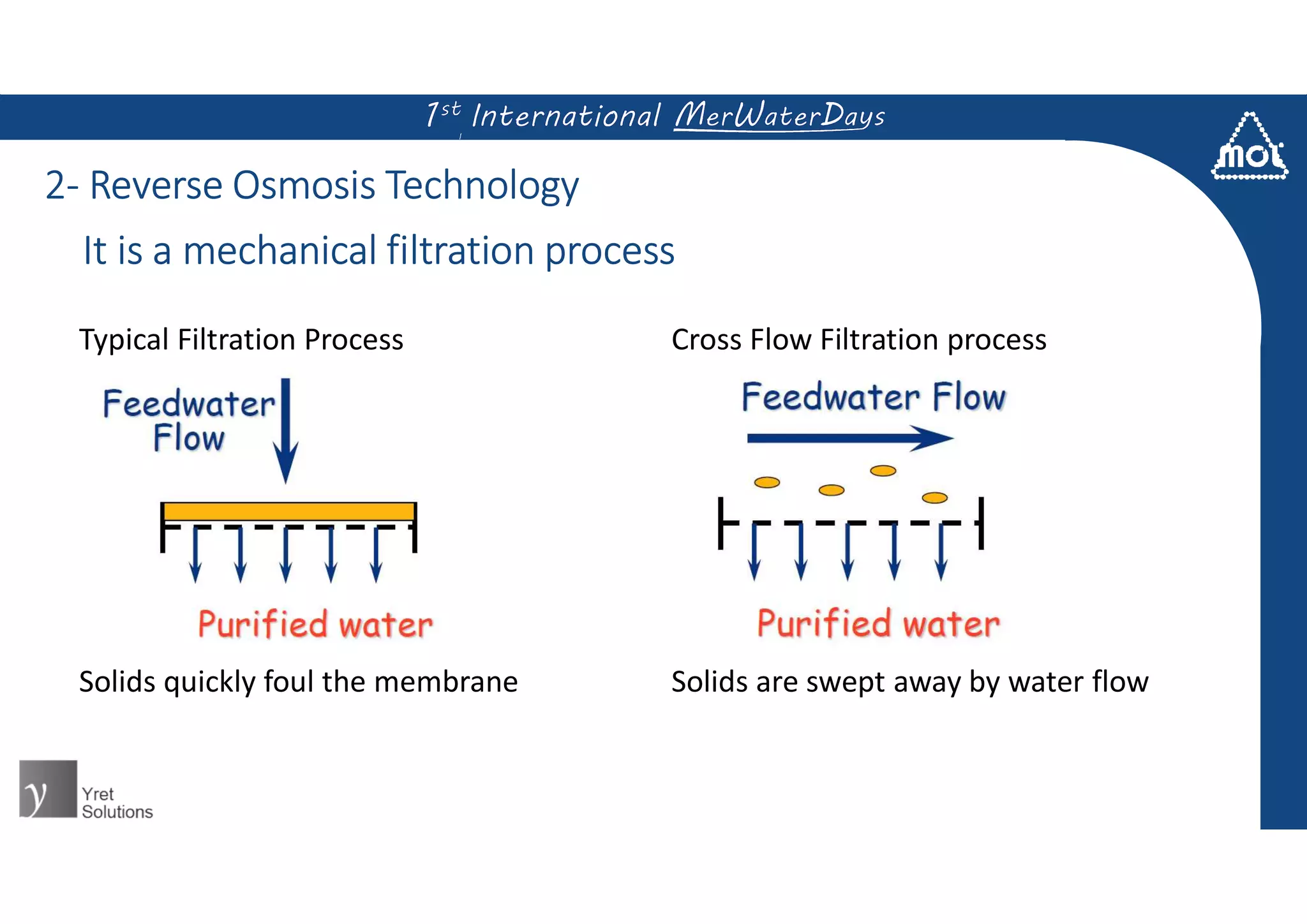
Typical Filtration Process
Solids quickly foul the membrane
Cross Flow Filtration process
Solids are swept away by water flow
2- Reverse Osmosis Technology
It is a mechanical filtration process
2- Reverse Osmosis Technology
One Influent
Two effluents : permeate and concentrate
High velocity prevent fouling of the filtering media
11
Cross Flow Filtration
contact@yretsolutions.comOlivier AMIOT
2- Reverse Osmosis Technology
3 major components always found in RO units :
1. Filtration unit : decrease suspended solids, risk of fouling
2. High pressure pump : activation of RO
3. Membranes
12
Major Components
contact@yretsolutions.comOlivier AMIOT
WASTE
PRODUCT
HP Pump
Filtration Unit
2- Reverse Osmosis Technology
13contact@yretsolutions.comOlivier AMIOT
2- Reverse Osmosis Technology
Two materials have been used for membranes :
1. Cellulose Acetate
2. Polyamide (thin film composite membrane)
• Acetate
Historically first, Cheap
pH range between 4-8, Temp < 35°C, low resistance to bacterias
• Polyamide
Better resistance to hydrolysis, and bacterias,
pH from 4-11, higher temperature
14
Membrane Technologies
contact@yretsolutions.comOlivier AMIOT
• Polyamide thin film membrane :
0.2µm
• Microporous substrate layer :
polysulfone, 40µm
• Reinforcing base : polyester 100-
120µm
• Pore size around 0.0001 µm
15
2- Reverse Osmosis Technology
Polyamide membrane film composite typical thickness
contact@yretsolutions.comOlivier AMIOT
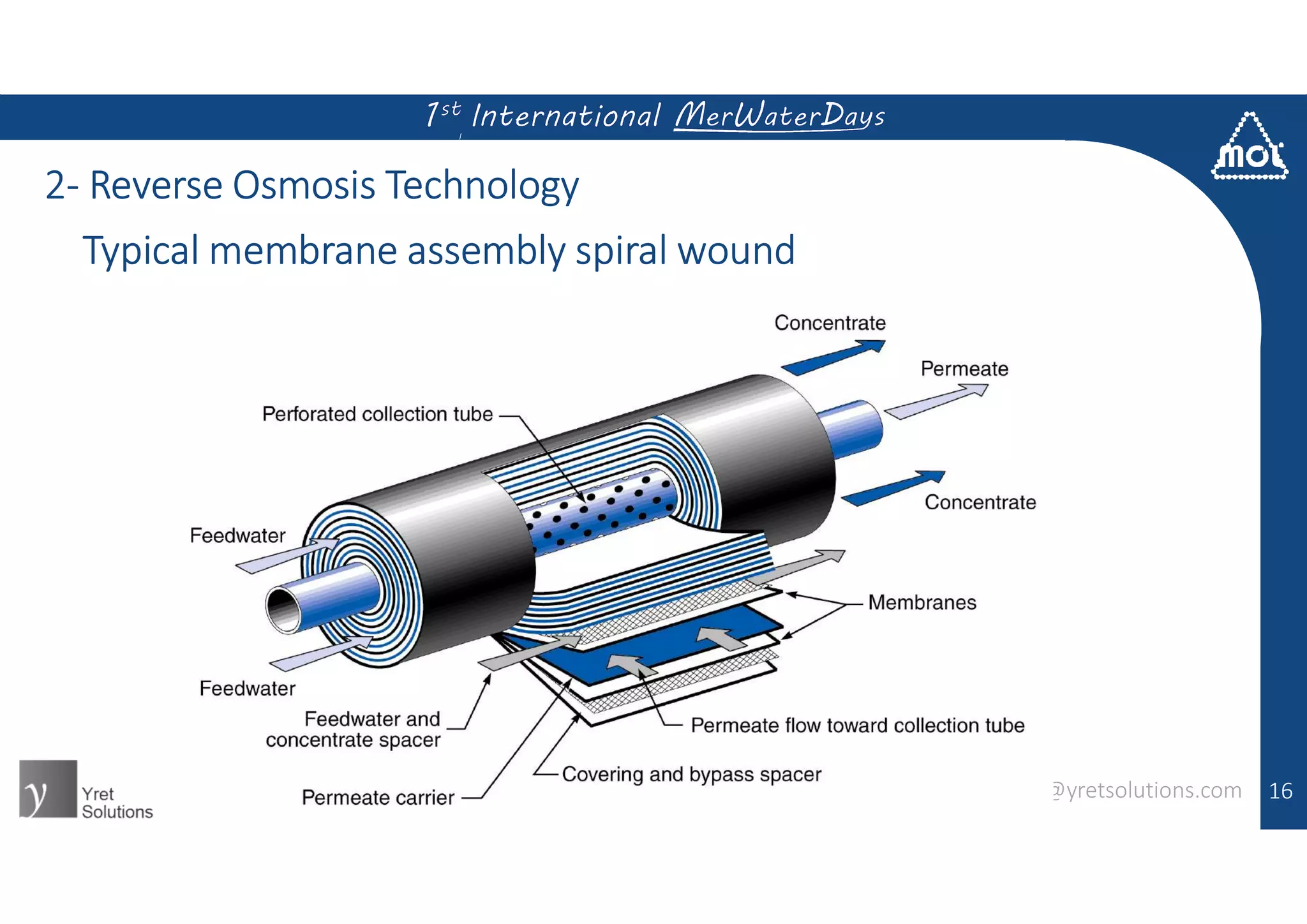
2- Reverse Osmosis Technology
16
Typical membrane assembly spiral wound
contact@yretsolutions.comOlivier AMIOT
17
2- Reverse Osmosis Technology
Spiral wound flow patern
contact@yretsolutions.comOlivier AMIOT
2- Reverse Osmosis Technology
• Removes nonionic impurities and dissolved solids (i.e. organics, silica, bacteria)
• Reduction of hazardous chemical storage and handling associated with ion
exchange
• Economic advantages increase with increasing feed TDS
18
Advantages of RO
contact@yretsolutions.comOlivier AMIOT
2- Reverse Osmosis Technology
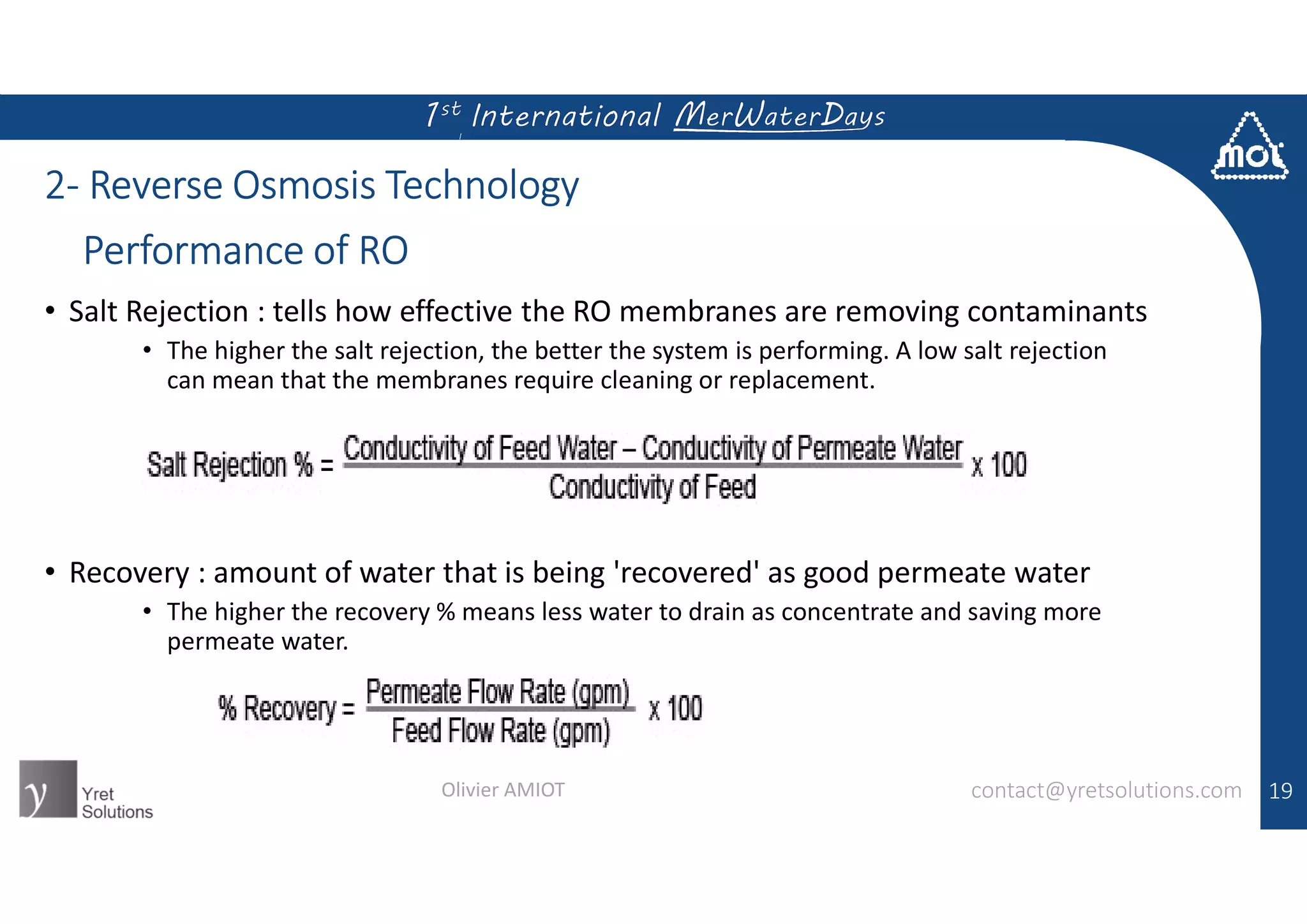
• Salt Rejection : tells how effective the RO membranes are removing contaminants
• The higher the salt rejection, the better the system is performing. A low salt rejection
can mean that the membranes require cleaning or replacement.
• Recovery : amount of water that is being 'recovered' as good permeate water
• The higher the recovery % means less water to drain as concentrate and saving more
permeate water.
19contact@yretsolutions.comOlivier AMIOT
Performance of RO
2- Reverse Osmosis Technology
• Concentrate is rejected and this can be a significant volume of water.
• RO membranes reject a fixed percentage of feedwater ions
Further treatment is required for many applications.
• Ultimate filter which is easily fouled:
Increased operating costs
Reduced membrane life
20
Disadvantages of RO
contact@yretsolutions.comOlivier AMIOT
2- Reverse Osmosis Technology
21
RO Membrane Problems
contact@yretsolutions.comOlivier AMIOT
Suspended solids
fouling
Precipitation Bio fouling Dissolve
Colloids and
solids, High
FI
Filtration
unit
Hardness,
sulfates, high
LI
Sequestrant,
softener
Bacterial and
living material
contamination
UF units, MOL-
Lik, biocides
(!!)
Oxidizing
compounds,
aggressive
chemicals
Active carbon
2- Reverse Osmosis Technology
22
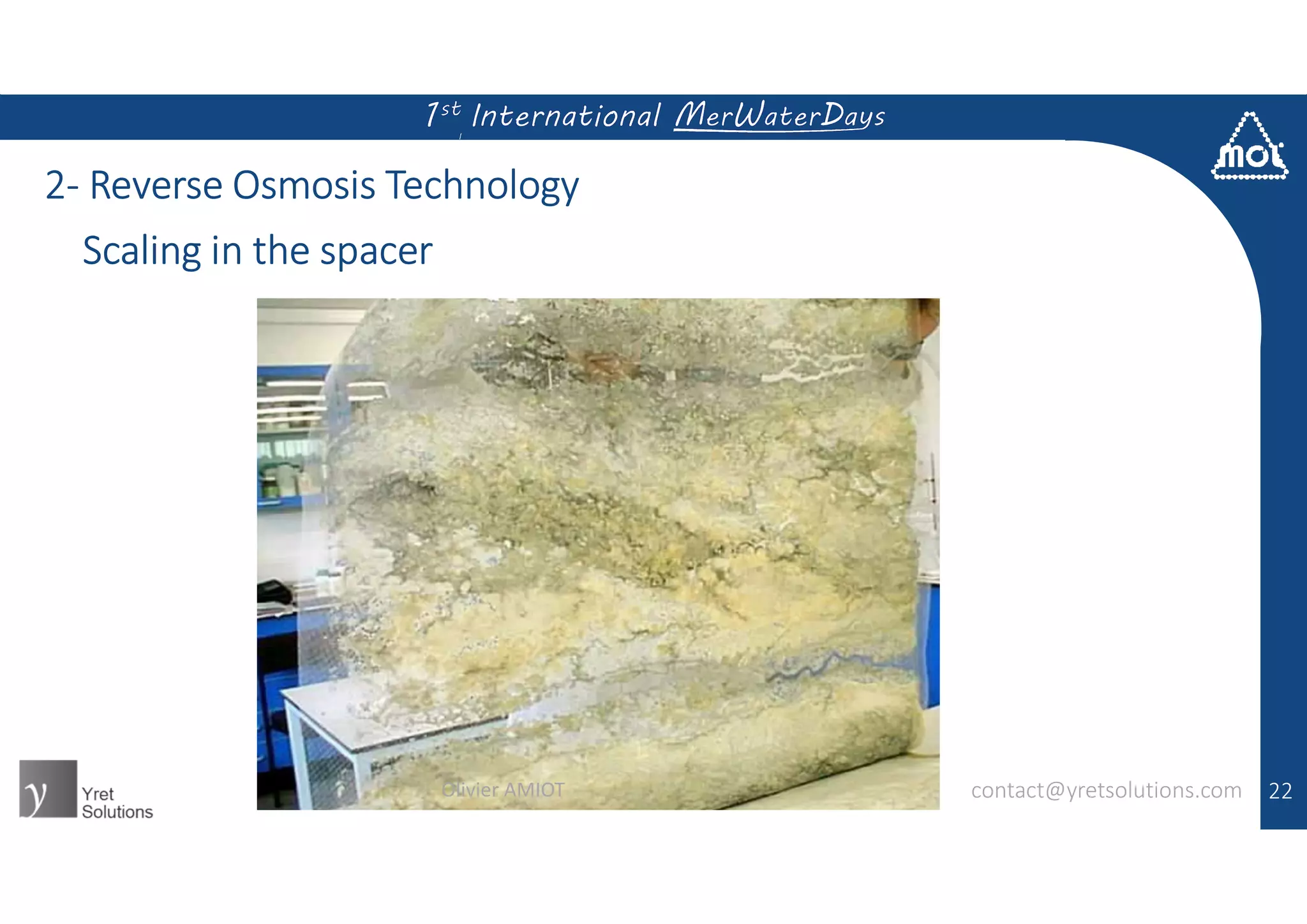
Scaling in the spacer
contact@yretsolutions.comOlivier AMIOT
2- Reverse Osmosis Technology
23
Fouled membrane
contact@yretsolutions.comOlivier AMIOT
2- Reverse Osmosis Technology
24
Over-pressure effects on membrane
contact@yretsolutions.comOlivier AMIOT
2- Reverse Osmosis Technology
• Act pro-actively
 Filtration stage
 Anti-scalant adapted technologies (either soft or sequestrant)
 MOL Lik
 Follow-up indicators (pressure, recovery, salt rejection, flowrates) : carefull
about normalized values
• Maintenance
 Cleaning process adapted to type of fouling/membranes
25
Troubleshooting
contact@yretsolutions.comOlivier AMIOT
3- Reverse Osmosis Market Applications
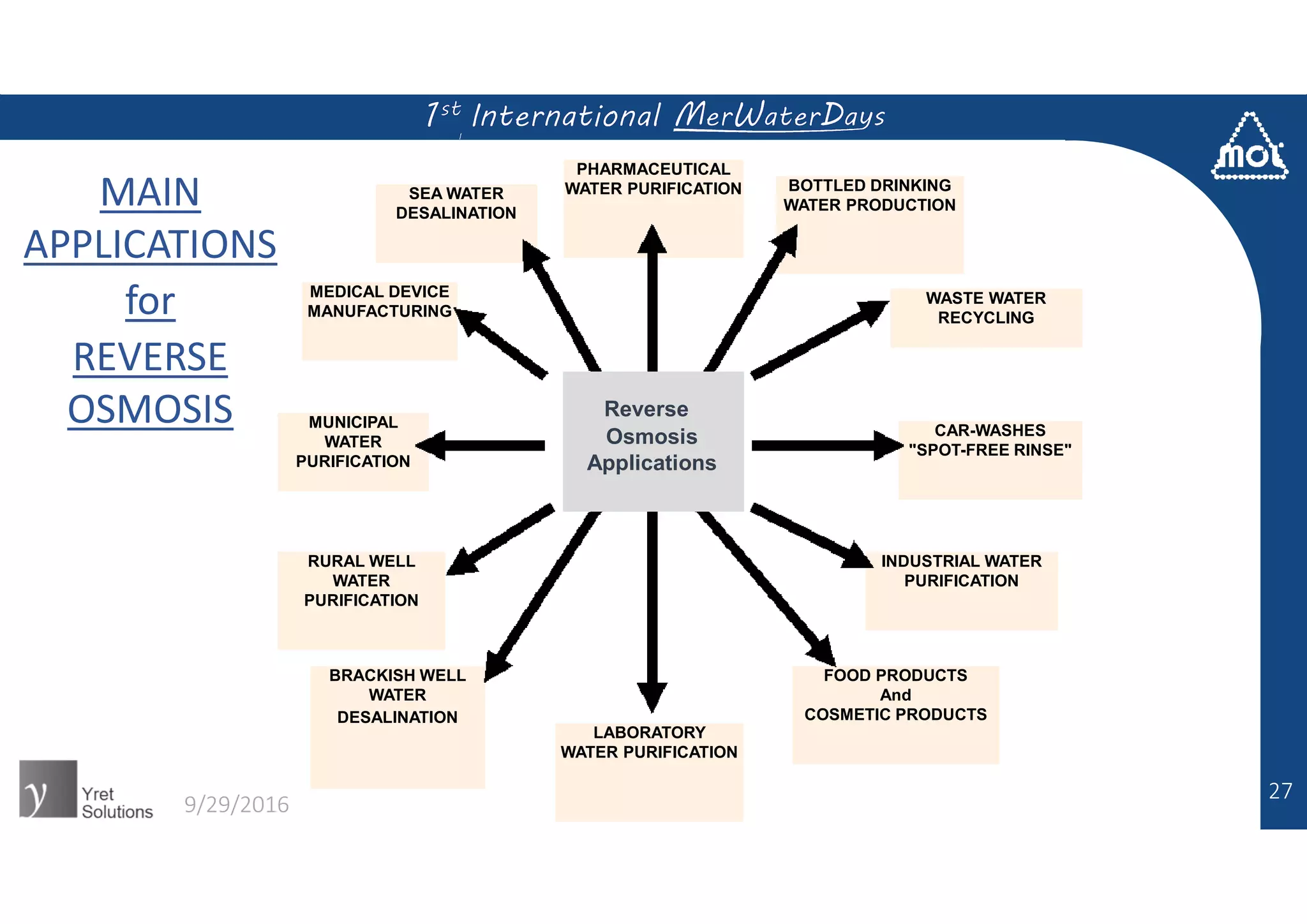
INDUSTRIAL WATER
PURIFICATION
RURAL WELL
WATER
PURIFICATION
MUNICIPAL
WATER
PURIFICATION
MEDICAL DEVICE
MANUFACTURING
SEA WATER
DESALINATION
WASTE WATER
RECYCLING
BRACKISH WELL
WATER
DESALINATION
CAR-WASHES
"SPOT-FREE RINSE"
FOOD PRODUCTS
And
COSMETIC PRODUCTS
MAIN
APPLICATIONS
for
REVERSE
OSMOSIS
LABORATORY
WATER PURIFICATION
BOTTLED DRINKING
WATER PRODUCTION
PHARMACEUTICAL
WATER PURIFICATION
Reverse
Osmosis
Applications
9/29/2016
27
3- Reverse Osmosis Market Applications
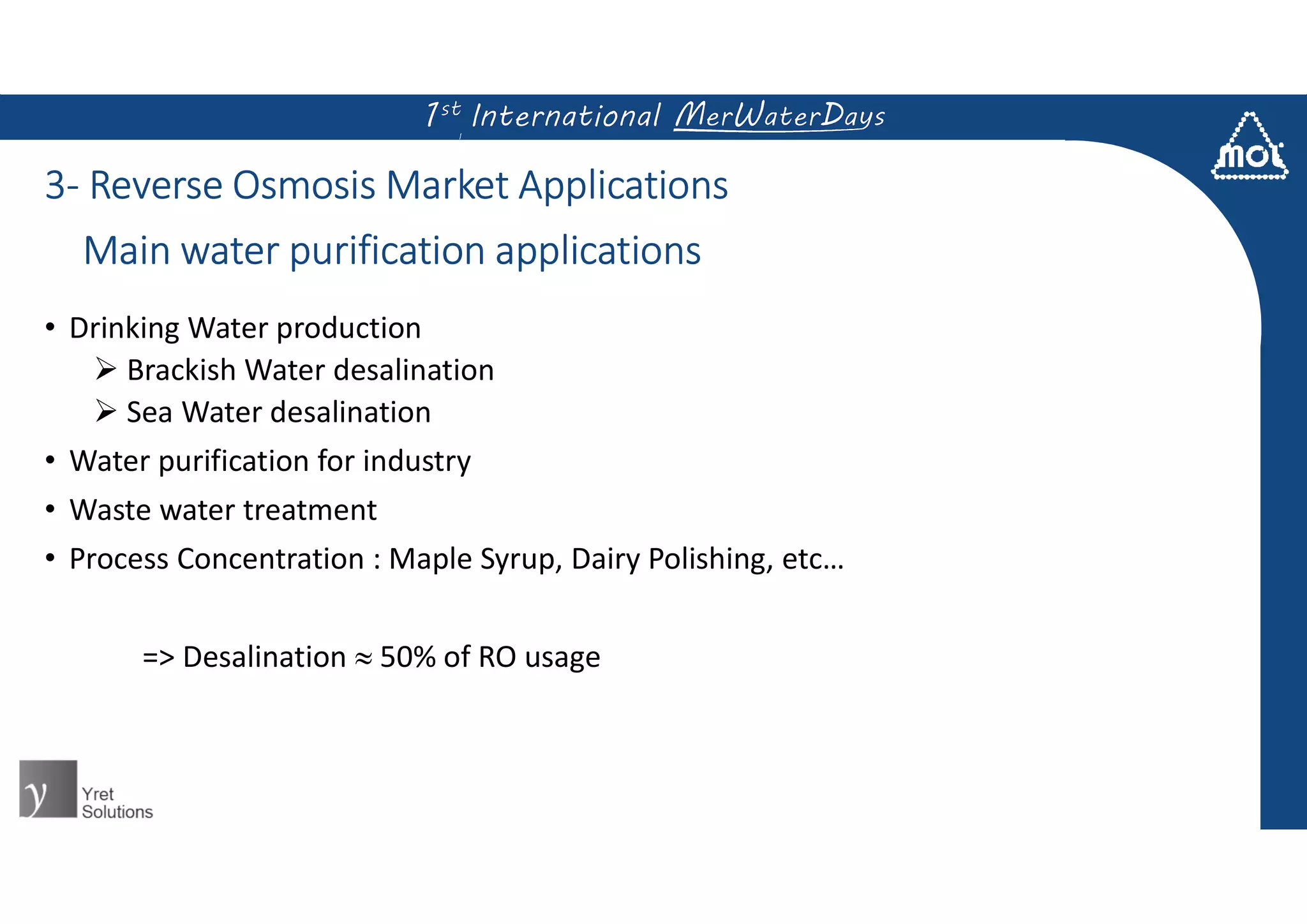
• Drinking Water production
 Brackish Water desalination
 Sea Water desalination
• Water purification for industry
• Waste water treatment
• Process Concentration : Maple Syrup, Dairy Polishing, etc…
=> Desalination  50% of RO usage
Main water purification applications
3- Reverse Osmosis Market Applications
• Salinity is 2000 mg/L – 10000 mg/L
• Pressures of 14 bar – 21 bar are used to achieve rejection coefficients greater
than 90% and to obtain water with saline concentrations of lower than 500 mg/L
• Values recommended by the WHO as a requirement for potable water production
• Costs for production 0.25 $US/L of treated water
Brackish Water Desalination
3- Reverse Osmosis Market Applications
• Salinity of this type of water is 30000 mg/L – 40000 mg/L.
• Working pressures of 50 bar – 70 bar.
• Operating costs of this type of treatment plant are estimated to be 1 – 1.25$US/ L
of treated water.
Sea Water Desalination
3- Reverse Osmosis Market Applications
• RO allows water of the quality demanded by the electronic industry and industry
to be obtained from drinking water (concentration of dissolved solids < 200
mg/L).
• The main problem with this type of installation is the bio-fouling of the
membranes
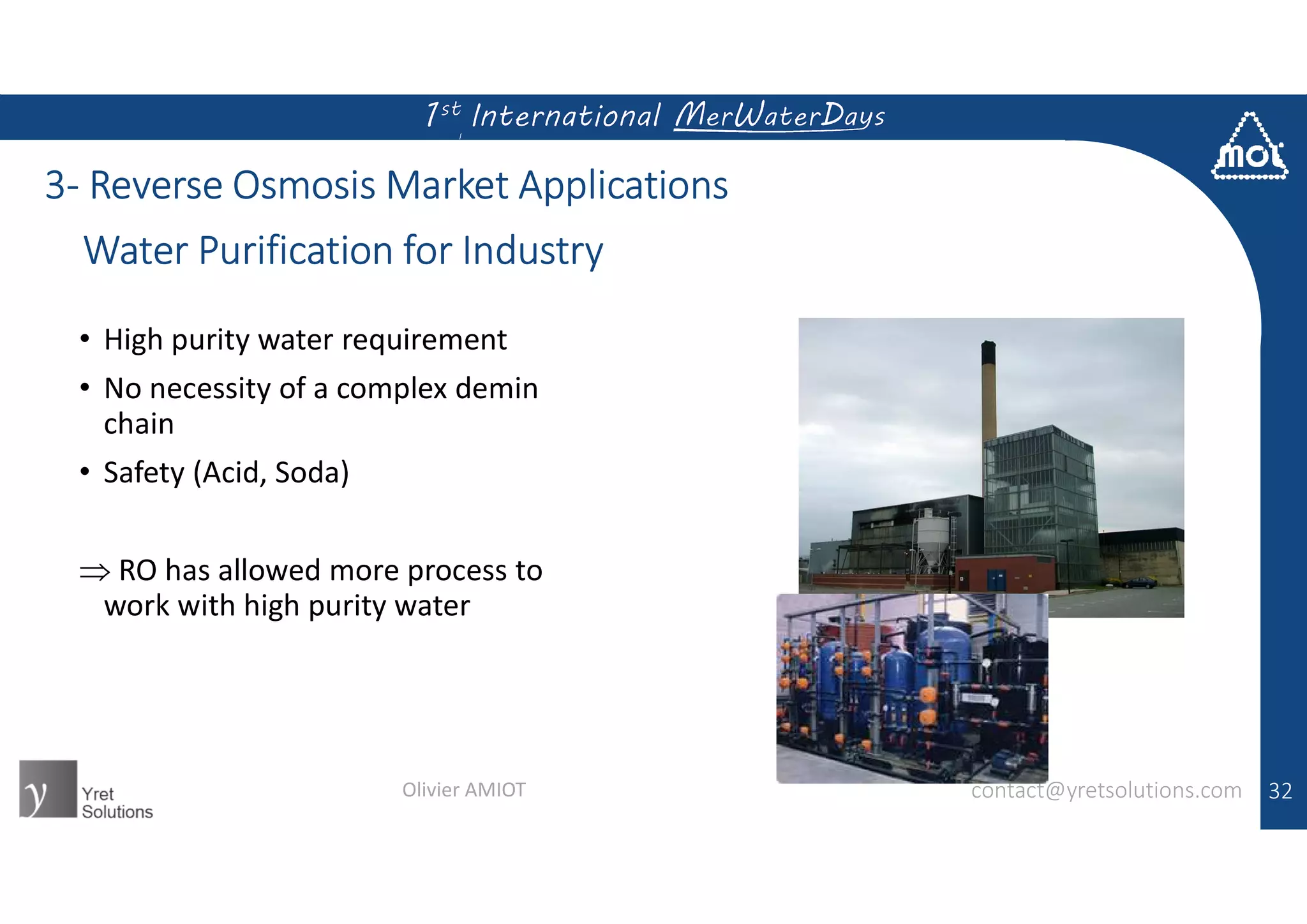
• Water for process and utilities.
Water Purification for Industry
32
3- Reverse Osmosis Market Applications
Water Purification for Industry
contact@yretsolutions.comOlivier AMIOT
• High purity water requirement
• No necessity of a complex demin
chain
• Safety (Acid, Soda)
 RO has allowed more process to
work with high purity water
Waste Water Treatment
• Wastewaters contain
organic contaminants, including pharmaceutical compounds,
pathogens,
disinfection by-products,
pesticides.
• Some are less affected by biological degradation by bacteria in
activated sludge process.
• High water solubility, they are dissolved in water and not being removed in
the sludge
• Phenol based molecules
• RO process for separation is a key step in the safe recovery of water
from wastewater source.
Process Concentration
• Maple Syrup Concentration
• Dairy Polishing
• RO instead of heating and evaporation
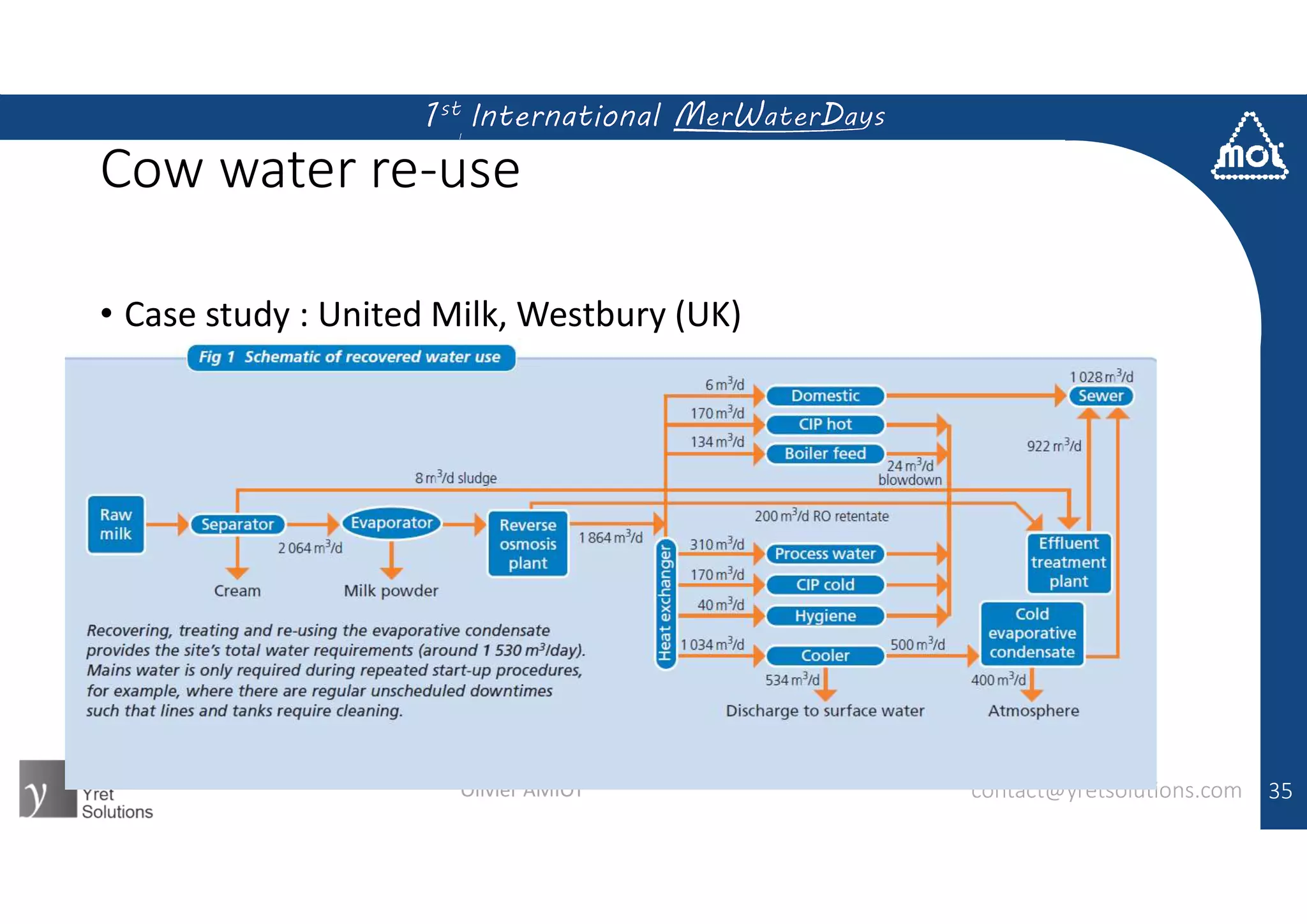
Cow water re-use
• Case study : United Milk, Westbury (UK)
contact@yretsolutions.comOlivier AMIOT 35
Cow water re-use
Environmental Benefits :
• Reduce Water inlet
• Reduce effluent discharge
• Improve heat recovery
Problem :
• In some countries : water sanitation requirement
contact@yretsolutions.comOlivier AMIOT 36
4- Evolution and Trends
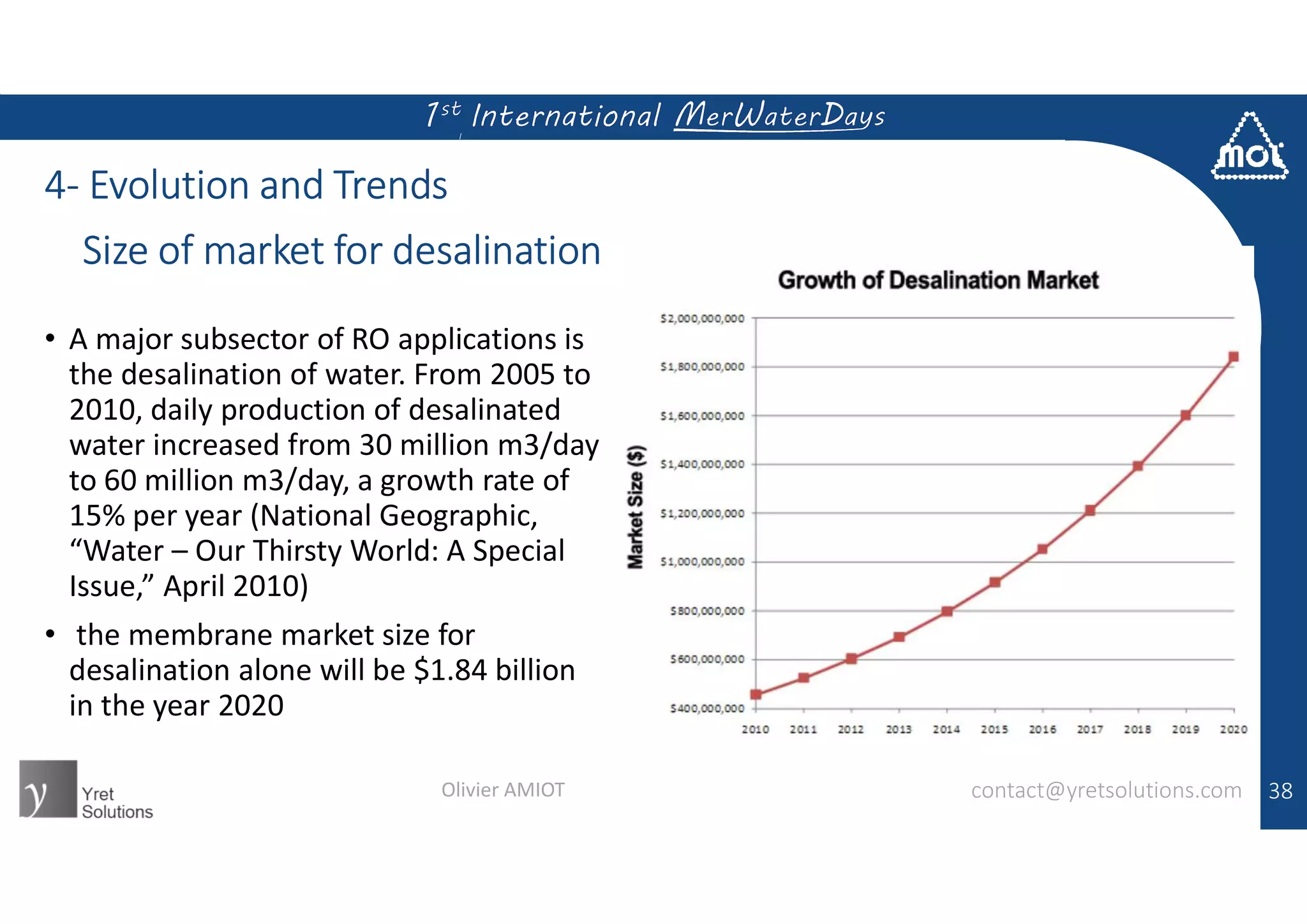
• A major subsector of RO applications is
the desalination of water. From 2005 to
2010, daily production of desalinated
water increased from 30 million m3/day
to 60 million m3/day, a growth rate of
15% per year (National Geographic,
“Water – Our Thirsty World: A Special
Issue,” April 2010)
• the membrane market size for
desalination alone will be $1.84 billion
in the year 2020
38
Size of market for desalination
contact@yretsolutions.comOlivier AMIOT
4- Evolution and Trends
• Progress in automation of module
manufacturing
• Gluing of membrane is more precise :
reduce amount of glue
• Technology of spacer
 “More membrane”
 Reduced thickness of collection channel
39
Membrane module evolutions
contact@yretsolutions.comOlivier AMIOT
4- Evolution and Trends
Increased exchange surface :
• 340 ft2 in the 90’s
• 365 ft2 in the 2000’s
• 400 and 440 ft2 in the 2010’s
Between 18% and 30% of surface availability for filtration
Two schools for RO :
• Classical filtration + 400 ft2 membrane, spacer 34 mil (864 µm)
• UF + 440 ft2 membrane, spacer 27 mil (686 µm)
40
Membrane module evolutions
contact@yretsolutions.comOlivier AMIOT
4- Evolution and Trends
• Better control of pressure inside vessel (less pressure drop across membranes)
• Better design and construction methods
 Carter/tubes can be built now for 8 modules instead of 6
41
Membrane module evolutions
contact@yretsolutions.comOlivier AMIOT
4- Evolution and Trends
Pressure for industrial, utilities applications
• Last 15 years :
• Pressure dropped from 15-18b
• Then to 10-12 b
• Less then 9b
• Claims for brackish in Low Pressure membrane : 5b.
42
Membrane module evolutions
contact@yretsolutions.comOlivier AMIOT
4- Evolution and Trends
1st objectives : on sea-waters
• Increase retention, but lower pressure
• Main problem : water needed inside the module, on concentrate side for salt
washing : need to work on recycling
UHP Membrane (100-150b)
• Interest for working on concentrate, and recycling of water
43
Membrane future evolutions
contact@yretsolutions.comOlivier AMIOT
5- Future Development
New application and new technology
45
New Application
contact@yretsolutions.comOlivier AMIOT
5- Future Development
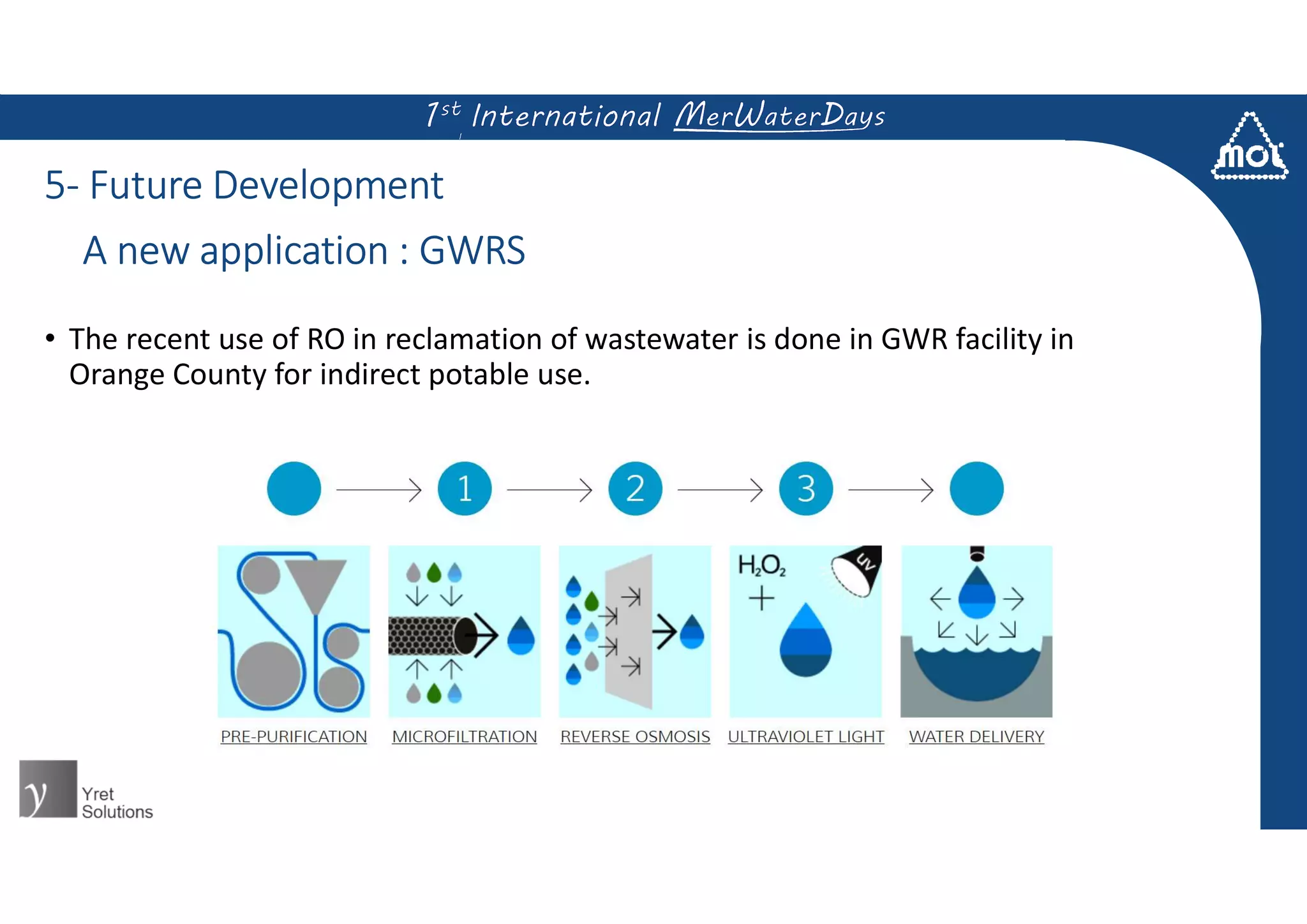
• The recent use of RO in reclamation of wastewater is done in GWR facility in
Orange County for indirect potable use.
A new application : GWRS
5- Future Development
Location : Orange County, California
The Orange County Water Basin was becoming salty due
to overpumping of fresh ground water and pacific sea
water penetration
Instead of rejecting waste water directly to Pacific, it is
treated and injected into ground to refill the water basins
47
Ground Water Replenishement System (GWRS)
contact@yretsolutions.comOlivier AMIOT
5- Future Development
Quality was achieved using reverse osmosis
Capacity of production : 492 000 m3/day
48
Ground Water Replenishement System (GWRS)
contact@yretsolutions.comOlivier AMIOT
5- Future Development
49contact@yretsolutions.comOlivier AMIOT
Drought :
Sea water
infiltration
Step 2 : RO
treated waste
water injection
Sea water
pushed back
50
New Technology
contact@yretsolutions.comOlivier AMIOT
5- Future Development
Publication source :
Carbon nanotube membranes for water purification: A bright future in
water desalination,
Rasel Das et al, Nanotechnology and Catalysis Research Center, University of
Malaya, NUS Centre for Nanofibers and Nanotechnology (NUSCNN) Singapore
Industrial development :
NanoH2O launched first industrial production of CNT
NanoH2O was acquired in april 2014 by LG Chem
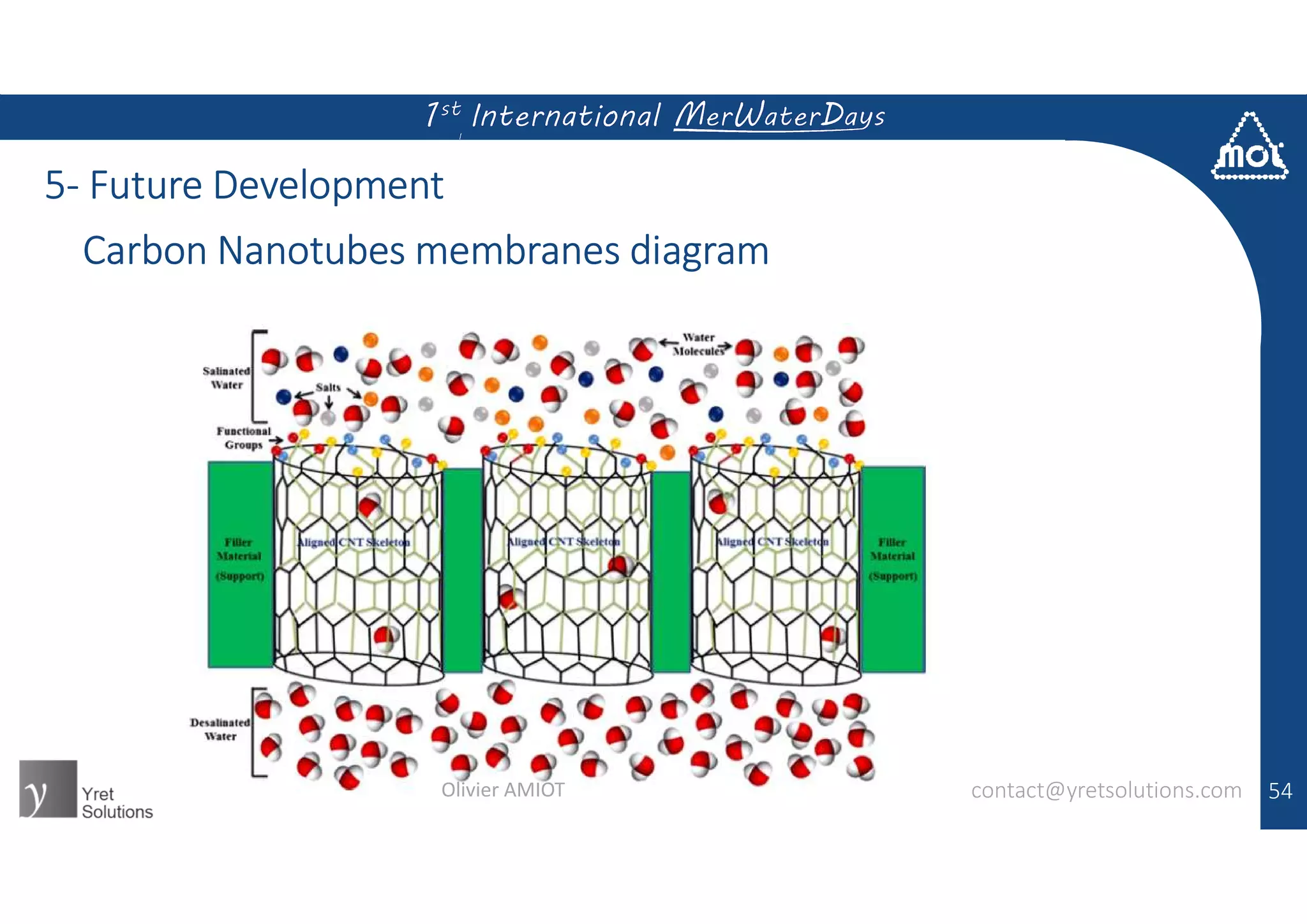
Carbon Nanotubes membranes
5- Future Development
• Why ?
• Desalination has a high cost due to high energy load
• High pressure pump : 50 to 70 bars
• Fouling and low resistance to biological fouling
• Low resistance to some aggressive chemical compounds
Carbon Nanotubes vs Polyamide
5- Future Development
Advantages :
• Non-polar tubes : strong invitation for polar water molecule crossing the channel
• Self-cleaning
• Anti-fouling
Benefits :
• Reduced Energy load
• Eased maintenance
Carbon Nanotubes membranes claims
5- Future Development
54
Carbon Nanotubes membranes diagram
contact@yretsolutions.comOlivier AMIOT
5- Future Development
• Sea water and brackish water desalination, no industrial applications claimed so
far
• Competition says : distribution of tube channel is uneven
55
Carbon Nanotubes limitations
contact@yretsolutions.comOlivier AMIOT
Promising technology but needs to be confirmed
A competitor of LG Chem is also launching CNT
THANK YOU

Olivier amiot reverse_osmosis

  • 1.
    Reverse Osmosis Where dowe stand today & where are we heading Present and Future
  • 2.
    Agenda Introducing myself 1. Osmosisand reverse osmosis, facts and history 2. Reverse Osmosis units : how it works 3. Markets 4. Technical Evolutions and Trends 5. Future development
  • 3.
    Olivier AMIOT • Chemistryand Chemical Eng, 20 years of prof.experience • Sales Manager and Service Equipment Manager with Nalco for 17 years, Business developer on new markets (Institutional, Glass-manufacturing, Dairies, District Utilities, Pulp & Paper Utilities, Middle market manufacturing)  Leader in launching new technologies with new customers’ approaches (Coil-Flo, Value- Added services, MetroModel, Legionella Pneumophilia) Recognized as a Sales-Leader and Water consultant in 2005 • I set up Yret Solutions for helping my customers from industries and institutional segments improve the performances and results of their water systems : Increase availability of their assets (Productivity, Manage Costs), Reduce their risks and environmental impact (S.H.& E), Increase performance in Hygiene, Safety and Productivity, Increase and Sustain life of equipment. contact@yretsolutions.comOlivier AMIOT 3
  • 4.
    1- Osmosis andReverse Osmosis
  • 5.
    1- Osmosis andReverse Osmosis • Discovered in 1748 by Jean-Antoine Nollet • In 1854, Thomas Graham invented the term of Osmosis, from the Greek word meaning push/pressure • Osmosis is one of the mechanism explaining the degradation of polyesters plastics (boats) Facts and History
  • 6.
    Osmosis : waterflow through a membrane contact@yretsolutions.comOlivier AMIOT 6
  • 7.
    Osmosis in nature: blood cells cytolisys contact@yretsolutions.comOlivier AMIOT 7 Dehydration : Sports Warm and dry weather Cytolysis : Low salinity outside
  • 8.
    • First researchstarted during the 40’s by request of the US Gov. • First application in 1959 for water desalination • First customer : NASA • Development for water desalination started during the 70’s 8 Reverse Osmosis Apply pressure on the strong solution : water will flow from strong solution to pure water contact@yretsolutions.comOlivier AMIOT
  • 9.
    2- Reverse OsmosisTechnical Facts
  • 10.
    Typical Filtration Process Solidsquickly foul the membrane Cross Flow Filtration process Solids are swept away by water flow 2- Reverse Osmosis Technology It is a mechanical filtration process
  • 11.
    2- Reverse OsmosisTechnology One Influent Two effluents : permeate and concentrate High velocity prevent fouling of the filtering media 11 Cross Flow Filtration contact@yretsolutions.comOlivier AMIOT
  • 12.
    2- Reverse OsmosisTechnology 3 major components always found in RO units : 1. Filtration unit : decrease suspended solids, risk of fouling 2. High pressure pump : activation of RO 3. Membranes 12 Major Components contact@yretsolutions.comOlivier AMIOT WASTE PRODUCT HP Pump Filtration Unit
  • 13.
    2- Reverse OsmosisTechnology 13contact@yretsolutions.comOlivier AMIOT
  • 14.
    2- Reverse OsmosisTechnology Two materials have been used for membranes : 1. Cellulose Acetate 2. Polyamide (thin film composite membrane) • Acetate Historically first, Cheap pH range between 4-8, Temp < 35°C, low resistance to bacterias • Polyamide Better resistance to hydrolysis, and bacterias, pH from 4-11, higher temperature 14 Membrane Technologies contact@yretsolutions.comOlivier AMIOT
  • 15.
    • Polyamide thinfilm membrane : 0.2µm • Microporous substrate layer : polysulfone, 40µm • Reinforcing base : polyester 100- 120µm • Pore size around 0.0001 µm 15 2- Reverse Osmosis Technology Polyamide membrane film composite typical thickness contact@yretsolutions.comOlivier AMIOT
  • 16.
    2- Reverse OsmosisTechnology 16 Typical membrane assembly spiral wound contact@yretsolutions.comOlivier AMIOT
  • 17.
    17 2- Reverse OsmosisTechnology Spiral wound flow patern contact@yretsolutions.comOlivier AMIOT
  • 18.
    2- Reverse OsmosisTechnology • Removes nonionic impurities and dissolved solids (i.e. organics, silica, bacteria) • Reduction of hazardous chemical storage and handling associated with ion exchange • Economic advantages increase with increasing feed TDS 18 Advantages of RO contact@yretsolutions.comOlivier AMIOT
  • 19.
    2- Reverse OsmosisTechnology • Salt Rejection : tells how effective the RO membranes are removing contaminants • The higher the salt rejection, the better the system is performing. A low salt rejection can mean that the membranes require cleaning or replacement. • Recovery : amount of water that is being 'recovered' as good permeate water • The higher the recovery % means less water to drain as concentrate and saving more permeate water. 19contact@yretsolutions.comOlivier AMIOT Performance of RO
  • 20.
    2- Reverse OsmosisTechnology • Concentrate is rejected and this can be a significant volume of water. • RO membranes reject a fixed percentage of feedwater ions Further treatment is required for many applications. • Ultimate filter which is easily fouled: Increased operating costs Reduced membrane life 20 Disadvantages of RO contact@yretsolutions.comOlivier AMIOT
  • 21.
    2- Reverse OsmosisTechnology 21 RO Membrane Problems contact@yretsolutions.comOlivier AMIOT Suspended solids fouling Precipitation Bio fouling Dissolve Colloids and solids, High FI Filtration unit Hardness, sulfates, high LI Sequestrant, softener Bacterial and living material contamination UF units, MOL- Lik, biocides (!!) Oxidizing compounds, aggressive chemicals Active carbon
  • 22.
    2- Reverse OsmosisTechnology 22 Scaling in the spacer contact@yretsolutions.comOlivier AMIOT
  • 23.
    2- Reverse OsmosisTechnology 23 Fouled membrane contact@yretsolutions.comOlivier AMIOT
  • 24.
    2- Reverse OsmosisTechnology 24 Over-pressure effects on membrane contact@yretsolutions.comOlivier AMIOT
  • 25.
    2- Reverse OsmosisTechnology • Act pro-actively  Filtration stage  Anti-scalant adapted technologies (either soft or sequestrant)  MOL Lik  Follow-up indicators (pressure, recovery, salt rejection, flowrates) : carefull about normalized values • Maintenance  Cleaning process adapted to type of fouling/membranes 25 Troubleshooting contact@yretsolutions.comOlivier AMIOT
  • 26.
    3- Reverse OsmosisMarket Applications
  • 27.
    INDUSTRIAL WATER PURIFICATION RURAL WELL WATER PURIFICATION MUNICIPAL WATER PURIFICATION MEDICALDEVICE MANUFACTURING SEA WATER DESALINATION WASTE WATER RECYCLING BRACKISH WELL WATER DESALINATION CAR-WASHES "SPOT-FREE RINSE" FOOD PRODUCTS And COSMETIC PRODUCTS MAIN APPLICATIONS for REVERSE OSMOSIS LABORATORY WATER PURIFICATION BOTTLED DRINKING WATER PRODUCTION PHARMACEUTICAL WATER PURIFICATION Reverse Osmosis Applications 9/29/2016 27
  • 28.
    3- Reverse OsmosisMarket Applications • Drinking Water production  Brackish Water desalination  Sea Water desalination • Water purification for industry • Waste water treatment • Process Concentration : Maple Syrup, Dairy Polishing, etc… => Desalination  50% of RO usage Main water purification applications
  • 29.
    3- Reverse OsmosisMarket Applications • Salinity is 2000 mg/L – 10000 mg/L • Pressures of 14 bar – 21 bar are used to achieve rejection coefficients greater than 90% and to obtain water with saline concentrations of lower than 500 mg/L • Values recommended by the WHO as a requirement for potable water production • Costs for production 0.25 $US/L of treated water Brackish Water Desalination
  • 30.
    3- Reverse OsmosisMarket Applications • Salinity of this type of water is 30000 mg/L – 40000 mg/L. • Working pressures of 50 bar – 70 bar. • Operating costs of this type of treatment plant are estimated to be 1 – 1.25$US/ L of treated water. Sea Water Desalination
  • 31.
    3- Reverse OsmosisMarket Applications • RO allows water of the quality demanded by the electronic industry and industry to be obtained from drinking water (concentration of dissolved solids < 200 mg/L). • The main problem with this type of installation is the bio-fouling of the membranes • Water for process and utilities. Water Purification for Industry
  • 32.
    32 3- Reverse OsmosisMarket Applications Water Purification for Industry contact@yretsolutions.comOlivier AMIOT • High purity water requirement • No necessity of a complex demin chain • Safety (Acid, Soda)  RO has allowed more process to work with high purity water
  • 33.
    Waste Water Treatment •Wastewaters contain organic contaminants, including pharmaceutical compounds, pathogens, disinfection by-products, pesticides. • Some are less affected by biological degradation by bacteria in activated sludge process. • High water solubility, they are dissolved in water and not being removed in the sludge • Phenol based molecules • RO process for separation is a key step in the safe recovery of water from wastewater source.
  • 34.
    Process Concentration • MapleSyrup Concentration • Dairy Polishing • RO instead of heating and evaporation
  • 35.
    Cow water re-use •Case study : United Milk, Westbury (UK) contact@yretsolutions.comOlivier AMIOT 35
  • 36.
    Cow water re-use EnvironmentalBenefits : • Reduce Water inlet • Reduce effluent discharge • Improve heat recovery Problem : • In some countries : water sanitation requirement contact@yretsolutions.comOlivier AMIOT 36
  • 37.
  • 38.
    4- Evolution andTrends • A major subsector of RO applications is the desalination of water. From 2005 to 2010, daily production of desalinated water increased from 30 million m3/day to 60 million m3/day, a growth rate of 15% per year (National Geographic, “Water – Our Thirsty World: A Special Issue,” April 2010) • the membrane market size for desalination alone will be $1.84 billion in the year 2020 38 Size of market for desalination contact@yretsolutions.comOlivier AMIOT
  • 39.
    4- Evolution andTrends • Progress in automation of module manufacturing • Gluing of membrane is more precise : reduce amount of glue • Technology of spacer  “More membrane”  Reduced thickness of collection channel 39 Membrane module evolutions contact@yretsolutions.comOlivier AMIOT
  • 40.
    4- Evolution andTrends Increased exchange surface : • 340 ft2 in the 90’s • 365 ft2 in the 2000’s • 400 and 440 ft2 in the 2010’s Between 18% and 30% of surface availability for filtration Two schools for RO : • Classical filtration + 400 ft2 membrane, spacer 34 mil (864 µm) • UF + 440 ft2 membrane, spacer 27 mil (686 µm) 40 Membrane module evolutions contact@yretsolutions.comOlivier AMIOT
  • 41.
    4- Evolution andTrends • Better control of pressure inside vessel (less pressure drop across membranes) • Better design and construction methods  Carter/tubes can be built now for 8 modules instead of 6 41 Membrane module evolutions contact@yretsolutions.comOlivier AMIOT
  • 42.
    4- Evolution andTrends Pressure for industrial, utilities applications • Last 15 years : • Pressure dropped from 15-18b • Then to 10-12 b • Less then 9b • Claims for brackish in Low Pressure membrane : 5b. 42 Membrane module evolutions contact@yretsolutions.comOlivier AMIOT
  • 43.
    4- Evolution andTrends 1st objectives : on sea-waters • Increase retention, but lower pressure • Main problem : water needed inside the module, on concentrate side for salt washing : need to work on recycling UHP Membrane (100-150b) • Interest for working on concentrate, and recycling of water 43 Membrane future evolutions contact@yretsolutions.comOlivier AMIOT
  • 44.
    5- Future Development Newapplication and new technology
  • 45.
  • 46.
    5- Future Development •The recent use of RO in reclamation of wastewater is done in GWR facility in Orange County for indirect potable use. A new application : GWRS
  • 47.
    5- Future Development Location: Orange County, California The Orange County Water Basin was becoming salty due to overpumping of fresh ground water and pacific sea water penetration Instead of rejecting waste water directly to Pacific, it is treated and injected into ground to refill the water basins 47 Ground Water Replenishement System (GWRS) contact@yretsolutions.comOlivier AMIOT
  • 48.
    5- Future Development Qualitywas achieved using reverse osmosis Capacity of production : 492 000 m3/day 48 Ground Water Replenishement System (GWRS) contact@yretsolutions.comOlivier AMIOT
  • 49.
    5- Future Development 49contact@yretsolutions.comOlivierAMIOT Drought : Sea water infiltration Step 2 : RO treated waste water injection Sea water pushed back
  • 50.
  • 51.
    5- Future Development Publicationsource : Carbon nanotube membranes for water purification: A bright future in water desalination, Rasel Das et al, Nanotechnology and Catalysis Research Center, University of Malaya, NUS Centre for Nanofibers and Nanotechnology (NUSCNN) Singapore Industrial development : NanoH2O launched first industrial production of CNT NanoH2O was acquired in april 2014 by LG Chem Carbon Nanotubes membranes
  • 52.
    5- Future Development •Why ? • Desalination has a high cost due to high energy load • High pressure pump : 50 to 70 bars • Fouling and low resistance to biological fouling • Low resistance to some aggressive chemical compounds Carbon Nanotubes vs Polyamide
  • 53.
    5- Future Development Advantages: • Non-polar tubes : strong invitation for polar water molecule crossing the channel • Self-cleaning • Anti-fouling Benefits : • Reduced Energy load • Eased maintenance Carbon Nanotubes membranes claims
  • 54.
    5- Future Development 54 CarbonNanotubes membranes diagram contact@yretsolutions.comOlivier AMIOT
  • 55.
    5- Future Development •Sea water and brackish water desalination, no industrial applications claimed so far • Competition says : distribution of tube channel is uneven 55 Carbon Nanotubes limitations contact@yretsolutions.comOlivier AMIOT Promising technology but needs to be confirmed A competitor of LG Chem is also launching CNT
  • 56.