Group Members
Chia Ding Shan A0098525U
Dhanasekar Rajagopal A0103317W
Du Yao A0040527N
Feng Houyuan A0098526R
Han Jiong A0082244L
Vishwak Vajendar A0102831W
Wu Runqi A0040053B
Zhang Zhengchang A0104438L
For information on other new technologies that are becoming economically feasible,
see http://www.slideshare.net/Funk98/presentations
• Introduction to Carbon Nanotubes
• Growth Drivers
 Development of Synthesis methods
 Advancement in CNTs materials
 Increasing Market demands
• Entrepreneurial opportunities
 Synthetic Skin
 Self Healing
• Q & A
• Introduction to Carbon Nanotubes
• Growth Drivers
 Development of Synthesis methods
 Advancement in CNTs materials
 Increasing Market demands
• Entrepreneurial opportunities
 Stretchable Artificial Skin
 Self Healing
• Q&A
What is Carbon Nanotubes (CNTs)
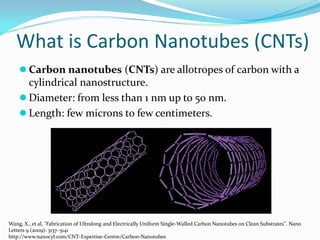
 Carbon nanotubes (CNTs) are allotropes of carbon with a
cylindrical nanostructure.
 Diameter: from less than 1 nm up to 50 nm.
 Length: few microns to few centimeters.
Wang, X., et al, "Fabrication of Ultralong and Electrically Uniform Single-Walled Carbon Nanotubes on Clean Substrates". Nano
Letters 9 (2009): 3137–3141
http://www.nanocyl.com/CNT-Expertise-Centre/Carbon-Nanotubes
Types of CNTs
 SWNT
 Wrapping of a 2-D graphene sheet into a seamless
cylinder.
 Characterized by how it is wrapped, and varies in
properties, e.g. metallic vs. semiconducting
 MWNT
 Multiple rolled layers of graphene.
 Russian Doll model: multiple concentric cylinders
 Parchment model: single sheet rolled in around
itself
http://www.nanocyl.com/CNT-Expertise-Centre/Carbon-Nanotubes
Mechanical Properties of CNTs
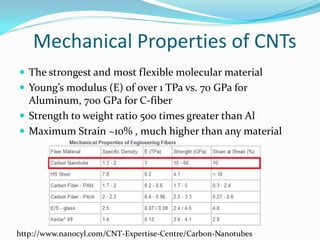
 The strongest and most flexible molecular material
 Young’s modulus (E) of over 1 TPa vs. 70 GPa for
Aluminum, 700 GPa for C-fiber
 Strength to weight ratio 500 times greater than Al
 Maximum Strain ~10% , much higher than any material
http://www.nanocyl.com/CNT-Expertise-Centre/Carbon-Nanotubes
Conductivity Properties of CNTs
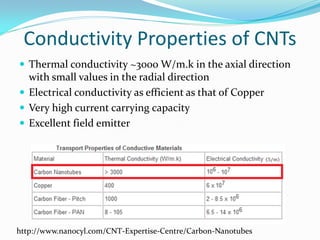
 Thermal conductivity ~3000 W/m.k in the axial direction
with small values in the radial direction
 Electrical conductivity as efficient as that of Copper
 Very high current carrying capacity
 Excellent field emitter
http://www.nanocyl.com/CNT-Expertise-Centre/Carbon-Nanotubes
• Introduction to Carbon Nanotubes
• Growth Drivers
 Development of Synthesis methods
 Advancement in CNTs materials
 Increasing Market demands
• Entrepreneurial opportunities
 Synthetic Skin
 Self Healing
• Q & A
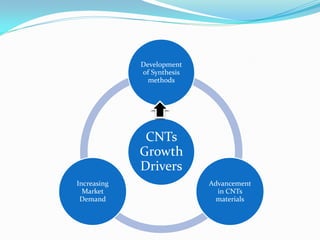
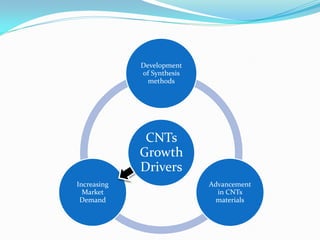
CNTs
Growth
Drivers
Development
of Synthesis
methods
Advancement
in CNTs
materials
Increasing
Market
Demand
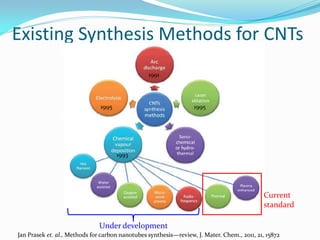
Existing Synthesis Methods for CNTs
1991
1995
1993
Under development
Current
standard
1995
Jan Prasek et. al., Methods for carbon nanotubes synthesis—review, J. Mater. Chem., 2011, 21, 15872
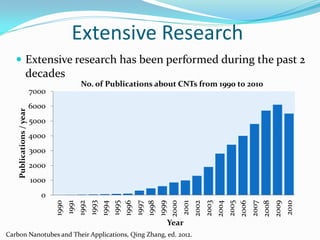
Extensive Research
 Extensive research has been performed during the past 2
decades
Carbon Nanotubes and Their Applications, Qing Zhang, ed. 2012.
0
1000
2000
3000
4000
5000
6000
7000
1990
1991
1992
1993
1994
1995
1996
1997
1998
1999
2000
2001
2002
2003
2004
2005
2006
2007
2008
2009
2010
Publications/year
Year
No. of Publications about CNTs from 1990 t0 2010
$1
$10
$100
$1,000
$10,000
Price(USD/gram)
Year
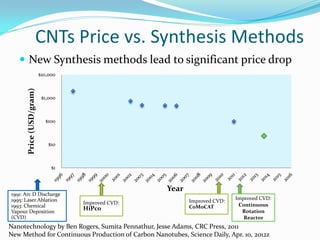
Nanotechnology by Ben Rogers, Sumita Pennathur, Jesse Adams, CRC Press, 2011
New Method for Continuous Production of Carbon Nanotubes, Science Daily, Apr. 10, 2012z
Improved CVD:
HiPco
1991: Arc D Discharge
1995: Laser Ablation
1993: Chemical
Vapour Deposition
(CVD)
CNTs Price vs. Synthesis Methods
 New Synthesis methods lead to significant price drop
Improved CVD:
Continuous
Rotation
Reactor
Improved CVD:
CoMoCAT
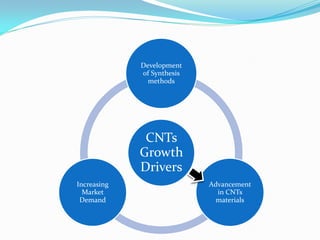
CNTs
Growth
Drivers
Development
of Synthesis
methods
Advancement
in CNTs
materials
Increasing
Market
Demand
Improvements in CNTs and its Impact
Improvement Property Performance
improved
Potential
Application
Carbon Nanobud Field Emission
Characteristics
3X reduced Field
threshold
Electronics – FET
Graphenated
Carbon nanotubes
Energy Storage 7.3X increase in
Capacitance/unit
area
Supercapacitor
Doped Carbon
nanotubes
Energy Storage Triple capacity in
batteries
Batteries
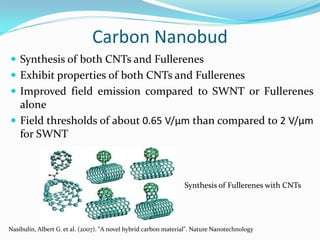
Carbon Nanobud
 Synthesis of both CNTs and Fullerenes
 Exhibit properties of both CNTs and Fullerenes
 Improved field emission compared to SWNT or Fullerenes
alone
 Field thresholds of about 0.65 V/μm than compared to 2 V/μm
for SWNT
Synthesis of Fullerenes with CNTs
Nasibulin, Albert G. et al. (2007). "A novel hybrid carbon material". Nature Nanotechnology
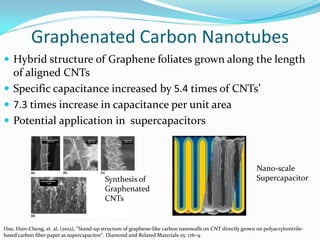
Graphenated Carbon Nanotubes
 Hybrid structure of Graphene foliates grown along the length
of aligned CNTs
 Specific capacitance increased by 5.4 times of CNTs’
 7.3 times increase in capacitance per unit area
 Potential application in supercapacitors
Hsu, Hsin-Cheng, et. al, (2012), "Stand-up structure of graphene-like carbon nanowalls on CNT directly grown on polyacrylonitrile-
based carbon fiber paper as supercapacitor". Diamond and Related Materials 25: 176–9
Synthesis of
Graphenated
CNTs
Nano-scale
Supercapacitor
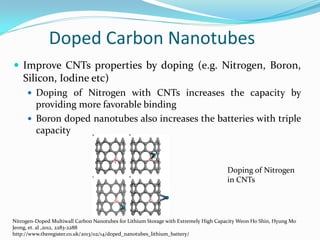
Doped Carbon Nanotubes
 Improve CNTs properties by doping (e.g. Nitrogen, Boron,
Silicon, Iodine etc)
 Doping of Nitrogen with CNTs increases the capacity by
providing more favorable binding
 Boron doped nanotubes also increases the batteries with triple
capacity
Doping of Nitrogen
in CNTs
Nitrogen-Doped Multiwall Carbon Nanotubes for Lithium Storage with Extremely High Capacity Weon Ho Shin, Hyung Mo
Jeong, et. al ,2012, 2283-2288
http://www.theregister.co.uk/2013/02/14/doped_nanotubes_lithium_battery/
CNTs
Growth
Drivers
Development
of Synthesis
methods
Advancement
in CNTs
materials
Increasing
Market
Demand
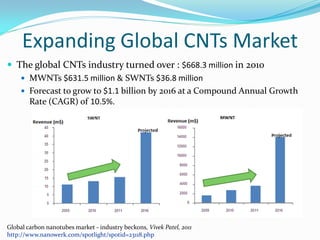
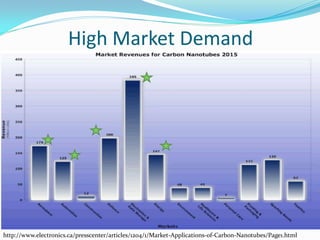
Expanding Global CNTs Market
 The global CNTs industry turned over : $668.3 million in 2010
 MWNTs $631.5 million & SWNTs $36.8 million
 Forecast to grow to $1.1 billion by 2016 at a Compound Annual Growth
Rate (CAGR) of 10.5%.
Global carbon nanotubes market - industry beckons, Vivek Patel, 2011
http://www.nanowerk.com/spotlight/spotid=23118.php
High Market Demand
http://www.electronics.ca/presscenter/articles/1204/1/Market-Applications-of-Carbon-Nanotubes/Page1.html
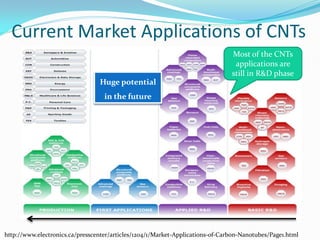
Current Market Applications of CNTs
Most of the CNTs
applications are
still in R&D phase
http://www.electronics.ca/presscenter/articles/1204/1/Market-Applications-of-Carbon-Nanotubes/Page1.html
Huge potential
in the future
Kiloton/year
$1
$10
$100
$1,000
Price(USD/gram)
Year
15
12
9
6
3
0
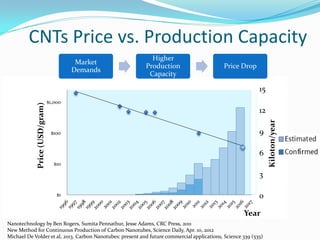
CNTs Price vs. Production Capacity
Market
Demands
Higher
Production
Capacity
Price Drop
Nanotechnology by Ben Rogers, Sumita Pennathur, Jesse Adams, CRC Press, 2011
New Method for Continuous Production of Carbon Nanotubes, Science Daily, Apr. 10, 2012
Michael De Volder et al, 2013. Carbon Nanotubes: present and future commercial applications, Science 339 (535)
 Most of the CNTs
applications are in
Research phase and need
market application
 Improving production
process
 Increase production
efficiency
 Lower cost for more
commercialized
applications
Challenges Ahead
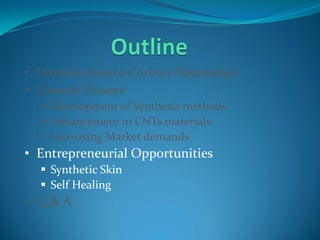
• Introduction to Carbon Nanotubes
• Growth Drivers
 Development of Synthesis methods
 Advancement in CNTs materials
 Increasing Market demands
• Entrepreneurial Opportunities
 Synthetic Skin
 Self Healing
• Q & A
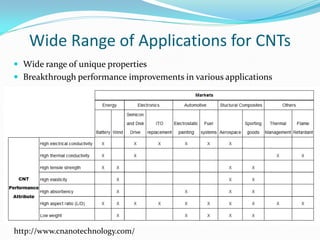
Wide Range of Applications for CNTs
http://www.cnanotechnology.com/
 Wide range of unique properties
 Breakthrough performance improvements in various applications
CNTs-based Synthetic Skin
(Introduction Video)
Source: http://www.youtube.com/watch?v=NJHZylgWeJw
Click to Play video
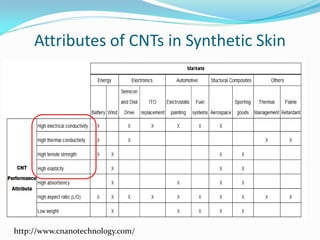
Attributes of CNTs in Synthetic Skin
http://www.cnanotechnology.com/
PROPERTIES OF HUMAN SKIN PROPERTIES OF CNTs SYNTHETIC
SKIN
Strength and Elasticity Mechanically resistant but elastic at the
same time1
Sensitivity Thermally and Electrically conductive1,2
Self Healing Self – Healing process of CNTs induced
by electronic excitations2
Biological structure Carbon-based (Biocompatibility)3
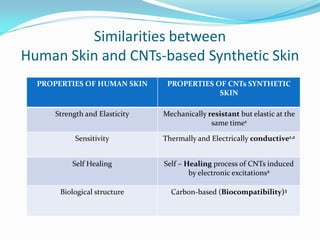
Similarities between
Human Skin and CNTs-based Synthetic Skin
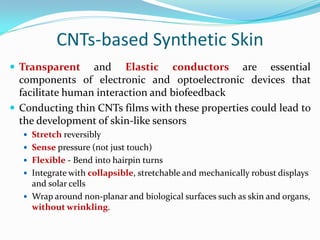
 Transparent and Elastic conductors are essential
components of electronic and optoelectronic devices that
facilitate human interaction and biofeedback
 Conducting thin CNTs films with these properties could lead to
the development of skin-like sensors
 Stretch reversibly
 Sense pressure (not just touch)
 Flexible - Bend into hairpin turns
 Integrate with collapsible, stretchable and mechanically robust displays
and solar cells
 Wrap around non-planar and biological surfaces such as skin and organs,
without wrinkling.
CNTs-based Synthetic Skin
Strain and Electrical conductivity
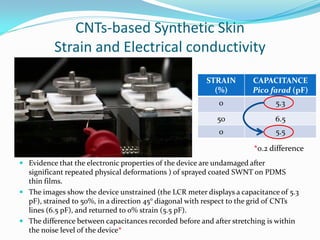
 Evidence that the electronic properties of the device are undamaged after
significant repeated physical deformations ) of sprayed coated SWNT on PDMS
thin films.
 The images show the device unstrained (the LCR meter displays a capacitance of 5.3
pF), strained to 50%, in a direction 45° diagonal with respect to the grid of CNTs
lines (6.5 pF), and returned to 0% strain (5.5 pF).
 The difference between capacitances recorded before and after stretching is within
the noise level of the device*
STRAIN
(%)
CAPACITANCE
Pico farad (pF)
0 5.3
50 6.5
0 5.5
*0.2 difference
CNTs-based Synthetic Skin
Strain and Electrical Resistivity (Sensitivity)
Graph A : Changes in Resistance versus time in
response to 4 cycles of stretching
Graph B: Resistance versus number of stretches
over 12,500 cycles of stretching to 25%
A
B
Attributes of CNTs in Synthetic Skin
http://www.cnanotechnology.com/
Self
Healing
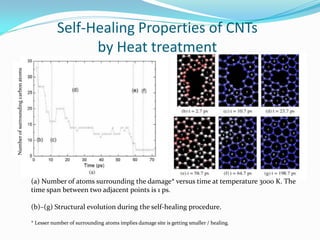
Numberofsurroundingcarbonatoms
(a) Number of atoms surrounding the damage* versus time at temperature 3000 K. The
time span between two adjacent points is 1 ps.
(b)–(g) Structural evolution during the self-healing procedure.
* Lesser number of surrounding atoms implies damage site is getting smaller / healing.
Self-Healing Properties of CNTs
by Heat treatment
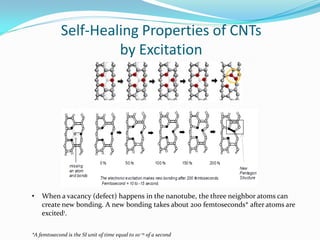
• When a vacancy (defect) happens in the nanotube, the three neighbor atoms can
create new bonding. A new bonding takes about 200 femtoseconds* after atoms are
excited1.
*A femtosecond is the SI unit of time equal to 10−15 of a second
Self-Healing Properties of CNTs
by Excitation
Challenges Ahead
 Improving mechanical properties
 Better durability
 Improving biocompatibility / biostability
 Safe – Human Trials
 Electrical stimulations to relay to human nervous system.
 Improving self healing methods
 Faster healing methods
 “Natural” healing methods
 Room temperature healing
 Healing in the absence of light or electric excitations
 Healing in the absence of catalysts
Carbon nanotubes and their economic feasibility

Carbon nanotubes and their economic feasibility

  • 1.
    Group Members Chia DingShan A0098525U Dhanasekar Rajagopal A0103317W Du Yao A0040527N Feng Houyuan A0098526R Han Jiong A0082244L Vishwak Vajendar A0102831W Wu Runqi A0040053B Zhang Zhengchang A0104438L For information on other new technologies that are becoming economically feasible, see http://www.slideshare.net/Funk98/presentations
  • 2.
    • Introduction toCarbon Nanotubes • Growth Drivers  Development of Synthesis methods  Advancement in CNTs materials  Increasing Market demands • Entrepreneurial opportunities  Synthetic Skin  Self Healing • Q & A
  • 3.
    • Introduction toCarbon Nanotubes • Growth Drivers  Development of Synthesis methods  Advancement in CNTs materials  Increasing Market demands • Entrepreneurial opportunities  Stretchable Artificial Skin  Self Healing • Q&A
  • 4.
    What is CarbonNanotubes (CNTs)  Carbon nanotubes (CNTs) are allotropes of carbon with a cylindrical nanostructure.  Diameter: from less than 1 nm up to 50 nm.  Length: few microns to few centimeters. Wang, X., et al, "Fabrication of Ultralong and Electrically Uniform Single-Walled Carbon Nanotubes on Clean Substrates". Nano Letters 9 (2009): 3137–3141 http://www.nanocyl.com/CNT-Expertise-Centre/Carbon-Nanotubes
  • 5.
    Types of CNTs SWNT  Wrapping of a 2-D graphene sheet into a seamless cylinder.  Characterized by how it is wrapped, and varies in properties, e.g. metallic vs. semiconducting  MWNT  Multiple rolled layers of graphene.  Russian Doll model: multiple concentric cylinders  Parchment model: single sheet rolled in around itself http://www.nanocyl.com/CNT-Expertise-Centre/Carbon-Nanotubes
  • 6.
    Mechanical Properties ofCNTs  The strongest and most flexible molecular material  Young’s modulus (E) of over 1 TPa vs. 70 GPa for Aluminum, 700 GPa for C-fiber  Strength to weight ratio 500 times greater than Al  Maximum Strain ~10% , much higher than any material http://www.nanocyl.com/CNT-Expertise-Centre/Carbon-Nanotubes
  • 7.
    Conductivity Properties ofCNTs  Thermal conductivity ~3000 W/m.k in the axial direction with small values in the radial direction  Electrical conductivity as efficient as that of Copper  Very high current carrying capacity  Excellent field emitter http://www.nanocyl.com/CNT-Expertise-Centre/Carbon-Nanotubes
  • 8.
    • Introduction toCarbon Nanotubes • Growth Drivers  Development of Synthesis methods  Advancement in CNTs materials  Increasing Market demands • Entrepreneurial opportunities  Synthetic Skin  Self Healing • Q & A
  • 9.
  • 10.
    Existing Synthesis Methodsfor CNTs 1991 1995 1993 Under development Current standard 1995 Jan Prasek et. al., Methods for carbon nanotubes synthesis—review, J. Mater. Chem., 2011, 21, 15872
  • 11.
    Extensive Research  Extensiveresearch has been performed during the past 2 decades Carbon Nanotubes and Their Applications, Qing Zhang, ed. 2012. 0 1000 2000 3000 4000 5000 6000 7000 1990 1991 1992 1993 1994 1995 1996 1997 1998 1999 2000 2001 2002 2003 2004 2005 2006 2007 2008 2009 2010 Publications/year Year No. of Publications about CNTs from 1990 t0 2010
  • 12.
    $1 $10 $100 $1,000 $10,000 Price(USD/gram) Year Nanotechnology by BenRogers, Sumita Pennathur, Jesse Adams, CRC Press, 2011 New Method for Continuous Production of Carbon Nanotubes, Science Daily, Apr. 10, 2012z Improved CVD: HiPco 1991: Arc D Discharge 1995: Laser Ablation 1993: Chemical Vapour Deposition (CVD) CNTs Price vs. Synthesis Methods  New Synthesis methods lead to significant price drop Improved CVD: Continuous Rotation Reactor Improved CVD: CoMoCAT
  • 13.
  • 14.
    Improvements in CNTsand its Impact Improvement Property Performance improved Potential Application Carbon Nanobud Field Emission Characteristics 3X reduced Field threshold Electronics – FET Graphenated Carbon nanotubes Energy Storage 7.3X increase in Capacitance/unit area Supercapacitor Doped Carbon nanotubes Energy Storage Triple capacity in batteries Batteries
  • 15.
    Carbon Nanobud  Synthesisof both CNTs and Fullerenes  Exhibit properties of both CNTs and Fullerenes  Improved field emission compared to SWNT or Fullerenes alone  Field thresholds of about 0.65 V/μm than compared to 2 V/μm for SWNT Synthesis of Fullerenes with CNTs Nasibulin, Albert G. et al. (2007). "A novel hybrid carbon material". Nature Nanotechnology
  • 16.
    Graphenated Carbon Nanotubes Hybrid structure of Graphene foliates grown along the length of aligned CNTs  Specific capacitance increased by 5.4 times of CNTs’  7.3 times increase in capacitance per unit area  Potential application in supercapacitors Hsu, Hsin-Cheng, et. al, (2012), "Stand-up structure of graphene-like carbon nanowalls on CNT directly grown on polyacrylonitrile- based carbon fiber paper as supercapacitor". Diamond and Related Materials 25: 176–9 Synthesis of Graphenated CNTs Nano-scale Supercapacitor
  • 17.
    Doped Carbon Nanotubes Improve CNTs properties by doping (e.g. Nitrogen, Boron, Silicon, Iodine etc)  Doping of Nitrogen with CNTs increases the capacity by providing more favorable binding  Boron doped nanotubes also increases the batteries with triple capacity Doping of Nitrogen in CNTs Nitrogen-Doped Multiwall Carbon Nanotubes for Lithium Storage with Extremely High Capacity Weon Ho Shin, Hyung Mo Jeong, et. al ,2012, 2283-2288 http://www.theregister.co.uk/2013/02/14/doped_nanotubes_lithium_battery/
  • 18.
  • 19.
    Expanding Global CNTsMarket  The global CNTs industry turned over : $668.3 million in 2010  MWNTs $631.5 million & SWNTs $36.8 million  Forecast to grow to $1.1 billion by 2016 at a Compound Annual Growth Rate (CAGR) of 10.5%. Global carbon nanotubes market - industry beckons, Vivek Patel, 2011 http://www.nanowerk.com/spotlight/spotid=23118.php
  • 20.
  • 21.
    Current Market Applicationsof CNTs Most of the CNTs applications are still in R&D phase http://www.electronics.ca/presscenter/articles/1204/1/Market-Applications-of-Carbon-Nanotubes/Page1.html Huge potential in the future
  • 22.
    Kiloton/year $1 $10 $100 $1,000 Price(USD/gram) Year 15 12 9 6 3 0 CNTs Price vs.Production Capacity Market Demands Higher Production Capacity Price Drop Nanotechnology by Ben Rogers, Sumita Pennathur, Jesse Adams, CRC Press, 2011 New Method for Continuous Production of Carbon Nanotubes, Science Daily, Apr. 10, 2012 Michael De Volder et al, 2013. Carbon Nanotubes: present and future commercial applications, Science 339 (535)
  • 23.
     Most ofthe CNTs applications are in Research phase and need market application  Improving production process  Increase production efficiency  Lower cost for more commercialized applications Challenges Ahead
  • 24.
    • Introduction toCarbon Nanotubes • Growth Drivers  Development of Synthesis methods  Advancement in CNTs materials  Increasing Market demands • Entrepreneurial Opportunities  Synthetic Skin  Self Healing • Q & A
  • 25.
    Wide Range ofApplications for CNTs http://www.cnanotechnology.com/  Wide range of unique properties  Breakthrough performance improvements in various applications
  • 26.
    CNTs-based Synthetic Skin (IntroductionVideo) Source: http://www.youtube.com/watch?v=NJHZylgWeJw Click to Play video
  • 27.
    Attributes of CNTsin Synthetic Skin http://www.cnanotechnology.com/
  • 28.
    PROPERTIES OF HUMANSKIN PROPERTIES OF CNTs SYNTHETIC SKIN Strength and Elasticity Mechanically resistant but elastic at the same time1 Sensitivity Thermally and Electrically conductive1,2 Self Healing Self – Healing process of CNTs induced by electronic excitations2 Biological structure Carbon-based (Biocompatibility)3 Similarities between Human Skin and CNTs-based Synthetic Skin
  • 29.
     Transparent andElastic conductors are essential components of electronic and optoelectronic devices that facilitate human interaction and biofeedback  Conducting thin CNTs films with these properties could lead to the development of skin-like sensors  Stretch reversibly  Sense pressure (not just touch)  Flexible - Bend into hairpin turns  Integrate with collapsible, stretchable and mechanically robust displays and solar cells  Wrap around non-planar and biological surfaces such as skin and organs, without wrinkling. CNTs-based Synthetic Skin
  • 30.
    CNTs-based Synthetic Skin Strainand Electrical conductivity  Evidence that the electronic properties of the device are undamaged after significant repeated physical deformations ) of sprayed coated SWNT on PDMS thin films.  The images show the device unstrained (the LCR meter displays a capacitance of 5.3 pF), strained to 50%, in a direction 45° diagonal with respect to the grid of CNTs lines (6.5 pF), and returned to 0% strain (5.5 pF).  The difference between capacitances recorded before and after stretching is within the noise level of the device* STRAIN (%) CAPACITANCE Pico farad (pF) 0 5.3 50 6.5 0 5.5 *0.2 difference
  • 31.
    CNTs-based Synthetic Skin Strainand Electrical Resistivity (Sensitivity) Graph A : Changes in Resistance versus time in response to 4 cycles of stretching Graph B: Resistance versus number of stretches over 12,500 cycles of stretching to 25% A B
  • 32.
    Attributes of CNTsin Synthetic Skin http://www.cnanotechnology.com/ Self Healing
  • 33.
    Numberofsurroundingcarbonatoms (a) Number ofatoms surrounding the damage* versus time at temperature 3000 K. The time span between two adjacent points is 1 ps. (b)–(g) Structural evolution during the self-healing procedure. * Lesser number of surrounding atoms implies damage site is getting smaller / healing. Self-Healing Properties of CNTs by Heat treatment
  • 34.
    • When avacancy (defect) happens in the nanotube, the three neighbor atoms can create new bonding. A new bonding takes about 200 femtoseconds* after atoms are excited1. *A femtosecond is the SI unit of time equal to 10−15 of a second Self-Healing Properties of CNTs by Excitation
  • 35.
    Challenges Ahead  Improvingmechanical properties  Better durability  Improving biocompatibility / biostability  Safe – Human Trials  Electrical stimulations to relay to human nervous system.  Improving self healing methods  Faster healing methods  “Natural” healing methods  Room temperature healing  Healing in the absence of light or electric excitations  Healing in the absence of catalysts