CARBON NANOTUBE
Presented by :
Ahmad Abdallh
Date : 27/4/2016
Table of content
1. Introduction ( Advanced Materials ) .
2. Nano Technology ( What Is Nano Technology ? ) .
3. Carbon Nanotube ( What Is Carbon Nanotube ? ) .
4. Types Of Carbon Nanotube .
5. Structure Of Carbon Nanotube .
6. Processing Of Carbon Nanotube .
1. Introduction ( Advanced Materials )
• Materials that are utilized in high-technology (or high-tech) applications are
sometimes termed advanced materials.
• By high technology we mean a device or product that operates or functions
using relatively intricate and complicated principles .
• These advanced materials are typically traditional materials whose properties
have been enhanced, and also newly developed, high-performance materials.
• Classification of modern material ( Advances material ) :
I. Semiconductors .
II. Biomaterials .
III. Smart Materials .
IV. Nanomaterial's .
2. Nano technology
What is Nano technology ?
• Nanotechnology ("nanotech") is manipulation of matter on an atomic,
molecular, and supramolecular scale. The earliest, widespread description
of nanotechnology ( 2 ) .
• However, unlike these other materials, they are not distinguished on the
basis of their chemistry, but rather, size; the nano-prefix denotes that the
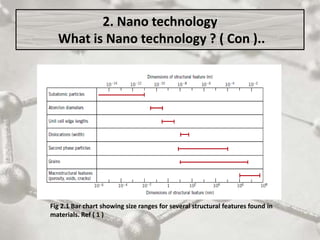
dimensions of these structural entities are on the order of a nanometer
(10−9
m)—as a rule, less than 100 nanometers (10−7
) (equivalent to
approximately 500 atom diameters) ( 1 ) .
• This ability to carefully arrange atoms provides opportunities to develop
mechanical, electrical, magnetic, and other properties ( 1 ) .
2. Nano technology
What is Nano technology ? ( Con )..
Fig 2.1 Bar chart showing size ranges for several structural features found in
materials. Ref ( 1 )
3. Carbon nanotube
What is Carbon Nanotube ?
• The discovery of carbon nanotubes (CNTs) in 1991 , Iijima ( japan ) opened
up a new area in materials science .
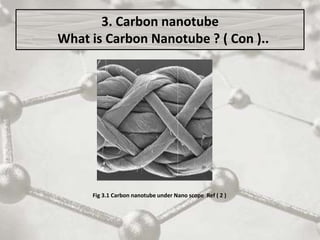
• A carbon nanotube is a tube-shaped material, made of carbon, having a
diameter measuring on the nanometer scale , with length-to-diameter
ratio of up to 132,000,000:1 .
• A nanometer is one-billionth of a meter, or about 10,000 times smaller
than a human hair .
• Carbon nanotubes have many structures, differing in length, thickness,
and number of layers .
3. Carbon nanotube
What is Carbon Nanotube ? ( Con )..
Fig 3.1 Carbon nanotube under Nano scope Ref ( 2 )
4. Types of carbon nanotube
• Until now there is no consensus on some terms describing carbon
nanotubes in scientific literature .
• We can classify Carbon nanotube in two type , a) Single-walled , and
b) Multi-walled .
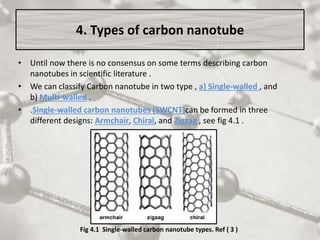
• .Single-walled carbon nanotubes (SWCNT)can be formed in three
different designs: Armchair, Chiral, and Zigzag , see fig 4.1 .
Fig 4.1 Single-walled carbon nanotube types. Ref ( 3 )
4. Types of carbon nanotube ( Con )..
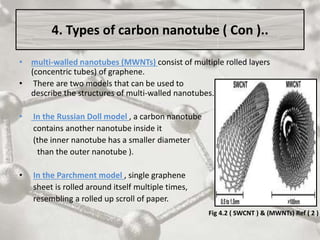
• multi-walled nanotubes (MWNTs) consist of multiple rolled layers
(concentric tubes) of graphene.
• There are two models that can be used to
describe the structures of multi-walled nanotubes.
• In the Russian Doll model , a carbon nanotube
contains another nanotube inside it
(the inner nanotube has a smaller diameter
than the outer nanotube ).
• In the Parchment model , single graphene
sheet is rolled around itself multiple times,
resembling a rolled up scroll of paper.
Fig 4.2 ( SWCNT ) & (MWNTs) Ref ( 2 )
5. Structure of carbon nanotube
 Carbon structure :
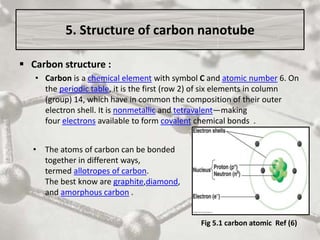
• Carbon is a chemical element with symbol C and atomic number 6. On
the periodic table, it is the first (row 2) of six elements in column
(group) 14, which have in common the composition of their outer
electron shell. It is nonmetallic and tetravalent—making
four electrons available to form covalent chemical bonds .
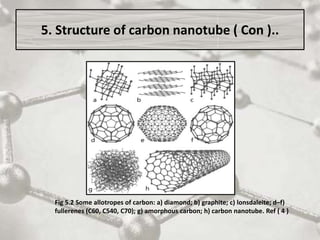
• The atoms of carbon can be bonded
together in different ways,
termed allotropes of carbon.
The best know are graphite,diamond,
and amorphous carbon .
Fig 5.1 carbon atomic Ref (6)
5. Structure of carbon nanotube ( Con )..
Fig 5.2 Some allotropes of carbon: a) diamond; b) graphite; c) lonsdaleite; d–f)
fullerenes (C60, C540, C70); g) amorphous carbon; h) carbon nanotube. Ref ( 4 )
5. Structure of carbon nanotube ( Con )..
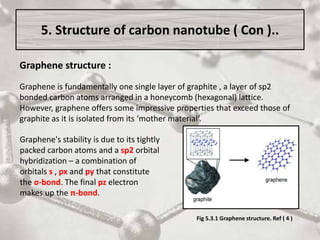
Fig 5.3.1 Graphene structure. Ref ( 4 )
Graphene structure :
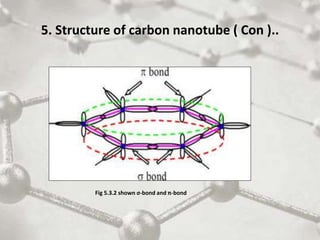
Graphene is fundamentally one single layer of graphite , a layer of sp2
bonded carbon atoms arranged in a honeycomb (hexagonal) lattice.
However, graphene offers some impressive properties that exceed those of
graphite as it is isolated from its ‘mother material’.
Graphene's stability is due to its tightly
packed carbon atoms and a sp2 orbital
hybridization – a combination of
orbitals s , px and py that constitute
the σ-bond. The final pz electron
makes up the π-bond.
5. Structure of carbon nanotube ( Con )..
Fig 5.3.2 shown σ-bond and π-bond
5. Structure of carbon nanotube ( Con )..
 Carbon nanotube structure :
• The Structure of Carbon Nanotubes (CNT) can be imagined as a cylinder
formed by rolling a graphene sheet and then closing it on both sides by
fullerene hemispheres.
• The bonding in carbon nanotubes is sp², with each atom joined to three
neighbor's , as in graphite.
• The graphene sheet can be rolled in different ways to get the three type of
SWNTS :
1. Zigzag
2. Armchair
3. Chiral
5. Structure of carbon nanotube ( Con )..
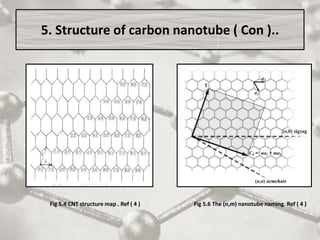
• The structure of a nanotube can be specified by a vector, (n,m), which
defines how the graphene sheet is rolled up.
• These numbers specify a "vector" for the mapping, where m and n are
integers see fig 5.4
• Any tube "named" (n,0) has carbon-carbon bonds that are parallel to the
tube axis, and form, at an open end, a "zig-zag" pattern; these tubes are
referred to as "zig-zag" tubes.
• Tubes named (n,n), where the two integers are equal, have carbon-carbon
bonds that are perpendicular to the tube axis, and are often called
"armchair" tubes.
• All the other tubes, named (m,n), where m does not equal n, and neither
is 0, are chiral, and have left-and right-handed variants.
5. Structure of carbon nanotube ( Con )..
Fig 5.4 CNT structure map . Ref ( 4 ) Fig 5.6 The (n,m) nanotube naming. Ref ( 4 )
6. Processing Of Carbon Nanotube
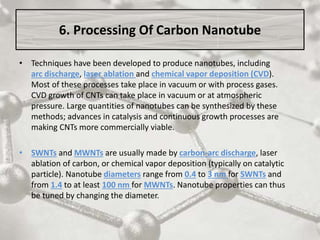
• Techniques have been developed to produce nanotubes, including
arc discharge, laser ablation and chemical vapor deposition (CVD).
Most of these processes take place in vacuum or with process gases.
CVD growth of CNTs can take place in vacuum or at atmospheric
pressure. Large quantities of nanotubes can be synthesized by these
methods; advances in catalysis and continuous growth processes are
making CNTs more commercially viable.
• SWNTs and MWNTs are usually made by carbon-arc discharge, laser
ablation of carbon, or chemical vapor deposition (typically on catalytic
particle). Nanotube diameters range from 0.4 to 3 nm for SWNTs and
from 1.4 to at least 100 nm for MWNTs. Nanotube properties can thus
be tuned by changing the diameter.
6. Processing Of Carbon Nanotube ( Con )..
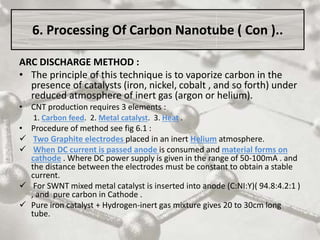
ARC DISCHARGE METHOD :
• The principle of this technique is to vaporize carbon in the
presence of catalysts (iron, nickel, cobalt , and so forth) under
reduced atmosphere of inert gas (argon or helium).
• CNT production requires 3 elements :
1. Carbon feed. 2. Metal catalyst. 3. Heat .
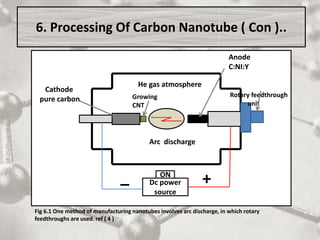
• Procedure of method see fig 6.1 :
 Two Graphite electrodes placed in an inert Helium atmosphere.
 When DC current is passed anode is consumed and material forms on
cathode . Where DC power supply is given in the range of 50-100mA . and
the distance between the electrodes must be constant to obtain a stable
current.
 For SWNT mixed metal catalyst is inserted into anode (C:NI:Y)( 94.8:4.2:1 )
, and pure carbon in Cathode .
 Pure iron catalyst + Hydrogen-inert gas mixture gives 20 to 30cm long
tube.
Dc power
source
_ +
Cathode
pure carbon
Anode
C:NI:Y
Growing
CNT
Arc discharge
He gas atmosphere
Rotary feedthrough
unit
ON
Fig 6.1 One method of manufacturing nanotubes involves arc discharge, in which rotary
feedthroughs are used. ref ( 4 )
6. Processing Of Carbon Nanotube ( Con )..
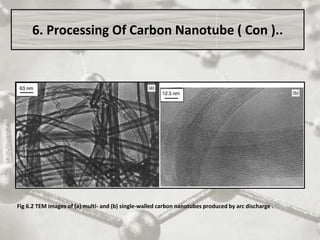
Fig 6.2 TEM images of (a) multi- and (b) single-walled carbon nanotubes produced by arc discharge .
6. Processing Of Carbon Nanotube ( Con )..
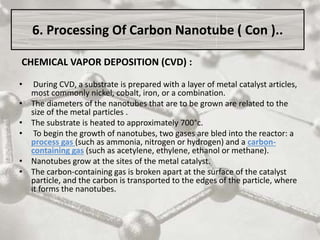
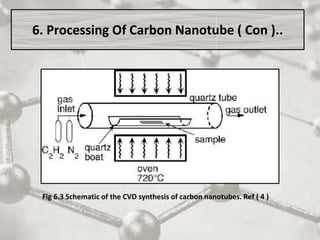
CHEMICAL VAPOR DEPOSITION (CVD) :
• During CVD, a substrate is prepared with a layer of metal catalyst articles,
most commonly nickel, cobalt, iron, or a combination.
• The diameters of the nanotubes that are to be grown are related to the
size of the metal particles .
• The substrate is heated to approximately 700°c.
• To begin the growth of nanotubes, two gases are bled into the reactor: a
process gas (such as ammonia, nitrogen or hydrogen) and a carbon-
containing gas (such as acetylene, ethylene, ethanol or methane).
• Nanotubes grow at the sites of the metal catalyst.
• The carbon-containing gas is broken apart at the surface of the catalyst
particle, and the carbon is transported to the edges of the particle, where
it forms the nanotubes.
6. Processing Of Carbon Nanotube ( Con )..
Fig 6.3 Schematic of the CVD synthesis of carbon nanotubes. Ref ( 4 )
6. Processing Of Carbon Nanotube ( Con )..
• Nano science is the most rapidly developing field that has been
fascinating scientists for years and the last decade has been the most
productive in terms of research on it.
• But for this to be productive in every aspect its impacts both positive
and negative are to be studied extensively and thereupon reach a
point where negative aspects can be worked around.
• It is however a field having quite a potential for future applications.
• Nanomaterials, particularly carbon nanotubes (CNTs), hold great
promise for a variety of industrial, consumer, and biomedical
applications, due to their outstanding and novel properties.
10. Conclusion
1. Callister, William D., and David G. Rethwisch. Materials science and engineering: an
introduction. Vol. 7. New York: Wiley, 2007.
2. Dresselhaus, M. S., G. Dresselhas, and A. Jorio. "Advanced Topics in the Synthesis,
Structure, Properties and Applications." (2008).
3. Pulickel M. Ajayan and Otto Z. Zhou (2001) TAP 80: pp. 391 – 425 Applications of Carbon
Nanotubes
4. http://www.ozytive.com/2014/07/06/carbon-nanotubes-ibm/
5. http://www.ncnr.nist.gov/staff/taner/nanotube/types.html
6. https://en.wikipedia.org
7. http://www.azonano.com/article.aspx?ArticleID=983
8. http://www.nanoscience.com/products/carbon-nanotube-synthesis/technology-
overview/
9. https://www.google.com.cy/carbon+nanotube
10. http://www.nature.com/nmat/journal/v4/n12/fig_tab/nmat1516_F3.html
11. References
Introduction to Carbon Nanotubes (CNTs)

Introduction to Carbon Nanotubes (CNTs)

  • 1.
    CARBON NANOTUBE Presented by: Ahmad Abdallh Date : 27/4/2016
  • 2.
    Table of content 1.Introduction ( Advanced Materials ) . 2. Nano Technology ( What Is Nano Technology ? ) . 3. Carbon Nanotube ( What Is Carbon Nanotube ? ) . 4. Types Of Carbon Nanotube . 5. Structure Of Carbon Nanotube . 6. Processing Of Carbon Nanotube .
  • 3.
    1. Introduction (Advanced Materials ) • Materials that are utilized in high-technology (or high-tech) applications are sometimes termed advanced materials. • By high technology we mean a device or product that operates or functions using relatively intricate and complicated principles . • These advanced materials are typically traditional materials whose properties have been enhanced, and also newly developed, high-performance materials. • Classification of modern material ( Advances material ) : I. Semiconductors . II. Biomaterials . III. Smart Materials . IV. Nanomaterial's .
  • 4.
    2. Nano technology Whatis Nano technology ? • Nanotechnology ("nanotech") is manipulation of matter on an atomic, molecular, and supramolecular scale. The earliest, widespread description of nanotechnology ( 2 ) . • However, unlike these other materials, they are not distinguished on the basis of their chemistry, but rather, size; the nano-prefix denotes that the dimensions of these structural entities are on the order of a nanometer (10−9 m)—as a rule, less than 100 nanometers (10−7 ) (equivalent to approximately 500 atom diameters) ( 1 ) . • This ability to carefully arrange atoms provides opportunities to develop mechanical, electrical, magnetic, and other properties ( 1 ) .
  • 5.
    2. Nano technology Whatis Nano technology ? ( Con ).. Fig 2.1 Bar chart showing size ranges for several structural features found in materials. Ref ( 1 )
  • 6.
    3. Carbon nanotube Whatis Carbon Nanotube ? • The discovery of carbon nanotubes (CNTs) in 1991 , Iijima ( japan ) opened up a new area in materials science . • A carbon nanotube is a tube-shaped material, made of carbon, having a diameter measuring on the nanometer scale , with length-to-diameter ratio of up to 132,000,000:1 . • A nanometer is one-billionth of a meter, or about 10,000 times smaller than a human hair . • Carbon nanotubes have many structures, differing in length, thickness, and number of layers .
  • 7.
    3. Carbon nanotube Whatis Carbon Nanotube ? ( Con ).. Fig 3.1 Carbon nanotube under Nano scope Ref ( 2 )
  • 8.
    4. Types ofcarbon nanotube • Until now there is no consensus on some terms describing carbon nanotubes in scientific literature . • We can classify Carbon nanotube in two type , a) Single-walled , and b) Multi-walled . • .Single-walled carbon nanotubes (SWCNT)can be formed in three different designs: Armchair, Chiral, and Zigzag , see fig 4.1 . Fig 4.1 Single-walled carbon nanotube types. Ref ( 3 )
  • 9.
    4. Types ofcarbon nanotube ( Con ).. • multi-walled nanotubes (MWNTs) consist of multiple rolled layers (concentric tubes) of graphene. • There are two models that can be used to describe the structures of multi-walled nanotubes. • In the Russian Doll model , a carbon nanotube contains another nanotube inside it (the inner nanotube has a smaller diameter than the outer nanotube ). • In the Parchment model , single graphene sheet is rolled around itself multiple times, resembling a rolled up scroll of paper. Fig 4.2 ( SWCNT ) & (MWNTs) Ref ( 2 )
  • 10.
    5. Structure ofcarbon nanotube  Carbon structure : • Carbon is a chemical element with symbol C and atomic number 6. On the periodic table, it is the first (row 2) of six elements in column (group) 14, which have in common the composition of their outer electron shell. It is nonmetallic and tetravalent—making four electrons available to form covalent chemical bonds . • The atoms of carbon can be bonded together in different ways, termed allotropes of carbon. The best know are graphite,diamond, and amorphous carbon . Fig 5.1 carbon atomic Ref (6)
  • 11.
    5. Structure ofcarbon nanotube ( Con ).. Fig 5.2 Some allotropes of carbon: a) diamond; b) graphite; c) lonsdaleite; d–f) fullerenes (C60, C540, C70); g) amorphous carbon; h) carbon nanotube. Ref ( 4 )
  • 12.
    5. Structure ofcarbon nanotube ( Con ).. Fig 5.3.1 Graphene structure. Ref ( 4 ) Graphene structure : Graphene is fundamentally one single layer of graphite , a layer of sp2 bonded carbon atoms arranged in a honeycomb (hexagonal) lattice. However, graphene offers some impressive properties that exceed those of graphite as it is isolated from its ‘mother material’. Graphene's stability is due to its tightly packed carbon atoms and a sp2 orbital hybridization – a combination of orbitals s , px and py that constitute the σ-bond. The final pz electron makes up the π-bond.
  • 13.
    5. Structure ofcarbon nanotube ( Con ).. Fig 5.3.2 shown σ-bond and π-bond
  • 14.
    5. Structure ofcarbon nanotube ( Con )..  Carbon nanotube structure : • The Structure of Carbon Nanotubes (CNT) can be imagined as a cylinder formed by rolling a graphene sheet and then closing it on both sides by fullerene hemispheres. • The bonding in carbon nanotubes is sp², with each atom joined to three neighbor's , as in graphite. • The graphene sheet can be rolled in different ways to get the three type of SWNTS : 1. Zigzag 2. Armchair 3. Chiral
  • 15.
    5. Structure ofcarbon nanotube ( Con ).. • The structure of a nanotube can be specified by a vector, (n,m), which defines how the graphene sheet is rolled up. • These numbers specify a "vector" for the mapping, where m and n are integers see fig 5.4 • Any tube "named" (n,0) has carbon-carbon bonds that are parallel to the tube axis, and form, at an open end, a "zig-zag" pattern; these tubes are referred to as "zig-zag" tubes. • Tubes named (n,n), where the two integers are equal, have carbon-carbon bonds that are perpendicular to the tube axis, and are often called "armchair" tubes. • All the other tubes, named (m,n), where m does not equal n, and neither is 0, are chiral, and have left-and right-handed variants.
  • 16.
    5. Structure ofcarbon nanotube ( Con ).. Fig 5.4 CNT structure map . Ref ( 4 ) Fig 5.6 The (n,m) nanotube naming. Ref ( 4 )
  • 17.
    6. Processing OfCarbon Nanotube • Techniques have been developed to produce nanotubes, including arc discharge, laser ablation and chemical vapor deposition (CVD). Most of these processes take place in vacuum or with process gases. CVD growth of CNTs can take place in vacuum or at atmospheric pressure. Large quantities of nanotubes can be synthesized by these methods; advances in catalysis and continuous growth processes are making CNTs more commercially viable. • SWNTs and MWNTs are usually made by carbon-arc discharge, laser ablation of carbon, or chemical vapor deposition (typically on catalytic particle). Nanotube diameters range from 0.4 to 3 nm for SWNTs and from 1.4 to at least 100 nm for MWNTs. Nanotube properties can thus be tuned by changing the diameter.
  • 18.
    6. Processing OfCarbon Nanotube ( Con ).. ARC DISCHARGE METHOD : • The principle of this technique is to vaporize carbon in the presence of catalysts (iron, nickel, cobalt , and so forth) under reduced atmosphere of inert gas (argon or helium). • CNT production requires 3 elements : 1. Carbon feed. 2. Metal catalyst. 3. Heat . • Procedure of method see fig 6.1 :  Two Graphite electrodes placed in an inert Helium atmosphere.  When DC current is passed anode is consumed and material forms on cathode . Where DC power supply is given in the range of 50-100mA . and the distance between the electrodes must be constant to obtain a stable current.  For SWNT mixed metal catalyst is inserted into anode (C:NI:Y)( 94.8:4.2:1 ) , and pure carbon in Cathode .  Pure iron catalyst + Hydrogen-inert gas mixture gives 20 to 30cm long tube.
  • 19.
    Dc power source _ + Cathode purecarbon Anode C:NI:Y Growing CNT Arc discharge He gas atmosphere Rotary feedthrough unit ON Fig 6.1 One method of manufacturing nanotubes involves arc discharge, in which rotary feedthroughs are used. ref ( 4 ) 6. Processing Of Carbon Nanotube ( Con )..
  • 20.
    Fig 6.2 TEMimages of (a) multi- and (b) single-walled carbon nanotubes produced by arc discharge . 6. Processing Of Carbon Nanotube ( Con )..
  • 21.
    CHEMICAL VAPOR DEPOSITION(CVD) : • During CVD, a substrate is prepared with a layer of metal catalyst articles, most commonly nickel, cobalt, iron, or a combination. • The diameters of the nanotubes that are to be grown are related to the size of the metal particles . • The substrate is heated to approximately 700°c. • To begin the growth of nanotubes, two gases are bled into the reactor: a process gas (such as ammonia, nitrogen or hydrogen) and a carbon- containing gas (such as acetylene, ethylene, ethanol or methane). • Nanotubes grow at the sites of the metal catalyst. • The carbon-containing gas is broken apart at the surface of the catalyst particle, and the carbon is transported to the edges of the particle, where it forms the nanotubes. 6. Processing Of Carbon Nanotube ( Con )..
  • 22.
    Fig 6.3 Schematicof the CVD synthesis of carbon nanotubes. Ref ( 4 ) 6. Processing Of Carbon Nanotube ( Con )..
  • 23.
    • Nano scienceis the most rapidly developing field that has been fascinating scientists for years and the last decade has been the most productive in terms of research on it. • But for this to be productive in every aspect its impacts both positive and negative are to be studied extensively and thereupon reach a point where negative aspects can be worked around. • It is however a field having quite a potential for future applications. • Nanomaterials, particularly carbon nanotubes (CNTs), hold great promise for a variety of industrial, consumer, and biomedical applications, due to their outstanding and novel properties. 10. Conclusion
  • 24.
    1. Callister, WilliamD., and David G. Rethwisch. Materials science and engineering: an introduction. Vol. 7. New York: Wiley, 2007. 2. Dresselhaus, M. S., G. Dresselhas, and A. Jorio. "Advanced Topics in the Synthesis, Structure, Properties and Applications." (2008). 3. Pulickel M. Ajayan and Otto Z. Zhou (2001) TAP 80: pp. 391 – 425 Applications of Carbon Nanotubes 4. http://www.ozytive.com/2014/07/06/carbon-nanotubes-ibm/ 5. http://www.ncnr.nist.gov/staff/taner/nanotube/types.html 6. https://en.wikipedia.org 7. http://www.azonano.com/article.aspx?ArticleID=983 8. http://www.nanoscience.com/products/carbon-nanotube-synthesis/technology- overview/ 9. https://www.google.com.cy/carbon+nanotube 10. http://www.nature.com/nmat/journal/v4/n12/fig_tab/nmat1516_F3.html 11. References