NANOROBOTICS
BY PRAVEEN KUMAR PK
S6 BCA
25
CONTENTS
 Introduction
 Objectives
 History
 Working
 Technical Specification
 Applications
 Advantages
 Disadvantages
 Future Enhancement
 Conclusion
 Bibliography
INTRODUCTION
• Nanorobotics is the technology of creating machines or
robots between 1 nanometer and 100 nanometer in size.
• The robots or machines created using nanotechnology
are known as Nanobots.
• A Single Nanobot will only be about 1/80,000 th of a
Human Hair.
OBJECTIVES
 The goal of nanorobotics is to create a sustainable and durable machine, which is invisible to the naked eye for
functions such as drug delivery , cancer treatment etc
HISTORY
• The idea of Nanorobotics was first proposed by Dr.Richard Feynman In 1959.
• In 1980 , Eric Drexler elaborated move on this topic in his book.
• But only in 2018 , the practically usable nanobot was invented by Adriano Cavalcanti.
WORKING
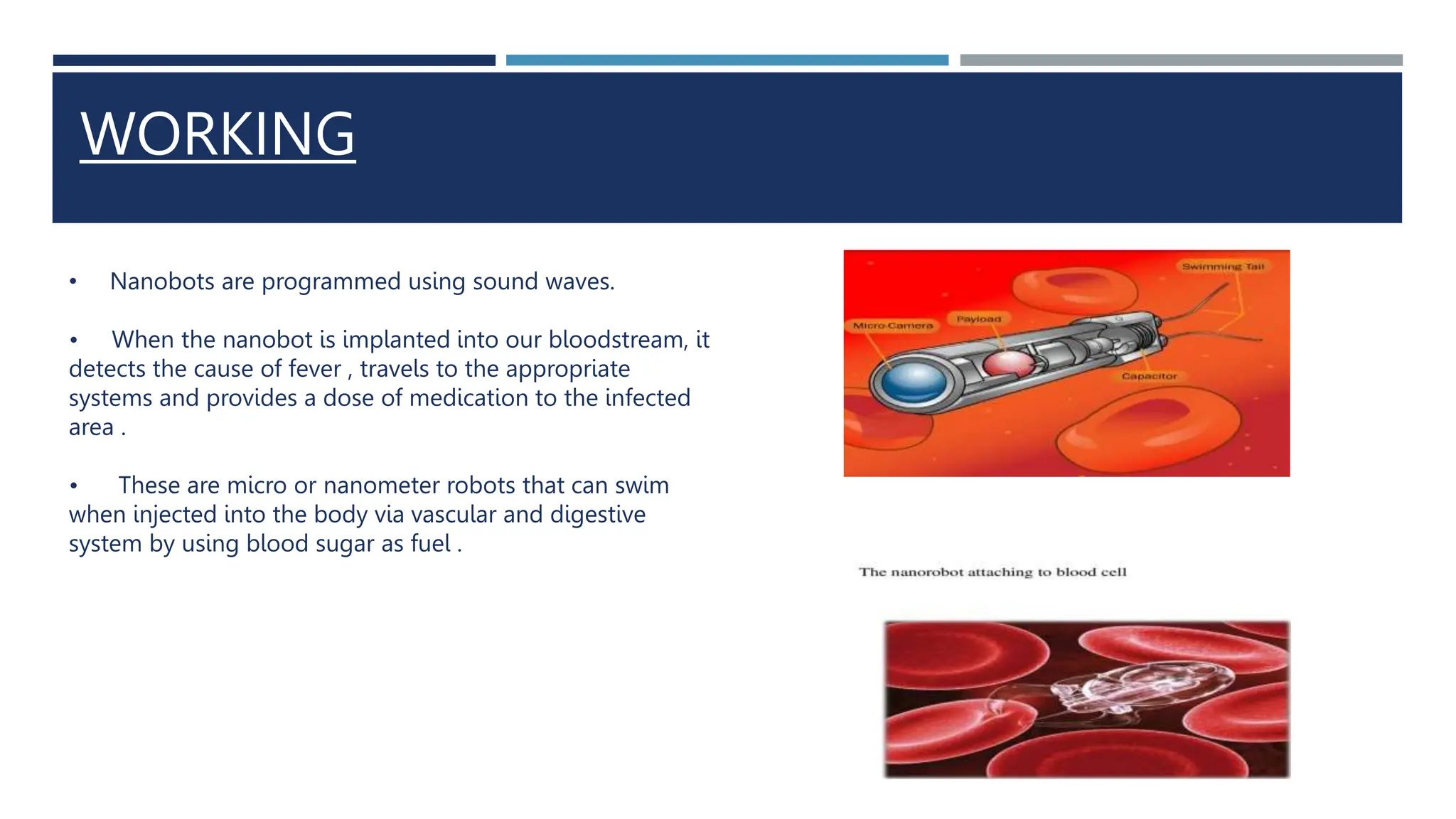
• Nanobots are programmed using sound waves.
• When the nanobot is implanted into our bloodstream, it
detects the cause of fever , travels to the appropriate
systems and provides a dose of medication to the infected
area .
• These are micro or nanometer robots that can swim
when injected into the body via vascular and digestive
system by using blood sugar as fuel .
TECHNICAL SPECIFICATIONS
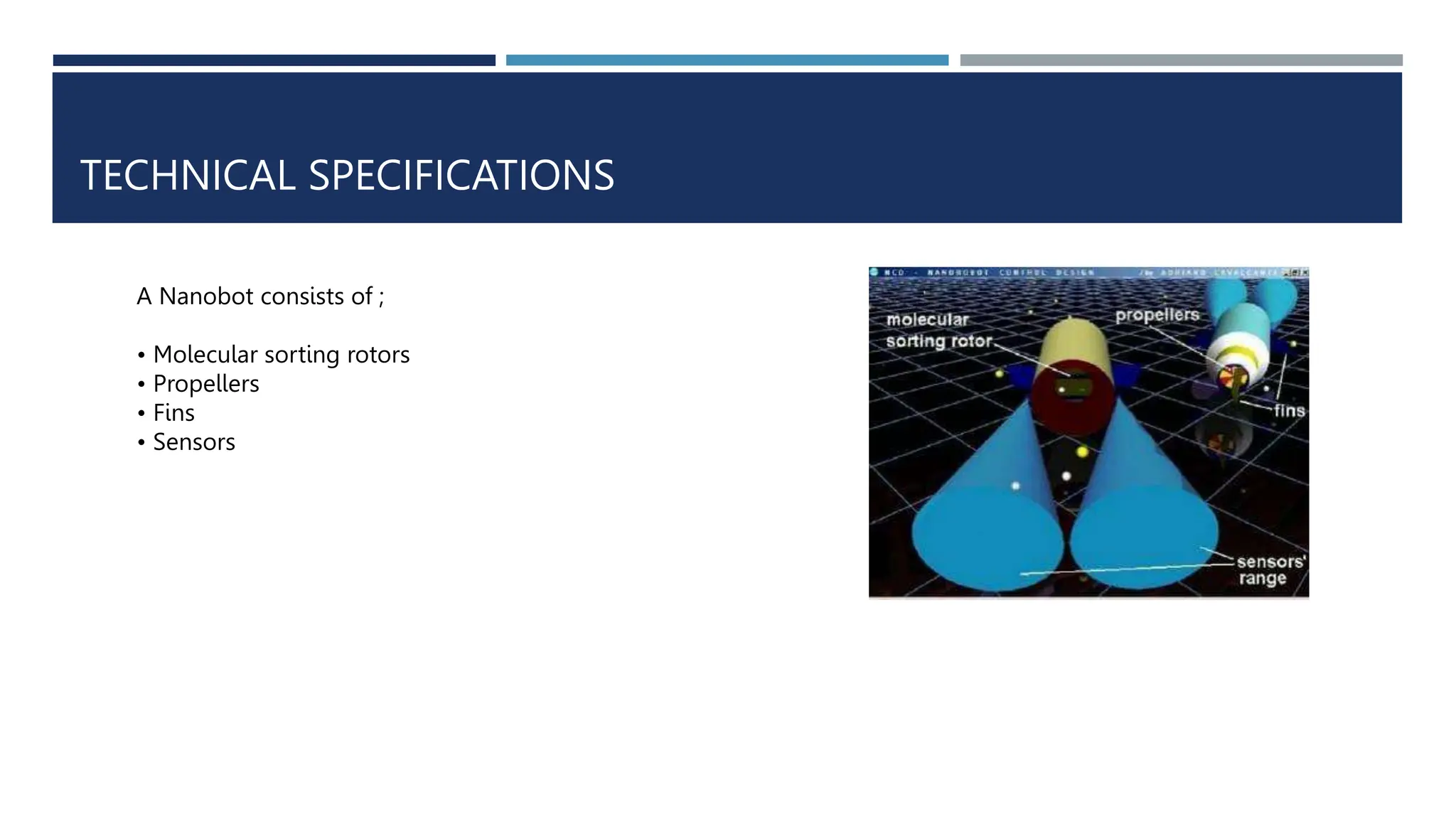
A Nanobot consists of ;
• Molecular sorting rotors
• Propellers
• Fins
• Sensors
Elements in a Nanobot ;
• Carbon is the principle element comprising the bulk of a nanobot.
• The nanobots contain polystyrene microspheres ( A synthetic hydrocarbon polymer )
These nanobots are known as “ Microbeads “.
• Many other elements that are used in nanoscales are as follows :
* Hydrogen
* Sulphur
* Oxygen
* Nitrogen
* Fluorine
* Silicon
APPLICATIONS
■ The primary function of nanorobotics include ;
• Breaking up Blood cells
• Fighting cancer
• Parasite Removal
• Breaking up Kidney stones
• Breaking Arteriosclerosis
■ Energy :
Nanobots helps in making solar cells more efficient and
affordable. It is also difficult to repair these solar cells due to the
elements inside them being small and complex.
■ Electronics :
With the help of nanorobotics, we can create faster and Portable systems that can store and manage large amount of
data.
■ Water :
Nanobots can Help to clean the impurities from water.
■ Food :
In Food sector, it can create impenetrable barrier to gases such as Oxygen and Carbon dioxide.
ADVANTAGES
• Rapid elimination of diseases .
• Durability ( they can remain operational for years , decades or centuries)
• Minimum side effects.
• Speeding up of medical treatment.
DISADVANTAGES
• Lack of knowledge (Not a fully explored field ).
• Nano implements could adjust human DNA structure .
• Environmental hazards (the disposal)
FUTURE ENHANCEMENT
 Nanorobotics is a indeed a technology for the future.
 It would help to build faster computers , advanced pharmaceuticals , controlled drug delivery , crack proof surface
coating etc
 Helps in reducing the size of electronic devices.
CONCLUSION
• Nanorobotics is the technology of creating machines or robots between 1 nanometer
and 100 nanometer in size.
• Nanorobotics can theoretically destroy all common diseases of the 21st century, thereby
ending much of the pain and suffering.
• Nanobots can be programmed using sound waves to carry out functions like curing
fevers , destroying cancer cells , breaking up arteriosclerosis etc
BIBLIOGRAPHY
WEBSITES
• https://www.nanowerk.com/
• https://www.nationalgeographic.org/encyclopedia/nanotechnology/
• http://www.nanodic.com/
• https://www.nano.gov/nanotech-101/what/working-nanoscale
• https://www.molecularcloud.org/
• https://en.wikipedia.org/wiki/nanotechnology
THANK YOU

Nanorobotics - pk.pptx SEMINAR ON NANOROBOTICS

  • 1.
  • 2.
    CONTENTS  Introduction  Objectives History  Working  Technical Specification  Applications  Advantages  Disadvantages  Future Enhancement  Conclusion  Bibliography
  • 3.
    INTRODUCTION • Nanorobotics isthe technology of creating machines or robots between 1 nanometer and 100 nanometer in size. • The robots or machines created using nanotechnology are known as Nanobots. • A Single Nanobot will only be about 1/80,000 th of a Human Hair.
  • 4.
    OBJECTIVES  The goalof nanorobotics is to create a sustainable and durable machine, which is invisible to the naked eye for functions such as drug delivery , cancer treatment etc
  • 5.
    HISTORY • The ideaof Nanorobotics was first proposed by Dr.Richard Feynman In 1959. • In 1980 , Eric Drexler elaborated move on this topic in his book. • But only in 2018 , the practically usable nanobot was invented by Adriano Cavalcanti.
  • 6.
    WORKING • Nanobots areprogrammed using sound waves. • When the nanobot is implanted into our bloodstream, it detects the cause of fever , travels to the appropriate systems and provides a dose of medication to the infected area . • These are micro or nanometer robots that can swim when injected into the body via vascular and digestive system by using blood sugar as fuel .
  • 7.
    TECHNICAL SPECIFICATIONS A Nanobotconsists of ; • Molecular sorting rotors • Propellers • Fins • Sensors
  • 8.
    Elements in aNanobot ; • Carbon is the principle element comprising the bulk of a nanobot. • The nanobots contain polystyrene microspheres ( A synthetic hydrocarbon polymer ) These nanobots are known as “ Microbeads “. • Many other elements that are used in nanoscales are as follows : * Hydrogen * Sulphur * Oxygen * Nitrogen * Fluorine * Silicon
  • 9.
    APPLICATIONS ■ The primaryfunction of nanorobotics include ; • Breaking up Blood cells • Fighting cancer • Parasite Removal • Breaking up Kidney stones • Breaking Arteriosclerosis ■ Energy : Nanobots helps in making solar cells more efficient and affordable. It is also difficult to repair these solar cells due to the elements inside them being small and complex.
  • 10.
    ■ Electronics : Withthe help of nanorobotics, we can create faster and Portable systems that can store and manage large amount of data. ■ Water : Nanobots can Help to clean the impurities from water. ■ Food : In Food sector, it can create impenetrable barrier to gases such as Oxygen and Carbon dioxide.
  • 11.
    ADVANTAGES • Rapid eliminationof diseases . • Durability ( they can remain operational for years , decades or centuries) • Minimum side effects. • Speeding up of medical treatment.
  • 12.
    DISADVANTAGES • Lack ofknowledge (Not a fully explored field ). • Nano implements could adjust human DNA structure . • Environmental hazards (the disposal)
  • 13.
    FUTURE ENHANCEMENT  Nanoroboticsis a indeed a technology for the future.  It would help to build faster computers , advanced pharmaceuticals , controlled drug delivery , crack proof surface coating etc  Helps in reducing the size of electronic devices.
  • 14.
    CONCLUSION • Nanorobotics isthe technology of creating machines or robots between 1 nanometer and 100 nanometer in size. • Nanorobotics can theoretically destroy all common diseases of the 21st century, thereby ending much of the pain and suffering. • Nanobots can be programmed using sound waves to carry out functions like curing fevers , destroying cancer cells , breaking up arteriosclerosis etc
  • 15.
    BIBLIOGRAPHY WEBSITES • https://www.nanowerk.com/ • https://www.nationalgeographic.org/encyclopedia/nanotechnology/ •http://www.nanodic.com/ • https://www.nano.gov/nanotech-101/what/working-nanoscale • https://www.molecularcloud.org/ • https://en.wikipedia.org/wiki/nanotechnology
  • 16.