THE HUMAN 
GENOME PROJECT
     Ma. Veah Luisa O. Pascasio
OUTLINE

• Background
• Goals and Findings
• Mechanism
• Benefits and Risks
• Ethical, Legal, Social Issues
Background

An international research project with a primary 
  goal of determining the sequence of chemical 
  base pairs which make up DNA, and of 
  identifying and mapping the approximately 
  20,000–25,000 genes of the human genome from 
  both a physical and functional standpoint. 
Background

• begun formally in 1990
• the Human Genome Project is a 13­year 
  effort coordinated by the U.S. 
  Department of Energy and the National 
  Institutes of Health.
• It was planned to last 15 years, but rapid 
  technological advances have 
  accelerated the expected completion 
  date to 2003. 
Goals

• identify all the approximate 30,000 
  genes in human DNA,
• determine the sequences of the 3 
  billion chemical base pairs that 
  make up human DNA,
• store this information in databases,
Goals

• improve tools for data analysis,
• transfer related technologies to 
  the private sector, and
• address the ethical, legal, and 
  social issues (ELSI) that may arise 
  from the project.
Goals

• To answer the question:
   – What actually specifies the 
     human organism? What makes 
     us human? This is what medical 
     science is about­­the specific 
     ways in which we are different 
     from animals.
Findings

• Approximately 23,000 genes in human 
  beings, the same range as in mice and 
  roundworms. 
• The human genome has significantly more 
  segmental duplications (nearly identical, 
  repeated sections of DNA) than other 
  mammalian genomes.
• At  the time when the draft sequence was 
  published less than 7% of protein families 
  appeared to be vertebrate specific.
Mechanism

• Physical and Genetic Map
• Partial Sequencing


   Youtube.com/Human Genome Project. html
Benefits 

• Knowledge of the effects of variation 
  of DNA among individuals can 
  revolutionize the ways to diagnose, 
  treat and even prevent a number of 
  diseases that affects the human 
  beings.
• It provides clues to the understanding 
  of human biology.
Benefits 

• learning about nonhuman organisms' 
  DNA sequences can lead to an 
  understanding of their natural 
  capabilities that can be applied 
  toward solving challenges in health 
  care, energy sources, agriculture, and 
  environmental cleanup.
Benefits 
• Molecular Medicine
  – earlier detection of genetic 
    predispositions to disease
  – gene therapy and control systems for 
    drugs
• Microbial Genomics
  – environmental monitoring to detect 
    pollutants
  – understanding disease vulnerabilities and 
    revealing drug targets
Benefits 

• Bioarchaeology, Anthropology, Evolution, 
  and Human Migration
  – study migration of different population 
    groups based on female genetic 
    inheritance
  – compare breakpoints in the evolution of 
    mutations with ages of populations and 
    historical events

• DNA Forensics (Identification)
RISKS

• Enhancement engineering is 
  widely regarded as both 
  scientifically and ethically 
  problematic. From a scientific 
  standpoint, it is unlikely that we will 
  soon be able to enhance normally 
  functioning genes without risking 
  grave side effects.
RISKS

• assess health damage and risks 
  caused by radiation exposure, 
  including low­dose exposures
• assess health damage and risks 
  caused by exposure to mutagenic 
  chemicals and cancer­causing toxins
• reduce the likelihood of heritable 
  mutations
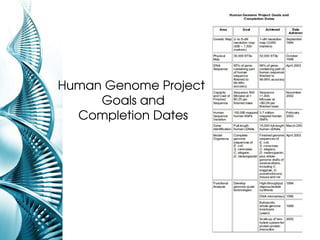
Human Genome Project 
     Goals and
  Completion Dates
• Reference:
  – The Human Genome Project by Walter Gilbert

Human genome

Editor's Notes

  • #9 Understanding how these genes express themselves will provide clues to how diseases are caused. These sections may underlie the creation of new primate-specific genes