Mycobacterium
leprae
Govind P. Sah, M.Sc.
Lecture notes, Medical Microbiology
CMLT 2nd year
Normal habitat
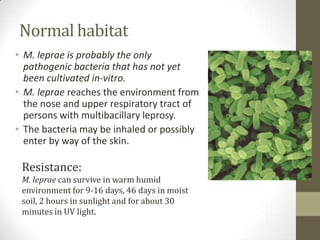
• M. leprae is probably the only
pathogenic bacteria that has not yet
been cultivated in-vitro.
• M. leprae reaches the environment from
the nose and upper respiratory tract of
persons with multibacillary leprosy.
• The bacteria may be inhaled or possibly
enter by way of the skin.
Resistance:
M. leprae can survive in warm humid
environment for 9-16 days, 46 days in moist
soil, 2 hours in sunlight and for about 30
minutes in UV light.
Morphology
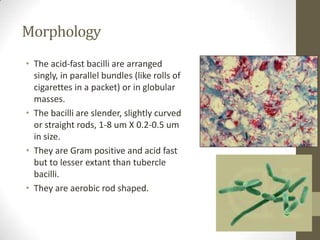
• The acid-fast bacilli are arranged
singly, in parallel bundles (like rolls of
cigarettes in a packet) or in globular
masses.
• The bacilli are slender, slightly curved
or straight rods, 1-8 um X 0.2-0.5 um
in size.
• They are Gram positive and acid fast
but to lesser extant than tubercle
bacilli.
• They are aerobic rod shaped.
Cultivation
• M. leprae is found only in cases of human
infection.
• They have not yet been grown ion
artificial media or tissue culture.
• The generation time of leprae bacillus is
found to be 12-13 days on an average.
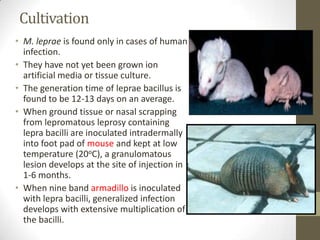
• When ground tissue or nasal scrapping
from lepromatous leprosy containing
lepra bacilli are inoculated intradermally
into foot pad of mouse and kept at low
temperature (20oC), a granulomatous
lesion develops at the site of injection in
1-6 months.
• When nine band armadillo is inoculated
with lepra bacilli, generalized infection
develops with extensive multiplication of
the bacilli.
Contraction of disease
• It is likely to spread through direct skin contact
(damaged skin) and air dispersement of
infectious aerosols from coughing or sneezing of
infected patient.
• Contracting the disease depends on how
susceptible the person is to the disease, how
long you are exposed, and environmental
conditions.
• Only 10 to 29% of people exposed to bacilli
actually develop leprosy.
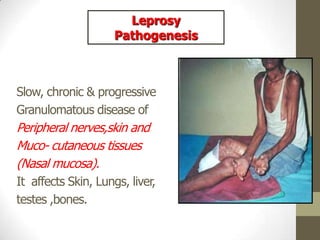
Slow, chronic & progressive
Granulomatous disease of
Peripheral nerves,skin and
Muco- cutaneous tissues
(Nasal mucosa).
It affects Skin, Lungs, liver,
testes ,bones.
Leprosy
Pathogenesis
Pathogenesis
• Leprosy is a chronic granulomatous disease that usually involves skin, peripheral
nerves and nasal mucosa.
• Incubation period is long and varies from 3-15 years.
• Prolonged close contact with infective patient is necessary for transmission of the
disease.
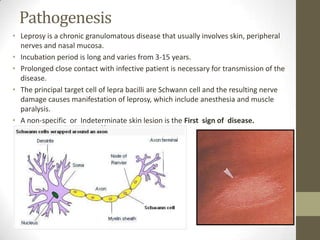
• The principal target cell of lepra bacilli are Schwann cell and the resulting nerve
damage causes manifestation of leprosy, which include anesthesia and muscle
paralysis.
• A non-specific or Indeterminate skin lesion is the First sign of disease.
• Clinical manifestaion is determined by cellular immune response of
the individual to the bacilli. There are two major forms (polar
forms) of leprosy:
1. Lepromatous leprosy:
2. Tuberculoid leprosy
3. Many patients occupy an intermediate position on the spectrum,
which may be classified as borderline lepromatous (BL) which
may turn into any of the polar forms.
Pathogenesis…
Types of leprosy
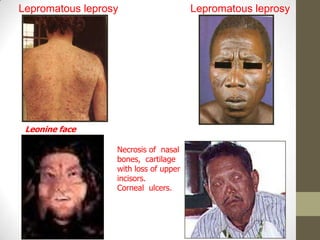
1. Lepromatous or nodular type:
• It is a generalized form and found in host with low resistance.
The bacteria disseminate hematogenously although, the
lesions are superficial.
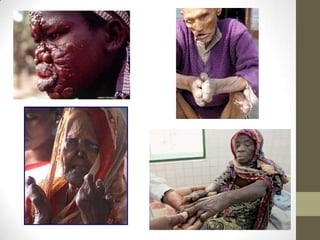
• Lesions are large, diffuse and granulomatous. Facial
disfigurement is common which is due to extensive collagen
destruction and scarring leading to thickening of the loose skin
of the forehead, lips and ears, resulting the classic leonine
facies.
Lepromatous leprosy Lepromatous leprosy
Leonine face
Necrosis of nasal
bones, cartilage
with loss of upper
incisors.
Corneal ulcers.
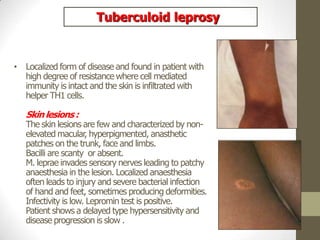
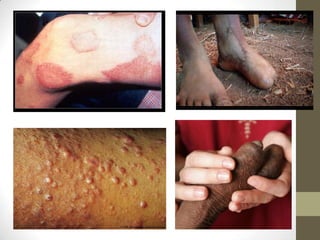
• Localized form of disease and found in patient with
high degree of resistance where cell mediated
immunity is intact and the skin is infiltrated with
helper TH1 cells.
Skin lesions :
The skin lesions are few and characterized by non-
elevated macular, hyperpigmented, anasthetic
patches on the trunk, face and limbs.
Bacilli are scanty or absent.
M. leprae invades sensory nerves leading to patchy
anaesthesia in the lesion. Localized anaesthesia
often leads to injury and severe bacterial infection
of hand and feet, sometimes producing deformities.
Infectivity is low. Lepromin test is positive.
Patient shows a delayed type hypersensitivity and
disease progression is slow .
Tuberculoid leprosy
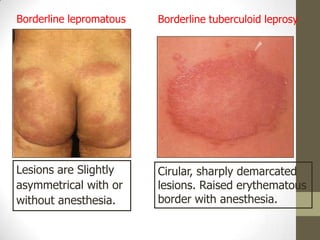
Borderline tuberculoid leprosyBorderline lepromatous
Lesions are Slightly
asymmetrical with or
without anesthesia.
Cirular, sharply demarcated
lesions. Raised erythematous
border with anesthesia.
Symptoms
• Symptoms usually take 3 to 5 years to show up after a person
has been infected.
• Severe pain, muscle weakness
• Loss of fingers or toes
• Skin lesions
• Symmetrical skin rash mostly found on face, ears, wrists,
elbows, knees, or butt
• More severe forms of leprosy can include the collapsing of the
nose
Laboratory diagnosis
• Diagnosis of leprosy is based primarily on clinical signs and
symptoms.
• Specimens: skin biopsy and scrapings from lesion and nasal
mucosa.
A. Direct evidences:
I. Direct slit skin smear and acid fast staining:
• The skin and the nasal secretions provide the most readily
available specimens for all bacteriological based investigations
in leprosy, they entirely relate to the demonstration of acid-
fast bacilli (AFB).
• Smears (slit skin smear) are prepared from material scraped
from the edges of a small slit incised into a skin lesion or into
normal-appearing skin. Smears are also sometimes made of
nasal secretions obtained by having the patient blow his nose.
Smears are subsequently dried, fixed, stained (modified Ziehl-
Neelsen Staining) and examined under microscope.
Laboratorydiagnosis…..
• Bacteriological index ranges from 1 to 6+ as shown below:
• 1-10 bacilli in 100 fields = 1+
• 1-10 bacilli in 10 fields = 2+
• 1-10 bacilli per field = 3+
• 10-100 bacilli per field = 4+
• 100-1,000 bacilli per filed = 5+
• More than 1,000 bacilli, clumps and groups in every field = 6+
II. Skin and nerve biopsy:
• skin biopsy is collected from active edge of the patches and nerve biopsy from
thickened nerve for histological confirmation of tuberculoid leprosy when acid
fast bacilli can not be demonstrated by direct smear.
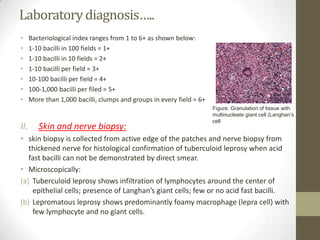
• Microscopically:
(a) Tuberculoid leprosy shows infiltration of lymphocytes around the center of
epithelial cells; presence of Langhan’s giant cells; few or no acid fast bacilli.
(b) Lepromatous leprosy shows predominantly foamy macrophage (lepra cell) with
few lymphocyte and no giant cells.
Figure: Granulation of tissue with
multinucleate giant cell (Langhan’s
cell
Laboratorydiagnosis…..
B. Indirect evidences
I. Lepromin test: the test is helpful in assessment of prognosis of the
disease.
II. Serological test: Serodiagnosis of leprosy involves detection of
antiphenoloc glycolipid-1 (anti PGL-1) antibodies. Various
serological tests like latex-agglutination, Mycobacterial leprae
particle agglutination (MLPA) test and ELISA could be used for
diagnosis of leprosy.
Treatment
• WHO recommended multidrug therapy (MDT) for all leprosy
cases based on dapsone, rifampicin and clofazimine.
• Dapsome has been successfully used for over 50 years, but
now the bacteria are becoming resistant to the treatment.
• Now they have started using multidrug therapy of Rifampicin,
Clofazamine, and Dapsome
Mycobacterium leprae

Mycobacterium leprae

  • 1.
    Mycobacterium leprae Govind P. Sah,M.Sc. Lecture notes, Medical Microbiology CMLT 2nd year
  • 2.
    Normal habitat • M.leprae is probably the only pathogenic bacteria that has not yet been cultivated in-vitro. • M. leprae reaches the environment from the nose and upper respiratory tract of persons with multibacillary leprosy. • The bacteria may be inhaled or possibly enter by way of the skin. Resistance: M. leprae can survive in warm humid environment for 9-16 days, 46 days in moist soil, 2 hours in sunlight and for about 30 minutes in UV light.
  • 3.
    Morphology • The acid-fastbacilli are arranged singly, in parallel bundles (like rolls of cigarettes in a packet) or in globular masses. • The bacilli are slender, slightly curved or straight rods, 1-8 um X 0.2-0.5 um in size. • They are Gram positive and acid fast but to lesser extant than tubercle bacilli. • They are aerobic rod shaped.
  • 4.
    Cultivation • M. lepraeis found only in cases of human infection. • They have not yet been grown ion artificial media or tissue culture. • The generation time of leprae bacillus is found to be 12-13 days on an average. • When ground tissue or nasal scrapping from lepromatous leprosy containing lepra bacilli are inoculated intradermally into foot pad of mouse and kept at low temperature (20oC), a granulomatous lesion develops at the site of injection in 1-6 months. • When nine band armadillo is inoculated with lepra bacilli, generalized infection develops with extensive multiplication of the bacilli.
  • 5.
    Contraction of disease •It is likely to spread through direct skin contact (damaged skin) and air dispersement of infectious aerosols from coughing or sneezing of infected patient. • Contracting the disease depends on how susceptible the person is to the disease, how long you are exposed, and environmental conditions. • Only 10 to 29% of people exposed to bacilli actually develop leprosy.
  • 6.
    Slow, chronic &progressive Granulomatous disease of Peripheral nerves,skin and Muco- cutaneous tissues (Nasal mucosa). It affects Skin, Lungs, liver, testes ,bones. Leprosy Pathogenesis
  • 7.
    Pathogenesis • Leprosy isa chronic granulomatous disease that usually involves skin, peripheral nerves and nasal mucosa. • Incubation period is long and varies from 3-15 years. • Prolonged close contact with infective patient is necessary for transmission of the disease. • The principal target cell of lepra bacilli are Schwann cell and the resulting nerve damage causes manifestation of leprosy, which include anesthesia and muscle paralysis. • A non-specific or Indeterminate skin lesion is the First sign of disease.
  • 8.
    • Clinical manifestaionis determined by cellular immune response of the individual to the bacilli. There are two major forms (polar forms) of leprosy: 1. Lepromatous leprosy: 2. Tuberculoid leprosy 3. Many patients occupy an intermediate position on the spectrum, which may be classified as borderline lepromatous (BL) which may turn into any of the polar forms. Pathogenesis…
  • 9.
    Types of leprosy 1.Lepromatous or nodular type: • It is a generalized form and found in host with low resistance. The bacteria disseminate hematogenously although, the lesions are superficial. • Lesions are large, diffuse and granulomatous. Facial disfigurement is common which is due to extensive collagen destruction and scarring leading to thickening of the loose skin of the forehead, lips and ears, resulting the classic leonine facies.
  • 10.
    Lepromatous leprosy Lepromatousleprosy Leonine face Necrosis of nasal bones, cartilage with loss of upper incisors. Corneal ulcers.
  • 11.
    • Localized formof disease and found in patient with high degree of resistance where cell mediated immunity is intact and the skin is infiltrated with helper TH1 cells. Skin lesions : The skin lesions are few and characterized by non- elevated macular, hyperpigmented, anasthetic patches on the trunk, face and limbs. Bacilli are scanty or absent. M. leprae invades sensory nerves leading to patchy anaesthesia in the lesion. Localized anaesthesia often leads to injury and severe bacterial infection of hand and feet, sometimes producing deformities. Infectivity is low. Lepromin test is positive. Patient shows a delayed type hypersensitivity and disease progression is slow . Tuberculoid leprosy
  • 12.
    Borderline tuberculoid leprosyBorderlinelepromatous Lesions are Slightly asymmetrical with or without anesthesia. Cirular, sharply demarcated lesions. Raised erythematous border with anesthesia.
  • 13.
    Symptoms • Symptoms usuallytake 3 to 5 years to show up after a person has been infected. • Severe pain, muscle weakness • Loss of fingers or toes • Skin lesions • Symmetrical skin rash mostly found on face, ears, wrists, elbows, knees, or butt • More severe forms of leprosy can include the collapsing of the nose
  • 14.
    Laboratory diagnosis • Diagnosisof leprosy is based primarily on clinical signs and symptoms. • Specimens: skin biopsy and scrapings from lesion and nasal mucosa. A. Direct evidences: I. Direct slit skin smear and acid fast staining: • The skin and the nasal secretions provide the most readily available specimens for all bacteriological based investigations in leprosy, they entirely relate to the demonstration of acid- fast bacilli (AFB). • Smears (slit skin smear) are prepared from material scraped from the edges of a small slit incised into a skin lesion or into normal-appearing skin. Smears are also sometimes made of nasal secretions obtained by having the patient blow his nose. Smears are subsequently dried, fixed, stained (modified Ziehl- Neelsen Staining) and examined under microscope.
  • 15.
    Laboratorydiagnosis….. • Bacteriological indexranges from 1 to 6+ as shown below: • 1-10 bacilli in 100 fields = 1+ • 1-10 bacilli in 10 fields = 2+ • 1-10 bacilli per field = 3+ • 10-100 bacilli per field = 4+ • 100-1,000 bacilli per filed = 5+ • More than 1,000 bacilli, clumps and groups in every field = 6+ II. Skin and nerve biopsy: • skin biopsy is collected from active edge of the patches and nerve biopsy from thickened nerve for histological confirmation of tuberculoid leprosy when acid fast bacilli can not be demonstrated by direct smear. • Microscopically: (a) Tuberculoid leprosy shows infiltration of lymphocytes around the center of epithelial cells; presence of Langhan’s giant cells; few or no acid fast bacilli. (b) Lepromatous leprosy shows predominantly foamy macrophage (lepra cell) with few lymphocyte and no giant cells. Figure: Granulation of tissue with multinucleate giant cell (Langhan’s cell
  • 16.
    Laboratorydiagnosis….. B. Indirect evidences I.Lepromin test: the test is helpful in assessment of prognosis of the disease. II. Serological test: Serodiagnosis of leprosy involves detection of antiphenoloc glycolipid-1 (anti PGL-1) antibodies. Various serological tests like latex-agglutination, Mycobacterial leprae particle agglutination (MLPA) test and ELISA could be used for diagnosis of leprosy.
  • 17.
    Treatment • WHO recommendedmultidrug therapy (MDT) for all leprosy cases based on dapsone, rifampicin and clofazimine. • Dapsome has been successfully used for over 50 years, but now the bacteria are becoming resistant to the treatment. • Now they have started using multidrug therapy of Rifampicin, Clofazamine, and Dapsome