Dr.Abhinav Golla
MBBS,MD Pathology
Assistant Proffesor
AIMS.
Medicure Diagnostics & research center , Vijayanagar colony , Hyderabad,Telangana.
INTRODUCTION
• Chronic granulomatous infectious disease.
• Caused by Mycobacterium leprae
• Mainly involves the peripheral nerves
and skin
• Other organs may involve:
Mucosa of mouth
Upper respiratory tract
Eyes Bones & Muscles. Testes etc.
• Commonly involves every organ except :
CNS, Ovary and Lungs.
• Oldest and most
dreaded disease known
to Mankind.
India in 600BC Kustha
Roga & attributed to
punishment or curse of
God
M. leprae was
discovered by Gerhard
Henrik Armauer Hansen
in 1873 in Norway.
Hence referred to as
Hansen’s disease.
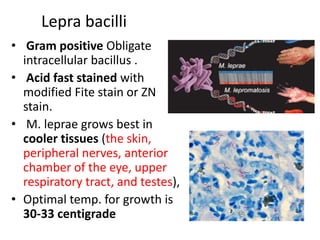
Lepra bacilli
• Gram positive Obligate
intracellular bacillus .
• Acid fast stained with
modified Fite stain or ZN
stain.
• M. leprae grows best in
cooler tissues (the skin,
peripheral nerves, anterior
chamber of the eye, upper
respiratory tract, and testes),
• Optimal temp. for growth is
30-33 centigrade
M. leprae remains one of the
few bacterial species that still
has not been cultivated on
artificial medium or tissue
culture and produces no known
toxins, but can grow in
Nude mouse
Nine banded armadillos(best)
Mode of transmission
• Transmission by inhalation
• Droplet infection(most common)
Transmission by contact
• Skin to skin contact with infectious
cases
• Contact with soil or fomites .
• Other Routes .
• Insect Vectors e.g.. Mosquito,
Bedbugs
• Tattooing needles
• Breast feeding and Transplacental
infection do not occur.
Incubation period
• Long incubation
period
• Ranged: 2 to 40
years or more
Average: 3-5 years
• Generation time :
12 days.
VIRULENCE FACTOR
• The cell wall contains large
amounts of an M. leprae–
specific phenolic glycolipid
(PGL-1), which is detected
in serologic tests.
• The unique trisaccharide
of M. leprae binds to the
basal lamina of Schwann
cells; this interaction is
probably relevant to the
fact that M. leprae is the
only bacterium to invade
peripheral nerves.
• Ridley- Jopling 1966 (Research
purposes)
• Most widely accepted
Divides Leprosy cases into five
groups according to their
position on an
immunohistological
scale.
• Tuberculoid (TT)
• Borderline Tuberculoid (BT)
• Borderline Borderline (BB)
• Borderline Lepromatous (BL)
• Lepromatous (LL)
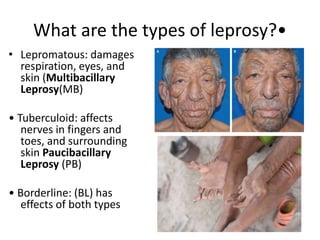
What are the types of leprosy?•
• Lepromatous: damages
respiration, eyes, and
skin (Multibacillary
Leprosy(MB)
• Tuberculoid: affects
nerves in fingers and
toes, and surrounding
skin Paucibacillary
Leprosy (PB)
• Borderline: (BL) has
effects of both types
Indeterminate leprosy
• Earliest & transitory
phase.
• One or two vague
hypopigmented
macule with definite
sensory impairment.
• If untreated may
progress towards
tuberculoid,
borderline or
lepromatous leprosy.
• Spontaneous
regression may occur.
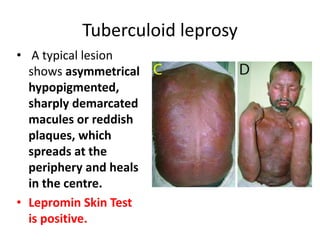
Tuberculoid leprosy
• A typical lesion
shows asymmetrical
hypopigmented,
sharply demarcated
macules or reddish
plaques, which
spreads at the
periphery and heals
in the centre.
• Lepromin Skin Test
is positive.
MICROSCOPY
Histologically TT resemble
tuberculosis.
Characterized by tuberculoid
granuloma, made up of
epitheloid cell in the center
surrounded by Langhans giant
cells, lymphocytes and foci of
non-caseating necrosis.
Weak acid-fast bacilli.
Lepromatous leprosy involves:
• The skin, ◦ peripheral
nerves, ◦ anterior chamber
of the eye, ◦ upper airways
(down to the larynx), ◦
testes, ◦ hands and feet.
• The vital organs and CNS
are rarely affected,
presumably because the
core temperature is too
high for growth of M.
leprae.
• Macular, papular, or
nodular lesions form on
the face, ears, wrists,
elbows, and knees.
• With progression, the
nodular lesions
coalesce to yield a
distinctive leonine
facies.
• Skin smear shows high
bacterial count.
• Lepromatous Leprosy:
Leonine Face
• Lepromatous lesions contain large aggregates
of lipid-laden macrophages (lepra cells), often
filled with masses (“globi”) of acid-fast bacilli.
Because of the abundant bacteria,
lepromatous leprosy is referred to as
“multibacillary”.
Lepromin skin test is negative.
MICROSCOPY
• Characterized by diffuse
infiltration of foamy
macrophages in the dermis.
• Lymphocytes are scanty and
giant cells typically absent.
• Lepromatous leprosy. Acid-
fast bacilli (“red snappers”)
within macrophages
Lepromatous leprosy- the
dermis shows clear space.
BODERLINE TUBERCULOID
• Four or more lesions, asymmentrically
distributed.
• Macules or plaques of variable sizes with well
or ill-defined margins & satellite lesions.
Peripheral nerves enlarged asymmentrically.
• Senstaion : hypoesthesia.
• Lepromin test may be weakly positive
Diagnosis
1-Clinical symptoms
diagnosis: (anesthesia,
nerve enlargement, and
characteristic skin
lesions).
2-Slit-skin smears: Ziehl
Neelson staining of skin
smear.
3-Skin biopsy.
4-Nerve biopsy.
5-Lepromin test.
Skin Smear Tests
• Ziehl Neelsen
Carbol Fuchsin
Stain (ZNCF)
• Absence of
bacteria in smear:
Paucibacillary
• Presence of
bacteria in smear:
Multibacillary
Procedure to Lepromin Skin Test
• A tiny sample of leprosy antigen is injected under the skin,
usually in the forearm.
• The skin gets pushed up, forming a small bump.
• This is an indication that the antigen has been injected to
the correct depth.
• The site of the injection is marked, and is examined for
reaction,
• First after 3 days(early reaction-Fernandez reaction:-
redness and induration)
• After 21 days(late reaction- Mitsuda reaction:-
nodule>5mm).
WORLDS
LEPROSY DAY
January 30
• Date was chosen by French
humanitarian Raoul Follereau as a
tribute to the life of the
Mahatma Gandhi who had
compassion for people afflicted
with leprosy.

Leprosy . Dr. Abhinav Golla , Associate Professor , Lab Director & Consultant Pathologist . Aadhya Medicure Pathlabs .

  • 1.
    Dr.Abhinav Golla MBBS,MD Pathology AssistantProffesor AIMS. Medicure Diagnostics & research center , Vijayanagar colony , Hyderabad,Telangana.
  • 2.
    INTRODUCTION • Chronic granulomatousinfectious disease. • Caused by Mycobacterium leprae • Mainly involves the peripheral nerves and skin • Other organs may involve: Mucosa of mouth Upper respiratory tract Eyes Bones & Muscles. Testes etc. • Commonly involves every organ except : CNS, Ovary and Lungs.
  • 3.
    • Oldest andmost dreaded disease known to Mankind. India in 600BC Kustha Roga & attributed to punishment or curse of God M. leprae was discovered by Gerhard Henrik Armauer Hansen in 1873 in Norway. Hence referred to as Hansen’s disease.
  • 4.
    Lepra bacilli • Grampositive Obligate intracellular bacillus . • Acid fast stained with modified Fite stain or ZN stain. • M. leprae grows best in cooler tissues (the skin, peripheral nerves, anterior chamber of the eye, upper respiratory tract, and testes), • Optimal temp. for growth is 30-33 centigrade
  • 5.
    M. leprae remainsone of the few bacterial species that still has not been cultivated on artificial medium or tissue culture and produces no known toxins, but can grow in Nude mouse Nine banded armadillos(best)
  • 6.
    Mode of transmission •Transmission by inhalation • Droplet infection(most common) Transmission by contact • Skin to skin contact with infectious cases • Contact with soil or fomites . • Other Routes . • Insect Vectors e.g.. Mosquito, Bedbugs • Tattooing needles • Breast feeding and Transplacental infection do not occur.
  • 7.
    Incubation period • Longincubation period • Ranged: 2 to 40 years or more Average: 3-5 years • Generation time : 12 days.
  • 8.
    VIRULENCE FACTOR • Thecell wall contains large amounts of an M. leprae– specific phenolic glycolipid (PGL-1), which is detected in serologic tests. • The unique trisaccharide of M. leprae binds to the basal lamina of Schwann cells; this interaction is probably relevant to the fact that M. leprae is the only bacterium to invade peripheral nerves.
  • 10.
    • Ridley- Jopling1966 (Research purposes) • Most widely accepted Divides Leprosy cases into five groups according to their position on an immunohistological scale. • Tuberculoid (TT) • Borderline Tuberculoid (BT) • Borderline Borderline (BB) • Borderline Lepromatous (BL) • Lepromatous (LL)
  • 12.
    What are thetypes of leprosy?• • Lepromatous: damages respiration, eyes, and skin (Multibacillary Leprosy(MB) • Tuberculoid: affects nerves in fingers and toes, and surrounding skin Paucibacillary Leprosy (PB) • Borderline: (BL) has effects of both types
  • 13.
    Indeterminate leprosy • Earliest& transitory phase. • One or two vague hypopigmented macule with definite sensory impairment. • If untreated may progress towards tuberculoid, borderline or lepromatous leprosy. • Spontaneous regression may occur.
  • 14.
    Tuberculoid leprosy • Atypical lesion shows asymmetrical hypopigmented, sharply demarcated macules or reddish plaques, which spreads at the periphery and heals in the centre. • Lepromin Skin Test is positive.
  • 16.
    MICROSCOPY Histologically TT resemble tuberculosis. Characterizedby tuberculoid granuloma, made up of epitheloid cell in the center surrounded by Langhans giant cells, lymphocytes and foci of non-caseating necrosis. Weak acid-fast bacilli.
  • 17.
    Lepromatous leprosy involves: •The skin, ◦ peripheral nerves, ◦ anterior chamber of the eye, ◦ upper airways (down to the larynx), ◦ testes, ◦ hands and feet. • The vital organs and CNS are rarely affected, presumably because the core temperature is too high for growth of M. leprae.
  • 18.
    • Macular, papular,or nodular lesions form on the face, ears, wrists, elbows, and knees. • With progression, the nodular lesions coalesce to yield a distinctive leonine facies. • Skin smear shows high bacterial count. • Lepromatous Leprosy: Leonine Face
  • 19.
    • Lepromatous lesionscontain large aggregates of lipid-laden macrophages (lepra cells), often filled with masses (“globi”) of acid-fast bacilli. Because of the abundant bacteria, lepromatous leprosy is referred to as “multibacillary”. Lepromin skin test is negative.
  • 20.
    MICROSCOPY • Characterized bydiffuse infiltration of foamy macrophages in the dermis. • Lymphocytes are scanty and giant cells typically absent. • Lepromatous leprosy. Acid- fast bacilli (“red snappers”) within macrophages Lepromatous leprosy- the dermis shows clear space.
  • 21.
    BODERLINE TUBERCULOID • Fouror more lesions, asymmentrically distributed. • Macules or plaques of variable sizes with well or ill-defined margins & satellite lesions. Peripheral nerves enlarged asymmentrically. • Senstaion : hypoesthesia. • Lepromin test may be weakly positive
  • 22.
    Diagnosis 1-Clinical symptoms diagnosis: (anesthesia, nerveenlargement, and characteristic skin lesions). 2-Slit-skin smears: Ziehl Neelson staining of skin smear. 3-Skin biopsy. 4-Nerve biopsy. 5-Lepromin test.
  • 23.
    Skin Smear Tests •Ziehl Neelsen Carbol Fuchsin Stain (ZNCF) • Absence of bacteria in smear: Paucibacillary • Presence of bacteria in smear: Multibacillary
  • 25.
    Procedure to LeprominSkin Test • A tiny sample of leprosy antigen is injected under the skin, usually in the forearm. • The skin gets pushed up, forming a small bump. • This is an indication that the antigen has been injected to the correct depth. • The site of the injection is marked, and is examined for reaction, • First after 3 days(early reaction-Fernandez reaction:- redness and induration) • After 21 days(late reaction- Mitsuda reaction:- nodule>5mm).
  • 26.
    WORLDS LEPROSY DAY January 30 •Date was chosen by French humanitarian Raoul Follereau as a tribute to the life of the Mahatma Gandhi who had compassion for people afflicted with leprosy.