Muscular System
Dr. Pooja Walia
Assistant Professor
Department of Education,
Mizoram University
• Muscular System
• Types of Muscles
• Skeletel Muscle
• Smooth Muscle
• Cardiac Muscle
• Properties of Muscular System
• Functions of Muscular System
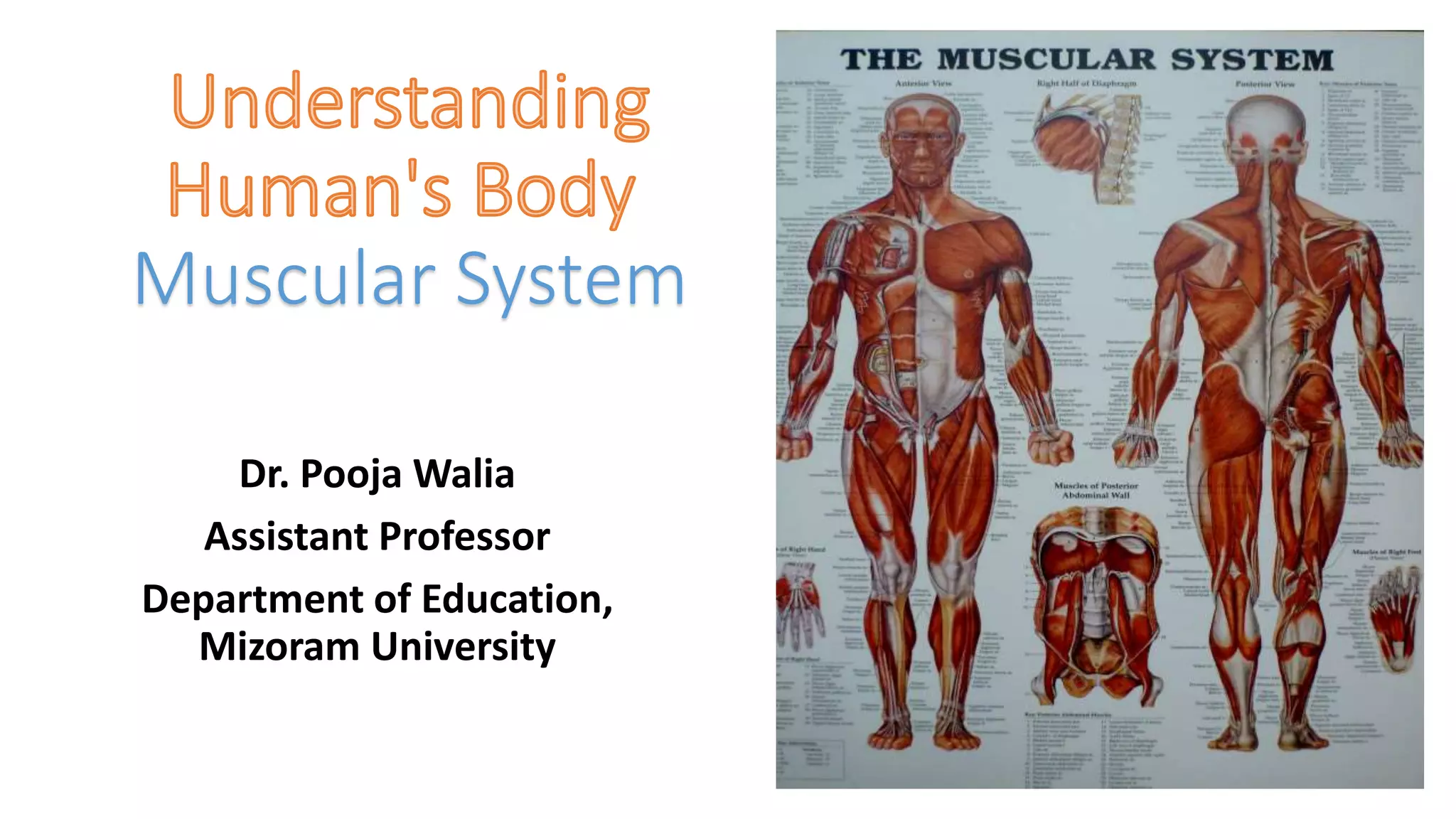
• The muscular system is composed of specialized cells
called muscle fiber. Muscles, attached to bones
or internal organs and blood vessels, are responsible for
movement. Nearly all movement in the body is the result
of muscle contraction.
• The integrated action of joints, bones, and skeletal muscles
produces obvious movements such as walking and running.
• The predominant function of Muscular System is contractibility.
Some other important functions are such as
posture, joint stability, and heat production.
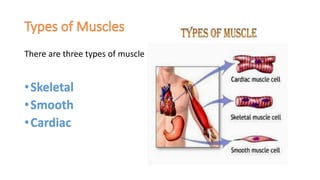
There are three types of muscle:
•Skeletal
•Smooth
•Cardiac
Skeletal muscle is attached to bones responsible for
skeletal movements. The peripheral portion of
the central nervous system (CNS) controls the skeletal
muscles. Thus, these muscles are under conscious, or
voluntary control. The basic unit is the
muscle fiber with many nuclei. These muscle fibers are
striated (having transverse streaks) and each acts
independently of neighboring muscle fibers.
Skeletal muscles also produce more subtle movements
that result in
various facial expressions, eye movements,
and respiration.
Smooth muscle, found in the walls of the
hollow internal organs such as blood vessels,
the gastrointestinal tract, bladder, and uterus, is
under control of the autonomic nervous system.
Smooth muscle cannot be controlled consciously
and thus acts involuntarily. The non-striated
(smooth) muscle cell is spindle-shaped and has
one central nucleus. Smooth muscle contracts
slowly and rhythmically.
Cardiac muscle, found in the walls of the heart, is
also under control of the autonomic nervous
system. The cardiac muscle cell has one central
nucleus, like smooth muscle, but it also is striated,
like skeletal muscle. The cardiac muscle cell is
rectangular in shape. The contraction of cardiac
muscle is involuntary, strong, and rhythmical.
• Excitablity and Irritabilty: They are capable of recieving and
responding stimulation.
• Contractible: After recieving stimulation they are capable of
contracting or shortening.
• Extensible: A muscle can be streched without damage by the
application of force.
• Elasticity: A muscle is able to return to its original resting shape and
length after being extended or contracted.
• Adapatability: It can be changed in response to how it is used.
• Posture, such as sitting and standing, is maintained as a
result of muscle contraction. The skeletal muscles are
continually making fine adjustments that hold the body in
stationary positions.
• The tendons of many muscles extend over joints and in this
way contribute to joint stability. This is particularly evident in
the knee and shoulder joints, where muscle tendons are a
major factor in stabilizing the joint.
• Heat production, to maintain body temperature, is an
important by-product of muscle metabolism. Nearly 85
percent of the heat produced in the body is the result of
muscle contraction.
email ID:poojawaliakuk@gmail.com

Muscular system

  • 1.
    Muscular System Dr. PoojaWalia Assistant Professor Department of Education, Mizoram University
  • 2.
    • Muscular System •Types of Muscles • Skeletel Muscle • Smooth Muscle • Cardiac Muscle • Properties of Muscular System • Functions of Muscular System
  • 3.
    • The muscularsystem is composed of specialized cells called muscle fiber. Muscles, attached to bones or internal organs and blood vessels, are responsible for movement. Nearly all movement in the body is the result of muscle contraction. • The integrated action of joints, bones, and skeletal muscles produces obvious movements such as walking and running. • The predominant function of Muscular System is contractibility. Some other important functions are such as posture, joint stability, and heat production.
  • 4.
    There are threetypes of muscle: •Skeletal •Smooth •Cardiac
  • 5.
    Skeletal muscle isattached to bones responsible for skeletal movements. The peripheral portion of the central nervous system (CNS) controls the skeletal muscles. Thus, these muscles are under conscious, or voluntary control. The basic unit is the muscle fiber with many nuclei. These muscle fibers are striated (having transverse streaks) and each acts independently of neighboring muscle fibers. Skeletal muscles also produce more subtle movements that result in various facial expressions, eye movements, and respiration.
  • 6.
    Smooth muscle, foundin the walls of the hollow internal organs such as blood vessels, the gastrointestinal tract, bladder, and uterus, is under control of the autonomic nervous system. Smooth muscle cannot be controlled consciously and thus acts involuntarily. The non-striated (smooth) muscle cell is spindle-shaped and has one central nucleus. Smooth muscle contracts slowly and rhythmically.
  • 7.
    Cardiac muscle, foundin the walls of the heart, is also under control of the autonomic nervous system. The cardiac muscle cell has one central nucleus, like smooth muscle, but it also is striated, like skeletal muscle. The cardiac muscle cell is rectangular in shape. The contraction of cardiac muscle is involuntary, strong, and rhythmical.
  • 8.
    • Excitablity andIrritabilty: They are capable of recieving and responding stimulation. • Contractible: After recieving stimulation they are capable of contracting or shortening. • Extensible: A muscle can be streched without damage by the application of force. • Elasticity: A muscle is able to return to its original resting shape and length after being extended or contracted. • Adapatability: It can be changed in response to how it is used.
  • 9.
    • Posture, suchas sitting and standing, is maintained as a result of muscle contraction. The skeletal muscles are continually making fine adjustments that hold the body in stationary positions. • The tendons of many muscles extend over joints and in this way contribute to joint stability. This is particularly evident in the knee and shoulder joints, where muscle tendons are a major factor in stabilizing the joint. • Heat production, to maintain body temperature, is an important by-product of muscle metabolism. Nearly 85 percent of the heat produced in the body is the result of muscle contraction.
  • 10.