MembranesMembranes
MembranesMembranes covercover andand lineline all theall the
parts of our body, inside and out.parts of our body, inside and out.
Typical of the science of anatomy,Typical of the science of anatomy,
there are different names forthere are different names for
membranes in different placesmembranes in different places
all over the body!all over the body!
There areThere are fourfour basic kinds ofbasic kinds of
membranesmembranes in the body.in the body.
Almost all of these are formed fromAlmost all of these are formed from
epithelialepithelial tissue.tissue.
1. Mucous Membranes1. Mucous Membranes
These are open to the outside of the body.
Sticky mucus helps protect our openings.
o Digestive (mouth, esophagus, etc.)
o Respiratory (nose, trachea, etc.)
o Reproductive (vagina)
o Urinary (urethra)
2. Serous Membranes2. Serous Membranes
These are in spaces contained inside our bodies
(no openings to the outside).
When they line a body cavity they are called parietal
membranes.
When they cover organs they are called visceral
membranes.
Serous membranes are thin, wet, and slippery.
Fluids may pass through them easily.
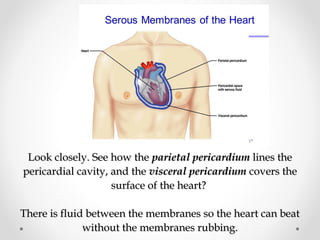
Look closely. See how theLook closely. See how the parietal pericardiumparietal pericardium lines thelines the
pericardial cavity, and thepericardial cavity, and the visceral pericardiumvisceral pericardium covers thecovers the
surface of the heart?surface of the heart?
There is fluid between the membranes so the heart can beatThere is fluid between the membranes so the heart can beat
without the membranes rubbing.without the membranes rubbing.
The serous membranes of different cavities
have different names.
Examples:
o Pleura ( lines the pleural cavities)
o Peritoneum (lines the abdominal cavity)
o Pericardium (lines the pericardial cavity)
Review:
Remember what is in each of these cavities?
Medical note:
Serous membranes can get infected and
inflamed.
These are very serious illnesses:
o Pleura – Pleursy
o Peritoneum – Peritonitis
o Pericardium – Pericarditis or endocarditis
3. Cutaneous Membranes3. Cutaneous Membranes
Cutaneous membranes are thick, warm, dry,
and waterproof.
•Skin (that’s it!)
Subcutaneous = under the skin.
When you get a shot in the arm, it is a subcutaneous
injection, meaning the medicine was delivered under
your skin.
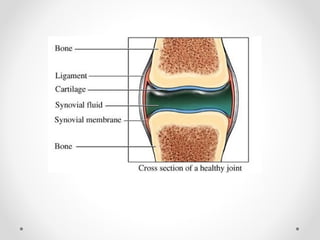
4. Synovial Membranes4. Synovial Membranes
These are thicker, tougher membranes and surround and
cover the joints in our body (like knees or elbows). They are
filled with a slippery lubricant called synovial fluid, so our
joints move smoothly.
These are NOT epithelial tissue, but instead are made of
connective tissue.
There are other connective tissue membranes, but this is the
only kind we’ll talk about right now.
Membranes

Membranes

  • 1.
  • 2.
    MembranesMembranes covercover andandlineline all theall the parts of our body, inside and out.parts of our body, inside and out.
  • 3.
    Typical of thescience of anatomy,Typical of the science of anatomy, there are different names forthere are different names for membranes in different placesmembranes in different places all over the body!all over the body!
  • 4.
    There areThere arefourfour basic kinds ofbasic kinds of membranesmembranes in the body.in the body. Almost all of these are formed fromAlmost all of these are formed from epithelialepithelial tissue.tissue.
  • 5.
    1. Mucous Membranes1.Mucous Membranes These are open to the outside of the body. Sticky mucus helps protect our openings. o Digestive (mouth, esophagus, etc.) o Respiratory (nose, trachea, etc.) o Reproductive (vagina) o Urinary (urethra)
  • 6.
    2. Serous Membranes2.Serous Membranes These are in spaces contained inside our bodies (no openings to the outside). When they line a body cavity they are called parietal membranes. When they cover organs they are called visceral membranes. Serous membranes are thin, wet, and slippery. Fluids may pass through them easily.
  • 7.
    Look closely. Seehow theLook closely. See how the parietal pericardiumparietal pericardium lines thelines the pericardial cavity, and thepericardial cavity, and the visceral pericardiumvisceral pericardium covers thecovers the surface of the heart?surface of the heart? There is fluid between the membranes so the heart can beatThere is fluid between the membranes so the heart can beat without the membranes rubbing.without the membranes rubbing.
  • 8.
    The serous membranesof different cavities have different names. Examples: o Pleura ( lines the pleural cavities) o Peritoneum (lines the abdominal cavity) o Pericardium (lines the pericardial cavity) Review: Remember what is in each of these cavities?
  • 9.
    Medical note: Serous membranescan get infected and inflamed. These are very serious illnesses: o Pleura – Pleursy o Peritoneum – Peritonitis o Pericardium – Pericarditis or endocarditis
  • 10.
    3. Cutaneous Membranes3.Cutaneous Membranes Cutaneous membranes are thick, warm, dry, and waterproof. •Skin (that’s it!) Subcutaneous = under the skin. When you get a shot in the arm, it is a subcutaneous injection, meaning the medicine was delivered under your skin.
  • 11.
    4. Synovial Membranes4.Synovial Membranes These are thicker, tougher membranes and surround and cover the joints in our body (like knees or elbows). They are filled with a slippery lubricant called synovial fluid, so our joints move smoothly. These are NOT epithelial tissue, but instead are made of connective tissue. There are other connective tissue membranes, but this is the only kind we’ll talk about right now.