By: Alex and Mark
OOPS! You’ve missed an arrow!
Please go back!
What is the Muscular System?
The human body has more then 650 different muscles which
 are attached to the skeleton The main job of the muscular
 system is to provide movement for the body. The muscular
 system consists of three different types of muscle tissues
 skeletal, cardiac, and smooth. Each of these different
 tissues has the ability to contract, which then allows body
 movements and functions. There are two types of muscles
 in the system and they are the involuntary muscles, and the
 voluntary muscles. The muscle we can control by ourselves
 are called the voluntary muscles and the ones we can’t
 control are the involuntary muscles like the heart for
 example.
OOPS! You’ve missed an arrow!
Please go back!
The 3 different muscle tissues
 Skeletal muscle tissue: which represents the majority of the
  muscular tissue in the body. Skeletal muscle is the type of muscle
  which powers movement of the skeleton as in walking and lifting.

 Cardiac muscle: A type of muscle with unique features only found in
  the heart. The cardiac muscle is the muscle of the heart.

 Smooth muscle: Generally forms the supporting tissue of blood
  vessels and hollow internal organs such as the stomach, intestine, and
  bladder. So named because of the absence of microscopic lines called
  "cross-striations" which are seen in the other two types.
OOPS! You’ve missed an arrow!
Please go back!
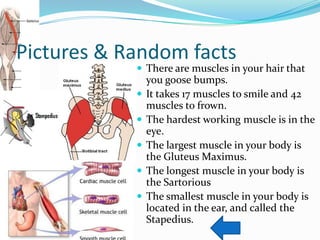
Pictures & Random facts
             There are muscles in your hair that
                you goose bumps.
               It takes 17 muscles to smile and 42
                muscles to frown.
               The hardest working muscle is in the
                eye.
               The largest muscle in your body is
                the Gluteus Maximus.
               The longest muscle in your body is
                the Sartorious
               The smallest muscle in your body is
                located in the ear, and called the
                Stapedius.
OOPS! You’ve missed an arrow!
Please go back!
Different Muscle Disseases
OOPS! You’ve missed an arrow!
Please go back!
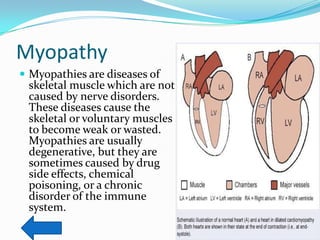
Myopathy
 Myopathies are diseases of
 skeletal muscle which are not
 caused by nerve disorders.
 These diseases cause the
 skeletal or voluntary muscles
 to become weak or wasted.
 Myopathies are usually
 degenerative, but they are
 sometimes caused by drug
 side effects, chemical
 poisoning, or a chronic
 disorder of the immune
 system.
OOPS! You’ve missed an arrow!
Please go back!
Muscular Dystrophy
 Muscular dystrophy (MD) is a broad term that
 describes a genetic (inherited) disorder of the
 muscles. Muscular dystrophy causes the muscles in
 the body to become very weak. The muscles break
 down and are replaced with fatty deposits over time.
 Muscular dystrophy is a genetic disorder that is
 characterized by muscle wasting and weakening.
OOPS! You’ve missed an arrow!
Please go back!
Rhabdomyolysis
 Rhabdomyolysis is the breakdown of muscle fibers
 resulting in the release of muscle fiber contents into
 the circulation. Some of these are toxic to the kidney
 and frequenty result in kidney damage. Many clinical
 features of rhabdomyolysis are nonspecific, and the
 course of the syndrome varies depending on the
 underlying condition.
OOPS! You’ve missed an arrow!
Please go back!
Credits
 http://www.medterms.com
 http://images.google.ca/imghp?hl=en&tab=wi (Google
  Images)
  And then rest to me and mark 

Muscular System

  • 1.
  • 2.
    OOPS! You’ve missedan arrow! Please go back!
  • 3.
    What is theMuscular System? The human body has more then 650 different muscles which are attached to the skeleton The main job of the muscular system is to provide movement for the body. The muscular system consists of three different types of muscle tissues skeletal, cardiac, and smooth. Each of these different tissues has the ability to contract, which then allows body movements and functions. There are two types of muscles in the system and they are the involuntary muscles, and the voluntary muscles. The muscle we can control by ourselves are called the voluntary muscles and the ones we can’t control are the involuntary muscles like the heart for example.
  • 4.
    OOPS! You’ve missedan arrow! Please go back!
  • 5.
    The 3 differentmuscle tissues  Skeletal muscle tissue: which represents the majority of the muscular tissue in the body. Skeletal muscle is the type of muscle which powers movement of the skeleton as in walking and lifting.  Cardiac muscle: A type of muscle with unique features only found in the heart. The cardiac muscle is the muscle of the heart.  Smooth muscle: Generally forms the supporting tissue of blood vessels and hollow internal organs such as the stomach, intestine, and bladder. So named because of the absence of microscopic lines called "cross-striations" which are seen in the other two types.
  • 6.
    OOPS! You’ve missedan arrow! Please go back!
  • 7.
    Pictures & Randomfacts  There are muscles in your hair that you goose bumps.  It takes 17 muscles to smile and 42 muscles to frown.  The hardest working muscle is in the eye.  The largest muscle in your body is the Gluteus Maximus.  The longest muscle in your body is the Sartorious  The smallest muscle in your body is located in the ear, and called the Stapedius.
  • 8.
    OOPS! You’ve missedan arrow! Please go back!
  • 9.
  • 10.
    OOPS! You’ve missedan arrow! Please go back!
  • 11.
    Myopathy  Myopathies arediseases of skeletal muscle which are not caused by nerve disorders. These diseases cause the skeletal or voluntary muscles to become weak or wasted. Myopathies are usually degenerative, but they are sometimes caused by drug side effects, chemical poisoning, or a chronic disorder of the immune system.
  • 12.
    OOPS! You’ve missedan arrow! Please go back!
  • 13.
    Muscular Dystrophy  Musculardystrophy (MD) is a broad term that describes a genetic (inherited) disorder of the muscles. Muscular dystrophy causes the muscles in the body to become very weak. The muscles break down and are replaced with fatty deposits over time. Muscular dystrophy is a genetic disorder that is characterized by muscle wasting and weakening.
  • 14.
    OOPS! You’ve missedan arrow! Please go back!
  • 15.
    Rhabdomyolysis  Rhabdomyolysis isthe breakdown of muscle fibers resulting in the release of muscle fiber contents into the circulation. Some of these are toxic to the kidney and frequenty result in kidney damage. Many clinical features of rhabdomyolysis are nonspecific, and the course of the syndrome varies depending on the underlying condition.
  • 16.
    OOPS! You’ve missedan arrow! Please go back!
  • 17.
    Credits  http://www.medterms.com  http://images.google.ca/imghp?hl=en&tab=wi(Google Images)   And then rest to me and mark 