Flow chart of animal tissues…
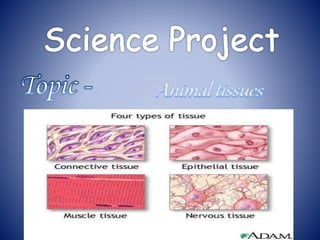
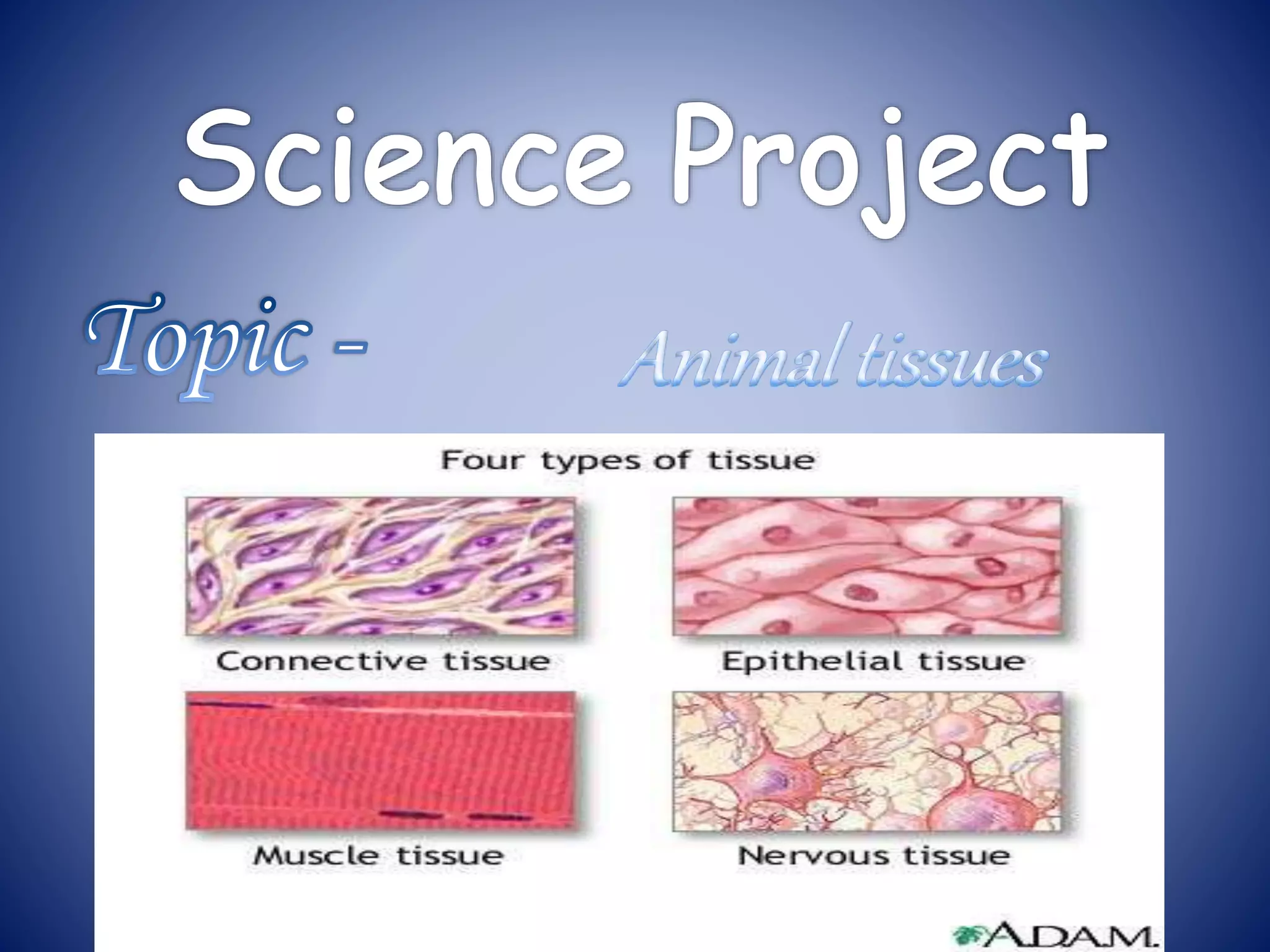
Types of ANIMAL TISSUES …
TYPES ORIGIN
FUNCTION
S
Epithelial Tissues : Ectoderm,Endoder
m,Mesoderm .
Secretion , Protection , Absorption
etc..
Connective Tissues : Mesoderm . Support , Binding , Storage ,
Protection , Circulation .
Muscular Tissues : Mesoderm . Locomotion and Movement .
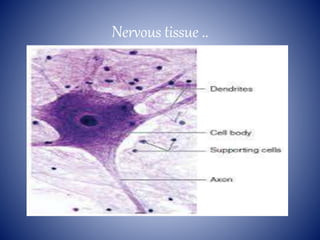
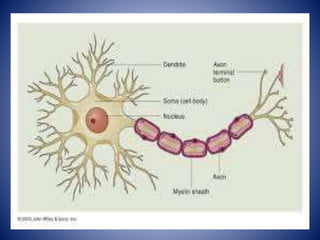
Nervous Tissues : Ectoderm . Control , Coordination and
Conduction of impulse .
EPITHELIAL TISSUES ….
Word epithelial is composed of two words Epi –
upon , thelio – grows .[Means- A tissue which grows
upon another tissue is called EPITHELIAL] .
Nature :
1. It is the simplest tissue. It is the
protective tissue of animal ’s body.
2. It covers most organs and cavities within
the body.
3. It also form a barrier to keep different
body systems separate .
4. It always rest upon underlying connective
tissues.
EPEHTELIAL TISSUES continue ..
5. Epithelial cells are closely packed, so there is very little
inter-cellular space between the cells. Due to less of
intercellular space blood vessels, lymph vessels and
capallaries are unable to pierce this tissue, so blood
circulation is absent in epithelium. Hence cells depend for
their nutrients up on the underlying connective tissue.
6. At the junction of the [Epithelial tissue and connective
tissue] layer is present which is called of basement
membrane, which is formed of mucopolysaccharides and
collagen fibrils.
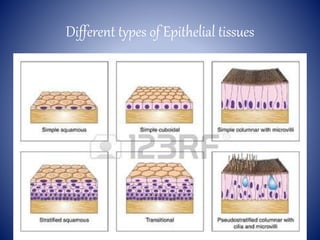
Different types of Epithelial tissues
Epithelial tissues …
STRUCTURE LOCATION FUNCTION
Simple Squamous :
Simple layer of flatened & polygonal
cells, large centrally located nucleus.
Alveoli, blood vessels heart
wall
Filtration, absorption and
secretion
Simple Cuboidal :
Single layer of cube-shaped cells,
centrally located nucleus .
Testes , Ovary, kidney tubules, salivary
duct and pancreatic ducts
Excretion, Secretion and
absorption
Simple Columnar :[non
ciliated]
Single layer of pillar shaped
cells.
Lining of stomach, small and large
intestine, digestive glands and gall
bladder .
Secretion and absorption
Simple Columnar :[ciliated
Simple layer of ciliated rectangular Oviduct, Vas deferens, few portions of Movement of gametes, and
Connective tissue
I. Areolar Connective Tissue .
II. Dense regular Connective Tissue .
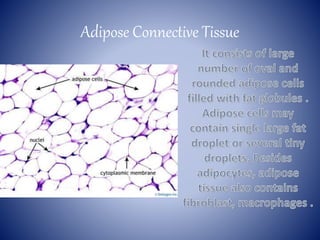
III.Adipose Connective Tissue .
IV. Skeletal Connective Tissue .
V. Fluid Connective Tissue .
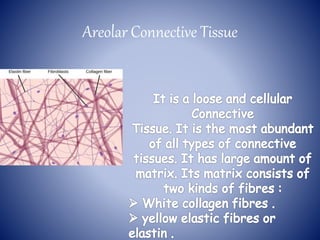
Areolar Connective Tissue
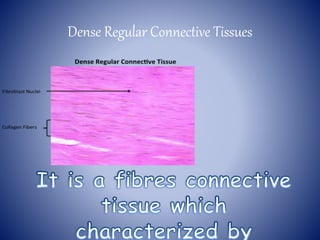
Dense Regular Connective Tissues
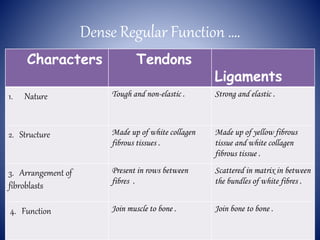
Dense Regular Function ….
Characters Tendons
Ligaments
1. Nature Tough and non-elastic . Strong and elastic .
2. Structure Made up of white collagen
fibrous tissues .
Made up of yellow fibrous
tissue and white collagen
fibrous tissue .
3. Arrangement of
fibroblasts
Present in rows between
fibres .
Scattered in matrix in between
the bundles of white fibres .
4. Function Join muscle to bone . Join bone to bone .
Adipose Connective Tissue
Skeletal tissue
• Skeletal tissue forms the rigid skeleton which
supports the vertebrate body , helps in locomotion and
provides protection to many vital organs. It is
mesodermal in origin. There are two types of skeletal
tissue :
I. Cartilage
II. Bone
Cartilage ..
Cartilage is a special type of connective tissue which forms the soft
endoskeleton of the body. It consists of extensive ground
substance called chondrin .
Types of cartilage :
I. Hyaline cartilage
II. White fibrous cartilage
III. Yellow elastic cartilage
IV. Calcified cartilage
Bones ..
• Bone is the hardest tissue of the body. It forms endoskeleton to give firm
support to the muscles.
• Its functions are :
i. Bones form hard endoskeleton which give shape and support to the body .
ii. Bones protect vital organs of the body, such as brain, spinal cord, lungs,
etc.
iii. Bones provide skeletal support to body and attaches the muscles.
iv. Bone marrow is the centre of blood cell formation in vertabrates.
Fluid Connective Tissue :
It is a special type of connective tissue
which maintains link among different parts
of the body. It receives materials from
certain parts of the body and transports
them to the other parts .
It constitutes the transport system of the
animals .
It consists of two basic components
I. Blood
II. Lymph
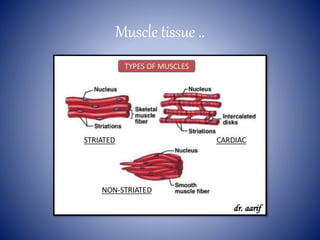
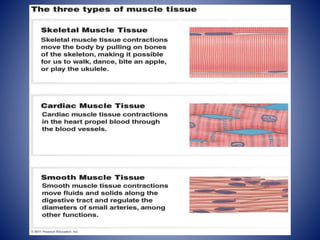
Muscle tissue ..
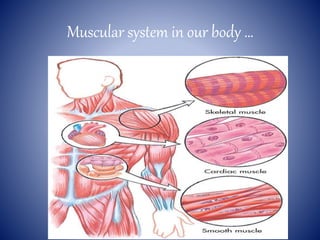
Muscular system in our body …
Nervous tissue ..
Made by -
Bhavya Patel
Roll no - 906
Class - 9

tissue

  • 2.
    Flow chart ofanimal tissues…
  • 3.
    Types of ANIMALTISSUES … TYPES ORIGIN FUNCTION S Epithelial Tissues : Ectoderm,Endoder m,Mesoderm . Secretion , Protection , Absorption etc.. Connective Tissues : Mesoderm . Support , Binding , Storage , Protection , Circulation . Muscular Tissues : Mesoderm . Locomotion and Movement . Nervous Tissues : Ectoderm . Control , Coordination and Conduction of impulse .
  • 4.
    EPITHELIAL TISSUES …. Wordepithelial is composed of two words Epi – upon , thelio – grows .[Means- A tissue which grows upon another tissue is called EPITHELIAL] . Nature : 1. It is the simplest tissue. It is the protective tissue of animal ’s body. 2. It covers most organs and cavities within the body. 3. It also form a barrier to keep different body systems separate . 4. It always rest upon underlying connective tissues.
  • 5.
    EPEHTELIAL TISSUES continue.. 5. Epithelial cells are closely packed, so there is very little inter-cellular space between the cells. Due to less of intercellular space blood vessels, lymph vessels and capallaries are unable to pierce this tissue, so blood circulation is absent in epithelium. Hence cells depend for their nutrients up on the underlying connective tissue. 6. At the junction of the [Epithelial tissue and connective tissue] layer is present which is called of basement membrane, which is formed of mucopolysaccharides and collagen fibrils.
  • 6.
    Different types ofEpithelial tissues
  • 7.
    Epithelial tissues … STRUCTURELOCATION FUNCTION Simple Squamous : Simple layer of flatened & polygonal cells, large centrally located nucleus. Alveoli, blood vessels heart wall Filtration, absorption and secretion Simple Cuboidal : Single layer of cube-shaped cells, centrally located nucleus . Testes , Ovary, kidney tubules, salivary duct and pancreatic ducts Excretion, Secretion and absorption Simple Columnar :[non ciliated] Single layer of pillar shaped cells. Lining of stomach, small and large intestine, digestive glands and gall bladder . Secretion and absorption Simple Columnar :[ciliated Simple layer of ciliated rectangular Oviduct, Vas deferens, few portions of Movement of gametes, and
  • 8.
    Connective tissue I. AreolarConnective Tissue . II. Dense regular Connective Tissue . III.Adipose Connective Tissue . IV. Skeletal Connective Tissue . V. Fluid Connective Tissue .
  • 9.
  • 10.
  • 11.
    Dense Regular Function…. Characters Tendons Ligaments 1. Nature Tough and non-elastic . Strong and elastic . 2. Structure Made up of white collagen fibrous tissues . Made up of yellow fibrous tissue and white collagen fibrous tissue . 3. Arrangement of fibroblasts Present in rows between fibres . Scattered in matrix in between the bundles of white fibres . 4. Function Join muscle to bone . Join bone to bone .
  • 12.
  • 13.
    Skeletal tissue • Skeletaltissue forms the rigid skeleton which supports the vertebrate body , helps in locomotion and provides protection to many vital organs. It is mesodermal in origin. There are two types of skeletal tissue : I. Cartilage II. Bone
  • 14.
    Cartilage .. Cartilage isa special type of connective tissue which forms the soft endoskeleton of the body. It consists of extensive ground substance called chondrin . Types of cartilage : I. Hyaline cartilage II. White fibrous cartilage III. Yellow elastic cartilage IV. Calcified cartilage
  • 15.
    Bones .. • Boneis the hardest tissue of the body. It forms endoskeleton to give firm support to the muscles. • Its functions are : i. Bones form hard endoskeleton which give shape and support to the body . ii. Bones protect vital organs of the body, such as brain, spinal cord, lungs, etc. iii. Bones provide skeletal support to body and attaches the muscles. iv. Bone marrow is the centre of blood cell formation in vertabrates.
  • 16.
    Fluid Connective Tissue: It is a special type of connective tissue which maintains link among different parts of the body. It receives materials from certain parts of the body and transports them to the other parts . It constitutes the transport system of the animals . It consists of two basic components I. Blood II. Lymph
  • 17.
  • 19.
    Muscular system inour body …
  • 20.
  • 22.
    Made by - BhavyaPatel Roll no - 906 Class - 9