CARDIAC
OUTPUT-
II
DR NILESH KATE
ASSOCIATE PROF
DEPARTMENT OF PHYSIOLOGY.
Thursday, February 4, 2016
OBJECTIVES.
 Regulation of cardiac output.
 Control mechanisms.
 Extrinsic & intrinsic.
 Role of heart rate in cardiac output
 Integrated control.
 Heart lung preparation.
 Cardiac & vascular function curves.
Thursday, February 4, 2016
REGULATION OF CARDIAC
OUTPUT.
 Since CO = SV × HR
 SO main factors
controlling are
 Venous return
 Myocardial
contractility
 Peripheral resistance
 Heart rate.
Thursday, February 4, 2016
CARDIAC OUTPUT CONTROL
MECHANISMS.
 Intrinsic.
 Respiratory pump.
 Cardiac pump.
 Muscle pump.
 Blood volume.
 Sympathetic discharge.
 Standing body position.
 Resistance to venous
return.
 Extrinsic.
 Sympathetic activity.
 Parasympathetic
activity.
Thursday, February 4, 2016
INTRINSIC MECHANISMS.
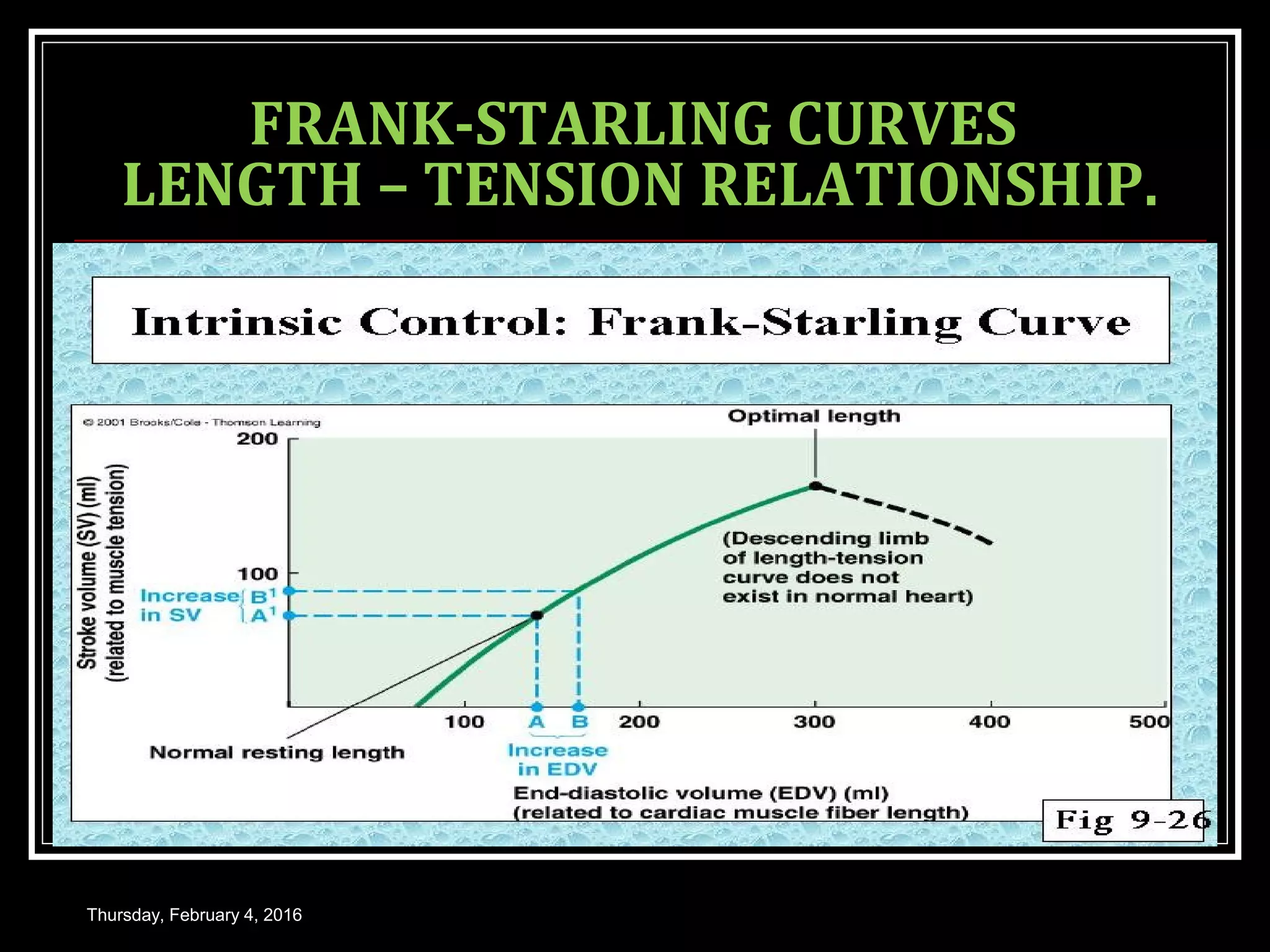
 Based on Frank Starling’s
mechanism/law –
“Within Physiological
limits the force of
contraction of cardiac
muscle is directly
proportional to initial
length of muscle fibre.”
 Initial length of muscle
fibre decided by
condition of muscle
before contraction –
affected by End-
diastolic Volume.
Thursday, February 4, 2016
FRANK-STARLING CURVES
LENGTH – TENSION RELATIONSHIP.
Thursday, February 4, 2016
FACTORS AFFECTING END-
DIASTOLIC VOLUME.
 Respiratory pump.
 Cardiac pump.
 Muscle pump.
 Blood volume.
 Sympathetic discharge.
 Standing body position.
 Resistance to venous
return.
Thursday, February 4, 2016
RESPIRATORY PUMP.
 Intrapleural pressure
 Diameter of IVC
increased – pressure
decreased
 Increased blood flow
to right atrium during
inspiration.
Thursday, February 4, 2016
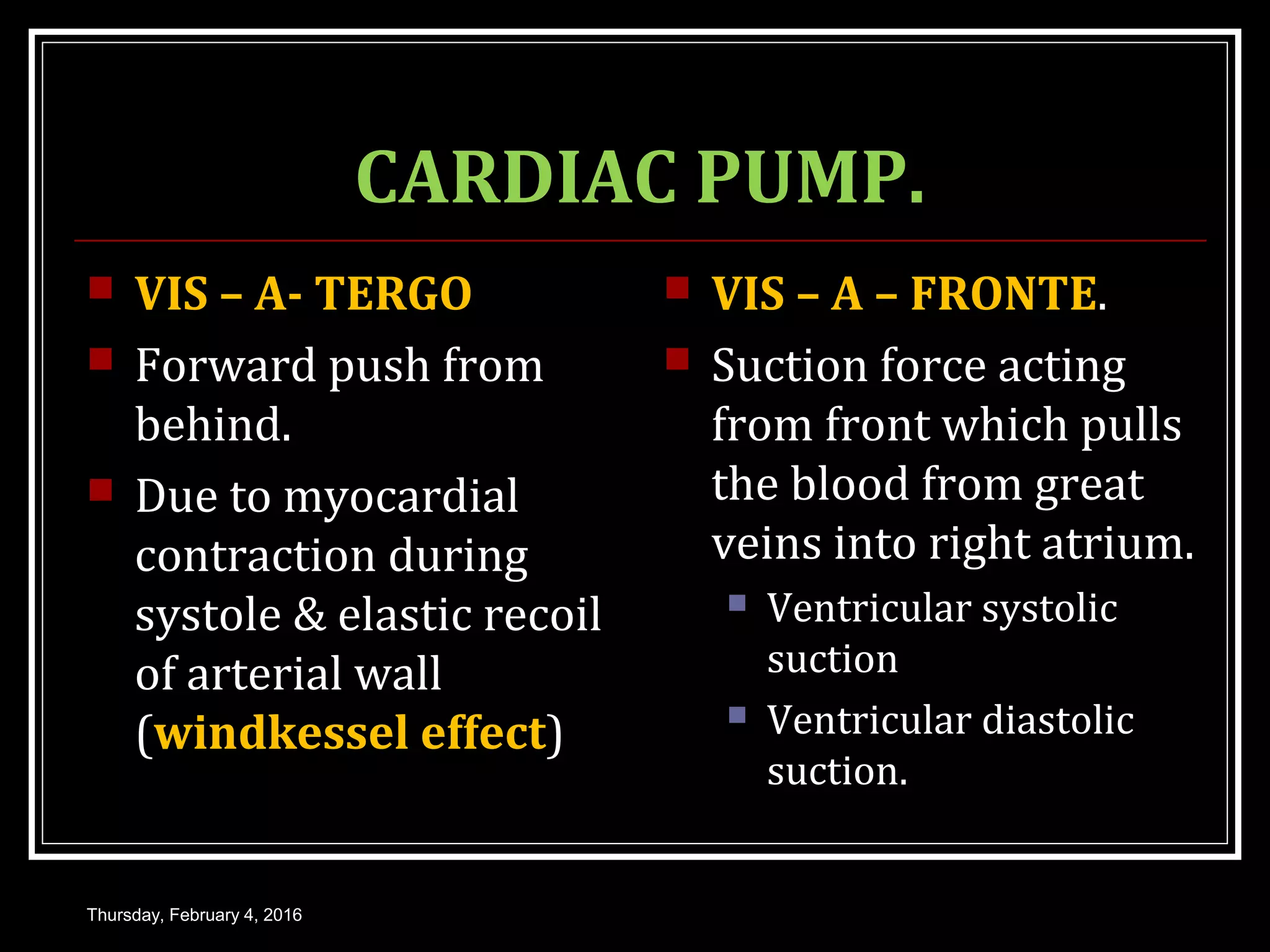
CARDIAC PUMP.
 VIS – A- TERGO
 Forward push from
behind.
 Due to myocardial
contraction during
systole & elastic recoil
of arterial wall
(windkessel effect)
 VIS – A – FRONTE.
 Suction force acting
from front which pulls
the blood from great
veins into right atrium.
 Ventricular systolic
suction
 Ventricular diastolic
suction.
Thursday, February 4, 2016
MUSCLE PUMP.
 Working of muscle
pumps.
 During contraction
 During relaxation.
 With rhythmic
contraction – blood is
squeezed to the heart.
 Applied – Varicose
Veins
Thursday, February 4, 2016
BLOOD VOLUME.
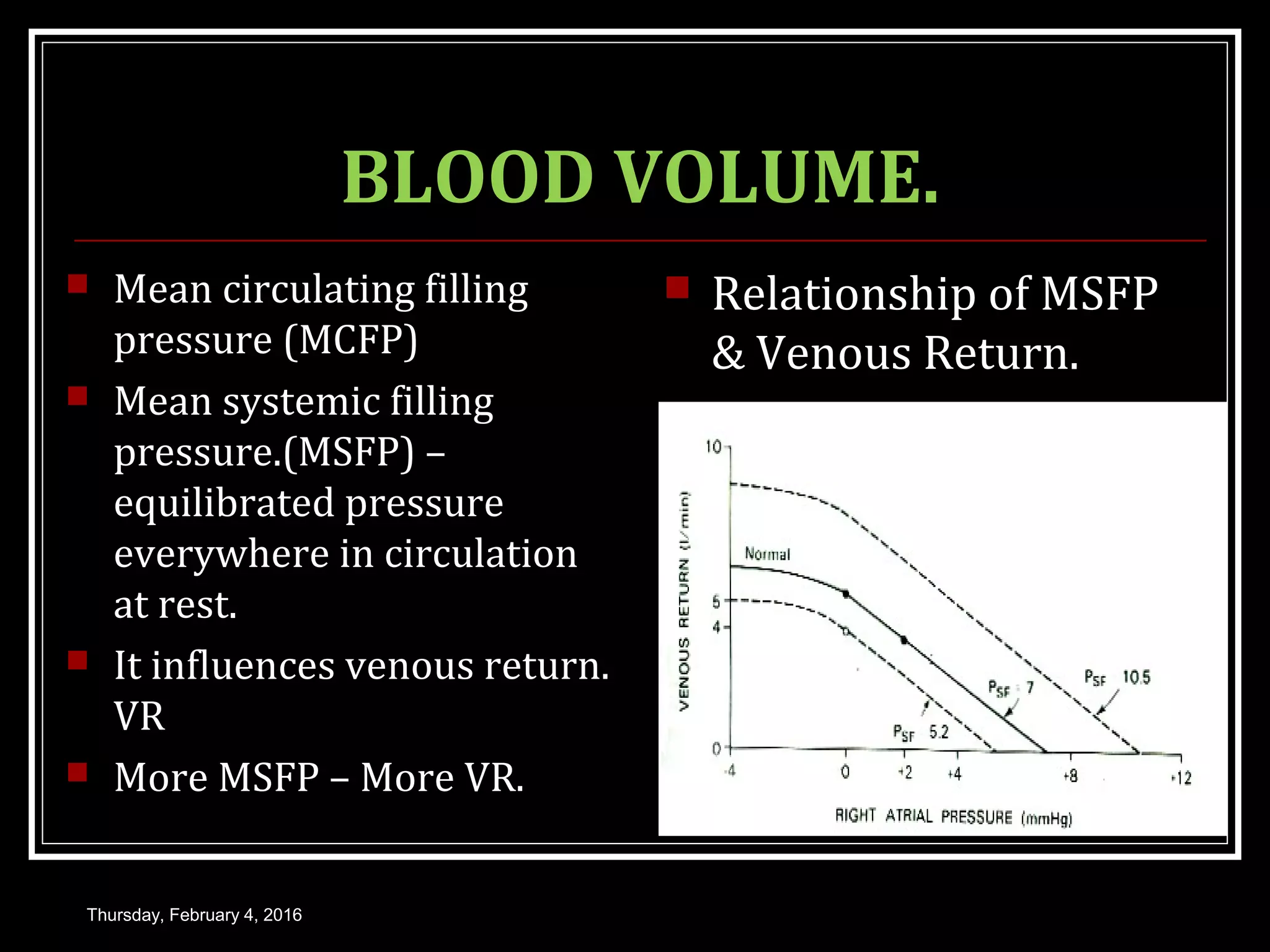
 Mean circulating filling
pressure (MCFP)
 Mean systemic filling
pressure.(MSFP) –
equilibrated pressure
everywhere in circulation
at rest.
 It influences venous return.
VR
 More MSFP – More VR.
 Relationship of MSFP
& Venous Return.
Thursday, February 4, 2016
BLOOD VOLUME.
 MCFP – depends upon
level of blood volume.
 Relationship of MCFP
& blood volume.
Thursday, February 4, 2016
SYMPATHETIC DISCHARGE.
 Sympathetic stimulation
 Increase venous tone
 Decrease venous system
capacity- MCFP increases –
increase VR
 At normal blood volume
sympathetic stimulation
raises MCFP from 7 to 17
mm Hg & Inhibition lowers
MCFP 7 to 4 mmHg.
Thursday, February 4, 2016
STANDING BODY POSITION.
 Prolonged standing –
more venous pooling
– decrease venous
return.
Thursday, February 4, 2016
RESISTANCE TO VENOUS RETURN.
 2/3rd
by Veins & 1/3rd
by Arteries.
 Decrease resistance to half increases venous
return twice & vice –versa.
 Relation of VR & resistance.
Thursday, February 4, 2016
EXTRINSIC MECHANISMS
AUTONOMIC NEURAL MECHANISM.
 Increase in stroke
volume due to
increase in myocardial
contractility without
change in initial
muscle length.
 Homometric
mechanism.
 Sympathetic activity.
 Parasympathetic
activity.
Thursday, February 4, 2016
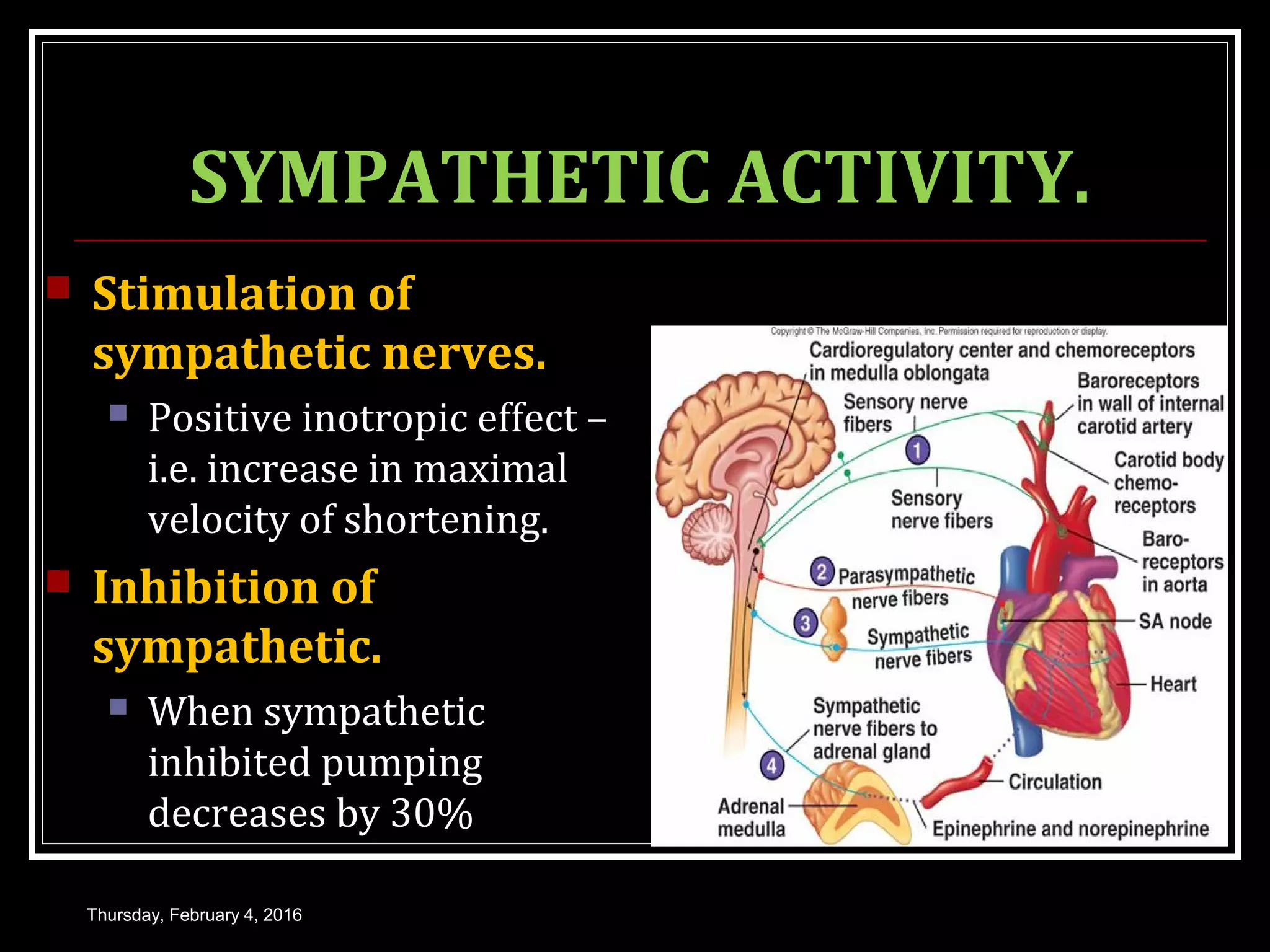
SYMPATHETIC ACTIVITY.
 Stimulation of
sympathetic nerves.
 Positive inotropic effect –
i.e. increase in maximal
velocity of shortening.
 Inhibition of
sympathetic.
 When sympathetic
inhibited pumping
decreases by 30%
Thursday, February 4, 2016
CHARACTERISTICS OF INCREASED
MYOCARDIAL CONTRACTILITY.
 Mechanism – activation
of B1 adrenergic
receptors– activation of
Adenyl cyclase – increase
intracellular Camp – rapid
intake of Ca via protein
kinase.
 Ventricle contracts more
forcefully
 EDV – Decreased.
Thursday, February 4, 2016
PARASYMPATHETIC ACTIVITY.
 Negative Inotropic
Effect.
 Effect not much
pronounced as vagal
fibres supply mainly
atria not ventricles.
Thursday, February 4, 2016
ROLE OF HEART RATE IN
CARDIAC OUTPUT.
 SINCE CO = HR × SV
 But if HR increased alones
CO not changes as
increase HR decrease
diastolic time & EDV
 During exercise increase
HR along with
Chronotropic (Rate)effect
increases CO.
Thursday, February 4, 2016
INTEGRATED CONTRL OF
CARDIAC OUTPUT.
 Interaction of frank
starling mechanism &
myocardial contractility.
 Shift to left – Increased
myocardial contractility
 Shift to right - Decreased
myocardial contractility
Thursday, February 4, 2016
INCREASED MYOCARDIAL
CONTRACTILITY
 Sympathetic stimulation –
β adrenergic receptors.
 Catecholamine.
 Xanthenes – caffeine,
Theophylline , inhibit
breakdown of cAMP
 Glucagon- increase cAMP
 Digitalis & related drugs –
Inhibitory effect on Na-K-
ATPase.
Thursday, February 4, 2016
DECREASED MYOCARDIAL
CONTRACTILITY
 Parasympathetic (vagal)
stimulation.
 Heart failure.
 Myocardial infarction.
 Hypercapnia, hypoxia &
acidosis decrease in cAMP
 Drugs – Quinidine,
Procainamide,
Barbiturates
Thursday, February 4, 2016
HEART LUNG PREPARATION.
 To demonstrate effect
of various factors on
activities of Heart.
Thursday, February 4, 2016
USES OF HEART LUNG
PREPARATION
 Effect of venous return
on stroke volume ( Frank
starling mechanism)
 Effect of sympathetic
stimulation on SV.
 Combined effect of both.
 Effect of peripheral
resistance on CO.
 Cardiac Function Curves.
Thursday, February 4, 2016
CARDIAC FUNCTION CURVES.
 It’s the graphical
analysis of CO,
capacity of ventricles
to pump &
relationship between
CO & CVP
 Useful in patients with
cardiac failure.
 Normal cardiac
function curve.
Thursday, February 4, 2016
HYPER EFFECTIVE CARDIAC
FUNCTION CURVE.
 Sympathetic
stimulation of heart.
 Heart hypertrophy.
Thursday, February 4, 2016
HYPO EFFECTIVE CARDIAC
FUNCTION CURVE.
 Reduced sympathetic
discharge.
 Decreased ventricular
compliance, in MI,
myocarditis.
 Insufficient pumping ;
valvular, septal defects
 Reduced ventricular
filling.
 Increased load
Thursday, February 4, 2016
VASCULAR FUNCTION CURVES.
 Reflects relationship
between venous return
& venous pressure.
 Normal
 Effect of increased
blood volume.
Thursday, February 4, 2016
CARDIOVASCULAR FUNCTION
CURVES.
 Normal
 During exercise
 In CCF.
Thursday, February 4, 2016
Thank you.
Thursday, February 4, 2016

Cardiac output 2

  • 1.
    CARDIAC OUTPUT- II DR NILESH KATE ASSOCIATEPROF DEPARTMENT OF PHYSIOLOGY. Thursday, February 4, 2016
  • 2.
    OBJECTIVES.  Regulation ofcardiac output.  Control mechanisms.  Extrinsic & intrinsic.  Role of heart rate in cardiac output  Integrated control.  Heart lung preparation.  Cardiac & vascular function curves. Thursday, February 4, 2016
  • 3.
    REGULATION OF CARDIAC OUTPUT. Since CO = SV × HR  SO main factors controlling are  Venous return  Myocardial contractility  Peripheral resistance  Heart rate. Thursday, February 4, 2016
  • 4.
    CARDIAC OUTPUT CONTROL MECHANISMS. Intrinsic.  Respiratory pump.  Cardiac pump.  Muscle pump.  Blood volume.  Sympathetic discharge.  Standing body position.  Resistance to venous return.  Extrinsic.  Sympathetic activity.  Parasympathetic activity. Thursday, February 4, 2016
  • 5.
    INTRINSIC MECHANISMS.  Basedon Frank Starling’s mechanism/law – “Within Physiological limits the force of contraction of cardiac muscle is directly proportional to initial length of muscle fibre.”  Initial length of muscle fibre decided by condition of muscle before contraction – affected by End- diastolic Volume. Thursday, February 4, 2016
  • 6.
  • 7.
    FRANK-STARLING CURVES LENGTH –TENSION RELATIONSHIP. Thursday, February 4, 2016
  • 8.
    FACTORS AFFECTING END- DIASTOLICVOLUME.  Respiratory pump.  Cardiac pump.  Muscle pump.  Blood volume.  Sympathetic discharge.  Standing body position.  Resistance to venous return. Thursday, February 4, 2016
  • 9.
    RESPIRATORY PUMP.  Intrapleuralpressure  Diameter of IVC increased – pressure decreased  Increased blood flow to right atrium during inspiration. Thursday, February 4, 2016
  • 10.
    CARDIAC PUMP.  VIS– A- TERGO  Forward push from behind.  Due to myocardial contraction during systole & elastic recoil of arterial wall (windkessel effect)  VIS – A – FRONTE.  Suction force acting from front which pulls the blood from great veins into right atrium.  Ventricular systolic suction  Ventricular diastolic suction. Thursday, February 4, 2016
  • 11.
    MUSCLE PUMP.  Workingof muscle pumps.  During contraction  During relaxation.  With rhythmic contraction – blood is squeezed to the heart.  Applied – Varicose Veins Thursday, February 4, 2016
  • 12.
    BLOOD VOLUME.  Meancirculating filling pressure (MCFP)  Mean systemic filling pressure.(MSFP) – equilibrated pressure everywhere in circulation at rest.  It influences venous return. VR  More MSFP – More VR.  Relationship of MSFP & Venous Return. Thursday, February 4, 2016
  • 13.
    BLOOD VOLUME.  MCFP– depends upon level of blood volume.  Relationship of MCFP & blood volume. Thursday, February 4, 2016
  • 14.
    SYMPATHETIC DISCHARGE.  Sympatheticstimulation  Increase venous tone  Decrease venous system capacity- MCFP increases – increase VR  At normal blood volume sympathetic stimulation raises MCFP from 7 to 17 mm Hg & Inhibition lowers MCFP 7 to 4 mmHg. Thursday, February 4, 2016
  • 15.
    STANDING BODY POSITION. Prolonged standing – more venous pooling – decrease venous return. Thursday, February 4, 2016
  • 16.
    RESISTANCE TO VENOUSRETURN.  2/3rd by Veins & 1/3rd by Arteries.  Decrease resistance to half increases venous return twice & vice –versa.  Relation of VR & resistance. Thursday, February 4, 2016
  • 17.
    EXTRINSIC MECHANISMS AUTONOMIC NEURALMECHANISM.  Increase in stroke volume due to increase in myocardial contractility without change in initial muscle length.  Homometric mechanism.  Sympathetic activity.  Parasympathetic activity. Thursday, February 4, 2016
  • 18.
    SYMPATHETIC ACTIVITY.  Stimulationof sympathetic nerves.  Positive inotropic effect – i.e. increase in maximal velocity of shortening.  Inhibition of sympathetic.  When sympathetic inhibited pumping decreases by 30% Thursday, February 4, 2016
  • 19.
    CHARACTERISTICS OF INCREASED MYOCARDIALCONTRACTILITY.  Mechanism – activation of B1 adrenergic receptors– activation of Adenyl cyclase – increase intracellular Camp – rapid intake of Ca via protein kinase.  Ventricle contracts more forcefully  EDV – Decreased. Thursday, February 4, 2016
  • 20.
    PARASYMPATHETIC ACTIVITY.  NegativeInotropic Effect.  Effect not much pronounced as vagal fibres supply mainly atria not ventricles. Thursday, February 4, 2016
  • 21.
    ROLE OF HEARTRATE IN CARDIAC OUTPUT.  SINCE CO = HR × SV  But if HR increased alones CO not changes as increase HR decrease diastolic time & EDV  During exercise increase HR along with Chronotropic (Rate)effect increases CO. Thursday, February 4, 2016
  • 22.
    INTEGRATED CONTRL OF CARDIACOUTPUT.  Interaction of frank starling mechanism & myocardial contractility.  Shift to left – Increased myocardial contractility  Shift to right - Decreased myocardial contractility Thursday, February 4, 2016
  • 23.
    INCREASED MYOCARDIAL CONTRACTILITY  Sympatheticstimulation – β adrenergic receptors.  Catecholamine.  Xanthenes – caffeine, Theophylline , inhibit breakdown of cAMP  Glucagon- increase cAMP  Digitalis & related drugs – Inhibitory effect on Na-K- ATPase. Thursday, February 4, 2016
  • 24.
    DECREASED MYOCARDIAL CONTRACTILITY  Parasympathetic(vagal) stimulation.  Heart failure.  Myocardial infarction.  Hypercapnia, hypoxia & acidosis decrease in cAMP  Drugs – Quinidine, Procainamide, Barbiturates Thursday, February 4, 2016
  • 25.
    HEART LUNG PREPARATION. To demonstrate effect of various factors on activities of Heart. Thursday, February 4, 2016
  • 26.
    USES OF HEARTLUNG PREPARATION  Effect of venous return on stroke volume ( Frank starling mechanism)  Effect of sympathetic stimulation on SV.  Combined effect of both.  Effect of peripheral resistance on CO.  Cardiac Function Curves. Thursday, February 4, 2016
  • 27.
    CARDIAC FUNCTION CURVES. It’s the graphical analysis of CO, capacity of ventricles to pump & relationship between CO & CVP  Useful in patients with cardiac failure.  Normal cardiac function curve. Thursday, February 4, 2016
  • 28.
    HYPER EFFECTIVE CARDIAC FUNCTIONCURVE.  Sympathetic stimulation of heart.  Heart hypertrophy. Thursday, February 4, 2016
  • 29.
    HYPO EFFECTIVE CARDIAC FUNCTIONCURVE.  Reduced sympathetic discharge.  Decreased ventricular compliance, in MI, myocarditis.  Insufficient pumping ; valvular, septal defects  Reduced ventricular filling.  Increased load Thursday, February 4, 2016
  • 30.
    VASCULAR FUNCTION CURVES. Reflects relationship between venous return & venous pressure.  Normal  Effect of increased blood volume. Thursday, February 4, 2016
  • 31.
    CARDIOVASCULAR FUNCTION CURVES.  Normal During exercise  In CCF. Thursday, February 4, 2016
  • 32.