DR NILESH KATE
MBBS,MD
PROFESSOR
ESIC MEDICAL COLLEGE, GULBARGA.
DEPT. OF PHYSIOLOGY
GIT
MOTILITY
OBJECTIVES.
 Mastication
 Lubrication of food by saliva
 Deglutition
INTRODUCTION
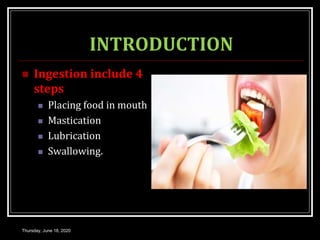
 Ingestion include 4
steps
 Placing food in mouth
 Mastication
 Lubrication
 Swallowing.
Thursday, June 18, 2020
MASTICATION
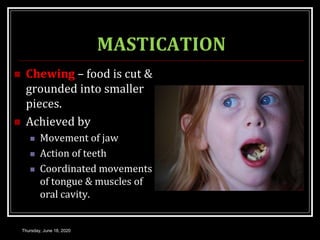
 Chewing – food is cut &
grounded into smaller
pieces.
 Achieved by
 Movement of jaw
 Action of teeth
 Coordinated movements
of tongue & muscles of
oral cavity.
Thursday, June 18, 2020
CHEWING REFLEX
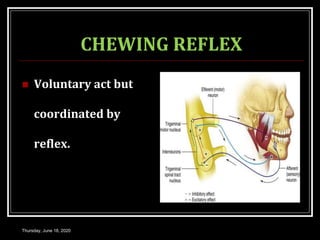
 Voluntary act but
coordinated by
reflex.
Thursday, June 18, 2020
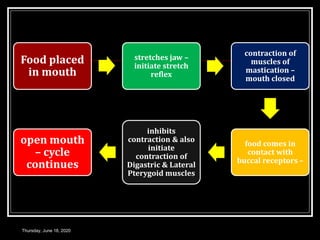
Food placed
in mouth
stretches jaw –
initiate stretch
reflex
contraction of
muscles of
mastication –
mouth closed
food comes in
contact with
buccal receptors –
inhibits
contraction & also
initiate
contraction of
Digastric & Lateral
Pterygoid muscles
open mouth
– cycle
continues
MUSCLES OF MASTICATION
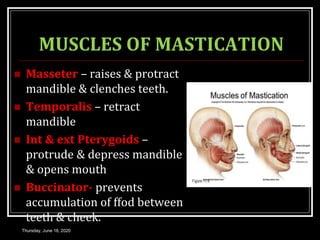
 Masseter – raises & protract
mandible & clenches teeth.
 Temporalis – retract
mandible
 Int & ext Pterygoids –
protrude & depress mandible
& opens mouth
 Buccinator- prevents
accumulation of ffod between
teeth & cheek.
Thursday, June 18, 2020
FUNCTIONS OF MASTICATION
 Breaking of food into smaller pieces.
 Mixing of food with saliva
 Swallowing & lubrication & softening of food
 Stimulate olfactory receptors & taste
receptors & increase pleasure of eating &
stimulate gastric secretion.
Thursday, June 18, 2020
DEGLUTITION
 Def – Passage of food from oral cavity to into
stomach.
 Phases
 Oral
 Pharyngeal
 Oesophageal
Thursday, June 18, 2020
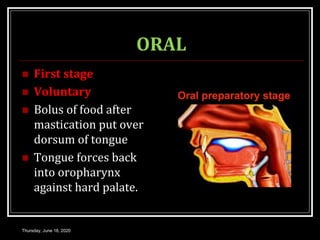
ORAL
 First stage
 Voluntary
 Bolus of food after
mastication put over
dorsum of tongue
 Tongue forces back
into oropharynx
against hard palate.
Thursday, June 18, 2020
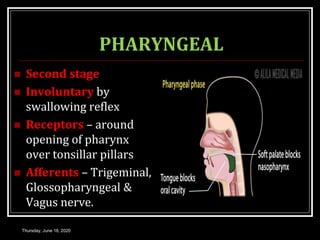
PHARYNGEAL
 Second stage
 Involuntary by
swallowing reflex
 Receptors – around
opening of pharynx
over tonsillar pillars
 Afferents – Trigeminal,
Glossopharyngeal &
Vagus nerve.
Thursday, June 18, 2020
PHARYNGEAL
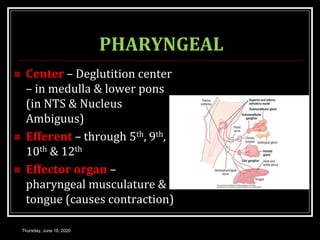
 Center – Deglutition center
– in medulla & lower pons
(in NTS & Nucleus
Ambiguus)
 Efferent – through 5th, 9th,
10th & 12th
 Effector organ –
pharyngeal musculature &
tongue (causes contraction)
Thursday, June 18, 2020
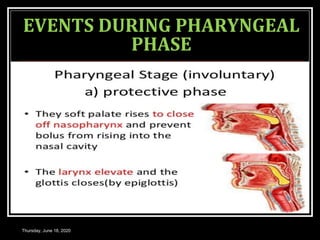
EVENTS DURING PHARYNGEAL
PHASE
Thursday, June 18, 2020
OESOPHAGEAL
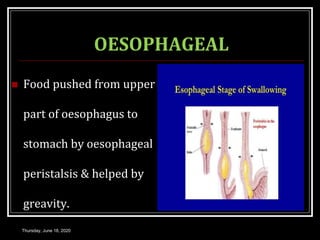
 Food pushed from upper
part of oesophagus to
stomach by oesophageal
peristalsis & helped by
greavity.
Thursday, June 18, 2020
APPLIED PHYSIOLOGY
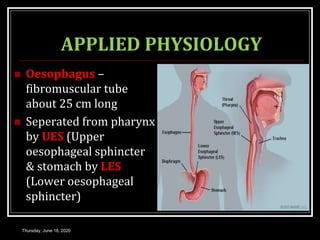
 Oesophagus –
fibromuscular tube
about 25 cm long
 Seperated from pharynx
by UES (Upper
oesophageal sphincter
& stomach by LES
(Lower oesophageal
sphincter)
Thursday, June 18, 2020
OESOPHAGEAL PERISTALSIS
 Primary – Initiated by swallowing &
coordinated by vagal fibers from swallowing
centers
 As food enters oesophagus UES contracts prevents
regurgitation of food into mouth & propels food
down.
 As reaches LES , it relaxes & allow food to enter
stomach.
Thursday, June 18, 2020
OESOPHAGEAL PERISTALSIS
 Secondary – when primary peristalsis is not
able to pass food down, remaining food
stretches mechanical receptors & initiate
secondary peristalsis.
 It is coordinated by intrinsic nervous system
of oesophagus.
Thursday, June 18, 2020
DISORDERS OF SWALLOWING
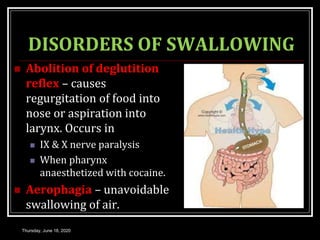
 Abolition of deglutition
reflex – causes
regurgitation of food into
nose or aspiration into
larynx. Occurs in
 IX & X nerve paralysis
 When pharynx
anaesthetized with cocaine.
 Aerophagia – unavoidable
swallowing of air.
Thursday, June 18, 2020
DISORDERS OF SWALLOWING
 Dysphagia – Difficulty in swallowing.
 Cardiac achalsia – neuromuscular disorder
of LES, failure of LES to relax & food
accumulate in lower oesophagus.
 Gastroesophageal reflux disease.
 Incompetence of LES, leads to reflux of acidic
gastric content into oesophagus.
 Causes pain & irritation.
Thursday, June 18, 2020
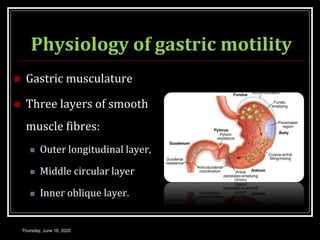
Physiology of gastric motility
 Gastric musculature
 Three layers of smooth
muscle fibres:
 Outer longitudinal layer,
 Middle circular layer
 Inner oblique layer.
Thursday, June 18, 2020
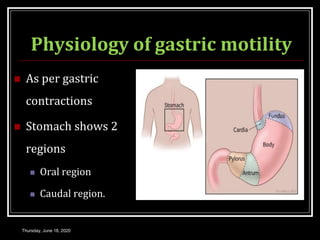
Physiology of gastric motility
 As per gastric
contractions
 Stomach shows 2
regions
 Oral region
 Caudal region.
Thursday, June 18, 2020
Motor functions of stomach
 Done by the gastric motility are:
 Storage of food,
 Mixing of food and
 Slow emptying of food.
Thursday, June 18, 2020
Initiation of gastric motility
 Basal electrical rhythm.
 Represents a wave of depolarization of
smooth muscle cells from the circular
muscles of the fundus of stomach
To the pyloric sphincter.
Thursday, June 18, 2020
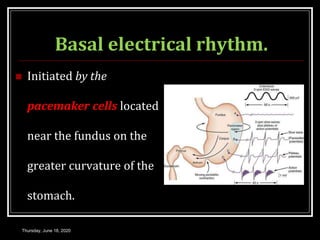
Basal electrical rhythm.
 Initiated by the
pacemaker cells located
near the fundus on the
greater curvature of the
stomach.
Thursday, June 18, 2020
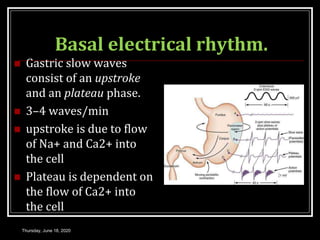
Basal electrical rhythm.
 Gastric slow waves
consist of an upstroke
and an plateau phase.
 3–4 waves/min
 upstroke is due to flow
of Na+ and Ca2+ into
the cell
 Plateau is dependent on
the flow of Ca2+ into
the cell
Thursday, June 18, 2020
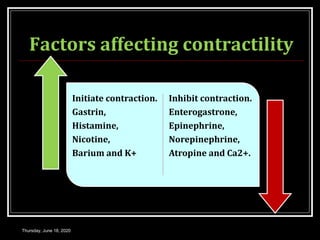
Factors affecting contractility
Thursday, June 18, 2020
Initiate contraction.
Gastrin,
Histamine,
Nicotine,
Barium and K+
Inhibit contraction.
Enterogastrone,
Epinephrine,
Norepinephrine,
Atropine and Ca2+.
Types of gastric motility.
 Motility of empty stomach
 Migrating motor complex
 Hunger contractions
 Gastric motility related to meal
 Receptive relaxation
 Mixing peristaltic waves
 Gastric emptying.
Thursday, June 18, 2020
Motility of empty stomach
 Migrating motor complex
 Hunger contractions
Thursday, June 18, 2020
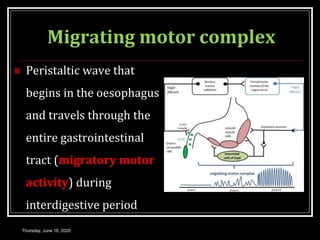
Migrating motor complex
 Peristaltic wave that
begins in the oesophagus
and travels through the
entire gastrointestinal
tract (migratory motor
activity) during
interdigestive period
Thursday, June 18, 2020
Interdigestive housekeepers
 Remove any food remaining in the stomach
and intestines during interdigestive period
Thursday, June 18, 2020
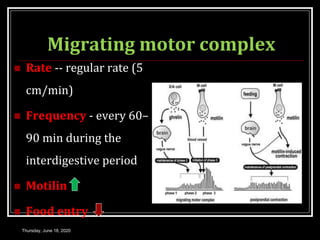
Migrating motor complex
 Rate -- regular rate (5
cm/min)
 Frequency - every 60–
90 min during the
interdigestive period
 Motilin
 Food entry
Thursday, June 18, 2020
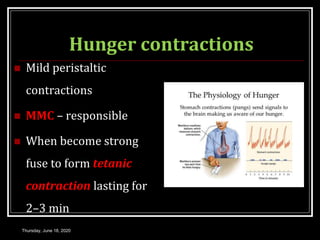
Hunger contractions
 Mild peristaltic
contractions
 MMC – responsible
 When become strong
fuse to form tetanic
contraction lasting for
2–3 min
Thursday, June 18, 2020
Gastric motility related to
meal
 Receptive relaxation
 Mixing peristaltic waves
 Gastric emptying.
Thursday, June 18, 2020
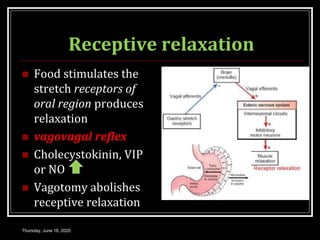
Receptive relaxation
 Food stimulates the
stretch receptors of
oral region produces
relaxation
 vagovagal reflex
 Cholecystokinin, VIP
or NO
 Vagotomy abolishes
receptive relaxation
Thursday, June 18, 2020
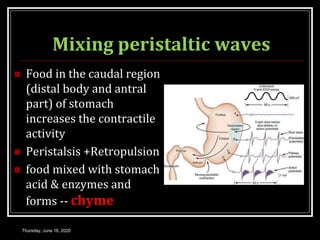
Mixing peristaltic waves
 Food in the caudal region
(distal body and antral
part) of stomach
increases the contractile
activity
 Peristalsis +Retropulsion
 food mixed with stomach
acid & enzymes and
forms -- chyme
Thursday, June 18, 2020
Initiation and production of
peristalsis
 Co-ordinated pattern of smooth muscle contraction and
relaxation where wave of relaxation precedes wave of
contraction.
 Rhythm determined by the BER
 The number of spikes fired in a
 Slow wave determines the force of each peristaltic contraction
Thursday, June 18, 2020
Mixing mechanism of peristalsis and
retropulsion
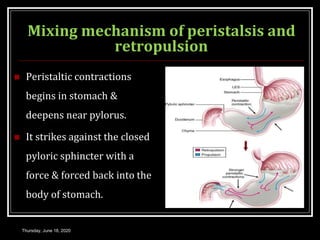
 Peristaltic contractions
begins in stomach &
deepens near pylorus.
 It strikes against the closed
pyloric sphincter with a
force & forced back into the
body of stomach.
Thursday, June 18, 2020
Mixing mechanism of peristalsis and
retropulsion
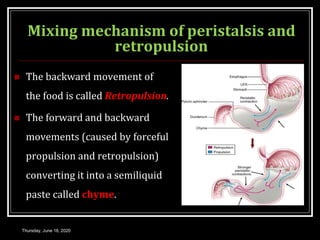
 The backward movement of
the food is called Retropulsion.
 The forward and backward
movements (caused by forceful
propulsion and retropulsion)
converting it into a semiliquid
paste called chyme.
Thursday, June 18, 2020
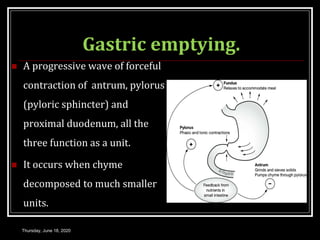
Gastric emptying.
 A progressive wave of forceful
contraction of antrum, pylorus
(pyloric sphincter) and
proximal duodenum, all the
three function as a unit.
 It occurs when chyme
decomposed to much smaller
units.
Thursday, June 18, 2020
Factors regulating gastric
emptying.
 Fluidity of chyme
 Gastric factors
 Duodenal factors
 Other factors.
Thursday, June 18, 2020
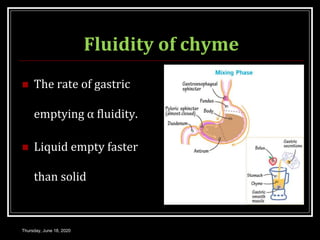
Fluidity of chyme
 The rate of gastric
emptying α fluidity.
 Liquid empty faster
than solid
Thursday, June 18, 2020
Gastric factors
 Volume of food in the stomach – directly
proportional.
 Gastrin hormone. promotes gastric
emptying.
 Type of food ingested –(Fastest)
Carbohydrate >protein > fats (slowest).
Thursday, June 18, 2020
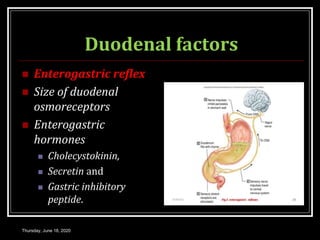
Duodenal factors
 Enterogastric reflex
 Size of duodenal
osmoreceptors
 Enterogastric
hormones
 Cholecystokinin,
 Secretin and
 Gastric inhibitory
peptide.
Thursday, June 18, 2020
Other factors affecting gastric
motility..
Anger
and
Aggression
Depression
and
Fear
Vagotomy and
peptide Y
Thursday, June 18, 2020
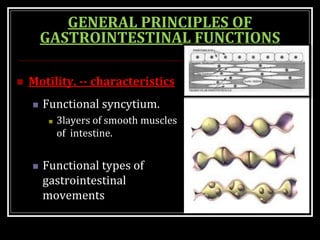
GENERAL PRINCIPLES OF
GASTROINTESTINAL FUNCTIONS
 Motility. -- characteristics
 Functional syncytium.
 3layers of smooth muscles
of intestine.
 Functional types of
gastrointestinal
movements
GENERAL PRINCIPLES OF
GASTROINTESTINAL FUNCTIONS
 Propulsive
 Contraction ring
 Receptive relaxation.
 Mixing
 Peristaltic contractions
 Local constrictive contractions.
SMALL INTESTINE MOTILITY
 DURING INTERDIGESTIVE PERIOD
 DURING DIGESTIVE PERIOD
 MOTILITY REFLEXES.
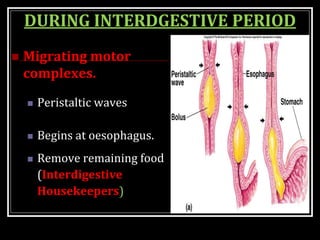
DURING INTERDGESTIVE PERIOD
 Migrating motor
complexes.
 Peristaltic waves
 Begins at oesophagus.
 Remove remaining food
(Interdigestive
Housekeepers)
Migrating Motor Complexes.
 RATE- Regular 5 cm/min every 60-90 min.
 Close correlation between BER & MMC.
 Associated with increase in gastric secretion, bile
flow & pancreatic secretion.
 Abolished immediately with entry of food.
DURING DIGESTIVE PERIOD
 Mixing movements
 Propulsive movements
 Movements of villi.
Mixing movements
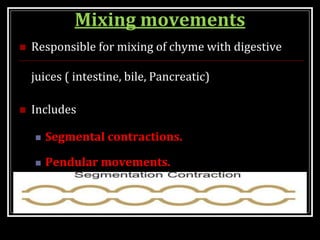
 Responsible for mixing of chyme with digestive
juices ( intestine, bile, Pancreatic)
 Includes
 Segmental contractions.
 Pendular movements.
SEGMENTAL CONTRACTIONS.
 Features
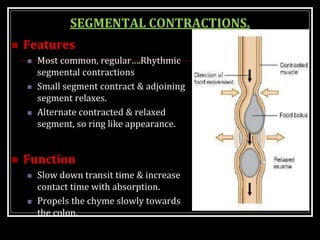
 Most common, regular….Rhythmic
segmental contractions
 Small segment contract & adjoining
segment relaxes.
 Alternate contracted & relaxed
segment, so ring like appearance.
 Function
 Slow down transit time & increase
contact time with absorption.
 Propels the chyme slowly towards
the colon.
SEGMENTAL CONTRACTIONS. (cont…)
 Rate & duration.
 12 times/ min ( duodenum)
 8 times / min (ileum)
 Types (2 types)
 Eccentric ( lesser than 2 cm in length)
 Concentric (longer than 2cm in length)
 Control
 Initiation
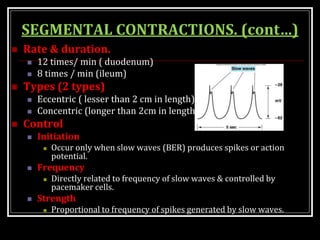
 Occur only when slow waves (BER) produces spikes or action
potential.
 Frequency
 Directly related to frequency of slow waves & controlled by
pacemaker cells.
 Strength
 Proportional to frequency of spikes generated by slow waves.
PENDULAR MOVEMENTS.
 Small constrictive waves sweep forward &
backward or upward & downward in
pendular fashion.
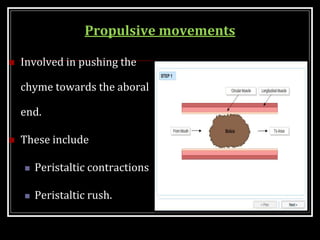
Propulsive movements
 Involved in pushing the
chyme towards the aboral
end.
 These include
 Peristaltic contractions
 Peristaltic rush.
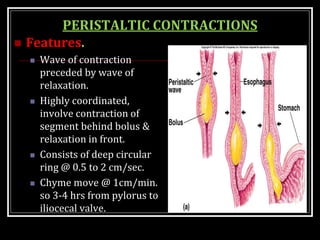
PERISTALTIC CONTRACTIONS
 Features.
 Wave of contraction
preceded by wave of
relaxation.
 Highly coordinated,
involve contraction of
segment behind bolus &
relaxation in front.
 Consists of deep circular
ring @ 0.5 to 2 cm/sec.
 Chyme move @ 1cm/min.
so 3-4 hrs from pylorus to
iliocecal valve.
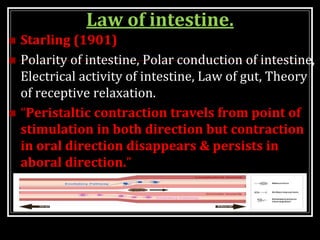
Law of intestine.
 Starling (1901)
 Polarity of intestine, Polar conduction of intestine,
Electrical activity of intestine, Law of gut, Theory
of receptive relaxation.
 “Peristaltic contraction travels from point of
stimulation in both direction but contraction
in oral direction disappears & persists in
aboral direction.”
PERISTALTIC CONTRACTIONS
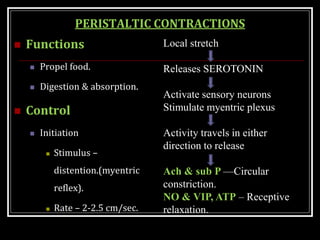
 Functions
 Propel food.
 Digestion & absorption.
 Control
 Initiation
 Stimulus –
distention.(myentric
reflex).
 Rate – 2-2.5 cm/sec.
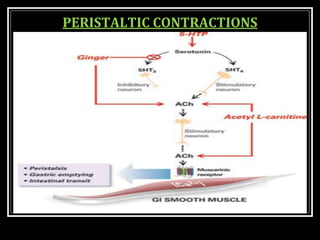
Local stretch
Releases SEROTONIN
Activate sensory neurons
Stimulate myentric plexus
Activity travels in either
direction to release
Ach & sub P —Circular
constriction.
NO & VIP, ATP – Receptive
relaxation.
PERISTALTIC CONTRACTIONS
PERISTALTIC RUSH.
 Very powerful peristaltic contractions
 When intestinal mucosa irritated
 Partly initiated by extrinsic nervous system & partly by
myentric reflex.
 Begins in duodenum through entire length up to iliocecal
valve.
 Relieve small intestine irritant or extensive distention.
 E.g. ---Diarrhoea.
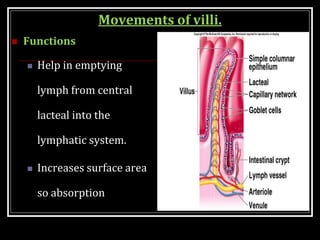
Movements of villi.
 Features
 Consists of alternate shortening & elongation of
villi by contraction & relaxation of muscles.
 Initiation.
 Local nervous reflexes.
 Villikinin.– hormone from small intestine mucosa.
Movements of villi.
 Functions
 Help in emptying
lymph from central
lacteal into the
lymphatic system.
 Increases surface area
so absorption
MOTILITY REFLEXES.
 Gastroileal reflex.
 Distention of stomach by food.
 Reflex stimulation of vagus.
 Relaxation of iliocecal sphincter
 Intestinointesinal reflex.
 Over distention of one segment
 Relaxation of smooth muscle of rest of
intestine.
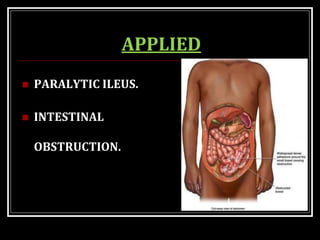
APPLIED
 PARALYTIC ILEUS.
 INTESTINAL
OBSTRUCTION.
PARALYTIC ILEUS.
 Adynamic ileus.
 Pathophysiology –
intestinal motility
markedly decreased
leads to retention of
contents
 Irregular distension of
small intestine by
pockets of gas & fluids.
 Causes ---
 Direct inhibition of
smooth muscle of small
intestine due to handling
of intestine. e.g.
Intraabdominal
operations & trauma.
 Reflex inhibition due to
increased discharge of
noradrenergic fibres in
splanchnic nerves.
Thursday, June 18, 2020
INTESTINAL OBSTRUCTION.
 Causes –
 Due to tumors,
strictures and fibrotic
bands in abdomen.
 Features –
 Intestinal colic – severe pain
due to peristaltic rush.
 Distension of small intestine
due to increased
intraluminal pressure.
 Local ischemia.
 Sweating , hypotension &
severe vomiting due to
stimulation of visceral afferent
nerves.
 When obstruction in upper
part of small intestine—
antiperistaltic reflux causes
intestinal juices to flow into
stomach.
 When obstruction in upper
part of small intestine— vomit
become more basic than
acidic.
Thursday, June 18, 2020
LARGE INTESTINE MOTILITY.
 Slow wave activity.
 Coordinated by BER Or Slow wave
activity (SWA)
 Frequency of SWA gradually increase
down the LI.
 9/min – iliocecal valve to 16/min at
sigmoid colon.
LARGE INTESTINE MOVEMENTS.
 Functions
 Absorption of water & electrolyte from chyme
(Proximal)
 Storage of faecal matter.(Distal)
 Contractile activity serves 2 main functions
 Increase efficacy for absorption
 Promotes excretion of faecal matter.
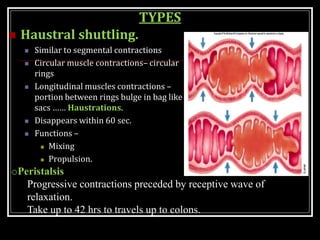
TYPES
 Haustral shuttling.
 Similar to segmental contractions
 Circular muscle contractions– circular
rings
 Longitudinal muscles contractions –
portion between rings bulge in bag like
sacs …… Haustrations.
 Disappears within 60 sec.
 Functions –
 Mixing
 Propulsion.
oPeristalsis
Progressive contractions preceded by receptive wave of
relaxation.
Take up to 42 hrs to travels up to colons.
TYPES
 Mass movements.
 Special types of peristaltic contractions in colon only.
 3-4 times a day after a meals.
 Contraction of the smooth muscle over a large area distal to the
constriction.
 Force faecal matter into rectum initiate defecation reflex.
 Can be initiated by
 Gastro colic reflex
 Intense stimulation of parasympathetic nerves.
 Over distention of segment of colon.
DEFAECATION REFLEX.
 Functional anatomy.
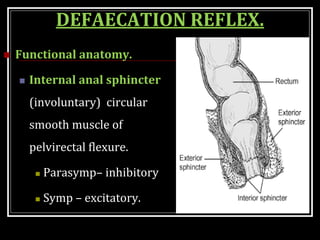
 Internal anal sphincter
(involuntary) circular
smooth muscle of
pelvirectal flexure.
 Parasymp– inhibitory
 Symp – excitatory.
DEFAECATION REFLEX.
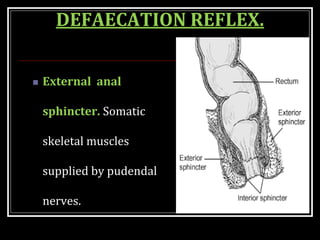
 External anal
sphincter. Somatic
skeletal muscles
supplied by pudendal
nerves.
DEFAECATION REFLEX.
 Act of defaecation
 Involves both – voluntary & reflex activity.
 Reflex contraction of distal colon & rectum –
propel faecal matter in anal canal.
 Reflex relaxation of internal anal sphincter.
 Reflex relaxation with voluntary control of Ext
anal sphincter & voluntary contraction of
abdominal muscles.
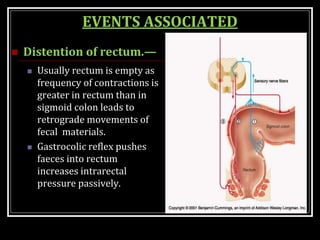
EVENTS ASSOCIATED
 Distention of rectum.—
 Usually rectum is empty as
frequency of contractions is
greater in rectum than in
sigmoid colon leads to
retrograde movements of
fecal materials.
 Gastrocolic reflex pushes
faeces into rectum
increases intrarectal
pressure passively.
Defaecation reflexes.
Intrinsic reflex.
Mediated by intrinsic nerve plexus.
Distension of rectum initiate afferents through myentric
plexus. --- Initiate peristalsis in descending colon, sigmoid
colon, rectum –-- Increase intra-rectal pressure. ---
Relaxation of internal anal sphincter.
Thursday, June 18, 2020
Spinal cord reflex.
 Distension of rectum by faeces – afferent through pelvic
nerves to sacral part of spinal cord –-- reflex parasympathetic
discharge & pelvic splanchnic nerves to cause --- intense
peristaltic contractions --- rectal pressure above 55 mm Hg.
 Relaxation of internal & external anal sphincter.
Thursday, June 18, 2020
EVENTS ASSOCIATED
 Role of voluntary control on defaecation.
 When defeacation is Not allowed --- voluntary
control maintains contraction of external anal
sphincter by pudendal nerves – internal sphincter
also closes --- rectum relaxes to accommodate
more faecal matter.
EVENTS ASSOCIATED
 Role of voluntary control on defaecation.
 When defeacation is allowed. --- external
sphincter relaxed voluntarily --- intra abdominal
pressure raised by Valsalva manoeuvre. --- smooth
muscle of distal colon & rectum contract forcefully
& propel faecal matter outside.
EVENTS ASSOCIATED
 Role of voluntary control on defaecation.
Voluntary initiation of defaecation. --- before pressure
reached that relaxes both sphincters (less than 55mmhg &
more than 18mm Hg) ---by voluntary relaxing external
sphincter & contracting abdominal muscles.
APPLIED
 Defaecation in Infants. – automatic emptying of
lower bowel without voluntary control.
 Individuals with spinal cord transactions. ---
initially retention of faeces occurs --- later reflex
returns quickly --- as rectal pressure reaches 55
mm Hg reflex evacuation occurs automatically.
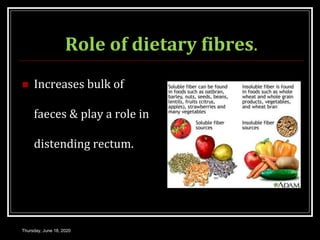
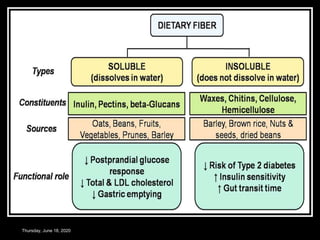
Role of dietary fibres.
 Increases bulk of
faeces & play a role in
distending rectum.
Thursday, June 18, 2020
APPLIED
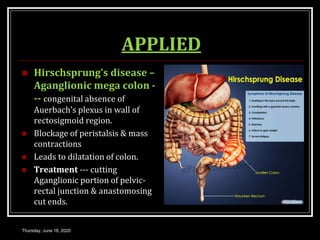
 Hirschsprung’s disease –
Aganglionic mega colon -
-- congenital absence of
Auerbach’s plexus in wall of
rectosigmoid region.
 Blockage of peristalsis & mass
contractions
 Leads to dilatation of colon.
 Treatment --- cutting
Aganglionic portion of pelvic-
rectal junction & anastomosing
cut ends.
Thursday, June 18, 2020
APPLIED
 Constipation.---
 Failure of voiding of faeces --- due to infrequent mass
movements in colon – faeces remain in colon for longer
time – becomes hard & dry due to fluid absorption.
 Due to irregular bowel habits.
Thursday, June 18, 2020
THANK YOU.

Git motility

  • 1.
    DR NILESH KATE MBBS,MD PROFESSOR ESICMEDICAL COLLEGE, GULBARGA. DEPT. OF PHYSIOLOGY GIT MOTILITY
  • 2.
    OBJECTIVES.  Mastication  Lubricationof food by saliva  Deglutition
  • 3.
    INTRODUCTION  Ingestion include4 steps  Placing food in mouth  Mastication  Lubrication  Swallowing. Thursday, June 18, 2020
  • 4.
    MASTICATION  Chewing –food is cut & grounded into smaller pieces.  Achieved by  Movement of jaw  Action of teeth  Coordinated movements of tongue & muscles of oral cavity. Thursday, June 18, 2020
  • 5.
    CHEWING REFLEX  Voluntaryact but coordinated by reflex. Thursday, June 18, 2020
  • 6.
    Thursday, June 18,2020 Food placed in mouth stretches jaw – initiate stretch reflex contraction of muscles of mastication – mouth closed food comes in contact with buccal receptors – inhibits contraction & also initiate contraction of Digastric & Lateral Pterygoid muscles open mouth – cycle continues
  • 7.
    MUSCLES OF MASTICATION Masseter – raises & protract mandible & clenches teeth.  Temporalis – retract mandible  Int & ext Pterygoids – protrude & depress mandible & opens mouth  Buccinator- prevents accumulation of ffod between teeth & cheek. Thursday, June 18, 2020
  • 8.
    FUNCTIONS OF MASTICATION Breaking of food into smaller pieces.  Mixing of food with saliva  Swallowing & lubrication & softening of food  Stimulate olfactory receptors & taste receptors & increase pleasure of eating & stimulate gastric secretion. Thursday, June 18, 2020
  • 9.
    DEGLUTITION  Def –Passage of food from oral cavity to into stomach.  Phases  Oral  Pharyngeal  Oesophageal Thursday, June 18, 2020
  • 10.
    ORAL  First stage Voluntary  Bolus of food after mastication put over dorsum of tongue  Tongue forces back into oropharynx against hard palate. Thursday, June 18, 2020
  • 11.
    PHARYNGEAL  Second stage Involuntary by swallowing reflex  Receptors – around opening of pharynx over tonsillar pillars  Afferents – Trigeminal, Glossopharyngeal & Vagus nerve. Thursday, June 18, 2020
  • 12.
    PHARYNGEAL  Center –Deglutition center – in medulla & lower pons (in NTS & Nucleus Ambiguus)  Efferent – through 5th, 9th, 10th & 12th  Effector organ – pharyngeal musculature & tongue (causes contraction) Thursday, June 18, 2020
  • 13.
  • 14.
    OESOPHAGEAL  Food pushedfrom upper part of oesophagus to stomach by oesophageal peristalsis & helped by greavity. Thursday, June 18, 2020
  • 15.
    APPLIED PHYSIOLOGY  Oesophagus– fibromuscular tube about 25 cm long  Seperated from pharynx by UES (Upper oesophageal sphincter & stomach by LES (Lower oesophageal sphincter) Thursday, June 18, 2020
  • 16.
    OESOPHAGEAL PERISTALSIS  Primary– Initiated by swallowing & coordinated by vagal fibers from swallowing centers  As food enters oesophagus UES contracts prevents regurgitation of food into mouth & propels food down.  As reaches LES , it relaxes & allow food to enter stomach. Thursday, June 18, 2020
  • 17.
    OESOPHAGEAL PERISTALSIS  Secondary– when primary peristalsis is not able to pass food down, remaining food stretches mechanical receptors & initiate secondary peristalsis.  It is coordinated by intrinsic nervous system of oesophagus. Thursday, June 18, 2020
  • 18.
    DISORDERS OF SWALLOWING Abolition of deglutition reflex – causes regurgitation of food into nose or aspiration into larynx. Occurs in  IX & X nerve paralysis  When pharynx anaesthetized with cocaine.  Aerophagia – unavoidable swallowing of air. Thursday, June 18, 2020
  • 19.
    DISORDERS OF SWALLOWING Dysphagia – Difficulty in swallowing.  Cardiac achalsia – neuromuscular disorder of LES, failure of LES to relax & food accumulate in lower oesophagus.  Gastroesophageal reflux disease.  Incompetence of LES, leads to reflux of acidic gastric content into oesophagus.  Causes pain & irritation. Thursday, June 18, 2020
  • 20.
    Physiology of gastricmotility  Gastric musculature  Three layers of smooth muscle fibres:  Outer longitudinal layer,  Middle circular layer  Inner oblique layer. Thursday, June 18, 2020
  • 21.
    Physiology of gastricmotility  As per gastric contractions  Stomach shows 2 regions  Oral region  Caudal region. Thursday, June 18, 2020
  • 22.
    Motor functions ofstomach  Done by the gastric motility are:  Storage of food,  Mixing of food and  Slow emptying of food. Thursday, June 18, 2020
  • 23.
    Initiation of gastricmotility  Basal electrical rhythm.  Represents a wave of depolarization of smooth muscle cells from the circular muscles of the fundus of stomach To the pyloric sphincter. Thursday, June 18, 2020
  • 24.
    Basal electrical rhythm. Initiated by the pacemaker cells located near the fundus on the greater curvature of the stomach. Thursday, June 18, 2020
  • 25.
    Basal electrical rhythm. Gastric slow waves consist of an upstroke and an plateau phase.  3–4 waves/min  upstroke is due to flow of Na+ and Ca2+ into the cell  Plateau is dependent on the flow of Ca2+ into the cell Thursday, June 18, 2020
  • 26.
    Factors affecting contractility Thursday,June 18, 2020 Initiate contraction. Gastrin, Histamine, Nicotine, Barium and K+ Inhibit contraction. Enterogastrone, Epinephrine, Norepinephrine, Atropine and Ca2+.
  • 27.
    Types of gastricmotility.  Motility of empty stomach  Migrating motor complex  Hunger contractions  Gastric motility related to meal  Receptive relaxation  Mixing peristaltic waves  Gastric emptying. Thursday, June 18, 2020
  • 28.
    Motility of emptystomach  Migrating motor complex  Hunger contractions Thursday, June 18, 2020
  • 29.
    Migrating motor complex Peristaltic wave that begins in the oesophagus and travels through the entire gastrointestinal tract (migratory motor activity) during interdigestive period Thursday, June 18, 2020
  • 30.
    Interdigestive housekeepers  Removeany food remaining in the stomach and intestines during interdigestive period Thursday, June 18, 2020
  • 31.
    Migrating motor complex Rate -- regular rate (5 cm/min)  Frequency - every 60– 90 min during the interdigestive period  Motilin  Food entry Thursday, June 18, 2020
  • 32.
    Hunger contractions  Mildperistaltic contractions  MMC – responsible  When become strong fuse to form tetanic contraction lasting for 2–3 min Thursday, June 18, 2020
  • 33.
    Gastric motility relatedto meal  Receptive relaxation  Mixing peristaltic waves  Gastric emptying. Thursday, June 18, 2020
  • 34.
    Receptive relaxation  Foodstimulates the stretch receptors of oral region produces relaxation  vagovagal reflex  Cholecystokinin, VIP or NO  Vagotomy abolishes receptive relaxation Thursday, June 18, 2020
  • 35.
    Mixing peristaltic waves Food in the caudal region (distal body and antral part) of stomach increases the contractile activity  Peristalsis +Retropulsion  food mixed with stomach acid & enzymes and forms -- chyme Thursday, June 18, 2020
  • 36.
    Initiation and productionof peristalsis  Co-ordinated pattern of smooth muscle contraction and relaxation where wave of relaxation precedes wave of contraction.  Rhythm determined by the BER  The number of spikes fired in a  Slow wave determines the force of each peristaltic contraction Thursday, June 18, 2020
  • 37.
    Mixing mechanism ofperistalsis and retropulsion  Peristaltic contractions begins in stomach & deepens near pylorus.  It strikes against the closed pyloric sphincter with a force & forced back into the body of stomach. Thursday, June 18, 2020
  • 38.
    Mixing mechanism ofperistalsis and retropulsion  The backward movement of the food is called Retropulsion.  The forward and backward movements (caused by forceful propulsion and retropulsion) converting it into a semiliquid paste called chyme. Thursday, June 18, 2020
  • 39.
    Gastric emptying.  Aprogressive wave of forceful contraction of antrum, pylorus (pyloric sphincter) and proximal duodenum, all the three function as a unit.  It occurs when chyme decomposed to much smaller units. Thursday, June 18, 2020
  • 40.
    Factors regulating gastric emptying. Fluidity of chyme  Gastric factors  Duodenal factors  Other factors. Thursday, June 18, 2020
  • 41.
    Fluidity of chyme The rate of gastric emptying α fluidity.  Liquid empty faster than solid Thursday, June 18, 2020
  • 42.
    Gastric factors  Volumeof food in the stomach – directly proportional.  Gastrin hormone. promotes gastric emptying.  Type of food ingested –(Fastest) Carbohydrate >protein > fats (slowest). Thursday, June 18, 2020
  • 43.
    Duodenal factors  Enterogastricreflex  Size of duodenal osmoreceptors  Enterogastric hormones  Cholecystokinin,  Secretin and  Gastric inhibitory peptide. Thursday, June 18, 2020
  • 44.
    Other factors affectinggastric motility.. Anger and Aggression Depression and Fear Vagotomy and peptide Y Thursday, June 18, 2020
  • 45.
    GENERAL PRINCIPLES OF GASTROINTESTINALFUNCTIONS  Motility. -- characteristics  Functional syncytium.  3layers of smooth muscles of intestine.  Functional types of gastrointestinal movements
  • 46.
    GENERAL PRINCIPLES OF GASTROINTESTINALFUNCTIONS  Propulsive  Contraction ring  Receptive relaxation.  Mixing  Peristaltic contractions  Local constrictive contractions.
  • 47.
    SMALL INTESTINE MOTILITY DURING INTERDIGESTIVE PERIOD  DURING DIGESTIVE PERIOD  MOTILITY REFLEXES.
  • 48.
    DURING INTERDGESTIVE PERIOD Migrating motor complexes.  Peristaltic waves  Begins at oesophagus.  Remove remaining food (Interdigestive Housekeepers)
  • 49.
    Migrating Motor Complexes. RATE- Regular 5 cm/min every 60-90 min.  Close correlation between BER & MMC.  Associated with increase in gastric secretion, bile flow & pancreatic secretion.  Abolished immediately with entry of food.
  • 50.
    DURING DIGESTIVE PERIOD Mixing movements  Propulsive movements  Movements of villi.
  • 51.
    Mixing movements  Responsiblefor mixing of chyme with digestive juices ( intestine, bile, Pancreatic)  Includes  Segmental contractions.  Pendular movements.
  • 52.
    SEGMENTAL CONTRACTIONS.  Features Most common, regular….Rhythmic segmental contractions  Small segment contract & adjoining segment relaxes.  Alternate contracted & relaxed segment, so ring like appearance.  Function  Slow down transit time & increase contact time with absorption.  Propels the chyme slowly towards the colon.
  • 53.
    SEGMENTAL CONTRACTIONS. (cont…) Rate & duration.  12 times/ min ( duodenum)  8 times / min (ileum)  Types (2 types)  Eccentric ( lesser than 2 cm in length)  Concentric (longer than 2cm in length)  Control  Initiation  Occur only when slow waves (BER) produces spikes or action potential.  Frequency  Directly related to frequency of slow waves & controlled by pacemaker cells.  Strength  Proportional to frequency of spikes generated by slow waves.
  • 54.
    PENDULAR MOVEMENTS.  Smallconstrictive waves sweep forward & backward or upward & downward in pendular fashion.
  • 55.
    Propulsive movements  Involvedin pushing the chyme towards the aboral end.  These include  Peristaltic contractions  Peristaltic rush.
  • 56.
    PERISTALTIC CONTRACTIONS  Features. Wave of contraction preceded by wave of relaxation.  Highly coordinated, involve contraction of segment behind bolus & relaxation in front.  Consists of deep circular ring @ 0.5 to 2 cm/sec.  Chyme move @ 1cm/min. so 3-4 hrs from pylorus to iliocecal valve.
  • 57.
    Law of intestine. Starling (1901)  Polarity of intestine, Polar conduction of intestine, Electrical activity of intestine, Law of gut, Theory of receptive relaxation.  “Peristaltic contraction travels from point of stimulation in both direction but contraction in oral direction disappears & persists in aboral direction.”
  • 58.
    PERISTALTIC CONTRACTIONS  Functions Propel food.  Digestion & absorption.  Control  Initiation  Stimulus – distention.(myentric reflex).  Rate – 2-2.5 cm/sec. Local stretch Releases SEROTONIN Activate sensory neurons Stimulate myentric plexus Activity travels in either direction to release Ach & sub P —Circular constriction. NO & VIP, ATP – Receptive relaxation.
  • 59.
  • 60.
    PERISTALTIC RUSH.  Verypowerful peristaltic contractions  When intestinal mucosa irritated  Partly initiated by extrinsic nervous system & partly by myentric reflex.  Begins in duodenum through entire length up to iliocecal valve.  Relieve small intestine irritant or extensive distention.  E.g. ---Diarrhoea.
  • 61.
    Movements of villi. Features  Consists of alternate shortening & elongation of villi by contraction & relaxation of muscles.  Initiation.  Local nervous reflexes.  Villikinin.– hormone from small intestine mucosa.
  • 62.
    Movements of villi. Functions  Help in emptying lymph from central lacteal into the lymphatic system.  Increases surface area so absorption
  • 63.
    MOTILITY REFLEXES.  Gastroilealreflex.  Distention of stomach by food.  Reflex stimulation of vagus.  Relaxation of iliocecal sphincter  Intestinointesinal reflex.  Over distention of one segment  Relaxation of smooth muscle of rest of intestine.
  • 64.
    APPLIED  PARALYTIC ILEUS. INTESTINAL OBSTRUCTION.
  • 65.
    PARALYTIC ILEUS.  Adynamicileus.  Pathophysiology – intestinal motility markedly decreased leads to retention of contents  Irregular distension of small intestine by pockets of gas & fluids.  Causes ---  Direct inhibition of smooth muscle of small intestine due to handling of intestine. e.g. Intraabdominal operations & trauma.  Reflex inhibition due to increased discharge of noradrenergic fibres in splanchnic nerves. Thursday, June 18, 2020
  • 66.
    INTESTINAL OBSTRUCTION.  Causes–  Due to tumors, strictures and fibrotic bands in abdomen.  Features –  Intestinal colic – severe pain due to peristaltic rush.  Distension of small intestine due to increased intraluminal pressure.  Local ischemia.  Sweating , hypotension & severe vomiting due to stimulation of visceral afferent nerves.  When obstruction in upper part of small intestine— antiperistaltic reflux causes intestinal juices to flow into stomach.  When obstruction in upper part of small intestine— vomit become more basic than acidic. Thursday, June 18, 2020
  • 67.
    LARGE INTESTINE MOTILITY. Slow wave activity.  Coordinated by BER Or Slow wave activity (SWA)  Frequency of SWA gradually increase down the LI.  9/min – iliocecal valve to 16/min at sigmoid colon.
  • 68.
    LARGE INTESTINE MOVEMENTS. Functions  Absorption of water & electrolyte from chyme (Proximal)  Storage of faecal matter.(Distal)  Contractile activity serves 2 main functions  Increase efficacy for absorption  Promotes excretion of faecal matter.
  • 69.
    TYPES  Haustral shuttling. Similar to segmental contractions  Circular muscle contractions– circular rings  Longitudinal muscles contractions – portion between rings bulge in bag like sacs …… Haustrations.  Disappears within 60 sec.  Functions –  Mixing  Propulsion. oPeristalsis Progressive contractions preceded by receptive wave of relaxation. Take up to 42 hrs to travels up to colons.
  • 70.
    TYPES  Mass movements. Special types of peristaltic contractions in colon only.  3-4 times a day after a meals.  Contraction of the smooth muscle over a large area distal to the constriction.  Force faecal matter into rectum initiate defecation reflex.  Can be initiated by  Gastro colic reflex  Intense stimulation of parasympathetic nerves.  Over distention of segment of colon.
  • 71.
    DEFAECATION REFLEX.  Functionalanatomy.  Internal anal sphincter (involuntary) circular smooth muscle of pelvirectal flexure.  Parasymp– inhibitory  Symp – excitatory.
  • 72.
    DEFAECATION REFLEX.  Externalanal sphincter. Somatic skeletal muscles supplied by pudendal nerves.
  • 73.
    DEFAECATION REFLEX.  Actof defaecation  Involves both – voluntary & reflex activity.  Reflex contraction of distal colon & rectum – propel faecal matter in anal canal.  Reflex relaxation of internal anal sphincter.  Reflex relaxation with voluntary control of Ext anal sphincter & voluntary contraction of abdominal muscles.
  • 74.
    EVENTS ASSOCIATED  Distentionof rectum.—  Usually rectum is empty as frequency of contractions is greater in rectum than in sigmoid colon leads to retrograde movements of fecal materials.  Gastrocolic reflex pushes faeces into rectum increases intrarectal pressure passively.
  • 75.
    Defaecation reflexes. Intrinsic reflex. Mediatedby intrinsic nerve plexus. Distension of rectum initiate afferents through myentric plexus. --- Initiate peristalsis in descending colon, sigmoid colon, rectum –-- Increase intra-rectal pressure. --- Relaxation of internal anal sphincter. Thursday, June 18, 2020
  • 76.
    Spinal cord reflex. Distension of rectum by faeces – afferent through pelvic nerves to sacral part of spinal cord –-- reflex parasympathetic discharge & pelvic splanchnic nerves to cause --- intense peristaltic contractions --- rectal pressure above 55 mm Hg.  Relaxation of internal & external anal sphincter. Thursday, June 18, 2020
  • 77.
    EVENTS ASSOCIATED  Roleof voluntary control on defaecation.  When defeacation is Not allowed --- voluntary control maintains contraction of external anal sphincter by pudendal nerves – internal sphincter also closes --- rectum relaxes to accommodate more faecal matter.
  • 78.
    EVENTS ASSOCIATED  Roleof voluntary control on defaecation.  When defeacation is allowed. --- external sphincter relaxed voluntarily --- intra abdominal pressure raised by Valsalva manoeuvre. --- smooth muscle of distal colon & rectum contract forcefully & propel faecal matter outside.
  • 79.
    EVENTS ASSOCIATED  Roleof voluntary control on defaecation. Voluntary initiation of defaecation. --- before pressure reached that relaxes both sphincters (less than 55mmhg & more than 18mm Hg) ---by voluntary relaxing external sphincter & contracting abdominal muscles.
  • 80.
    APPLIED  Defaecation inInfants. – automatic emptying of lower bowel without voluntary control.  Individuals with spinal cord transactions. --- initially retention of faeces occurs --- later reflex returns quickly --- as rectal pressure reaches 55 mm Hg reflex evacuation occurs automatically.
  • 81.
    Role of dietaryfibres.  Increases bulk of faeces & play a role in distending rectum. Thursday, June 18, 2020
  • 82.
  • 83.
    APPLIED  Hirschsprung’s disease– Aganglionic mega colon - -- congenital absence of Auerbach’s plexus in wall of rectosigmoid region.  Blockage of peristalsis & mass contractions  Leads to dilatation of colon.  Treatment --- cutting Aganglionic portion of pelvic- rectal junction & anastomosing cut ends. Thursday, June 18, 2020
  • 84.
    APPLIED  Constipation.---  Failureof voiding of faeces --- due to infrequent mass movements in colon – faeces remain in colon for longer time – becomes hard & dry due to fluid absorption.  Due to irregular bowel habits. Thursday, June 18, 2020
  • 85.