Local control of blood flow-II
Prof. Dr. Rashid Mahmood
05/02/19 Presentation Title | Presented By: Name 2
Local control of blood flow-II
Prof. Dr. Rashid Mahmood
05/02/19 Presentation Title | Presented By: Name 3
Recap
Control of Blood Flow
Local Humoral Nervous
Acute
Long-
term
Special Areas
1.Kidney
2.Brain
3.Skin
4.Muscles
Endocrines
1.Epinephrine
2.Norepinephrine
3.Angiotensin I
4.ADH
Chemical factors
1.Prostaglandins
2.Bradykinin
3.Histamine
4.CO2
5.Osmolarity
Ions
1.H+
2.K+
3.Ca++
4.Mg++
5.Na+
© Prof. Dr. Rashid Mahmood 4
Endothelium-
Derived Factors
Sympathetic
Para-sympathetic
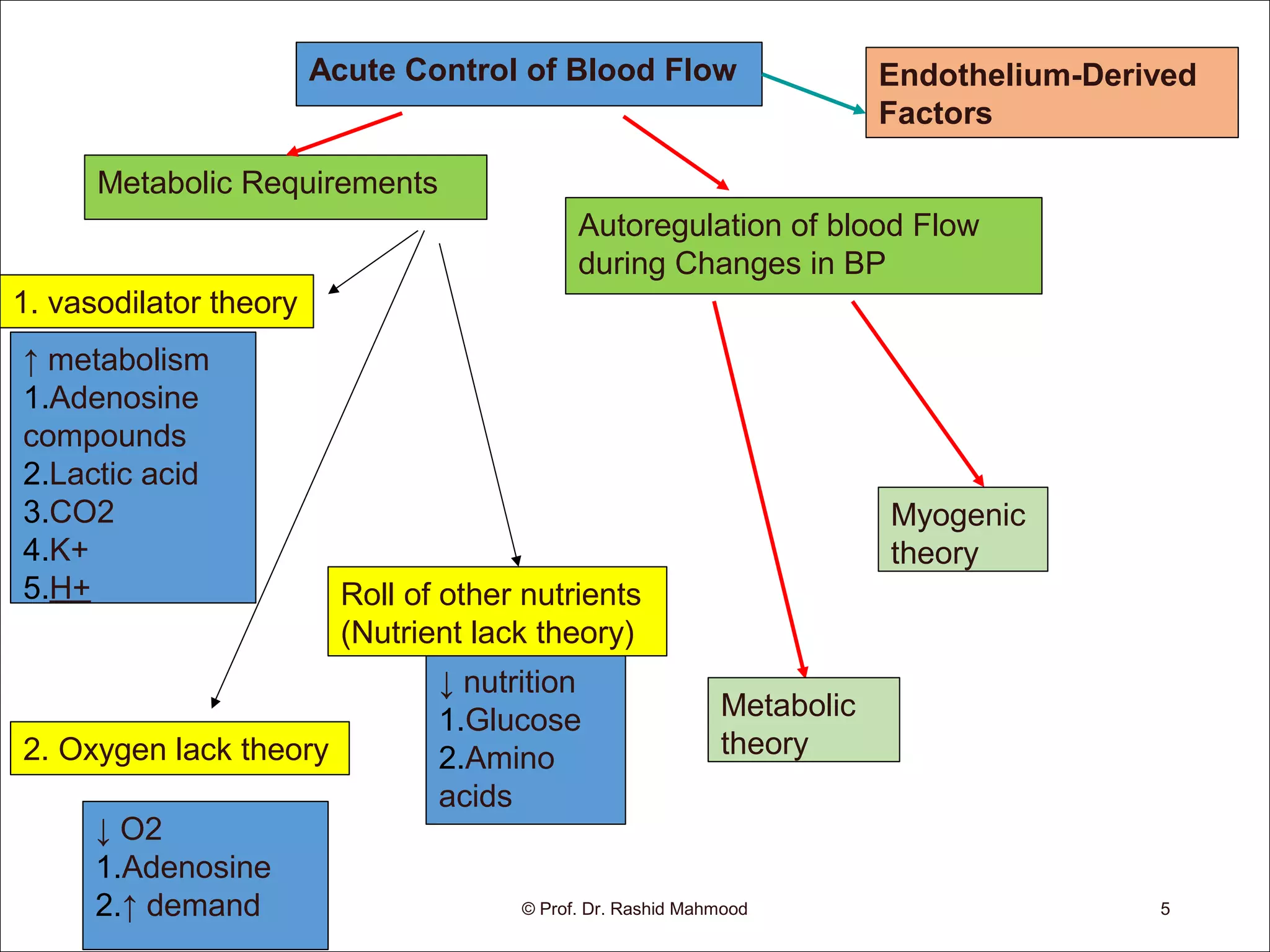
Acute Control of Blood Flow
↑ metabolism
1.Adenosine
compounds
2.Lactic acid
3.CO2
4.K+
5.H+
↓ O2
1.Adenosine
2.↑ demand
↓ nutrition
1.Glucose
2.Amino
acids
Autoregulation of blood Flow
during Changes in BP
Metabolic
theory
Myogenic
theory
© Prof. Dr. Rashid Mahmood 5
1. vasodilator theory
2. Oxygen lack theory
Roll of other nutrients
(Nutrient lack theory)
Metabolic Requirements
Endothelium-Derived
Factors
Summary of Mechanisms of
vasodilation in acute local control
Small vessels
Vasomotion
(pre-capillary
sphincter)
Metabolic
factors (micro
vessels)
Large vessels
EDRF(endothelial
derived relaxing
factor)
(nitric oxide)
© Prof. Dr. Rashid Mahmood 6
Objectives
Goal/Aim: To understand the importance and
mechanism of Mechanism of Blood Flow Control
Specific Objectives: At the end of the lesson
student will be able to :
 List the regulatory mechanisms of local control of
blood flow
 Describe different factors involved in Acute control
of blood flow
3. Describe different factors involved in Long term of
control of blood flow
4. Describe the Humoral & Nervous control of local
circulation
© Prof. Dr. Rashid Mahmood 7
Long-term control
Collateral Blood Vessels
↑Tissue Vascularity
Angiogenesis
Angiogenesis factors
released FROM
1.Ischemic tissues
2.Growing tissues
3.↑ Metabolism
Angiogenesis factors
include
1.VEGF (Vasculo-
Endothelial Growth
Factor)
2.Platelet-Derived Growth
Factor (PDGF)
3.FGF (Fibroblast Growth
Factor)
4.Angiogenin
© Prof. Dr. Rashid Mahmood 8
Vascular Remodeling
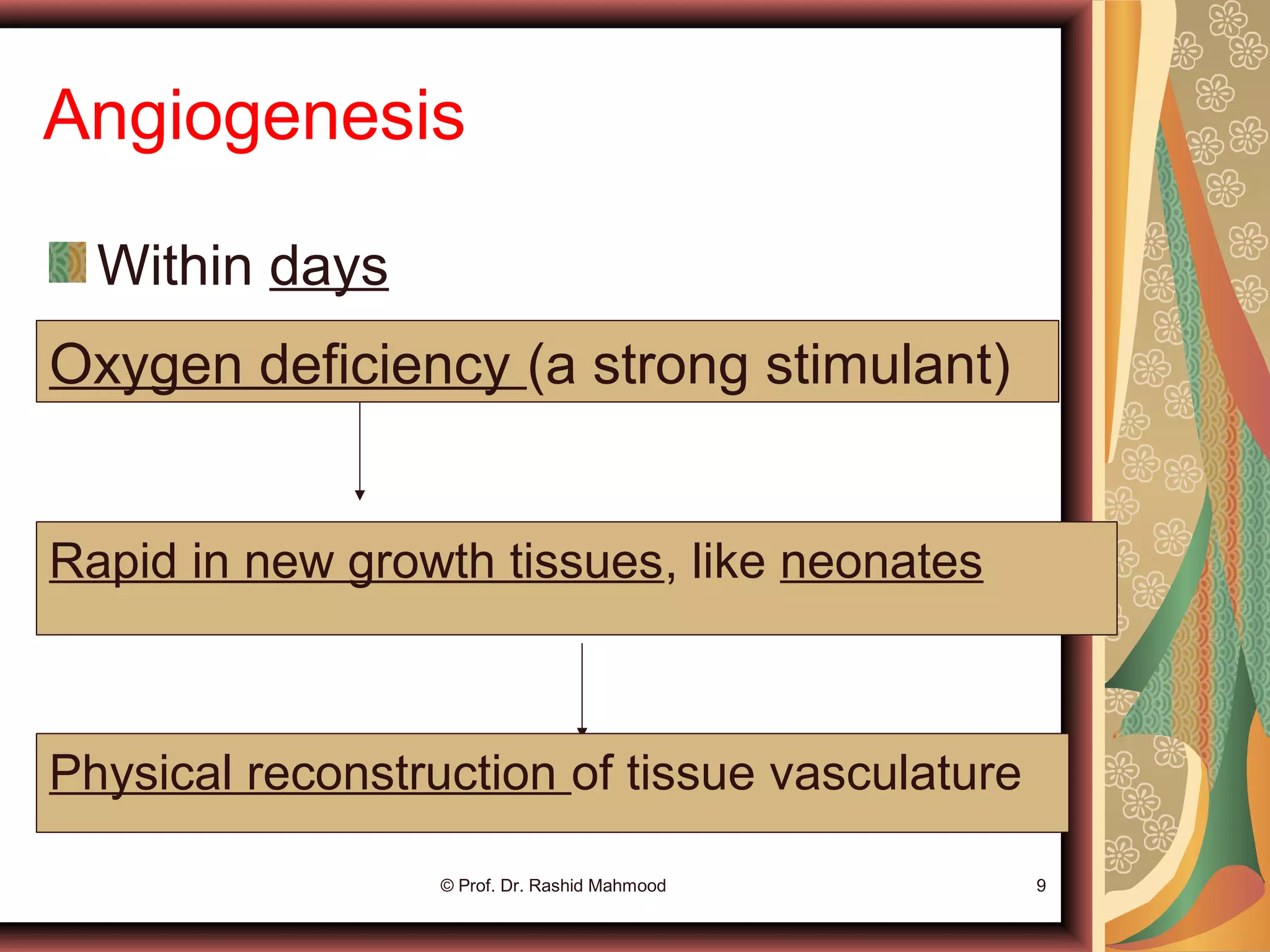
Angiogenesis
Within days
© Prof. Dr. Rashid Mahmood 9
Oxygen deficiency (a strong stimulant)
Rapid in new growth tissues, like neonates
Physical reconstruction of tissue vasculature
Angiogenesis
© Prof. Dr. Rashid Mahmood 10
Roll of O2 in long term
High altitude
Angiogenesis
Retrolental fibroplasia
© Prof. Dr. Rashid Mahmood 11
© Prof. Dr. Rashid Mahmood 12
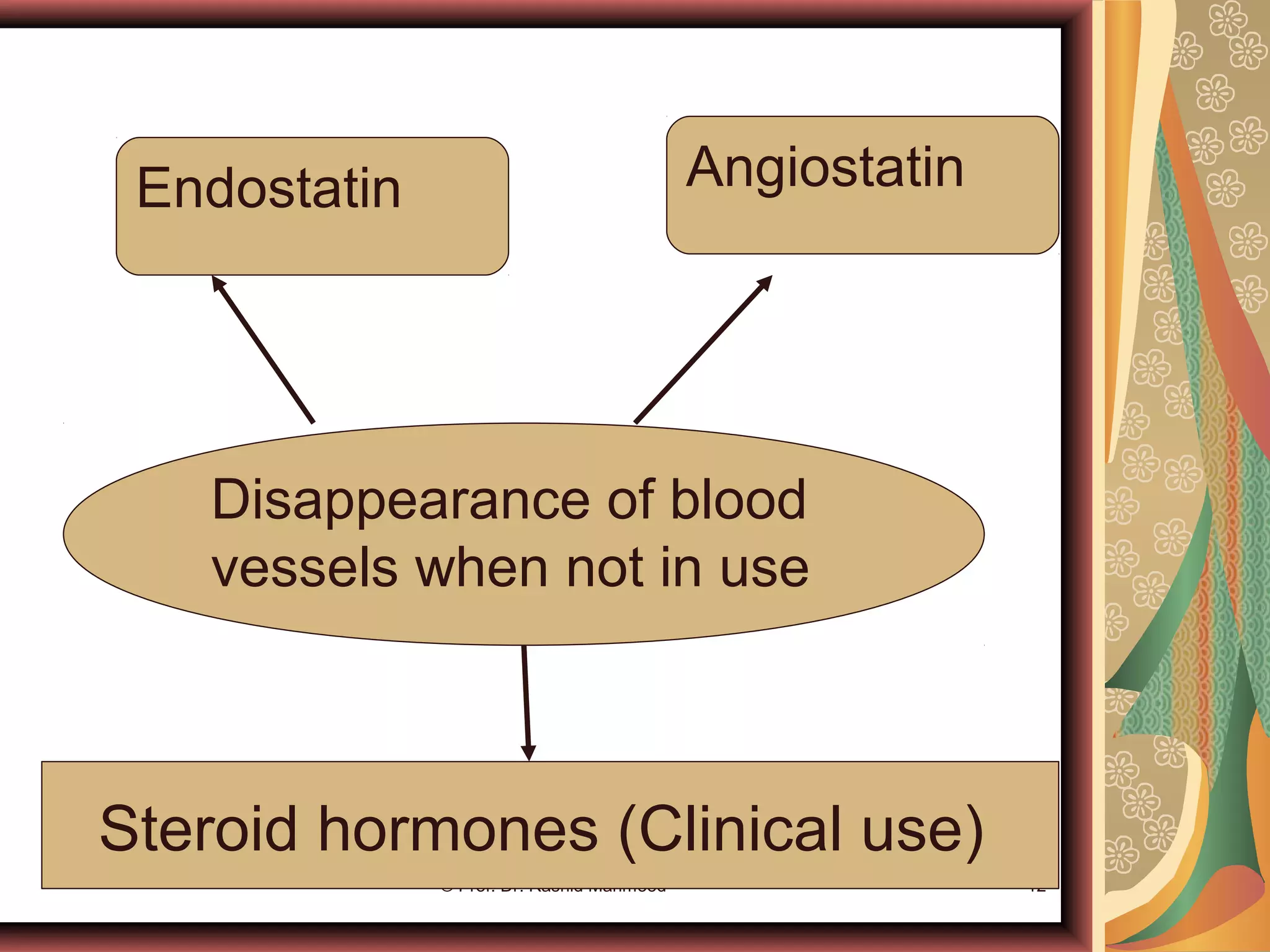
Disappearance of blood
vessels when not in use
AngiostatinEndostatin
Steroid hormones (Clinical use)
© Prof. Dr. Rashid Mahmood 13
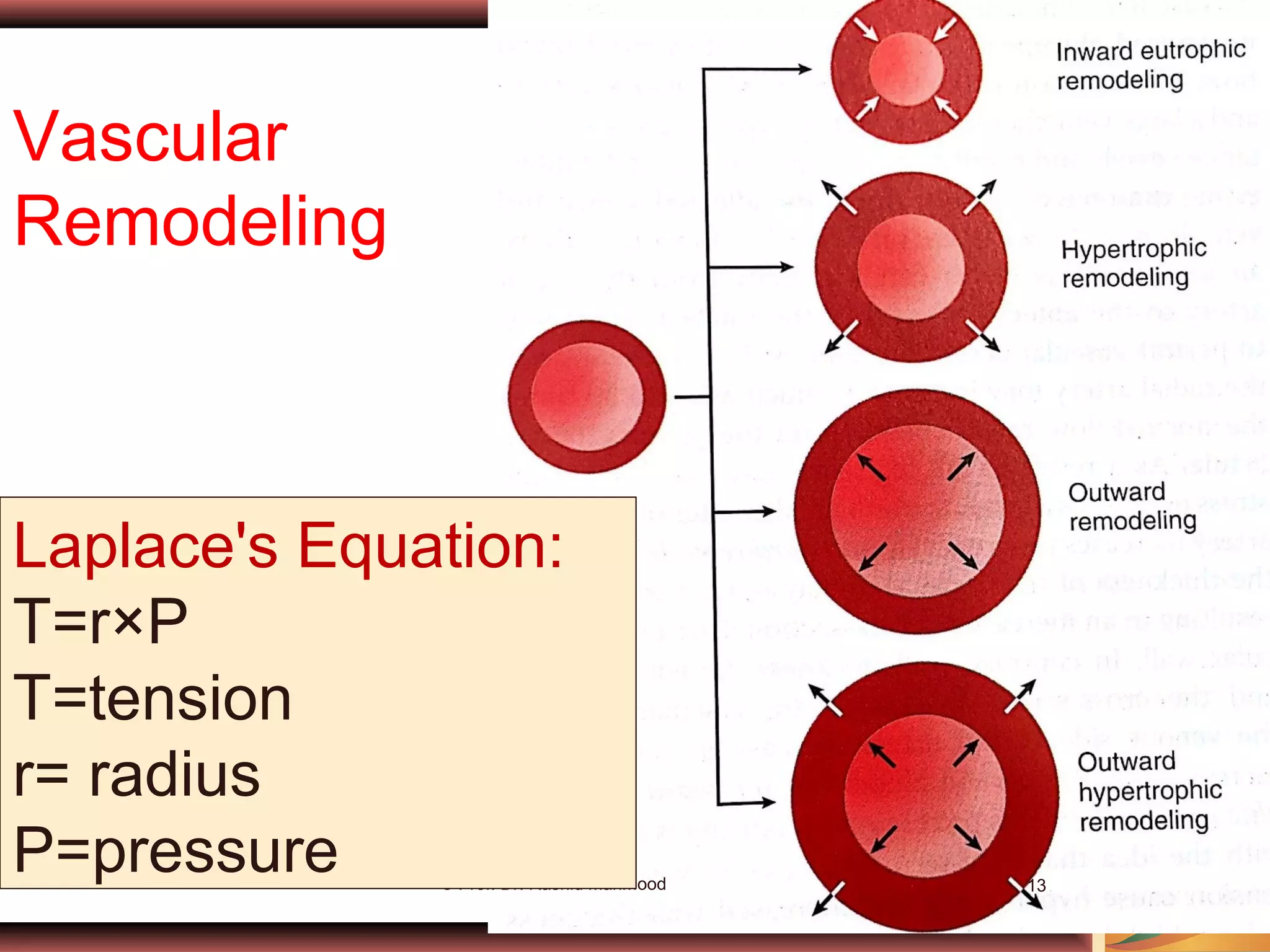
Vascular
Remodeling
Laplace's Equation:
T=r×P
T=tension
r= radius
P=pressure
Special phenomena of Long-Term
Local Blood Flow Regulation
© Prof. Dr. Rashid Mahmood 14
Vascularity Is Determined by Maximum
Blood Flow Need, Not by Average Need
after extra vascularity does develop, the extra blood vessels
normally remain mainly vasoconstricted unless required
Development of Collateral Circulation
Assessment Q. 5
Name any TWO Angiogenesis
factors.
© Prof. Dr. Rashid Mahmood 15
1. VEGF (Vasculo-Endothelial Growth Factor)
2. Platelet-Derived Growth Factor (PDGF)
3. FGF (Fibroblast Growth Factor)
4. Angiogenin
Objectives
Goal/Aim: To understand the importance and
mechanism of Mechanism of Blood Flow Control
Specific Objectives: At the end of the lesson
student will be able to :
 List the regulatory mechanisms of local control of
blood flow
 Describe different factors involved in Acute control
of blood flow
 Describe different factors involved in Long term of
control of blood flow
4. Describe the Humoral & Nervous control of local
circulation
© Prof. Dr. Rashid Mahmood 16
Humoral Control of the
Circulation
Vasoconstrictor
Agents
Norepinephrine
and Epinephrine
Angiotensin II, &
Vasopressin
Vasodilator
Agents
Bradykinin,
Histamine
Effects:
arteriolar dilation
↑ capillary
permeability
– Edema
© Prof. Dr. Rashid Mahmood 17
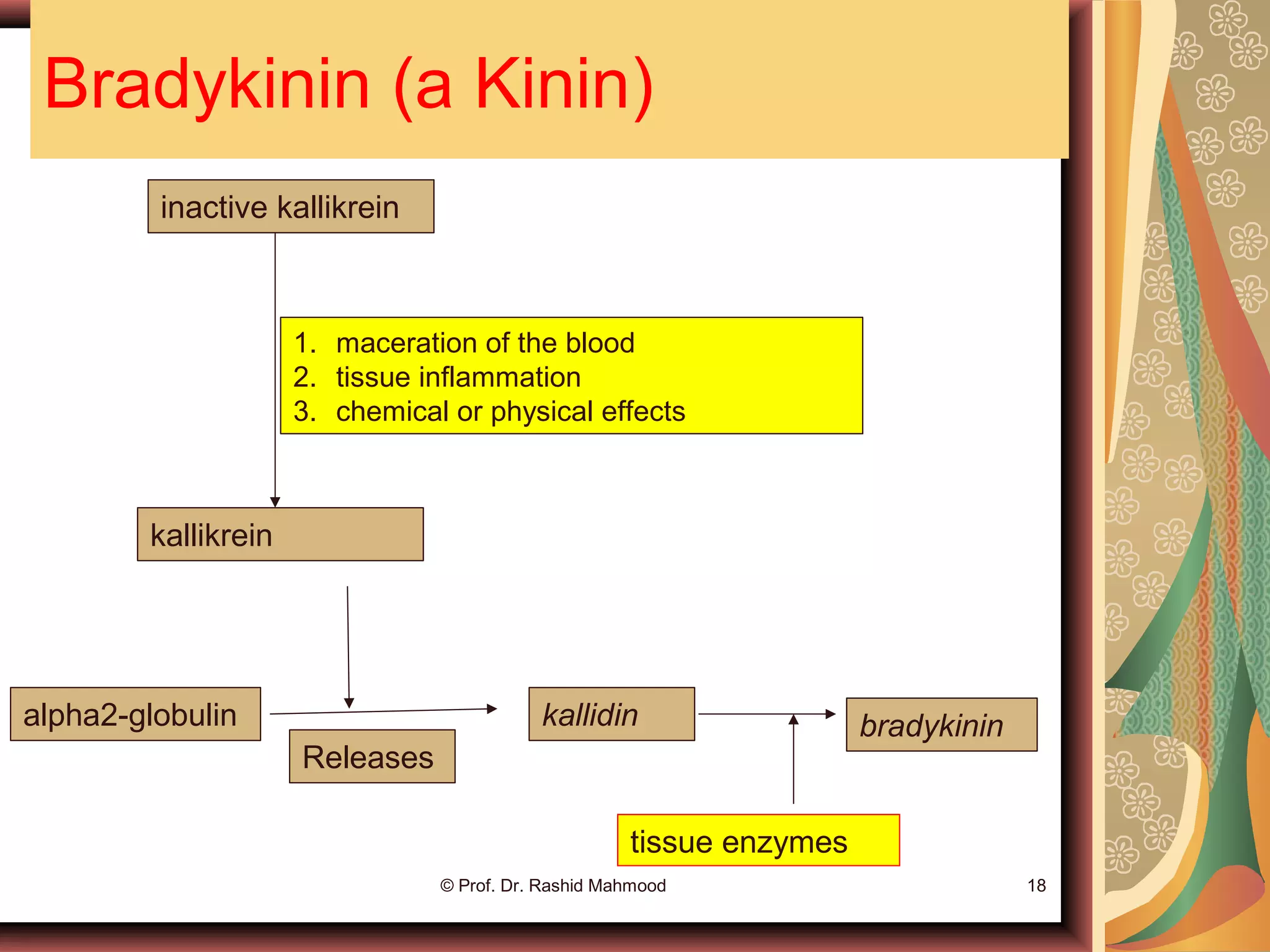
Bradykinin (a Kinin)
© Prof. Dr. Rashid Mahmood 18
inactive kallikrein
kallikrein
1. maceration of the blood
2. tissue inflammation
3. chemical or physical effects
alpha2-globulin
Releases
kallidin bradykinin
tissue enzymes
Inactivation of bradykinin
In few minutes
By carboxypeptidase or by
Converting Enzyme
© Prof. Dr. Rashid Mahmood 19
Histamine
© Prof. Dr. Rashid Mahmood 20
Basophils
Mast cells
Damage
Inflammation,
Allergic
reaction
Produced in almost every tissue
Nervous Control of Local Blood
Flow
Sympathetic:
Vasoconstriction
Exceptions:
– Coronary vessels
– Some vasodilator fibers to skeletal
muscles
Parasympathetic Stimulation:
Vasodilation
Indirect effect© Prof. Dr. Rashid Mahmood 21
Core knowledge Points (1/2)
1. local blood flow in an exact way, the
tissues almost never suffer from
oxygen and nutritional deficiency
2. Blood flow is directly proportional to
metabolic rate
3. Blood flow to the tissues is
automatically regulated in spite of
changes in blood pressure, within
physiological limits (Autoregulation)
4. Regulatory mechanisms include Local,
Humoral, & Nervous mechanisms© Prof. Dr. Rashid Mahmood 22
Core knowledge Points (2/2)
5. Different multiple factors are involved in
Acute control of blood flow, and Long term
control
6. Endothelium-Derived Relaxing and
contracting Factors play a key role in
autoregulation
7. Humoral control of local circulation
involves certain Endocrines , Ions, and
Chemical factors
8. Nervous control of blood flow involves
Sympathetic, and to some extent Para-
sympathetic nervous system
© Prof. Dr. Rashid Mahmood 23
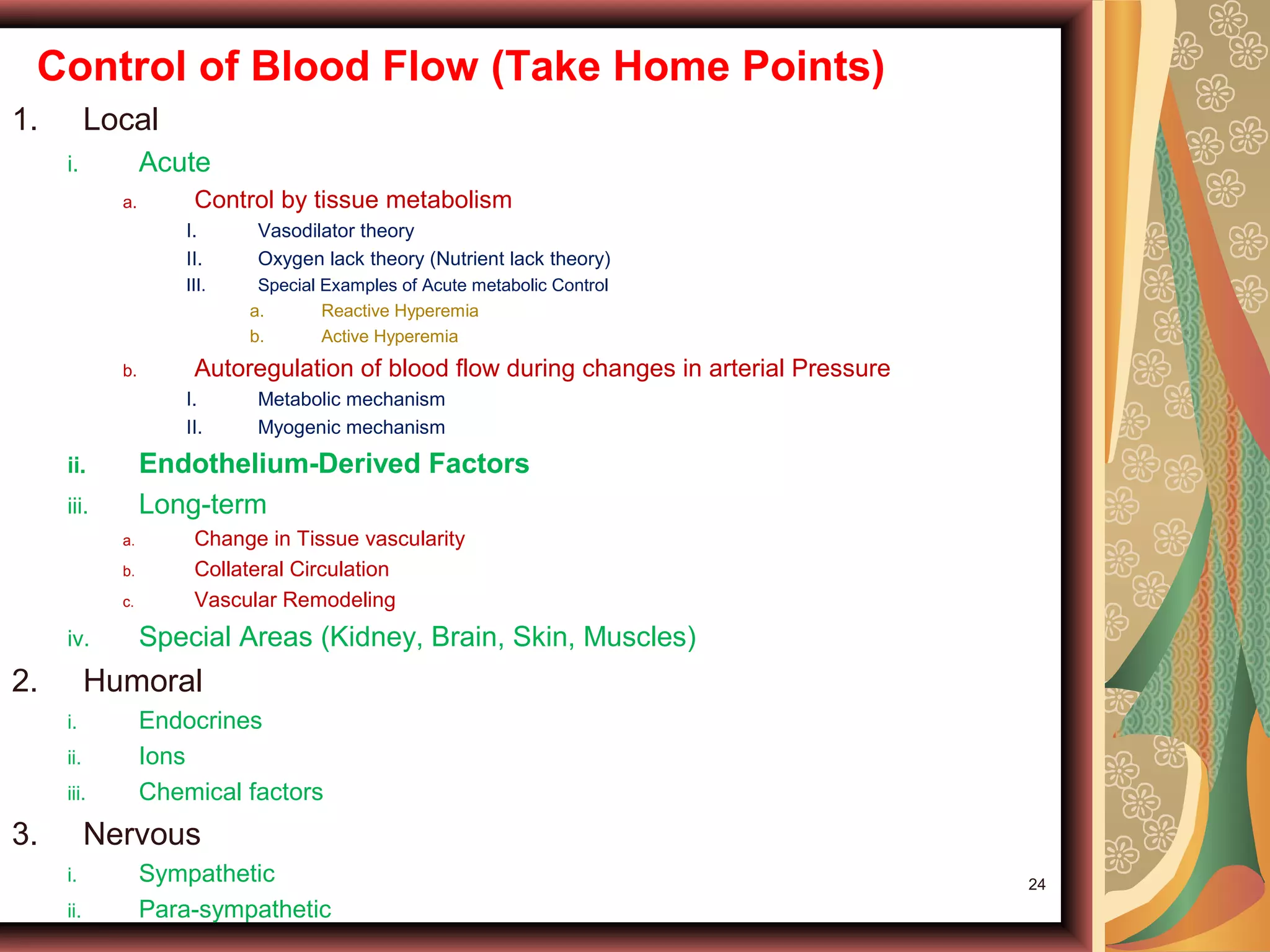
Control of Blood Flow (Take Home Points)
1. Local
i. Acute
a. Control by tissue metabolism
I. Vasodilator theory
II. Oxygen lack theory (Nutrient lack theory)
III. Special Examples of Acute metabolic Control
a. Reactive Hyperemia
b. Active Hyperemia
b. Autoregulation of blood flow during changes in arterial Pressure
I. Metabolic mechanism
II. Myogenic mechanism
ii. Endothelium-Derived Factors
iii. Long-term
a. Change in Tissue vascularity
b. Collateral Circulation
c. Vascular Remodeling
iv. Special Areas (Kidney, Brain, Skin, Muscles)
2. Humoral
i. Endocrines
ii. Ions
iii. Chemical factors
3. Nervous
i. Sympathetic
ii. Para-sympathetic
24
Learning Resources
Guyton and Hall (Text book of physiology), 13th
Edition
Ganong (Text book of physiology), 25th Edition
Berne & Levy Principles of Physiology (Koeppen
BM), 6th Edition
Human Physiology Stuart Fox, 13th Edition
Human Physiology : from cells to system with
Power Lecture DVD Lauralee Sherwood, 9th
edition
Internet
© Prof. Dr. Rashid Mahmood
25
Next topic:
Regulation of blood pressure –I
Prior knowledge required for next lecture
Overview of the Circulation; Medical Physics
of Pressure, Flow, and Resistance
Vascular Distensibility and Functions of the
Arterial and Venous Systems
Local and Humoral Control of Blood Flow by
the Tissues
Nervous Regulation of the Circulation
Basic Physiology of autonomic nervous
system © Prof. Dr. Rashid Mahmood
26
World Book and Copyright Day (also known
as International Day of the Book)
(April 23rd
)
The things I want to know are in books; my
best friend is the man who’ll get me a book
to read (Abraham Lincoln)
The book you don’t read won’t help (Jim
Rohn)
I read a lot of obscure books and it is nice
to open a book (Bill Gates)
Finishing a good book is like leaving a
good friend (William Feather)
© Prof. Dr. Rashid Mahmood 27
Assessment Q. 6-8
6. What is the effect of Bradykinin and
Histamine on blood vessels in addition
to arteriolar dilation?
7. When the World Book and Copyright
Day is celebrated each year?
8. Feedback
© Prof. Dr. Rashid Mahmood 28
ThankYou
Questions/ Comments/Feedback
rashid.mahmood@rmi.edu.pk,
drrashid62@gmail.com

Mechanism of blood flow control-II

  • 1.
    Local control ofblood flow-II Prof. Dr. Rashid Mahmood
  • 2.
    05/02/19 Presentation Title| Presented By: Name 2 Local control of blood flow-II Prof. Dr. Rashid Mahmood
  • 3.
    05/02/19 Presentation Title| Presented By: Name 3 Recap
  • 4.
    Control of BloodFlow Local Humoral Nervous Acute Long- term Special Areas 1.Kidney 2.Brain 3.Skin 4.Muscles Endocrines 1.Epinephrine 2.Norepinephrine 3.Angiotensin I 4.ADH Chemical factors 1.Prostaglandins 2.Bradykinin 3.Histamine 4.CO2 5.Osmolarity Ions 1.H+ 2.K+ 3.Ca++ 4.Mg++ 5.Na+ © Prof. Dr. Rashid Mahmood 4 Endothelium- Derived Factors Sympathetic Para-sympathetic
  • 5.
    Acute Control ofBlood Flow ↑ metabolism 1.Adenosine compounds 2.Lactic acid 3.CO2 4.K+ 5.H+ ↓ O2 1.Adenosine 2.↑ demand ↓ nutrition 1.Glucose 2.Amino acids Autoregulation of blood Flow during Changes in BP Metabolic theory Myogenic theory © Prof. Dr. Rashid Mahmood 5 1. vasodilator theory 2. Oxygen lack theory Roll of other nutrients (Nutrient lack theory) Metabolic Requirements Endothelium-Derived Factors
  • 6.
    Summary of Mechanismsof vasodilation in acute local control Small vessels Vasomotion (pre-capillary sphincter) Metabolic factors (micro vessels) Large vessels EDRF(endothelial derived relaxing factor) (nitric oxide) © Prof. Dr. Rashid Mahmood 6
  • 7.
    Objectives Goal/Aim: To understandthe importance and mechanism of Mechanism of Blood Flow Control Specific Objectives: At the end of the lesson student will be able to :  List the regulatory mechanisms of local control of blood flow  Describe different factors involved in Acute control of blood flow 3. Describe different factors involved in Long term of control of blood flow 4. Describe the Humoral & Nervous control of local circulation © Prof. Dr. Rashid Mahmood 7
  • 8.
    Long-term control Collateral BloodVessels ↑Tissue Vascularity Angiogenesis Angiogenesis factors released FROM 1.Ischemic tissues 2.Growing tissues 3.↑ Metabolism Angiogenesis factors include 1.VEGF (Vasculo- Endothelial Growth Factor) 2.Platelet-Derived Growth Factor (PDGF) 3.FGF (Fibroblast Growth Factor) 4.Angiogenin © Prof. Dr. Rashid Mahmood 8 Vascular Remodeling
  • 9.
    Angiogenesis Within days © Prof.Dr. Rashid Mahmood 9 Oxygen deficiency (a strong stimulant) Rapid in new growth tissues, like neonates Physical reconstruction of tissue vasculature
  • 10.
    Angiogenesis © Prof. Dr.Rashid Mahmood 10
  • 11.
    Roll of O2in long term High altitude Angiogenesis Retrolental fibroplasia © Prof. Dr. Rashid Mahmood 11
  • 12.
    © Prof. Dr.Rashid Mahmood 12 Disappearance of blood vessels when not in use AngiostatinEndostatin Steroid hormones (Clinical use)
  • 13.
    © Prof. Dr.Rashid Mahmood 13 Vascular Remodeling Laplace's Equation: T=r×P T=tension r= radius P=pressure
  • 14.
    Special phenomena ofLong-Term Local Blood Flow Regulation © Prof. Dr. Rashid Mahmood 14 Vascularity Is Determined by Maximum Blood Flow Need, Not by Average Need after extra vascularity does develop, the extra blood vessels normally remain mainly vasoconstricted unless required Development of Collateral Circulation
  • 15.
    Assessment Q. 5 Nameany TWO Angiogenesis factors. © Prof. Dr. Rashid Mahmood 15 1. VEGF (Vasculo-Endothelial Growth Factor) 2. Platelet-Derived Growth Factor (PDGF) 3. FGF (Fibroblast Growth Factor) 4. Angiogenin
  • 16.
    Objectives Goal/Aim: To understandthe importance and mechanism of Mechanism of Blood Flow Control Specific Objectives: At the end of the lesson student will be able to :  List the regulatory mechanisms of local control of blood flow  Describe different factors involved in Acute control of blood flow  Describe different factors involved in Long term of control of blood flow 4. Describe the Humoral & Nervous control of local circulation © Prof. Dr. Rashid Mahmood 16
  • 17.
    Humoral Control ofthe Circulation Vasoconstrictor Agents Norepinephrine and Epinephrine Angiotensin II, & Vasopressin Vasodilator Agents Bradykinin, Histamine Effects: arteriolar dilation ↑ capillary permeability – Edema © Prof. Dr. Rashid Mahmood 17
  • 18.
    Bradykinin (a Kinin) ©Prof. Dr. Rashid Mahmood 18 inactive kallikrein kallikrein 1. maceration of the blood 2. tissue inflammation 3. chemical or physical effects alpha2-globulin Releases kallidin bradykinin tissue enzymes
  • 19.
    Inactivation of bradykinin Infew minutes By carboxypeptidase or by Converting Enzyme © Prof. Dr. Rashid Mahmood 19
  • 20.
    Histamine © Prof. Dr.Rashid Mahmood 20 Basophils Mast cells Damage Inflammation, Allergic reaction Produced in almost every tissue
  • 21.
    Nervous Control ofLocal Blood Flow Sympathetic: Vasoconstriction Exceptions: – Coronary vessels – Some vasodilator fibers to skeletal muscles Parasympathetic Stimulation: Vasodilation Indirect effect© Prof. Dr. Rashid Mahmood 21
  • 22.
    Core knowledge Points(1/2) 1. local blood flow in an exact way, the tissues almost never suffer from oxygen and nutritional deficiency 2. Blood flow is directly proportional to metabolic rate 3. Blood flow to the tissues is automatically regulated in spite of changes in blood pressure, within physiological limits (Autoregulation) 4. Regulatory mechanisms include Local, Humoral, & Nervous mechanisms© Prof. Dr. Rashid Mahmood 22
  • 23.
    Core knowledge Points(2/2) 5. Different multiple factors are involved in Acute control of blood flow, and Long term control 6. Endothelium-Derived Relaxing and contracting Factors play a key role in autoregulation 7. Humoral control of local circulation involves certain Endocrines , Ions, and Chemical factors 8. Nervous control of blood flow involves Sympathetic, and to some extent Para- sympathetic nervous system © Prof. Dr. Rashid Mahmood 23
  • 24.
    Control of BloodFlow (Take Home Points) 1. Local i. Acute a. Control by tissue metabolism I. Vasodilator theory II. Oxygen lack theory (Nutrient lack theory) III. Special Examples of Acute metabolic Control a. Reactive Hyperemia b. Active Hyperemia b. Autoregulation of blood flow during changes in arterial Pressure I. Metabolic mechanism II. Myogenic mechanism ii. Endothelium-Derived Factors iii. Long-term a. Change in Tissue vascularity b. Collateral Circulation c. Vascular Remodeling iv. Special Areas (Kidney, Brain, Skin, Muscles) 2. Humoral i. Endocrines ii. Ions iii. Chemical factors 3. Nervous i. Sympathetic ii. Para-sympathetic 24
  • 25.
    Learning Resources Guyton andHall (Text book of physiology), 13th Edition Ganong (Text book of physiology), 25th Edition Berne & Levy Principles of Physiology (Koeppen BM), 6th Edition Human Physiology Stuart Fox, 13th Edition Human Physiology : from cells to system with Power Lecture DVD Lauralee Sherwood, 9th edition Internet © Prof. Dr. Rashid Mahmood 25
  • 26.
    Next topic: Regulation ofblood pressure –I Prior knowledge required for next lecture Overview of the Circulation; Medical Physics of Pressure, Flow, and Resistance Vascular Distensibility and Functions of the Arterial and Venous Systems Local and Humoral Control of Blood Flow by the Tissues Nervous Regulation of the Circulation Basic Physiology of autonomic nervous system © Prof. Dr. Rashid Mahmood 26
  • 27.
    World Book andCopyright Day (also known as International Day of the Book) (April 23rd ) The things I want to know are in books; my best friend is the man who’ll get me a book to read (Abraham Lincoln) The book you don’t read won’t help (Jim Rohn) I read a lot of obscure books and it is nice to open a book (Bill Gates) Finishing a good book is like leaving a good friend (William Feather) © Prof. Dr. Rashid Mahmood 27
  • 28.
    Assessment Q. 6-8 6.What is the effect of Bradykinin and Histamine on blood vessels in addition to arteriolar dilation? 7. When the World Book and Copyright Day is celebrated each year? 8. Feedback © Prof. Dr. Rashid Mahmood 28
  • 29.

Editor's Notes

  • #16 Angiogenesis factors include VEGF (Vasculo-Endothelial Growth Factor) FGF (Fibroblast Growth Factor) Angiogenin
  • #29 ↑ capillary permeability