
Local Control of Blood
         Flow
               By:
          M. Rasjad Indra
   Lab. Ilmu Faal FK UNIBRAW
Introduction
 The greater the metabolism       the greater
 its blood flow
  – Liver: 95 ml/min/100 g of liver tissue.
  – Kidneys: 1100 ml/min  cleansing the blood.
 The importance of blood flow control    
 effective & efficient
  –   Serving metabolic need
  –   Efficient heart workload.
Mechanism of Blood Flow Control
   Acute control (rapid changes in local vasodilatation /
    vasoconstriction):
    –   Effect of tissue metabolism
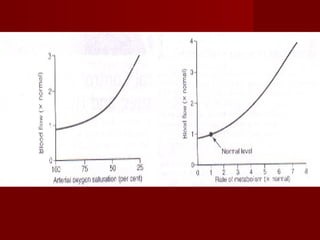
    –   The availability of oxygen changes.
    –   Two basic theories:
          Vasodilator theory: adenosine; CO2; histamine; K+ & H+
          Oxygen lack theory: vasomotion in metarterioles & precapillary
           sphincters.
    – Other nutrients besides Oxygen:
    – Lack of glucose  vasodilatation
    – Vitamin B deficiency  vasodilatation
The examples of acute metabolic
        control of local blood flow
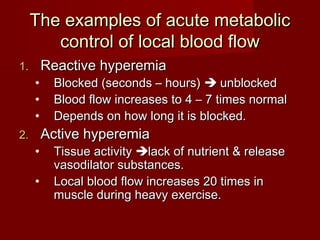
1.       Reactive hyperemia
     •    Blocked (seconds – hours)  unblocked
     •    Blood flow increases to 4 – 7 times normal
     •    Depends on how long it is blocked.
2.       Active hyperemia
     •    Tissue activity lack of nutrient & release
          vasodilator substances.
     •    Local blood flow increases 20 times in
          muscle during heavy exercise.
Blood flow control & The arterial
           pressure changes
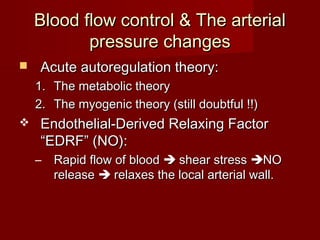
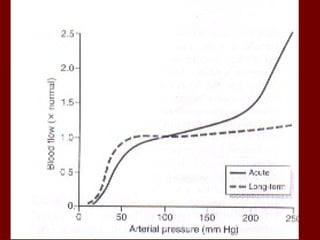
   Acute autoregulation theory:
    1.   The metabolic theory
    2.   The myogenic theory (still doubtful !!)
   Endothelial-Derived Relaxing Factor
    “EDRF” (NO):
    –    Rapid flow of blood  shear stress NO
         release  relaxes the local arterial wall.
Long Term Blood Flow Regulation

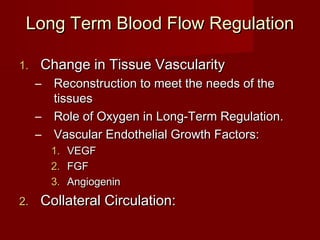
1.   Change in Tissue Vascularity
     –   Reconstruction to meet the needs of the
         tissues
     –   Role of Oxygen in Long-Term Regulation.
     –   Vascular Endothelial Growth Factors:
         1.   VEGF
         2.   FGF
         3.   Angiogenin
2.   Collateral Circulation:
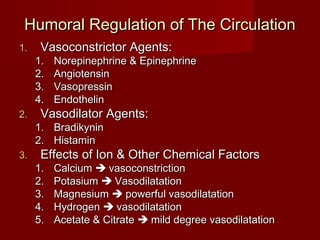
Humoral Regulation of The Circulation
1.    Vasoconstrictor Agents:
     1.   Norepinephrine & Epinephrine
     2.   Angiotensin
     3.   Vasopressin
     4.   Endothelin
2.    Vasodilator Agents:
     1. Bradikynin
     2. Histamin
3.    Effects of Ion & Other Chemical Factors
     1.   Calcium  vasoconstriction
     2.   Potasium  Vasodilatation
     3.   Magnesium  powerful vasodilatation
     4.   Hydrogen  vasodilatation
     5.   Acetate & Citrate  mild degree vasodilatation
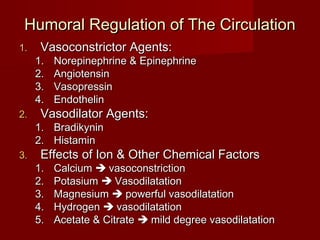
Humoral Regulation of The Circulation
1.    Vasoconstrictor Agents:
     1.   Norepinephrine & Epinephrine
     2.   Angiotensin
     3.   Vasopressin
     4.   Endothelin
2.    Vasodilator Agents:
     1. Bradikynin
     2. Histamin
3.    Effects of Ion & Other Chemical Factors
     1.   Calcium  vasoconstriction
     2.   Potasium  Vasodilatation
     3.   Magnesium  powerful vasodilatation
     4.   Hydrogen  vasodilatation
     5.   Acetate & Citrate  mild degree vasodilatation

Pengendalian aliran darah

  • 1.
    Local Control ofBlood Flow By: M. Rasjad Indra Lab. Ilmu Faal FK UNIBRAW
  • 2.
    Introduction  The greaterthe metabolism  the greater its blood flow – Liver: 95 ml/min/100 g of liver tissue. – Kidneys: 1100 ml/min  cleansing the blood.  The importance of blood flow control  effective & efficient – Serving metabolic need – Efficient heart workload.
  • 3.
    Mechanism of BloodFlow Control  Acute control (rapid changes in local vasodilatation / vasoconstriction): – Effect of tissue metabolism – The availability of oxygen changes. – Two basic theories:  Vasodilator theory: adenosine; CO2; histamine; K+ & H+  Oxygen lack theory: vasomotion in metarterioles & precapillary sphincters. – Other nutrients besides Oxygen: – Lack of glucose  vasodilatation – Vitamin B deficiency  vasodilatation
  • 5.
    The examples ofacute metabolic control of local blood flow 1. Reactive hyperemia • Blocked (seconds – hours)  unblocked • Blood flow increases to 4 – 7 times normal • Depends on how long it is blocked. 2. Active hyperemia • Tissue activity lack of nutrient & release vasodilator substances. • Local blood flow increases 20 times in muscle during heavy exercise.
  • 6.
    Blood flow control& The arterial pressure changes  Acute autoregulation theory: 1. The metabolic theory 2. The myogenic theory (still doubtful !!)  Endothelial-Derived Relaxing Factor “EDRF” (NO): – Rapid flow of blood  shear stress NO release  relaxes the local arterial wall.
  • 8.
    Long Term BloodFlow Regulation 1. Change in Tissue Vascularity – Reconstruction to meet the needs of the tissues – Role of Oxygen in Long-Term Regulation. – Vascular Endothelial Growth Factors: 1. VEGF 2. FGF 3. Angiogenin 2. Collateral Circulation:
  • 9.
    Humoral Regulation ofThe Circulation 1. Vasoconstrictor Agents: 1. Norepinephrine & Epinephrine 2. Angiotensin 3. Vasopressin 4. Endothelin 2. Vasodilator Agents: 1. Bradikynin 2. Histamin 3. Effects of Ion & Other Chemical Factors 1. Calcium  vasoconstriction 2. Potasium  Vasodilatation 3. Magnesium  powerful vasodilatation 4. Hydrogen  vasodilatation 5. Acetate & Citrate  mild degree vasodilatation
  • 10.
    Humoral Regulation ofThe Circulation 1. Vasoconstrictor Agents: 1. Norepinephrine & Epinephrine 2. Angiotensin 3. Vasopressin 4. Endothelin 2. Vasodilator Agents: 1. Bradikynin 2. Histamin 3. Effects of Ion & Other Chemical Factors 1. Calcium  vasoconstriction 2. Potasium  Vasodilatation 3. Magnesium  powerful vasodilatation 4. Hydrogen  vasodilatation 5. Acetate & Citrate  mild degree vasodilatation