DR NILESH KATE
MBBS,MD
ASSOCIATE PROF
ESIC MEDICAL COLLEGE, GULBARGA.
DEPT. OF PHYSIOLOGY
CARDIAC CYCLE
OBJECTIVES.
 Introduction
 Phases of cardiac cycle
 Events during cardiac cycle
 Duration of each phase
 Applied Physiology.
INTRODUCTION
 The heart as a pump.
 2 separate pump in series.
 Systole – contraction
 Diastole – relaxation.
 Cardiac cycle – both
electrical & mechanical
events from beginning of
one heart beat to beginning
of next.
Thursday, December 28, 2017
DURATION OF CARDIAC CYCLE
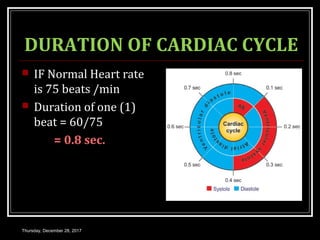
 IF Normal Heart rate
is 75 beats /min
 Duration of one (1)
beat = 60/75
= 0.8 sec.
Thursday, December 28, 2017
PHASES OF CARDIAC CYCLE
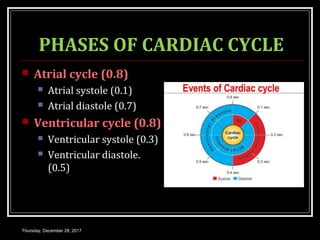
 Atrial cycle (0.8)
 Atrial systole (0.1)
 Atrial diastole (0.7)
 Ventricular cycle (0.8)
 Ventricular systole (0.3)
 Ventricular diastole.
(0.5)
Thursday, December 28, 2017
ATRIAL CYCLE
 Atrial systole (0.1)
 Coincide with last rapid
filling phase of
ventricles.
 Before this valves are
open, ventricles relaxed
with already 75% blood
 Contraction add only
remaining 25% blood.
Thursday, December 28, 2017
EFFECTS OF ATRIAL SYSTOLE.
 Intraatrial pressure
 Right – 4-6mm Hg.
 Left – 7-8 mm Hg.
 Intraventricular
pressure.
 Narrowing of origin of
great veins-
Decreasing Venous
Return.
Thursday, December 28, 2017
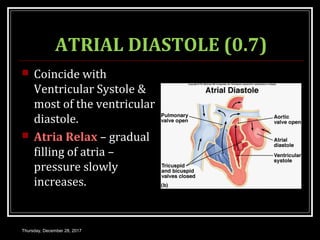
ATRIAL DIASTOLE (0.7)
 Coincide with
Ventricular Systole &
most of the ventricular
diastole.
 Atria Relax – gradual
filling of atria –
pressure slowly
increases.
Thursday, December 28, 2017
VENTRICULAR CYCLE
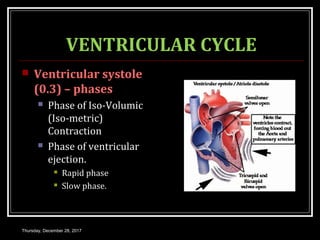
 Ventricular systole
(0.3) – phases
 Phase of Iso-Volumic
(Iso-metric)
Contraction
 Phase of ventricular
ejection.
 Rapid phase
 Slow phase.
Thursday, December 28, 2017
VENTRICULAR CYCLE (cont….)
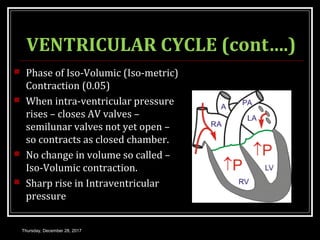
 Phase of Iso-Volumic (Iso-metric)
Contraction (0.05)
 When intra-ventricular pressure
rises – closes AV valves –
semilunar valves not yet open –
so contracts as closed chamber.
 No change in volume so called –
Iso-Volumic contraction.
 Sharp rise in Intraventricular
pressure
Thursday, December 28, 2017
VENTRICULAR CYCLE (cont….)
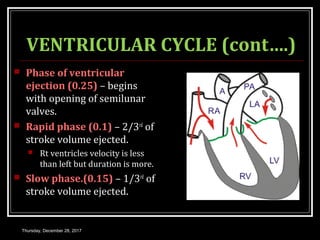
 Phase of ventricular
ejection (0.25) – begins
with opening of semilunar
valves.
 Rapid phase (0.1) – 2/3rd
of
stroke volume ejected.
 Rt ventricles velocity is less
than left but duration is more.
 Slow phase.(0.15) – 1/3rd
of
stroke volume ejected.
Thursday, December 28, 2017
VENTRICULAR CYCLE
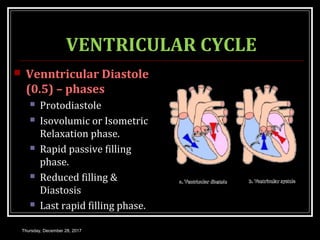
 Venntricular Diastole
(0.5) – phases
 Protodiastole
 Isovolumic or Isometric
Relaxation phase.
 Rapid passive filling
phase.
 Reduced filling &
Diastosis
 Last rapid filling phase.
Thursday, December 28, 2017
PROTODIASTOLE
0.04 sec.
 Ventricular systole ends
– ventricles relax –
Intraventricular
pressure falls – blood
comes back from vessels
to ventricles – semilunar
valves closes – 2nd
heart
sound
 Causes Diacrotic Notch
in pulse.
Thursday, December 28, 2017
ISOVOLUMIC OR ISOMETRIC
 Lasts for 0.06 sec
 Begins with closure of
semilunar valves.
 A-V valves not yet open –
relax as closed chamber –
as volume remains same
– Iso-Volumic relaxation.
 Ends with opening of A-V
valves
Thursday, December 28, 2017
RAPID PASSIVE FILLING
PHASE.
 As A-V valves open
atria till now in
diastole filled with
venous return with
increased pressure
causes – rapid passive
filling of ventricles ( 3rd
heart sound)
Thursday, December 28, 2017
REDUCED FILLING &
DIASTOSIS
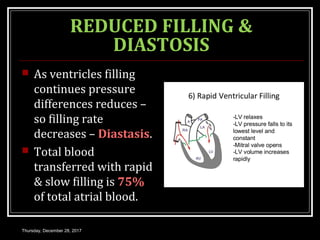
 As ventricles filling
continues pressure
differences reduces –
so filling rate
decreases – Diastasis.
 Total blood
transferred with rapid
& slow filling is 75%
of total atrial blood.
Thursday, December 28, 2017
LAST RAPID FILLING PHASE.
 As said earlier – it
coincide with atrial
systole – add
remaining 25 % of
blood to ventricles.
 With this ventricular
cycle completes.
Thursday, December 28, 2017
EVENTS DURING CARDIAC
CYCLE
 Pressure changes.
 In Ventricles
 In Atria.
 In Aorta
 In Pulmonary Artery.
 Volume changes.
 In ventricles
 During Atrial systole
 During Ventricular
systole.
Thursday, December 28, 2017
PRESSURE CHANGES.
IN VENTRICLES
 During Atrial systole
 Ventricular systole
 Ventricular diastole.
Thursday, December 28, 2017
PRESSURE CHANGES.
IN VENTRICLES
DURING ATRIAL SYSTOLE
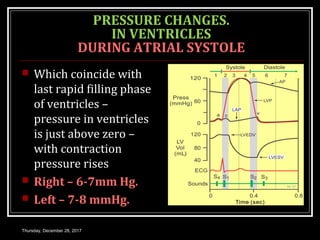
 Which coincide with
last rapid filling phase
of ventricles –
pressure in ventricles
is just above zero –
with contraction
pressure rises
 Right – 6-7mm Hg.
 Left – 7-8 mmHg.
Thursday, December 28, 2017
PRESSURE CHANGES.
IN VENTRICLES
DURING VENTRICULAR SYSTOLE
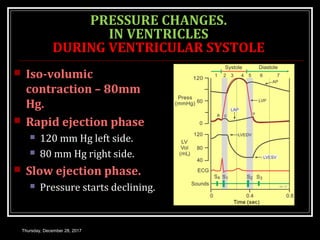
 Iso-volumic
contraction – 80mm
Hg.
 Rapid ejection phase
 120 mm Hg left side.
 80 mm Hg right side.
 Slow ejection phase.
 Pressure starts declining.
Thursday, December 28, 2017
PRESSURE CHANGES.
IN VENTRICLES VENTRICULAR
DIASTOLE.
 Protodiastole – pressure
drops rapidly – upto 80
mmHg.
 Iso-volumic or Isometric
Relaxation phase – 2-3 mm
Hg.
 Rapid passive filling phase –
further falls (GH)
 Reduced filling & Diastosis –
Pressure just above zero.
 Last rapid filling phase.
Thursday, December 28, 2017
PRESSURE CHANGES IN ATRIA.
DURING ATRIAL SYSTOLE
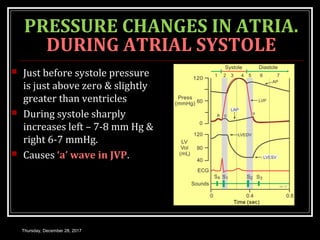
 Just before systole pressure
is just above zero & slightly
greater than ventricles
 During systole sharply
increases left – 7-8 mm Hg &
right 6-7 mmHg.
 Causes ‘a’ wave in JVP.
Thursday, December 28, 2017
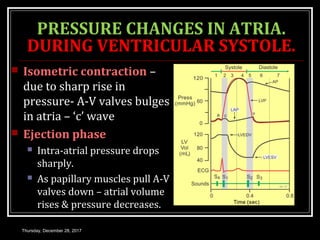
PRESSURE CHANGES IN ATRIA.
DURING VENTRICULAR SYSTOLE.
 Isometric contraction –
due to sharp rise in
pressure- A-V valves bulges
in atria – ‘c’ wave
 Ejection phase
 Intra-atrial pressure drops
sharply.
 As papillary muscles pull A-V
valves down – atrial volume
rises & pressure decreases.
Thursday, December 28, 2017
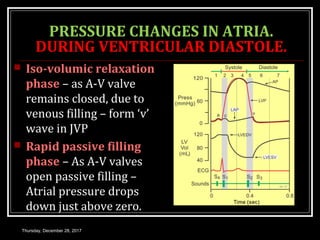
PRESSURE CHANGES IN ATRIA.
DURING VENTRICULAR DIASTOLE.
 Iso-volumic relaxation
phase – as A-V valve
remains closed, due to
venous filling – form ‘v’
wave in JVP
 Rapid passive filling
phase – As A-V valves
open passive filling –
Atrial pressure drops
down just above zero.
Thursday, December 28, 2017
PRESSURE CHANGES IN AORTA
DURING ATRIAL SYSTOLE
 Pressure in Aorta is 80
mm Hg.
Thursday, December 28, 2017
PRESSURE CHANGES IN AORTA
DURING VENTRICULAR SYSTOLE
 During ventricular
systole – aortic
pressure is less than
intraventricular
pressure.
 As systole continues
pressure reaches
equal to ventricles
(120mm Hg)
Thursday, December 28, 2017
PRESSURE CHANGES IN AORTA
DURING VENTRICULAR DIASTOLE
 During Protodiastole –
Aortic pressure is higher
than ventricles – back
flow of blood – 2nd
HS &
Diacrotic notch.
 Rest of diastole – aortic
pressure decline slowly
up to 80 mm Hg.
Thursday, December 28, 2017
PRESSURE CHANGES IN
PULMONARY ARTERY.
 Similar to Aorta but
pressures are low.
 Systolic pressure goes
up to 15-18 mm Hg.
 Diastolic pressure up
to 8-10 mm Hg.
Thursday, December 28, 2017
VOLUME CHANGES.
IN VENTRICLES
 During Atrial systole
 Coincide with last rapid
filling phase
 Out of total 130 ml (EDV)
in ventricles, 105 ml (75%)
blood already reaches
ventricle before systole
 25 ml (25%) transferred
due to atrial systole.
Thursday, December 28, 2017
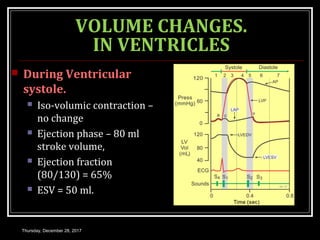
VOLUME CHANGES.
IN VENTRICLES
 During Ventricular
systole.
 Iso-volumic contraction –
no change
 Ejection phase – 80 ml
stroke volume,
 Ejection fraction
(80/130) = 65%
 ESV = 50 ml.
Thursday, December 28, 2017
VALVULAR EVENTS (HEART
SOUNDS)
 First heart sound
 Second heart sound
 Third heart sound
 Fourth heart sound
Thursday, December 28, 2017
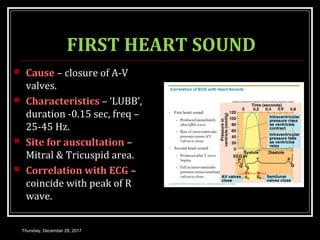
FIRST HEART SOUND
 Cause – closure of A-V
valves.
 Characteristics – ‘LUBB’,
duration -0.15 sec, freq –
25-45 Hz.
 Site for auscultation –
Mitral & Tricuspid area.
 Correlation with ECG –
coincide with peak of R
wave.
Thursday, December 28, 2017
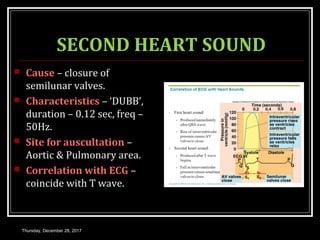
SECOND HEART SOUND
 Cause – closure of
semilunar valves.
 Characteristics – ‘DUBB’,
duration – 0.12 sec, freq –
50Hz.
 Site for auscultation –
Aortic & Pulmonary area.
 Correlation with ECG –
coincide with T wave.
Thursday, December 28, 2017
THIRD HEART SOUND
 Cause – Inrush of blood
during rapid filling
phase.
 Characteristics –
Duration – 0.1 sec.
 Correlation with ECG –
appears between T & P
wave.
Thursday, December 28, 2017
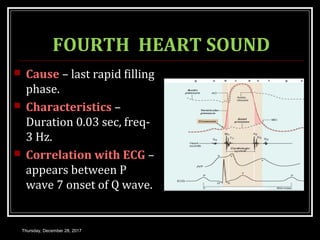
FOURTH HEART SOUND
 Cause – last rapid filling
phase.
 Characteristics –
Duration 0.03 sec, freq-
3 Hz.
 Correlation with ECG –
appears between P
wave 7 onset of Q wave.
Thursday, December 28, 2017
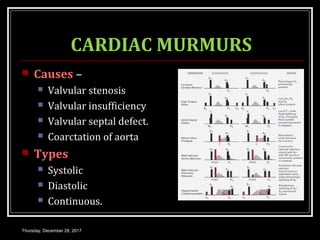
CARDIAC MURMURS
 Abnormal heart sounds
during cardiac cycle.
 Mechanism of
production – produced
due to turbulent blood
flow.
Thursday, December 28, 2017
CARDIAC MURMURS
 Causes –
 Valvular stenosis
 Valvular insufficiency
 Valvular septal defect.
 Coarctation of aorta
 Types
 Systolic
 Diastolic
 Continuous.
Thursday, December 28, 2017
DURATION OF EACH PHASE
 Effect of heart rate –
 As HR – cardiac cycle
duration
 If HR 200, CC =
60/200 = 0.3 sec.
 Duration of each
phases
 But diastole > systole
Thursday, December 28, 2017
APPLIED PHYSIOLOGY.
 Coronary blood flow
to subendocardial
area occurs during
diastole – so diastole
duration cardiac
perfusion
 Ventricular filling also
occurs during diastole
HR CO
Thursday, December 28, 2017
THANK YOU

CARDIAC CYCLE

  • 1.
    DR NILESH KATE MBBS,MD ASSOCIATEPROF ESIC MEDICAL COLLEGE, GULBARGA. DEPT. OF PHYSIOLOGY CARDIAC CYCLE
  • 2.
    OBJECTIVES.  Introduction  Phasesof cardiac cycle  Events during cardiac cycle  Duration of each phase  Applied Physiology.
  • 3.
    INTRODUCTION  The heartas a pump.  2 separate pump in series.  Systole – contraction  Diastole – relaxation.  Cardiac cycle – both electrical & mechanical events from beginning of one heart beat to beginning of next. Thursday, December 28, 2017
  • 4.
    DURATION OF CARDIACCYCLE  IF Normal Heart rate is 75 beats /min  Duration of one (1) beat = 60/75 = 0.8 sec. Thursday, December 28, 2017
  • 5.
    PHASES OF CARDIACCYCLE  Atrial cycle (0.8)  Atrial systole (0.1)  Atrial diastole (0.7)  Ventricular cycle (0.8)  Ventricular systole (0.3)  Ventricular diastole. (0.5) Thursday, December 28, 2017
  • 6.
    ATRIAL CYCLE  Atrialsystole (0.1)  Coincide with last rapid filling phase of ventricles.  Before this valves are open, ventricles relaxed with already 75% blood  Contraction add only remaining 25% blood. Thursday, December 28, 2017
  • 7.
    EFFECTS OF ATRIALSYSTOLE.  Intraatrial pressure  Right – 4-6mm Hg.  Left – 7-8 mm Hg.  Intraventricular pressure.  Narrowing of origin of great veins- Decreasing Venous Return. Thursday, December 28, 2017
  • 8.
    ATRIAL DIASTOLE (0.7) Coincide with Ventricular Systole & most of the ventricular diastole.  Atria Relax – gradual filling of atria – pressure slowly increases. Thursday, December 28, 2017
  • 9.
    VENTRICULAR CYCLE  Ventricularsystole (0.3) – phases  Phase of Iso-Volumic (Iso-metric) Contraction  Phase of ventricular ejection.  Rapid phase  Slow phase. Thursday, December 28, 2017
  • 10.
    VENTRICULAR CYCLE (cont….) Phase of Iso-Volumic (Iso-metric) Contraction (0.05)  When intra-ventricular pressure rises – closes AV valves – semilunar valves not yet open – so contracts as closed chamber.  No change in volume so called – Iso-Volumic contraction.  Sharp rise in Intraventricular pressure Thursday, December 28, 2017
  • 11.
    VENTRICULAR CYCLE (cont….) Phase of ventricular ejection (0.25) – begins with opening of semilunar valves.  Rapid phase (0.1) – 2/3rd of stroke volume ejected.  Rt ventricles velocity is less than left but duration is more.  Slow phase.(0.15) – 1/3rd of stroke volume ejected. Thursday, December 28, 2017
  • 12.
    VENTRICULAR CYCLE  VenntricularDiastole (0.5) – phases  Protodiastole  Isovolumic or Isometric Relaxation phase.  Rapid passive filling phase.  Reduced filling & Diastosis  Last rapid filling phase. Thursday, December 28, 2017
  • 13.
    PROTODIASTOLE 0.04 sec.  Ventricularsystole ends – ventricles relax – Intraventricular pressure falls – blood comes back from vessels to ventricles – semilunar valves closes – 2nd heart sound  Causes Diacrotic Notch in pulse. Thursday, December 28, 2017
  • 14.
    ISOVOLUMIC OR ISOMETRIC Lasts for 0.06 sec  Begins with closure of semilunar valves.  A-V valves not yet open – relax as closed chamber – as volume remains same – Iso-Volumic relaxation.  Ends with opening of A-V valves Thursday, December 28, 2017
  • 15.
    RAPID PASSIVE FILLING PHASE. As A-V valves open atria till now in diastole filled with venous return with increased pressure causes – rapid passive filling of ventricles ( 3rd heart sound) Thursday, December 28, 2017
  • 16.
    REDUCED FILLING & DIASTOSIS As ventricles filling continues pressure differences reduces – so filling rate decreases – Diastasis.  Total blood transferred with rapid & slow filling is 75% of total atrial blood. Thursday, December 28, 2017
  • 17.
    LAST RAPID FILLINGPHASE.  As said earlier – it coincide with atrial systole – add remaining 25 % of blood to ventricles.  With this ventricular cycle completes. Thursday, December 28, 2017
  • 18.
    EVENTS DURING CARDIAC CYCLE Pressure changes.  In Ventricles  In Atria.  In Aorta  In Pulmonary Artery.  Volume changes.  In ventricles  During Atrial systole  During Ventricular systole. Thursday, December 28, 2017
  • 19.
    PRESSURE CHANGES. IN VENTRICLES During Atrial systole  Ventricular systole  Ventricular diastole. Thursday, December 28, 2017
  • 20.
    PRESSURE CHANGES. IN VENTRICLES DURINGATRIAL SYSTOLE  Which coincide with last rapid filling phase of ventricles – pressure in ventricles is just above zero – with contraction pressure rises  Right – 6-7mm Hg.  Left – 7-8 mmHg. Thursday, December 28, 2017
  • 21.
    PRESSURE CHANGES. IN VENTRICLES DURINGVENTRICULAR SYSTOLE  Iso-volumic contraction – 80mm Hg.  Rapid ejection phase  120 mm Hg left side.  80 mm Hg right side.  Slow ejection phase.  Pressure starts declining. Thursday, December 28, 2017
  • 22.
    PRESSURE CHANGES. IN VENTRICLESVENTRICULAR DIASTOLE.  Protodiastole – pressure drops rapidly – upto 80 mmHg.  Iso-volumic or Isometric Relaxation phase – 2-3 mm Hg.  Rapid passive filling phase – further falls (GH)  Reduced filling & Diastosis – Pressure just above zero.  Last rapid filling phase. Thursday, December 28, 2017
  • 23.
    PRESSURE CHANGES INATRIA. DURING ATRIAL SYSTOLE  Just before systole pressure is just above zero & slightly greater than ventricles  During systole sharply increases left – 7-8 mm Hg & right 6-7 mmHg.  Causes ‘a’ wave in JVP. Thursday, December 28, 2017
  • 24.
    PRESSURE CHANGES INATRIA. DURING VENTRICULAR SYSTOLE.  Isometric contraction – due to sharp rise in pressure- A-V valves bulges in atria – ‘c’ wave  Ejection phase  Intra-atrial pressure drops sharply.  As papillary muscles pull A-V valves down – atrial volume rises & pressure decreases. Thursday, December 28, 2017
  • 25.
    PRESSURE CHANGES INATRIA. DURING VENTRICULAR DIASTOLE.  Iso-volumic relaxation phase – as A-V valve remains closed, due to venous filling – form ‘v’ wave in JVP  Rapid passive filling phase – As A-V valves open passive filling – Atrial pressure drops down just above zero. Thursday, December 28, 2017
  • 26.
    PRESSURE CHANGES INAORTA DURING ATRIAL SYSTOLE  Pressure in Aorta is 80 mm Hg. Thursday, December 28, 2017
  • 27.
    PRESSURE CHANGES INAORTA DURING VENTRICULAR SYSTOLE  During ventricular systole – aortic pressure is less than intraventricular pressure.  As systole continues pressure reaches equal to ventricles (120mm Hg) Thursday, December 28, 2017
  • 28.
    PRESSURE CHANGES INAORTA DURING VENTRICULAR DIASTOLE  During Protodiastole – Aortic pressure is higher than ventricles – back flow of blood – 2nd HS & Diacrotic notch.  Rest of diastole – aortic pressure decline slowly up to 80 mm Hg. Thursday, December 28, 2017
  • 29.
    PRESSURE CHANGES IN PULMONARYARTERY.  Similar to Aorta but pressures are low.  Systolic pressure goes up to 15-18 mm Hg.  Diastolic pressure up to 8-10 mm Hg. Thursday, December 28, 2017
  • 30.
    VOLUME CHANGES. IN VENTRICLES During Atrial systole  Coincide with last rapid filling phase  Out of total 130 ml (EDV) in ventricles, 105 ml (75%) blood already reaches ventricle before systole  25 ml (25%) transferred due to atrial systole. Thursday, December 28, 2017
  • 31.
    VOLUME CHANGES. IN VENTRICLES During Ventricular systole.  Iso-volumic contraction – no change  Ejection phase – 80 ml stroke volume,  Ejection fraction (80/130) = 65%  ESV = 50 ml. Thursday, December 28, 2017
  • 32.
    VALVULAR EVENTS (HEART SOUNDS) First heart sound  Second heart sound  Third heart sound  Fourth heart sound Thursday, December 28, 2017
  • 33.
    FIRST HEART SOUND Cause – closure of A-V valves.  Characteristics – ‘LUBB’, duration -0.15 sec, freq – 25-45 Hz.  Site for auscultation – Mitral & Tricuspid area.  Correlation with ECG – coincide with peak of R wave. Thursday, December 28, 2017
  • 34.
    SECOND HEART SOUND Cause – closure of semilunar valves.  Characteristics – ‘DUBB’, duration – 0.12 sec, freq – 50Hz.  Site for auscultation – Aortic & Pulmonary area.  Correlation with ECG – coincide with T wave. Thursday, December 28, 2017
  • 35.
    THIRD HEART SOUND Cause – Inrush of blood during rapid filling phase.  Characteristics – Duration – 0.1 sec.  Correlation with ECG – appears between T & P wave. Thursday, December 28, 2017
  • 36.
    FOURTH HEART SOUND Cause – last rapid filling phase.  Characteristics – Duration 0.03 sec, freq- 3 Hz.  Correlation with ECG – appears between P wave 7 onset of Q wave. Thursday, December 28, 2017
  • 37.
    CARDIAC MURMURS  Abnormalheart sounds during cardiac cycle.  Mechanism of production – produced due to turbulent blood flow. Thursday, December 28, 2017
  • 38.
    CARDIAC MURMURS  Causes–  Valvular stenosis  Valvular insufficiency  Valvular septal defect.  Coarctation of aorta  Types  Systolic  Diastolic  Continuous. Thursday, December 28, 2017
  • 39.
    DURATION OF EACHPHASE  Effect of heart rate –  As HR – cardiac cycle duration  If HR 200, CC = 60/200 = 0.3 sec.  Duration of each phases  But diastole > systole Thursday, December 28, 2017
  • 40.
    APPLIED PHYSIOLOGY.  Coronaryblood flow to subendocardial area occurs during diastole – so diastole duration cardiac perfusion  Ventricular filling also occurs during diastole HR CO Thursday, December 28, 2017
  • 41.