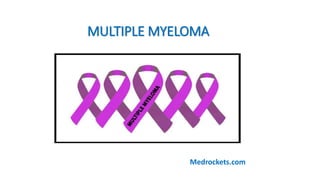
MULTIPLE MYELOMA
Medrockets.com
INTRODUCTION
• Multiple Myeloma (also k/a Myeloma, Plasma cell
myeloma, plasmocytoma, monoclonal gammopathy
or Kahler disease )
• It is a cancer of the plasma cell characterized by a
malignant proliferation of plasma cells derived from a
single clone
• is a progressive hematologic (blood) disease.
• Plasma cell an important part of the immune system
that produces immunoglobulin (antibodies) to help
fight infection and disease.
• Most common primary malignancy of bone (~40%)
Medrockets.com
INCIDENCE
• Multiple myeloma is the 2nd most prevalent blood
cancer after non-Hodgkin's lymphoma.
• Most common primary malignancy of bone
• Age group – more common in 4th to 6th decade
• Male : Female 2:1
• More in african-americans than Caucasians
• Risk factors – radiation - exposure to petroleum
products
• Average age at diagnosis is 62 years for men and 61
years for women
Medrockets.com
RISK FACTORS
• Age >60.
• Exposure to pesticides ( DDT ).
• Radiation
• Wood,leather,sheet metal & nuclear industry worker
• Exposure to ptroleum products (Benzene)
• Kaposi’s sarcoma Herpes Virus(Presence of IL-6 and HHV8 )
•
Medrockets.com
• Multiple myeloma is characterized by excessive numbers of abnormal
plasma cells in the bone marrow and overproduction of intact
monoclonal immunoglobulin (IgG, IgA, IgD, or IgE) or Bence-Jones
protein (free monoclonal κ and λ light chains). Hypercalcemia,
anemia, renal damage, increased susceptibility to bacterial infection,
and impaired production of normal immunoglobulin are common
clinical manifestations of multiple myeloma. It is often also
characterized by diffuse osteoporosis, usually in the pelvis, spine, ribs,
and skull.
PATHOPHYSIOLOGY
• 15% to 20% of patients with myeloma produce incomplete
immunoglobulins, containing only the light chain portion of the
immunoglobulin
• Primarily in the urine, rather than in the blood
(immunoelectrophoresis)
• Different from monoclonal (M) protein or paraprotein
• Absent in nonsecretory myeloma (1%)
Bence Jones proteins
Medrockets.com
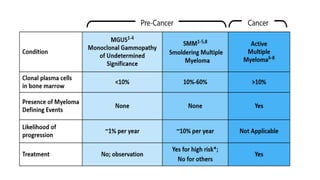
Classification of Myeloma
1. Monoclonal Gammopathy of Undetermined Significance
(MGUS)
2. Asymptomatic Multiple Myeloma
• Smoldering (SMM)
• Indolent (IMM)
3. Symptomatic Multiple Myeloma (MM)
Medrockets.com
Monoclonal Gammopathy of Undetermined
Significance (MGUS)
• Serum M protein <3 g/dL
• Bone marrow plasma cells <10%
• Absence of anemia, renal failure, hypercalcemia, lytic bone lesions
• 1% of the general population and in about 3% of normal individuals
over 70 years of age
• 16% -malignant plasma cell disorder
• Disease Management - observation
Medrockets.com
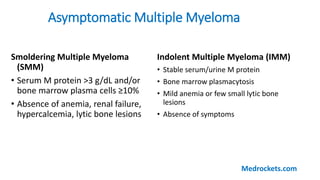
Asymptomatic Multiple Myeloma
Smoldering Multiple Myeloma
(SMM)
• Serum M protein >3 g/dL and/or
bone marrow plasma cells ≥10%
• Absence of anemia, renal failure,
hypercalcemia, lytic bone lesions
Indolent Multiple Myeloma (IMM)
• Stable serum/urine M protein
• Bone marrow plasmacytosis
• Mild anemia or few small lytic bone
lesions
• Absence of symptoms
Medrockets.com
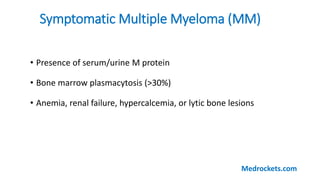
Symptomatic Multiple Myeloma (MM)
• Presence of serum/urine M protein
• Bone marrow plasmacytosis (>30%)
• Anemia, renal failure, hypercalcemia, or lytic bone lesions
Medrockets.com
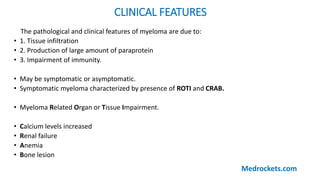
CLINICAL FEATURES
The pathological and clinical features of myeloma are due to:
• 1. Tissue infiltration
• 2. Production of large amount of paraprotein
• 3. Impairment of immunity.
• May be symptomatic or asymptomatic.
• Symptomatic myeloma characterized by presence of ROTI and CRAB.
• Myeloma Related Organ or Tissue Impairment.
• Calcium levels increased
• Renal failure
• Anemia
• Bone lesion
Medrockets.com
Mechanism of disease
• Plasma cell proliferation - > anemia, bone marrow suppression,
infection risk
• Osteoclasts - > bony lesions, fractures, vertebral collapse, spinal cord
compression
• Paraprotein, hypercalcemia -> renal failure
• Hypercalcemia – polyuria, thirst, drowsiness, coma
Medrockets.com
Clinical Manifestations of Multiple Myeloma
•BONE PAIN (Pain in the lower
back, long bones or ribs)
•Generalized malaise,Weight loss,
•Anaemia,Thrombocytopenia
(Bleeding)
• Renal failure( Light chains and
amyloid depostion)
•Symptoms of hypercalcemia
•Nausea
•Fatigue
•Thirst
•Symptoms of hyperviscosity
•Headaches
•Bruising
•Ischemic neurologic symptoms
•Hyperuricemia
•Infections
•Other neurologic symptoms
Peripheral neuropathy
•Meningitis
Medrockets.com
Myeloma bone disease
• Rapid growth of myeloma cells inhibits normal bone-
forming cells osteoblasts
• production of substances that activate the cells that
resorb bone called osteoclasts is increased
Common bones affected:
 Skull
 Spine ( Thoracic ,Lumbar)
 Pelvis
 Long bones
 Spinal cord – compression can occur
Medrockets.com
Diagnostic features of active or
symptomatic myeloma
Organ damage classified as “CRAB”
• C – calcium elevation (>10 mg/L)
• R – renal dysfunction (creatinine >2 mg/dL)
• A – anemia (hemoglobin <10 g/dL or ≥2 g/dL decrease from
patient’s normal)
• B – bone disease (lytic lesions or osteoporosis)
*ONE OR MORE required for diagnosis of SYMPTOMATIC
MYELOMA.
Other less common features can also be criteria for an
individual patient, including:
• Recurrent severe infections
• Neuropathy linked to myeloma
• Amyloidosis or M-component deposition
• Other unique features
Medrockets.com
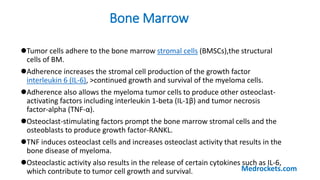
Bone Marrow
Tumor cells adhere to the bone marrow stromal cells (BMSCs),the structural
cells of BM.
Adherence increases the stromal cell production of the growth factor
interleukin 6 (IL-6), >continued growth and survival of the myeloma cells.
Adherence also allows the myeloma tumor cells to produce other osteoclast-
activating factors including interleukin 1-beta (IL-1β) and tumor necrosis
factor-alpha (TNF-α).
Osteoclast-stimulating factors prompt the bone marrow stromal cells and the
osteoblasts to produce growth factor-RANKL.
TNF induces osteoclast cells and increases osteoclast activity that results in the
bone disease of myeloma.
Osteoclastic activity also results in the release of certain cytokines such as IL-6,
which contribute to tumor cell growth and survival. Medrockets.com
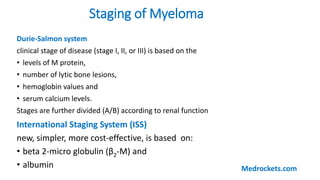
Staging of Myeloma
Durie-Salmon system
clinical stage of disease (stage I, II, or III) is based on the
• levels of M protein,
• number of lytic bone lesions,
• hemoglobin values and
• serum calcium levels.
Stages are further divided (A/B) according to renal function
International Staging System (ISS)
new, simpler, more cost-effective, is based on:
• beta 2-micro globulin (β2-M) and
• albumin Medrockets.com
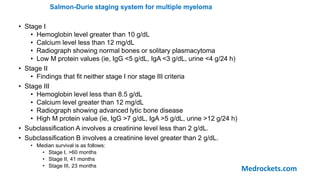
Salmon-Durie staging system for multiple myeloma
• Stage I
• Hemoglobin level greater than 10 g/dL
• Calcium level less than 12 mg/dL
• Radiograph showing normal bones or solitary plasmacytoma
• Low M protein values (ie, IgG <5 g/dL, IgA <3 g/dL, urine <4 g/24 h)
• Stage II
• Findings that fit neither stage I nor stage III criteria
• Stage III
• Hemoglobin level less than 8.5 g/dL
• Calcium level greater than 12 mg/dL
• Radiograph showing advanced lytic bone disease
• High M protein value (ie, IgG >7 g/dL, IgA >5 g/dL, urine >12 g/24 h)
• Subclassification A involves a creatinine level less than 2 g/dL.
• Subclassification B involves a creatinine level greater than 2 g/dL.
• Median survival is as follows:
• Stage I, >60 months
• Stage II, 41 months
• Stage III, 23 months
Medrockets.com
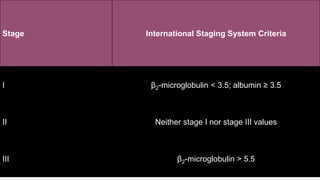
Stage International Staging System Criteria
I β2-microglobulin < 3.5; albumin ≥ 3.5
II Neither stage I nor stage III values
III β2-microglobulin > 5.5
• The classic triad of myeloma
• Marrow plasmacytosis (>10%)
• Lytic bone lesions
• Serum and/or urine M component
• The diagnosis may be made in the absence of bone
lesions if the plasmacytosis is associated with a
progressive increase in the M component over time
or if extramedullary mass lesions develop
DIAGNOSIS
Medrockets.com
Major
• І Plasmacytoma on tissue biopsy
• II = Bone marrow with greater than 30% plasma cells
• III = Monoclonal globulin spike on serum protein electrophoresis, with an immunoglobulin
(Ig) G peak of greater than 35 g/L or an IgA peak of greater than 20 g/L, or urine protein
electrophoresis (in the presence of amyloidosis) result of greater than 1 g/24 h
MINOR
• a = Bone marrow with 10-30% plasma cells
• b = Monoclonal globulin spike present but less than category III
• c = Lytic bone lesions
• d =Depressed normal Igs
The diagnosis of MM requires at least 1 major and 1 minor criterion or at least 3 minor
criteria including both a and b
DIAGNOSTIC CRITERIA
Medrockets.com
• Anemia, leukopenia, thrombocytopenia
• ALb, reversed A:G ratio
• serum creat, uric acid, urea
• Abnormal coagulation
• Serum Ca
• Proteinuria and cast
• ESR
• LOW NORMAL ALKALINE PHOSPHATASE
• Red cells show rouleaux formation
• BENCE-JONES PROTEIN in urine in 30%
LABORATORY FINDINGS
Medrockets.com
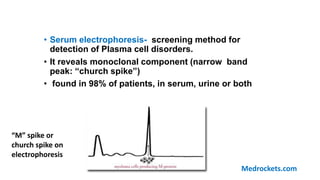
• Serum electrophoresis- screening method for
detection of Plasma cell disorders.
• It reveals monoclonal component (narrow band
peak: “church spike”)
• found in 98% of patients, in serum, urine or both
“M” spike or
church spike on
electrophoresis
Medrockets.com
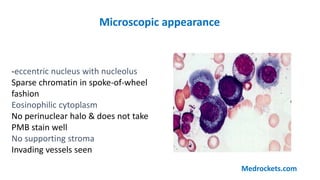
-eccentric nucleus with nucleolus
Sparse chromatin in spoke-of-wheel
fashion
Eosinophilic cytoplasm
No perinuclear halo & does not take
PMB stain well
No supporting stroma
Invading vessels seen
Microscopic appearance
Medrockets.com
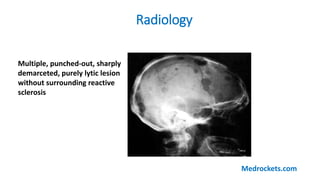
Radiology
Multiple, punched-out, sharply
demarceted, purely lytic lesion
without surrounding reactive
sclerosis
Medrockets.com
Differential diagnosis
• Other Plasma cell disorders- MGUS (monoclonal
gammopathy of uncertain significance),
Waldenstrom`s disease
• Bone metastasis –breast, prostatic Ca
• Hyperparathyroidism
• Other reasons for renal failure-ex. chronic glomerulo-
nephritis
Medrockets.com
Test Values indicating favorable prognosis
B 2-M <3 μg/mL
Albumin ≥3.5 g/dL
PCLI < 1%
CRP <6 μg/mL
LDH Age ≤60 y: 100-190 U/L
Age >60 y: 110-210 U/L
Plasmablastic
morphology
Absence of plasmablastic morphology
Chromosomal analysis
(FISH)
Normal chromosome 13
GOOD PROGNOSTIC FACTORS
Medrockets.com
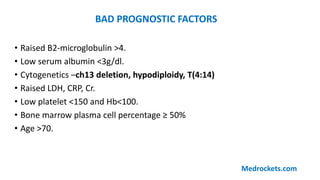
• Raised B2-microglobulin >4.
• Low serum albumin <3g/dl.
• Cytogenetics –ch13 deletion, hypodiploidy, T(4:14)
• Raised LDH, CRP, Cr.
• Low platelet <150 and Hb<100.
• Bone marrow plasma cell percentage ≥ 50%
• Age >70.
BAD PROGNOSTIC FACTORS
Medrockets.com
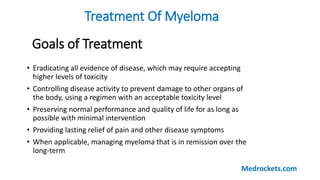
Goals of Treatment
Treatment Of Myeloma
• Eradicating all evidence of disease, which may require accepting
higher levels of toxicity
• Controlling disease activity to prevent damage to other organs of
the body, using a regimen with an acceptable toxicity level
• Preserving normal performance and quality of life for as long as
possible with minimal intervention
• Providing lasting relief of pain and other disease symptoms
• When applicable, managing myeloma that is in remission over the
long-term
Medrockets.com
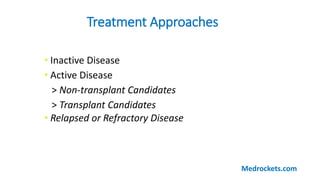
Treatment Approaches
• Inactive Disease
• Active Disease
> Non-transplant Candidates
> Transplant Candidates
• Relapsed or Refractory Disease
Medrockets.com
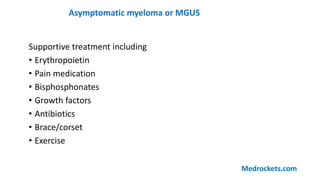
Supportive treatment including
• Erythropoietin
• Pain medication
• Bisphosphonates
• Growth factors
• Antibiotics
• Brace/corset
• Exercise
Asymptomatic myeloma or MGUS
Medrockets.com
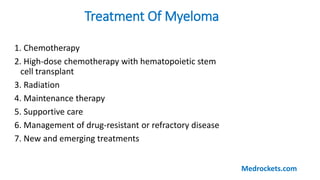
1. Chemotherapy
2. High-dose chemotherapy with hematopoietic stem
cell transplant
3. Radiation
4. Maintenance therapy
5. Supportive care
6. Management of drug-resistant or refractory disease
7. New and emerging treatments
Treatment Of Myeloma
Medrockets.com
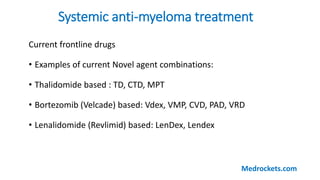
Current frontline drugs
• Examples of current Novel agent combinations:
• Thalidomide based : TD, CTD, MPT
• Bortezomib (Velcade) based: Vdex, VMP, CVD, PAD, VRD
• Lenalidomide (Revlimid) based: LenDex, Lendex
Systemic anti-myeloma treatment
Medrockets.com
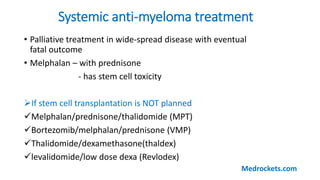
Systemic anti-myeloma treatment
• Palliative treatment in wide-spread disease with eventual
fatal outcome
• Melphalan – with prednisone
- has stem cell toxicity
If stem cell transplantation is NOT planned
Melphalan/prednisone/thalidomide (MPT)
Bortezomib/melphalan/prednisone (VMP)
Thalidomide/dexamethasone(thaldex)
levalidomide/low dose dexa (Revlodex)
Medrockets.com
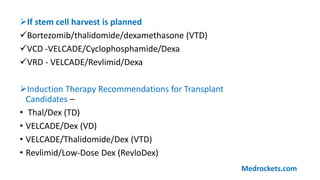
If stem cell harvest is planned
Bortezomib/thalidomide/dexamethasone (VTD)
VCD -VELCADE/Cyclophosphamide/Dexa
VRD - VELCADE/Revlimid/Dexa
Induction Therapy Recommendations for Transplant
Candidates –
• Thal/Dex (TD)
• VELCADE/Dex (VD)
• VELCADE/Thalidomide/Dex (VTD)
• Revlimid/Low-Dose Dex (RevloDex)
Medrockets.com
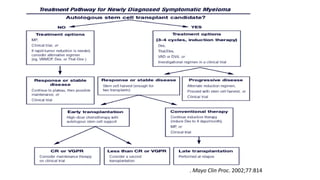
. Mayo Clin Proc. 2002;77:814
Options for relapsed/refractory disease
• Repeat initial therapy if relapse after 6mths of discontinuing
therapy
• Corticosteroids
• Thalidomide based regimens
• Bortezomib
• Salvage chemotherapy ( eg. VAD, Cyclophosphamide-VAD,
EDAP or oral cyclophosphamide
• Consider second transplant if stem cells available/ harvest
possible
• investigation regimen in clinical trial
Medrockets.com
Radiation
• Myeloma is radiosensitive
• Eventually looses its susceptibility
• Relieves pain
• Can be used for control of local disease
• Total body irradiation not advised
Surgical options
• Compression of intraspinal nerves – laminectomy,
removal of myelomatous tissue and post-op irradiation
• In cases with instability  spinal fusion
• Intramedullary fixation seldom posible as soft bone
retains metal badly Medrockets.com
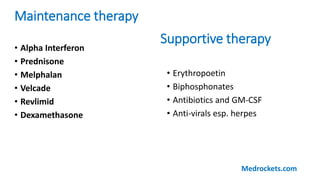
Maintenance therapy
• Alpha Interferon
• Prednisone
• Melphalan
• Velcade
• Revlimid
• Dexamethasone
Supportive therapy
• Erythropoetin
• Biphosphonates
• Antibiotics and GM-CSF
• Anti-virals esp. herpes
Medrockets.com
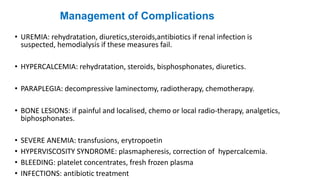
Management of Complications
• UREMIA: rehydratation, diuretics,steroids,antibiotics if renal infection is
suspected, hemodialysis if these measures fail.
• HYPERCALCEMIA: rehydratation, steroids, bisphosphonates, diuretics.
• PARAPLEGIA: decompressive laminectomy, radiotherapy, chemotherapy.
• BONE LESIONS: if painful and localised, chemo or local radio-therapy, analgetics,
biphosphonates.
• SEVERE ANEMIA: transfusions, erytropoetin
• HYPERVISCOSITY SYNDROME: plasmapheresis, correction of hypercalcemia.
• BLEEDING: platelet concentrates, fresh frozen plasma
• INFECTIONS: antibiotic treatment
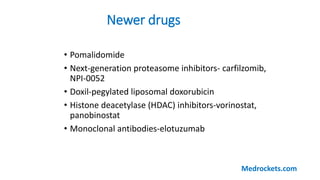
Newer drugs
• Pomalidomide
• Next-generation proteasome inhibitors- carfilzomib,
NPI-0052
• Doxil-pegylated liposomal doxorubicin
• Histone deacetylase (HDAC) inhibitors-vorinostat,
panobinostat
• Monoclonal antibodies-elotuzumab
Medrockets.com
Medrockets.com
THANK YOU

Multiple myeloma

  • 1.
  • 2.
    INTRODUCTION • Multiple Myeloma(also k/a Myeloma, Plasma cell myeloma, plasmocytoma, monoclonal gammopathy or Kahler disease ) • It is a cancer of the plasma cell characterized by a malignant proliferation of plasma cells derived from a single clone • is a progressive hematologic (blood) disease. • Plasma cell an important part of the immune system that produces immunoglobulin (antibodies) to help fight infection and disease. • Most common primary malignancy of bone (~40%) Medrockets.com
  • 3.
    INCIDENCE • Multiple myelomais the 2nd most prevalent blood cancer after non-Hodgkin's lymphoma. • Most common primary malignancy of bone • Age group – more common in 4th to 6th decade • Male : Female 2:1 • More in african-americans than Caucasians • Risk factors – radiation - exposure to petroleum products • Average age at diagnosis is 62 years for men and 61 years for women Medrockets.com
  • 4.
    RISK FACTORS • Age>60. • Exposure to pesticides ( DDT ). • Radiation • Wood,leather,sheet metal & nuclear industry worker • Exposure to ptroleum products (Benzene) • Kaposi’s sarcoma Herpes Virus(Presence of IL-6 and HHV8 ) • Medrockets.com
  • 5.
    • Multiple myelomais characterized by excessive numbers of abnormal plasma cells in the bone marrow and overproduction of intact monoclonal immunoglobulin (IgG, IgA, IgD, or IgE) or Bence-Jones protein (free monoclonal κ and λ light chains). Hypercalcemia, anemia, renal damage, increased susceptibility to bacterial infection, and impaired production of normal immunoglobulin are common clinical manifestations of multiple myeloma. It is often also characterized by diffuse osteoporosis, usually in the pelvis, spine, ribs, and skull. PATHOPHYSIOLOGY
  • 6.
    • 15% to20% of patients with myeloma produce incomplete immunoglobulins, containing only the light chain portion of the immunoglobulin • Primarily in the urine, rather than in the blood (immunoelectrophoresis) • Different from monoclonal (M) protein or paraprotein • Absent in nonsecretory myeloma (1%) Bence Jones proteins Medrockets.com
  • 7.
    Classification of Myeloma 1.Monoclonal Gammopathy of Undetermined Significance (MGUS) 2. Asymptomatic Multiple Myeloma • Smoldering (SMM) • Indolent (IMM) 3. Symptomatic Multiple Myeloma (MM) Medrockets.com
  • 8.
    Monoclonal Gammopathy ofUndetermined Significance (MGUS) • Serum M protein <3 g/dL • Bone marrow plasma cells <10% • Absence of anemia, renal failure, hypercalcemia, lytic bone lesions • 1% of the general population and in about 3% of normal individuals over 70 years of age • 16% -malignant plasma cell disorder • Disease Management - observation Medrockets.com
  • 9.
    Asymptomatic Multiple Myeloma SmolderingMultiple Myeloma (SMM) • Serum M protein >3 g/dL and/or bone marrow plasma cells ≥10% • Absence of anemia, renal failure, hypercalcemia, lytic bone lesions Indolent Multiple Myeloma (IMM) • Stable serum/urine M protein • Bone marrow plasmacytosis • Mild anemia or few small lytic bone lesions • Absence of symptoms Medrockets.com
  • 10.
    Symptomatic Multiple Myeloma(MM) • Presence of serum/urine M protein • Bone marrow plasmacytosis (>30%) • Anemia, renal failure, hypercalcemia, or lytic bone lesions Medrockets.com
  • 12.
    CLINICAL FEATURES The pathologicaland clinical features of myeloma are due to: • 1. Tissue infiltration • 2. Production of large amount of paraprotein • 3. Impairment of immunity. • May be symptomatic or asymptomatic. • Symptomatic myeloma characterized by presence of ROTI and CRAB. • Myeloma Related Organ or Tissue Impairment. • Calcium levels increased • Renal failure • Anemia • Bone lesion Medrockets.com
  • 13.
    Mechanism of disease •Plasma cell proliferation - > anemia, bone marrow suppression, infection risk • Osteoclasts - > bony lesions, fractures, vertebral collapse, spinal cord compression • Paraprotein, hypercalcemia -> renal failure • Hypercalcemia – polyuria, thirst, drowsiness, coma Medrockets.com
  • 14.
    Clinical Manifestations ofMultiple Myeloma •BONE PAIN (Pain in the lower back, long bones or ribs) •Generalized malaise,Weight loss, •Anaemia,Thrombocytopenia (Bleeding) • Renal failure( Light chains and amyloid depostion) •Symptoms of hypercalcemia •Nausea •Fatigue •Thirst •Symptoms of hyperviscosity •Headaches •Bruising •Ischemic neurologic symptoms •Hyperuricemia •Infections •Other neurologic symptoms Peripheral neuropathy •Meningitis Medrockets.com
  • 15.
    Myeloma bone disease •Rapid growth of myeloma cells inhibits normal bone- forming cells osteoblasts • production of substances that activate the cells that resorb bone called osteoclasts is increased Common bones affected:  Skull  Spine ( Thoracic ,Lumbar)  Pelvis  Long bones  Spinal cord – compression can occur Medrockets.com
  • 16.
    Diagnostic features ofactive or symptomatic myeloma Organ damage classified as “CRAB” • C – calcium elevation (>10 mg/L) • R – renal dysfunction (creatinine >2 mg/dL) • A – anemia (hemoglobin <10 g/dL or ≥2 g/dL decrease from patient’s normal) • B – bone disease (lytic lesions or osteoporosis) *ONE OR MORE required for diagnosis of SYMPTOMATIC MYELOMA. Other less common features can also be criteria for an individual patient, including: • Recurrent severe infections • Neuropathy linked to myeloma • Amyloidosis or M-component deposition • Other unique features Medrockets.com
  • 17.
    Bone Marrow Tumor cellsadhere to the bone marrow stromal cells (BMSCs),the structural cells of BM. Adherence increases the stromal cell production of the growth factor interleukin 6 (IL-6), >continued growth and survival of the myeloma cells. Adherence also allows the myeloma tumor cells to produce other osteoclast- activating factors including interleukin 1-beta (IL-1β) and tumor necrosis factor-alpha (TNF-α). Osteoclast-stimulating factors prompt the bone marrow stromal cells and the osteoblasts to produce growth factor-RANKL. TNF induces osteoclast cells and increases osteoclast activity that results in the bone disease of myeloma. Osteoclastic activity also results in the release of certain cytokines such as IL-6, which contribute to tumor cell growth and survival. Medrockets.com
  • 18.
    Staging of Myeloma Durie-Salmonsystem clinical stage of disease (stage I, II, or III) is based on the • levels of M protein, • number of lytic bone lesions, • hemoglobin values and • serum calcium levels. Stages are further divided (A/B) according to renal function International Staging System (ISS) new, simpler, more cost-effective, is based on: • beta 2-micro globulin (β2-M) and • albumin Medrockets.com
  • 19.
    Salmon-Durie staging systemfor multiple myeloma • Stage I • Hemoglobin level greater than 10 g/dL • Calcium level less than 12 mg/dL • Radiograph showing normal bones or solitary plasmacytoma • Low M protein values (ie, IgG <5 g/dL, IgA <3 g/dL, urine <4 g/24 h) • Stage II • Findings that fit neither stage I nor stage III criteria • Stage III • Hemoglobin level less than 8.5 g/dL • Calcium level greater than 12 mg/dL • Radiograph showing advanced lytic bone disease • High M protein value (ie, IgG >7 g/dL, IgA >5 g/dL, urine >12 g/24 h) • Subclassification A involves a creatinine level less than 2 g/dL. • Subclassification B involves a creatinine level greater than 2 g/dL. • Median survival is as follows: • Stage I, >60 months • Stage II, 41 months • Stage III, 23 months Medrockets.com
  • 20.
    Stage International StagingSystem Criteria I β2-microglobulin < 3.5; albumin ≥ 3.5 II Neither stage I nor stage III values III β2-microglobulin > 5.5
  • 21.
    • The classictriad of myeloma • Marrow plasmacytosis (>10%) • Lytic bone lesions • Serum and/or urine M component • The diagnosis may be made in the absence of bone lesions if the plasmacytosis is associated with a progressive increase in the M component over time or if extramedullary mass lesions develop DIAGNOSIS Medrockets.com
  • 22.
    Major • І Plasmacytomaon tissue biopsy • II = Bone marrow with greater than 30% plasma cells • III = Monoclonal globulin spike on serum protein electrophoresis, with an immunoglobulin (Ig) G peak of greater than 35 g/L or an IgA peak of greater than 20 g/L, or urine protein electrophoresis (in the presence of amyloidosis) result of greater than 1 g/24 h MINOR • a = Bone marrow with 10-30% plasma cells • b = Monoclonal globulin spike present but less than category III • c = Lytic bone lesions • d =Depressed normal Igs The diagnosis of MM requires at least 1 major and 1 minor criterion or at least 3 minor criteria including both a and b DIAGNOSTIC CRITERIA Medrockets.com
  • 23.
    • Anemia, leukopenia,thrombocytopenia • ALb, reversed A:G ratio • serum creat, uric acid, urea • Abnormal coagulation • Serum Ca • Proteinuria and cast • ESR • LOW NORMAL ALKALINE PHOSPHATASE • Red cells show rouleaux formation • BENCE-JONES PROTEIN in urine in 30% LABORATORY FINDINGS Medrockets.com
  • 24.
    • Serum electrophoresis-screening method for detection of Plasma cell disorders. • It reveals monoclonal component (narrow band peak: “church spike”) • found in 98% of patients, in serum, urine or both “M” spike or church spike on electrophoresis Medrockets.com
  • 25.
    -eccentric nucleus withnucleolus Sparse chromatin in spoke-of-wheel fashion Eosinophilic cytoplasm No perinuclear halo & does not take PMB stain well No supporting stroma Invading vessels seen Microscopic appearance Medrockets.com
  • 26.
    Radiology Multiple, punched-out, sharply demarceted,purely lytic lesion without surrounding reactive sclerosis Medrockets.com
  • 27.
    Differential diagnosis • OtherPlasma cell disorders- MGUS (monoclonal gammopathy of uncertain significance), Waldenstrom`s disease • Bone metastasis –breast, prostatic Ca • Hyperparathyroidism • Other reasons for renal failure-ex. chronic glomerulo- nephritis Medrockets.com
  • 28.
    Test Values indicatingfavorable prognosis B 2-M <3 μg/mL Albumin ≥3.5 g/dL PCLI < 1% CRP <6 μg/mL LDH Age ≤60 y: 100-190 U/L Age >60 y: 110-210 U/L Plasmablastic morphology Absence of plasmablastic morphology Chromosomal analysis (FISH) Normal chromosome 13 GOOD PROGNOSTIC FACTORS Medrockets.com
  • 29.
    • Raised B2-microglobulin>4. • Low serum albumin <3g/dl. • Cytogenetics –ch13 deletion, hypodiploidy, T(4:14) • Raised LDH, CRP, Cr. • Low platelet <150 and Hb<100. • Bone marrow plasma cell percentage ≥ 50% • Age >70. BAD PROGNOSTIC FACTORS Medrockets.com
  • 30.
    Goals of Treatment TreatmentOf Myeloma • Eradicating all evidence of disease, which may require accepting higher levels of toxicity • Controlling disease activity to prevent damage to other organs of the body, using a regimen with an acceptable toxicity level • Preserving normal performance and quality of life for as long as possible with minimal intervention • Providing lasting relief of pain and other disease symptoms • When applicable, managing myeloma that is in remission over the long-term Medrockets.com
  • 31.
    Treatment Approaches • InactiveDisease • Active Disease > Non-transplant Candidates > Transplant Candidates • Relapsed or Refractory Disease Medrockets.com
  • 32.
    Supportive treatment including •Erythropoietin • Pain medication • Bisphosphonates • Growth factors • Antibiotics • Brace/corset • Exercise Asymptomatic myeloma or MGUS Medrockets.com
  • 33.
    1. Chemotherapy 2. High-dosechemotherapy with hematopoietic stem cell transplant 3. Radiation 4. Maintenance therapy 5. Supportive care 6. Management of drug-resistant or refractory disease 7. New and emerging treatments Treatment Of Myeloma Medrockets.com
  • 34.
    Current frontline drugs •Examples of current Novel agent combinations: • Thalidomide based : TD, CTD, MPT • Bortezomib (Velcade) based: Vdex, VMP, CVD, PAD, VRD • Lenalidomide (Revlimid) based: LenDex, Lendex Systemic anti-myeloma treatment Medrockets.com
  • 35.
    Systemic anti-myeloma treatment •Palliative treatment in wide-spread disease with eventual fatal outcome • Melphalan – with prednisone - has stem cell toxicity If stem cell transplantation is NOT planned Melphalan/prednisone/thalidomide (MPT) Bortezomib/melphalan/prednisone (VMP) Thalidomide/dexamethasone(thaldex) levalidomide/low dose dexa (Revlodex) Medrockets.com
  • 36.
    If stem cellharvest is planned Bortezomib/thalidomide/dexamethasone (VTD) VCD -VELCADE/Cyclophosphamide/Dexa VRD - VELCADE/Revlimid/Dexa Induction Therapy Recommendations for Transplant Candidates – • Thal/Dex (TD) • VELCADE/Dex (VD) • VELCADE/Thalidomide/Dex (VTD) • Revlimid/Low-Dose Dex (RevloDex) Medrockets.com
  • 37.
    . Mayo ClinProc. 2002;77:814
  • 38.
    Options for relapsed/refractorydisease • Repeat initial therapy if relapse after 6mths of discontinuing therapy • Corticosteroids • Thalidomide based regimens • Bortezomib • Salvage chemotherapy ( eg. VAD, Cyclophosphamide-VAD, EDAP or oral cyclophosphamide • Consider second transplant if stem cells available/ harvest possible • investigation regimen in clinical trial Medrockets.com
  • 39.
    Radiation • Myeloma isradiosensitive • Eventually looses its susceptibility • Relieves pain • Can be used for control of local disease • Total body irradiation not advised Surgical options • Compression of intraspinal nerves – laminectomy, removal of myelomatous tissue and post-op irradiation • In cases with instability  spinal fusion • Intramedullary fixation seldom posible as soft bone retains metal badly Medrockets.com
  • 40.
    Maintenance therapy • AlphaInterferon • Prednisone • Melphalan • Velcade • Revlimid • Dexamethasone Supportive therapy • Erythropoetin • Biphosphonates • Antibiotics and GM-CSF • Anti-virals esp. herpes Medrockets.com
  • 41.
    Management of Complications •UREMIA: rehydratation, diuretics,steroids,antibiotics if renal infection is suspected, hemodialysis if these measures fail. • HYPERCALCEMIA: rehydratation, steroids, bisphosphonates, diuretics. • PARAPLEGIA: decompressive laminectomy, radiotherapy, chemotherapy. • BONE LESIONS: if painful and localised, chemo or local radio-therapy, analgetics, biphosphonates. • SEVERE ANEMIA: transfusions, erytropoetin • HYPERVISCOSITY SYNDROME: plasmapheresis, correction of hypercalcemia. • BLEEDING: platelet concentrates, fresh frozen plasma • INFECTIONS: antibiotic treatment
  • 42.
    Newer drugs • Pomalidomide •Next-generation proteasome inhibitors- carfilzomib, NPI-0052 • Doxil-pegylated liposomal doxorubicin • Histone deacetylase (HDAC) inhibitors-vorinostat, panobinostat • Monoclonal antibodies-elotuzumab Medrockets.com
  • 43.