MULTIPLE MYELOMA
BY DR KD DELE [] DEPT OF INTERNAL MEDICINE
INTRODUCTION
• Multiple myeloma is a malignant disease of the plasma cells of
bone marrow that is characterized by
• Clonal expansion of abnormal, proliferating plasma cells in the
bone marrow microenvironment – replacing the marrow,
• Production of monoclonal paraproteinemia [i.e. abnormal Ig,
mainly IgG (60%) or IgA (20%) and rarely IgM and IgD, IgE]
• and/or excretion of the monoclonal paraprotein in the urine
(20% cases)
• and associated organ dysfunction
Plasma cells: a fully differentiated b lymphocyte cell
EPIDEMIOLOGY
• Myeloma is a disease of older adults;
• median age at presentation: 65 years.
• <65 years: 37% patients; 65 – 74 years: 26% patients; >75 years:
37% patients
• It is rare under 40 years of age.
• 1% of all malignant disease and 13% of hematologic cancers.
• Commoner in males and in black Africans, less common in Asians.
• In patients presenting at an age under 60 years, 10-year survival is
approximately 30%
PATHOPHYSIOLOGY
• Myeloma arises from an asymptomatic premalignant proliferation
of monoclonal plasma cells that are derived from post–germinal-
center B lymphocyte cells.
• Myeloma is thought to evolve most commonly from a monoclonal
gammopathy of undetermined clinical significance (MGUS) that
progresses to smouldering myeloma and, finally, to symptomatic
myeloma
• Several genetic abnormalities that occur in tumour plasma cells
play major roles in the pathogenesis of myeloma
OTHER TYPES OF MM
• 1. Light Chain Myeloma: incomplete Ig, i.e light chains antibodies. They collect in
the kidneys
• 2. Non-secretory Myeloma: Tests are negative for paraproteins. More agrresive
myeloma. Need BMAT for diagnosis
• 3. Solitary Plasmacytoma: Cancerous plasma cells forming tumours
• 4. Extramedullary Plasmacytoma: In soft tissues outside the bone marrows eg
throat sinuses, nose & larynx
• 5. Monoclonal Gammopathy of Undetermined Significance (MGUS): precancerous
• 6. Smoldering Multiple Myeloma (SMM): precancerous
• 7. Immunoglobulin D (IgD) Myeloma: 1-2%
• 8. Immunoglobulin E (IgE) Myeloma: rarest
PATHOLOGICAL FEATURES
• 1. Bone disease:
• There is dysregulation of bone remodelling which leads to the
typical lesions, usually seen in the spine, skull, long bones and
ribs.
• There is increased osteoclastic activity with no increased
osteoblast formation of bone.
PATHOLOGICAL FEATURES
• 2. Bone destruction:
• This often cause
• fractures of long bones or
• vertebral collapse (which can cause spinal cord compression) and
• hypercalcaemia.
• 3.Soft tissue plasmacytomas (tumours)
• This is the usual cause of spinal cord compression in myeloma.
PATHOLOGICAL FEATURES
• 4. Bone marrow infiltration with plasma cells:
• This results in
• anaemia,
• neutropenia,
• thrombocytopenia,
• 5. Hyperviscosity
• Very high paraprotein levels (either IgG or IgA) may rarely result in
symptoms of hyperviscosity (it is commoner with IgM)
PATHOLOGICAL FEATURES
• 6. Renal impairment:
• owing to a combination of factors –
• deposition of light chains in the renal tubules,
• hypercalcaemia,
• hyperuricaemia,
• use of NSAIDs, and
• deposition of amyloid.
PATHOLOGICAL FEATURES
• 7. Recurrent infection
• This is also due to a combination of factors:
• Reduction in the production of normal immunoglobulin (immuneparesis)
• Neutropenia
• Immunosuppressive effects of chemotherapy
• Patients are especially prone to infections from organisms such as
Streptococcus pneumoniae and Haemophilus influenzae. & thus
recurrent respiratory tract/urinary tract.
DIFFERENTIAL DIAGNOSES
• Hodgkin’s and non-Hodgkin’s lymphoma
• Acute leukaemia
• Metastatic carcinomas; Myelofibrosis
• Systemic lupus erythematosus
• Disseminated tuberculosis
• Myelodysplastic syndromes
• HIV
• Other causes of pancytopenia
CLINICAL SYMPTOMS AND SIGNS
• Patients can be asymptomatic, the diagnosis being suspected by ‘routine’
abnormal blood tests.
• The most common presenting complaints are those related to
• Bony lesion (80%) & Bone pain (58%)
• symptoms of anaemia (73%)
• recurrent infections
• symptoms of renal failure (20–40%) e.g. oliguric or anuric renal failure
• symptoms of hypercalcaemia
• rarely, symptoms of hyperviscosity and
• bleeding due to thrombocytopenia
CLINICAL SYMPTOMS AND SIGNS
• Bony Involvement:
• Bone pain is most common in the back, hips, or ribs
• Most commonly backache owing to vertebral involvement (60%)
• May present as a pathologic fracture, especially of the femoral
neck or vertebrae.
• Features of spinal cord compression, with neurological signs, with
peripheral neuropathy, or radiculopathy
• hyperviscosity syndrome:
• mucosal bleeding, vertigo, nausea, visual disturbances,
alterations in mental status.
CLINICAL SYMPTOMS AND SIGNS
• Examination findings may include:
• pallor, bone tenderness, and soft tissue masses.
• Patients may have neurologic signs related to neuropathy or spinal
cord compression.
• Others include:
• enlarged tongue (1 amyloidosis), peripheral or autonomic
neuropathy, congestive heart failure, or hepatomegaly.
• Fever occurs mainly with infection.
LIFE-THREATENING COMPLICATIONS
• Renal impairment: requires urgent attention and patients may need to
be considered for long-term peritoneal or haemodialysis.
• Hypercalcaemia: treat by rehydration and use of bisphosphonates such
as pamidronate.
• Spinal cord compression due to myeloma: treat with dexamethasone,
followed by radiotherapy to the lesion delineated by a magnetic
resonance imaging (MRI) scan.
• Hyperviscosity due to high circulating levels of paraprotein: may be
corrected by plasmapheresis
INVESTIGATIONS: HAEMATOLOGY
• Full blood count.
• Hb: Anaemia is nearly unversal
• WCC: Usually normal, raised in infection. May be low.
• Platelet count: Usually normal. May be low.
• ESR: almost always high to vey high.
• Blood film.
• rouleaux formation: usually marked – as as a consequence of the
paraprotein.(absent rouleaux formation does not exclude MM)
• Plasma cells: rarely seen, if seen, consider leukaemia.
INVESTIGATIONS: BLOOD CHEMISTRY
• C-reactive protein: almost always raised.
• Urea and electrolytes: There may be evidence of renal failure
• Calcium: is normal or raised.
• Total protein: is normal or raised.
• Serum albumin: is normal or low. Useful in prognosis.
• Alkaline phosphatase: is usually normal.
• LDH: raised. Useful in prognosis.
• Uric acid: normal or raised.
• Serum β2-microglobulin > 2.5 mg/L – useful in prognosis.
PROGNOSIS (MEDIAN SURVIVAL MONTHS)
• Stage 1 – β2M < 3.5 mg/L and s albumin ≥ 35 g/L: 62 months
• Stage 2 – i.e. not stage 1 or 3: 44 months
• Stage 3 – β2M ≥ 5.5 mg/L: 29 months
• ~
• Monoclonal gammopathy of unknown significance (MGUS).
• MGUS describes an isolated finding of a monoclonal paraprotein in
the serum, usually in the elderly;
• 20–30% go on to develop multiple myeloma over a 25-year period.
INVESTIGATIONS: IMMUNOLOGY
• Serum protein electrophoresis (PEP): detects paraprotein in
serum. It characteristically shows a monoclonal band.
• Immunofixation electrophoresis (IEE): detects paraprotein in
serum. reveals it to be a monoclonal immunoglobulin.
• Serum free light chain assay: 15% of patients will have no
demonstrable paraprotein in the serum because their myeloma
cells produce only light chains and not intact immunoglobulin
• Urine PEP/IEE: [excretion of light chains paraprotein i.e. Bence
Jones protein – either kappa or lambda].
INVESTIGATIONS: IMMUNOLOGY
• 24-hour urine electrophoresis and immunofixation is used for
assessment of light-chain excretion.
• Urine PEP/IEE:
• excretion of light chains paraprotein i.e. Bence Jones protein –
either kappa or lambda].
INVESTIGATIONS: BMAT
• Bone marrow aspirate or trephine:
• Shows characteristic infiltration by plasma cells. There is
replacement of the medullary cavity by abnormal plasma cells
• Amyloid may be found.
INVESTIGATIONS: IMAGING
• Bone radiographs are important in establishing the diagnosis of myeloma
• Skeletal survey:
• this may show characteristic lytic lesions, most easily seen the axial
skeleton: skull, spine, proximal long bones, and ribs
• Generalized osteoporosis
• CT, MRI and PET scan: better quality than plain radiographs
• are used in plasmacytomas (bone or soft tissue deposits).
• MRI spine is useful if there is back pain:
• may show imminent compression/collapse.
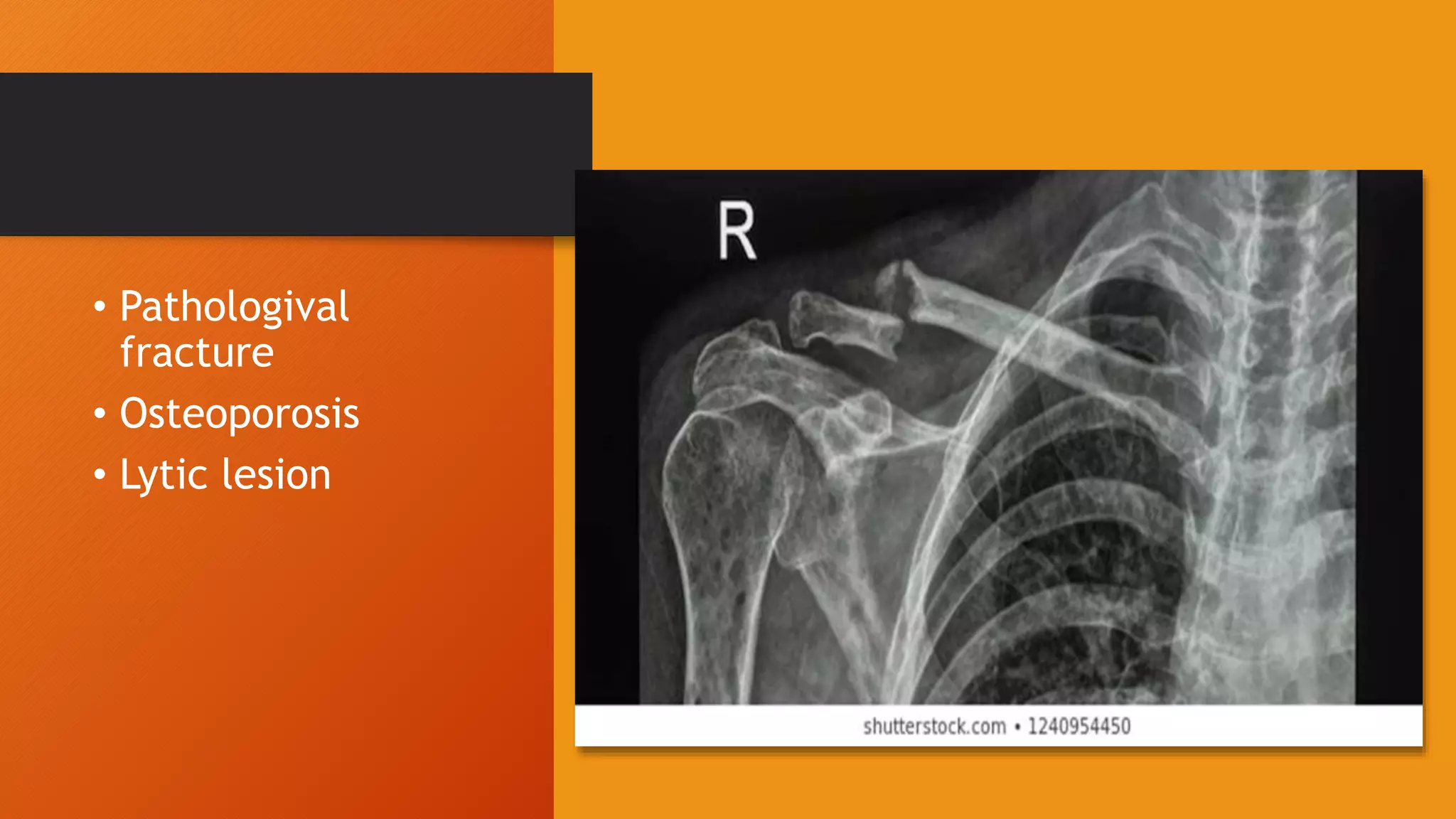
• Pathologival
fracture
• Osteoporosis
• Lytic lesion
• Multiple “punched-out”
lytic lesions are seen
throughout theskull/
calvarium.
• A large lytic lesion at
the vertex disrupts
both the inner and
outer table.
• Spinal cord
compression.
• This patient with
multiple myeloma
presented with rapidly
deteriorating lower
limb weakness.
• An MRI whole spine was
performed.
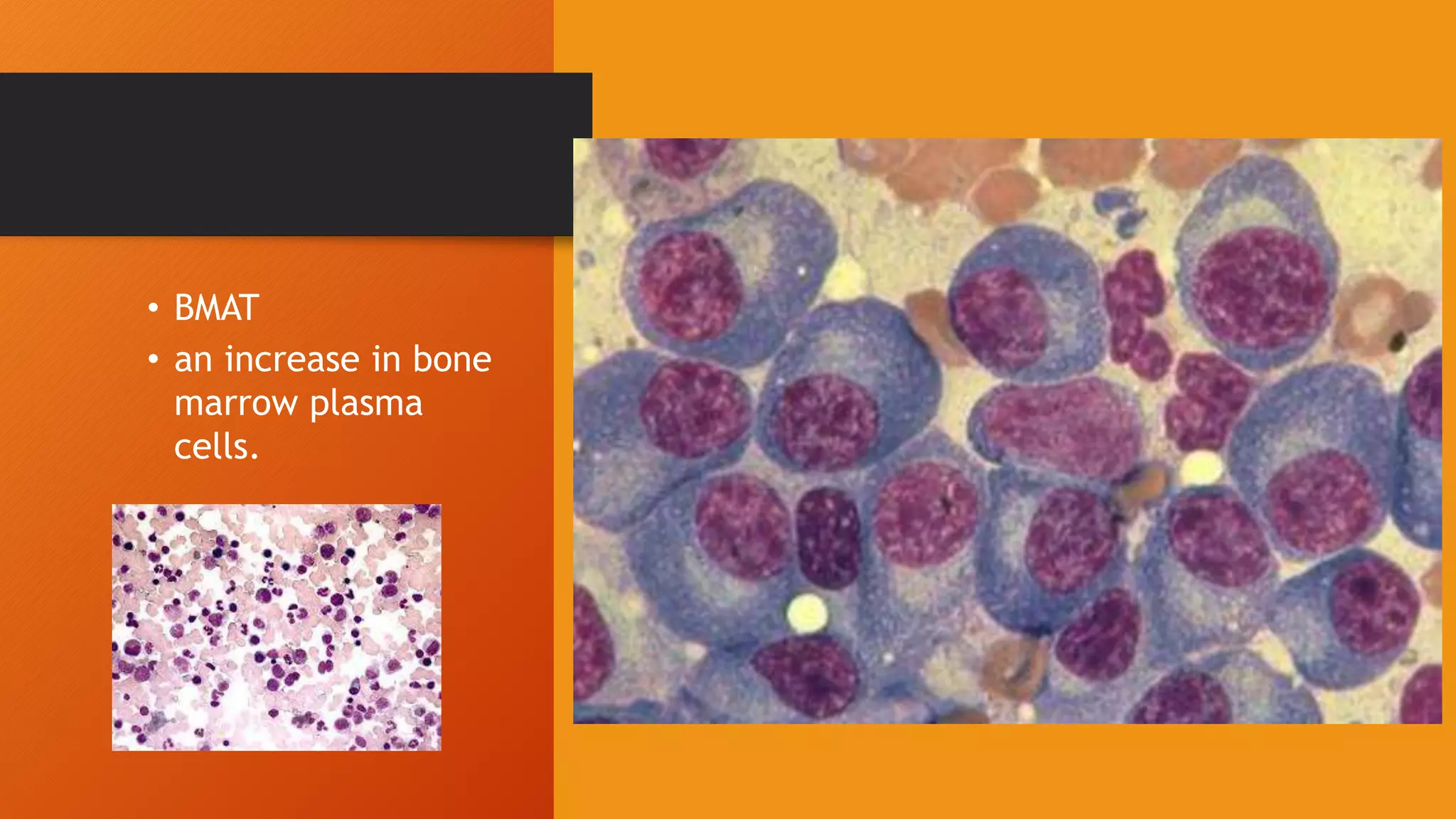
• BMAT
• an increase in bone
marrow plasma
cells.
DIAGNOSIS
• The Hallmark of Diagnosis
• Two out of three diagnostic features should be present:
• paraproteinemia (serum) or Bence Jones protein (urine)
• radiological evidence of lytic bone lesions
• an increase in bone marrow plasma cells.
• For symptomatic myeloma, evidence of end organ failure should also
be present, i.e. anaemia, lytic lesions, renal impairment,
hypercalcaemia, recurrent infections.
TREATMENT
• Myeloma remains incurable.
• Therapy is aimed at treatment of specific complications,
prevention of these and prolongation of overall survival.
• Complete remissions are rare.
• 2 components of treatment:
• good supportive and symptomatic care and
• chemotherapy
SUPPORTIVE THERAPY
• Anaemia
• Should be corrected;
• Blood transfusion may be required.
• Erythropoietin often helps.
• Transfusion should be undertaken cautiously in patients with
hyperviscosity.
• Infection
• Shouldd be treated promptly with antibiotics.
• Give yearly flu vaccinations.
SUPPORTIVE THERAPY
• Bone pain
• can be helped most quickly by radiotherapy and systemic
chemotherapy or high-dose dexamethasone.
• NSAIDs are usually avoided because of the risk of renal failure.
• Bisphosphonates, e.g. zoledronate, which inhibit osteoclast
activity, reduce progression of bone disease.
SUPPORTIVE THERAPY
• Pathological fractures
• may also be prevented
• by prompt orthopaedic surgery (kyphoplasty) with pinning of
lytic bone lesions seen on the skeletal survey.
• Kyphoplasty and vertebroplasty may be useful in treating
vertebral fractures.
CHEMOTHERAPY
• Refer haematology
FURTHER MGT
• When to Refer
• All patients with multiple myeloma should be referred to a
hematologist or an oncologist.
• When to Admit
• Hospitalization is indicated for
• treatment of acute kidney failure, hypercalcemia, infections
etc
• suspicion of spinal cord compression,
• chemotherapy regimens,
• for hematopoietic stem cell transplantation.
REFERENCES
• Damon E et al, (2013). Blood Disorders. Ch 13, Current Medical
Diagnosis & Treatment 52nd Ed, MCGraw Hill: New York.
• Kumar P. & Clark M. (Ed). 2009. Ch 9, Malignant disease. Clinical
Medicine. 7th ed, Elsevier Limited: Edinburg
• Palumbo A, & Anderson K., 2011. Multiple Myeloma. N Engl J Med
364;11 March 17, 2011

Multiple Myeloma, by Dr KD DELE

  • 1.
    MULTIPLE MYELOMA BY DRKD DELE [] DEPT OF INTERNAL MEDICINE
  • 2.
    INTRODUCTION • Multiple myelomais a malignant disease of the plasma cells of bone marrow that is characterized by • Clonal expansion of abnormal, proliferating plasma cells in the bone marrow microenvironment – replacing the marrow, • Production of monoclonal paraproteinemia [i.e. abnormal Ig, mainly IgG (60%) or IgA (20%) and rarely IgM and IgD, IgE] • and/or excretion of the monoclonal paraprotein in the urine (20% cases) • and associated organ dysfunction Plasma cells: a fully differentiated b lymphocyte cell
  • 3.
    EPIDEMIOLOGY • Myeloma isa disease of older adults; • median age at presentation: 65 years. • <65 years: 37% patients; 65 – 74 years: 26% patients; >75 years: 37% patients • It is rare under 40 years of age. • 1% of all malignant disease and 13% of hematologic cancers. • Commoner in males and in black Africans, less common in Asians. • In patients presenting at an age under 60 years, 10-year survival is approximately 30%
  • 4.
    PATHOPHYSIOLOGY • Myeloma arisesfrom an asymptomatic premalignant proliferation of monoclonal plasma cells that are derived from post–germinal- center B lymphocyte cells. • Myeloma is thought to evolve most commonly from a monoclonal gammopathy of undetermined clinical significance (MGUS) that progresses to smouldering myeloma and, finally, to symptomatic myeloma • Several genetic abnormalities that occur in tumour plasma cells play major roles in the pathogenesis of myeloma
  • 5.
    OTHER TYPES OFMM • 1. Light Chain Myeloma: incomplete Ig, i.e light chains antibodies. They collect in the kidneys • 2. Non-secretory Myeloma: Tests are negative for paraproteins. More agrresive myeloma. Need BMAT for diagnosis • 3. Solitary Plasmacytoma: Cancerous plasma cells forming tumours • 4. Extramedullary Plasmacytoma: In soft tissues outside the bone marrows eg throat sinuses, nose & larynx • 5. Monoclonal Gammopathy of Undetermined Significance (MGUS): precancerous • 6. Smoldering Multiple Myeloma (SMM): precancerous • 7. Immunoglobulin D (IgD) Myeloma: 1-2% • 8. Immunoglobulin E (IgE) Myeloma: rarest
  • 6.
    PATHOLOGICAL FEATURES • 1.Bone disease: • There is dysregulation of bone remodelling which leads to the typical lesions, usually seen in the spine, skull, long bones and ribs. • There is increased osteoclastic activity with no increased osteoblast formation of bone.
  • 7.
    PATHOLOGICAL FEATURES • 2.Bone destruction: • This often cause • fractures of long bones or • vertebral collapse (which can cause spinal cord compression) and • hypercalcaemia. • 3.Soft tissue plasmacytomas (tumours) • This is the usual cause of spinal cord compression in myeloma.
  • 8.
    PATHOLOGICAL FEATURES • 4.Bone marrow infiltration with plasma cells: • This results in • anaemia, • neutropenia, • thrombocytopenia, • 5. Hyperviscosity • Very high paraprotein levels (either IgG or IgA) may rarely result in symptoms of hyperviscosity (it is commoner with IgM)
  • 9.
    PATHOLOGICAL FEATURES • 6.Renal impairment: • owing to a combination of factors – • deposition of light chains in the renal tubules, • hypercalcaemia, • hyperuricaemia, • use of NSAIDs, and • deposition of amyloid.
  • 10.
    PATHOLOGICAL FEATURES • 7.Recurrent infection • This is also due to a combination of factors: • Reduction in the production of normal immunoglobulin (immuneparesis) • Neutropenia • Immunosuppressive effects of chemotherapy • Patients are especially prone to infections from organisms such as Streptococcus pneumoniae and Haemophilus influenzae. & thus recurrent respiratory tract/urinary tract.
  • 11.
    DIFFERENTIAL DIAGNOSES • Hodgkin’sand non-Hodgkin’s lymphoma • Acute leukaemia • Metastatic carcinomas; Myelofibrosis • Systemic lupus erythematosus • Disseminated tuberculosis • Myelodysplastic syndromes • HIV • Other causes of pancytopenia
  • 12.
    CLINICAL SYMPTOMS ANDSIGNS • Patients can be asymptomatic, the diagnosis being suspected by ‘routine’ abnormal blood tests. • The most common presenting complaints are those related to • Bony lesion (80%) & Bone pain (58%) • symptoms of anaemia (73%) • recurrent infections • symptoms of renal failure (20–40%) e.g. oliguric or anuric renal failure • symptoms of hypercalcaemia • rarely, symptoms of hyperviscosity and • bleeding due to thrombocytopenia
  • 13.
    CLINICAL SYMPTOMS ANDSIGNS • Bony Involvement: • Bone pain is most common in the back, hips, or ribs • Most commonly backache owing to vertebral involvement (60%) • May present as a pathologic fracture, especially of the femoral neck or vertebrae. • Features of spinal cord compression, with neurological signs, with peripheral neuropathy, or radiculopathy • hyperviscosity syndrome: • mucosal bleeding, vertigo, nausea, visual disturbances, alterations in mental status.
  • 14.
    CLINICAL SYMPTOMS ANDSIGNS • Examination findings may include: • pallor, bone tenderness, and soft tissue masses. • Patients may have neurologic signs related to neuropathy or spinal cord compression. • Others include: • enlarged tongue (1 amyloidosis), peripheral or autonomic neuropathy, congestive heart failure, or hepatomegaly. • Fever occurs mainly with infection.
  • 15.
    LIFE-THREATENING COMPLICATIONS • Renalimpairment: requires urgent attention and patients may need to be considered for long-term peritoneal or haemodialysis. • Hypercalcaemia: treat by rehydration and use of bisphosphonates such as pamidronate. • Spinal cord compression due to myeloma: treat with dexamethasone, followed by radiotherapy to the lesion delineated by a magnetic resonance imaging (MRI) scan. • Hyperviscosity due to high circulating levels of paraprotein: may be corrected by plasmapheresis
  • 16.
    INVESTIGATIONS: HAEMATOLOGY • Fullblood count. • Hb: Anaemia is nearly unversal • WCC: Usually normal, raised in infection. May be low. • Platelet count: Usually normal. May be low. • ESR: almost always high to vey high. • Blood film. • rouleaux formation: usually marked – as as a consequence of the paraprotein.(absent rouleaux formation does not exclude MM) • Plasma cells: rarely seen, if seen, consider leukaemia.
  • 17.
    INVESTIGATIONS: BLOOD CHEMISTRY •C-reactive protein: almost always raised. • Urea and electrolytes: There may be evidence of renal failure • Calcium: is normal or raised. • Total protein: is normal or raised. • Serum albumin: is normal or low. Useful in prognosis. • Alkaline phosphatase: is usually normal. • LDH: raised. Useful in prognosis. • Uric acid: normal or raised. • Serum β2-microglobulin > 2.5 mg/L – useful in prognosis.
  • 18.
    PROGNOSIS (MEDIAN SURVIVALMONTHS) • Stage 1 – β2M < 3.5 mg/L and s albumin ≥ 35 g/L: 62 months • Stage 2 – i.e. not stage 1 or 3: 44 months • Stage 3 – β2M ≥ 5.5 mg/L: 29 months • ~ • Monoclonal gammopathy of unknown significance (MGUS). • MGUS describes an isolated finding of a monoclonal paraprotein in the serum, usually in the elderly; • 20–30% go on to develop multiple myeloma over a 25-year period.
  • 19.
    INVESTIGATIONS: IMMUNOLOGY • Serumprotein electrophoresis (PEP): detects paraprotein in serum. It characteristically shows a monoclonal band. • Immunofixation electrophoresis (IEE): detects paraprotein in serum. reveals it to be a monoclonal immunoglobulin. • Serum free light chain assay: 15% of patients will have no demonstrable paraprotein in the serum because their myeloma cells produce only light chains and not intact immunoglobulin • Urine PEP/IEE: [excretion of light chains paraprotein i.e. Bence Jones protein – either kappa or lambda].
  • 20.
    INVESTIGATIONS: IMMUNOLOGY • 24-hoururine electrophoresis and immunofixation is used for assessment of light-chain excretion. • Urine PEP/IEE: • excretion of light chains paraprotein i.e. Bence Jones protein – either kappa or lambda].
  • 21.
    INVESTIGATIONS: BMAT • Bonemarrow aspirate or trephine: • Shows characteristic infiltration by plasma cells. There is replacement of the medullary cavity by abnormal plasma cells • Amyloid may be found.
  • 22.
    INVESTIGATIONS: IMAGING • Boneradiographs are important in establishing the diagnosis of myeloma • Skeletal survey: • this may show characteristic lytic lesions, most easily seen the axial skeleton: skull, spine, proximal long bones, and ribs • Generalized osteoporosis • CT, MRI and PET scan: better quality than plain radiographs • are used in plasmacytomas (bone or soft tissue deposits). • MRI spine is useful if there is back pain: • may show imminent compression/collapse.
  • 23.
  • 24.
    • Multiple “punched-out” lyticlesions are seen throughout theskull/ calvarium. • A large lytic lesion at the vertex disrupts both the inner and outer table.
  • 25.
    • Spinal cord compression. •This patient with multiple myeloma presented with rapidly deteriorating lower limb weakness. • An MRI whole spine was performed.
  • 26.
    • BMAT • anincrease in bone marrow plasma cells.
  • 27.
    DIAGNOSIS • The Hallmarkof Diagnosis • Two out of three diagnostic features should be present: • paraproteinemia (serum) or Bence Jones protein (urine) • radiological evidence of lytic bone lesions • an increase in bone marrow plasma cells. • For symptomatic myeloma, evidence of end organ failure should also be present, i.e. anaemia, lytic lesions, renal impairment, hypercalcaemia, recurrent infections.
  • 28.
    TREATMENT • Myeloma remainsincurable. • Therapy is aimed at treatment of specific complications, prevention of these and prolongation of overall survival. • Complete remissions are rare. • 2 components of treatment: • good supportive and symptomatic care and • chemotherapy
  • 29.
    SUPPORTIVE THERAPY • Anaemia •Should be corrected; • Blood transfusion may be required. • Erythropoietin often helps. • Transfusion should be undertaken cautiously in patients with hyperviscosity. • Infection • Shouldd be treated promptly with antibiotics. • Give yearly flu vaccinations.
  • 30.
    SUPPORTIVE THERAPY • Bonepain • can be helped most quickly by radiotherapy and systemic chemotherapy or high-dose dexamethasone. • NSAIDs are usually avoided because of the risk of renal failure. • Bisphosphonates, e.g. zoledronate, which inhibit osteoclast activity, reduce progression of bone disease.
  • 31.
    SUPPORTIVE THERAPY • Pathologicalfractures • may also be prevented • by prompt orthopaedic surgery (kyphoplasty) with pinning of lytic bone lesions seen on the skeletal survey. • Kyphoplasty and vertebroplasty may be useful in treating vertebral fractures.
  • 32.
  • 33.
    FURTHER MGT • Whento Refer • All patients with multiple myeloma should be referred to a hematologist or an oncologist. • When to Admit • Hospitalization is indicated for • treatment of acute kidney failure, hypercalcemia, infections etc • suspicion of spinal cord compression, • chemotherapy regimens, • for hematopoietic stem cell transplantation.
  • 34.
    REFERENCES • Damon Eet al, (2013). Blood Disorders. Ch 13, Current Medical Diagnosis & Treatment 52nd Ed, MCGraw Hill: New York. • Kumar P. & Clark M. (Ed). 2009. Ch 9, Malignant disease. Clinical Medicine. 7th ed, Elsevier Limited: Edinburg • Palumbo A, & Anderson K., 2011. Multiple Myeloma. N Engl J Med 364;11 March 17, 2011