MULTIPLE MYELOMA
Praveen Kumar T S
Junior resident
Department of orthopedics
MCH Trivandrum
MULTIPLE MYELOMA
• Plasma cell neoplasm
• Characterized by monoclonal proliferation plasma cells
• Presents with skeletal lesions
• Neoplastic plasma cells produces immunoglobulins
• Heavy chains – IgG 52% IgA 21%
• Light chains – kappa and lamda (Bence Jones Proteins)
• Most common primary malignant bone tumour
EPIDEMIOLOGY
• AGE GROUP 40 – 70
• Male > females
• Incidence 1 / 100000
ETIOLOGY
• UNKNOWN
• Genetic factors – deletion of 13q14,mutation of p53 and Rb gens
• Environmental factors
• Chronic inflammations
• Infections
• Radiations
PATHOPHYSIOLOGY
• The pathological and clinical features of myeloma are due to
1. Tissue infiltration of abnormal plasma cells
2. Production of large amount of abnormal immunoglobulins
3. Impairment of immunity
MYELOMA BONE DISEASE
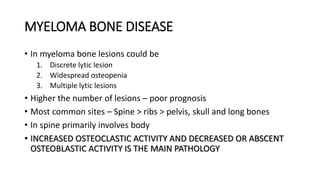
• In myeloma bone lesions could be
1. Discrete lytic lesion
2. Widespread osteopenia
3. Multiple lytic lesions
• Higher the number of lesions – poor prognosis
• Most common sites – Spine > ribs > pelvis, skull and long bones
• In spine primarily involves body
• INCREASED OSTEOCLASTIC ACTIVITY AND DECREASED OR ABSCENT
OSTEOBLASTIC ACTIVITY IS THE MAIN PATHOLOGY
MYELOMA BONE DISEASE
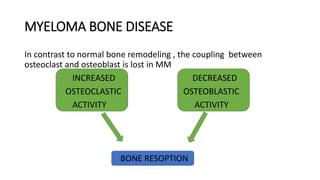
In contrast to normal bone remodeling , the coupling between
osteoclast and osteoblast is lost in MM
INCREASED DECREASED
OSTEOCLASTIC OSTEOBLASTIC
ACTIVITY ACTIVITY
BONE RESOPTION
MYELOMA BONE DISEASE
The main difference of MM from other metastatic bone disease is
Decreased or absent osteoblastic activity
In MM increased osteoclastic activity is due to
1. Increased production of RANKL
2. Increased production of other cytokines which promote bone
resorption(IL1,IL6,TNF)
3. Suppression of Osteoprotegerin(OPG)
CLINICAL FEATURES
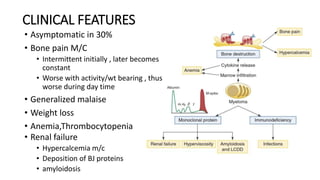
• Asymptomatic in 30%
• Bone pain M/C
• Intermittent initially , later becomes
constant
• Worse with activity/wt bearing , thus
worse during day time
• Generalized malaise
• Weight loss
• Anemia,Thrombocytopenia
• Renal failure
• Hypercalcemia m/c
• Deposition of BJ proteins
• amyloidosis
CLINICAL FEATURES
• Symptoms of Hypercalcemia
• Nausea
• Fatigue
• Thirst
• Symptoms of hyperviscosity
• Headaches
• Ischemic neurological symptoms
• Pathological fractures
• Recurrent infection
• Pneumonia
• pyelonephritis
INVESTIGATIONS
• Haemogram
• Anemia
• WBC – normal or moderate leucopenia
• Thrombocytopenia
• ESR –raised, often > 100
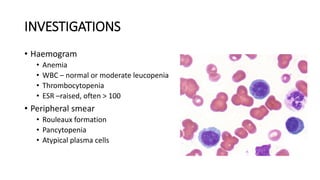
• Peripheral smear
• Rouleaux formation
• Pancytopenia
• Atypical plasma cells
INVT…
• Blood chemistry
• Serum Ca – elevated
• Urea,Creatinin,uric acid –may be elevated
• ALP – decreased or normal
• Serum proteins- Reverse albumin globulin ratio
• Low albumin and high globulin
• Serum BETA 2 Microglobulin – ELEVATED(POOR PROGNOSIS)
• Serum LDH - elevated
• Urine Analysis
• BJP
INVT…
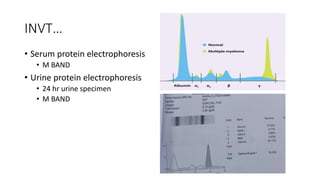
• Serum protein electrophoresis
• M BAND
• Urine protein electrophoresis
• 24 hr urine specimen
• M BAND
INVT..
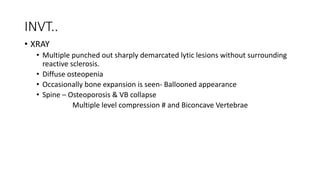
• XRAY
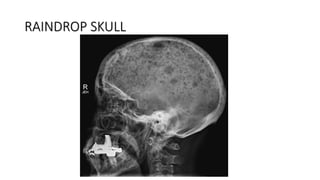
• Multiple punched out sharply demarcated lytic lesions without surrounding
reactive sclerosis.
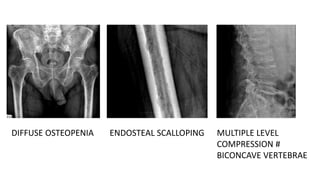
• Diffuse osteopenia
• Occasionally bone expansion is seen- Ballooned appearance
• Spine – Osteoporosis & VB collapse
Multiple level compression # and Biconcave Vertebrae
RAINDROP SKULL
DIFFUSE OSTEOPENIA ENDOSTEAL SCALLOPING MULTIPLE LEVEL
COMPRESSION #
BICONCAVE VERTEBRAE
INVST…
• MRI
• Most sensitive for bone lesions
• PET Scan
• Most sensitive for extramedullary disease
CROSS SECTIONAL IMAGING(CT,PET,MRI) > SKELETAL SURVEY
INVT….
• Bone scan
• Less useful
• Appears as cold
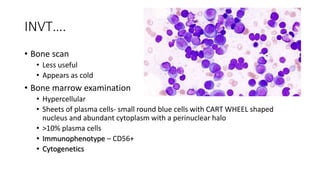
• Bone marrow examination
• Hypercellular
• Sheets of plasma cells- small round blue cells with CART WHEEL shaped
nucleus and abundant cytoplasm with a perinuclear halo
• >10% plasma cells
• Immunophenotype – CD56+
• Cytogenetics
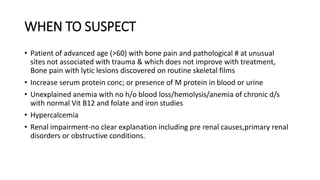
WHEN TO SUSPECT
• Patient of advanced age (>60) with bone pain and pathological # at unusual
sites not associated with trauma & which does not improve with treatment,
Bone pain with lytic lesions discovered on routine skeletal films
• Increase serum protein conc; or presence of M protein in blood or urine
• Unexplained anemia with no h/o blood loss/hemolysis/anemia of chronic d/s
with normal Vit B12 and folate and iron studies
• Hypercalcemia
• Renal impairment-no clear explanation including pre renal causes,primary renal
disorders or obstructive conditions.
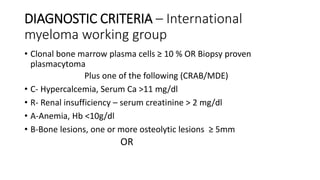
DIAGNOSTIC CRITERIA – International
myeloma working group
• Clonal bone marrow plasma cells ≥ 10 % OR Biopsy proven
plasmacytoma
Plus one of the following (CRAB/MDE)
• C- Hypercalcemia, Serum Ca >11 mg/dl
• R- Renal insufficiency – serum creatinine > 2 mg/dl
• A-Anemia, Hb <10g/dl
• B-Bone lesions, one or more osteolytic lesions ≥ 5mm
OR
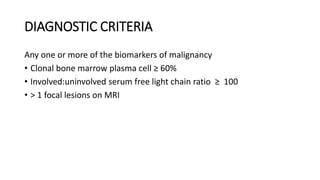
DIAGNOSTIC CRITERIA
Any one or more of the biomarkers of malignancy
• Clonal bone marrow plasma cell ≥ 60%
• Involved:uninvolved serum free light chain ratio ≥ 100
• > 1 focal lesions on MRI
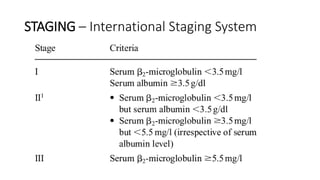
STAGING – International Staging System
DIFFERENTIAL DIAGNOSIS
• MGUS
• Smoldering Multiple myeloma
• Solitary Plasmacytoma
• POEMS syndrome
• Waldenstrom macroglobulinemia
• AL Amyloidosis
• Metastatic carcinoma
MGUS
• Serum M protein < 3 g/dl
• Bone marrow plasma cells < 10 %
• No features of end organ damage
• Risk of progression to MM – 1% per year
Smoldering Multiple myeloma
• M protein ≥ 3 g/dl
• Bone marrow plasma cells 10-60%
• No end organ damage
Solitary plasmacytoma
• Single skeletal lesion
• No plasma cells in bone marrow
• No end organ damage
• Can progress to MM
BAD PROGNOSIS
• Age > 65
• Hb < 10 g/dl
• Albumin <3 g/dl
• Serum β2 microglobulin > 4 mg/dl
• Platelet count < 1.5L
• Involvement of more than three bones
TREATMENT
• MM is not curable
• The goal of the treatment is Disease control and improved quality of
life
1. SYSTEMIC THERAPY
Treatment using medications
1. Chemotherapy
2. Targeted Therapy
3. Immunomodulatory drugs
4. Steroids
5. Bone modifying agents
CHEMOTHERAPY
• Cyclophosphamide
• Doxorubicin
• Melphalan
• Etoposide
• Cisplatin etc..
TARGATED THERAPY
Targets the cancer specific genes,proteins or the tissue environment
that contributes to cancer growth and survival
• Proteasome inhibitors
• Bortezomib
• Histone deacetylase inhibitors
• Panobinostat
• Monoclonal antibodies
• Elotuzumab
• Daratumumab
IMMUNOMODULATORY DRUGS
• Thalidomide
• Lenolidomide
• Pomalidomide
• Prednisolone
• Dexamathasone
STEROIDS
BONE MODIFYING AGENTS
• BISPHOSPHONATES
1. Pamidronate
90 mg iv over 2 hours every 3 – 4 weeks
2. Zoledronic acid
4 mg iv over 15 minutes every 3 – 4 weeks
S/E
1. Renal toxicity
2. Osteonecrosis of jaw
• DENOSUMAB- RANKL inhibitor
2. BONE MARROW STEM CELL
TRANSPLANTATION
• 2 TYPES
1. Autologous- patients own stem cell
2. Allogenic-Donated stem cell
3. RADIATION THERAPY
• Patients with bone pain when chemotherapy is not effective
• Not a disease directed treatment
• Used to treat bone disease if there impending or actual pathological
fractures
4. SURGERY
5. SUPPORTIVE CARE
• Prevention and treatment of infections
• Monitoring,Prevention and management of complications
• Transfusions
THANK YOU

Multiple myeloma

  • 1.
    MULTIPLE MYELOMA Praveen KumarT S Junior resident Department of orthopedics MCH Trivandrum
  • 2.
    MULTIPLE MYELOMA • Plasmacell neoplasm • Characterized by monoclonal proliferation plasma cells • Presents with skeletal lesions • Neoplastic plasma cells produces immunoglobulins • Heavy chains – IgG 52% IgA 21% • Light chains – kappa and lamda (Bence Jones Proteins) • Most common primary malignant bone tumour
  • 3.
    EPIDEMIOLOGY • AGE GROUP40 – 70 • Male > females • Incidence 1 / 100000
  • 4.
    ETIOLOGY • UNKNOWN • Geneticfactors – deletion of 13q14,mutation of p53 and Rb gens • Environmental factors • Chronic inflammations • Infections • Radiations
  • 5.
    PATHOPHYSIOLOGY • The pathologicaland clinical features of myeloma are due to 1. Tissue infiltration of abnormal plasma cells 2. Production of large amount of abnormal immunoglobulins 3. Impairment of immunity
  • 6.
    MYELOMA BONE DISEASE •In myeloma bone lesions could be 1. Discrete lytic lesion 2. Widespread osteopenia 3. Multiple lytic lesions • Higher the number of lesions – poor prognosis • Most common sites – Spine > ribs > pelvis, skull and long bones • In spine primarily involves body • INCREASED OSTEOCLASTIC ACTIVITY AND DECREASED OR ABSCENT OSTEOBLASTIC ACTIVITY IS THE MAIN PATHOLOGY
  • 7.
    MYELOMA BONE DISEASE Incontrast to normal bone remodeling , the coupling between osteoclast and osteoblast is lost in MM INCREASED DECREASED OSTEOCLASTIC OSTEOBLASTIC ACTIVITY ACTIVITY BONE RESOPTION
  • 8.
    MYELOMA BONE DISEASE Themain difference of MM from other metastatic bone disease is Decreased or absent osteoblastic activity In MM increased osteoclastic activity is due to 1. Increased production of RANKL 2. Increased production of other cytokines which promote bone resorption(IL1,IL6,TNF) 3. Suppression of Osteoprotegerin(OPG)
  • 9.
    CLINICAL FEATURES • Asymptomaticin 30% • Bone pain M/C • Intermittent initially , later becomes constant • Worse with activity/wt bearing , thus worse during day time • Generalized malaise • Weight loss • Anemia,Thrombocytopenia • Renal failure • Hypercalcemia m/c • Deposition of BJ proteins • amyloidosis
  • 10.
    CLINICAL FEATURES • Symptomsof Hypercalcemia • Nausea • Fatigue • Thirst • Symptoms of hyperviscosity • Headaches • Ischemic neurological symptoms • Pathological fractures • Recurrent infection • Pneumonia • pyelonephritis
  • 11.
    INVESTIGATIONS • Haemogram • Anemia •WBC – normal or moderate leucopenia • Thrombocytopenia • ESR –raised, often > 100 • Peripheral smear • Rouleaux formation • Pancytopenia • Atypical plasma cells
  • 12.
    INVT… • Blood chemistry •Serum Ca – elevated • Urea,Creatinin,uric acid –may be elevated • ALP – decreased or normal • Serum proteins- Reverse albumin globulin ratio • Low albumin and high globulin • Serum BETA 2 Microglobulin – ELEVATED(POOR PROGNOSIS) • Serum LDH - elevated • Urine Analysis • BJP
  • 13.
    INVT… • Serum proteinelectrophoresis • M BAND • Urine protein electrophoresis • 24 hr urine specimen • M BAND
  • 14.
    INVT.. • XRAY • Multiplepunched out sharply demarcated lytic lesions without surrounding reactive sclerosis. • Diffuse osteopenia • Occasionally bone expansion is seen- Ballooned appearance • Spine – Osteoporosis & VB collapse Multiple level compression # and Biconcave Vertebrae
  • 15.
  • 16.
    DIFFUSE OSTEOPENIA ENDOSTEALSCALLOPING MULTIPLE LEVEL COMPRESSION # BICONCAVE VERTEBRAE
  • 17.
    INVST… • MRI • Mostsensitive for bone lesions • PET Scan • Most sensitive for extramedullary disease CROSS SECTIONAL IMAGING(CT,PET,MRI) > SKELETAL SURVEY
  • 18.
    INVT…. • Bone scan •Less useful • Appears as cold • Bone marrow examination • Hypercellular • Sheets of plasma cells- small round blue cells with CART WHEEL shaped nucleus and abundant cytoplasm with a perinuclear halo • >10% plasma cells • Immunophenotype – CD56+ • Cytogenetics
  • 19.
    WHEN TO SUSPECT •Patient of advanced age (>60) with bone pain and pathological # at unusual sites not associated with trauma & which does not improve with treatment, Bone pain with lytic lesions discovered on routine skeletal films • Increase serum protein conc; or presence of M protein in blood or urine • Unexplained anemia with no h/o blood loss/hemolysis/anemia of chronic d/s with normal Vit B12 and folate and iron studies • Hypercalcemia • Renal impairment-no clear explanation including pre renal causes,primary renal disorders or obstructive conditions.
  • 20.
    DIAGNOSTIC CRITERIA –International myeloma working group • Clonal bone marrow plasma cells ≥ 10 % OR Biopsy proven plasmacytoma Plus one of the following (CRAB/MDE) • C- Hypercalcemia, Serum Ca >11 mg/dl • R- Renal insufficiency – serum creatinine > 2 mg/dl • A-Anemia, Hb <10g/dl • B-Bone lesions, one or more osteolytic lesions ≥ 5mm OR
  • 21.
    DIAGNOSTIC CRITERIA Any oneor more of the biomarkers of malignancy • Clonal bone marrow plasma cell ≥ 60% • Involved:uninvolved serum free light chain ratio ≥ 100 • > 1 focal lesions on MRI
  • 22.
  • 23.
    DIFFERENTIAL DIAGNOSIS • MGUS •Smoldering Multiple myeloma • Solitary Plasmacytoma • POEMS syndrome • Waldenstrom macroglobulinemia • AL Amyloidosis • Metastatic carcinoma
  • 24.
    MGUS • Serum Mprotein < 3 g/dl • Bone marrow plasma cells < 10 % • No features of end organ damage • Risk of progression to MM – 1% per year
  • 25.
    Smoldering Multiple myeloma •M protein ≥ 3 g/dl • Bone marrow plasma cells 10-60% • No end organ damage
  • 26.
    Solitary plasmacytoma • Singleskeletal lesion • No plasma cells in bone marrow • No end organ damage • Can progress to MM
  • 27.
    BAD PROGNOSIS • Age> 65 • Hb < 10 g/dl • Albumin <3 g/dl • Serum β2 microglobulin > 4 mg/dl • Platelet count < 1.5L • Involvement of more than three bones
  • 28.
    TREATMENT • MM isnot curable • The goal of the treatment is Disease control and improved quality of life
  • 29.
    1. SYSTEMIC THERAPY Treatmentusing medications 1. Chemotherapy 2. Targeted Therapy 3. Immunomodulatory drugs 4. Steroids 5. Bone modifying agents
  • 30.
    CHEMOTHERAPY • Cyclophosphamide • Doxorubicin •Melphalan • Etoposide • Cisplatin etc..
  • 31.
    TARGATED THERAPY Targets thecancer specific genes,proteins or the tissue environment that contributes to cancer growth and survival • Proteasome inhibitors • Bortezomib • Histone deacetylase inhibitors • Panobinostat • Monoclonal antibodies • Elotuzumab • Daratumumab
  • 32.
    IMMUNOMODULATORY DRUGS • Thalidomide •Lenolidomide • Pomalidomide • Prednisolone • Dexamathasone STEROIDS
  • 33.
    BONE MODIFYING AGENTS •BISPHOSPHONATES 1. Pamidronate 90 mg iv over 2 hours every 3 – 4 weeks 2. Zoledronic acid 4 mg iv over 15 minutes every 3 – 4 weeks S/E 1. Renal toxicity 2. Osteonecrosis of jaw • DENOSUMAB- RANKL inhibitor
  • 34.
    2. BONE MARROWSTEM CELL TRANSPLANTATION • 2 TYPES 1. Autologous- patients own stem cell 2. Allogenic-Donated stem cell
  • 35.
    3. RADIATION THERAPY •Patients with bone pain when chemotherapy is not effective • Not a disease directed treatment • Used to treat bone disease if there impending or actual pathological fractures 4. SURGERY
  • 36.
    5. SUPPORTIVE CARE •Prevention and treatment of infections • Monitoring,Prevention and management of complications • Transfusions
  • 37.