MULTIPLE MYELOMA
DR.AMRINDER SINGH
DR.KRISHNA KUMARI
MODERATORS-DR.NAGINA AGGARWAL
DR. VISHAKHA MITTAL
DR. R.K.GUPTA
INTRODUCTION
• Neoplastic proliferation of plasma cells derived from a single clone
• Myeloma cells produce monoclonal immunoglobulins - produce
symptoms
EPIDEMIOLOGY
• Occurs in all races and all geographic locations
• Blacks> whites
• Lowest in asia and developing countries
• M>F
• Obese
• Older adults-Median age=69 years
• India Incidence- 1/100000 , 50,000 new cases diagnosed each year
with younger median age at diagnosis-55 years.
ETIOLOGY
• No single common molecular pathogenetic pathway has yet emerged.
• Radiation
• Farmers, wood workers, leather workers, and those exposed to petroleum
products
• Hyperdiploidy, 13q14 deletions, translocations t(11;14)(q13;q32),
t(4;14)(p16;q32), and t(14;16), 1q amplification or 1p deletion, and
17p13 deletions
• N-ras, K-ras, and B-raf mutations are most common
Pathogenesis
CLINICAL PRESENTATION
Common features Uncommon features
Anemia Hyperviscosity syndrome
Bone pain Paresthesias
Elevated creatinine Hepatomegaly - splenomegaly
Fatigue/generalized weakness Spinal cord compression from an
extramedullary plasmacytoma -
Medical emergency
Hypercalcemia Lymphadenopathy
Weight loss Pleural effusion
Infection
CLINICAL PRESENTATION
• Anemia
• normocytic, normochromic
• Bone marrow replacement
• Kidney damage
• Dilution in the case of a large M-protein
• Bone pain- OAF(Osteoclast activating factor)
• Fractures
• Vertebral collapse- spinal cord compression
• Bone pains induced by movement
• No night pain
• Lytic lesions – no osteoblastic activity
CLINICAL PRESENTATION
• Elevated creatinine
• Light chain cast nephropathy (also called myeloma kidney)
• Hypercalcemia
• Amyloid
• Hyperuricemia
• Recurrent UTI
• NSAIDS/bisphosphonates
• Myeloma cell infiltration in kidney
• Earliest manifestation of tubular damage- FANCONI SYNDROME
• AKI- if dehydration
• Fatigue/generalized weakness
• Hypercalcemia
• Due to osteolytic lesions
• lethargy, weakness, depression, and confusion
• Weight loss
• Clotting abnormalities
• failure of antibody-coated platelets to function properly
• Interaction of the M component with clotting factors I, II, V, VII, or VIII;
• Antibody to clotting factors; or
• amyloid damage of endothelium
CLINICAL PRESENTATION
• Infection
• Impaired lymphocyte function
• Suppression of normal plasma cell function
• Hypogammaglobulinemia
• Streptococcus pneumoniae and gram-negative organisms are the most
frequent pathogens.
• Most common infections are pneumonias and pyelonephritis
• Streptococcus pneumoniae, Staphylococcus aureus, and Klebsiella
pneumoniae in the lungs
• Escherichia coli and other gram-negative organisms in the urinary tract
CLINICAL PRESENTATION
• Hyperviscosity syndrome( normal relative serum viscosity is 1.8)
• IgM > IgA/IgG(IgG3 max)
• Encephalopathy
• Headache , visual disturbances, ataxia, vertigo, retinopathy
• Shortness of breath
• Chest pain
• Vaso-occlusion, exacerbation or precipitation of heart failure
• Raynaud’s phenomenon and impaired circulation
• if the M component forms cryoglobulins
• Paresthesias
• Thoracic or lumbosacral Radiculopathy- M/C neurologic complication of MM
• Infiltration of peripheral nerves by amyloid
• carpal tunnel syndrome
• sensorimotor mono- and polyneuropathies ( S>M)
• More with IgM isotypes
CLINICAL PRESENTATION
• Hepatomegaly -4 percent cases
• Splenomegaly -1 percent cases.
• Spinal cord compression from an extramedullary plasmacytoma/#(
5%) - Medical emergency
• Lymphadenopathy -1 percent
• Pleural effusion(rare)
PATHOLOGIC FEATURES
• Secretory Myeloma
• 97 % secrete Monoclonal (M) protein
• IgG – 52 percent
• IgA – 21 percent
• Kappa or lambda light chain only (Bence Jones) – 16 percent
• IgD – 2 percent
• Biclonal – 2 percent
• IgM – 0.5 percent
• Negative – 6.5 percent
PATHOLOGIC FEATURES
• Oligo-secretory myeloma
• 5 to 10 % of MM patients at diagnosis
• Absence of measurable disease in serum or urine by the following parameters
• Serum M protein <1 g/dL, and
• Urine M protein <200 mg/24 hours
• Monitoring using FLC
PATHOLOGIC FEATURES
• Light Chain Myeloma
• 16%
• Kappa > Lambda
• Lambda light chains are more common in IgD myeloma and myeloma
associated with amyloidosis
• Higher chance of Renal failure( Lambda> kappa)
PATHOLOGIC FEATURES
• Non-secretory myeloma
• 3% of all cases
• Serum, urine immunofixation - normal
• 60 % - monoclonal FLC +ve
• Nonmeasurable, FLC only myeloma
• 40% - normal serum FLC ratio
• 85 % = M-protein that can be detected in the cytoplasm of the neoplastic plasma cells
• 15 % = True non-producer myeloma
WHEN TO SUSPECT
• Disease of elderly
• Patient of advanced age(average 69 years) with bone pain and pathological
fractures at unusual sites not associated with trauma and which does not
improve with treatment, bone pain with lytic lesions discovered on routine
skeletal films or other imaging modalities.
• An increased total serum protein concentration and/or the presence of a
monoclonal(M) protein in the serum and urine.
• Unexplained anemia, with no history of blood loss/hemolysis/anemia of chronic
disease, with normal vitB12 and folate and iron studies.
• Hypercalcemia, which is either symptomatic or discovered incidentally, with
normal vitamin and history of malignancy sarcoidosis or use of medications such
thiazides.
• Renal impairment- no clear explanation including pre-renal causes, primary renal
disorders or obstructive conditions.
INVESTIGATIONS
• Haemogram- Anemia, Leukopenia, Thrombocytopenia, Raised
ESR(often>100)
• values correlate neither with tumor burden nor with
treatment response. Hence its importance is uncertain.
• Peripheral smear
• Rouleaux formation
• Pancytopenia
• Monoclonal plasma cells can be seen
• > 2000/mm3 S/O Plasma cell leukemia
• SPEP/UPEP
• Serum & urine Immunofixation
• Free light chain assay
INVESTIGATIONS
• Urinalysis
• Protein- near all light chains initially-Bence Jones proteinuria
• After glomerular involvement
• non selective proteinuria
• Albumin
• Casts
• KFTs
• Elevated urea / creatinine
• Serum calcium- raised
• Serum uric acid- raised
• Anion gap decreased- M component and calcium ---unmeasured
cations.
• Serum ALP – Normal(absent osteoblastic activity)
• Serum protein – elevated
• Albumin- decreased
• Globulins- elevated
• Serum Beta -2 microglobulin- Higher= poorer prognosis
INVESTIGATIONS
• IMAGING – may reveal punched out lytic lesions/ diffuse
osteopenia/collapsed vertebrae
• CT - bone abnormalities
• PET/CT - Most sensitive for extramedullary disease
• MRI - Most sensitive for bone lesions
• Practice Changing UpDate
• For patients with suspected multiple myeloma, we prefer cross-sectional imaging
(low-dose CT, PET/CT, or MRI scan), rather than a skeletal survey, as the imaging
modality to detect bone involvement.
• Accumulating data suggest that patients who previously would have met criteria for
smoldering myeloma based on negative skeletal surveys, but who have lesions
detected by one of these modalities, have a shorter time to progression than similar
patients with negative cross-sectional imaging
INVESTIGATIONS
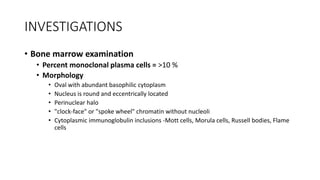
• Bone marrow examination
• Percent monoclonal plasma cells = >10 %
• Morphology
• Oval with abundant basophilic cytoplasm
• Nucleus is round and eccentrically located
• Perinuclear halo
• "clock-face" or "spoke wheel" chromatin without nucleoli
• Cytoplasmic immunoglobulin inclusions -Mott cells, Morula cells, Russell bodies, Flame
cells
INVESTIGATIONS
• Bone marrow examination
• Immunophenotype – Flow cytometry or immunohistochemistry
• The normal kappa/lambda ratio in the bone marrow is 2:1. A ratio of more than 4:1 or
less than 1:2 is considered to meet the definition of kappa or lambda monoclonality,
respectively.
• CD79a, VS38c, CD138, and CD38 +ve
• CD19 -ve
• Cytogenetics
Diagnostic criteria –International Myeloma
Working Group Criteria
• Clonal bone marrow plasma cells ≥10 percent OR biopsy-proven
plasmacytoma
PLUS one of the following
• Anemia – Hemoglobin <10 g/dL OR >2 g/dL below normal(lower limit)
• Hypercalcemia – Serum calcium >11 mg/dL
• Renal insufficiency – eCrCl <40 mL/min or serum creatinine >2 mg/dL
• Bone lesions – One or more osteolytic lesions ≥5 mm
CRAB/MDE
Diagnostic criteria
• Biomarker associated with near inevitable progression to end-organ
damage
• ≥60 % clonal plasma cells in the bone marrow
• Involved/uninvolved FLC ratio > 100
• MRI with more than one focal lesion (involving bone or bone marrow)
DIFFERENTIAL DIAGNOSIS
• Monoclonal gammopathy of undetermined significance
• Smoldering multiple myeloma
• Waldenström macroglobulinemia and IgM MM
• Solitary plasmacytoma
• AL amyloidosis
• POEMS syndrome
• Metastatic carcinoma
Monoclonal gammopathy of undetermined
significance
• M protein <3 g/dL
• Clonal bone marrow plasma cells <10 percent
• Absence of lytic lesions, anemia, hypercalcemia, and renal
insufficiency (end-organ damage) that can be attributed to the
plasma cell proliferative disorder
 Risk of progression to MM of approximately 1 % per year
Non-IgG subtype
abnormal kappa/lambda free
light chain ratio
serum M protein >1.5 g/dL
Smoldering multiple myeloma
• M-protein ≥3 g/dL or urinary monoclonal protein ≥500 mg per 24
hr and/or 10 to 60 percent bone marrow plasma cells
• No end-organ damage
 Progression to MM risk
bone marrow plasmacytosis >10%
abnormal kappa/lambda free light chain ratio
serum M protein >3 g/dL
Solitary plasmacytoma
• Biopsy-proven solitary lesion of bone or soft tissue with evidence of
clonal plasma cells
• Normal bone marrow
• Normal skeletal survey and MRI (or CT) of spine and pelvis (except for
the primary solitary lesion)
• Absence of end-organ damage
 Extramedullary plasmacytomas usually involve the submucosal
lymphoid tissue of the nasopharynx or paranasal sinuses without
marrow plasmacytosis.
Waldenström macroglobulinemia and IgM
multiple myeloma
• Lymphoplasmacytic lymphoma (LPL)
• Lymphoplasmacytic infiltration in bone marrow or lymphatic tissue
and an IgM monoclonal gammopathy in the blood.
• Features
• Tumor infilration- Cytopenias, fever, night sweats, weight loss, LN, HSM
• M-protein- Hyperviscosity, cryoglobulinemia, cold agglutinin, neuropathy,
amyloidosis
• CD56 -ve
• CD19, and CD20 +ve
POEMS syndrome
• POEMS syndrome (osteosclerotic myeloma: Polyneuropathy,
Organomegaly, Endocrinopathy, Monoclonal protein, Skin changes)
• endocrinopathy (excluding diabetes mellitus or hypothyroidism)
AL amyloidosis
• previously referred to as primary amyloidosis
• plasma cell proliferative disorder
• <20 percent bone marrow plasma cells
• no lytic bone lesions on imaging
• modest amount of Bence Jones proteinuria
• tissue deposits of amyloid fibrils or non-fibrillar material
• nephrotic syndrome
• heart failure
• hepatomegaly, and other findings
that are not seen in MM.
Metastatic carcinoma
• Kidney, Breast, Non-small cell lung cancer etc
• Lytic bone lesions
• constitutional symptoms
• a small M component
• <10 percent clonal plasma cells in the bone marrow
likely to have metastatic carcinoma with an unrelated MGUS rather
than MM
DURIE SALMON STAGING FOR MULTIPLE MYELOMA
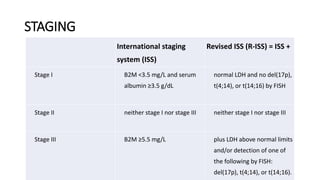
STAGING
International staging
system (ISS)
Revised ISS (R-ISS) = ISS +
Stage I B2M <3.5 mg/L and serum
albumin ≥3.5 g/dL
normal LDH and no del(17p),
t(4;14), or t(14;16) by FISH
Stage II neither stage I nor stage III neither stage I nor stage III
Stage III B2M ≥5.5 mg/L plus LDH above normal limits
and/or detection of one of
the following by FISH:
del(17p), t(4;14), or t(14;16).
Treatment
• 1. Supportive treatment / management of complications
• 2. Specific therapy
TREATMENT OF COMPLICATIONS
Hypercalcemia Asymptomatic
Anorexia, nausea, vomiting
Polyuria, polydipsia
Constipation
Weakness, confusion, or stupor
Renal insufficiency
Hydration- isotonic saline@200-300mL/h
Dexamethasone as part of myeloma
therapy
Bisphosphonate such as zoledronic acid
(4 mg I/V) once a month initially
Calcitonin (4 IU/kg q8h)
Denosumab
Hemodialysis
Renal insufficiency Uremic features Avoidance of nephrotoxins
HD
Infection Fever Influenza, pneumococcal
vaccine
IVIG
Antibiotic prophylaxis (1st
month of induction)-
fluoroquinolone
Rx according to agent
Skeletal lytic lesions Bone pain
Fractures
Bisphosphonate
Vertebroplasty/Kyphoplasty
# = Conservative, Surgery
Cord compression Features S/o myelopathy Dexamethasone
Local Radiation
Surgical decompression
+
Pain Pain NSAID
Opiods
Anemia Fatigue Blood tranfusion
Hyperviscosity syndrome oronasal bleeding, blurred
vision, neurologic
symptoms, confusion, and
heart failure.
Plasmapharesis
Thrombosis As per DVT Rx
Neuropathy Pain, tingling, numbness Stop bortezomib
Pregabalin/Gabapentin/
Duloxetine
TREATMENT: MGUS
• No specific intervention
• Follow-up once a year or less frequently
• Exception: higher risk MGUS
• serum protein electrophoresis
• complete blood count
• Creatinine
• calcium
should be repeated every 6 months.
• MGUS and severe polyneuropathy is considered for
therapeutic intervention
• absence of any other potential causes for neuropathy.
• plasmapheresis and occasionally rituximab in patients with IgM MGUS
• myeloma-like therapy in those with IgG or IgA disease
TREATMENT: SMM
• Patients with SMM only require antitumor therapy when myeloma-
defining events are identified.
• SPEP, CBC, Serum calcium, KFT, UPEP, IMMUNOFIXATION to be
performed at diagnosis and in 2-3 months repeat---if stable---4-6
months for 1 year…..then every 6-12 months
TREATMENT: Solitary plasmacytoma
• Local Radiotherapy
• Prolonged disease-free survival after local radiation therapy at a dose
of around 40 Gy.
TREATMENT: Symptomtic myeloma(standard
Risk)
• Determine HCT eligibility
• All patients need to be assessed to determine eligibility for autologous
hematopoietic cell transplantation (HCT)
• Age >70 years, significant cardiopulmonary problems, or
other comorbid illnesses
• Induction therapy
• Patients eligible for HCT = Induction therapy - HCT - Maintenance
• Patients ineligible for HCT = Induction - Maintenance chemo
HCT eligible
• Induction regimens
• Lenalidomide plus dexamethasone (Rd)
• Bortezomib, lenalidomide, dexamethasone (VRd)- SUPERIOR
• Bortezomib, cyclophosphamide, dexamethasone (VCd)
• Bortezomib, melphalan, prednisone (VMP)
three to four months prior to stem cell collection.
HCT eligible
• Following induction therapy and stem cell collection
• Early transplant strategy – Proceed with autologous HCT (single or double)
directly after recovery from stem cell collection
• Delayed transplant strategy – Continued therapy, usually with the same
regimen used for induction, reserving autologous HCT until first relapse
• Allogeneic HCT
• early or delayed autologous HCT > either chemotherapy alone or
allogeneic HCT
Early and delayed transplant strategies
• Similar survival rates
• Decision is individualized taking into account patient preference, age,
response to and tolerability of initial chemotherapy, and logistic
factors
• Early HCT
• at least two years of maintenance therapy post-transplant
• Delayed HCT
• complete a total of 8 to 12 cycles of triplet therapy followed by lenalidomide-
based maintenance until relapse
Maintenance after HCT
• Virtually all patients eventually develop relapsed disease even after
HCT.
• For standard risk = Lenalidomide
• For high risk = Bortezomib
Rx continued until the patient reaches a plateau phase (usually 12 to 18
months), which is defined as a stable level of M-protein
HCT ineligible
• Bortezomib-based triplet regimen for 8 to 12 cycles followed by
lenalidomide-based maintenance therapy.
• In patients who are frail and are not felt to be candidates for triplet
therapy
• doublet therapy with lenalidomide and low dose dexamethasone until
progression.
• Maintenance therapy prolongs progression-free survival
• Lenalidomide maintenance
• Lenalidomide plus dexamethasone (Rd) - SUPERIOR
HIGH RISK MYELOMA
• Do poorly with all conventional treatment options
• Should be encouraged to enroll in a clinical trial investigating novel
therapeutic strategies
• For transplant-eligible patients
• triplet-based induction therapy followed by early autologous HCT and
proteasome-inhibitor-based maintenance .
• Transplant-ineligible patients
• 8 to 12 cycles of triplet-based induction therapy followed by proteasome-
inhibitor-based maintenance
EVALUATING RESPONSE TO TREATMENT
• Should be evaluated before each treatment cycle to determine how
their disease is responding to therapy and to assess for potential
treatment-related and disease-related complications.
• Measurement of M protein in serum and urine
• FLC assay
• Patients without measureable M-protein or abnormal FLC
• periodic bone marrow aspirates and biopsies
• Whole body PET/CT
18F-FDG PET/CT : also a valuable tool to
evaluate response in patients with oligo- or
nonsecretory myeloma.
PET/CT showing multiple
fluorodeoxyglucose (FDG)-avid
lesions in skeleton (left panel) with
their resolution on achieving
complete response (CR) (right panel)
• Time to disease progression =most important marker of survival
• Platelet count <150,000/microL
• Albumin <3 g/dL
• Age >65 years
• Beta-2-microglobulin >4 mg/dL
• Involvement of more than three bones
• Hemoglobin <10 g/dL
Resource poor setting
• Unavailability of HCT, Bortezomib, Lenalidomide etc
• Standard risk
• Melphalan + Prednisolone +/- Thalidomide
• Bortezomib + Cyclophosphamide + Dexamethasone
• High Risk
• Melphalan + Prednisolone + Thalidomide
• If HCT is available
• Induction with Thalidomide + Dexamethasone
• Avoid Melphalan
Effectiveness of various regimens
• Thalidomide + dexamethasone- 66%
• Lenalidomide/Bortezomib + Dexamethasone- >80%
• Lenalidomide + Bortezomib + Dexamethasone - 100% response rate and
30% complete response (CR) rate
• Bortezomib + thalidomide + dexamethasone or
bortezomib + cyclophosphamide + dexamethasone)- >90% response rate.
RELAPSED DISEASE
• Almost all patients with MM who survive initial treatment will eventually relapse
• Relapsed or refractory MM is usually identified on routine surveillance
• Therapy for relapsed disease is indicated if there is a clinical relapse or a rapid rise in paraproteins
• Options-
• HCT
• a rechallenge of the previous chemotherapy regimen
• a trial of a new regimen
• Multiple regimens
• Daratumumab, lenalidomide, dexamethasone (DRd)
• Elotuzumab, lenalidomide, dexamethasone(Erd)
• Daratumumab, bortezomib, dexamethasone (DVd)
• Bortezomib, lenalidomide, dexamethasone (VRd)
• Bortezomib, cyclophosphamide, dexamethasone (VCD)
• Ixazomib, lenalidomide, dexamethasone (IRd)
• Panobinostat, bortezomib, dexamethasone
• Daratumumab is a monoclonal antibody targeted against CD38
• Elotuzumab is a humanized monoclonal antibody targeted against
SLAMF7, a glycoprotein expressed on MM and natural killer cells
• Panobinostat — Panobinostat is a histone deacetylase (HDAC)
inhibitor
• Bortezomib
• Herpes zoster prophylaxis
• Neuropathy can be decreased both by its subcutaneous administration and
administration on a weekly schedule.
• Lenalidomide
• Prophylaxis for deep-vein thrombosis (DVT) with either aspirin or if patients
are at a greater risk of DVT, warfarin or low-molecular-weight heparin.
TAKE HOME MESSAGE
• Disease of elderly
• Should suspect when-elderly patient present with bone pain or with
symptoms that are often non-specific, such as nausea, vomiting,
malaise, weakness, recurrent infections, and weight loss.
• New update- cross-sectional imaging > conventional skeletal survey
• Survival in the older increased due to availability of non-transplant
options.
• Remains incurable.
Refrences
• Uptodate.com
• Harrison 20th edition
• ICMR consensus document on multiple myeloma 2017
THANK YOU

Multiple myeloma final 2018 updated

  • 1.
    MULTIPLE MYELOMA DR.AMRINDER SINGH DR.KRISHNAKUMARI MODERATORS-DR.NAGINA AGGARWAL DR. VISHAKHA MITTAL DR. R.K.GUPTA
  • 2.
    INTRODUCTION • Neoplastic proliferationof plasma cells derived from a single clone • Myeloma cells produce monoclonal immunoglobulins - produce symptoms
  • 3.
    EPIDEMIOLOGY • Occurs inall races and all geographic locations • Blacks> whites • Lowest in asia and developing countries • M>F • Obese • Older adults-Median age=69 years • India Incidence- 1/100000 , 50,000 new cases diagnosed each year with younger median age at diagnosis-55 years.
  • 4.
    ETIOLOGY • No singlecommon molecular pathogenetic pathway has yet emerged. • Radiation • Farmers, wood workers, leather workers, and those exposed to petroleum products • Hyperdiploidy, 13q14 deletions, translocations t(11;14)(q13;q32), t(4;14)(p16;q32), and t(14;16), 1q amplification or 1p deletion, and 17p13 deletions • N-ras, K-ras, and B-raf mutations are most common
  • 6.
  • 9.
    CLINICAL PRESENTATION Common featuresUncommon features Anemia Hyperviscosity syndrome Bone pain Paresthesias Elevated creatinine Hepatomegaly - splenomegaly Fatigue/generalized weakness Spinal cord compression from an extramedullary plasmacytoma - Medical emergency Hypercalcemia Lymphadenopathy Weight loss Pleural effusion Infection
  • 10.
    CLINICAL PRESENTATION • Anemia •normocytic, normochromic • Bone marrow replacement • Kidney damage • Dilution in the case of a large M-protein • Bone pain- OAF(Osteoclast activating factor) • Fractures • Vertebral collapse- spinal cord compression • Bone pains induced by movement • No night pain • Lytic lesions – no osteoblastic activity
  • 13.
    CLINICAL PRESENTATION • Elevatedcreatinine • Light chain cast nephropathy (also called myeloma kidney) • Hypercalcemia • Amyloid • Hyperuricemia • Recurrent UTI • NSAIDS/bisphosphonates • Myeloma cell infiltration in kidney • Earliest manifestation of tubular damage- FANCONI SYNDROME • AKI- if dehydration
  • 14.
    • Fatigue/generalized weakness •Hypercalcemia • Due to osteolytic lesions • lethargy, weakness, depression, and confusion • Weight loss • Clotting abnormalities • failure of antibody-coated platelets to function properly • Interaction of the M component with clotting factors I, II, V, VII, or VIII; • Antibody to clotting factors; or • amyloid damage of endothelium
  • 15.
    CLINICAL PRESENTATION • Infection •Impaired lymphocyte function • Suppression of normal plasma cell function • Hypogammaglobulinemia • Streptococcus pneumoniae and gram-negative organisms are the most frequent pathogens. • Most common infections are pneumonias and pyelonephritis • Streptococcus pneumoniae, Staphylococcus aureus, and Klebsiella pneumoniae in the lungs • Escherichia coli and other gram-negative organisms in the urinary tract
  • 16.
    CLINICAL PRESENTATION • Hyperviscositysyndrome( normal relative serum viscosity is 1.8) • IgM > IgA/IgG(IgG3 max) • Encephalopathy • Headache , visual disturbances, ataxia, vertigo, retinopathy • Shortness of breath • Chest pain • Vaso-occlusion, exacerbation or precipitation of heart failure • Raynaud’s phenomenon and impaired circulation • if the M component forms cryoglobulins • Paresthesias • Thoracic or lumbosacral Radiculopathy- M/C neurologic complication of MM • Infiltration of peripheral nerves by amyloid • carpal tunnel syndrome • sensorimotor mono- and polyneuropathies ( S>M) • More with IgM isotypes
  • 17.
    CLINICAL PRESENTATION • Hepatomegaly-4 percent cases • Splenomegaly -1 percent cases. • Spinal cord compression from an extramedullary plasmacytoma/#( 5%) - Medical emergency • Lymphadenopathy -1 percent • Pleural effusion(rare)
  • 18.
    PATHOLOGIC FEATURES • SecretoryMyeloma • 97 % secrete Monoclonal (M) protein • IgG – 52 percent • IgA – 21 percent • Kappa or lambda light chain only (Bence Jones) – 16 percent • IgD – 2 percent • Biclonal – 2 percent • IgM – 0.5 percent • Negative – 6.5 percent
  • 19.
    PATHOLOGIC FEATURES • Oligo-secretorymyeloma • 5 to 10 % of MM patients at diagnosis • Absence of measurable disease in serum or urine by the following parameters • Serum M protein <1 g/dL, and • Urine M protein <200 mg/24 hours • Monitoring using FLC
  • 20.
    PATHOLOGIC FEATURES • LightChain Myeloma • 16% • Kappa > Lambda • Lambda light chains are more common in IgD myeloma and myeloma associated with amyloidosis • Higher chance of Renal failure( Lambda> kappa)
  • 21.
    PATHOLOGIC FEATURES • Non-secretorymyeloma • 3% of all cases • Serum, urine immunofixation - normal • 60 % - monoclonal FLC +ve • Nonmeasurable, FLC only myeloma • 40% - normal serum FLC ratio • 85 % = M-protein that can be detected in the cytoplasm of the neoplastic plasma cells • 15 % = True non-producer myeloma
  • 22.
    WHEN TO SUSPECT •Disease of elderly • Patient of advanced age(average 69 years) with bone pain and pathological fractures at unusual sites not associated with trauma and which does not improve with treatment, bone pain with lytic lesions discovered on routine skeletal films or other imaging modalities. • An increased total serum protein concentration and/or the presence of a monoclonal(M) protein in the serum and urine. • Unexplained anemia, with no history of blood loss/hemolysis/anemia of chronic disease, with normal vitB12 and folate and iron studies. • Hypercalcemia, which is either symptomatic or discovered incidentally, with normal vitamin and history of malignancy sarcoidosis or use of medications such thiazides. • Renal impairment- no clear explanation including pre-renal causes, primary renal disorders or obstructive conditions.
  • 23.
    INVESTIGATIONS • Haemogram- Anemia,Leukopenia, Thrombocytopenia, Raised ESR(often>100) • values correlate neither with tumor burden nor with treatment response. Hence its importance is uncertain. • Peripheral smear • Rouleaux formation • Pancytopenia • Monoclonal plasma cells can be seen • > 2000/mm3 S/O Plasma cell leukemia
  • 25.
    • SPEP/UPEP • Serum& urine Immunofixation • Free light chain assay
  • 30.
    INVESTIGATIONS • Urinalysis • Protein-near all light chains initially-Bence Jones proteinuria • After glomerular involvement • non selective proteinuria • Albumin • Casts • KFTs • Elevated urea / creatinine • Serum calcium- raised • Serum uric acid- raised
  • 31.
    • Anion gapdecreased- M component and calcium ---unmeasured cations. • Serum ALP – Normal(absent osteoblastic activity) • Serum protein – elevated • Albumin- decreased • Globulins- elevated • Serum Beta -2 microglobulin- Higher= poorer prognosis
  • 32.
    INVESTIGATIONS • IMAGING –may reveal punched out lytic lesions/ diffuse osteopenia/collapsed vertebrae • CT - bone abnormalities • PET/CT - Most sensitive for extramedullary disease • MRI - Most sensitive for bone lesions • Practice Changing UpDate • For patients with suspected multiple myeloma, we prefer cross-sectional imaging (low-dose CT, PET/CT, or MRI scan), rather than a skeletal survey, as the imaging modality to detect bone involvement. • Accumulating data suggest that patients who previously would have met criteria for smoldering myeloma based on negative skeletal surveys, but who have lesions detected by one of these modalities, have a shorter time to progression than similar patients with negative cross-sectional imaging
  • 33.
    INVESTIGATIONS • Bone marrowexamination • Percent monoclonal plasma cells = >10 % • Morphology • Oval with abundant basophilic cytoplasm • Nucleus is round and eccentrically located • Perinuclear halo • "clock-face" or "spoke wheel" chromatin without nucleoli • Cytoplasmic immunoglobulin inclusions -Mott cells, Morula cells, Russell bodies, Flame cells
  • 35.
    INVESTIGATIONS • Bone marrowexamination • Immunophenotype – Flow cytometry or immunohistochemistry • The normal kappa/lambda ratio in the bone marrow is 2:1. A ratio of more than 4:1 or less than 1:2 is considered to meet the definition of kappa or lambda monoclonality, respectively. • CD79a, VS38c, CD138, and CD38 +ve • CD19 -ve • Cytogenetics
  • 38.
    Diagnostic criteria –InternationalMyeloma Working Group Criteria • Clonal bone marrow plasma cells ≥10 percent OR biopsy-proven plasmacytoma PLUS one of the following • Anemia – Hemoglobin <10 g/dL OR >2 g/dL below normal(lower limit) • Hypercalcemia – Serum calcium >11 mg/dL • Renal insufficiency – eCrCl <40 mL/min or serum creatinine >2 mg/dL • Bone lesions – One or more osteolytic lesions ≥5 mm CRAB/MDE
  • 39.
    Diagnostic criteria • Biomarkerassociated with near inevitable progression to end-organ damage • ≥60 % clonal plasma cells in the bone marrow • Involved/uninvolved FLC ratio > 100 • MRI with more than one focal lesion (involving bone or bone marrow)
  • 40.
    DIFFERENTIAL DIAGNOSIS • Monoclonalgammopathy of undetermined significance • Smoldering multiple myeloma • Waldenström macroglobulinemia and IgM MM • Solitary plasmacytoma • AL amyloidosis • POEMS syndrome • Metastatic carcinoma
  • 41.
    Monoclonal gammopathy ofundetermined significance • M protein <3 g/dL • Clonal bone marrow plasma cells <10 percent • Absence of lytic lesions, anemia, hypercalcemia, and renal insufficiency (end-organ damage) that can be attributed to the plasma cell proliferative disorder  Risk of progression to MM of approximately 1 % per year Non-IgG subtype abnormal kappa/lambda free light chain ratio serum M protein >1.5 g/dL
  • 42.
    Smoldering multiple myeloma •M-protein ≥3 g/dL or urinary monoclonal protein ≥500 mg per 24 hr and/or 10 to 60 percent bone marrow plasma cells • No end-organ damage  Progression to MM risk bone marrow plasmacytosis >10% abnormal kappa/lambda free light chain ratio serum M protein >3 g/dL
  • 43.
    Solitary plasmacytoma • Biopsy-provensolitary lesion of bone or soft tissue with evidence of clonal plasma cells • Normal bone marrow • Normal skeletal survey and MRI (or CT) of spine and pelvis (except for the primary solitary lesion) • Absence of end-organ damage  Extramedullary plasmacytomas usually involve the submucosal lymphoid tissue of the nasopharynx or paranasal sinuses without marrow plasmacytosis.
  • 44.
    Waldenström macroglobulinemia andIgM multiple myeloma • Lymphoplasmacytic lymphoma (LPL) • Lymphoplasmacytic infiltration in bone marrow or lymphatic tissue and an IgM monoclonal gammopathy in the blood. • Features • Tumor infilration- Cytopenias, fever, night sweats, weight loss, LN, HSM • M-protein- Hyperviscosity, cryoglobulinemia, cold agglutinin, neuropathy, amyloidosis • CD56 -ve • CD19, and CD20 +ve
  • 45.
    POEMS syndrome • POEMSsyndrome (osteosclerotic myeloma: Polyneuropathy, Organomegaly, Endocrinopathy, Monoclonal protein, Skin changes) • endocrinopathy (excluding diabetes mellitus or hypothyroidism)
  • 46.
    AL amyloidosis • previouslyreferred to as primary amyloidosis • plasma cell proliferative disorder • <20 percent bone marrow plasma cells • no lytic bone lesions on imaging • modest amount of Bence Jones proteinuria • tissue deposits of amyloid fibrils or non-fibrillar material • nephrotic syndrome • heart failure • hepatomegaly, and other findings that are not seen in MM.
  • 47.
    Metastatic carcinoma • Kidney,Breast, Non-small cell lung cancer etc • Lytic bone lesions • constitutional symptoms • a small M component • <10 percent clonal plasma cells in the bone marrow likely to have metastatic carcinoma with an unrelated MGUS rather than MM
  • 48.
    DURIE SALMON STAGINGFOR MULTIPLE MYELOMA
  • 49.
    STAGING International staging system (ISS) RevisedISS (R-ISS) = ISS + Stage I B2M <3.5 mg/L and serum albumin ≥3.5 g/dL normal LDH and no del(17p), t(4;14), or t(14;16) by FISH Stage II neither stage I nor stage III neither stage I nor stage III Stage III B2M ≥5.5 mg/L plus LDH above normal limits and/or detection of one of the following by FISH: del(17p), t(4;14), or t(14;16).
  • 51.
    Treatment • 1. Supportivetreatment / management of complications • 2. Specific therapy
  • 52.
    TREATMENT OF COMPLICATIONS HypercalcemiaAsymptomatic Anorexia, nausea, vomiting Polyuria, polydipsia Constipation Weakness, confusion, or stupor Renal insufficiency Hydration- isotonic saline@200-300mL/h Dexamethasone as part of myeloma therapy Bisphosphonate such as zoledronic acid (4 mg I/V) once a month initially Calcitonin (4 IU/kg q8h) Denosumab Hemodialysis Renal insufficiency Uremic features Avoidance of nephrotoxins HD
  • 53.
    Infection Fever Influenza,pneumococcal vaccine IVIG Antibiotic prophylaxis (1st month of induction)- fluoroquinolone Rx according to agent Skeletal lytic lesions Bone pain Fractures Bisphosphonate Vertebroplasty/Kyphoplasty # = Conservative, Surgery Cord compression Features S/o myelopathy Dexamethasone Local Radiation Surgical decompression
  • 54.
    + Pain Pain NSAID Opiods AnemiaFatigue Blood tranfusion Hyperviscosity syndrome oronasal bleeding, blurred vision, neurologic symptoms, confusion, and heart failure. Plasmapharesis Thrombosis As per DVT Rx Neuropathy Pain, tingling, numbness Stop bortezomib Pregabalin/Gabapentin/ Duloxetine
  • 55.
    TREATMENT: MGUS • Nospecific intervention • Follow-up once a year or less frequently • Exception: higher risk MGUS • serum protein electrophoresis • complete blood count • Creatinine • calcium should be repeated every 6 months. • MGUS and severe polyneuropathy is considered for therapeutic intervention • absence of any other potential causes for neuropathy. • plasmapheresis and occasionally rituximab in patients with IgM MGUS • myeloma-like therapy in those with IgG or IgA disease
  • 56.
    TREATMENT: SMM • Patientswith SMM only require antitumor therapy when myeloma- defining events are identified. • SPEP, CBC, Serum calcium, KFT, UPEP, IMMUNOFIXATION to be performed at diagnosis and in 2-3 months repeat---if stable---4-6 months for 1 year…..then every 6-12 months
  • 57.
    TREATMENT: Solitary plasmacytoma •Local Radiotherapy • Prolonged disease-free survival after local radiation therapy at a dose of around 40 Gy.
  • 58.
    TREATMENT: Symptomtic myeloma(standard Risk) •Determine HCT eligibility • All patients need to be assessed to determine eligibility for autologous hematopoietic cell transplantation (HCT) • Age >70 years, significant cardiopulmonary problems, or other comorbid illnesses • Induction therapy • Patients eligible for HCT = Induction therapy - HCT - Maintenance • Patients ineligible for HCT = Induction - Maintenance chemo
  • 59.
    HCT eligible • Inductionregimens • Lenalidomide plus dexamethasone (Rd) • Bortezomib, lenalidomide, dexamethasone (VRd)- SUPERIOR • Bortezomib, cyclophosphamide, dexamethasone (VCd) • Bortezomib, melphalan, prednisone (VMP) three to four months prior to stem cell collection.
  • 60.
    HCT eligible • Followinginduction therapy and stem cell collection • Early transplant strategy – Proceed with autologous HCT (single or double) directly after recovery from stem cell collection • Delayed transplant strategy – Continued therapy, usually with the same regimen used for induction, reserving autologous HCT until first relapse • Allogeneic HCT • early or delayed autologous HCT > either chemotherapy alone or allogeneic HCT
  • 61.
    Early and delayedtransplant strategies • Similar survival rates • Decision is individualized taking into account patient preference, age, response to and tolerability of initial chemotherapy, and logistic factors • Early HCT • at least two years of maintenance therapy post-transplant • Delayed HCT • complete a total of 8 to 12 cycles of triplet therapy followed by lenalidomide- based maintenance until relapse
  • 62.
    Maintenance after HCT •Virtually all patients eventually develop relapsed disease even after HCT. • For standard risk = Lenalidomide • For high risk = Bortezomib Rx continued until the patient reaches a plateau phase (usually 12 to 18 months), which is defined as a stable level of M-protein
  • 63.
    HCT ineligible • Bortezomib-basedtriplet regimen for 8 to 12 cycles followed by lenalidomide-based maintenance therapy. • In patients who are frail and are not felt to be candidates for triplet therapy • doublet therapy with lenalidomide and low dose dexamethasone until progression. • Maintenance therapy prolongs progression-free survival • Lenalidomide maintenance • Lenalidomide plus dexamethasone (Rd) - SUPERIOR
  • 64.
    HIGH RISK MYELOMA •Do poorly with all conventional treatment options • Should be encouraged to enroll in a clinical trial investigating novel therapeutic strategies • For transplant-eligible patients • triplet-based induction therapy followed by early autologous HCT and proteasome-inhibitor-based maintenance . • Transplant-ineligible patients • 8 to 12 cycles of triplet-based induction therapy followed by proteasome- inhibitor-based maintenance
  • 65.
    EVALUATING RESPONSE TOTREATMENT • Should be evaluated before each treatment cycle to determine how their disease is responding to therapy and to assess for potential treatment-related and disease-related complications. • Measurement of M protein in serum and urine • FLC assay • Patients without measureable M-protein or abnormal FLC • periodic bone marrow aspirates and biopsies • Whole body PET/CT
  • 66.
    18F-FDG PET/CT :also a valuable tool to evaluate response in patients with oligo- or nonsecretory myeloma. PET/CT showing multiple fluorodeoxyglucose (FDG)-avid lesions in skeleton (left panel) with their resolution on achieving complete response (CR) (right panel)
  • 67.
    • Time todisease progression =most important marker of survival • Platelet count <150,000/microL • Albumin <3 g/dL • Age >65 years • Beta-2-microglobulin >4 mg/dL • Involvement of more than three bones • Hemoglobin <10 g/dL
  • 68.
    Resource poor setting •Unavailability of HCT, Bortezomib, Lenalidomide etc • Standard risk • Melphalan + Prednisolone +/- Thalidomide • Bortezomib + Cyclophosphamide + Dexamethasone • High Risk • Melphalan + Prednisolone + Thalidomide • If HCT is available • Induction with Thalidomide + Dexamethasone • Avoid Melphalan
  • 69.
    Effectiveness of variousregimens • Thalidomide + dexamethasone- 66% • Lenalidomide/Bortezomib + Dexamethasone- >80% • Lenalidomide + Bortezomib + Dexamethasone - 100% response rate and 30% complete response (CR) rate • Bortezomib + thalidomide + dexamethasone or bortezomib + cyclophosphamide + dexamethasone)- >90% response rate.
  • 70.
    RELAPSED DISEASE • Almostall patients with MM who survive initial treatment will eventually relapse • Relapsed or refractory MM is usually identified on routine surveillance • Therapy for relapsed disease is indicated if there is a clinical relapse or a rapid rise in paraproteins • Options- • HCT • a rechallenge of the previous chemotherapy regimen • a trial of a new regimen • Multiple regimens • Daratumumab, lenalidomide, dexamethasone (DRd) • Elotuzumab, lenalidomide, dexamethasone(Erd) • Daratumumab, bortezomib, dexamethasone (DVd) • Bortezomib, lenalidomide, dexamethasone (VRd) • Bortezomib, cyclophosphamide, dexamethasone (VCD) • Ixazomib, lenalidomide, dexamethasone (IRd) • Panobinostat, bortezomib, dexamethasone
  • 71.
    • Daratumumab isa monoclonal antibody targeted against CD38 • Elotuzumab is a humanized monoclonal antibody targeted against SLAMF7, a glycoprotein expressed on MM and natural killer cells • Panobinostat — Panobinostat is a histone deacetylase (HDAC) inhibitor
  • 72.
    • Bortezomib • Herpeszoster prophylaxis • Neuropathy can be decreased both by its subcutaneous administration and administration on a weekly schedule. • Lenalidomide • Prophylaxis for deep-vein thrombosis (DVT) with either aspirin or if patients are at a greater risk of DVT, warfarin or low-molecular-weight heparin.
  • 75.
    TAKE HOME MESSAGE •Disease of elderly • Should suspect when-elderly patient present with bone pain or with symptoms that are often non-specific, such as nausea, vomiting, malaise, weakness, recurrent infections, and weight loss. • New update- cross-sectional imaging > conventional skeletal survey • Survival in the older increased due to availability of non-transplant options. • Remains incurable.
  • 76.
    Refrences • Uptodate.com • Harrison20th edition • ICMR consensus document on multiple myeloma 2017
  • 77.