The Chronic Lymphocytic Leukemia
(CLL)
Dr. Ayush Garg
• B-CLL is a neoplastic disease characterized by
proliferation and accumulation of small, mature, long-
living lymphocytes in blood, marrow and lymphoid
tissues (lymph nodes, spleen)
• IWCLL 2008 criteria- an absolute malignant b
lymphocyte count >5000
THE B-CLL - DEFINITION
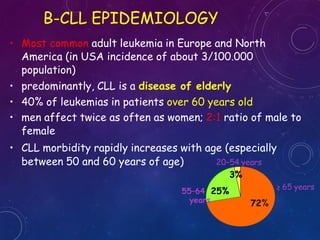
• Most common adult leukemia in Europe and North
America (in USA incidence of about 3/100.000
population)
• predominantly, CLL is a disease of elderly
• 40% of leukemias in patients over 60 years old
• men affect twice as often as women; 2:1 ratio of male to
female
• CLL morbidity rapidly increases with age (especially
between 50 and 60 years of age)
B-CLL EPIDEMIOLOGY
≥ 65 years
72%years
20–54 years
3%
55–64 25%
• The cause of CLL is unknown
• There is increased incidence in farmers,
rubber manufacturing workers and tire repair
workers
• Genetics factors have been postulated to play a
role in high incidence of CLL in some families (10%)
B-CLL ETIOLOGY &
PATHOGENESIS
• Often none! - 40% of patients are asymptomatic and
the diagnosis is typically accidental
• Unspecific: night sweats, fever, weakness (many patients
have fatigue, reduced exercises tolerance or malaise, weight
loss)
• Recurrent infections (bacterial, viral – herpes zoster, fungal) –
they are the most common cause of death
• Bleeding and symptoms of anemia and thrombocytopenia
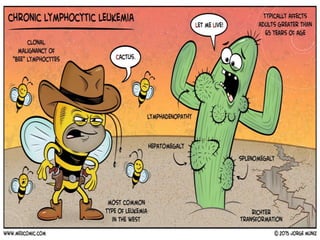
• Lymphadenopathy (lymph node enlargement)
– At diagnosis - nontender in 80% of patients
– Later - may become very large
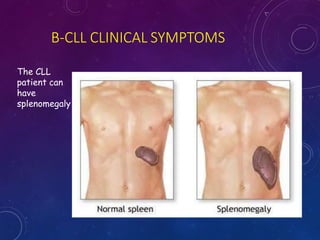
• Splenomegaly - mild to moderate in 50% of patients
• Hepatomegaly
• Some organs infiltration (lungs, pleura, skin and soft tissue)
B-CLL CLINICAL SYMPTOMS
CLL – Initial Symptoms
• Approximately 40% are asymptomatic at diagnosis –
discovered by a CBC
• In symptomatic cases the most common complaint is
fatigue
• Well’s syndrome – increase sensitivity to insects bites
• B symptoms – fever, sweats, weight loss
• Less often the initial complaint are enlarged nodes or
the development of an infection (bacterial)
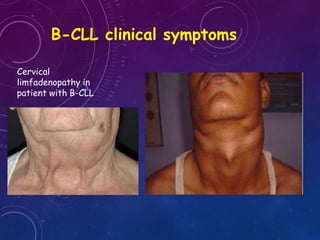
B-CLL clinical symptoms
Cervical
limfadenopathy in
patient with B-CLL
B-CLL CLINICAL SYMPTOMS
The CLL
patient can
have
splenomegaly
• Is always the transformation of CLL into an aggressive
lymphoma – diffuse large cell lymphoma (DLCL) or hodgkin‘s
lymphoma
• Usually evolves after a long indolent course -
• Can occur as 1st manifestation of CLL: primary richter‘s - but
still CLL
• Has a poor prognosis
RICHTER’S SYNDROME
DIAGNOSIS
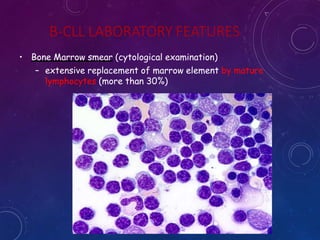
B-CLL LABORATORY FEATURES
• Bone Marrow smear (cytological examination)
– extensive replacement of marrow element by mature
lymphocytes (more than 30%)
– CD5+/CD19+/CD23+/ dim CD20+
– 90% of the patient have a very weak expression of
surface immunoglobulin (kappa or lambda light chain,
IgM, IgD)
– sometimes also CD38+,
– Dim expression of CD20, CD25, CD11c;
– lack expression of CD 10, CD 103, CD79a, FMC7
IMMUNOPHENOTYPING
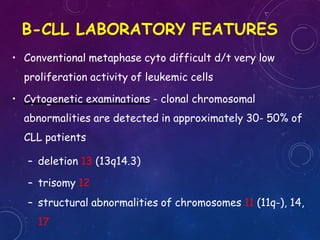
• Conventional metaphase cyto difficult d/t very low
proliferation activity of leukemic cells
• Cytogenetic examinations - clonal chromosomal
abnormalities are detected in approximately 30- 50% of
CLL patients
– deletion 13 (13q14.3)
– trisomy 12
– structural abnormalities of chromosomes 11 (11q-), 14,
17
B-CLL LABORATORY FEATURES
FISH
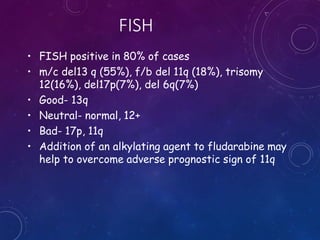
• FISH positive in 80% of cases
• m/c del13 q (55%), f/b del 11q (18%), trisomy
12(16%), del17p(7%), del 6q(7%)
• Good- 13q
• Neutral- normal, 12+
• Bad- 17p, 11q
• Addition of an alkylating agent to fludarabine may
help to overcome adverse prognostic sign of 11q
STAGING
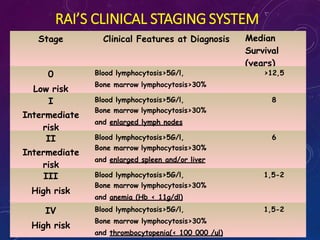
RAI’S CLINICAL STAGING SYSTEM
Stage Clinical Features at Diagnosis Median
Survival
(years)
0
Low risk
Blood lymphocytosis>5G/l,
Bone marrow lymphocytosis>30%
>12,5
I
Intermediate
risk
Blood lymphocytosis>5G/l,
Bone marrow lymphocytosis>30%
and enlarged lymph nodes
8
II
Intermediate
risk
Blood lymphocytosis>5G/l,
Bone marrow lymphocytosis>30%
and enlarged spleen and/or liver
6
III
High risk
Blood lymphocytosis>5G/l,
Bone marrow lymphocytosis>30%
and anemia (Hb < 11g/dl)
1,5-2
IV
High risk
Blood lymphocytosis>5G/l,
Bone marrow lymphocytosis>30%
and thrombocytopenia(< 100 000 /ul)
1,5-2
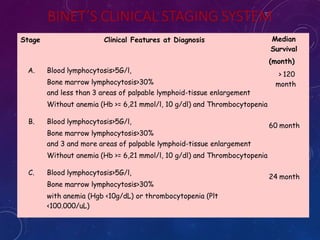
BINET’S CLINICAL STAGING SYSTEM
Stage Clinical Features at Diagnosis Median
Survival
(month)
> 120
month
60 month
24 month
A. Blood lymphocytosis>5G/l,
Bone marrow lymphocytosis>30%
and less than 3 areas of palpable lymphoid-tissue enlargement
Without anemia (Hb >= 6,21 mmol/l, 10 g/dl) and Thrombocytopenia
B. Blood lymphocytosis>5G/l,
Bone marrow lymphocytosis>30%
and 3 and more areas of palpable lymphoid-tissue enlargement
Without anemia (Hb >= 6,21 mmol/l, 10 g/dl) and Thrombocytopenia
C. Blood lymphocytosis>5G/l,
Bone marrow lymphocytosis>30%
with anemia (Hgb <10g/dL) or thrombocytopenia (Plt
<100.000/uL)
PROGNOSTICATION
MAJOR PHENOMENA UNDERLYING
CLL CLINICAL BEHAVIOR
• CLL has a highly varied clinical course.
• Phase 1: Diagnosis to need of first therapy (TTFT).
• Short TTFT independently associates with expression of ZAP70,
IgVH-UM status, INSR expression/del11q, TP53 mutations/del17p and
elevated genomic complexity.
• Phase 2: Time from first therapy to death (Survival).
• Short survival is determined by TP53 mutations/del17p, del11q status
and most comprehensively SNP array-based elevated genomic
complexity.
• Most CLL markers are unstable longitudinally necessitating outcome
analysis from the dates of marker measurements.
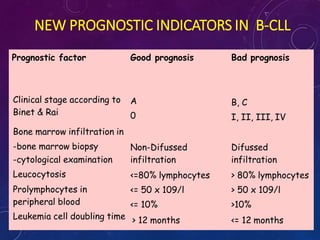
Prognostic factor Good prognosis Bad prognosis
A
0
B, C
I, II, III, IV
Clinical stage according to
Binet & Rai
Bone marrow infiltration in
-bone marrow biopsy
-cytological examination
Leucocytosis
Prolymphocytes in
peripheral blood
Leukemia cell doubling time
Non-Difussed
infiltration
<=80% lymphocytes
<= 50 x 109/l
<= 10%
> 12 months
Difussed
infiltration
> 80% lymphocytes
> 50 x 109/l
>10%
<= 12 months
NEW PROGNOSTIC INDICATORS IN B-CLL
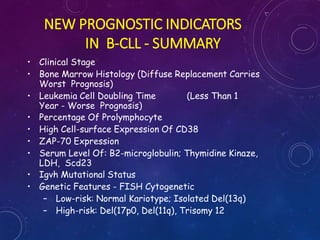
• Clinical Stage
• Bone Marrow Histology (Diffuse Replacement Carries
Worst Prognosis)
• Leukemia Cell Doubling Time (Less Than 1
Year - Worse Prognosis)
• Percentage Of Prolymphocyte
• High Cell-surface Expression Of CD38
• ZAP-70 Expression
• Serum Level Of: B2-microglobulin; Thymidine Kinaze,
LDH, Scd23
• Igvh Mutational Status
• Genetic Features - FISH Cytogenetic
– Low-risk: Normal Kariotype; Isolated Del(13q)
– High-risk: Del(17p0, Del(11q), Trisomy 12
NEW PROGNOSTIC INDICATORS
IN B-CLL - SUMMARY
TREATMENT
• We have to remember:
– B-CLL – indolent lymphoma, but incurable
– Elderly patients – risk of additional diseases
– Course of the disease can be very long, indolent for many years,
patient can die because of another reason which is not connected
to B-CLL.
• Decision about treatment depends on clinical stage, prognostic factors
and patient’s condition
CLL – TREATMENT
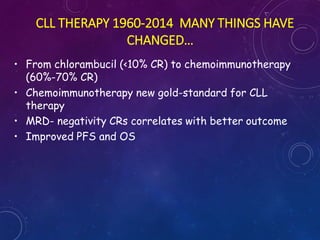
CLL THERAPY 1960-2014 MANY THINGS HAVE
CHANGED…
• From chlorambucil (<10% CR) to chemoimmunotherapy
(60%-70% CR)
• Chemoimmunotherapy new gold-standard for CLL
therapy
• MRD- negativity CRs correlates with better outcome
• Improved PFS and OS
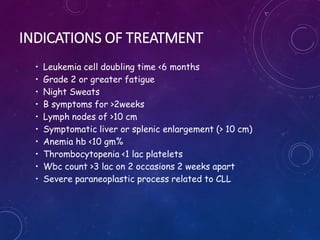
• Leukemia cell doubling time <6 months
• Grade 2 or greater fatigue
• Night Sweats
• B symptoms for >2weeks
• Lymph nodes of >10 cm
• Symptomatic liver or splenic enlargement (> 10 cm)
• Anemia hb <10 gm%
• Thrombocytopenia <1 lac platelets
• Wbc count >3 lac on 2 occasions 2 weeks apart
• Severe paraneoplastic process related to CLL
INDICATIONS OF TREATMENT
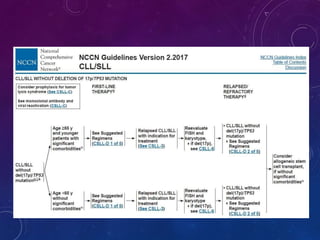
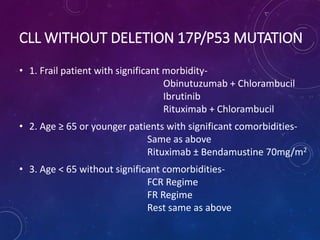
CLL WITHOUT DELETION 17P/P53 MUTATION
• 1. Frail patient with significant morbidity-
Obinutuzumab + Chlorambucil
Ibrutinib
Rituximab + Chlorambucil
• 2. Age ≥ 65 or younger patients with significant comorbidities-
Same as above
Rituximab ± Bendamustine 70mg/m2
• 3. Age < 65 without significant comorbidities-
FCR Regime
FR Regime
Rest same as above
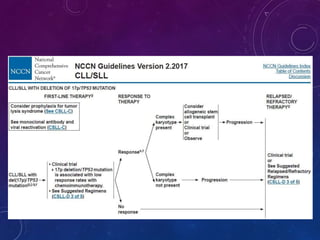
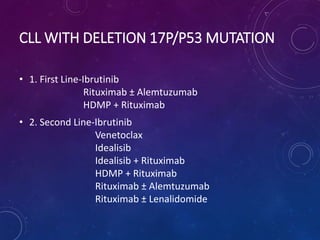
CLL WITH DELETION 17P/P53 MUTATION
• 1. First Line-Ibrutinib
Rituximab ± Alemtuzumab
HDMP + Rituximab
• 2. Second Line-Ibrutinib
Venetoclax
Idealisib
Idealisib + Rituximab
HDMP + Rituximab
Rituximab ± Alemtuzumab
Rituximab ± Lenalidomide
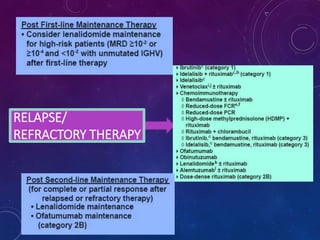
RELAPSE/
REFRACTORY THERAPY
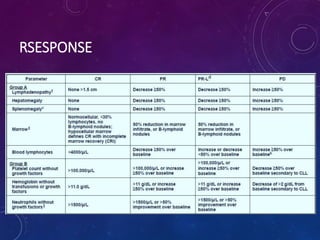
RSESPONSE
SUPPORTIVE CARE
Antiviral Prophylaxis: Acyclovir or Cotrimoxazole
Tumor Lysis Syndrome: Allopurinol
Antiummne Cytopenia: Corticosteroids
iv Immunoglobulins
Cyclosprin A
Splenectomy
Blood Transfusion
Thrombocytopenia: Anticoagulants
Aspirin / Warfarin
Tumor Flare Reaction: Steroids + Antihistamine
Vaccination: Annual Influenza Vaccine
Pneumococcal Vaccine every 5 years
Chronic Lymphocytic Leukemia

Chronic Lymphocytic Leukemia

  • 1.
    The Chronic LymphocyticLeukemia (CLL) Dr. Ayush Garg
  • 2.
    • B-CLL isa neoplastic disease characterized by proliferation and accumulation of small, mature, long- living lymphocytes in blood, marrow and lymphoid tissues (lymph nodes, spleen) • IWCLL 2008 criteria- an absolute malignant b lymphocyte count >5000 THE B-CLL - DEFINITION
  • 3.
    • Most commonadult leukemia in Europe and North America (in USA incidence of about 3/100.000 population) • predominantly, CLL is a disease of elderly • 40% of leukemias in patients over 60 years old • men affect twice as often as women; 2:1 ratio of male to female • CLL morbidity rapidly increases with age (especially between 50 and 60 years of age) B-CLL EPIDEMIOLOGY ≥ 65 years 72%years 20–54 years 3% 55–64 25%
  • 4.
    • The causeof CLL is unknown • There is increased incidence in farmers, rubber manufacturing workers and tire repair workers • Genetics factors have been postulated to play a role in high incidence of CLL in some families (10%) B-CLL ETIOLOGY & PATHOGENESIS
  • 5.
    • Often none!- 40% of patients are asymptomatic and the diagnosis is typically accidental • Unspecific: night sweats, fever, weakness (many patients have fatigue, reduced exercises tolerance or malaise, weight loss) • Recurrent infections (bacterial, viral – herpes zoster, fungal) – they are the most common cause of death • Bleeding and symptoms of anemia and thrombocytopenia • Lymphadenopathy (lymph node enlargement) – At diagnosis - nontender in 80% of patients – Later - may become very large • Splenomegaly - mild to moderate in 50% of patients • Hepatomegaly • Some organs infiltration (lungs, pleura, skin and soft tissue) B-CLL CLINICAL SYMPTOMS
  • 6.
    CLL – InitialSymptoms • Approximately 40% are asymptomatic at diagnosis – discovered by a CBC • In symptomatic cases the most common complaint is fatigue • Well’s syndrome – increase sensitivity to insects bites • B symptoms – fever, sweats, weight loss • Less often the initial complaint are enlarged nodes or the development of an infection (bacterial)
  • 7.
  • 8.
    B-CLL CLINICAL SYMPTOMS TheCLL patient can have splenomegaly
  • 9.
    • Is alwaysthe transformation of CLL into an aggressive lymphoma – diffuse large cell lymphoma (DLCL) or hodgkin‘s lymphoma • Usually evolves after a long indolent course - • Can occur as 1st manifestation of CLL: primary richter‘s - but still CLL • Has a poor prognosis RICHTER’S SYNDROME
  • 10.
  • 11.
    B-CLL LABORATORY FEATURES •Bone Marrow smear (cytological examination) – extensive replacement of marrow element by mature lymphocytes (more than 30%)
  • 12.
    – CD5+/CD19+/CD23+/ dimCD20+ – 90% of the patient have a very weak expression of surface immunoglobulin (kappa or lambda light chain, IgM, IgD) – sometimes also CD38+, – Dim expression of CD20, CD25, CD11c; – lack expression of CD 10, CD 103, CD79a, FMC7 IMMUNOPHENOTYPING
  • 13.
    • Conventional metaphasecyto difficult d/t very low proliferation activity of leukemic cells • Cytogenetic examinations - clonal chromosomal abnormalities are detected in approximately 30- 50% of CLL patients – deletion 13 (13q14.3) – trisomy 12 – structural abnormalities of chromosomes 11 (11q-), 14, 17 B-CLL LABORATORY FEATURES
  • 14.
    FISH • FISH positivein 80% of cases • m/c del13 q (55%), f/b del 11q (18%), trisomy 12(16%), del17p(7%), del 6q(7%) • Good- 13q • Neutral- normal, 12+ • Bad- 17p, 11q • Addition of an alkylating agent to fludarabine may help to overcome adverse prognostic sign of 11q
  • 15.
  • 16.
    RAI’S CLINICAL STAGINGSYSTEM Stage Clinical Features at Diagnosis Median Survival (years) 0 Low risk Blood lymphocytosis>5G/l, Bone marrow lymphocytosis>30% >12,5 I Intermediate risk Blood lymphocytosis>5G/l, Bone marrow lymphocytosis>30% and enlarged lymph nodes 8 II Intermediate risk Blood lymphocytosis>5G/l, Bone marrow lymphocytosis>30% and enlarged spleen and/or liver 6 III High risk Blood lymphocytosis>5G/l, Bone marrow lymphocytosis>30% and anemia (Hb < 11g/dl) 1,5-2 IV High risk Blood lymphocytosis>5G/l, Bone marrow lymphocytosis>30% and thrombocytopenia(< 100 000 /ul) 1,5-2
  • 17.
    BINET’S CLINICAL STAGINGSYSTEM Stage Clinical Features at Diagnosis Median Survival (month) > 120 month 60 month 24 month A. Blood lymphocytosis>5G/l, Bone marrow lymphocytosis>30% and less than 3 areas of palpable lymphoid-tissue enlargement Without anemia (Hb >= 6,21 mmol/l, 10 g/dl) and Thrombocytopenia B. Blood lymphocytosis>5G/l, Bone marrow lymphocytosis>30% and 3 and more areas of palpable lymphoid-tissue enlargement Without anemia (Hb >= 6,21 mmol/l, 10 g/dl) and Thrombocytopenia C. Blood lymphocytosis>5G/l, Bone marrow lymphocytosis>30% with anemia (Hgb <10g/dL) or thrombocytopenia (Plt <100.000/uL)
  • 18.
  • 19.
    MAJOR PHENOMENA UNDERLYING CLLCLINICAL BEHAVIOR • CLL has a highly varied clinical course. • Phase 1: Diagnosis to need of first therapy (TTFT). • Short TTFT independently associates with expression of ZAP70, IgVH-UM status, INSR expression/del11q, TP53 mutations/del17p and elevated genomic complexity. • Phase 2: Time from first therapy to death (Survival). • Short survival is determined by TP53 mutations/del17p, del11q status and most comprehensively SNP array-based elevated genomic complexity. • Most CLL markers are unstable longitudinally necessitating outcome analysis from the dates of marker measurements.
  • 20.
    Prognostic factor Goodprognosis Bad prognosis A 0 B, C I, II, III, IV Clinical stage according to Binet & Rai Bone marrow infiltration in -bone marrow biopsy -cytological examination Leucocytosis Prolymphocytes in peripheral blood Leukemia cell doubling time Non-Difussed infiltration <=80% lymphocytes <= 50 x 109/l <= 10% > 12 months Difussed infiltration > 80% lymphocytes > 50 x 109/l >10% <= 12 months NEW PROGNOSTIC INDICATORS IN B-CLL
  • 21.
    • Clinical Stage •Bone Marrow Histology (Diffuse Replacement Carries Worst Prognosis) • Leukemia Cell Doubling Time (Less Than 1 Year - Worse Prognosis) • Percentage Of Prolymphocyte • High Cell-surface Expression Of CD38 • ZAP-70 Expression • Serum Level Of: B2-microglobulin; Thymidine Kinaze, LDH, Scd23 • Igvh Mutational Status • Genetic Features - FISH Cytogenetic – Low-risk: Normal Kariotype; Isolated Del(13q) – High-risk: Del(17p0, Del(11q), Trisomy 12 NEW PROGNOSTIC INDICATORS IN B-CLL - SUMMARY
  • 22.
  • 23.
    • We haveto remember: – B-CLL – indolent lymphoma, but incurable – Elderly patients – risk of additional diseases – Course of the disease can be very long, indolent for many years, patient can die because of another reason which is not connected to B-CLL. • Decision about treatment depends on clinical stage, prognostic factors and patient’s condition CLL – TREATMENT
  • 24.
    CLL THERAPY 1960-2014MANY THINGS HAVE CHANGED… • From chlorambucil (<10% CR) to chemoimmunotherapy (60%-70% CR) • Chemoimmunotherapy new gold-standard for CLL therapy • MRD- negativity CRs correlates with better outcome • Improved PFS and OS
  • 25.
    • Leukemia celldoubling time <6 months • Grade 2 or greater fatigue • Night Sweats • B symptoms for >2weeks • Lymph nodes of >10 cm • Symptomatic liver or splenic enlargement (> 10 cm) • Anemia hb <10 gm% • Thrombocytopenia <1 lac platelets • Wbc count >3 lac on 2 occasions 2 weeks apart • Severe paraneoplastic process related to CLL INDICATIONS OF TREATMENT
  • 28.
    CLL WITHOUT DELETION17P/P53 MUTATION • 1. Frail patient with significant morbidity- Obinutuzumab + Chlorambucil Ibrutinib Rituximab + Chlorambucil • 2. Age ≥ 65 or younger patients with significant comorbidities- Same as above Rituximab ± Bendamustine 70mg/m2 • 3. Age < 65 without significant comorbidities- FCR Regime FR Regime Rest same as above
  • 29.
    CLL WITH DELETION17P/P53 MUTATION • 1. First Line-Ibrutinib Rituximab ± Alemtuzumab HDMP + Rituximab • 2. Second Line-Ibrutinib Venetoclax Idealisib Idealisib + Rituximab HDMP + Rituximab Rituximab ± Alemtuzumab Rituximab ± Lenalidomide
  • 30.
  • 31.
  • 32.
    SUPPORTIVE CARE Antiviral Prophylaxis:Acyclovir or Cotrimoxazole Tumor Lysis Syndrome: Allopurinol Antiummne Cytopenia: Corticosteroids iv Immunoglobulins Cyclosprin A Splenectomy Blood Transfusion Thrombocytopenia: Anticoagulants Aspirin / Warfarin Tumor Flare Reaction: Steroids + Antihistamine Vaccination: Annual Influenza Vaccine Pneumococcal Vaccine every 5 years