Multiple Myeloma
Dr Harpreet Singh Bhatia
DMCH, Ludhiana,Punjab
2
Cancer of plasma cells.
Malignanat B cell lymphoproliferative disorder of the
marrow with plasma cell predominating.
Most common primary malignancy of bone.
Plasma cells come from B lymphocytes, and produce
antibodies (immunoglobulins).
Myeloma cells produce abnormal immunoglobulins.
– Overproduce monoclonal protein or paraprotein.
– Ineffective immunoglobulins.
– Leads to decreased bone marrow function.
– Destruction of bone tissue.
Incidence
• Increases with age
– Ages from 5th to 7th
decade
• Males > Females (2:1)
• Any pt > 40 yrs with new bone tumor should include in d/d of
MM and metastatic carcinoma,
• Accounts for about
– 1% of all malignancies in whites
– 13% of all hematologic cancers in whites
RISK FACTORS
• Age >60.
• Exposure to pesticides ( DDT ).
• Radiation
• Wood,leather,sheet metal & nuclear industry
worker
• Exposure to ptroleum products (Benzene)
• Kaposi’s sarcoma Herpes Virus(Presence of IL-
6 and HHV8 )
MULTIPLE MYELOMA: Pathophysiology
The pathological and clinical features of
myeloma are due to:
• 1. Tissue infiltration
• 2. Production of large amount of paraprotein
• 3. Impairment of immunity.
8
Skull
Spine
Thoracic
Lumbar
Vertebrae
Pelvis
Long bones
Spinal cord – compression
can occur
http://www.emedicine.com/Radio/topic460.htm#section~Introduction
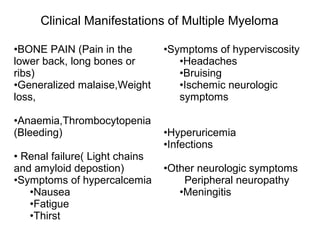
Clinical Manifestations of Multiple Myeloma
•BONE PAIN (Pain in the
lower back, long bones or
ribs)
•Generalized malaise,Weight
loss,
•Anaemia,Thrombocytopenia
(Bleeding)
• Renal failure( Light chains
and amyloid depostion)
•Symptoms of hypercalcemia
•Nausea
•Fatigue
•Thirst
•Symptoms of hyperviscosity
•Headaches
•Bruising
•Ischemic neurologic
symptoms
•Hyperuricemia
•Infections
•Other neurologic symptoms
Peripheral neuropathy
•Meningitis
Mechanism of disease
• Plasma cell proliferation - > anemia, bone
marrow suppression, infection risk
• Osteoclasts - > bony lesions, fractures,
vertebral collapse, spinal cord compression
• Paraprotein, hypercalcemia -> renal failure
• Hypercalcemia – polyuria, thirst, drowsiness,
coma
• May be symptomatic or asymptomatic.
• Symptomatic myeloma characterized by presence of ROTI
and CRAB.
• Myeloma Related Organ or Tissue Impairment.
• Calcium levels increased
• Renal failure
• Anemia
• Bone lesion
• FBC- normal or low.
• ESR, CRP-almost always raised.
• Blood film- Rouleaux formation, macrocytosis.
• U&Es, Cr-renal failure
• Serum B2 microglobulin >2.5mg/L.
• Raised LDH
• Serum calcium- normal or raised.
• Serum ALP-normal
• Total protein-normal or raised.
• Serum albumin- normal or low.
• SPE- monoclonal band.
• Serum free light chain assay
• Uric acid-normal or raised
• 24-hour urine electrophoresis and immunofixation is used for
assessment of light-chain excretion.
• Bone marrow aspirate or trephine shows characteristic infiltration by
plasma cells .Amyloid may be found.
1) Xrayz
- Multiple punched out sharply demarcated
purely lytic lesion without any srrounding
rective sclerosis.
- Lack of reactive bone formation
2) Immunochistochemistry
- +ve for CD 56
3)Monocolnal gammopathy
• In Monoclonal gammopathies &
Myeloma the single clone of plasma
cells produce a homogeneous
monoclonal immunoglobulin ( M
protein) characterized by the presence
of a sharp, well-defined band with a
single heavy chain and a similar band
with a kappa or lambda light chain
• The M protein is identified as a narrow
peak or "spike" in the g, ß or a 2 regions
Histologically
Small, round blue cells with clock face nuclei and abundant
cytoplasm with perinuclear clearing halo
Cytogenetics
FISH
Stage
International Staging System
Criteria
I β2-microglobulin < 3.5; albumin ≥ 3.5
II Neither stage I nor stage III values
III β2-microglobulin > 5.5
Staging:
Durie-Salmon system: widely used since
1975
Stage based on M-protein levels, bone
lesions, Hb values, serum calcium—many
variables
International Staging System
Simplified staging based on serum β2-
microglobulin
Staging
• Salmon-Durie staging system for multiple myeloma
• Stage I
– Hemoglobin level greater than 10 g/dL
– Calcium level less than 12 mg/dL
– Radiograph showing normal bones or solitary plasmacytoma
– Low M protein values (ie, IgG <5 g/dL, IgA <3 g/dL, urine <4 g/24 h)
• Stage II
– Findings that fit neither stage I nor stage III criteria
• Stage III
– Hemoglobin level less than 8.5 g/dL
– Calcium level greater than 12 mg/dL
– Radiograph showing advanced lytic bone disease
– High M protein value (ie, IgG >7 g/dL, IgA >5 g/dL, urine >12 g/24 h)
• Subclassification A involves a creatinine level less than 2 g/dL.
• Subclassification B involves a creatinine level greater than 2 g/dL.
• Median survival is as follows:
– Stage I, >60 months
– Stage II, 41 months
– Stage III, 23 months
Diagnosis
• The classic triad of myeloma
– Marrow plasmacytosis (>10%)
– Lytic bone lesions
– Serum and/or urine M component
• The diagnosis may be made in the absence of bone
lesions if the plasmacytosis is associated with a
progressive increase in the M component over time
or if extramedullary mass lesions develop
Confirmation of 1 major and 1 minor criterion
or 3 minor criteria in symptomatic patients
Major Diagnostic Criteria Minor Diagnostic Criteria
Biopsy-proven
plasmacytoma
Bone marrow sample =
10% to 30% plasma cells
Bone marrow sample =
30% plasma cells
Minor monoclonal
immunoglobulin levels in
blood or urine (< 3 g/dL)
Elevated monoclonal
immunoglobulin levels in
blood or urine
Osteopenia/lytic bone
lesions (confirmed through
imaging studies)
Abnormally low antibody
levels (not associated with
malignant cells) in the blood
Slowly evolving cancer
• MGUS
Monoclonal Gammopathy of Unknown
Significance
• Asymptomatic myeloma
• Symptomatic myeloma
Myeloma classification
Monoclonal Gammopathy of Undetermined Significance
Serum M-protein < 3 g/dL
Bone marrow plasma cells < 10%
 Absence of anemia, renal failure, hypercalcemia, lytic bone lesions
Asymptomatic Multiple Myeloma
Smoldering Multiple Myeloma Indolent Multiple Myeloma
Serum M-protein > 3 g/dL and/or
bone marrow plasma cells ≥ 10%
Bone marrow plasmacytosis
No anemia, renal failure,
hypercalcemia, lytic
bone lesions
Mild anemia or few small lytic bone
lesions
 Stable serum/urine M-protein
No symptoms
Presence of serum/urine M-protein
Symptomatic Multiple Myeloma
Bone marrow plasmacytosis (> 10%)
Anemia, renal failure, hypercalcemia, or lytic bone lesions
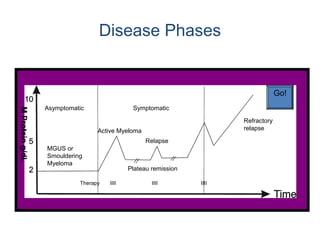
Disease Phases
Asymptomatic Symptomatic
MGUS or
Smouldering
Myeloma
Active Myeloma
Relapse
Refractory
relapse
Plateau remission
Therapy IIII IIII IIII
MProteing/dL
Go!
Bad prognosis if…
• Raised B2-microglobulin >4.
• Low serum albumin <3g/dl.
• Cytogenetics –ch13 deletion, hypodiploidy,
T(4:14)
• Raised LDH, CRP, Cr.
• Low platelet <150 and Hb<100.
• Bone marrow plasma cell percentage ≥ 50%
• Age >70.
Goals of MM Therapy
 Goals of treatment
 Address pain relief & other disease
symptoms
 Control disease activity
 prevent further organ damage
 Debulk tumor and use internal fixation
augmented with methacrylate
 Joint arthoplasty
 Prolong overall survival
 Preserve normal performance
28
Conventional chemotherapy:
 Melphalan
 Doxorubicin
 Cyclophosphamide
• Radiation therapy
• Stem cell transplantation:
– Autologous
– Allogenic
• Novel therapeutics:
– Thalidomide
– Lenalidomide
– Bortezomib
Thalomid®
Prescribing Information, Revlimid®
Prescribing Information; Velcade®
Prescribing Information
• Steroid therapy:
– Dexamethasone
– Prednisone
• Radiotherapy
• Surgery
• Bone care – bisphosphonates
• Transfusions
• Growth factors
• Treatment and prevention of infections
• Monitoring, management and prevention of
s/e
Other treatment / Supportive care
Management of Complications
• UREMIA: rehydratation, diuretics,steroids,antibiotics if renal
infection is suspected, hemodialysis if these measures fail.
• HYPERCALCEMIA: rehydratation, steroids, bisphosphonates,
diuretics.
• PARAPLEGIA: decompressive laminectomy, radiotherapy,
chemotherapy.
• BONE LESIONS: if painful and localised, chemo or local radio-
therapy, analgetics, biphosphonates.
• SEVERE ANEMIA: transfusions, erytropoetin
• HYPERVISCOSITY SYNDROME: plasmapheresis, correction of
hypercalcemia.
• BLEEDING: platelet concentrates, fresh frozen plasma
Current Frontline Options
•Examples of current Novel agent combinations:
•Thalidomide based : TD, CTD, MPT
•Bortezomib (Velcade) based: Vdex, VMP, CVD,
PAD, VRD
•Lenalidomide (Revlimid) based: LenDex, Lendex
Novel Therapies
Bortezomib
Thalidomide and analogues
Trisenox (Arsenic Trioxide)
Genasense (bcl-2 antisense)
Farnesyl Transferase Inhibitors
33
Recent Clinical Data: VISTA
 VMP (Velcade+Melphalan+Prednisolone) significantly prolongs
survival in the largest MP-based phase III study
Consistency of treatment effect
Rapid and durable responses with very high Complete
Response rate (similar to transplantation)
Prolonged Time To Progression
 VMP consistently superior across all prognostic subgroups
including patients with poor prognostic characteristics
 VMP well tolerated
 Results establish VMP as a new standard of care for MM patients not
eligible for HDT-ASCT, based on the highest level of evidence1
1. Anderson et al. Leukemia 2008;22:231-9.
Multiple Myeloma: Current Status
Relapsed Disease
• Transient Response to Therapy
• Survival 1-3 years
Diagnosis
• Survival 3-5 yrs
• Survival <12mo without therapy
Relapsed and
Refractory
• Resistant to all therapy
• Universally fatal
• Survival 6-9 months
First-Line:
• VAD
• MP
• Transplant (depending on age)
5-year Mortality: 75%; 10-year Mortality: 95-98%
Second Line:
• VAD
• Dexamethasone
• Thalidomide
• Transplant
• Investigational Therapy
Refractory:
• Supportive or palliative care
• Investigational Therapy
• Deaths 12,000/yr.
50 - 75% Response Rate
All patients relapse
Unmet Medical Need
Choice of therapy at relapse dependent on
duration of response & previous therapies.
Response rate & duration reduced with each
sequential regimen
Hope
New drugs on the horizon
• Carfilzomib
• Pomalidomide
• Panobinostat
• Vorinostat
• Elotuzumab
Old drugs with new use
• Bendamustine

Multiple myeloma

  • 1.
    Multiple Myeloma Dr HarpreetSingh Bhatia DMCH, Ludhiana,Punjab
  • 2.
    2 Cancer of plasmacells. Malignanat B cell lymphoproliferative disorder of the marrow with plasma cell predominating. Most common primary malignancy of bone. Plasma cells come from B lymphocytes, and produce antibodies (immunoglobulins). Myeloma cells produce abnormal immunoglobulins. – Overproduce monoclonal protein or paraprotein. – Ineffective immunoglobulins. – Leads to decreased bone marrow function. – Destruction of bone tissue.
  • 3.
    Incidence • Increases withage – Ages from 5th to 7th decade • Males > Females (2:1) • Any pt > 40 yrs with new bone tumor should include in d/d of MM and metastatic carcinoma, • Accounts for about – 1% of all malignancies in whites – 13% of all hematologic cancers in whites
  • 4.
    RISK FACTORS • Age>60. • Exposure to pesticides ( DDT ). • Radiation • Wood,leather,sheet metal & nuclear industry worker • Exposure to ptroleum products (Benzene) • Kaposi’s sarcoma Herpes Virus(Presence of IL- 6 and HHV8 )
  • 5.
    MULTIPLE MYELOMA: Pathophysiology Thepathological and clinical features of myeloma are due to: • 1. Tissue infiltration • 2. Production of large amount of paraprotein • 3. Impairment of immunity.
  • 8.
    8 Skull Spine Thoracic Lumbar Vertebrae Pelvis Long bones Spinal cord– compression can occur http://www.emedicine.com/Radio/topic460.htm#section~Introduction
  • 9.
    Clinical Manifestations ofMultiple Myeloma •BONE PAIN (Pain in the lower back, long bones or ribs) •Generalized malaise,Weight loss, •Anaemia,Thrombocytopenia (Bleeding) • Renal failure( Light chains and amyloid depostion) •Symptoms of hypercalcemia •Nausea •Fatigue •Thirst •Symptoms of hyperviscosity •Headaches •Bruising •Ischemic neurologic symptoms •Hyperuricemia •Infections •Other neurologic symptoms Peripheral neuropathy •Meningitis
  • 10.
    Mechanism of disease •Plasma cell proliferation - > anemia, bone marrow suppression, infection risk • Osteoclasts - > bony lesions, fractures, vertebral collapse, spinal cord compression • Paraprotein, hypercalcemia -> renal failure • Hypercalcemia – polyuria, thirst, drowsiness, coma
  • 11.
    • May besymptomatic or asymptomatic. • Symptomatic myeloma characterized by presence of ROTI and CRAB. • Myeloma Related Organ or Tissue Impairment. • Calcium levels increased • Renal failure • Anemia • Bone lesion
  • 12.
    • FBC- normalor low. • ESR, CRP-almost always raised. • Blood film- Rouleaux formation, macrocytosis. • U&Es, Cr-renal failure • Serum B2 microglobulin >2.5mg/L. • Raised LDH • Serum calcium- normal or raised. • Serum ALP-normal • Total protein-normal or raised. • Serum albumin- normal or low. • SPE- monoclonal band. • Serum free light chain assay • Uric acid-normal or raised • 24-hour urine electrophoresis and immunofixation is used for assessment of light-chain excretion. • Bone marrow aspirate or trephine shows characteristic infiltration by plasma cells .Amyloid may be found.
  • 13.
    1) Xrayz - Multiplepunched out sharply demarcated purely lytic lesion without any srrounding rective sclerosis. - Lack of reactive bone formation 2) Immunochistochemistry - +ve for CD 56 3)Monocolnal gammopathy
  • 14.
    • In Monoclonalgammopathies & Myeloma the single clone of plasma cells produce a homogeneous monoclonal immunoglobulin ( M protein) characterized by the presence of a sharp, well-defined band with a single heavy chain and a similar band with a kappa or lambda light chain • The M protein is identified as a narrow peak or "spike" in the g, ß or a 2 regions
  • 15.
    Histologically Small, round bluecells with clock face nuclei and abundant cytoplasm with perinuclear clearing halo
  • 16.
  • 17.
  • 19.
    Stage International Staging System Criteria Iβ2-microglobulin < 3.5; albumin ≥ 3.5 II Neither stage I nor stage III values III β2-microglobulin > 5.5 Staging: Durie-Salmon system: widely used since 1975 Stage based on M-protein levels, bone lesions, Hb values, serum calcium—many variables International Staging System Simplified staging based on serum β2- microglobulin
  • 20.
    Staging • Salmon-Durie stagingsystem for multiple myeloma • Stage I – Hemoglobin level greater than 10 g/dL – Calcium level less than 12 mg/dL – Radiograph showing normal bones or solitary plasmacytoma – Low M protein values (ie, IgG <5 g/dL, IgA <3 g/dL, urine <4 g/24 h) • Stage II – Findings that fit neither stage I nor stage III criteria • Stage III – Hemoglobin level less than 8.5 g/dL – Calcium level greater than 12 mg/dL – Radiograph showing advanced lytic bone disease – High M protein value (ie, IgG >7 g/dL, IgA >5 g/dL, urine >12 g/24 h) • Subclassification A involves a creatinine level less than 2 g/dL. • Subclassification B involves a creatinine level greater than 2 g/dL. • Median survival is as follows: – Stage I, >60 months – Stage II, 41 months – Stage III, 23 months
  • 21.
    Diagnosis • The classictriad of myeloma – Marrow plasmacytosis (>10%) – Lytic bone lesions – Serum and/or urine M component • The diagnosis may be made in the absence of bone lesions if the plasmacytosis is associated with a progressive increase in the M component over time or if extramedullary mass lesions develop
  • 22.
    Confirmation of 1major and 1 minor criterion or 3 minor criteria in symptomatic patients Major Diagnostic Criteria Minor Diagnostic Criteria Biopsy-proven plasmacytoma Bone marrow sample = 10% to 30% plasma cells Bone marrow sample = 30% plasma cells Minor monoclonal immunoglobulin levels in blood or urine (< 3 g/dL) Elevated monoclonal immunoglobulin levels in blood or urine Osteopenia/lytic bone lesions (confirmed through imaging studies) Abnormally low antibody levels (not associated with malignant cells) in the blood
  • 23.
    Slowly evolving cancer •MGUS Monoclonal Gammopathy of Unknown Significance • Asymptomatic myeloma • Symptomatic myeloma
  • 24.
    Myeloma classification Monoclonal Gammopathyof Undetermined Significance Serum M-protein < 3 g/dL Bone marrow plasma cells < 10%  Absence of anemia, renal failure, hypercalcemia, lytic bone lesions Asymptomatic Multiple Myeloma Smoldering Multiple Myeloma Indolent Multiple Myeloma Serum M-protein > 3 g/dL and/or bone marrow plasma cells ≥ 10% Bone marrow plasmacytosis No anemia, renal failure, hypercalcemia, lytic bone lesions Mild anemia or few small lytic bone lesions  Stable serum/urine M-protein No symptoms Presence of serum/urine M-protein Symptomatic Multiple Myeloma Bone marrow plasmacytosis (> 10%) Anemia, renal failure, hypercalcemia, or lytic bone lesions
  • 25.
    Disease Phases Asymptomatic Symptomatic MGUSor Smouldering Myeloma Active Myeloma Relapse Refractory relapse Plateau remission Therapy IIII IIII IIII MProteing/dL Go!
  • 26.
    Bad prognosis if… •Raised B2-microglobulin >4. • Low serum albumin <3g/dl. • Cytogenetics –ch13 deletion, hypodiploidy, T(4:14) • Raised LDH, CRP, Cr. • Low platelet <150 and Hb<100. • Bone marrow plasma cell percentage ≥ 50% • Age >70.
  • 27.
    Goals of MMTherapy  Goals of treatment  Address pain relief & other disease symptoms  Control disease activity  prevent further organ damage  Debulk tumor and use internal fixation augmented with methacrylate  Joint arthoplasty  Prolong overall survival  Preserve normal performance
  • 28.
    28 Conventional chemotherapy:  Melphalan Doxorubicin  Cyclophosphamide • Radiation therapy • Stem cell transplantation: – Autologous – Allogenic • Novel therapeutics: – Thalidomide – Lenalidomide – Bortezomib Thalomid® Prescribing Information, Revlimid® Prescribing Information; Velcade® Prescribing Information • Steroid therapy: – Dexamethasone – Prednisone
  • 29.
    • Radiotherapy • Surgery •Bone care – bisphosphonates • Transfusions • Growth factors • Treatment and prevention of infections • Monitoring, management and prevention of s/e Other treatment / Supportive care
  • 30.
    Management of Complications •UREMIA: rehydratation, diuretics,steroids,antibiotics if renal infection is suspected, hemodialysis if these measures fail. • HYPERCALCEMIA: rehydratation, steroids, bisphosphonates, diuretics. • PARAPLEGIA: decompressive laminectomy, radiotherapy, chemotherapy. • BONE LESIONS: if painful and localised, chemo or local radio- therapy, analgetics, biphosphonates. • SEVERE ANEMIA: transfusions, erytropoetin • HYPERVISCOSITY SYNDROME: plasmapheresis, correction of hypercalcemia. • BLEEDING: platelet concentrates, fresh frozen plasma
  • 31.
    Current Frontline Options •Examplesof current Novel agent combinations: •Thalidomide based : TD, CTD, MPT •Bortezomib (Velcade) based: Vdex, VMP, CVD, PAD, VRD •Lenalidomide (Revlimid) based: LenDex, Lendex
  • 32.
    Novel Therapies Bortezomib Thalidomide andanalogues Trisenox (Arsenic Trioxide) Genasense (bcl-2 antisense) Farnesyl Transferase Inhibitors
  • 33.
    33 Recent Clinical Data:VISTA  VMP (Velcade+Melphalan+Prednisolone) significantly prolongs survival in the largest MP-based phase III study Consistency of treatment effect Rapid and durable responses with very high Complete Response rate (similar to transplantation) Prolonged Time To Progression  VMP consistently superior across all prognostic subgroups including patients with poor prognostic characteristics  VMP well tolerated  Results establish VMP as a new standard of care for MM patients not eligible for HDT-ASCT, based on the highest level of evidence1 1. Anderson et al. Leukemia 2008;22:231-9.
  • 34.
    Multiple Myeloma: CurrentStatus Relapsed Disease • Transient Response to Therapy • Survival 1-3 years Diagnosis • Survival 3-5 yrs • Survival <12mo without therapy Relapsed and Refractory • Resistant to all therapy • Universally fatal • Survival 6-9 months First-Line: • VAD • MP • Transplant (depending on age) 5-year Mortality: 75%; 10-year Mortality: 95-98% Second Line: • VAD • Dexamethasone • Thalidomide • Transplant • Investigational Therapy Refractory: • Supportive or palliative care • Investigational Therapy • Deaths 12,000/yr. 50 - 75% Response Rate All patients relapse Unmet Medical Need Choice of therapy at relapse dependent on duration of response & previous therapies. Response rate & duration reduced with each sequential regimen
  • 35.
    Hope New drugs onthe horizon • Carfilzomib • Pomalidomide • Panobinostat • Vorinostat • Elotuzumab Old drugs with new use • Bendamustine

Editor's Notes

  • #4 (Only 2 to 3 percent of cases are reported in patients &amp;lt; 30 years)