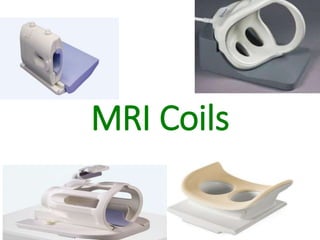
MRI Coils
MRI Coils
A coil, by definition, is anything wound in a
joined sequence of concentric rings. In other
words, it is a looped length of wire. It
becomes actively electromagnetic whenever
you run an electrical field through it.
A coil helps the MRI system capture high-
quality images of a part of the body and is
essential when generating images.
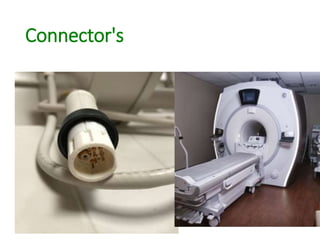
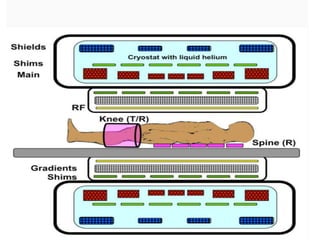
Connector's
• Gradient/ superconductive coil.
• Shim coil.
• Radio frequency coil (RF).
All these coils are shielded together. In that shield,
there is a cryogen of liquid helium that maintains a low
temperature that secures superconductivity.
Underneath that shield is another RF shielding with a
radiofrequency coil (body coil). The patient gets
inserted from the outside of the MRI Scanner and
connected to the patient coil.
MRI Coils types
Gradient/ syperconductive coils
These is the main coils in MRI scanner.
Gradients are simply loops of wire or thin conductive
sheets on a cylindrical shell that lies just inside the bore of
an MRI Scanner.
Its is made up of fiberglass coated with epoxy resin.
 When an electrical current passes through these coils, the
result is a secondary magnetic field which causes the
resonance frequency of protons to vary in a function of
position.
 The main function of gradients is to allow spatial
encoding of the MRI signal, but are also critical for a wide
range of physiologic technique.
MR systems use three sets of gradient
coils the x-, y- and z-gradients.
Shim coils
RF coils
• RF coils are responsible for transmitting/receiving
the signal. These coils are converting the signal into
data that get transferred into a computer and
processed to form the final image.
• The quality of the MRI images depends on the signal
to noise ratio (SNR) of the acquired signal from the
patient.
• Hence, the higher the SNR, the better. A lower
signal-to-noise ratio generally results in a grainy
appearance of the images.
RF coils
RF coils can be divided into three general categories:
• Transmit Only Coil- It only transmits signals.
• Receive Only Coil- It only receive signals.
• Transmit Receive Coil- It both transmits and receive
signsls.
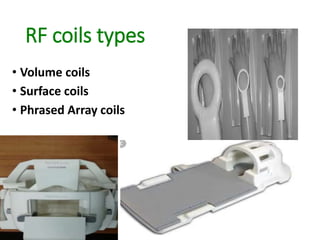
RF coils types
• Volume coils
• Surface coils
• Phrased Array coils
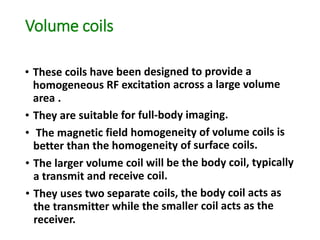
Volume coils
Volume coils
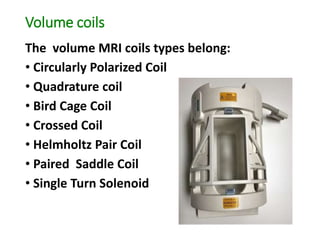
The volume MRI coils types belong:
• Circularly Polarized Coil
• Quadrature coil
• Bird Cage Coil
• Crossed Coil
• Helmholtz Pair Coil
• Paired Saddle Coil
• Single Turn Solenoid
Surface coils
• Surface coils are the coils with the simplest coil design.
• Basically, it is a loop of wire, either circular or rectangular,
that is placed over the region of interest (around the surface
of a patient) for increased magnetic sensitivity.
• As a type of RF coil, they belong into the group of receive
only coils.
• The surface coils have a great SNR for tissues placed near the
coil. Therefore, the further the tissue is from the coil, the less
sensitive it is.
• The surface coils are for spines, shoulders, the joint of the
jaw (temporomandibular joint), and imaging of other smaller
body parts.
Surface coils
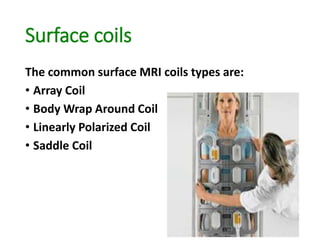
The common surface MRI coils types are:
• Array Coil
• Body Wrap Around Coil
• Linearly Polarized Coil
• Saddle Coil
Phrased Array coils
• These coils merge the benefits of smaller coils
(high SNR) with the benefits of larger coils (large
measurement field). Moreover, they consist of
separate multiple smaller coils that we use
individually or combined.
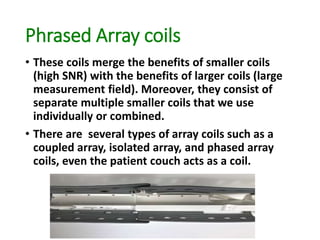
• There are several types of array coils such as a
coupled array, isolated array, and phased array
coils, even the patient couch acts as a coil.
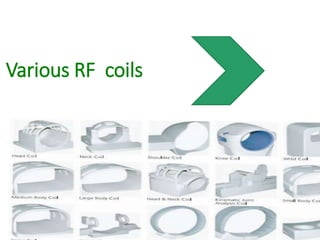
Various RF coils

Mri coils

  • 1.
  • 2.
    MRI Coils A coil,by definition, is anything wound in a joined sequence of concentric rings. In other words, it is a looped length of wire. It becomes actively electromagnetic whenever you run an electrical field through it. A coil helps the MRI system capture high- quality images of a part of the body and is essential when generating images.
  • 3.
  • 4.
    • Gradient/ superconductivecoil. • Shim coil. • Radio frequency coil (RF). All these coils are shielded together. In that shield, there is a cryogen of liquid helium that maintains a low temperature that secures superconductivity. Underneath that shield is another RF shielding with a radiofrequency coil (body coil). The patient gets inserted from the outside of the MRI Scanner and connected to the patient coil. MRI Coils types
  • 5.
    Gradient/ syperconductive coils Theseis the main coils in MRI scanner. Gradients are simply loops of wire or thin conductive sheets on a cylindrical shell that lies just inside the bore of an MRI Scanner. Its is made up of fiberglass coated with epoxy resin.  When an electrical current passes through these coils, the result is a secondary magnetic field which causes the resonance frequency of protons to vary in a function of position.  The main function of gradients is to allow spatial encoding of the MRI signal, but are also critical for a wide range of physiologic technique.
  • 6.
    MR systems usethree sets of gradient coils the x-, y- and z-gradients.
  • 8.
  • 9.
    RF coils • RFcoils are responsible for transmitting/receiving the signal. These coils are converting the signal into data that get transferred into a computer and processed to form the final image. • The quality of the MRI images depends on the signal to noise ratio (SNR) of the acquired signal from the patient. • Hence, the higher the SNR, the better. A lower signal-to-noise ratio generally results in a grainy appearance of the images.
  • 10.
    RF coils RF coilscan be divided into three general categories: • Transmit Only Coil- It only transmits signals. • Receive Only Coil- It only receive signals. • Transmit Receive Coil- It both transmits and receive signsls.
  • 11.
    RF coils types •Volume coils • Surface coils • Phrased Array coils
  • 12.
  • 13.
    Volume coils The volumeMRI coils types belong: • Circularly Polarized Coil • Quadrature coil • Bird Cage Coil • Crossed Coil • Helmholtz Pair Coil • Paired Saddle Coil • Single Turn Solenoid
  • 14.
    Surface coils • Surfacecoils are the coils with the simplest coil design. • Basically, it is a loop of wire, either circular or rectangular, that is placed over the region of interest (around the surface of a patient) for increased magnetic sensitivity. • As a type of RF coil, they belong into the group of receive only coils. • The surface coils have a great SNR for tissues placed near the coil. Therefore, the further the tissue is from the coil, the less sensitive it is. • The surface coils are for spines, shoulders, the joint of the jaw (temporomandibular joint), and imaging of other smaller body parts.
  • 15.
    Surface coils The commonsurface MRI coils types are: • Array Coil • Body Wrap Around Coil • Linearly Polarized Coil • Saddle Coil
  • 16.
    Phrased Array coils •These coils merge the benefits of smaller coils (high SNR) with the benefits of larger coils (large measurement field). Moreover, they consist of separate multiple smaller coils that we use individually or combined. • There are several types of array coils such as a coupled array, isolated array, and phased array coils, even the patient couch acts as a coil.
  • 18.