Barium swallow
Examination
Introduction:
Barium swallow is a special test of the pharynx,
oesophagus, and proximal stomach i.e. upper GI tract
using Contrast medium as Barium, and may be
performed as a single or double contrast study.
Barium migration into the bloodstream, known as
intravasation.
Barium sulfate forms the basis for a range of contrast
media used in fluoroscopic examinations of the
gastrointestinal tract.
Advantage
&Disadvantage
Anatomy:
Indications:
• High or low dysphagia.
• Gastro-oesophageal reflux disease (GORD/GORD).
• Assessment of a hiatus hernia.
• Generalised epigastric pain.
• Globus pharyngeus.
• Persistent vomiting.
• assessment of fistula.
• inability to pass the endoscope during UGIE.
Contradications:
Water soluble contrast agents should be used instead of
barium in the following cases:
• Suspected perforation.
• Post-operative assessment for leak.
• Anastomosis.
• Pregnancy.
• Lactating mother.
• Ulceration.
Patient Preparations:
Techniques:(Single
Contrast)
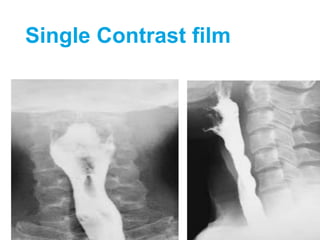
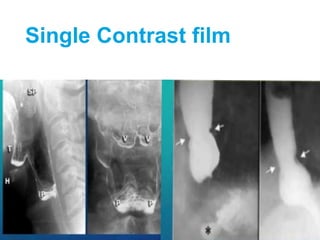
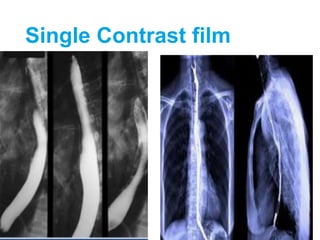
Single Contrast film
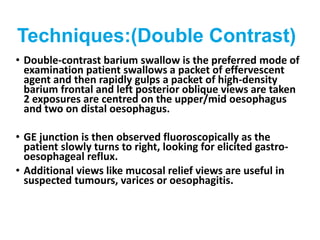
Techniques:(Double Contrast)
• Double-contrast barium swallow is the preferred mode of
examination patient swallows a packet of effervescent
agent and then rapidly gulps a packet of high-density
barium frontal and left posterior oblique views are taken
2 exposures are centred on the upper/mid oesophagus
and two on distal oesophagus.
• GE junction is then observed fluoroscopically as the
patient slowly turns to right, looking for elicited gastro-
oesophageal reflux.
• Additional views like mucosal relief views are useful in
suspected tumours, varices or oesophagitis.
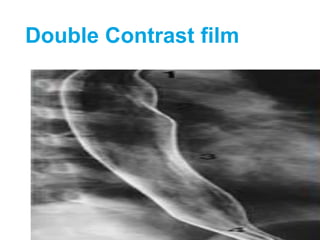
Double Contrast film
Complication
Pathology: Hiatus hernia
Pathology:Double arch
Pathology: Carcinoma
Pathology: Fistula
Pathology: Barrett's
Esophagus
Pathology: Esophagitis
Pathology: Zenker's Diverticulum
Pathology: Stritcher
Pathology: Achlasia
Barium swallow examination

Barium swallow examination