- Dr Nisar Ahmed Arain
Assistant Professor
Anesthesia/Critical Care/ER
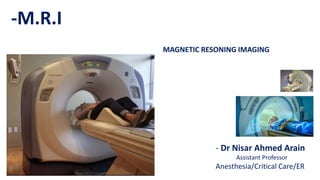
-M.R.I
MAGNETIC RESONING IMAGING
MRI is a radiological technique
Its Uses
a-Magnetism
b-Radio waves and a
c-Computer
d-to produce images of body structures
e--MRI is based on the principals of
NMR(Nuclear Medical Resonance)
The First Human examination of MRI
was performed in 1997 and
it took 5 hours to produce an image
- MRI
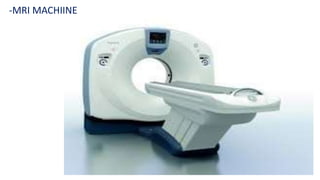
-MRI MACHIINE
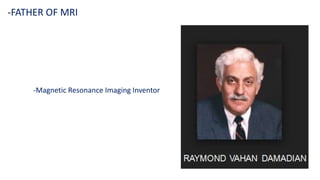
-Magnetic Resonance Imaging Inventor
-FATHER OF MRI
1-Most ailments of the Brain, including Tumors
and sport Injuries
2-Musculo skeletal problems
3-Most spinal conditions, injuries, Vascular
abnormalities
4-Female Pelvic problems
5-Prostate problems
6-Abnormal Gastro Intestinal tract conditions
7-Ear, Nose, and Throat conditions
8-Soft tissue and Bone Pathological conditions
-WHAT CAN BE DIAGNOSED
BY AN MRI SCAN
1-A Cardiac Pacemaker
2-Certain Dips in your head from Brain
operations
3-A Cochlear implant
4-A metallic foreign body in your Eye
where you had surgery in last 8 weeks
5-If you are Pregnant
-WHO CAN HAVE AN
MRI SCAN
1-MRI makes use of the magnetic
properties of certain atomic
nuclei
2-Hydrogen nucleus (single proton)
present in the water molecules and
therefore all body tissues
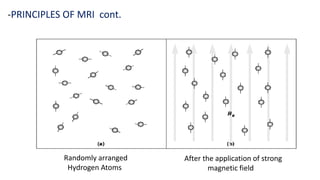
3-The hydrogen Nuclei partially
aligned by a strong magnetic field
in the scanner.
-PRINCIPLES OF MRI
-PRINCIPLES OF MRI cont.
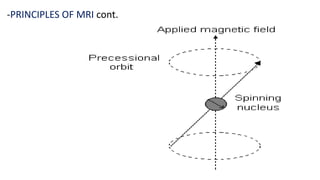
4-The nuclei can be rotated using
radio waves, and they subsequently
oscillate in the magnetic field while
returning to equilibrium
5-Simultaneously they emit a radio
signal, and this is detected using
antenna (coils)
6-Very detailed images can be made of
soft tissues
Randomly arranged
Hydrogen Atoms
-PRINCIPLES OF MRI cont.
After the application of strong
magnetic field
-PRINCIPLES OF MRI cont.
1-Scanner
2-Computer
3-Recording Hardware
-MAIN COMPONENTS OF MRI
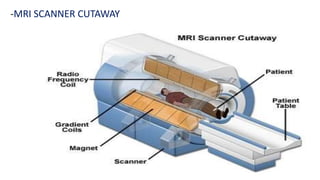
1- An MRI Scanner is a large tube
that contains powerful magnets
2-Main components of scanner are
a-Static Magnetic field coils
b-Gradient coils
c-RF (radio frequency) coils
-SCANNER
-MRI SCANNER CUTAWAY
1-Three methods to generate magnetic field
a-Fixed Magnet
b-Resistive Magnet
c-Super conducting Magnet
2-Fixed Magnets and Resistive Magnets are generally
restricted to field strengths below 0.4t
3-High resolution imaging systems use super conducting
Magnets
4-They need coils to be soaked in liquid Helium to reduce
their temperature to a value close to absolute zero
-STATIC MAGNETIC FIELD COILS
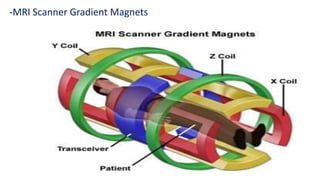
1-Gradient coils are used to produce deliberate
variations in the main Magnetic field
2-There are usually three sets of gradient coils,
one for each direction
3-The variation in the Magnetic field permits
localization of image slices as well as
phase encoding and frequency encoding
4-The set of gradient coils for the Z axis are
Helmholtz pairs, and for the X and Y
axis are paired saddle coils
-GRADIENT COILS
-MRI Scanner Gradient Magnets
1-RF coils act as transmitter and receiver
2-RF coils are the “ANTENNA” of the MRI
system
3-That transmit the RF signal and receives
the return signal
4-They are simply a loop of wires either
circular or rectangular
5-Helmholtz pair coils consist of two circular
coils parallel to each other. They are used
as the Z gradient coils in MRI Scanners
6-Paired saddle coils are also used for the X
and Y gradient coils
-RADIO FREQUENCY COIL
1-No ionizing Radiation
2-Variable thickness in any plane
3-Better contrast resolution
4-Many details are achieved without I/V
contrast
-ADVANTAGES OF MRI
1-Very Expensive
2-Dangerous for patients with
metallic devices placed within
the body
3-Difficult to be performed on
daustrophobic patients
4-Movement during scanning may
cause blurry images
5-RF transmitters can cause severe
burns if mis handled
-DISADVANTAGES OF MRI
SHAPES OF MRI
MACHINE
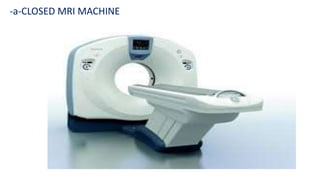
-a-CLOSED MRI MACHINE
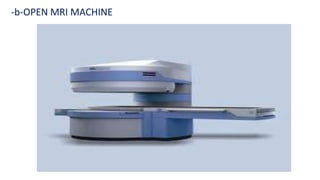
-b-OPEN MRI MACHINE
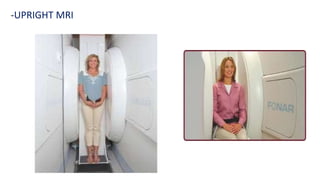
-UPRIGHT MRI
1-Since the earlier 1990’s FMRI had come
2-FMRI is based on the same technology as
MRI
3-FMRI looks at blood flow
4-It is a technique for measuring Brain activity
5-It works by detecting the charges in the
blood oxygenation and flow that occur in
response to neural activity
-FUNCTIONAL MRI
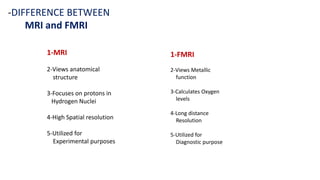
1-MRI
2-Views anatomical
structure
3-Focuses on protons in
Hydrogen Nuclei
4-High Spatial resolution
5-Utilized for
Experimental purposes
-DIFFERENCE BETWEEN
MRI and FMRI
1-FMRI
2-Views Metallic
function
3-Calculates Oxygen
levels
4-Long distance
Resolution
5-Utilized for
Diagnostic purpose
-MRI Scan
-DIFFERENCE BETWEEN MRI and FMRI
-FMRI Scan
-Comparison between
X Ray system=CT System=and MRI System
Mri and compatible equipment.

Mri and compatible equipment.

  • 1.
    - Dr NisarAhmed Arain Assistant Professor Anesthesia/Critical Care/ER -M.R.I MAGNETIC RESONING IMAGING
  • 2.
    MRI is aradiological technique Its Uses a-Magnetism b-Radio waves and a c-Computer d-to produce images of body structures e--MRI is based on the principals of NMR(Nuclear Medical Resonance) The First Human examination of MRI was performed in 1997 and it took 5 hours to produce an image - MRI
  • 3.
  • 4.
    -Magnetic Resonance ImagingInventor -FATHER OF MRI
  • 5.
    1-Most ailments ofthe Brain, including Tumors and sport Injuries 2-Musculo skeletal problems 3-Most spinal conditions, injuries, Vascular abnormalities 4-Female Pelvic problems 5-Prostate problems 6-Abnormal Gastro Intestinal tract conditions 7-Ear, Nose, and Throat conditions 8-Soft tissue and Bone Pathological conditions -WHAT CAN BE DIAGNOSED BY AN MRI SCAN
  • 6.
    1-A Cardiac Pacemaker 2-CertainDips in your head from Brain operations 3-A Cochlear implant 4-A metallic foreign body in your Eye where you had surgery in last 8 weeks 5-If you are Pregnant -WHO CAN HAVE AN MRI SCAN
  • 7.
    1-MRI makes useof the magnetic properties of certain atomic nuclei 2-Hydrogen nucleus (single proton) present in the water molecules and therefore all body tissues 3-The hydrogen Nuclei partially aligned by a strong magnetic field in the scanner. -PRINCIPLES OF MRI
  • 8.
    -PRINCIPLES OF MRIcont. 4-The nuclei can be rotated using radio waves, and they subsequently oscillate in the magnetic field while returning to equilibrium 5-Simultaneously they emit a radio signal, and this is detected using antenna (coils) 6-Very detailed images can be made of soft tissues
  • 9.
    Randomly arranged Hydrogen Atoms -PRINCIPLESOF MRI cont. After the application of strong magnetic field
  • 10.
  • 11.
  • 12.
    1- An MRIScanner is a large tube that contains powerful magnets 2-Main components of scanner are a-Static Magnetic field coils b-Gradient coils c-RF (radio frequency) coils -SCANNER
  • 13.
  • 14.
    1-Three methods togenerate magnetic field a-Fixed Magnet b-Resistive Magnet c-Super conducting Magnet 2-Fixed Magnets and Resistive Magnets are generally restricted to field strengths below 0.4t 3-High resolution imaging systems use super conducting Magnets 4-They need coils to be soaked in liquid Helium to reduce their temperature to a value close to absolute zero -STATIC MAGNETIC FIELD COILS
  • 15.
    1-Gradient coils areused to produce deliberate variations in the main Magnetic field 2-There are usually three sets of gradient coils, one for each direction 3-The variation in the Magnetic field permits localization of image slices as well as phase encoding and frequency encoding 4-The set of gradient coils for the Z axis are Helmholtz pairs, and for the X and Y axis are paired saddle coils -GRADIENT COILS
  • 16.
  • 17.
    1-RF coils actas transmitter and receiver 2-RF coils are the “ANTENNA” of the MRI system 3-That transmit the RF signal and receives the return signal 4-They are simply a loop of wires either circular or rectangular 5-Helmholtz pair coils consist of two circular coils parallel to each other. They are used as the Z gradient coils in MRI Scanners 6-Paired saddle coils are also used for the X and Y gradient coils -RADIO FREQUENCY COIL
  • 18.
    1-No ionizing Radiation 2-Variablethickness in any plane 3-Better contrast resolution 4-Many details are achieved without I/V contrast -ADVANTAGES OF MRI
  • 19.
    1-Very Expensive 2-Dangerous forpatients with metallic devices placed within the body 3-Difficult to be performed on daustrophobic patients 4-Movement during scanning may cause blurry images 5-RF transmitters can cause severe burns if mis handled -DISADVANTAGES OF MRI
  • 20.
  • 21.
  • 22.
  • 23.
  • 24.
    1-Since the earlier1990’s FMRI had come 2-FMRI is based on the same technology as MRI 3-FMRI looks at blood flow 4-It is a technique for measuring Brain activity 5-It works by detecting the charges in the blood oxygenation and flow that occur in response to neural activity -FUNCTIONAL MRI
  • 25.
    1-MRI 2-Views anatomical structure 3-Focuses onprotons in Hydrogen Nuclei 4-High Spatial resolution 5-Utilized for Experimental purposes -DIFFERENCE BETWEEN MRI and FMRI 1-FMRI 2-Views Metallic function 3-Calculates Oxygen levels 4-Long distance Resolution 5-Utilized for Diagnostic purpose
  • 26.
    -MRI Scan -DIFFERENCE BETWEENMRI and FMRI -FMRI Scan
  • 27.
    -Comparison between X Raysystem=CT System=and MRI System