Chapter 13 Trauma Radiography Heather Johnson, A.S., R.T. (R)
Trauma Centers Many types of facilities provide emergency medical care, ranging from major metropolitan medical center to small outpatient clinics in rural areas.  The term “Trauma Center” signifies a specific level of emergency medical care as defined by the American College of Surgeons Commission on Trauma.
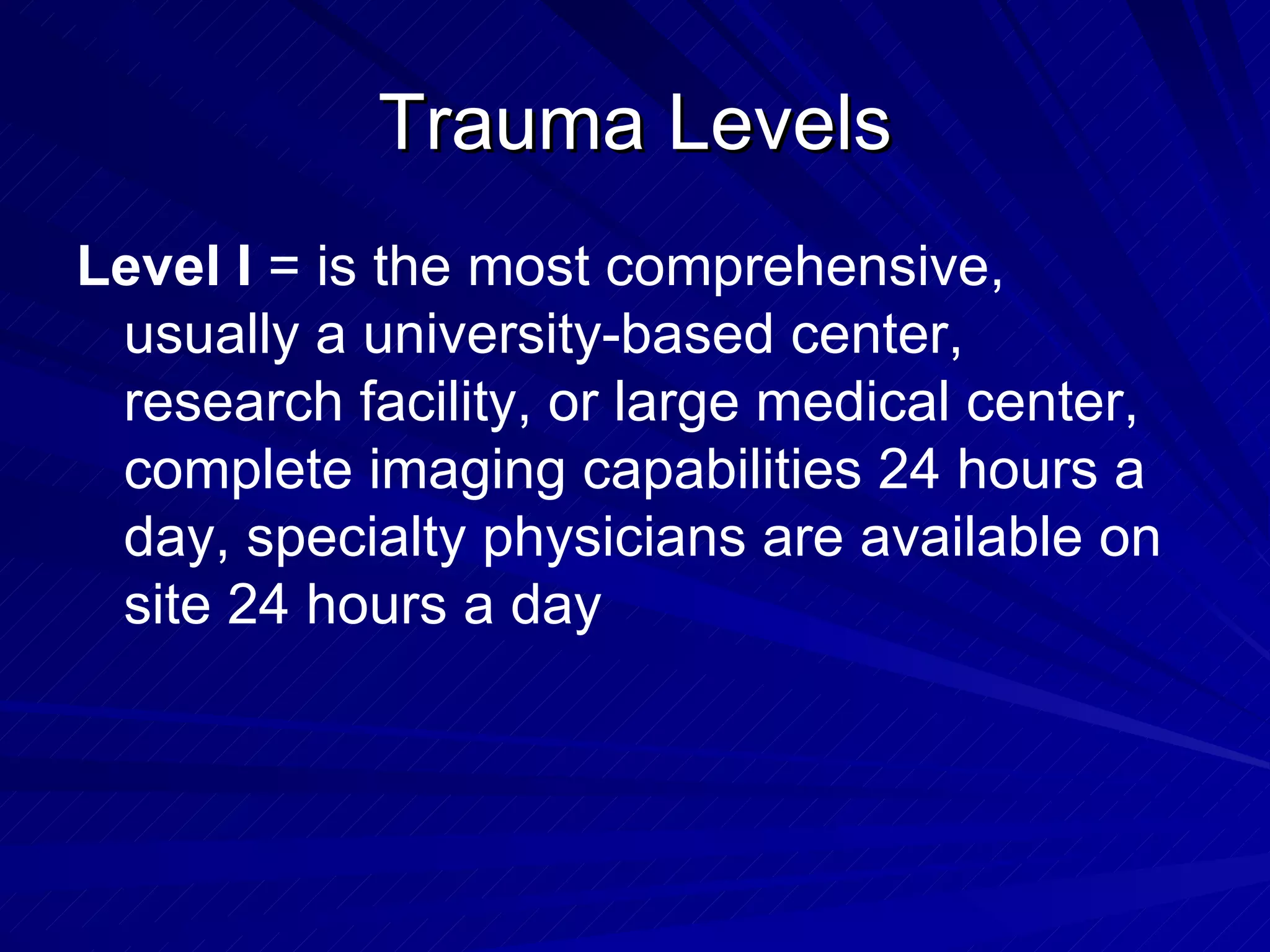
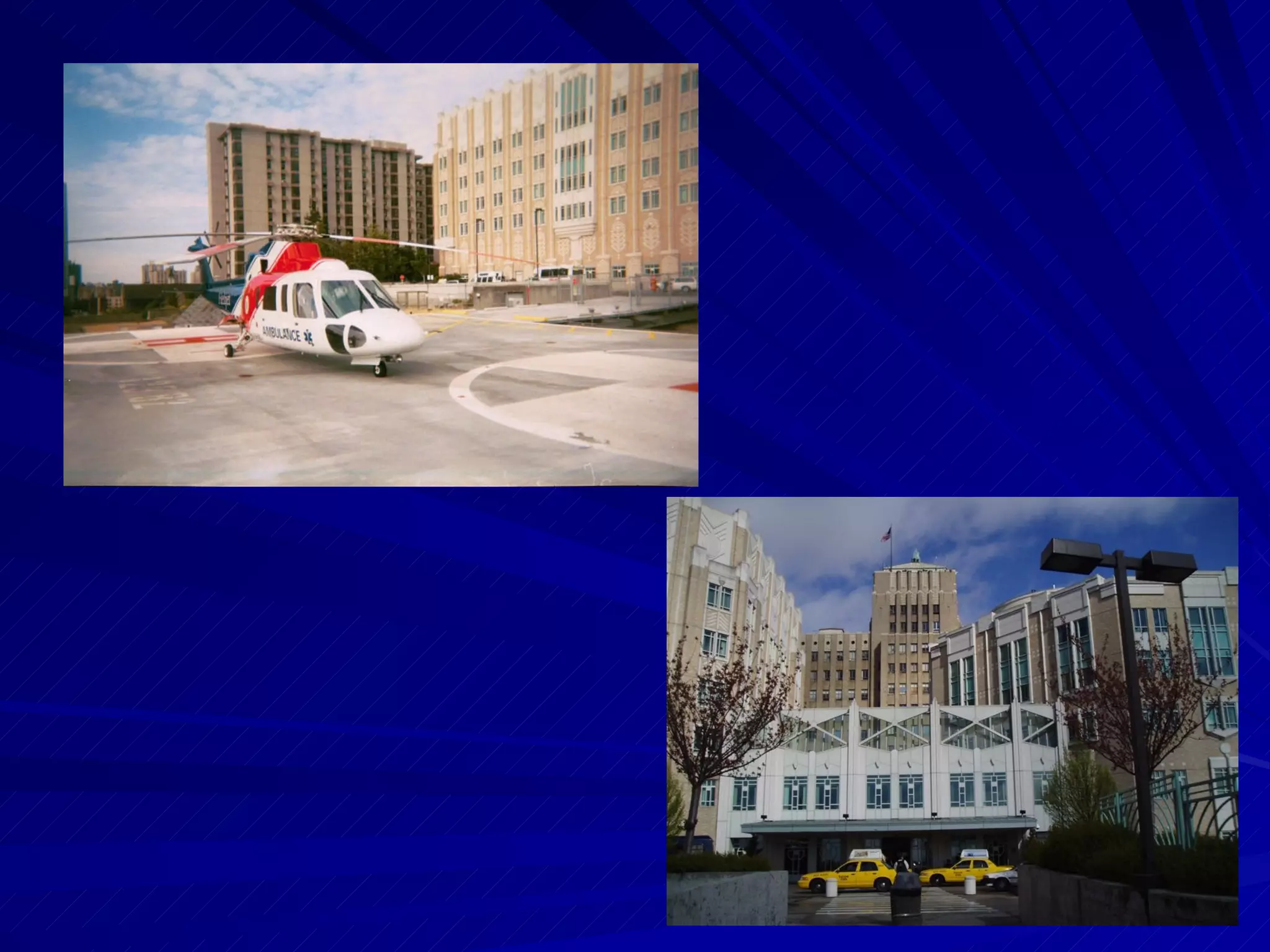
Trauma Levels Level I  = is the most comprehensive, usually a university-based center, research facility, or large medical center, complete imaging capabilities 24 hours a day, specialty physicians are available on site 24 hours a day
 
Trauma Levels Level II  = same as level one, but not a research facility, may not have as many specialists Level III  = no specialists, can stabilize patient for transport to a higher level center, may not have 24 hour imaging Level IV  = clinics, attend minor injuries, some stabilization before transfer
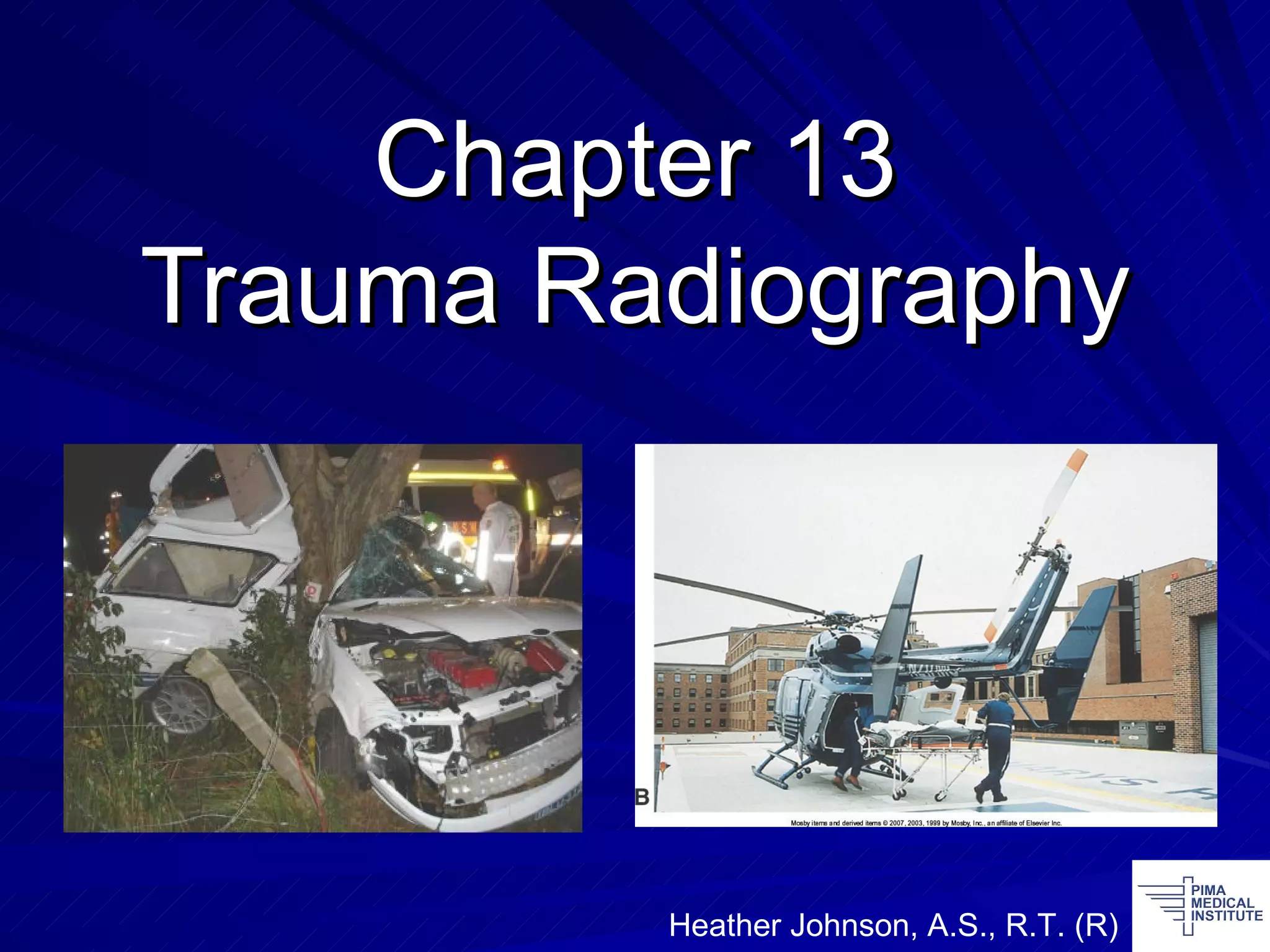
Introduction Trauma is defined as a sudden, unexpected, dramatic, forceful, or violent event Blunt, penetrating, explosive, and thermal   forces are common causes of traumatic injuries
 
 
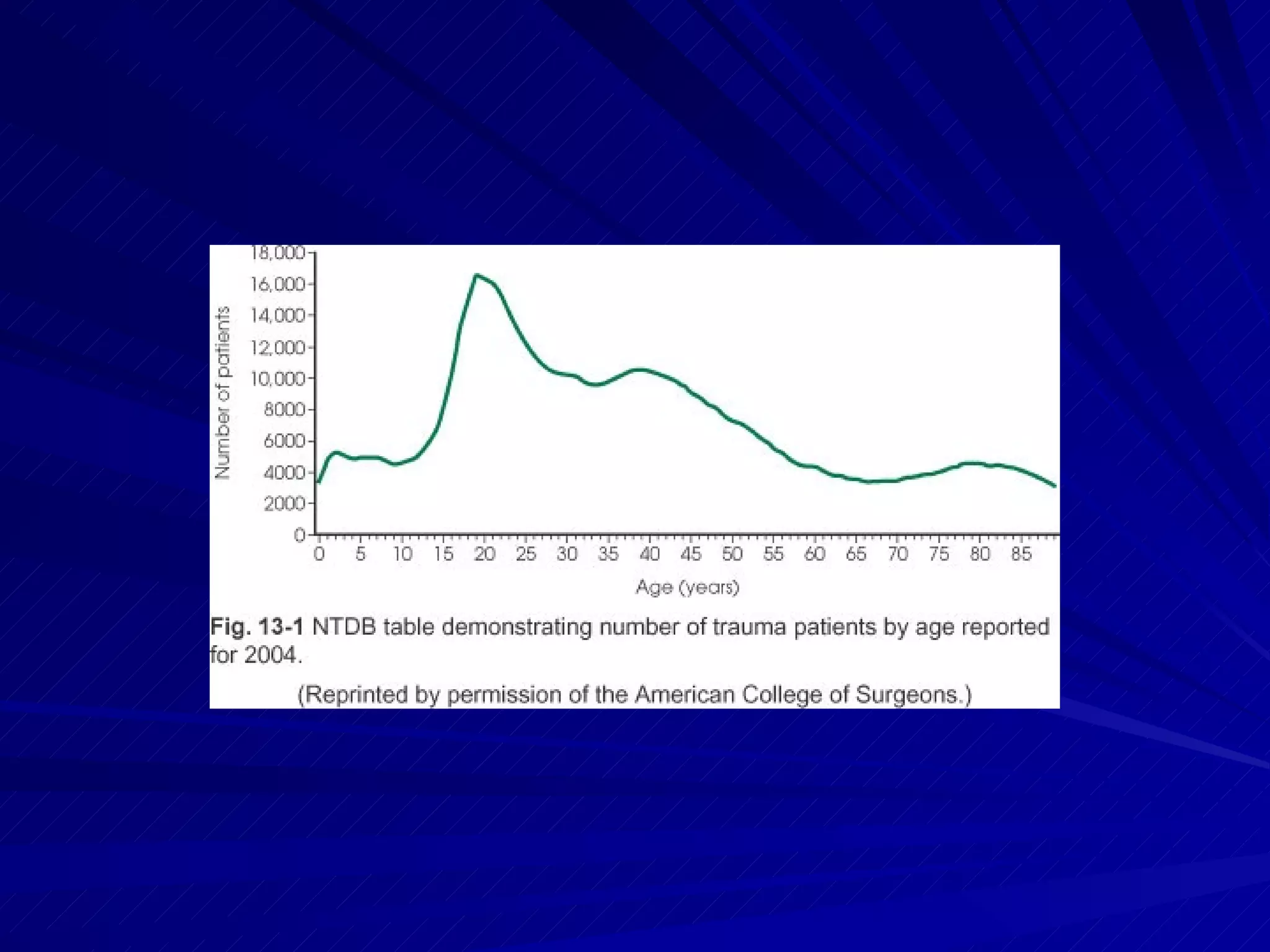
Introduction Trauma affects persons in all age ranges Radiographers in the emergency department (ED) must be prepared for a variety of procedures on patients in all age groups
 
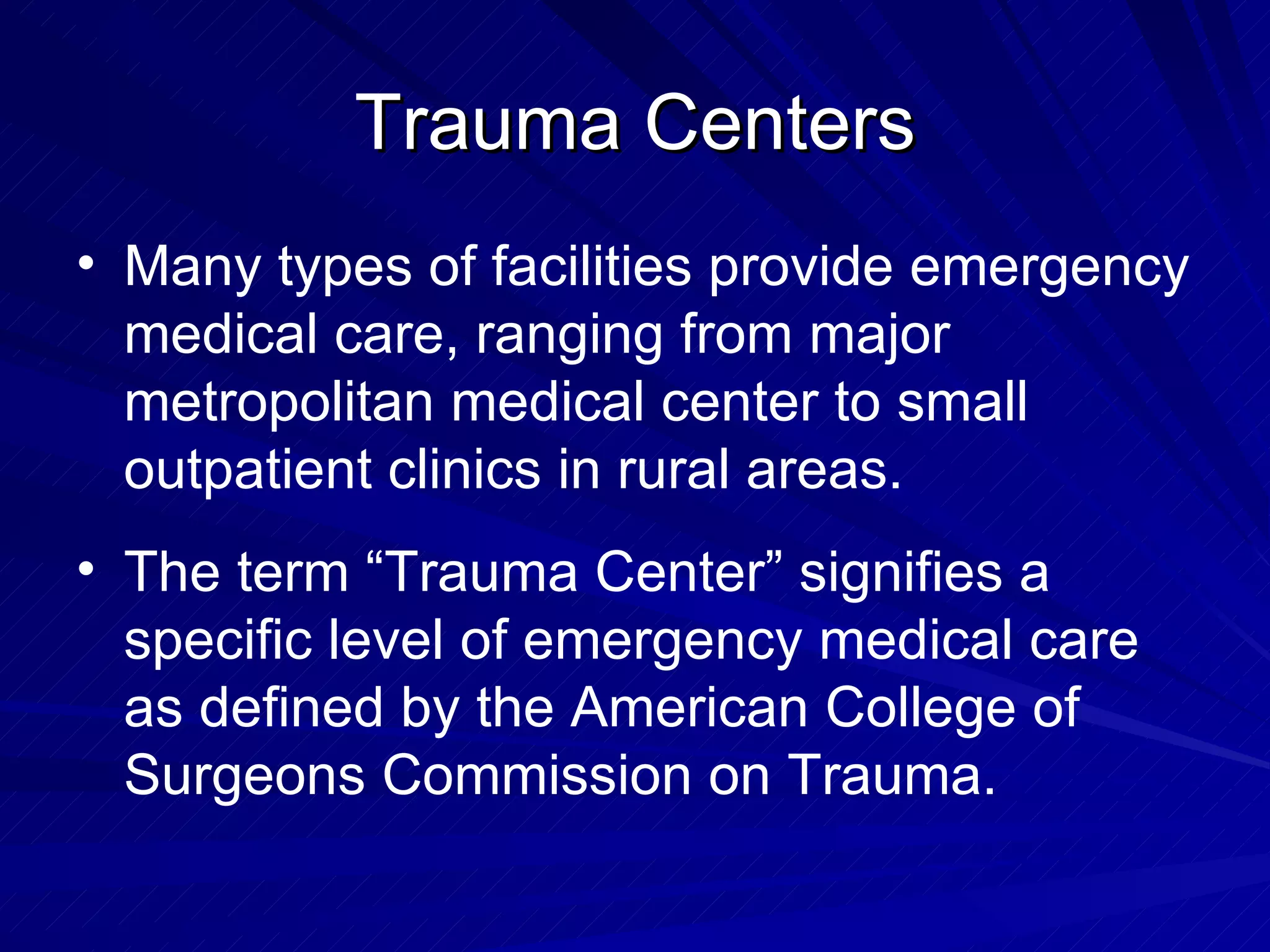
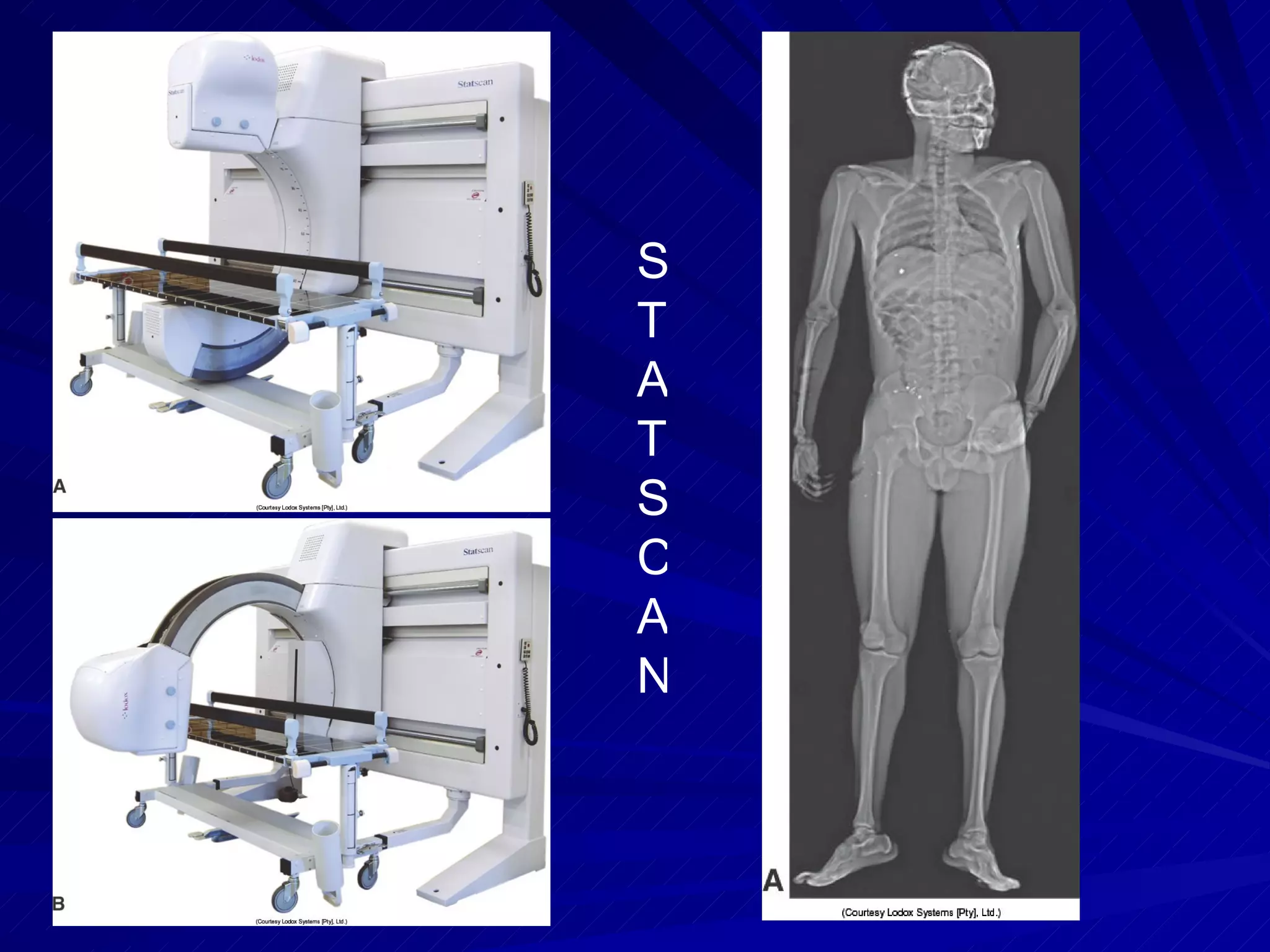
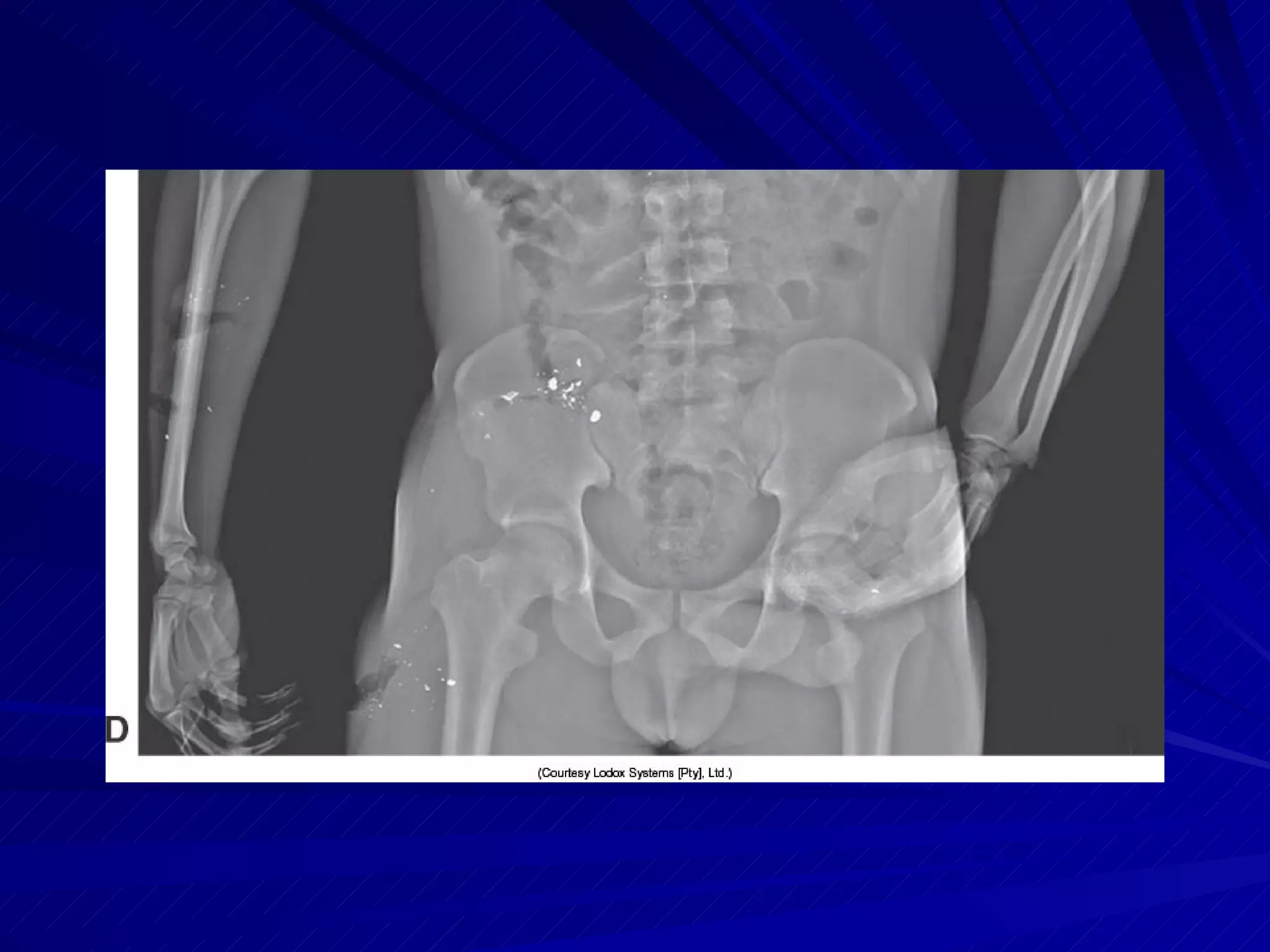
Preliminary Considerations Specialized trauma imaging systems reduce the amount of time required to obtain diagnostic images One type provides greater flexibility in IR/CR maneuverability Another type scans the entire body in a few seconds
 
STATSCAN
 
 
Mobile radiography is often used for ED procedures
Preliminary Considerations Mobile fluoroscopy units, or C-arms, may be used in fracture reduction or foreign body localizations Immobilization devices are a necessity in trauma imaging Trauma patients often cannot hold the required position
Radiographer’s Role in Trauma Depends upon department protocol and staffing Primary responsibilities Perform quality diagnostic imaging procedures Practice ethical radiation protection Provide patient care
Radiographer’s Role in Trauma Patient  level of consciousness  changes are common in trauma
“ Best Practices” in Trauma Radiography Speed Efficiency in producing quality images in the shortest possible time Accuracy Optimum image quality, minimum repeats Quality Quality cannot be sacrificed for speed Do not use patient condition as an excuse for poor quality images
“ Best Practices” in Trauma Radiography Positioning Important not to aggravate patient’s condition when obtaining images Move tube and IR, instead of patient, whenever possible Practice standard precautions Expect to be exposed to body fluids in ED Do not touch a patient without gloves!
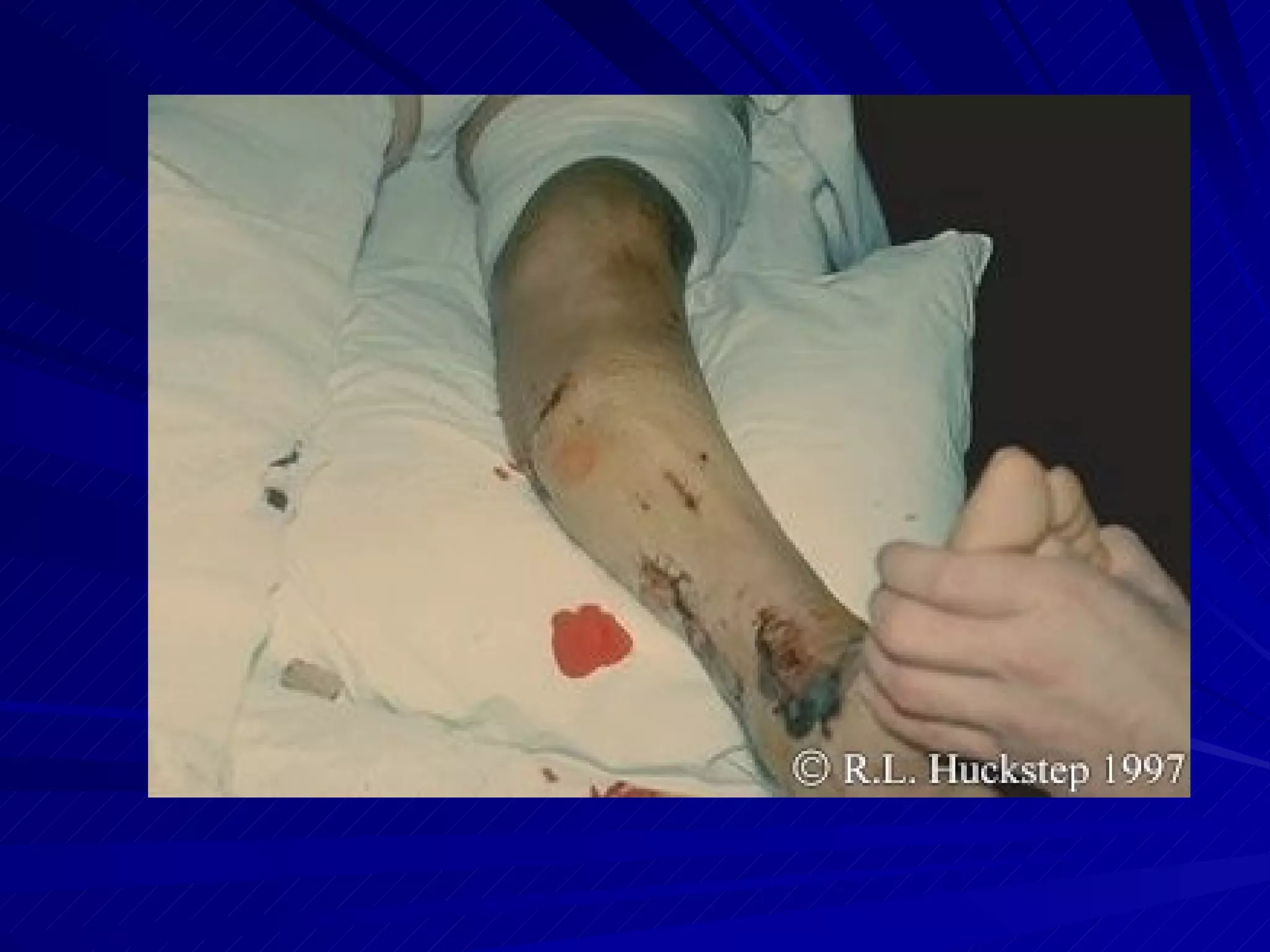
Disclaimer: The following three slides are gruesome.


“ Best Practices” in Trauma Radiography Anticipation Some injuries require follow-up procedures; knowing what to do increases appreciation for radiographer’s role in ED
“ Best Practices” in Trauma Radiography Attention to detail Pay careful attention to patient’s condition, which could change at any time Attention to ED protocol and scope of practice Know the protocol and scope of practice in your facility Professionalism Adhere to Code of Ethics
Radiographic Procedures in Trauma Slide
General Procedural Guidelines Slide
General Procedural Guidelines Patient preparation IR size SID ID markers Radiation protection Patient instructions Immobilization Documentation Image critique
Patient Preparation Use good communication skills with appropriate touch and eye contact Trauma often causes anxiety Check patient for potential artifacts Explain what you are removing and why Secure all personal effects using proper procedure for your facility
IR Size IR size for trauma procedures are the same as for routine procedures Use smallest IR that will demonstrate anatomy Collimate field size to anatomy of interest
SID SID is standardized as a part of procedural protocol When SID is not specified under a projection,  40 to 48  60 to 72   SID recommended for projections with increased OID
ID Markers Right or left side markers must be included on each image Other required ID markers must be in the blocker or elsewhere on the final image Markers used for penetrating trauma to identify entrance and exit wounds
 
Just Kidding…..
Radiation Protection Shield pediatric patients and patients of reproductive age  Warn other staff of exposure when performing mobile imaging Other radiation protection measures Close collimation  Optimum technique factors
Patient Instructions Explain and demonstrate positions, when possible  Explain respiration instructions for patients who can cooperate Use short exposure times to eliminate possibility of imaging motion
Immobilization Many ED patients arrive in some sort of immobilization device Immobilization devices are  not  to be removed unless ordered by a physician Imaging procedures are often performed without removal of the immobilization Images are used to rule out injury and show if it is safe to remove immobilization
 
 
Documentation Because deviation or adjustment of routine procedures is often required to accommodate a patient’s injury, documentation is important Make sure that deviation from routine is still within your scope of practice! Document deviation (AP, X-table, etc.), time, portable
Image Critique Criteria Image evaluation for trauma procedures is the same as for routine procedures Image quality is critical for an accurate diagnosis It is poor practice to accept lower quality images due to patient condition or difficulty of procedure
Trauma Projections
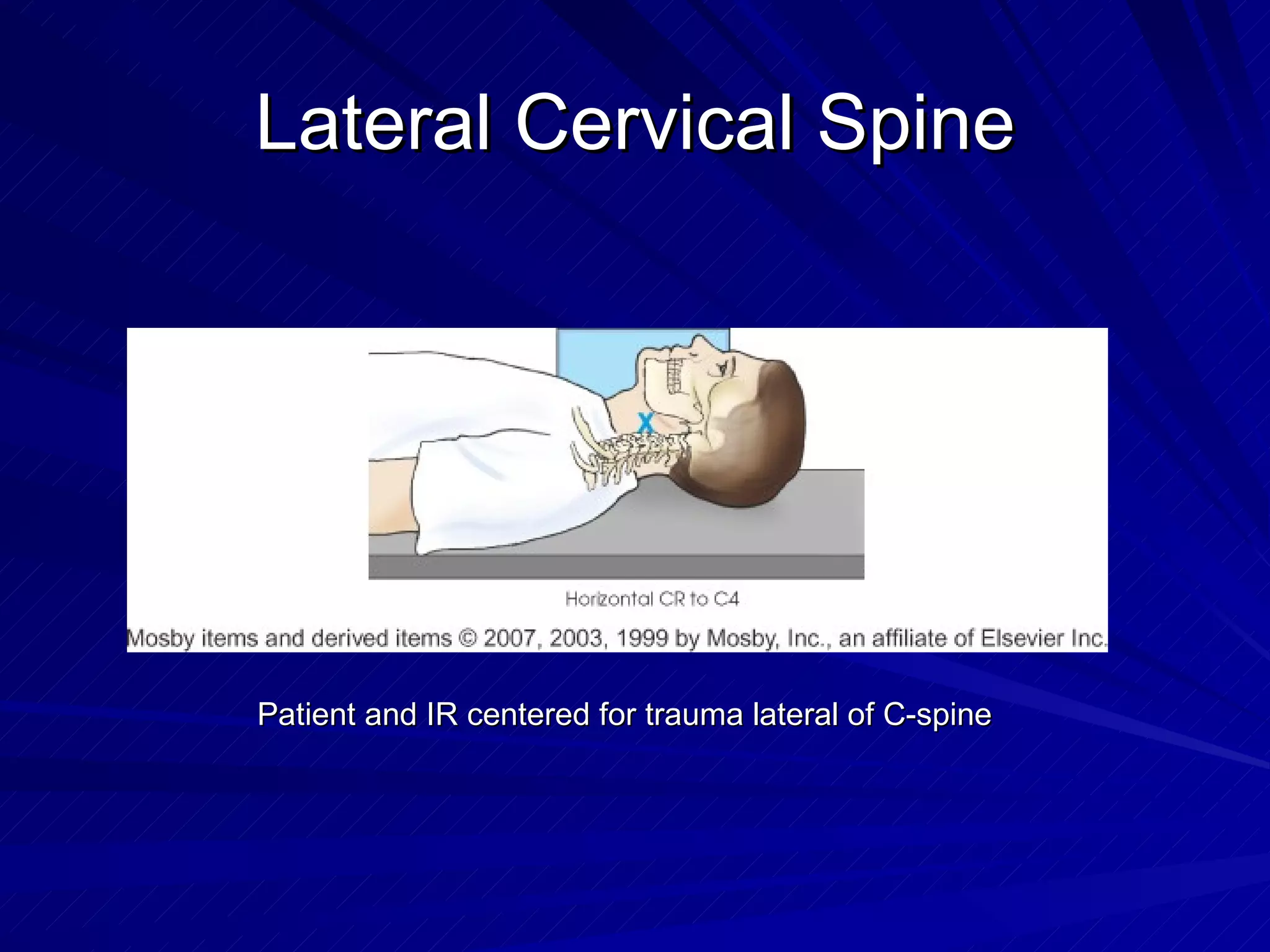
Lateral Cervical Spine Horizontal CR centered to midpoint of IR Pre-vertebral soft tissue must be visualized Image should demonstrate entire C-spine from sella turcica to top of T1 If all seven cervical vertebrae are not seen, then a swimmer’s view is required
Lateral Cervical Spine Patient and IR centered for trauma lateral of C-spine
Lateral Cervical Spine Lateral projection of C-spine in dorsal decubitus position; dislocation of C3-C4; C7 not demonstrated, so swimmer’s view is needed
Swimmer’s (cervicothoracic) Required if C7 and top of T1 not demonstrated on lateral C-spine Trauma usually requires dorsal decubitus position Patient supine without rotation Ask patient to raise arm opposite the x-ray tube over head Assist patient and provide support
Cervicothoracic Spine Relax shoulder closer to x-ray tube Vertical IR centered just above jugular notch Horizontal CR centered to C7-T1 interspace and midcoronal plane Use breathing technique if possible Blur ribs and lung markings to better demonstrate spine
Cervicothoracic Spine Image demonstrates lower cervical and upper thoracic vertebrae in profile between the shoulders
Cervicothoracic Spine Patient and IR positioned for trauma lateral projection of cervicothoracic vertebrae using dorsal decubitus position
Cervicothoracic Spine Lateral projection, dorsal decubitus position of cervicothoracic vertebrae
AP Axial Cervical Spine Patient is supine Usually immobilized with collar and spine board Place IR under spine board, if present, centered to C4 (Adam’s apple) Head and shoulders without rotation Ask patient to look straight ahead
AP Axial Cervical Spine CR directed 15 to 20 degrees cephalad to enter MSP at C4 Image demonstrates C3-T1 or T2, including all soft tissues If backboard is present, unavoidable artifacts may be seen
AP Axial Cervical Spine Patient and IR positioned for trauma AP axial C-spine
AP Axial Cervical Spine Trauma AP axial C-spine; complete dislocation at C2-C3
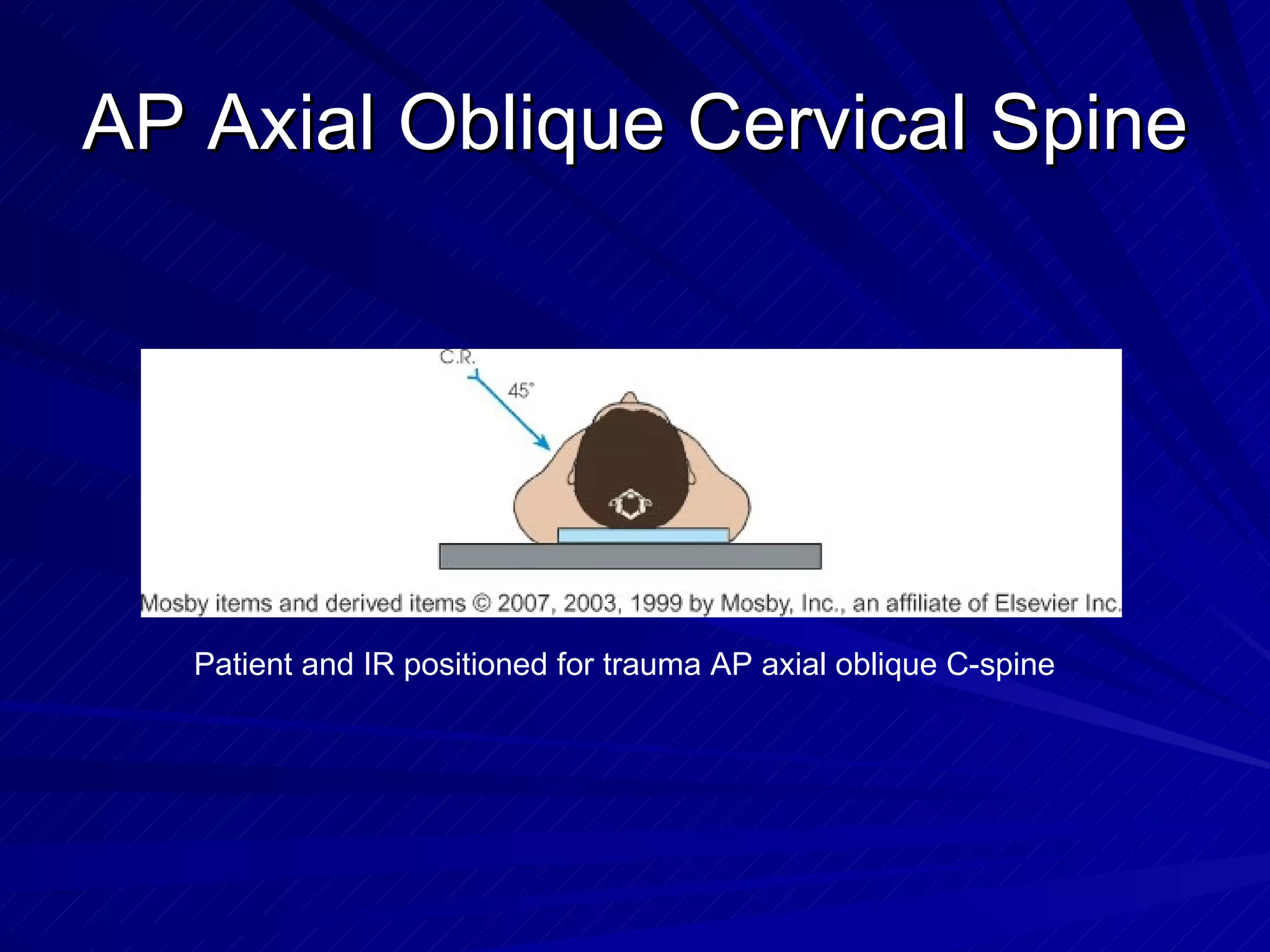
AP Axial Oblique Cervical Spine TRAUMA OBLIQUES Patient is supine Usually immobilized with collar and spine board Place IR under spine board (not bucky), if present, centered to C4 and adjacent mastoid process About 3   lateral to MSP
AP Axial Oblique Cervical Spine Head and shoulders without rotation Ask patient to look straight ahead CR has double angle 45 degrees lateromedially 15 to 20 degrees cephalic CR enters lateral to MSP at level of C4
AP Axial Oblique Cervical Spine CR exit should be in center of IR Image demonstrates side opposite CR C1-T1 or T2 bodies and disk spaces Intervertebral foramina open If backboard is present, unavoidable artifacts may be seen
AP Axial Oblique Cervical Spine Patient and IR positioned for trauma AP axial oblique C-spine
AP Axial Oblique Cervical Spine Trauma AP axial oblique C-spine
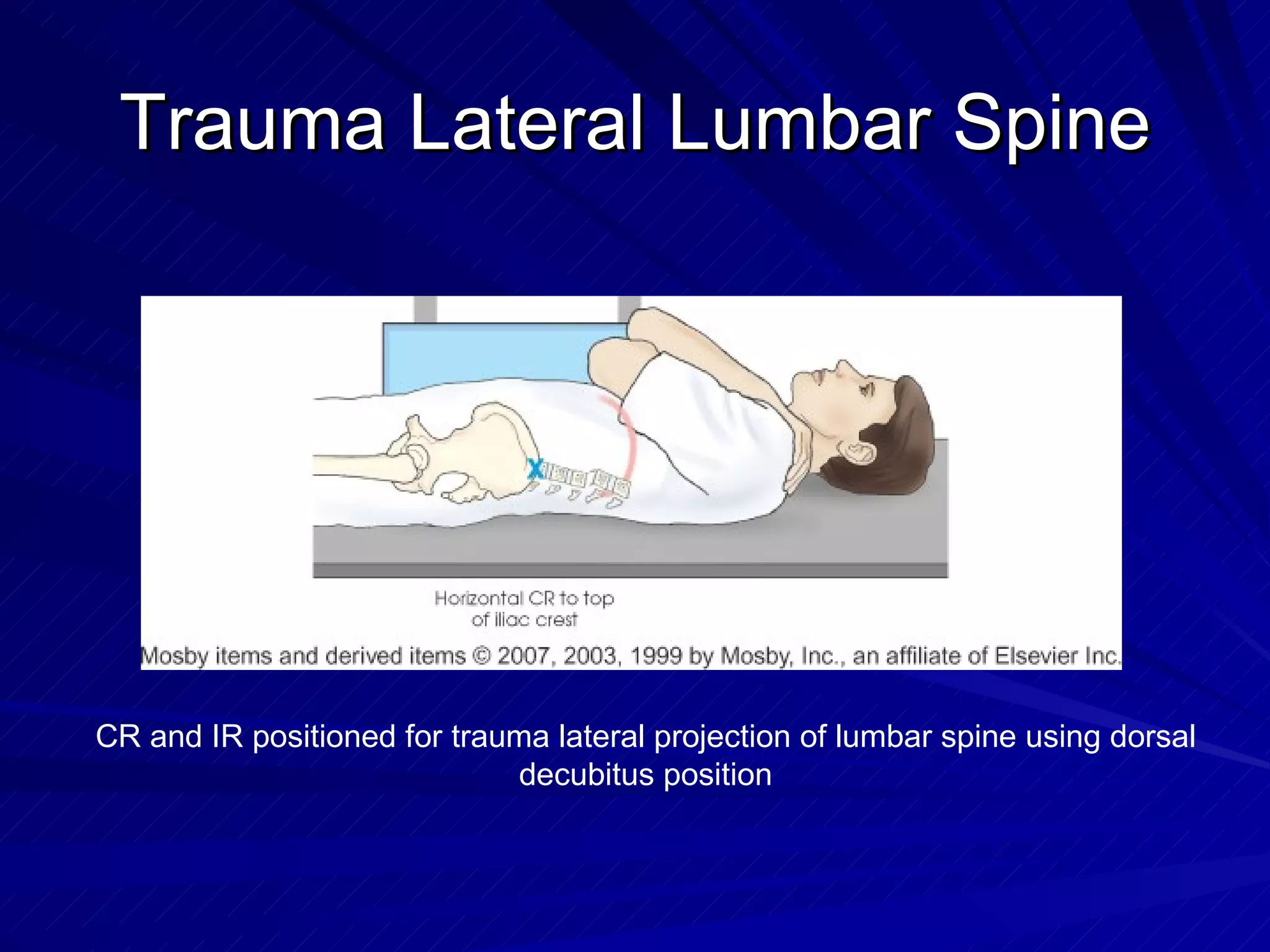
Thoracic and Lumbar Spine X-table laterals performed first Vertical grid and IR Top of IR 1.5   to 2   (3.8 to 5 cm) above shoulders for thoracic spine Centered to level of iliac crests for lumbar spine Have patient cross arms on anterior chest
Thoracic and Lumbar Spine CR horizontal  Centered to spine and IR Breathing technique improves visualization of thoracic vertebrae Exposure made on suspended respiration for lumbar vertebrae
Thoracic and Lumbar Spine Thoracic image demonstrates T3 or T4 to L1 Lumbar image demonstrates T12 to sacrum Vertebral bodies and spinous processes in profile
Trauma Lateral Lumbar Spine CR and IR positioned for trauma lateral projection of lumbar spine using dorsal decubitus position
Trauma Lateral Lumbar Spine Lateral projection of thoracolumbar spine, dorsal decubitus position; note fracture and dislocation of L2 and spine board artifacts
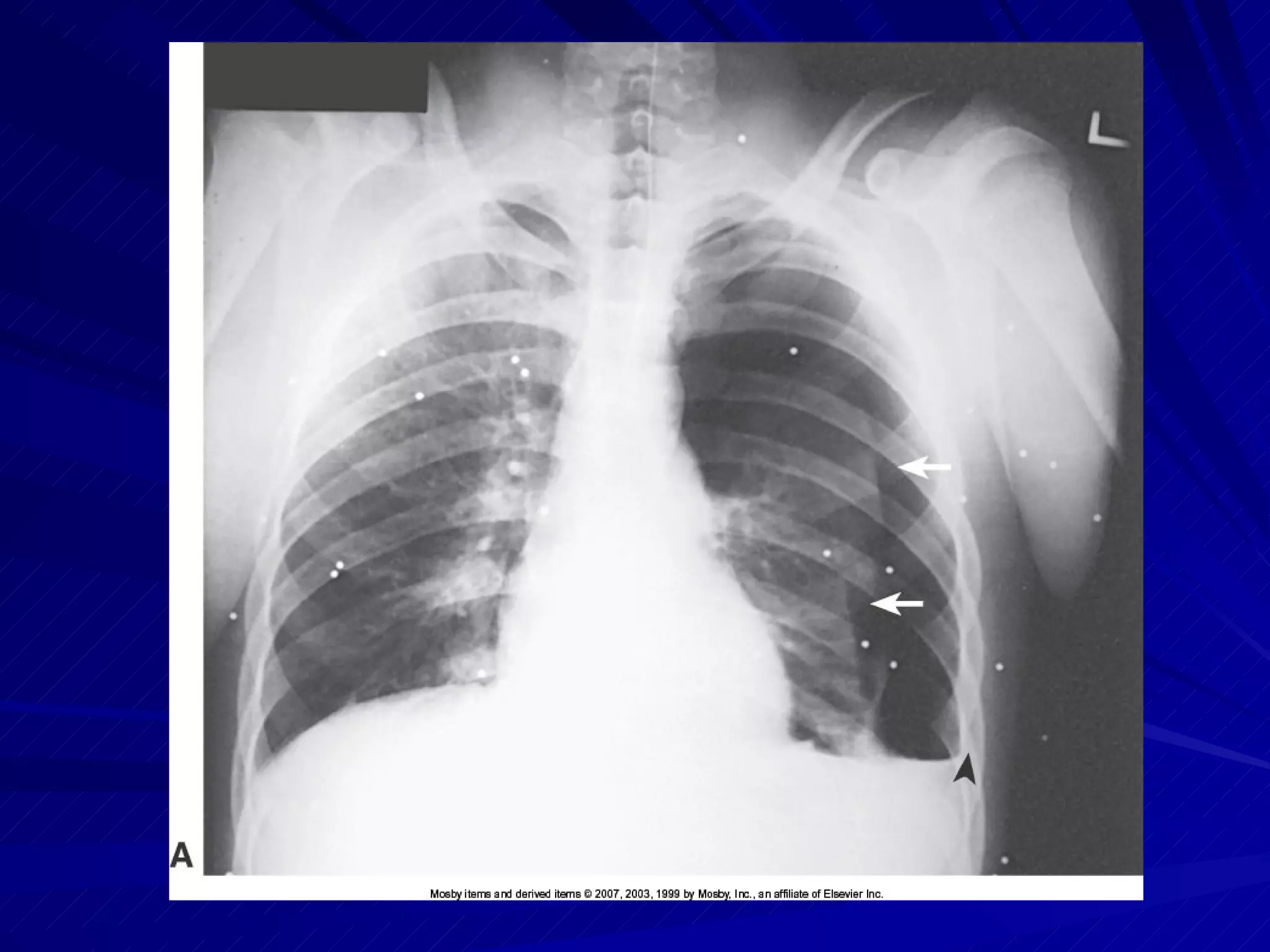
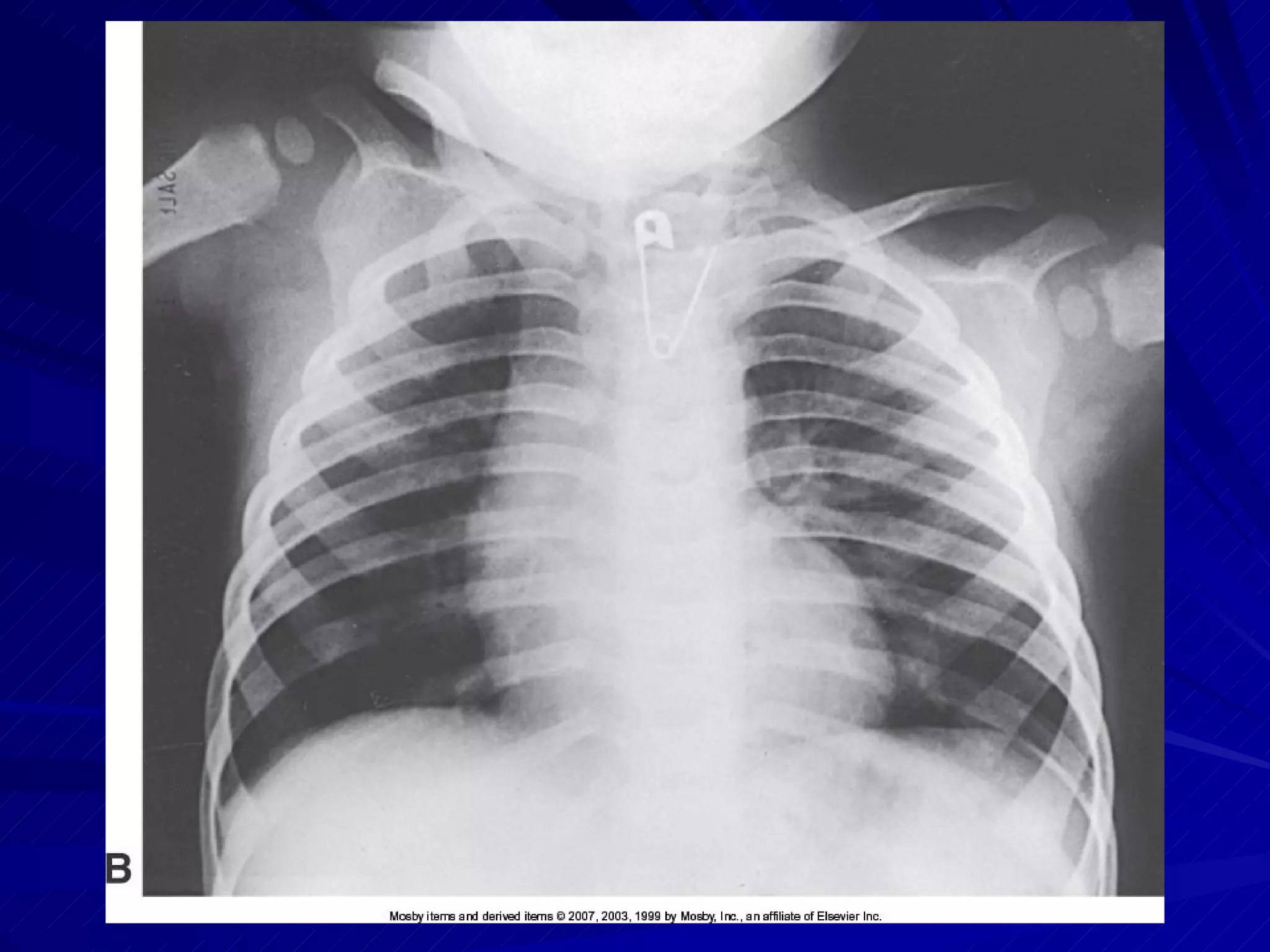
Chest Supine position used if general survey image of chest desired Check for need to demonstrate air-fluid levels If air-fluid levels are suspected, use X-table lateral If patient’s condition permits, lateral decubitus position with patient lying on affected side will also show air-fluid levels
Trauma AP Chest Obtain help to lift patient for IR placement Top of IR placed about 1.5   to 2   above shoulders Arms abducted MCP parallel to IR Use maximum SID to reduce heart magnification
Trauma AP Chest Ensure chin extended out of anatomy of interest CR directed perpendicular to center of IR look for light field slightly above shoulders and on sides of chest, CW or LW Exposure made upon second full inhalation, if possible
 
Trauma AP Chest Image demonstrates lung fields in their entirety Minimal rotation and distortion present
 
 
Abdomen If transfer to x-ray table is not possible, obtain lift help for IR placement IR centered to MSP at level of iliac crests Check for possibility of fluid accumulation in abdominal cavity Affects exposure factors Requires close monitoring of patient for status change during procedures
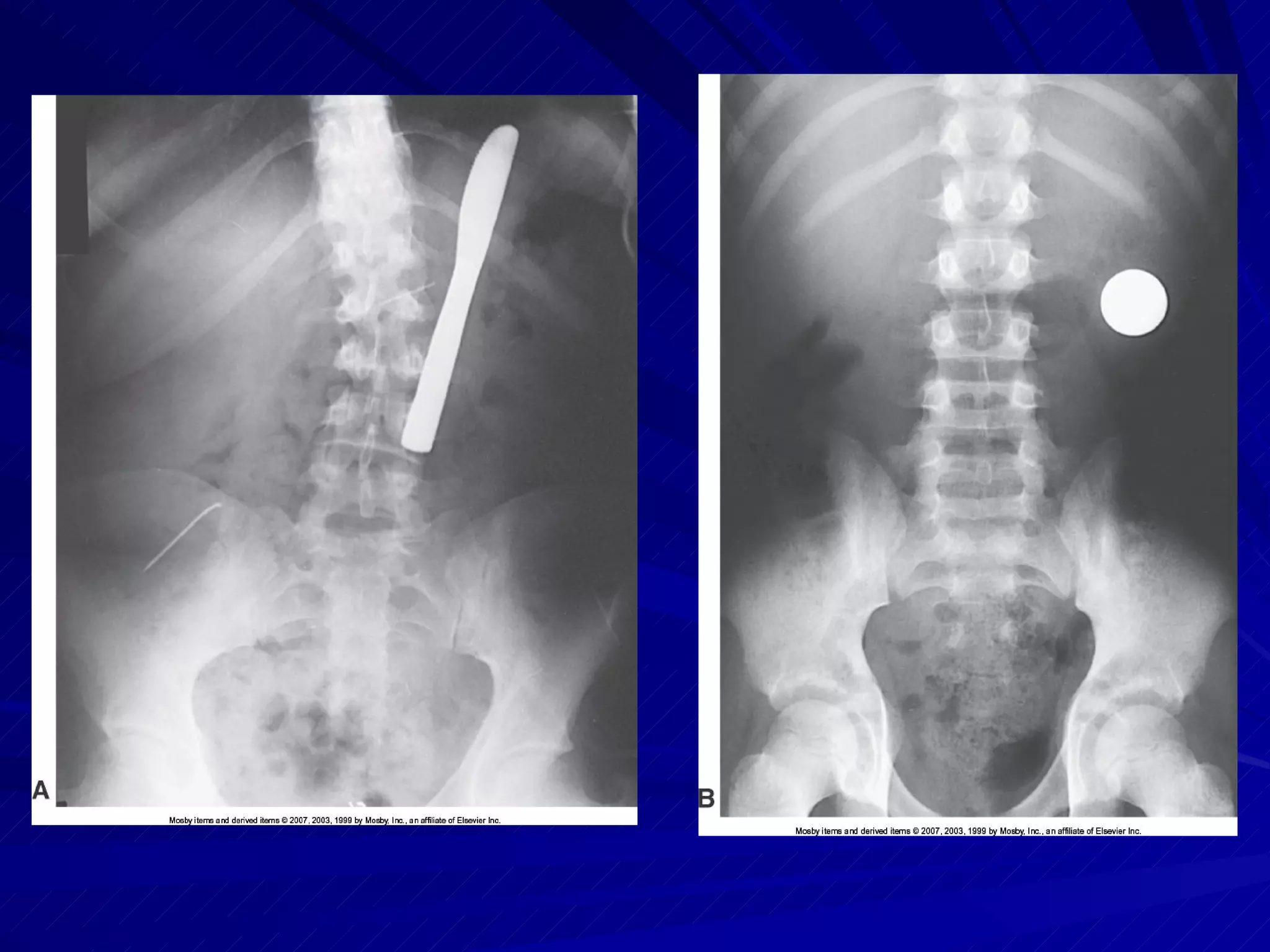
Abdomen Mark entrance and exit wounds, if present Align shoulders and hips in same plane MCP parallel to table CR perpendicular to center of IR Image demonstrates entire abdomen with pubic symphysis visible at lower border
 
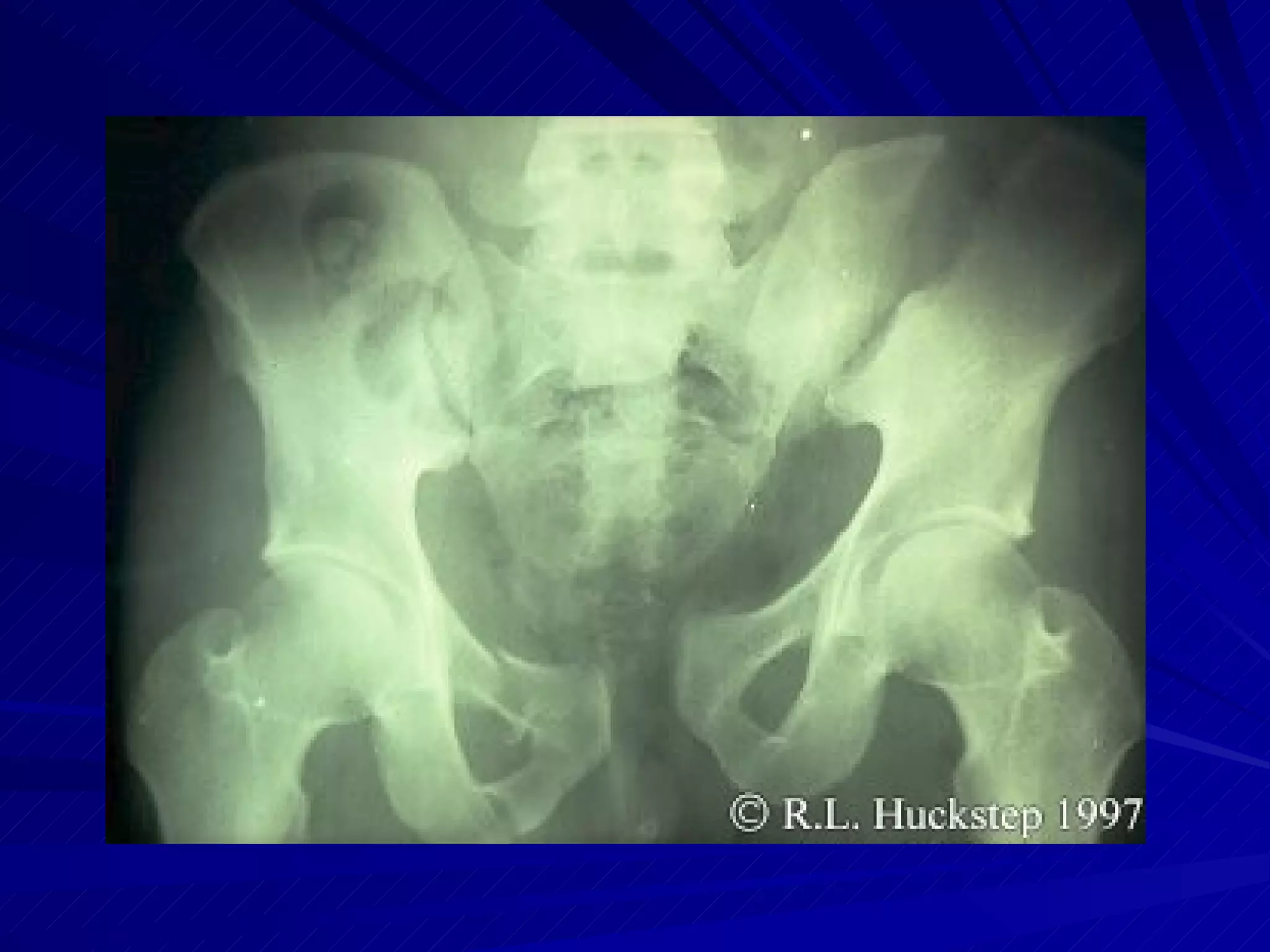
Pelvis Pelvic fractures have a high risk of hemorrhage – pay close attention to patient for status change Obtain lift help for IR placement if transfer to x-ray table is not possible IR centered 2   above pubic symphysis or 2   below ASIS  MCP parallel to IR
Pelvis Lower limbs internally rotated only if possible Ensure arms are not in anatomy of interest CR perpendicular to center of IR Exposure made on suspended respiration Image demonstrates entire pelvis and proximal femora
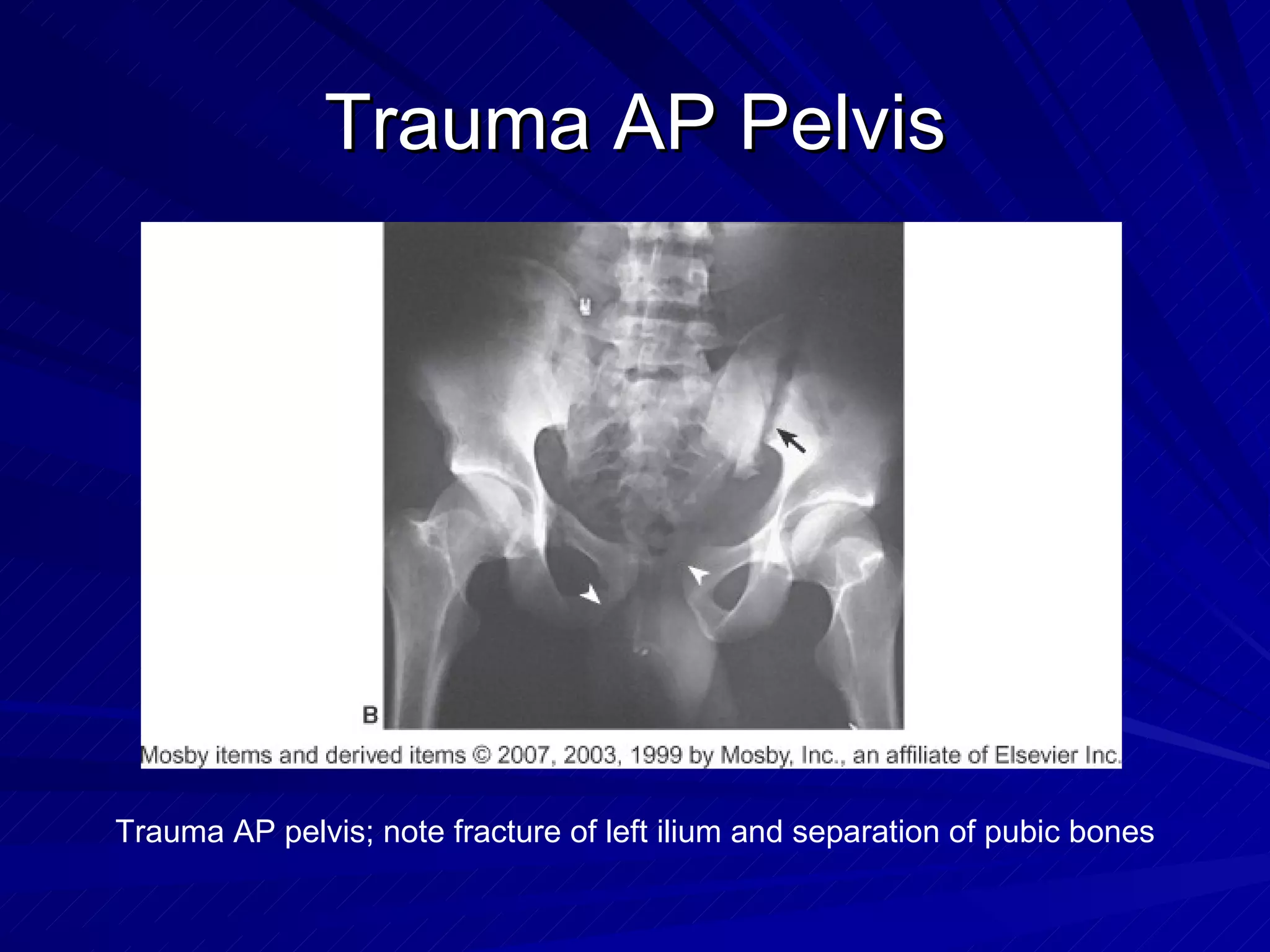
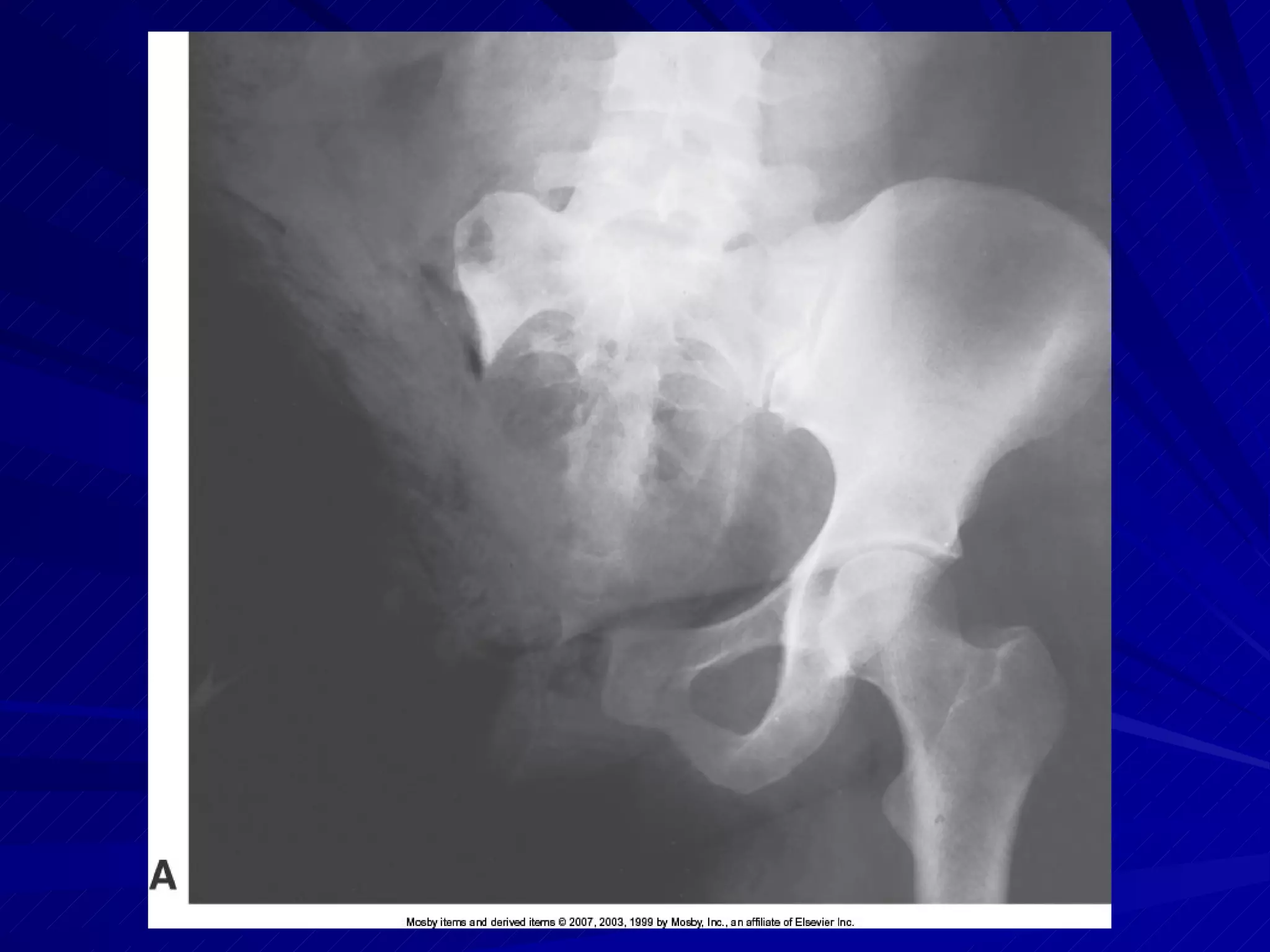
Trauma AP Pelvis Trauma AP pelvis; note fracture of left ilium and separation of pubic bones
 
Cranium Patients with head trauma are often referred to CT first When x-rays are ordered, a general survey requires AP and lateral projections Generally, the patient is supine Lateral projection uses dorsal decubitus position
Trauma Lateral Cranium Elevate head on radiolucent support Ensure C-spine injury has been ruled out
Trauma Lateral Cranium Trauma lateral projection of cranium; note multiple fractures in frontal bone
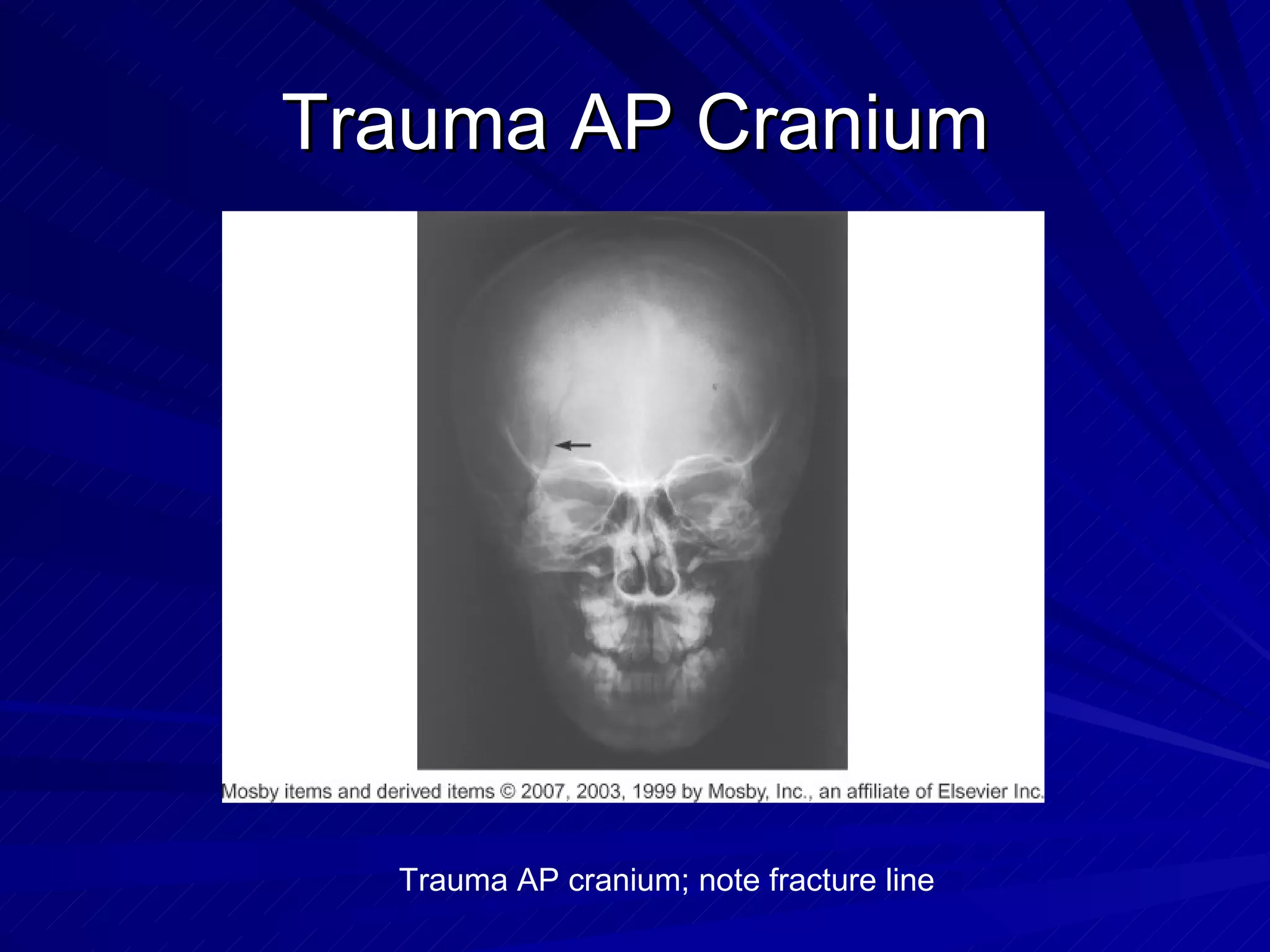
Trauma AP Cranium  Check with physician to determine anatomy of interest AP projection demonstrates anterior cranium AP axial projection (Towne) demonstrates posterior cranium
Trauma Cranium Patient and IR positioned for trauma AP cranium Patient and IR positioned for trauma AP axial cranium
Trauma AP Cranium Trauma AP cranium; note fracture line
Facial Bones Patients with facial bone injuries are often referred to CT first Anticipate profuse bleeding and use universal precautions
 
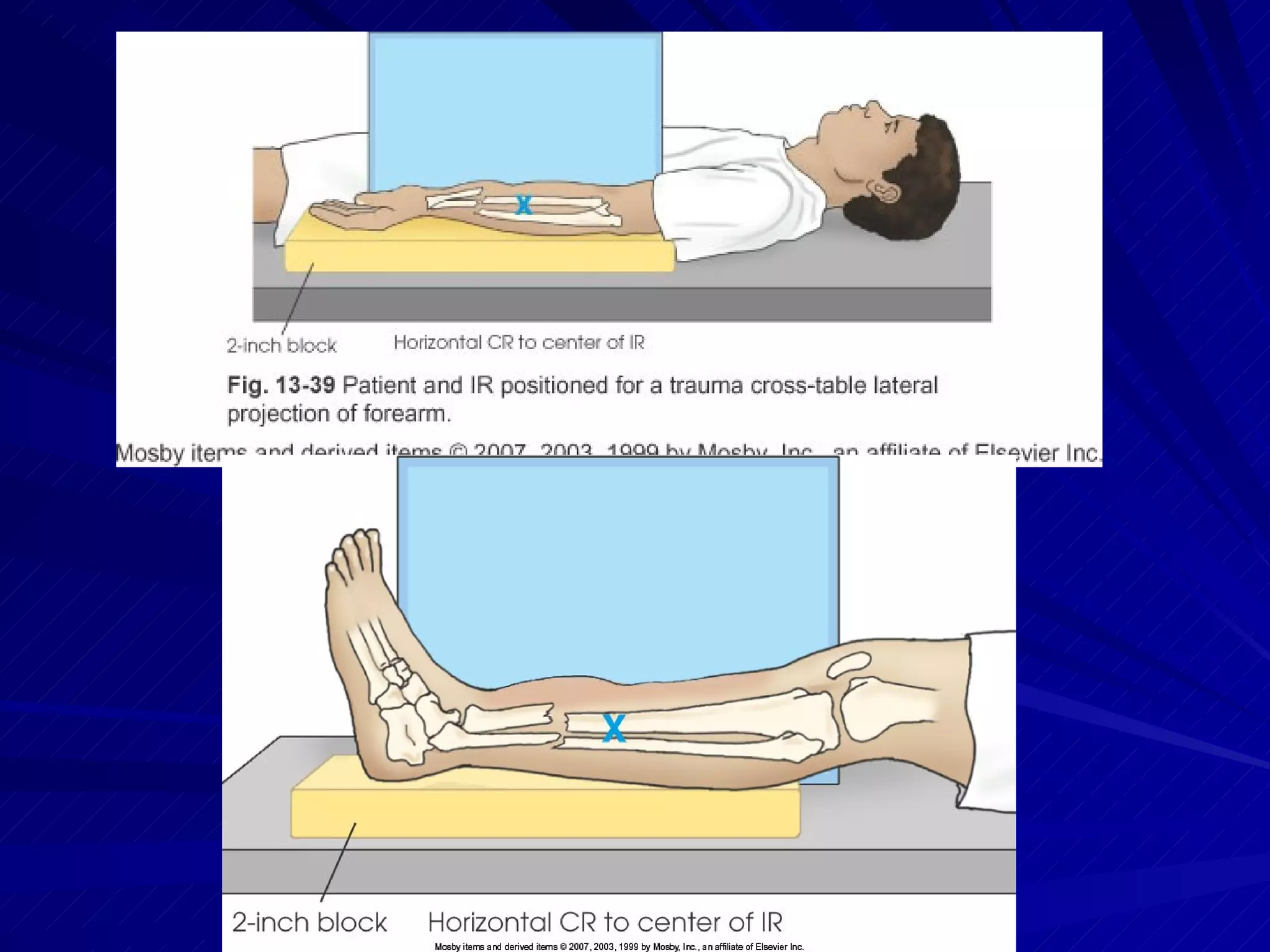
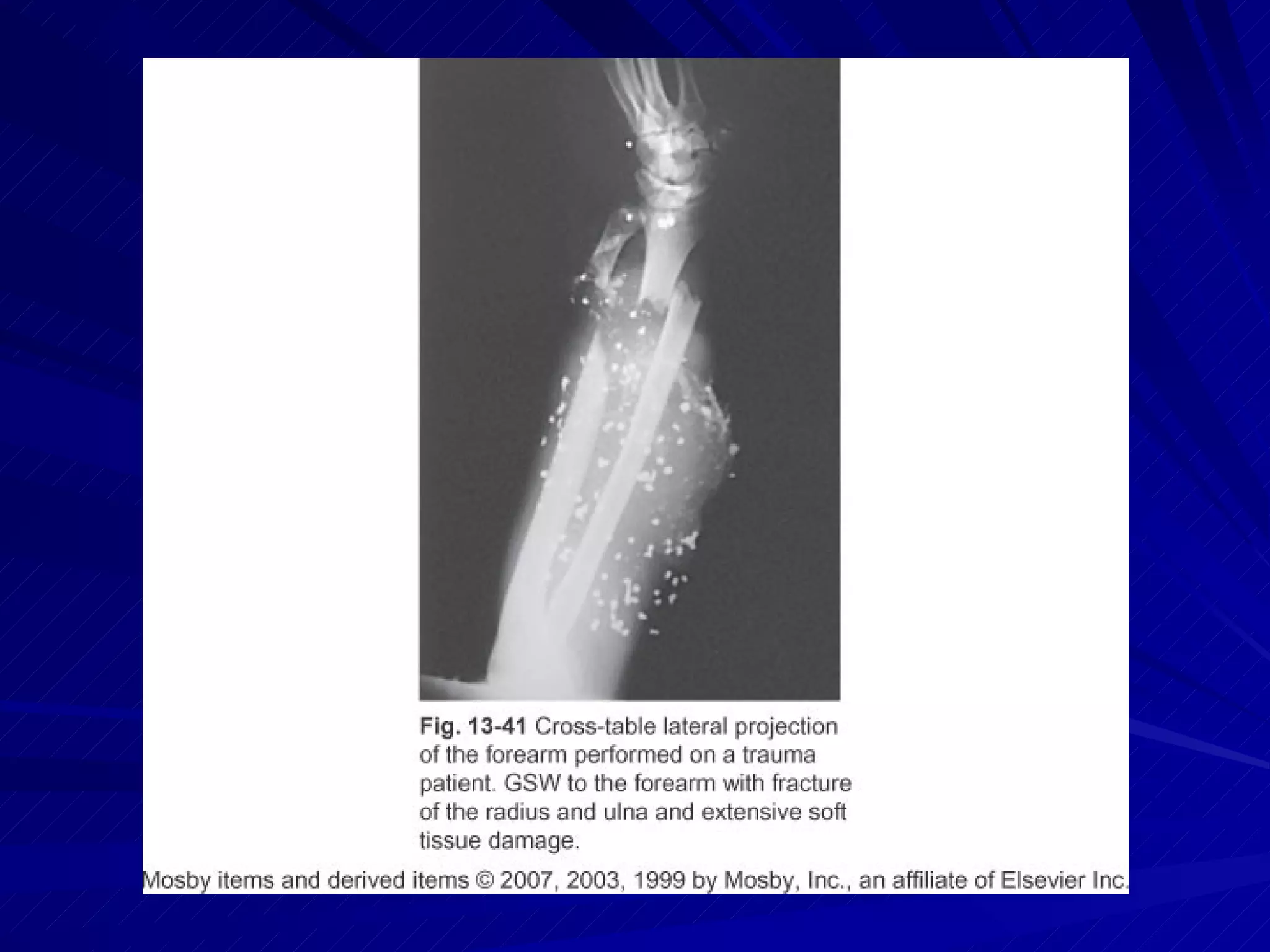
Upper and Lower Limbs Obtain lift help for IR placement Injured limbs should be lifted with support at   both joints Lift only enough to place IR Two projections at 90 degrees from each other required Do not attempt to rotate severely injured limbs for true positions
 
 
Upper and Lower Limbs Long bones require demonstration of adjacent joints Take separate projections, if necessary Maximize patient safety and comfort by moving IR and CR, rather than injured limb


Other Imaging Procedures in Trauma Slide
Other Imaging in Trauma CT is extensively used in trauma patients Often, CT is modality of choice Angiography may be used for vascular injuries Contrast studies are often ordered for evaluation of urinary system  Blunt abdominal trauma and suspected pelvic fractures often result in injury to urinary system
 
Time for the “good stuff”!


Trauma Radiography

  • 1.
    Chapter 13 TraumaRadiography Heather Johnson, A.S., R.T. (R)
  • 2.
    Trauma Centers Manytypes of facilities provide emergency medical care, ranging from major metropolitan medical center to small outpatient clinics in rural areas. The term “Trauma Center” signifies a specific level of emergency medical care as defined by the American College of Surgeons Commission on Trauma.
  • 3.
    Trauma Levels LevelI = is the most comprehensive, usually a university-based center, research facility, or large medical center, complete imaging capabilities 24 hours a day, specialty physicians are available on site 24 hours a day
  • 4.
  • 5.
    Trauma Levels LevelII = same as level one, but not a research facility, may not have as many specialists Level III = no specialists, can stabilize patient for transport to a higher level center, may not have 24 hour imaging Level IV = clinics, attend minor injuries, some stabilization before transfer
  • 6.
    Introduction Trauma isdefined as a sudden, unexpected, dramatic, forceful, or violent event Blunt, penetrating, explosive, and thermal forces are common causes of traumatic injuries
  • 7.
  • 8.
  • 9.
    Introduction Trauma affectspersons in all age ranges Radiographers in the emergency department (ED) must be prepared for a variety of procedures on patients in all age groups
  • 10.
  • 11.
    Preliminary Considerations Specializedtrauma imaging systems reduce the amount of time required to obtain diagnostic images One type provides greater flexibility in IR/CR maneuverability Another type scans the entire body in a few seconds
  • 12.
  • 13.
  • 14.
  • 15.
  • 16.
    Mobile radiography isoften used for ED procedures
  • 17.
    Preliminary Considerations Mobilefluoroscopy units, or C-arms, may be used in fracture reduction or foreign body localizations Immobilization devices are a necessity in trauma imaging Trauma patients often cannot hold the required position
  • 18.
    Radiographer’s Role inTrauma Depends upon department protocol and staffing Primary responsibilities Perform quality diagnostic imaging procedures Practice ethical radiation protection Provide patient care
  • 19.
    Radiographer’s Role inTrauma Patient level of consciousness changes are common in trauma
  • 20.
    “ Best Practices”in Trauma Radiography Speed Efficiency in producing quality images in the shortest possible time Accuracy Optimum image quality, minimum repeats Quality Quality cannot be sacrificed for speed Do not use patient condition as an excuse for poor quality images
  • 21.
    “ Best Practices”in Trauma Radiography Positioning Important not to aggravate patient’s condition when obtaining images Move tube and IR, instead of patient, whenever possible Practice standard precautions Expect to be exposed to body fluids in ED Do not touch a patient without gloves!
  • 22.
    Disclaimer: The followingthree slides are gruesome.
  • 23.
  • 24.
  • 25.
  • 26.
    “ Best Practices”in Trauma Radiography Anticipation Some injuries require follow-up procedures; knowing what to do increases appreciation for radiographer’s role in ED
  • 27.
    “ Best Practices”in Trauma Radiography Attention to detail Pay careful attention to patient’s condition, which could change at any time Attention to ED protocol and scope of practice Know the protocol and scope of practice in your facility Professionalism Adhere to Code of Ethics
  • 28.
  • 29.
  • 30.
    General Procedural GuidelinesPatient preparation IR size SID ID markers Radiation protection Patient instructions Immobilization Documentation Image critique
  • 31.
    Patient Preparation Usegood communication skills with appropriate touch and eye contact Trauma often causes anxiety Check patient for potential artifacts Explain what you are removing and why Secure all personal effects using proper procedure for your facility
  • 32.
    IR Size IRsize for trauma procedures are the same as for routine procedures Use smallest IR that will demonstrate anatomy Collimate field size to anatomy of interest
  • 33.
    SID SID isstandardized as a part of procedural protocol When SID is not specified under a projection, 40 to 48  60 to 72  SID recommended for projections with increased OID
  • 34.
    ID Markers Rightor left side markers must be included on each image Other required ID markers must be in the blocker or elsewhere on the final image Markers used for penetrating trauma to identify entrance and exit wounds
  • 35.
  • 36.
  • 37.
    Radiation Protection Shieldpediatric patients and patients of reproductive age Warn other staff of exposure when performing mobile imaging Other radiation protection measures Close collimation Optimum technique factors
  • 38.
    Patient Instructions Explainand demonstrate positions, when possible Explain respiration instructions for patients who can cooperate Use short exposure times to eliminate possibility of imaging motion
  • 39.
    Immobilization Many EDpatients arrive in some sort of immobilization device Immobilization devices are not to be removed unless ordered by a physician Imaging procedures are often performed without removal of the immobilization Images are used to rule out injury and show if it is safe to remove immobilization
  • 40.
  • 41.
  • 42.
    Documentation Because deviationor adjustment of routine procedures is often required to accommodate a patient’s injury, documentation is important Make sure that deviation from routine is still within your scope of practice! Document deviation (AP, X-table, etc.), time, portable
  • 43.
    Image Critique CriteriaImage evaluation for trauma procedures is the same as for routine procedures Image quality is critical for an accurate diagnosis It is poor practice to accept lower quality images due to patient condition or difficulty of procedure
  • 44.
  • 45.
    Lateral Cervical SpineHorizontal CR centered to midpoint of IR Pre-vertebral soft tissue must be visualized Image should demonstrate entire C-spine from sella turcica to top of T1 If all seven cervical vertebrae are not seen, then a swimmer’s view is required
  • 46.
    Lateral Cervical SpinePatient and IR centered for trauma lateral of C-spine
  • 47.
    Lateral Cervical SpineLateral projection of C-spine in dorsal decubitus position; dislocation of C3-C4; C7 not demonstrated, so swimmer’s view is needed
  • 48.
    Swimmer’s (cervicothoracic) Requiredif C7 and top of T1 not demonstrated on lateral C-spine Trauma usually requires dorsal decubitus position Patient supine without rotation Ask patient to raise arm opposite the x-ray tube over head Assist patient and provide support
  • 49.
    Cervicothoracic Spine Relaxshoulder closer to x-ray tube Vertical IR centered just above jugular notch Horizontal CR centered to C7-T1 interspace and midcoronal plane Use breathing technique if possible Blur ribs and lung markings to better demonstrate spine
  • 50.
    Cervicothoracic Spine Imagedemonstrates lower cervical and upper thoracic vertebrae in profile between the shoulders
  • 51.
    Cervicothoracic Spine Patientand IR positioned for trauma lateral projection of cervicothoracic vertebrae using dorsal decubitus position
  • 52.
    Cervicothoracic Spine Lateralprojection, dorsal decubitus position of cervicothoracic vertebrae
  • 53.
    AP Axial CervicalSpine Patient is supine Usually immobilized with collar and spine board Place IR under spine board, if present, centered to C4 (Adam’s apple) Head and shoulders without rotation Ask patient to look straight ahead
  • 54.
    AP Axial CervicalSpine CR directed 15 to 20 degrees cephalad to enter MSP at C4 Image demonstrates C3-T1 or T2, including all soft tissues If backboard is present, unavoidable artifacts may be seen
  • 55.
    AP Axial CervicalSpine Patient and IR positioned for trauma AP axial C-spine
  • 56.
    AP Axial CervicalSpine Trauma AP axial C-spine; complete dislocation at C2-C3
  • 57.
    AP Axial ObliqueCervical Spine TRAUMA OBLIQUES Patient is supine Usually immobilized with collar and spine board Place IR under spine board (not bucky), if present, centered to C4 and adjacent mastoid process About 3  lateral to MSP
  • 58.
    AP Axial ObliqueCervical Spine Head and shoulders without rotation Ask patient to look straight ahead CR has double angle 45 degrees lateromedially 15 to 20 degrees cephalic CR enters lateral to MSP at level of C4
  • 59.
    AP Axial ObliqueCervical Spine CR exit should be in center of IR Image demonstrates side opposite CR C1-T1 or T2 bodies and disk spaces Intervertebral foramina open If backboard is present, unavoidable artifacts may be seen
  • 60.
    AP Axial ObliqueCervical Spine Patient and IR positioned for trauma AP axial oblique C-spine
  • 61.
    AP Axial ObliqueCervical Spine Trauma AP axial oblique C-spine
  • 62.
    Thoracic and LumbarSpine X-table laterals performed first Vertical grid and IR Top of IR 1.5  to 2  (3.8 to 5 cm) above shoulders for thoracic spine Centered to level of iliac crests for lumbar spine Have patient cross arms on anterior chest
  • 63.
    Thoracic and LumbarSpine CR horizontal Centered to spine and IR Breathing technique improves visualization of thoracic vertebrae Exposure made on suspended respiration for lumbar vertebrae
  • 64.
    Thoracic and LumbarSpine Thoracic image demonstrates T3 or T4 to L1 Lumbar image demonstrates T12 to sacrum Vertebral bodies and spinous processes in profile
  • 65.
    Trauma Lateral LumbarSpine CR and IR positioned for trauma lateral projection of lumbar spine using dorsal decubitus position
  • 66.
    Trauma Lateral LumbarSpine Lateral projection of thoracolumbar spine, dorsal decubitus position; note fracture and dislocation of L2 and spine board artifacts
  • 67.
    Chest Supine positionused if general survey image of chest desired Check for need to demonstrate air-fluid levels If air-fluid levels are suspected, use X-table lateral If patient’s condition permits, lateral decubitus position with patient lying on affected side will also show air-fluid levels
  • 68.
    Trauma AP ChestObtain help to lift patient for IR placement Top of IR placed about 1.5  to 2  above shoulders Arms abducted MCP parallel to IR Use maximum SID to reduce heart magnification
  • 69.
    Trauma AP ChestEnsure chin extended out of anatomy of interest CR directed perpendicular to center of IR look for light field slightly above shoulders and on sides of chest, CW or LW Exposure made upon second full inhalation, if possible
  • 70.
  • 71.
    Trauma AP ChestImage demonstrates lung fields in their entirety Minimal rotation and distortion present
  • 72.
  • 73.
  • 74.
    Abdomen If transferto x-ray table is not possible, obtain lift help for IR placement IR centered to MSP at level of iliac crests Check for possibility of fluid accumulation in abdominal cavity Affects exposure factors Requires close monitoring of patient for status change during procedures
  • 75.
    Abdomen Mark entranceand exit wounds, if present Align shoulders and hips in same plane MCP parallel to table CR perpendicular to center of IR Image demonstrates entire abdomen with pubic symphysis visible at lower border
  • 76.
  • 77.
    Pelvis Pelvic fractureshave a high risk of hemorrhage – pay close attention to patient for status change Obtain lift help for IR placement if transfer to x-ray table is not possible IR centered 2  above pubic symphysis or 2  below ASIS MCP parallel to IR
  • 78.
    Pelvis Lower limbsinternally rotated only if possible Ensure arms are not in anatomy of interest CR perpendicular to center of IR Exposure made on suspended respiration Image demonstrates entire pelvis and proximal femora
  • 79.
    Trauma AP PelvisTrauma AP pelvis; note fracture of left ilium and separation of pubic bones
  • 80.
  • 81.
    Cranium Patients withhead trauma are often referred to CT first When x-rays are ordered, a general survey requires AP and lateral projections Generally, the patient is supine Lateral projection uses dorsal decubitus position
  • 82.
    Trauma Lateral CraniumElevate head on radiolucent support Ensure C-spine injury has been ruled out
  • 83.
    Trauma Lateral CraniumTrauma lateral projection of cranium; note multiple fractures in frontal bone
  • 84.
    Trauma AP Cranium Check with physician to determine anatomy of interest AP projection demonstrates anterior cranium AP axial projection (Towne) demonstrates posterior cranium
  • 85.
    Trauma Cranium Patientand IR positioned for trauma AP cranium Patient and IR positioned for trauma AP axial cranium
  • 86.
    Trauma AP CraniumTrauma AP cranium; note fracture line
  • 87.
    Facial Bones Patientswith facial bone injuries are often referred to CT first Anticipate profuse bleeding and use universal precautions
  • 88.
  • 89.
    Upper and LowerLimbs Obtain lift help for IR placement Injured limbs should be lifted with support at both joints Lift only enough to place IR Two projections at 90 degrees from each other required Do not attempt to rotate severely injured limbs for true positions
  • 90.
  • 91.
  • 92.
    Upper and LowerLimbs Long bones require demonstration of adjacent joints Take separate projections, if necessary Maximize patient safety and comfort by moving IR and CR, rather than injured limb
  • 93.
  • 94.
  • 95.
  • 96.
    Other Imaging Proceduresin Trauma Slide
  • 97.
    Other Imaging inTrauma CT is extensively used in trauma patients Often, CT is modality of choice Angiography may be used for vascular injuries Contrast studies are often ordered for evaluation of urinary system Blunt abdominal trauma and suspected pelvic fractures often result in injury to urinary system
  • 98.
  • 99.
    Time for the“good stuff”!
  • 100.
  • 101.
  • 102.
  • 103.
  • 104.
  • 105.
  • 106.