Reflexes
• Reflex -Rapid, involuntary Motor Response to
Stimulus
• Reflexes may:
– Inborn (Intrinsic) or Learned (Acquired)
– Involve only Peripheral Nerves & Spinal Cord
– Involve Higher Brain Centers as Well
3.
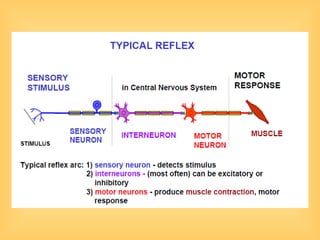
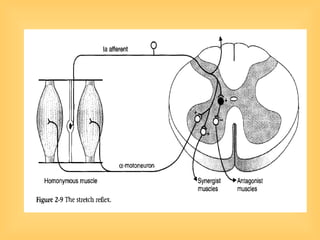
Reflex Arc
• 5Components of Reflex Arc
– Receptor – Site of Stimulus
– Sensory Neuron – Transmits Afferent Impulse to
CNS
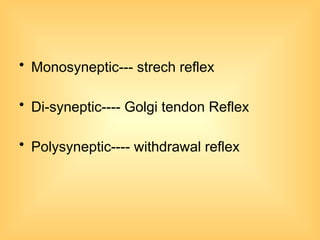
– Integration Center – Monosynaptic or Polysynaptic
Region within CNS
– Motor Neuron – Conducts Efferent Impulses from
Integration Center to Effector
– Effector – Muscle Fiber or Gland that Responds to
Efferent Impulse
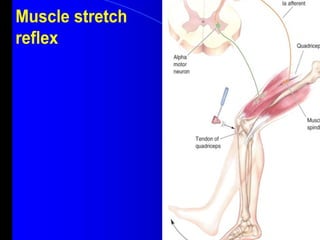
Stretch & DeepTendon Reflexes
• For Skeletal Muscles to Perform Normally:
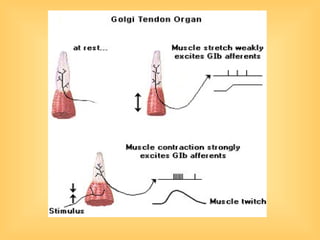
– Golgi Tendon Organs (Proprioceptors)
• Constantly Inform Brain as to State of Muscle
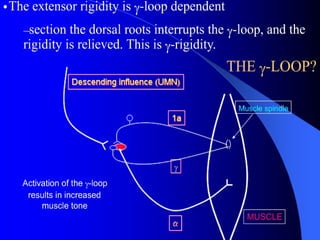
– Muscle Spindles
• Stretch Reflexes
• Maintain Healthy Muscle Tone
19.
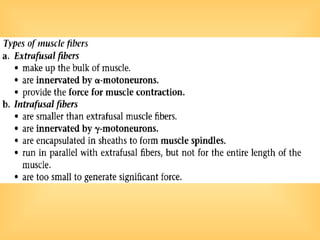
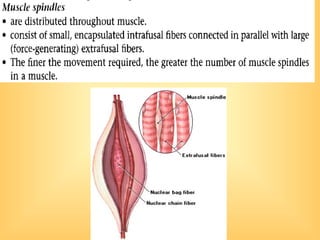
Muscle Spindles
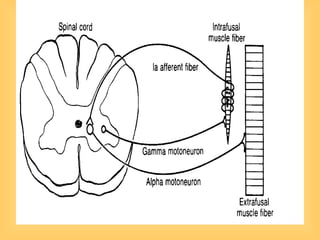
• Composedof 3-10 Intrafusal Muscle Fibers
– Lack Myofilaments in Central Regions
– Non-Contractile
– Receptive Surfaces
• Muscle Spindles Wrapped with 2 Types of
Afferent Endings
– Primary Sensory Endings of Type Ia Fibers
– Secondary Sensory Endings of Type II Fibers
– Innervated by γ Efferent Fibers
• Contractile Muscle Fibers
– Extrafusal Fibers
• Innervated by α Efferent Fibers
Operation of MuscleSpindles
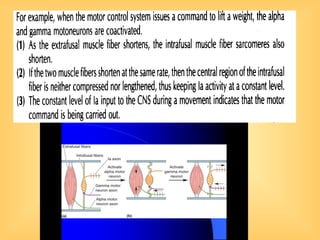
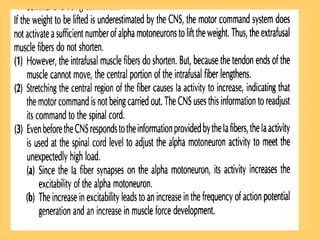
• Stretching Muscles
– Activates Muscle Spindle
– ↑ Rate of Action Potential in Ia Fibers
– Contracting Muscle ↓ Tension on Muscle Spindle
– ↓ Rate of Action Potential on I Fibers
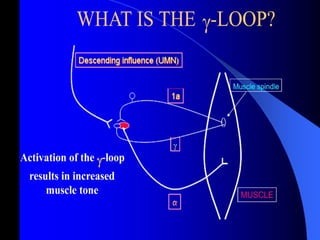
Muscle Tone
• Muscletone is due both to the viscoelastic
properties of the muscles and joints and to
whatever degree of alpha motor neuron
activity exists
65.
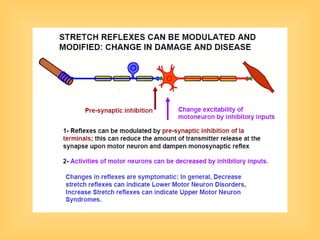
Abnormal Muscle Tone
•Abnormally high muscle tone, called
hypertonia,
• The increased resistance is due
• to a greater-than-normal level of alpha motor neuron
• activity, which keeps a muscle contracted despite the
• individual’s attempt to relax it. Hypertonia is usually
• found when there are disorders of the descending
• pathways that result in decreased inhibitory influence
• exerted by them on the motor neurons.
66.
upper motor neuron
disorders.
•Clinically, the descending pathways—primarily
• the corticospinal pathways—and neurons of the motor
• cortex are often referred to as the “upper motor
• neurons” (a confusing misnomer because they are not
• really motor neurons at all). Abnormalities due to their
• dysfunction are classed, therefore, as upper motor
neuron
• disorders.
67.
• Thus, hypertoniaindicates an upper motor
• neuron disorder.
• Spasticity is a form of hypertonia in which
the muscles do not develop increased tone
until they are stretched a bit, and after a brief
increase in tone, the contraction subsides for
a short time.
• Rigidity is a form of hypertonia
• in which the increased muscle contraction is
• continual and the resistance to passive
stretch is constant.
69.
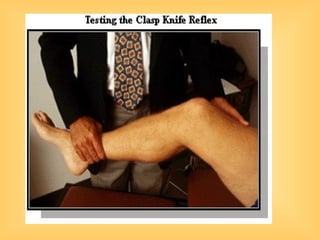
• When themuscles are hypertonic, the sequence of
moderate stretch muscle contraction, strong stretch
muscle relaxation is clearly seen. Passive flexion of
the elbow, for example, meets immediate resistance
as a result of the stretch reflex in the triceps muscle.
Further stretch activates the inverse stretch reflex.
The resistance to flexion suddenly collapses, and the
arm flexes. Continued passive flexion stretches the
muscle again, and the sequence may be repeated.
This sequence of resistance followed by give when a
limb is moved passively is known as the clasp-knife
effect because of its resemblance to the closing of a
pocket knife. It is also known as the lengthening
reaction because it is the response of a spastic
muscle to lengthening.
70.
Hypotonia
• Hypotonia isa condition of
abnormally low muscle tone,
accompanied by weakness, atrophy (a
decrease in muscle bulk), and
decreased or absent reflex responses.
• It more frequently accompanies
disorders of the alpha motor neurons
(“lower motor neurons”), neuromuscular
junctions, or the muscles themselves.
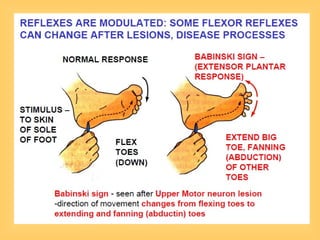
Flexor & CrossedExtensor Reflexes
• Flexor Reflex Initiated by Painful Stimulus
(Actual or Perceived) → Automatic
Withdrawal of Threatened Body Part
• Crossed Extensor Reflex - 2 Parts
– Stimulated Side Withdrawn
– Contralateral Side Extended
General Properties ofReflexes
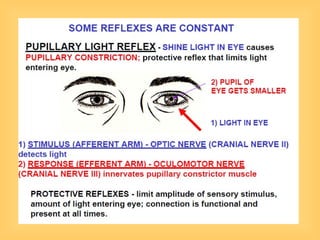
• Adequate Stimulus
• The stimulus that triggers a reflex is
generally very precise. This stimulus is
called the adequate stimulus for the
particular reflex
123.
• Final CommonPath
• The motor neurons that supply the
extrafusal fibers in skeletal muscles are
the efferent side of many reflex arcs. All
neural influences affecting muscular
contraction ultimately funnel through
them to the muscles, and they are
therefore called the final common
paths.
124.
• Central Excitatory& Inhibitory States
• the spinal cord also shows prolonged
changes in excitability, possibly
because of activity in reverberating
circuits or prolonged effects of synaptic
mediators.
• When the central excitatory state is
marked, excitatory impulses irradiate
not only to many somatic areas of the
spinal cord but also to autonomic areas.
125.
• In chronicallyparaplegic humans, for
example, a mild noxious stimulus may
cause, in addition to prolonged withdrawal-
extension patterns in all four limbs,
urination, defecation, sweating, and blood
pressure fluctuations (mass reflex).