Suresh Babu G
Motivation
Suresh Babu G
Assistant Professor
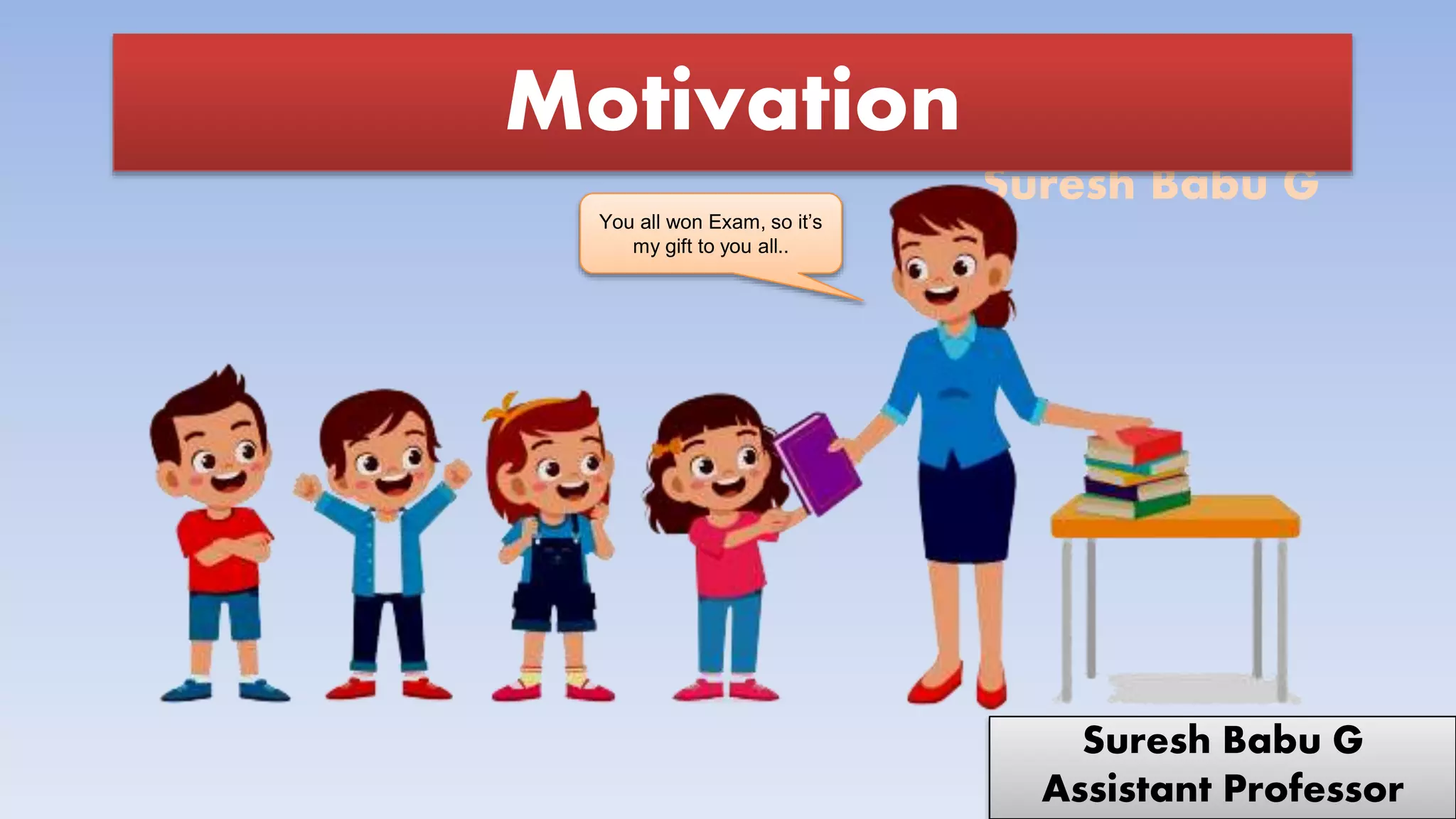
You all won Exam, so it’s
my gift to you all..
Suresh Babu G
Motivation
• The term motivation is originated from a Latin
word “motum” which means “to move”.
Motivation is the process of arousing or initiating
movement in the organism.
• Motivation is some thing which prompts, compels
and energizes an individual to act in a particular
manner at a particular time for attaining some
specific goal.
• It is a process of arousing, directing, maintaining
and controlling one’s interest in a particular
activity.
Suresh Babu G
Definitions of Motivation
• According to Mc Donald, motivation is an energy
change within the organism characterized by
affective arousal and anticipatory goal relations.
• Sorenson considers motivation as a psychological
and physiological condition that causes one to
expand effort to satisfy needs and wants.
• Lindsey defined motivation is a combination of
forces which initiate, direct and sustain behavior
towards a goal.
Suresh Babu G
Motive
• According to Fisher, a motive is an inclination or
impulsion to action plus some degree of orientation or
direction.
• Motive is something that incites an organism to
action, sustains it and gives direction.
• Motives are the springs of action.
• It is an inner state of mind or an aroused feeling
generated through basic needs or drives which compel
an individual to respond by creating a kind of tension
or urge to act.
Suresh Babu G
Significance of Motivation
• It energizes the leaner and thus it initiates
learning activity.
• Motives activate, direct and regulate the
behavior of the leaner.
• It controls the leaning behavior of the individual.
• It sustains activity when a goal is not
immediately available.
Suresh Babu G
• Motivation selects behavior.
• Motivation provides energy and accelerates the
behavior of the leaner.
• Motivation releases the tension and help in
satisfying the needs of the leaner.
Significance of Motivation
Suresh Babu G
Types of Motivation
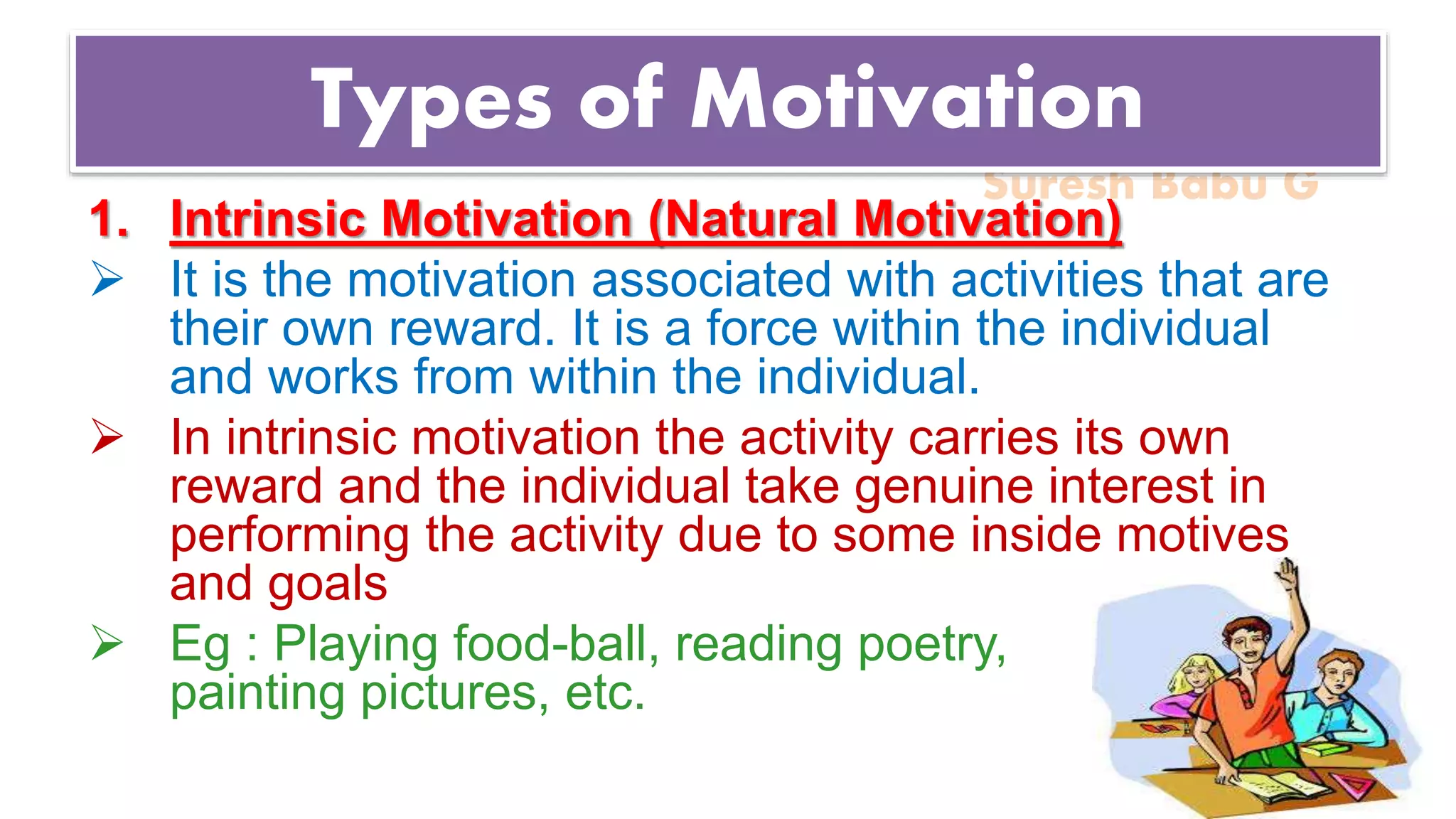
1. Intrinsic Motivation (Natural Motivation)
 It is the motivation associated with activities that are
their own reward. It is a force within the individual
and works from within the individual.
 In intrinsic motivation the activity carries its own
reward and the individual take genuine interest in
performing the activity due to some inside motives
and goals
 Eg : Playing food-ball, reading poetry,
painting pictures, etc.
Suresh Babu G
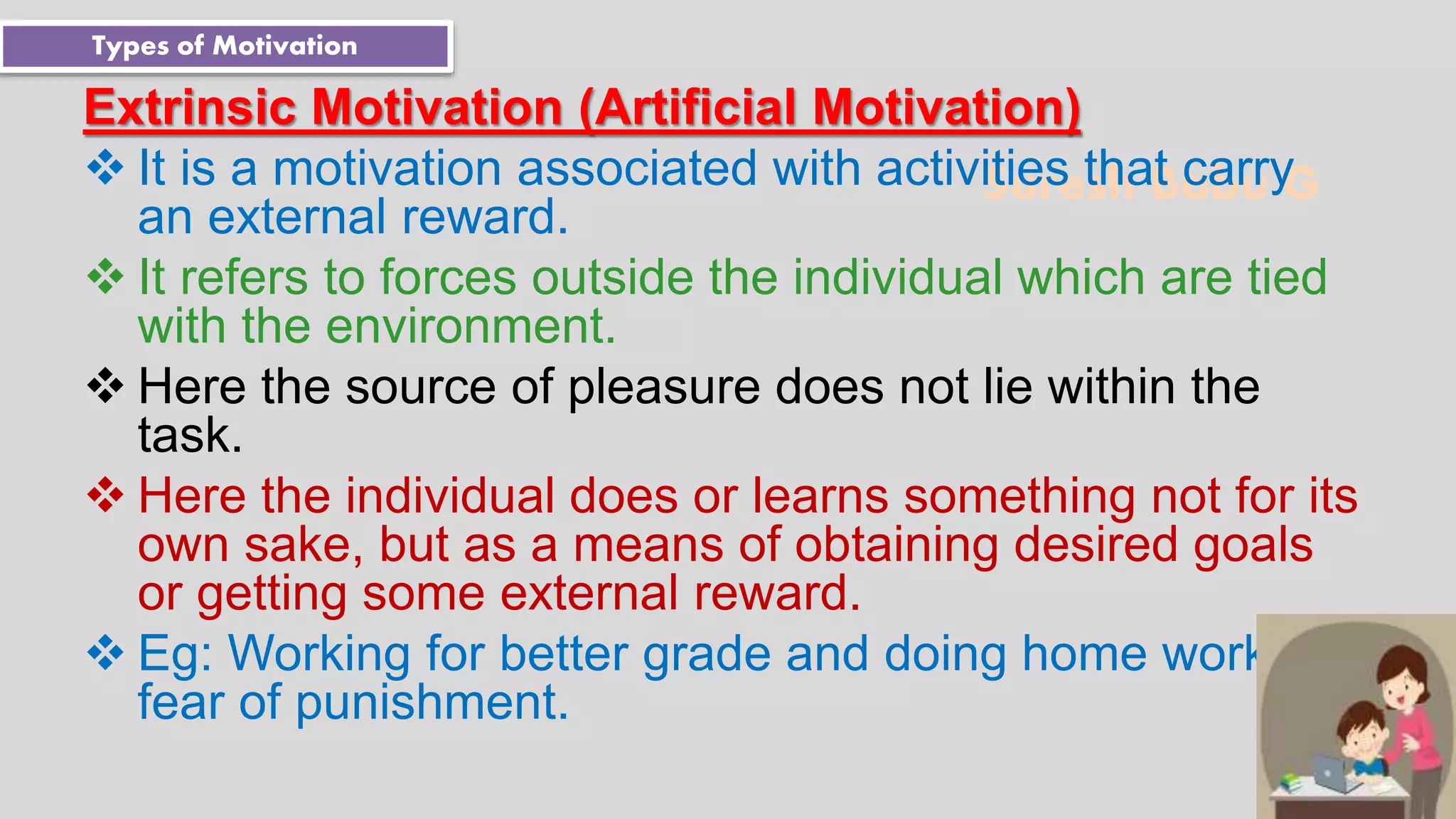
Extrinsic Motivation (Artificial Motivation)
 It is a motivation associated with activities that carry
an external reward.
 It refers to forces outside the individual which are tied
with the environment.
 Here the source of pleasure does not lie within the
task.
 Here the individual does or learns something not for its
own sake, but as a means of obtaining desired goals
or getting some external reward.
 Eg: Working for better grade and doing home work for
fear of punishment.
Types of Motivation
Suresh Babu G
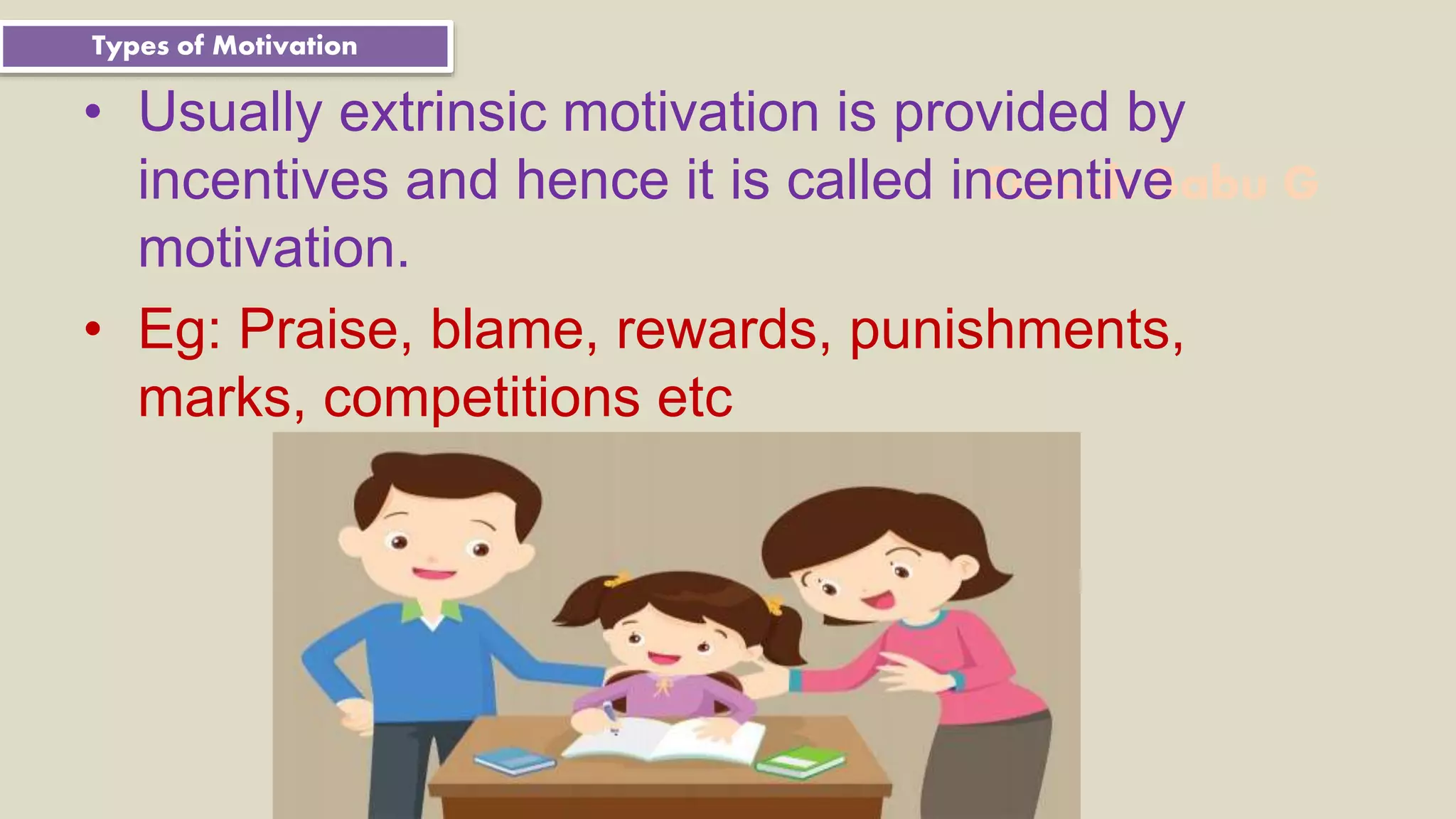
• Usually extrinsic motivation is provided by
incentives and hence it is called incentive
motivation.
• Eg: Praise, blame, rewards, punishments,
marks, competitions etc
Types of Motivation
Suresh Babu G
Achievement Motivation
• Achievement motivation is the desire to accomplish
difficult tasks and meet standards of excellence.
• It is one’s aspiration to do better, to achieve unique
accomplishment, to compete with a standard of
excellence, and to involve oneself with long term
achievement goals.
• According to Mc David, achievement motivation is a
system of goal direction in human activity that closely
related to competence, aggressiveness, dominance
and pursuit of excellence.
Suresh Babu G
Characteristics of Achievement Motivation
• It is manifested only when the individual perceives
performance as instrumental to a sense of personal
accomplishment.
• It is conditioned by one’s early training, experiences
and subsequent learning.
• It involves an exalted self-esteem and self-image
• It is a learned motive acquired in the process of
growing up and living in the society.
• It is the intense desire to perform with excellence for
its own sake.
Suresh Babu G
• It includes needs for success as well as need to
avoid failure.
• It is an outcome of social learning and
reinforcements which individual have
experienced.
Characteristics of Achievement Motivation
Suresh Babu G
Needs of Achievement Motivation
(Atkinson’s View)
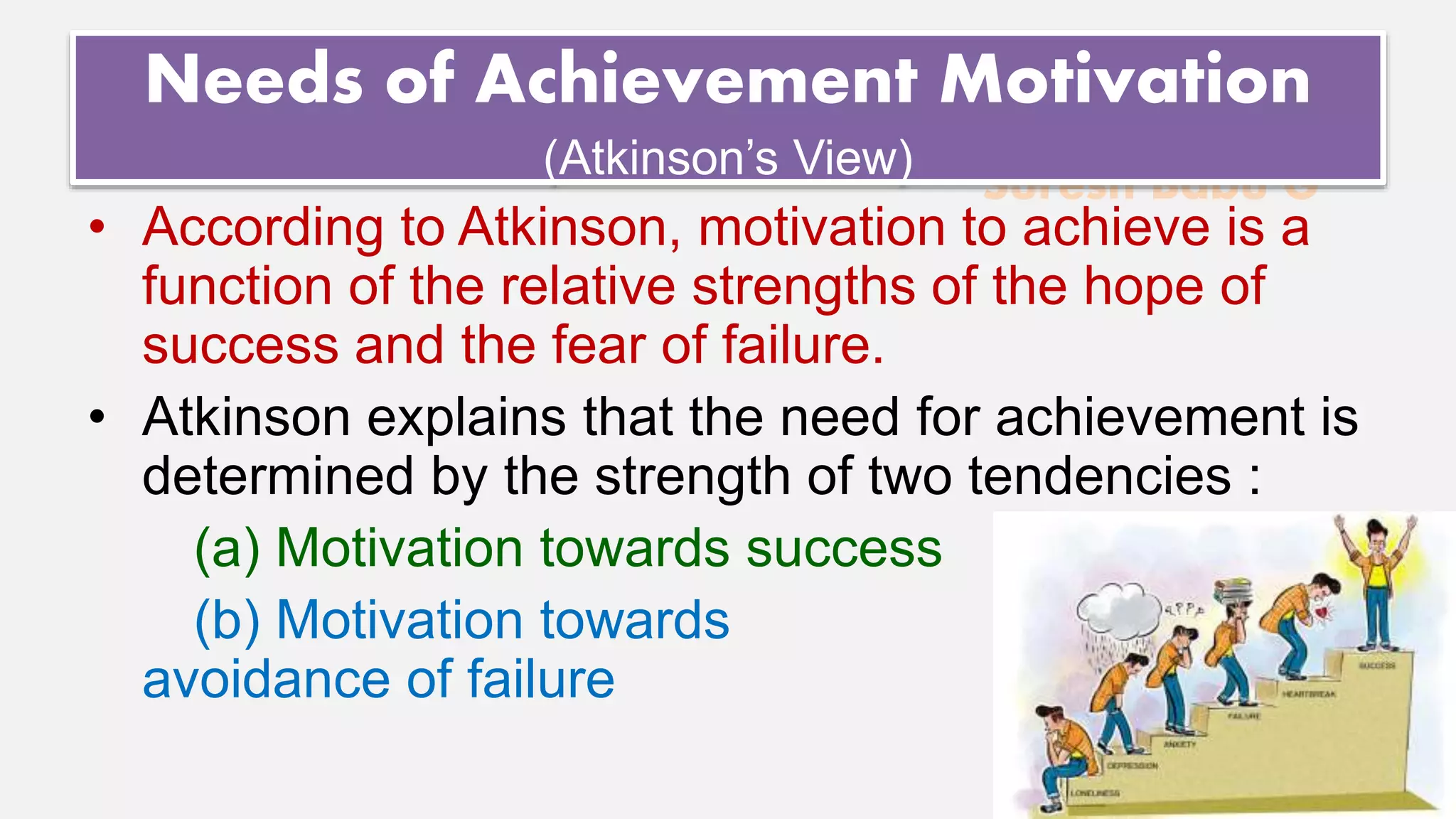
• According to Atkinson, motivation to achieve is a
function of the relative strengths of the hope of
success and the fear of failure.
• Atkinson explains that the need for achievement is
determined by the strength of two tendencies :
(a) Motivation towards success
(b) Motivation towards
avoidance of failure
Suresh Babu G
• Both of tendencies are influenced by the experiences
in early childhood, and parents attitude and are
composed of three factors : orientation(motive towards
success and avoidance of failure), expectation
(Subjective estimation for the chance of success or
failure) and value (incentive of success and failure).
• Atkinson developed a mathematical model for the
need of achievement motivation (n.Ach)
n.Ach = Ts – TAF
where Ts = approach tendency of subject
TAF = tendency to avoid failure
Needs of Achievement Motivation (Atkinson’s View)
Suresh Babu G
Strategies for Developing Motivation in Learners
The teacher should adopt the following techniques to
motivate pupils to learn:
• Adopt child centered approach
• Teaching should be based upon the previous
learning experience acquired by pupil
• Use progressive methods based on psychological
principles, AV-aids and direct experiences
• Develop clear perception of the goal
Suresh Babu G
• Teacher can use praise, reproof, rewards and
punishment for the achievement of goal
• Competition against one’s own past-record, ego-
involvement in learning etc
• Develop proper attitude
• Provide appropriate learning situation and
environment
• Ensure sublimation of innate impulses (curiosity,
construction etc)
Strategies for Developing Motivation in Learners
Suresh Babu G
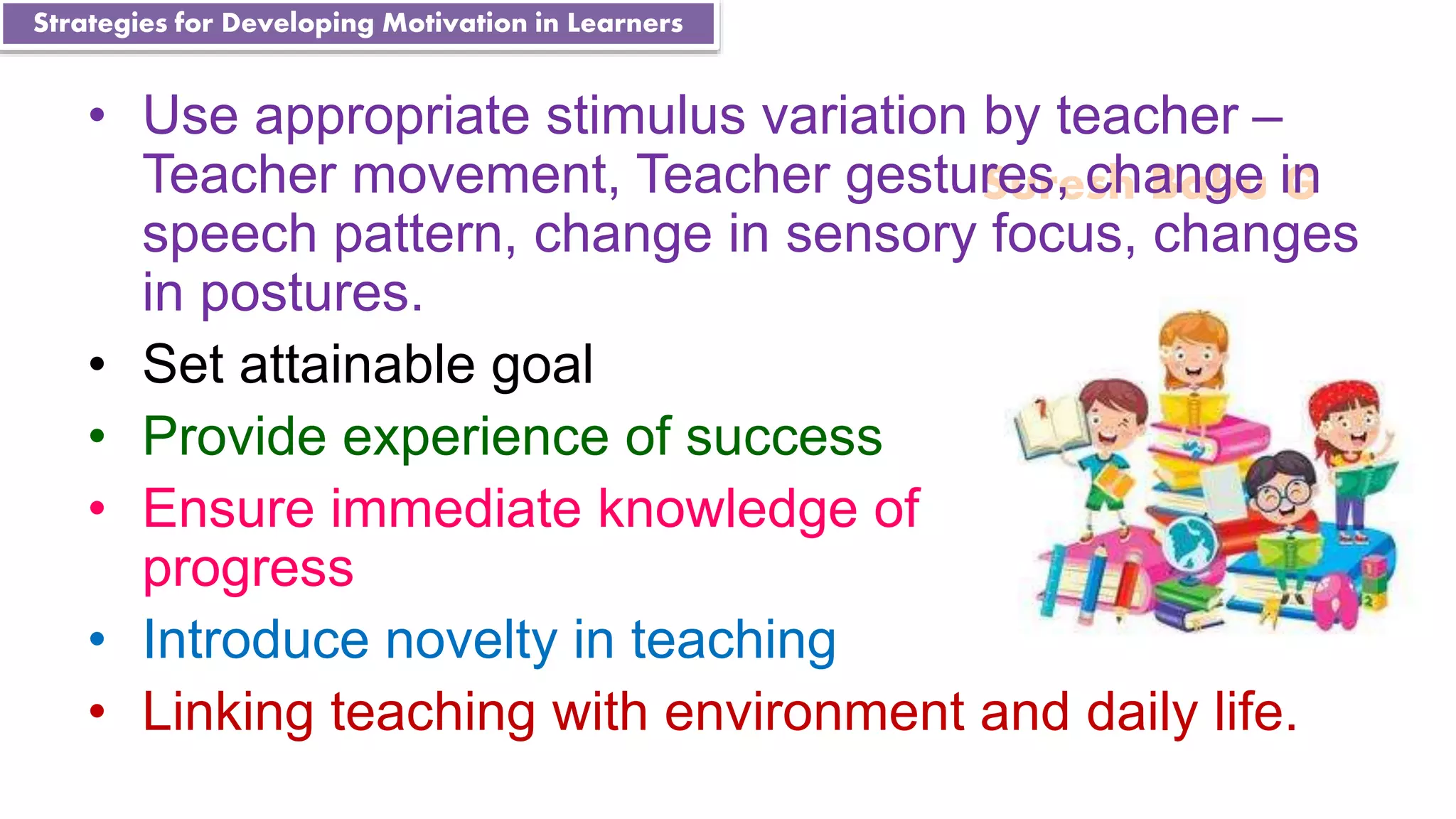
• Use appropriate stimulus variation by teacher –
Teacher movement, Teacher gestures, change in
speech pattern, change in sensory focus, changes
in postures.
• Set attainable goal
• Provide experience of success
• Ensure immediate knowledge of
progress
• Introduce novelty in teaching
• Linking teaching with environment and daily life.
Strategies for Developing Motivation in Learners
Suresh Babu G
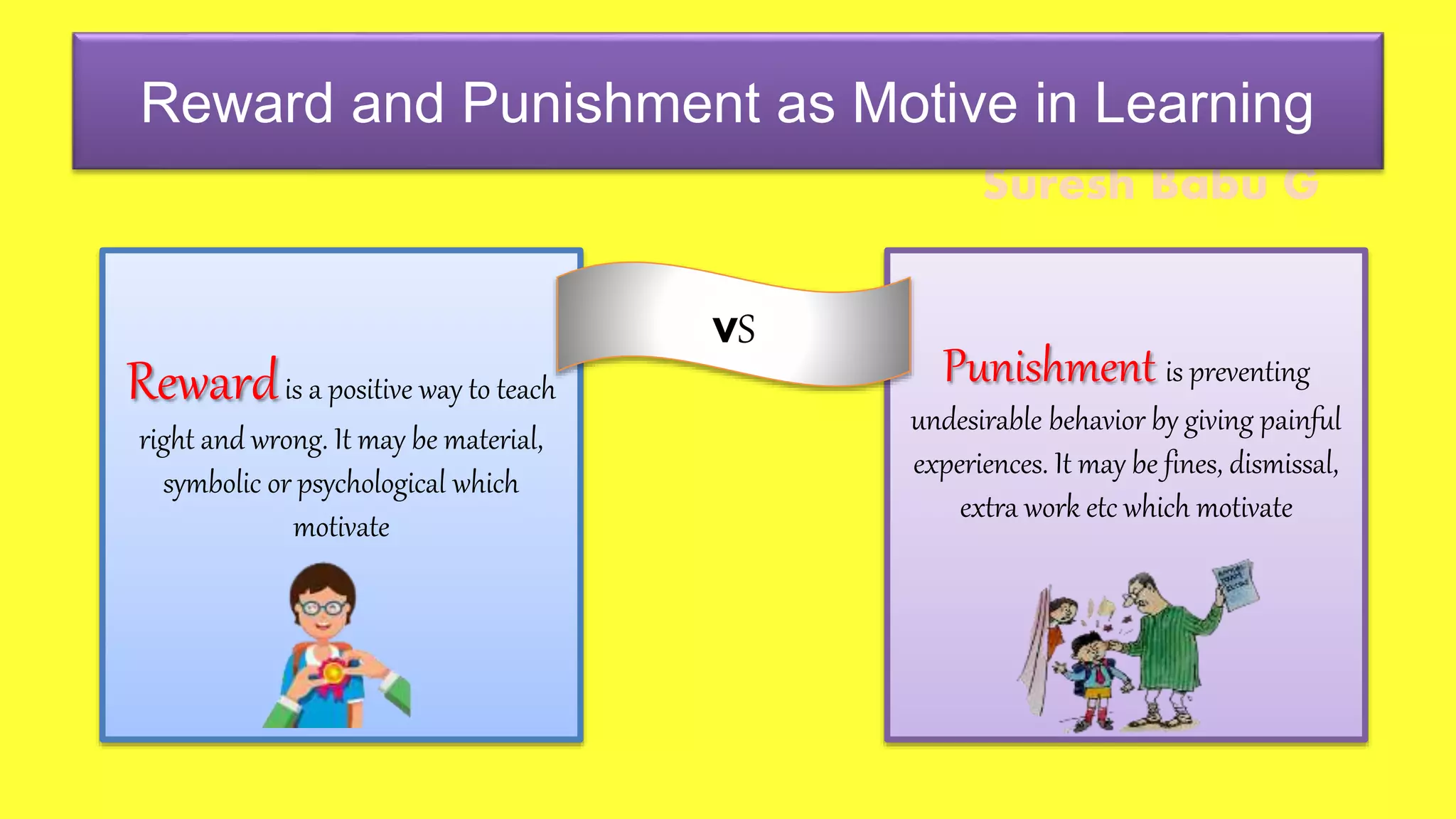
Reward and Punishment as Motive in Learning
Rewardis a positive way to teach
right and wrong. It may be material,
symbolic or psychological which
motivate
Punishment is preventing
undesirable behavior by giving painful
experiences. It may be fines, dismissal,
extra work etc which motivate
VS
Suresh Babu G
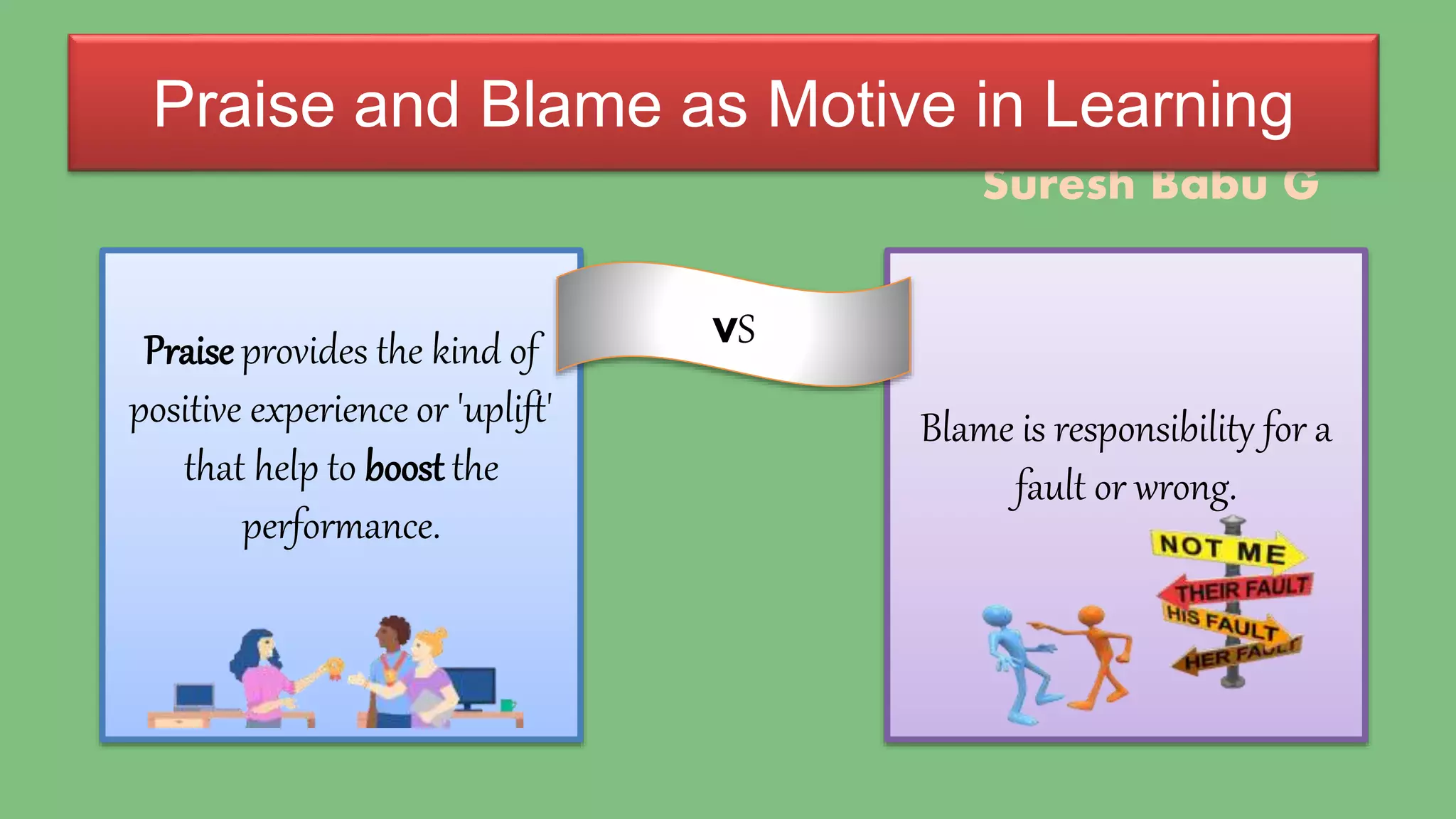
Praise and Blame as Motive in Learning
Praise provides the kind of
positive experience or 'uplift'
that help to boost the
performance.
Blame is responsibility for a
fault or wrong.
VS
Suresh Babu G
Motivate Students to Achieve their Goal

Motivation -Definition, Significance, Types of Motivation, Characteristics, Needs, Strategies for developing motivation in learners, Reward and punishment, Praise and Blame

  • 1.
    Suresh Babu G Motivation SureshBabu G Assistant Professor You all won Exam, so it’s my gift to you all..
  • 2.
    Suresh Babu G Motivation •The term motivation is originated from a Latin word “motum” which means “to move”. Motivation is the process of arousing or initiating movement in the organism. • Motivation is some thing which prompts, compels and energizes an individual to act in a particular manner at a particular time for attaining some specific goal. • It is a process of arousing, directing, maintaining and controlling one’s interest in a particular activity.
  • 3.
    Suresh Babu G Definitionsof Motivation • According to Mc Donald, motivation is an energy change within the organism characterized by affective arousal and anticipatory goal relations. • Sorenson considers motivation as a psychological and physiological condition that causes one to expand effort to satisfy needs and wants. • Lindsey defined motivation is a combination of forces which initiate, direct and sustain behavior towards a goal.
  • 4.
    Suresh Babu G Motive •According to Fisher, a motive is an inclination or impulsion to action plus some degree of orientation or direction. • Motive is something that incites an organism to action, sustains it and gives direction. • Motives are the springs of action. • It is an inner state of mind or an aroused feeling generated through basic needs or drives which compel an individual to respond by creating a kind of tension or urge to act.
  • 5.
    Suresh Babu G Significanceof Motivation • It energizes the leaner and thus it initiates learning activity. • Motives activate, direct and regulate the behavior of the leaner. • It controls the leaning behavior of the individual. • It sustains activity when a goal is not immediately available.
  • 6.
    Suresh Babu G •Motivation selects behavior. • Motivation provides energy and accelerates the behavior of the leaner. • Motivation releases the tension and help in satisfying the needs of the leaner. Significance of Motivation
  • 7.
    Suresh Babu G Typesof Motivation 1. Intrinsic Motivation (Natural Motivation)  It is the motivation associated with activities that are their own reward. It is a force within the individual and works from within the individual.  In intrinsic motivation the activity carries its own reward and the individual take genuine interest in performing the activity due to some inside motives and goals  Eg : Playing food-ball, reading poetry, painting pictures, etc.
  • 8.
    Suresh Babu G ExtrinsicMotivation (Artificial Motivation)  It is a motivation associated with activities that carry an external reward.  It refers to forces outside the individual which are tied with the environment.  Here the source of pleasure does not lie within the task.  Here the individual does or learns something not for its own sake, but as a means of obtaining desired goals or getting some external reward.  Eg: Working for better grade and doing home work for fear of punishment. Types of Motivation
  • 9.
    Suresh Babu G •Usually extrinsic motivation is provided by incentives and hence it is called incentive motivation. • Eg: Praise, blame, rewards, punishments, marks, competitions etc Types of Motivation
  • 10.
    Suresh Babu G AchievementMotivation • Achievement motivation is the desire to accomplish difficult tasks and meet standards of excellence. • It is one’s aspiration to do better, to achieve unique accomplishment, to compete with a standard of excellence, and to involve oneself with long term achievement goals. • According to Mc David, achievement motivation is a system of goal direction in human activity that closely related to competence, aggressiveness, dominance and pursuit of excellence.
  • 11.
    Suresh Babu G Characteristicsof Achievement Motivation • It is manifested only when the individual perceives performance as instrumental to a sense of personal accomplishment. • It is conditioned by one’s early training, experiences and subsequent learning. • It involves an exalted self-esteem and self-image • It is a learned motive acquired in the process of growing up and living in the society. • It is the intense desire to perform with excellence for its own sake.
  • 12.
    Suresh Babu G •It includes needs for success as well as need to avoid failure. • It is an outcome of social learning and reinforcements which individual have experienced. Characteristics of Achievement Motivation
  • 13.
    Suresh Babu G Needsof Achievement Motivation (Atkinson’s View) • According to Atkinson, motivation to achieve is a function of the relative strengths of the hope of success and the fear of failure. • Atkinson explains that the need for achievement is determined by the strength of two tendencies : (a) Motivation towards success (b) Motivation towards avoidance of failure
  • 14.
    Suresh Babu G •Both of tendencies are influenced by the experiences in early childhood, and parents attitude and are composed of three factors : orientation(motive towards success and avoidance of failure), expectation (Subjective estimation for the chance of success or failure) and value (incentive of success and failure). • Atkinson developed a mathematical model for the need of achievement motivation (n.Ach) n.Ach = Ts – TAF where Ts = approach tendency of subject TAF = tendency to avoid failure Needs of Achievement Motivation (Atkinson’s View)
  • 15.
    Suresh Babu G Strategiesfor Developing Motivation in Learners The teacher should adopt the following techniques to motivate pupils to learn: • Adopt child centered approach • Teaching should be based upon the previous learning experience acquired by pupil • Use progressive methods based on psychological principles, AV-aids and direct experiences • Develop clear perception of the goal
  • 16.
    Suresh Babu G •Teacher can use praise, reproof, rewards and punishment for the achievement of goal • Competition against one’s own past-record, ego- involvement in learning etc • Develop proper attitude • Provide appropriate learning situation and environment • Ensure sublimation of innate impulses (curiosity, construction etc) Strategies for Developing Motivation in Learners
  • 17.
    Suresh Babu G •Use appropriate stimulus variation by teacher – Teacher movement, Teacher gestures, change in speech pattern, change in sensory focus, changes in postures. • Set attainable goal • Provide experience of success • Ensure immediate knowledge of progress • Introduce novelty in teaching • Linking teaching with environment and daily life. Strategies for Developing Motivation in Learners
  • 18.
    Suresh Babu G Rewardand Punishment as Motive in Learning Rewardis a positive way to teach right and wrong. It may be material, symbolic or psychological which motivate Punishment is preventing undesirable behavior by giving painful experiences. It may be fines, dismissal, extra work etc which motivate VS
  • 19.
    Suresh Babu G Praiseand Blame as Motive in Learning Praise provides the kind of positive experience or 'uplift' that help to boost the performance. Blame is responsibility for a fault or wrong. VS
  • 20.
    Suresh Babu G MotivateStudents to Achieve their Goal