Motivation The willingness to expend a certain amount of effort to achieve a particular goal
Behavioral Views of Motivation B. F. Skinner  Programmed Instruction The student is reinforced for every correct response (the computer applauds!) This  motivates  the student to go to the next frame The student works through the program until the desired terminal behavior is shaped
Behavioral Views of Motivation REINFORCE DESIRED BEHAVIOR Students are motivated to complete a task by being promised a reward  Praise Grade Token to be exchanged for a desired object the privilege of engaging in a self-selected activity
Social Behavioral Theory Albert Bandura  We learn appropriate behavior in a social setting Observation Identification We work for a teacher we respect Imitation An older sibling gets good grades, so we try to get good grades also Vicarious Reinforcement A  classmate is rewarded for a behavior, so we practice the same behavior, hoping for a reward
Limitations of Behavioral View  Rewards are extrinsic Learner engages in an activity to earn a reward that is not inherently related to the activity Intrinsic Motivation Learner engages in an activity because it produces inherently positive consequences such as becoming more  knowledgeable competent independent
Dangers of Extrinsic Motivation  Changes in behavior are likely to be temporary When the extrinsic reward is obtained, the student reverts to earlier behavior Students develop a materialistic attitude toward learning “ What tangible reward will I get if I agree to learn this?” The “Undermining Effect” rewards undermine intrinsic desire to learn
Minimizing the  “Undermining Effect”  Avoid indiscriminate use of rewards Give rewards based upon a predetermined standard of excellence Give rewards when the task is challenging First prize at a science fair may cause a student to maintain a strong interest in science Avoid rewards for activities in which there exists a natural interest
Cognitive Views of Motivation  Humans are naturally motivated to learn because they strive for equilibrium This is achieved by: Assimilating a new experience by relating it to an existing scheme Accomodation of an existing scheme if the experience is too different to be assimilated
Cognitive Views of Motivation  Adkinson- The “Need for Achievement” Partly innate - partly based upon experience Individuals with a High Need for Achievement have a strong expectation for success low fear of failure anticipate the feeling of pride in accomplishment
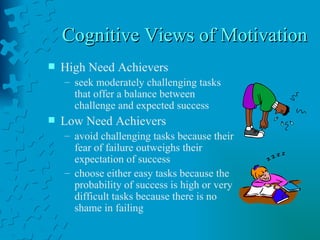
Cognitive Views of Motivation  High Need Achievers seek moderately challenging tasks that offer a balance between challenge and expected success Low Need Achievers avoid challenging tasks because their fear of failure outweighs their expectation of success choose either easy tasks because the probability of success is high or very difficult tasks because there is no shame in failing
Attribution Theory  When asked, learners attribute success or failure to four factors Lack of Ability “I have a poor head for numbers” Lack of Effort “I didn’t really study for the test.” Task Difficulty “That test was too hard” Luck “I guessed wrong about what to study.”
Attribution Theory  Luck and Task Difficulty are external attributions The “locus of control” is outside the learner Ability is a stable attribution It tends to stay the same over time Effort is an internal attribution The “locus of control” is with the learner Research indicates that  stable attributes (ability) lead to expectations of future success or failure internal attributes (effort) lead to pride in achievement
Humanistic Views of Motivation  Abraham Maslow Healthy individuals are motivated to seek fulfilling experiences Human motivation is based upon need gratification Maslow identified a five level hierarchy of needs
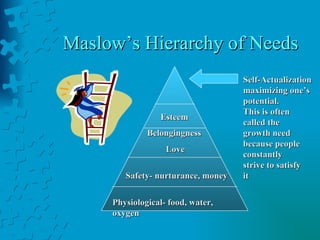
Maslow’s Hierarchy of Needs Physiological- food, water, oxygen Safety- nurturance, money Belongingness  Love Esteem Self-Actualization maximizing one’s potential. This is often called the growth need because people constantly strive to satisfy it

Motivation

  • 1.
    Motivation The willingnessto expend a certain amount of effort to achieve a particular goal
  • 2.
    Behavioral Views ofMotivation B. F. Skinner Programmed Instruction The student is reinforced for every correct response (the computer applauds!) This motivates the student to go to the next frame The student works through the program until the desired terminal behavior is shaped
  • 3.
    Behavioral Views ofMotivation REINFORCE DESIRED BEHAVIOR Students are motivated to complete a task by being promised a reward Praise Grade Token to be exchanged for a desired object the privilege of engaging in a self-selected activity
  • 4.
    Social Behavioral TheoryAlbert Bandura We learn appropriate behavior in a social setting Observation Identification We work for a teacher we respect Imitation An older sibling gets good grades, so we try to get good grades also Vicarious Reinforcement A classmate is rewarded for a behavior, so we practice the same behavior, hoping for a reward
  • 5.
    Limitations of BehavioralView Rewards are extrinsic Learner engages in an activity to earn a reward that is not inherently related to the activity Intrinsic Motivation Learner engages in an activity because it produces inherently positive consequences such as becoming more knowledgeable competent independent
  • 6.
    Dangers of ExtrinsicMotivation Changes in behavior are likely to be temporary When the extrinsic reward is obtained, the student reverts to earlier behavior Students develop a materialistic attitude toward learning “ What tangible reward will I get if I agree to learn this?” The “Undermining Effect” rewards undermine intrinsic desire to learn
  • 7.
    Minimizing the “Undermining Effect” Avoid indiscriminate use of rewards Give rewards based upon a predetermined standard of excellence Give rewards when the task is challenging First prize at a science fair may cause a student to maintain a strong interest in science Avoid rewards for activities in which there exists a natural interest
  • 8.
    Cognitive Views ofMotivation Humans are naturally motivated to learn because they strive for equilibrium This is achieved by: Assimilating a new experience by relating it to an existing scheme Accomodation of an existing scheme if the experience is too different to be assimilated
  • 9.
    Cognitive Views ofMotivation Adkinson- The “Need for Achievement” Partly innate - partly based upon experience Individuals with a High Need for Achievement have a strong expectation for success low fear of failure anticipate the feeling of pride in accomplishment
  • 10.
    Cognitive Views ofMotivation High Need Achievers seek moderately challenging tasks that offer a balance between challenge and expected success Low Need Achievers avoid challenging tasks because their fear of failure outweighs their expectation of success choose either easy tasks because the probability of success is high or very difficult tasks because there is no shame in failing
  • 11.
    Attribution Theory When asked, learners attribute success or failure to four factors Lack of Ability “I have a poor head for numbers” Lack of Effort “I didn’t really study for the test.” Task Difficulty “That test was too hard” Luck “I guessed wrong about what to study.”
  • 12.
    Attribution Theory Luck and Task Difficulty are external attributions The “locus of control” is outside the learner Ability is a stable attribution It tends to stay the same over time Effort is an internal attribution The “locus of control” is with the learner Research indicates that stable attributes (ability) lead to expectations of future success or failure internal attributes (effort) lead to pride in achievement
  • 13.
    Humanistic Views ofMotivation Abraham Maslow Healthy individuals are motivated to seek fulfilling experiences Human motivation is based upon need gratification Maslow identified a five level hierarchy of needs
  • 14.
    Maslow’s Hierarchy ofNeeds Physiological- food, water, oxygen Safety- nurturance, money Belongingness Love Esteem Self-Actualization maximizing one’s potential. This is often called the growth need because people constantly strive to satisfy it