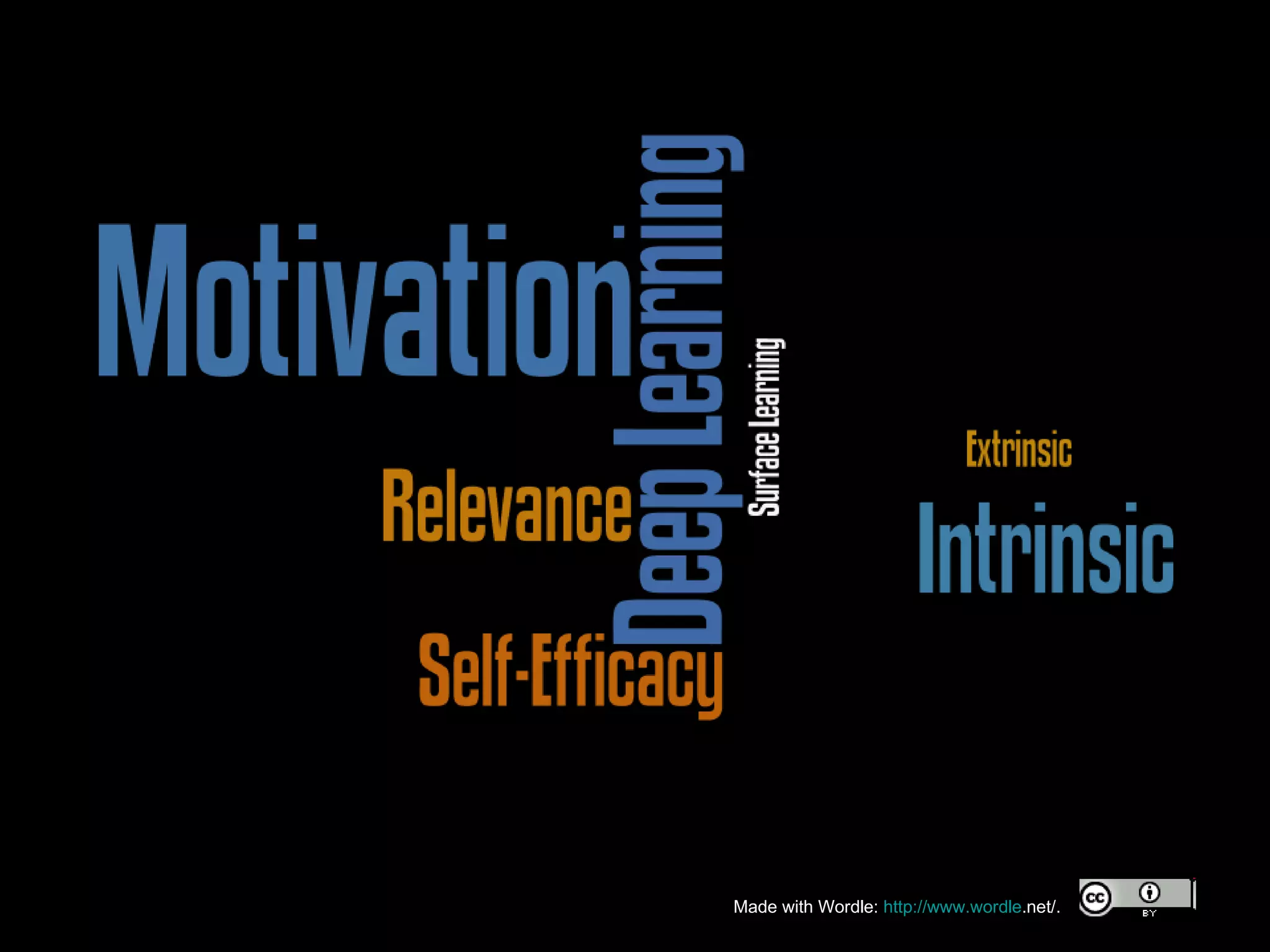

Made with Wordle:  http://www. wordle .net/ .
 
“ When it is very good,  instruction is  technical excellence  under the command of  artistic expression.” Raymond J Wlodkowski Enhancing Adult Motivation to Learn
Why design for motivation? Easier to teach someone who is highly motivated than one who is moderately motivated or resistant Motivated learner will make more mental effort Motivated learner more likely to use available learning resources The learning is “better” and longer lasting
Questions 1.  How do you make new material relevant to learners? 2. How do you help learners gain confidence in their ability to learn and succeed? 3.  What are recurrent or common stumbling blocks for your learners?  (Eg. When it takes a while to “get it.”)
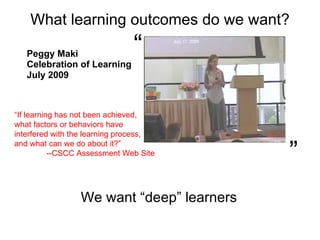
What learning outcomes do we want? Peggy Maki Celebration of Learning  July 2009 “  ”  We want “deep” learners “ If learning has not been achieved,  what factors or behaviors have interfered with the learning process,  and what can we do about it?”  --CSCC Assessment Web Site
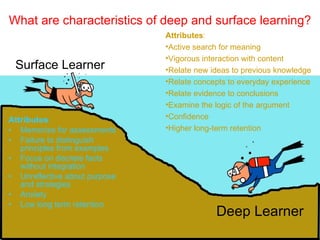
Surface Learner Attributes : Memorize for assessments Failure to distinguish principles from examples Focus on discrete facts without integration Unreflective about purpose and strategies Anxiety  Low long term retention Deep Learner Attributes : Active search for meaning Vigorous interaction with content Relate new ideas to previous knowledge Relate concepts to everyday experience Relate evidence to conclusions Examine the logic of the argument Confidence Higher long-term retention What are characteristics of deep and surface learning?
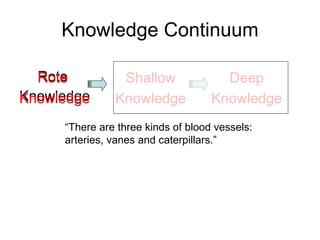
Knowledge Continuum Rote  Knowledge Shallow Knowledge Deep Knowledge “ There are three kinds of blood vessels:  arteries, vanes and caterpillars.” Rote  Knowledge Shallow Knowledge Deep Knowledge
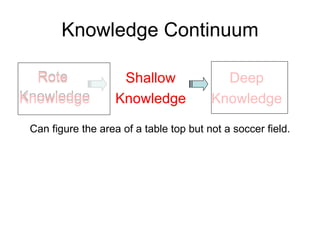
Knowledge Continuum Rote  Knowledge Shallow Knowledge Deep Knowledge Can figure the area of a table top but not a soccer field. Rote  Knowledge Shallow Knowledge Deep Knowledge
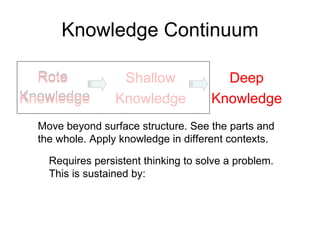
Knowledge Continuum Rote  Knowledge Shallow Knowledge Deep Knowledge Move beyond surface structure. See the parts and  the whole. Apply knowledge in different contexts. Rote  Knowledge Shallow Knowledge Deep Knowledge Requires persistent thinking to solve a problem.  This is sustained by:
OK, not this kind of motivation.
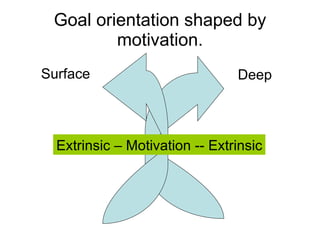
Goal orientation shaped by motivation. Surface Deep Extrinsic – Motivation -- Extrinsic
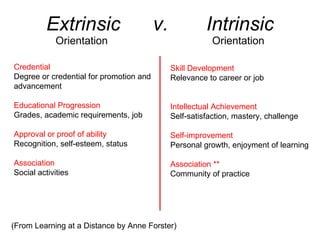
Extrinsic  v.  Intrinsic Orientation  Orientation Credential Degree or credential for promotion and advancement Educational Progression Grades, academic requirements, job Approval or proof of ability Recognition, self-esteem, status Association Social activities Skill Development Relevance to career or job Intellectual Achievement Self-satisfaction, mastery, challenge Self-improvement Personal growth, enjoyment of learning Association ** Community of practice (From Learning at a Distance by Anne Forster)
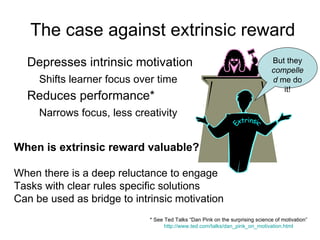
The case against extrinsic reward Depresses intrinsic motivation Shifts learner focus over time Reduces performance* Narrows focus, less creativity But they  compelled  me do it! Extrinsic When is extrinsic reward valuable? When there is a deep reluctance to engage Tasks with clear rules specific solutions Can be used as bridge to intrinsic motivation * See Ted Talks “Dan Pink on the surprising science of motivation” http://www.ted.com/talks/dan_pink_on_motivation.html
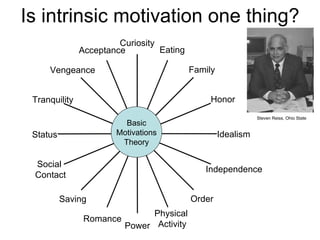
Is intrinsic motivation one thing? Basic Motivations Theory Steven Reiss, Ohio State Acceptance Vengeance Tranquility Status  Social  Contact  Saving Romance Power Physical  Activity Order Independence Idealism Honor Family Eating Curiosity
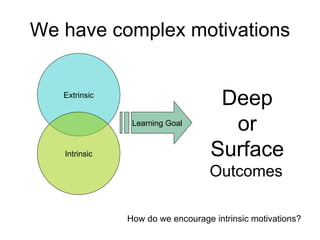
We have complex motivations Extrinsic Intrinsic Learning Goal Deep or Surface Outcomes   How do we encourage intrinsic motivations?
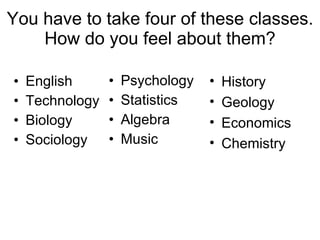
You have to take four of these classes. How do you feel about them? English Technology Biology Sociology Psychology Statistics Algebra Music History Geology Economics Chemistry
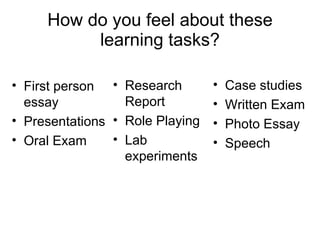
How do you feel about these learning tasks? First person essay Presentations Oral Exam Research Report Role Playing Lab experiments Case studies Written Exam Photo Essay Speech
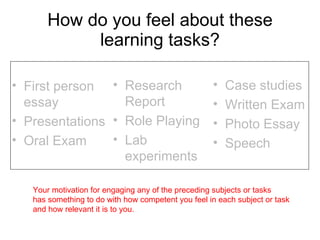
How do you feel about these learning tasks? First person essay Presentations Oral Exam Research Report Role Playing Lab experiments Case studies Written Exam Photo Essay Speech Your motivation for engaging any of the preceding subjects or tasks  has something to do with how competent you feel in each subject or task and how relevant it is to you.
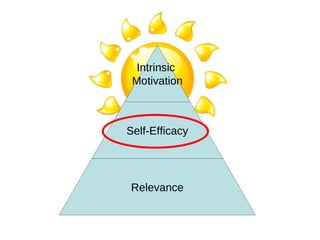
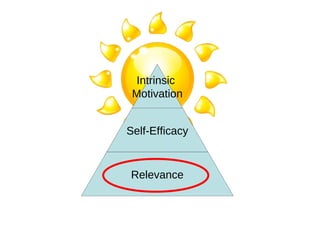
Relevance Intrinsic  Motivation Self-Efficacy Relevance
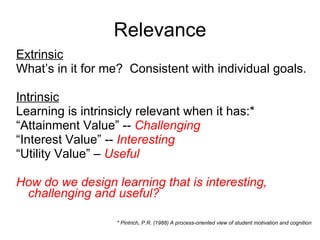
Relevance Extrinsic What’s in it for me?  Consistent with individual goals. Intrinsic Learning is intrinsicly relevant when it has:* “ Attainment Value” --  Challenging “ Interest Value” --  Interesting “ Utility Value” –  Useful How do we design learning that is interesting, challenging and useful? * Pintrich, P.R. (1988) A process-oriented view of student motivation and cognition
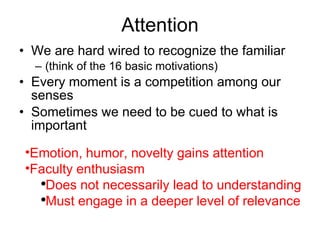
Attention We are hard wired to recognize the familiar (think of the 16 basic motivations) Every moment is a competition among our senses Sometimes we need to be cued to what is important  Emotion, humor, novelty gains attention Faculty enthusiasm Does not necessarily lead to understanding Must engage in a deeper level of relevance
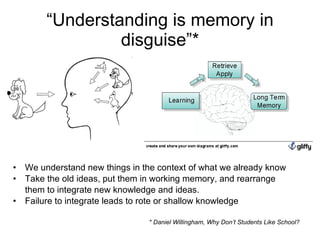
“ Understanding is memory in disguise”* We understand new things in the context of what we already know Take the old ideas, put them in working memory, and rearrange  them to integrate new knowledge and ideas. Failure to integrate leads to rote or shallow knowledge * Daniel Willingham, Why Don’t Students Like School?
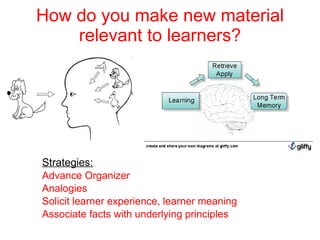
How do you make new material relevant to learners? Strategies: Advance Organizer  Analogies Solicit learner experience, learner meaning Associate facts with underlying principles
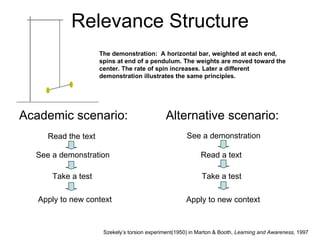
Relevance Structure Academic scenario: Alternative scenario: Read the text See a demonstration Take a test Read a text See a demonstration Take a test Apply to new context Apply to new context Szekely’s torsion experiment(1950) in Marton & Booth,  Learning and Awareness , 1997 The demonstration:  A horizontal bar, weighted at each end, spins at end of a pendulum. The weights are moved toward the center. The rate of spin increases. Later a different demonstration illustrates the same principles.
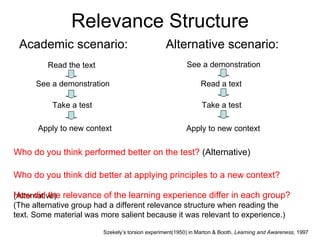
Relevance Structure Academic scenario: Alternative scenario: Read the text See a demonstration Take a test Read a text See a demonstration Take a test Apply to new context Apply to new context Who do you think performed better on the test?  (Alternative) Who do you think did better at applying principles to a new context?  (Alternative) How did the relevance of the learning experience differ in each group? (The alternative group had a different relevance structure when reading the text. Some material was more salient because it was relevant to experience.) Szekely’s torsion experiment(1950) in Marton & Booth,  Learning and Awareness , 1997
Intrinsic  Motivation Self-Efficacy Relevance
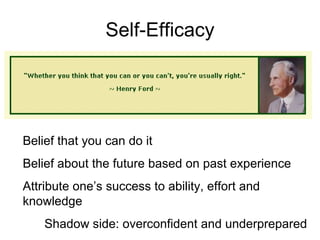
Self-Efficacy Belief that you can   do it Belief about the future based on past experience Attribute one’s success to ability, effort and knowledge Shadow side: overconfident and underprepared
Influences on Self-Efficacy Mastery Experiences:  Past success or failure, stored as prior knowledge in long-term memory Vicarious Experiences:  Observe someone we identify with succeeding or failing Social Persuasion:  Encouragement from a trusted friend or mentor Optimal Arousal:  We are relaxed, alert or enthused. Raymond Wlodkowski,  Enhancing Adult Motivation to Learn How do you help learners gain confidence in their ability to learn and succeed?
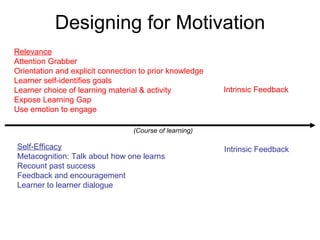
Designing for Motivation (Course of learning) Relevance Attention Grabber Orientation and explicit connection to prior knowledge Learner self-identifies goals Learner choice of learning material & activity Expose Learning Gap Use emotion to engage Self-Efficacy Metacognition: Talk about how one learns Recount past success Feedback and encouragement Learner to learner dialogue Intrinsic Feedback Intrinsic Feedback
Learning is problem solving Solving a problem is pleasurable Neuroscience shows that similar areas of the brain activate for both learning and pleasure/reward. Brain makes dopamine. The key is being able to  solve  the problem. Challenges moderately difficult Make it interesting to arouse curiosity * Daniel Willingham, Why Don’t Students Like School?
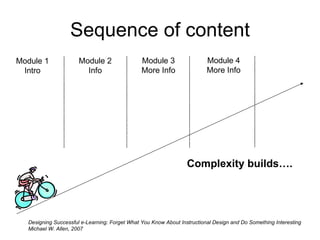
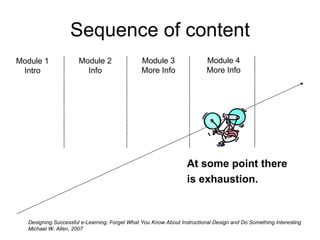
Sequence of content Module 1 Intro Module 2 Info Module 3 More Info Designing Successful e-Learning: Forget What You Know About Instructional Design and Do Something Interesting Michael W. Allen, 2007   Module 4 More Info Complexity builds….
Sequence of content Module 1 Intro Module 2 Info Module 3 More Info Designing Successful e-Learning: Forget What You Know About Instructional Design and Do Something Interesting Michael W. Allen, 2007   Module 4 More Info At some point there  is exhaustion.
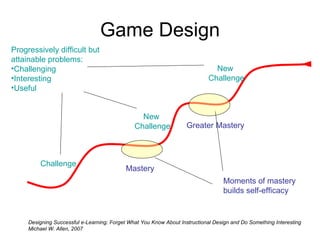
Game Design Challenge Mastery New  Challenge Greater Mastery Moments of mastery builds self-efficacy New  Challenge Progressively difficult but  attainable problems:  Challenging Interesting Useful Designing Successful e-Learning: Forget What You Know About Instructional Design and Do Something Interesting Michael W. Allen, 2007
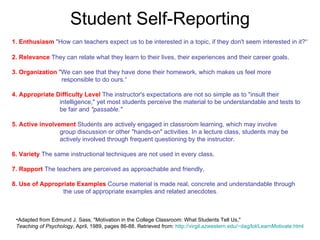
Student Self-Reporting 1. Enthusiasm   "How can teachers expect us to be interested in a topic, if they don't seem interested in it?“ 2. Relevance   They can relate what they learn to their lives, their experiences and their career goals .  3. Organization   "We can see that they have done their homework, which makes us feel more    responsible to do ours.“ 4. Appropriate Difficulty Level   The instructor's expectations are not so simple as to "insult their    intelligence," yet most students perceive the material to be understandable and tests to    be fair and  "passable." 5. Active involvement   Students are actively engaged in classroom learning, which may involve    group discussion or other "hands-on" activities. In a lecture class, students may be    actively involved through frequent questioning by the instructor . 6. Variety   The same instructional techniques are not used in every class .  7. Rapport   The teachers are perceived as approachable and friendly .  8. Use of Appropriate Examples   Course material is made real, concrete and understandable through    the use of appropriate examples and related anecdotes.   Adapted from Edmund J. Sass, "Motivation in the College Classroom: What Students Tell Us,"  Teaching of Psychology , April, 1989, pages 86-88. Retrieved from:  http:// virgil.azwestern.edu/~dag/lol/LearnMotivate.html
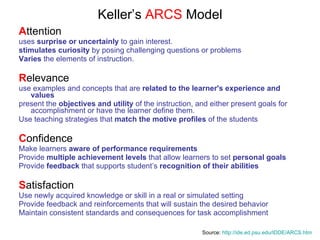
Keller’s  ARCS  Model A ttention uses  surprise or uncertainly  to gain interest.  stimulates curiosity  by posing challenging questions or problems Varies  the elements of instruction.  R elevance use examples and concepts that are  related to the learner's experience   and values   present the  objectives and utility  of the instruction, and either present goals for accomplishment or have the learner define them. Use teaching strategies that  match the motive profiles  of the students C onfidence Make learners  aware of performance requirements Provide  multiple achievement levels  that allow learners to set  personal goals Provide  feedback  that supports student’s  recognition of their abilities S atisfaction Use newly acquired knowledge or skill in a real or simulated setting Provide feedback and reinforcements that will sustain the desired behavior Maintain consistent standards and consequences for task accomplishment   Source:  http:// ide.ed.psu.edu/IDDE/ARCS.htm

Motivation and Learning

  • 1.
    Made with Wordle: http://www. wordle .net/ .
  • 2.
  • 3.
    “ When itis very good, instruction is technical excellence under the command of artistic expression.” Raymond J Wlodkowski Enhancing Adult Motivation to Learn
  • 4.
    Why design formotivation? Easier to teach someone who is highly motivated than one who is moderately motivated or resistant Motivated learner will make more mental effort Motivated learner more likely to use available learning resources The learning is “better” and longer lasting
  • 5.
    Questions 1. How do you make new material relevant to learners? 2. How do you help learners gain confidence in their ability to learn and succeed? 3. What are recurrent or common stumbling blocks for your learners? (Eg. When it takes a while to “get it.”)
  • 6.
    What learning outcomesdo we want? Peggy Maki Celebration of Learning July 2009 “ ” We want “deep” learners “ If learning has not been achieved, what factors or behaviors have interfered with the learning process, and what can we do about it?” --CSCC Assessment Web Site
  • 7.
    Surface Learner Attributes: Memorize for assessments Failure to distinguish principles from examples Focus on discrete facts without integration Unreflective about purpose and strategies Anxiety Low long term retention Deep Learner Attributes : Active search for meaning Vigorous interaction with content Relate new ideas to previous knowledge Relate concepts to everyday experience Relate evidence to conclusions Examine the logic of the argument Confidence Higher long-term retention What are characteristics of deep and surface learning?
  • 8.
    Knowledge Continuum Rote Knowledge Shallow Knowledge Deep Knowledge “ There are three kinds of blood vessels: arteries, vanes and caterpillars.” Rote Knowledge Shallow Knowledge Deep Knowledge
  • 9.
    Knowledge Continuum Rote Knowledge Shallow Knowledge Deep Knowledge Can figure the area of a table top but not a soccer field. Rote Knowledge Shallow Knowledge Deep Knowledge
  • 10.
    Knowledge Continuum Rote Knowledge Shallow Knowledge Deep Knowledge Move beyond surface structure. See the parts and the whole. Apply knowledge in different contexts. Rote Knowledge Shallow Knowledge Deep Knowledge Requires persistent thinking to solve a problem. This is sustained by:
  • 11.
    OK, not thiskind of motivation.
  • 12.
    Goal orientation shapedby motivation. Surface Deep Extrinsic – Motivation -- Extrinsic
  • 13.
    Extrinsic v. Intrinsic Orientation Orientation Credential Degree or credential for promotion and advancement Educational Progression Grades, academic requirements, job Approval or proof of ability Recognition, self-esteem, status Association Social activities Skill Development Relevance to career or job Intellectual Achievement Self-satisfaction, mastery, challenge Self-improvement Personal growth, enjoyment of learning Association ** Community of practice (From Learning at a Distance by Anne Forster)
  • 14.
    The case againstextrinsic reward Depresses intrinsic motivation Shifts learner focus over time Reduces performance* Narrows focus, less creativity But they compelled me do it! Extrinsic When is extrinsic reward valuable? When there is a deep reluctance to engage Tasks with clear rules specific solutions Can be used as bridge to intrinsic motivation * See Ted Talks “Dan Pink on the surprising science of motivation” http://www.ted.com/talks/dan_pink_on_motivation.html
  • 15.
    Is intrinsic motivationone thing? Basic Motivations Theory Steven Reiss, Ohio State Acceptance Vengeance Tranquility Status Social Contact Saving Romance Power Physical Activity Order Independence Idealism Honor Family Eating Curiosity
  • 16.
    We have complexmotivations Extrinsic Intrinsic Learning Goal Deep or Surface Outcomes How do we encourage intrinsic motivations?
  • 17.
    You have totake four of these classes. How do you feel about them? English Technology Biology Sociology Psychology Statistics Algebra Music History Geology Economics Chemistry
  • 18.
    How do youfeel about these learning tasks? First person essay Presentations Oral Exam Research Report Role Playing Lab experiments Case studies Written Exam Photo Essay Speech
  • 19.
    How do youfeel about these learning tasks? First person essay Presentations Oral Exam Research Report Role Playing Lab experiments Case studies Written Exam Photo Essay Speech Your motivation for engaging any of the preceding subjects or tasks has something to do with how competent you feel in each subject or task and how relevant it is to you.
  • 20.
    Relevance Intrinsic Motivation Self-Efficacy Relevance
  • 21.
    Relevance Extrinsic What’sin it for me? Consistent with individual goals. Intrinsic Learning is intrinsicly relevant when it has:* “ Attainment Value” -- Challenging “ Interest Value” -- Interesting “ Utility Value” – Useful How do we design learning that is interesting, challenging and useful? * Pintrich, P.R. (1988) A process-oriented view of student motivation and cognition
  • 22.
    Attention We arehard wired to recognize the familiar (think of the 16 basic motivations) Every moment is a competition among our senses Sometimes we need to be cued to what is important Emotion, humor, novelty gains attention Faculty enthusiasm Does not necessarily lead to understanding Must engage in a deeper level of relevance
  • 23.
    “ Understanding ismemory in disguise”* We understand new things in the context of what we already know Take the old ideas, put them in working memory, and rearrange them to integrate new knowledge and ideas. Failure to integrate leads to rote or shallow knowledge * Daniel Willingham, Why Don’t Students Like School?
  • 24.
    How do youmake new material relevant to learners? Strategies: Advance Organizer Analogies Solicit learner experience, learner meaning Associate facts with underlying principles
  • 25.
    Relevance Structure Academicscenario: Alternative scenario: Read the text See a demonstration Take a test Read a text See a demonstration Take a test Apply to new context Apply to new context Szekely’s torsion experiment(1950) in Marton & Booth, Learning and Awareness , 1997 The demonstration: A horizontal bar, weighted at each end, spins at end of a pendulum. The weights are moved toward the center. The rate of spin increases. Later a different demonstration illustrates the same principles.
  • 26.
    Relevance Structure Academicscenario: Alternative scenario: Read the text See a demonstration Take a test Read a text See a demonstration Take a test Apply to new context Apply to new context Who do you think performed better on the test? (Alternative) Who do you think did better at applying principles to a new context? (Alternative) How did the relevance of the learning experience differ in each group? (The alternative group had a different relevance structure when reading the text. Some material was more salient because it was relevant to experience.) Szekely’s torsion experiment(1950) in Marton & Booth, Learning and Awareness , 1997
  • 27.
    Intrinsic MotivationSelf-Efficacy Relevance
  • 28.
    Self-Efficacy Belief thatyou can do it Belief about the future based on past experience Attribute one’s success to ability, effort and knowledge Shadow side: overconfident and underprepared
  • 29.
    Influences on Self-EfficacyMastery Experiences: Past success or failure, stored as prior knowledge in long-term memory Vicarious Experiences: Observe someone we identify with succeeding or failing Social Persuasion: Encouragement from a trusted friend or mentor Optimal Arousal: We are relaxed, alert or enthused. Raymond Wlodkowski, Enhancing Adult Motivation to Learn How do you help learners gain confidence in their ability to learn and succeed?
  • 30.
    Designing for Motivation(Course of learning) Relevance Attention Grabber Orientation and explicit connection to prior knowledge Learner self-identifies goals Learner choice of learning material & activity Expose Learning Gap Use emotion to engage Self-Efficacy Metacognition: Talk about how one learns Recount past success Feedback and encouragement Learner to learner dialogue Intrinsic Feedback Intrinsic Feedback
  • 31.
    Learning is problemsolving Solving a problem is pleasurable Neuroscience shows that similar areas of the brain activate for both learning and pleasure/reward. Brain makes dopamine. The key is being able to solve the problem. Challenges moderately difficult Make it interesting to arouse curiosity * Daniel Willingham, Why Don’t Students Like School?
  • 32.
    Sequence of contentModule 1 Intro Module 2 Info Module 3 More Info Designing Successful e-Learning: Forget What You Know About Instructional Design and Do Something Interesting Michael W. Allen, 2007 Module 4 More Info Complexity builds….
  • 33.
    Sequence of contentModule 1 Intro Module 2 Info Module 3 More Info Designing Successful e-Learning: Forget What You Know About Instructional Design and Do Something Interesting Michael W. Allen, 2007 Module 4 More Info At some point there is exhaustion.
  • 34.
    Game Design ChallengeMastery New Challenge Greater Mastery Moments of mastery builds self-efficacy New Challenge Progressively difficult but attainable problems: Challenging Interesting Useful Designing Successful e-Learning: Forget What You Know About Instructional Design and Do Something Interesting Michael W. Allen, 2007
  • 35.
    Student Self-Reporting 1.Enthusiasm "How can teachers expect us to be interested in a topic, if they don't seem interested in it?“ 2. Relevance They can relate what they learn to their lives, their experiences and their career goals . 3. Organization "We can see that they have done their homework, which makes us feel more responsible to do ours.“ 4. Appropriate Difficulty Level The instructor's expectations are not so simple as to "insult their intelligence," yet most students perceive the material to be understandable and tests to be fair and "passable." 5. Active involvement Students are actively engaged in classroom learning, which may involve group discussion or other "hands-on" activities. In a lecture class, students may be actively involved through frequent questioning by the instructor . 6. Variety The same instructional techniques are not used in every class . 7. Rapport The teachers are perceived as approachable and friendly . 8. Use of Appropriate Examples Course material is made real, concrete and understandable through the use of appropriate examples and related anecdotes. Adapted from Edmund J. Sass, "Motivation in the College Classroom: What Students Tell Us," Teaching of Psychology , April, 1989, pages 86-88. Retrieved from: http:// virgil.azwestern.edu/~dag/lol/LearnMotivate.html
  • 36.
    Keller’s ARCS Model A ttention uses surprise or uncertainly to gain interest. stimulates curiosity by posing challenging questions or problems Varies the elements of instruction. R elevance use examples and concepts that are related to the learner's experience and values present the objectives and utility of the instruction, and either present goals for accomplishment or have the learner define them. Use teaching strategies that match the motive profiles of the students C onfidence Make learners aware of performance requirements Provide multiple achievement levels that allow learners to set personal goals Provide feedback that supports student’s recognition of their abilities S atisfaction Use newly acquired knowledge or skill in a real or simulated setting Provide feedback and reinforcements that will sustain the desired behavior Maintain consistent standards and consequences for task accomplishment Source: http:// ide.ed.psu.edu/IDDE/ARCS.htm

Editor's Notes

  • #8 Deep learners have longer retention and deeper understanding.