SAAQC
Motivation in Teaching
and in Learning
A report for St. Anthony
Academy of Quezon City
Teachers
SAAQC
Activity!
Guess the lucky number
1. Group yourselves into three
2. Ask for their nicknames and get the first letter of each person
3. Convert the alphabet into corresponding numbers
1. Ex. A=1, B=2, Z=26
4. Convert the letter into the equivalent number/s
5. Ask them if this one of the numbers is their lucky number
6. Note if yes or no.
You only have 1 minute to do this!
SAAQC
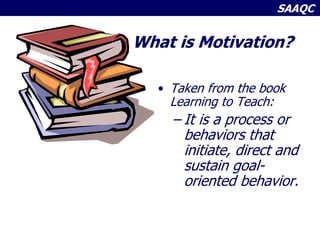
What is Motivation?
• Taken from the book
Learning to Teach:
– It is a process or
behaviors that
initiate, direct and
sustain goal-
oriented behavior.
SAAQC
Through Motivation
• The personal desire of the student must be directed
to the successful attempt to learn.
• Learners must be encouraged to take risks.
• They must also understand that “not getting it the
first time” is a part of succeeding.
SAAQC
“Do not train children to learn by force and harshness
but direct them to it by what amuses their minds, so
that you may be better able to discover with accuracy
the peculiar bent of the genius of each.”
- Plato
SAAQC
Types of Motivation
• Internal Motivation
• External Motivation
SAAQC
Types of Motivation
• Internal (Intrinsic) Motivation
• Is fueled by curiosity, the desire for mastery,
success, a sense of accomplishment,
confidence in ability .
• A sense of ownership and other factors within
us.
SAAQC
Types of Motivation
• Internal (Intrinsic) Motivation
• Expresses the love of learning for learning
sake.
– This is a quality many students lose by the time they
reach upper elementary grades.
SAAQC
Unfortunately, both successful
and failing students lose track
at some point.
• They stop being curious and lose their theoretical
abilities due to the following misconceptions about
school:
– It is a place for them to find out what someone
else wants from you.
– A place where to appear (stand-out) and conform
only.
SAAQC
Types of Motivation
• Internal (Intrinsic) Motivation
• Example:
– One way to cultivate internal motivation is to teach
students to recognize the relationship between effort
and outcome. Just spell it out and model the effort
outcome link in your own actions. Don’t assume
students already understand the relationship.
SAAQC
Types of Motivation
• External (Extrinsic) Motivation
• It is suggested that external motivation be
used instead as a means to help students
develop internal motivation to learn and behave
instead of the end.
• The most important role then is to make
students aware of the powerful social
reinforcement given to those who try hard,
learn and succeed.
SAAQC
Types of Motivation
• External (Extrinsic) Motivation
– External rewards result from completing an
activity or behaving in a certain way.
SAAQC
Types of Motivation
• External (Extrinsic) Motivation
• Examples: good grades, teacher or parents
praise, extra privileges or free time, public
recognition, competition, even material goods
such as stickers or candy.
• Note: These expected or relied on rewards by
many students get in the way of real learning.
SAAQC
Less of the External and more of the
Internal Motivation
• Kids deserve an engaging curriculum and a
caring atmosphere so they can act on their
natural desire to find out about stuff.
• No kid deserves to be manipulated with
externals so as to comply with what someone
else wants.
SAAQC
Passion for Learning
• Is not something you instill upon
• It is something you have to keep from
extinguishing
SAAQC
5 ways that teachers unintentionally
discourage students
• Setting overambitious expectations or
standards that overwhelm students
• Focusing on mistakes to motivate
• Comparing one student to another
• Making pessimistic interpretations
• Dominating students learning experiences by
helping too much
SAAQC
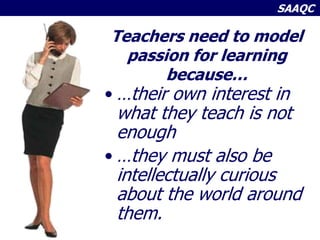
Teachers need to model
passion for learning
because…
• …their own interest in
what they teach is not
enough
• …they must also be
intellectually curious
about the world around
them.
SAAQC
Properly structured learning
experiences foster learning naturally
• This way, the teacher will:
– Provide them with opportunities to learn.
– Help them see the connection between
schoolwork and their lives
– Allow them ownership of their own learning and
accomplishments
– Account for individual styles and preferences.
SAAQC
Motivation Strategies that Work
(In a nutshell)
The strategies presented here assume a certain
philosophy of education: that a teacher’s
most important job is teaching students how
to learn and how to become independent
thinkers.
SAAQC
Motivation Strategies that Work
(In a nutshell)
• Organizing Instruction into integrated thematic skills
• Using cooperative learning and group approaches
• Recognizing and teaching to multiple intelligences
• Accommodating individual learning styles
• Stressing thinking skills over plain memorization
• Harnessing the power of technology
• Practicing authentic assessment of students learning
• Praising and encouraging students effectively
• Motivating students to value learning
• Acknowledging the importance of active teaching, engaged
time and academic learning time
• Using wise grouping practices
SAAQC
Children need activity
• Children need to be physically active in the classroom and that
children retain knowledge longer if they connect physically and
emotionally to the material.
• This also gives students a multisensory, multidimensional
mental model that’s easier to retain and retrieve.
• They experience the material more thoroughly.
SAAQC
A Teacher Succeeds when…
• …the interests and curiosity of the
student is fully maximized to boost their
effort to develop their model for
learning processes.
• …the successful student shares new
knowledge with others.
• …the successful student inspires others
by example.
SAAQC
The primary goal of schooling
is intellectual, not academic.
SAAQC
Intellectual vs. Academic
• Academic has to do with what people study.
• Intellectual means using your mind.
Fostering the intellect means
helping students develop their
capacity to play with ideas and to
take ideas seriously.
SAAQC
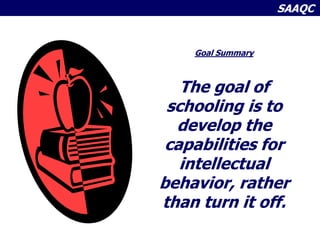
Goal Summary
The goal of
schooling is to
develop the
capabilities for
intellectual
behavior, rather
than turn it off.

Motivation in teaching and learning - saaqc

  • 1.
    SAAQC Motivation in Teaching andin Learning A report for St. Anthony Academy of Quezon City Teachers
  • 2.
    SAAQC Activity! Guess the luckynumber 1. Group yourselves into three 2. Ask for their nicknames and get the first letter of each person 3. Convert the alphabet into corresponding numbers 1. Ex. A=1, B=2, Z=26 4. Convert the letter into the equivalent number/s 5. Ask them if this one of the numbers is their lucky number 6. Note if yes or no. You only have 1 minute to do this!
  • 3.
    SAAQC What is Motivation? •Taken from the book Learning to Teach: – It is a process or behaviors that initiate, direct and sustain goal- oriented behavior.
  • 4.
    SAAQC Through Motivation • Thepersonal desire of the student must be directed to the successful attempt to learn. • Learners must be encouraged to take risks. • They must also understand that “not getting it the first time” is a part of succeeding.
  • 5.
    SAAQC “Do not trainchildren to learn by force and harshness but direct them to it by what amuses their minds, so that you may be better able to discover with accuracy the peculiar bent of the genius of each.” - Plato
  • 6.
    SAAQC Types of Motivation •Internal Motivation • External Motivation
  • 7.
    SAAQC Types of Motivation •Internal (Intrinsic) Motivation • Is fueled by curiosity, the desire for mastery, success, a sense of accomplishment, confidence in ability . • A sense of ownership and other factors within us.
  • 8.
    SAAQC Types of Motivation •Internal (Intrinsic) Motivation • Expresses the love of learning for learning sake. – This is a quality many students lose by the time they reach upper elementary grades.
  • 9.
    SAAQC Unfortunately, both successful andfailing students lose track at some point. • They stop being curious and lose their theoretical abilities due to the following misconceptions about school: – It is a place for them to find out what someone else wants from you. – A place where to appear (stand-out) and conform only.
  • 10.
    SAAQC Types of Motivation •Internal (Intrinsic) Motivation • Example: – One way to cultivate internal motivation is to teach students to recognize the relationship between effort and outcome. Just spell it out and model the effort outcome link in your own actions. Don’t assume students already understand the relationship.
  • 11.
    SAAQC Types of Motivation •External (Extrinsic) Motivation • It is suggested that external motivation be used instead as a means to help students develop internal motivation to learn and behave instead of the end. • The most important role then is to make students aware of the powerful social reinforcement given to those who try hard, learn and succeed.
  • 12.
    SAAQC Types of Motivation •External (Extrinsic) Motivation – External rewards result from completing an activity or behaving in a certain way.
  • 13.
    SAAQC Types of Motivation •External (Extrinsic) Motivation • Examples: good grades, teacher or parents praise, extra privileges or free time, public recognition, competition, even material goods such as stickers or candy. • Note: These expected or relied on rewards by many students get in the way of real learning.
  • 14.
    SAAQC Less of theExternal and more of the Internal Motivation • Kids deserve an engaging curriculum and a caring atmosphere so they can act on their natural desire to find out about stuff. • No kid deserves to be manipulated with externals so as to comply with what someone else wants.
  • 15.
    SAAQC Passion for Learning •Is not something you instill upon • It is something you have to keep from extinguishing
  • 16.
    SAAQC 5 ways thatteachers unintentionally discourage students • Setting overambitious expectations or standards that overwhelm students • Focusing on mistakes to motivate • Comparing one student to another • Making pessimistic interpretations • Dominating students learning experiences by helping too much
  • 17.
    SAAQC Teachers need tomodel passion for learning because… • …their own interest in what they teach is not enough • …they must also be intellectually curious about the world around them.
  • 18.
    SAAQC Properly structured learning experiencesfoster learning naturally • This way, the teacher will: – Provide them with opportunities to learn. – Help them see the connection between schoolwork and their lives – Allow them ownership of their own learning and accomplishments – Account for individual styles and preferences.
  • 19.
    SAAQC Motivation Strategies thatWork (In a nutshell) The strategies presented here assume a certain philosophy of education: that a teacher’s most important job is teaching students how to learn and how to become independent thinkers.
  • 20.
    SAAQC Motivation Strategies thatWork (In a nutshell) • Organizing Instruction into integrated thematic skills • Using cooperative learning and group approaches • Recognizing and teaching to multiple intelligences • Accommodating individual learning styles • Stressing thinking skills over plain memorization • Harnessing the power of technology • Practicing authentic assessment of students learning • Praising and encouraging students effectively • Motivating students to value learning • Acknowledging the importance of active teaching, engaged time and academic learning time • Using wise grouping practices
  • 21.
    SAAQC Children need activity •Children need to be physically active in the classroom and that children retain knowledge longer if they connect physically and emotionally to the material. • This also gives students a multisensory, multidimensional mental model that’s easier to retain and retrieve. • They experience the material more thoroughly.
  • 22.
    SAAQC A Teacher Succeedswhen… • …the interests and curiosity of the student is fully maximized to boost their effort to develop their model for learning processes. • …the successful student shares new knowledge with others. • …the successful student inspires others by example.
  • 23.
    SAAQC The primary goalof schooling is intellectual, not academic.
  • 24.
    SAAQC Intellectual vs. Academic •Academic has to do with what people study. • Intellectual means using your mind. Fostering the intellect means helping students develop their capacity to play with ideas and to take ideas seriously.
  • 25.
    SAAQC Goal Summary The goalof schooling is to develop the capabilities for intellectual behavior, rather than turn it off.