A TRILOGY
    OF         By: LATREIA E. ESTABILLO
            MAED-GenEd, MSU Grad. School

EFFECTIVE       EDUC 201 PROF. A. PULIDO
The illiterate of the twenty-first century will not be those who cannot read
  and write, but those who cannot learn, unlearn, and relearn. ––Alvin
                                     Toffler


 "Effective teaching produces beneficial
and purposeful student learning through
    ATTRIBUTES TOWARDS
   the use of appropriate procedures"
  THE LEARNING PROCESS
             (Diamond; 1987).
According to the book by Wotruba and Wright (1975)
             about teaching attributes:

          • Quality teachers socialize with students.
     • T. Dix (1993) defines the socialization process as communicating
        Quality teachers model positive social behavior
       and reinforcing positive expectations, behavior, and attributes.
      • Quality teachers students and reward positive
 Teachers must demonstrate forproject the thinking and decision-making
 processes that work toward expectations. good. They must also model
                              a common social
          respectful social skills and workable coping strategies.
      • Quality teachers project authoritative teaching
      Teachers must expect students to act morally and responsibly.
  Additionally, successful teachers reward and reinforce positive behavior
 Successful teachers are leaders who exercise sound decision-making without
                            and pro-social traits.
 being despotic or suppressive. Students must understand clearly the reasons
behind a teacher's demands. Authoritative teachers minimize power struggles,
check for understanding, secure student commitment to change, help students
 cope with difficult situations, and encourage students to solve problems and
                              regulate themselves
• Quality teachers are effective counselors.
TheSuccessful teachers help are patient. Successful is, he shouldwillthe
   • teacher needs to be empathic to teach effectively, that teachers see
      Quality teachers students adjust and develop skills in personal
pupils he teaches from pupils' points personalnot from meaningful listening,
  relationships, academics, conflicts, of view, control, his realistic of view.
   persistently work with students to achieve own point goals.
                   self-reflection, and personal responsibility.
Such empathetic approach willknowthelevel. Adeyanju A. ethumanly with the
  Attitudes affect teacher's performance teacher relate more al (2004) opine
      • Quality teachers make their content. Not only are
 pupils,teacher who their problems attitude towards teaching and towards his
 that a understandteachers knowledgeable, they convey ateacher
                             positive and teach more effectively than the true
     successful has a understand the learner and his problems.
             who does not
     pupils will obviously teach more effectively than the teacher who has
    developedof learning, thetowards the learners he has to deal with. 
        love negative attitudes excitement of discovery, and a
 Since empathy improves natural inquisitiveness. pupils, there is better
                             the teacher's understanding of
According to Dunhill (2000), a good and this will leads to effectivegeneral knowledge
  Quadri et al (2004) contribute teacher good first possess a wide teaching.  and
       teacher-pupil interaction that a must teacher must be caring, kind
and within the confinespupils. general knowledge, a sound understanding of the subject
firm in dealing with of this Firmness means the ability to ensure fair play and
                gives equal treatment to all students in his class. 
                            he is to teach in the classroom.
Quadri K. et al (2004) corroborate that a good teacher must be well knowledge versed in
his area of specialization, must know which to teach, when to teach and how to teach.
• Quality teachers have fun with their students.
 Teachers are •
  Their classrooms are to have good human the teacher and the students can
              expected cheerful, where both relationship, highly tolerant and
                 Quality teachers embrace diversity.
 express a sensebalanced. A goodis an understanding that learning is a joyful
   emotionally of humor. There personality trait of an effective teacher is
Teacherunderstand profound as an endeavor. assists the egos. to achievemust
 perseverance.•Perseverance knowledge of the learner backgrounds and have
   They must have that students come from different (Dunhill 2000). He his
                 Quality teachers have beliefs. teacher
                                    attribute
                                               strong
                          different faces opposition from other teachers in the
                                    values and of different home environments
always remember that thewhen he are product
 instructional goals even learners
     they have different potentials (Farrant 1999). 
                             school and self-assuredness, and equilibrium
 and Teachers maintain a sense of calm,opportunity to develop their learning
                                   interests. 
 throughout the conflicts that inevitably arise in working with young people.
    They don't take student behavior personally, rather they work to solve
                        problems and adjust behavior.
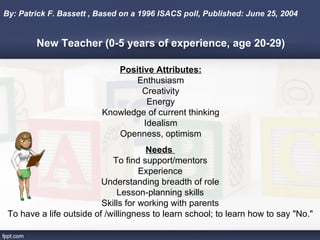
By: Patrick F. Bassett , Based on a 1996 ISACS poll, Published: June 25, 2004


        New Teacher (0-5 years of experience, age 20-29)

                             Positive Attributes:
                                 Enthusiasm
                                  Creativity
                                    Energy
                          Knowledge of current thinking
                                   Idealism
                             Openness, optimism
                                      Needs
                             To find support/mentors
                                     Experience
                          Understanding breadth of role
                               Lesson-planning skills
                          Skills for working with parents
 To have a life outside of /willingness to learn school; to learn how to say "No."
Mid-career Teacher (6-20 years of experience, age 30-39)


                            Positive Attributes:
                           Experience, expertise
                                Confidence
                 Bridge between old and new, continuity
  Loyalty, stability, role-modeling, ability to take on new assignments


                              Needs:
                 Leadership, mentoring opportunities
                  Understanding their complex lives
                            Recognition
                              Money
Veteran Teacher (21+ years of experience, age 40-69+)

                     Positive Attributes:
            Wisdom (about kids, families, school)
              Stability (psychological, personal)
             Sense of tradition, history of school
                           Mentoring
                 Link to outside community


                           Needs:
             Training for challenges of change
                       Understanding
                           Security
Debriefing Points To Ponder:
1. New teachers are expected to bring vitality; scholarly qualities
                   are not the primary issue.
 2. Heads recognize that new teachers need help; new teachers
                should not be afraid to ask for it.
 3. Mid-career teachers run the show; pay attention to what they
say and how they operate (and on a bad day, stay clear, because
                  often life is tough for them).
 4. Veteran teachers are an invaluable resource; don't discount
                               them.
Five Attitudes of Effective
         Teachers
  Bonni Gourneau, University of North Dakota
• Demonstrating Caring and Kindness
  Research by Larson and Silverman (2000) and Noddings
                   • Sharing Responsibility
    (1984) has emphasized the importance of developing a
            •
 Carlsonand respectful relationshipteachers’ learning and
  caring and Sensitively Claxton (1996) believe that the
   Richardson Hastie (1997) student-directed and students’
   Zimmerman(1999) statesAccepting Diversity
                  (1990) and believe between teachers and
Nel (1992)need to that it wouldbe in support of toward that
 agendas process overlap and points the all constructivist-
  learning stated should be organized in such each other,
  curricula have become focal seem for trend a way more
                            students.
          • attitudes inIndividualized practices.
        and the end result and learning Instruction
             Fostering teachers for positive learning.
pluralisticbased teachingwould be atheir ownlearning into
     students take responsibility needs to be translated
aStudents appreciated environment. helped them succeed
                  • Encouragingwho
                          teachers
   strong and clear commitment to multicultural education,
                                    Creativity
 which ultimately couldexperiences. Teachers who used
      with their learning result in positive effects on specific
intimidation in stresses the class and attitudes.
   This attitude front ofbehaviors resulted in a reluctance to
              classroom the importance of stimulating the
                            volunteer.
   students’ creativity. The students appreciated and were
 personally motivated when teachers designed lessons that
         considered their interests, skills, and needs.
There is potential in every student, and a teacher’s attitude and
actions can leave lasting impressions. Teachers need to be risk
  takers by being themselves and by trusting their students.
ELEMENTS OF TEACHING
    EFFECTIVENESS
   Teaching effectiveness is important because effective
teaching helps student learning. It has become even more
important as the emphasis on quality in higher education
                      has increased.
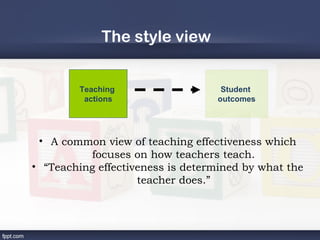
The style view


        Teaching                   Student
         actions                  outcomes


 • A common view of teaching effectiveness which
           focuses on how teachers teach.
• “Teaching effectiveness is determined by what the
                    teacher does.”
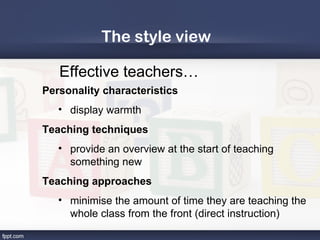
The style view

   Effective teachers…
Personality characteristics
   • display warmth
Teaching techniques
   • provide an overview at the start of teaching
     something new
Teaching approaches
   • minimise the amount of time they are teaching the
     whole class from the front (direct instruction)
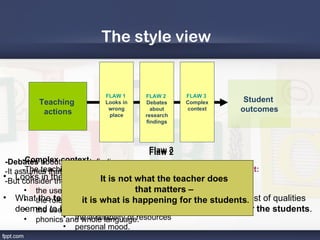
The style view


                           FLAW 1     FLAW 2     FLAW 3
         Teaching          Looks in   Debates    Complex        Student
          actions           wrong       about    context       outcomes
                            place     research
                                      findings


                                       Flaw 3
                                       Flaw 2
 -Debates aboutcontext findings
       -Complex research
                                              Flaw 1
       -The teaching – outcomes relationship is complicated by context:
 -It assumes that the research generalizations are unequivocal.
• Looks in the•wrong place not what the teacher does
 -But consider the debates of is students
                               It the
                       nature about:
        • the use •of rewards,
                       the subject beingthat matters –
                                            taught
• Whatthe role •of questioningday happening forpredetermined. list of qualities
        • the teacher demonstrates (against a the students
                       the time of inis
                         it is what discussion,
     deemed use •of “effective”)of the teaching environment
                       the nature rather than in history
        • the to be storytelling and narrative what is happening for the students.
        • phonics•and whole language.
                       the availability of resources
                  • personal mood.
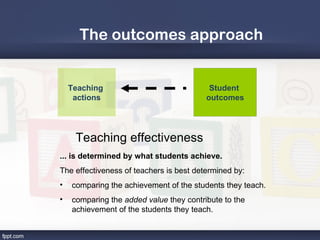
The outcomes approach


    Teaching                              Student
     actions                             outcomes


     Teaching effectiveness
... is determined by what students achieve.
The effectiveness of teachers is best determined by:
•   comparing the achievement of the students they teach.
•   comparing the added value they contribute to the
    achievement of the students they teach.
The outcomes approach


      Teaching             FLAW 1      FLAW 2          FLAW 3        Student
                             Prior    Diminishes     Measurement
       actions            knowledge     student       of learning   outcomes
                                      contribution


                                       Flaw 3 2
                                         Flaw
•Linking achievement to teaching actionsFlaw 1 of teaching of the student’s:
             The complexities of measurement:
                       While the assessment diminishes the role
      •Prior•knowledge is a powerful influence on student
                personal •organisation,must factors to achievement.
                             socio-economic attend
                     effectiveness
            • interest, • bias toa teacher’s role in developing
                 outcomes and the easily measured
            •            •
                 compare external assistancenot determine
      •Unfair tomotivation, summative achievements of students and to
                      these, outcomes do
      attributepersonal•attributions of success or failure, teaching.
            •                “black” box.
                 the difference to superior or inferior
                                    effectiveness.
            • beliefs about and motivations for particular subjects and tasks.
•Influence rather than change.
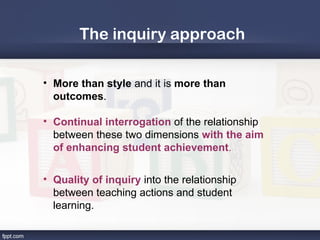
The inquiry approach

• More than style and it is more than
  outcomes.

• Continual interrogation of the relationship
  between these two dimensions with the aim
  of enhancing student achievement.

• Quality of inquiry into the relationship
  between teaching actions and student
  learning.
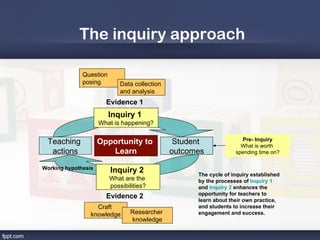
The inquiry approach

              Question
              posing         Data collection
                             and analysis
                       Evidence 1
                         Inquiry 1
                     What is happening?

                                                                     Pre- Inquiry
 Teaching            Opportunity to             Student              What is worth
  actions               Learn                  outcomes            spending time on?

Working hypothesis
                         Inquiry 2                   The cycle of inquiry established
                         What are the                by the processes of Inquiry 1
                         possibilities?              and Inquiry 2 enhances the
                                                     opportunity for teachers to
                       Evidence 2
                                                     learn about their own practice,
                   Craft                             and students to increase their
                 knowledge       Researcher          engagement and success.
                                 knowledge
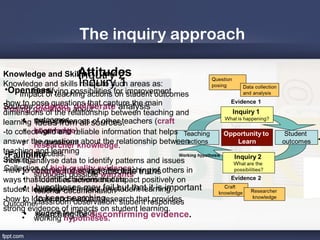
The inquiry approach

Knowledge and Skills    Attitudes
                        Inquiry 2
Knowledge and skills Inquiry 1 areas as:
                         relate to such
 •Openness teaching actions for improvement
         Identifying possibilities on student outcomes
     Impact of
-how to pose questions that capture the main
       •
Sources: ordered, about:
 Posing questions deliberate analysis
dimensions of the relationship between teaching and
       • ideas from
      •• outcomes all of other teachers (craft
learning the experiences sources.
       • knowledge)
          alignment
-to collect valid and reliable information that helps
answer the questions about the relationship between
       • engagement
      • researcher knowledge.
teaching success.
 •Fallibility learning
       • and
Seeking:
-how to analyse data to identify patterns and issues
 Collection of high quality evidence: truths
-how •• observe and analyse the teaching of others in
      to conjectures not absolute
          strongest possible warrants
ways • student achievement data
       that identifies actions that impact positively on
      •• evidence of impact on student learning.
student learning documentation but that it is important
          hypotheses may fail
       • teacher
-how to locate andsearching
          to keep observation: student responses
       • classroomevaluate research that provides
Outcome:
strong evidence of impacts on student learning.
       • student feedback.
      •• working hypotheses.
          searching for disconfirming evidence.
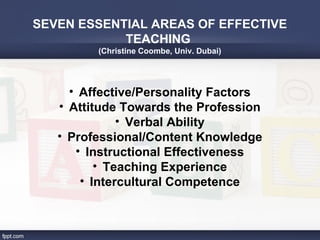
SEVEN ESSENTIAL AREAS OF EFFECTIVE
            TEACHING
         (Christine Coombe, Univ. Dubai)


     • Affective/Personality Factors
   • Attitude Towards the Profession
              • Verbal Ability
   • Professional/Content Knowledge
      • Instructional Effectiveness
          • Teaching Experience
       • Intercultural Competence
“The art of teaching is the art of awakening the natural
               curiosity of young minds.”
      Anatole France, French novelist and poet, 19th century
Trilogy effective teaching

Trilogy effective teaching

  • 1.
    A TRILOGY OF By: LATREIA E. ESTABILLO MAED-GenEd, MSU Grad. School EFFECTIVE EDUC 201 PROF. A. PULIDO
  • 2.
    The illiterate ofthe twenty-first century will not be those who cannot read and write, but those who cannot learn, unlearn, and relearn. ––Alvin Toffler "Effective teaching produces beneficial and purposeful student learning through ATTRIBUTES TOWARDS the use of appropriate procedures" THE LEARNING PROCESS (Diamond; 1987).
  • 3.
    According to thebook by Wotruba and Wright (1975) about teaching attributes: • Quality teachers socialize with students. • T. Dix (1993) defines the socialization process as communicating Quality teachers model positive social behavior and reinforcing positive expectations, behavior, and attributes. • Quality teachers students and reward positive Teachers must demonstrate forproject the thinking and decision-making processes that work toward expectations. good. They must also model a common social respectful social skills and workable coping strategies. • Quality teachers project authoritative teaching Teachers must expect students to act morally and responsibly. Additionally, successful teachers reward and reinforce positive behavior Successful teachers are leaders who exercise sound decision-making without and pro-social traits. being despotic or suppressive. Students must understand clearly the reasons behind a teacher's demands. Authoritative teachers minimize power struggles, check for understanding, secure student commitment to change, help students cope with difficult situations, and encourage students to solve problems and regulate themselves
  • 4.
    • Quality teachersare effective counselors. TheSuccessful teachers help are patient. Successful is, he shouldwillthe • teacher needs to be empathic to teach effectively, that teachers see Quality teachers students adjust and develop skills in personal pupils he teaches from pupils' points personalnot from meaningful listening, relationships, academics, conflicts, of view, control, his realistic of view. persistently work with students to achieve own point goals. self-reflection, and personal responsibility. Such empathetic approach willknowthelevel. Adeyanju A. ethumanly with the Attitudes affect teacher's performance teacher relate more al (2004) opine • Quality teachers make their content. Not only are pupils,teacher who their problems attitude towards teaching and towards his that a understandteachers knowledgeable, they convey ateacher positive and teach more effectively than the true successful has a understand the learner and his problems. who does not pupils will obviously teach more effectively than the teacher who has developedof learning, thetowards the learners he has to deal with.  love negative attitudes excitement of discovery, and a Since empathy improves natural inquisitiveness. pupils, there is better the teacher's understanding of According to Dunhill (2000), a good and this will leads to effectivegeneral knowledge Quadri et al (2004) contribute teacher good first possess a wide teaching.  and teacher-pupil interaction that a must teacher must be caring, kind and within the confinespupils. general knowledge, a sound understanding of the subject firm in dealing with of this Firmness means the ability to ensure fair play and gives equal treatment to all students in his class.  he is to teach in the classroom. Quadri K. et al (2004) corroborate that a good teacher must be well knowledge versed in his area of specialization, must know which to teach, when to teach and how to teach.
  • 5.
    • Quality teachershave fun with their students. Teachers are • Their classrooms are to have good human the teacher and the students can expected cheerful, where both relationship, highly tolerant and Quality teachers embrace diversity. express a sensebalanced. A goodis an understanding that learning is a joyful emotionally of humor. There personality trait of an effective teacher is Teacherunderstand profound as an endeavor. assists the egos. to achievemust perseverance.•Perseverance knowledge of the learner backgrounds and have They must have that students come from different (Dunhill 2000). He his Quality teachers have beliefs. teacher attribute strong different faces opposition from other teachers in the values and of different home environments always remember that thewhen he are product instructional goals even learners they have different potentials (Farrant 1999).  school and self-assuredness, and equilibrium and Teachers maintain a sense of calm,opportunity to develop their learning interests.  throughout the conflicts that inevitably arise in working with young people. They don't take student behavior personally, rather they work to solve problems and adjust behavior.
  • 6.
    By: Patrick F.Bassett , Based on a 1996 ISACS poll, Published: June 25, 2004 New Teacher (0-5 years of experience, age 20-29) Positive Attributes: Enthusiasm Creativity Energy Knowledge of current thinking Idealism Openness, optimism Needs To find support/mentors Experience Understanding breadth of role Lesson-planning skills Skills for working with parents To have a life outside of /willingness to learn school; to learn how to say "No."
  • 7.
    Mid-career Teacher (6-20years of experience, age 30-39) Positive Attributes: Experience, expertise Confidence Bridge between old and new, continuity Loyalty, stability, role-modeling, ability to take on new assignments Needs: Leadership, mentoring opportunities Understanding their complex lives Recognition Money
  • 8.
    Veteran Teacher (21+years of experience, age 40-69+) Positive Attributes: Wisdom (about kids, families, school) Stability (psychological, personal) Sense of tradition, history of school Mentoring Link to outside community Needs: Training for challenges of change Understanding Security
  • 9.
    Debriefing Points ToPonder: 1. New teachers are expected to bring vitality; scholarly qualities are not the primary issue. 2. Heads recognize that new teachers need help; new teachers should not be afraid to ask for it. 3. Mid-career teachers run the show; pay attention to what they say and how they operate (and on a bad day, stay clear, because often life is tough for them). 4. Veteran teachers are an invaluable resource; don't discount them.
  • 10.
    Five Attitudes ofEffective Teachers Bonni Gourneau, University of North Dakota
  • 11.
    • Demonstrating Caringand Kindness Research by Larson and Silverman (2000) and Noddings • Sharing Responsibility (1984) has emphasized the importance of developing a • Carlsonand respectful relationshipteachers’ learning and caring and Sensitively Claxton (1996) believe that the Richardson Hastie (1997) student-directed and students’ Zimmerman(1999) statesAccepting Diversity (1990) and believe between teachers and Nel (1992)need to that it wouldbe in support of toward that agendas process overlap and points the all constructivist- learning stated should be organized in such each other, curricula have become focal seem for trend a way more students. • attitudes inIndividualized practices. and the end result and learning Instruction Fostering teachers for positive learning. pluralisticbased teachingwould be atheir ownlearning into students take responsibility needs to be translated aStudents appreciated environment. helped them succeed • Encouragingwho teachers strong and clear commitment to multicultural education, Creativity which ultimately couldexperiences. Teachers who used with their learning result in positive effects on specific intimidation in stresses the class and attitudes. This attitude front ofbehaviors resulted in a reluctance to classroom the importance of stimulating the volunteer. students’ creativity. The students appreciated and were personally motivated when teachers designed lessons that considered their interests, skills, and needs.
  • 12.
    There is potentialin every student, and a teacher’s attitude and actions can leave lasting impressions. Teachers need to be risk takers by being themselves and by trusting their students.
  • 13.
    ELEMENTS OF TEACHING EFFECTIVENESS Teaching effectiveness is important because effective teaching helps student learning. It has become even more important as the emphasis on quality in higher education has increased.
  • 14.
    The style view Teaching Student actions outcomes • A common view of teaching effectiveness which focuses on how teachers teach. • “Teaching effectiveness is determined by what the teacher does.”
  • 15.
    The style view Effective teachers… Personality characteristics • display warmth Teaching techniques • provide an overview at the start of teaching something new Teaching approaches • minimise the amount of time they are teaching the whole class from the front (direct instruction)
  • 16.
    The style view FLAW 1 FLAW 2 FLAW 3 Teaching Looks in Debates Complex Student actions wrong about context outcomes place research findings Flaw 3 Flaw 2 -Debates aboutcontext findings -Complex research Flaw 1 -The teaching – outcomes relationship is complicated by context: -It assumes that the research generalizations are unequivocal. • Looks in the•wrong place not what the teacher does -But consider the debates of is students It the nature about: • the use •of rewards, the subject beingthat matters – taught • Whatthe role •of questioningday happening forpredetermined. list of qualities • the teacher demonstrates (against a the students the time of inis it is what discussion, deemed use •of “effective”)of the teaching environment the nature rather than in history • the to be storytelling and narrative what is happening for the students. • phonics•and whole language. the availability of resources • personal mood.
  • 17.
    The outcomes approach Teaching Student actions outcomes Teaching effectiveness ... is determined by what students achieve. The effectiveness of teachers is best determined by: • comparing the achievement of the students they teach. • comparing the added value they contribute to the achievement of the students they teach.
  • 18.
    The outcomes approach Teaching FLAW 1 FLAW 2 FLAW 3 Student Prior Diminishes Measurement actions knowledge student of learning outcomes contribution Flaw 3 2 Flaw •Linking achievement to teaching actionsFlaw 1 of teaching of the student’s: The complexities of measurement: While the assessment diminishes the role •Prior•knowledge is a powerful influence on student personal •organisation,must factors to achievement. socio-economic attend effectiveness • interest, • bias toa teacher’s role in developing outcomes and the easily measured • • compare external assistancenot determine •Unfair tomotivation, summative achievements of students and to these, outcomes do attributepersonal•attributions of success or failure, teaching. • “black” box. the difference to superior or inferior effectiveness. • beliefs about and motivations for particular subjects and tasks. •Influence rather than change.
  • 19.
    The inquiry approach •More than style and it is more than outcomes. • Continual interrogation of the relationship between these two dimensions with the aim of enhancing student achievement. • Quality of inquiry into the relationship between teaching actions and student learning.
  • 20.
    The inquiry approach Question posing Data collection and analysis Evidence 1 Inquiry 1 What is happening? Pre- Inquiry Teaching Opportunity to Student What is worth actions Learn outcomes spending time on? Working hypothesis Inquiry 2 The cycle of inquiry established What are the by the processes of Inquiry 1 possibilities? and Inquiry 2 enhances the opportunity for teachers to Evidence 2 learn about their own practice, Craft and students to increase their knowledge Researcher engagement and success. knowledge
  • 21.
    The inquiry approach Knowledgeand Skills Attitudes Inquiry 2 Knowledge and skills Inquiry 1 areas as: relate to such •Openness teaching actions for improvement Identifying possibilities on student outcomes Impact of -how to pose questions that capture the main • Sources: ordered, about: Posing questions deliberate analysis dimensions of the relationship between teaching and • ideas from •• outcomes all of other teachers (craft learning the experiences sources. • knowledge) alignment -to collect valid and reliable information that helps answer the questions about the relationship between • engagement • researcher knowledge. teaching success. •Fallibility learning • and Seeking: -how to analyse data to identify patterns and issues Collection of high quality evidence: truths -how •• observe and analyse the teaching of others in to conjectures not absolute strongest possible warrants ways • student achievement data that identifies actions that impact positively on •• evidence of impact on student learning. student learning documentation but that it is important hypotheses may fail • teacher -how to locate andsearching to keep observation: student responses • classroomevaluate research that provides Outcome: strong evidence of impacts on student learning. • student feedback. •• working hypotheses. searching for disconfirming evidence.
  • 22.
    SEVEN ESSENTIAL AREASOF EFFECTIVE TEACHING (Christine Coombe, Univ. Dubai) • Affective/Personality Factors • Attitude Towards the Profession • Verbal Ability • Professional/Content Knowledge • Instructional Effectiveness • Teaching Experience • Intercultural Competence
  • 23.
    “The art ofteaching is the art of awakening the natural curiosity of young minds.” Anatole France, French novelist and poet, 19th century