Austin-Travis County
Health & Human Services Department
Environmental Health Services Division
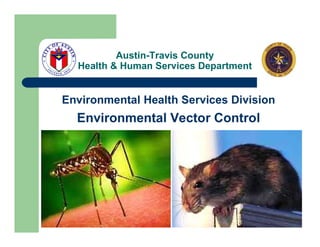
Environmental Vector Control
Goal
 Reduce human exposure to organisms
that transmit pathogens (vectors).
Program Staff & Service Areas
Supervisor – Sabrina Vidaurri, MS, R.S.
6 - Full-time field staff (year-round)
1 - Part-time field staff (seasonal - May through September)
All Program staff hold a Non-Commercial Political Subdivision
Pesticide Applicator license issued by the Texas Department
of Agriculture for health-related pest control (rodent & mosquito).
6 Districts within
 City of Austin
 Unincorporated Areas
in Travis County
Mosquito Control
Mosquitoes in Austin/Travis County of
Public Health importance
 The female mosquito bites for a blood meal
to produce eggs
 The mosquito may transmit arboviruses that
can cause illness to humans
– Culex sp.
 West Nile Virus, Saint Louise Encephalitis
– Aedes sp.
 Dengue, Chikungunya, Zika
Life Cycle
The length of time for the entire
life cycle to occur depends on
species and temperature. In
prime conditions this cycle can
occur in as little as four days or as
long as a month. For example the
Aedes mosquito can complete the
entire life cycle in about 8-10
days.
Culex quinquefasciatus
 Common name:
Southern house
mosquito
 Female
– Dusk to dawn feeder
– Prefers an avian blood
meal but will also feed
on other mammals
– Lays eggs in rafts in
stagnant, organic-rich
water
Aedes sp.
 Aedes ablopitus (Asian tiger mosquito)
Aedes aegypti (Yellow fever mosquito)
 Female
– Day feeder
– Prefers a human blood meal but will also feed on other
mammals
– Lays single eggs on sides of water holding containers
 Examples: flowerpots, spare tires
Aedes aegypti Aedes albopictus
Aedes sp.
Integrated Mosquito Management
(IMM)
 Site assessments
 Surveillance
 Public Education
 Application of control measures
 Evaluation of effectiveness
DEFEND YOURSELF!
 Clean rain gutters and
downspouts.
 Cover or discard old
tires.
 Eliminate all standing
stagnant water.
 Clean birdbaths and
wading pools weekly.
 Keep grass and
vegetation trimmed.
 Store containers so
they don’t hold water.
 Repair leaky faucets.
 Follow the 3 D’s
– Drain
– Dress
– DEET
Site Assessments
 Standing/stagnant water
 Dense vegetation
 Adult mosquitoes/larvae
Surveillance
 Larvae collection
 Adult mosquito collection
Surveillance
 Larvae
– Dipper
 Adults
– CDC Gravid trap
 Submitted to TX DSHS lab
Surveillance
Surveillance
STINKY WATER RECIPE (for 55 Gallons)
1 lb. - horse manure (semi-dry), 2 ounces - dried brewers yeast
2 ounces - egg white powder, 1 lb. - straw or grass clippings (dry)
1 – Small burlap bag*
Place manure, brewer’s yeast and egg white powder into a
burlap bag and hand mix together well.
Place a rock or fishing weight in the bottom of the bag
that’s large enough to weigh it down.
Place straw or grass clippings in the burlap bag on top of
the manure, brewer’s yeast and egg white powder mixture.
Fill the barrel with water.
Twist the burlap bag and securely attach a sufficient length
of cord to allow the bag to hang down half way in the barrel
and lowered as the water is drawn down.
Let stand for 3 – 4 days before use.
* Double bagging is not necessary
Surveillance
 Larvae
– Identify species
– GPS locations for GIS
mapping
– Tailor larviciding to reduce
dependence on adult
mosquito control
– Historical records of
seasonal mosquito activity
 Adult
– Use data to assess disease
presence
– ID geographic risk areas
– Assess need for and timing
of controls measures
– Monitor control measure
effectiveness to improve
prevention
– Better understand
transmission cycles and
vector species
Public Education
 Environmental Health Services offers
– Site Assessments
– Presentations upon request
– Regularly hands out flyers on reducing mosquito
breeding to public
– Partners with other COA Departments
Application of control
measures
 Biological Controls
– Source reduction
 Cultural/Physical Controls
 Chemical Controls
Biological Controls
(Source Reduction)
 Gambusia affinis
(Mosquito fish)
 B.t.i. (Bacillus thuringiensis)
– Larvacide that kills mosquitoes
during the larval stage or
development. It is made from a
naturally occurring bacterium in the
soil. The product kills larvae by
damaging their digestive system.
Biological Controls
(Source Reduction)
 FourStar (Briquets & Granular)
– Bacillus sphaericus & Bacillus thruingiensis subspceies israelensis
– Larvacide that kills mosquitoes during the larval stage or
development
 Attracitve Toxic Sugar
– The special combination of fruit extracts in the formula acts as a
bait to attract mosquitoes searching for a sugar meal, and the
encapsulated garlic is a gut toxin
Cultural/Physical Controls
(Source Reduction)
 Stormwater Ponds
– Retention/detention
– Water quality
 Waste Disposal
– Landfills
– Sanitary sewer
 Drainage
– Land grading
– Barrier placement
 Maintenance
– Lighting
– Structural repairs
Chemical Controls
Adulticides
Applied with truck mounted
ultra-low volume (ULV) cold
fogging unit (limited basis)
 Scourge
- Resmethrin
(synthetic pyrethroid)*
 Bio-Mist
- Permethrin
(synthetic pyrethroid)*
Larvicides
Applied at specific locations by
a licensed applicator
 Altosid (pellets/briquettes)
- Methoprene**
* man-made version of the chemical
found in chrysanthemum flowers
** insect growth regulator
Thermal Fogger
ULV Cold Fogger
Mosquito Misting Systems
 According to the EPA in November 25, 2014
– “Outdoor residential misting systems have not yet been studied sufficiently to
document their effectiveness in controlling mosquitoes or other yard and
garden pests, nor have they been scientifically proven to control or prevent the
spread of West Nile Virus or other diseases.”
 The American Mosquito Control Association discourages mosquito misting
systems due to:
– Unnecessary insecticide use
– Lack of efficacy data
– Non-target impacts (bees, dragon flies)
– Promotion of insecticide resistance (when using Pyrethrins or other chemical
control)
– Risk of pesticide exposure
– Incompatible with integrated pest management practices
Plants to Consider
 In planning your garden consider planting
these plants
– Marigolds
– Basil
– Lemon Balm or Horse Mint (Is invasive, consider planting in
pots)
– Catnip (Is invasive, consider planting in pots)
– Lavender
– Floss Flower
Helpful Sites
 American Mosquito Control Association
– http://www.mosquito.org
 Texas A&M Agrilife Extension
– http://citybugs.tamu.edu
 EPA Mosquito Control
– http://www2.epa.gov/mosquitocontrol
 National Pesticide Information Center
– http://npic.orst.edu/index.html
Rodent Control
Rodent Component
(Non-regulatory)
The Rodent component of the Program involves activities
related to the control of commensal rodents. These animals
are not only responsible for substantial property damage;
they may also transmit several diseases of public health
concern including murine typhus, plague, salmonellosis,
trichinosis, leptospirosis and rat-bite fever. State issued non-
commercial pesticide applicator license limits the provision of
Program services to individual residential property owners
only.
Rodent Site Assessments
IPM (Integrated Pest Management) Elements
 Inspection
 Identification
 Sanitation
 Rodent Proofing (exclusion)
 Trapping & Baiting
Rodent Identification
Rodent Exclusion
Austin-Travis County
Health & Human Services Department
Environmental Health Services Division
Environmental Vector Control
Questions
Sabrina Vidaurri, MS, R.S., Supervisor
512-978-0317
Sabrina.vidaurri@austintexas.gov
Program website:
https://www.austintexas.gov/department/environmental-vector-
control

Mosquito and Rodent Control

  • 1.
    Austin-Travis County Health &Human Services Department Environmental Health Services Division Environmental Vector Control
  • 2.
    Goal  Reduce humanexposure to organisms that transmit pathogens (vectors).
  • 3.
    Program Staff &Service Areas Supervisor – Sabrina Vidaurri, MS, R.S. 6 - Full-time field staff (year-round) 1 - Part-time field staff (seasonal - May through September) All Program staff hold a Non-Commercial Political Subdivision Pesticide Applicator license issued by the Texas Department of Agriculture for health-related pest control (rodent & mosquito). 6 Districts within  City of Austin  Unincorporated Areas in Travis County
  • 4.
  • 5.
    Mosquitoes in Austin/TravisCounty of Public Health importance  The female mosquito bites for a blood meal to produce eggs  The mosquito may transmit arboviruses that can cause illness to humans – Culex sp.  West Nile Virus, Saint Louise Encephalitis – Aedes sp.  Dengue, Chikungunya, Zika
  • 6.
    Life Cycle The lengthof time for the entire life cycle to occur depends on species and temperature. In prime conditions this cycle can occur in as little as four days or as long as a month. For example the Aedes mosquito can complete the entire life cycle in about 8-10 days.
  • 7.
    Culex quinquefasciatus  Commonname: Southern house mosquito  Female – Dusk to dawn feeder – Prefers an avian blood meal but will also feed on other mammals – Lays eggs in rafts in stagnant, organic-rich water
  • 8.
    Aedes sp.  Aedesablopitus (Asian tiger mosquito) Aedes aegypti (Yellow fever mosquito)  Female – Day feeder – Prefers a human blood meal but will also feed on other mammals – Lays single eggs on sides of water holding containers  Examples: flowerpots, spare tires
  • 9.
    Aedes aegypti Aedesalbopictus Aedes sp.
  • 10.
    Integrated Mosquito Management (IMM) Site assessments  Surveillance  Public Education  Application of control measures  Evaluation of effectiveness
  • 11.
    DEFEND YOURSELF!  Cleanrain gutters and downspouts.  Cover or discard old tires.  Eliminate all standing stagnant water.  Clean birdbaths and wading pools weekly.  Keep grass and vegetation trimmed.  Store containers so they don’t hold water.  Repair leaky faucets.  Follow the 3 D’s – Drain – Dress – DEET
  • 12.
    Site Assessments  Standing/stagnantwater  Dense vegetation  Adult mosquitoes/larvae
  • 19.
    Surveillance  Larvae collection Adult mosquito collection
  • 20.
    Surveillance  Larvae – Dipper Adults – CDC Gravid trap  Submitted to TX DSHS lab
  • 21.
  • 22.
    Surveillance STINKY WATER RECIPE(for 55 Gallons) 1 lb. - horse manure (semi-dry), 2 ounces - dried brewers yeast 2 ounces - egg white powder, 1 lb. - straw or grass clippings (dry) 1 – Small burlap bag* Place manure, brewer’s yeast and egg white powder into a burlap bag and hand mix together well. Place a rock or fishing weight in the bottom of the bag that’s large enough to weigh it down. Place straw or grass clippings in the burlap bag on top of the manure, brewer’s yeast and egg white powder mixture. Fill the barrel with water. Twist the burlap bag and securely attach a sufficient length of cord to allow the bag to hang down half way in the barrel and lowered as the water is drawn down. Let stand for 3 – 4 days before use. * Double bagging is not necessary
  • 23.
    Surveillance  Larvae – Identifyspecies – GPS locations for GIS mapping – Tailor larviciding to reduce dependence on adult mosquito control – Historical records of seasonal mosquito activity  Adult – Use data to assess disease presence – ID geographic risk areas – Assess need for and timing of controls measures – Monitor control measure effectiveness to improve prevention – Better understand transmission cycles and vector species
  • 24.
    Public Education  EnvironmentalHealth Services offers – Site Assessments – Presentations upon request – Regularly hands out flyers on reducing mosquito breeding to public – Partners with other COA Departments
  • 25.
    Application of control measures Biological Controls – Source reduction  Cultural/Physical Controls  Chemical Controls
  • 26.
    Biological Controls (Source Reduction) Gambusia affinis (Mosquito fish)  B.t.i. (Bacillus thuringiensis) – Larvacide that kills mosquitoes during the larval stage or development. It is made from a naturally occurring bacterium in the soil. The product kills larvae by damaging their digestive system.
  • 27.
    Biological Controls (Source Reduction) FourStar (Briquets & Granular) – Bacillus sphaericus & Bacillus thruingiensis subspceies israelensis – Larvacide that kills mosquitoes during the larval stage or development  Attracitve Toxic Sugar – The special combination of fruit extracts in the formula acts as a bait to attract mosquitoes searching for a sugar meal, and the encapsulated garlic is a gut toxin
  • 28.
    Cultural/Physical Controls (Source Reduction) Stormwater Ponds – Retention/detention – Water quality  Waste Disposal – Landfills – Sanitary sewer  Drainage – Land grading – Barrier placement  Maintenance – Lighting – Structural repairs
  • 29.
    Chemical Controls Adulticides Applied withtruck mounted ultra-low volume (ULV) cold fogging unit (limited basis)  Scourge - Resmethrin (synthetic pyrethroid)*  Bio-Mist - Permethrin (synthetic pyrethroid)* Larvicides Applied at specific locations by a licensed applicator  Altosid (pellets/briquettes) - Methoprene** * man-made version of the chemical found in chrysanthemum flowers ** insect growth regulator
  • 30.
  • 31.
  • 32.
    Mosquito Misting Systems According to the EPA in November 25, 2014 – “Outdoor residential misting systems have not yet been studied sufficiently to document their effectiveness in controlling mosquitoes or other yard and garden pests, nor have they been scientifically proven to control or prevent the spread of West Nile Virus or other diseases.”  The American Mosquito Control Association discourages mosquito misting systems due to: – Unnecessary insecticide use – Lack of efficacy data – Non-target impacts (bees, dragon flies) – Promotion of insecticide resistance (when using Pyrethrins or other chemical control) – Risk of pesticide exposure – Incompatible with integrated pest management practices
  • 33.
    Plants to Consider In planning your garden consider planting these plants – Marigolds – Basil – Lemon Balm or Horse Mint (Is invasive, consider planting in pots) – Catnip (Is invasive, consider planting in pots) – Lavender – Floss Flower
  • 34.
    Helpful Sites  AmericanMosquito Control Association – http://www.mosquito.org  Texas A&M Agrilife Extension – http://citybugs.tamu.edu  EPA Mosquito Control – http://www2.epa.gov/mosquitocontrol  National Pesticide Information Center – http://npic.orst.edu/index.html
  • 35.
  • 36.
    Rodent Component (Non-regulatory) The Rodentcomponent of the Program involves activities related to the control of commensal rodents. These animals are not only responsible for substantial property damage; they may also transmit several diseases of public health concern including murine typhus, plague, salmonellosis, trichinosis, leptospirosis and rat-bite fever. State issued non- commercial pesticide applicator license limits the provision of Program services to individual residential property owners only.
  • 37.
    Rodent Site Assessments IPM(Integrated Pest Management) Elements  Inspection  Identification  Sanitation  Rodent Proofing (exclusion)  Trapping & Baiting
  • 38.
  • 39.
  • 40.
  • 45.
    Austin-Travis County Health &Human Services Department Environmental Health Services Division Environmental Vector Control Questions Sabrina Vidaurri, MS, R.S., Supervisor 512-978-0317 Sabrina.vidaurri@austintexas.gov Program website: https://www.austintexas.gov/department/environmental-vector- control