MBBS.USMLE, DPH, Dip-Card, M.Phil, FCPS,PhD
Professor Community Medicine
Gujranwala Medical College Gujranwala.
Ex- Professor Community and Family
Medicine UmulQurrah University Makka
Saudi Arabia
1
10/11/2023 2/53
Prof Muhammad Tauseef Jawaid
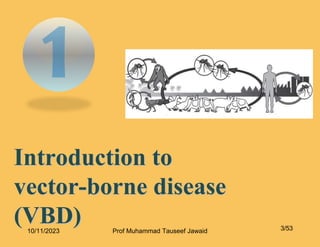
Introduction to
vector-borne disease
(VBD)
10/11/2023 3/53
Prof Muhammad Tauseef Jawaid
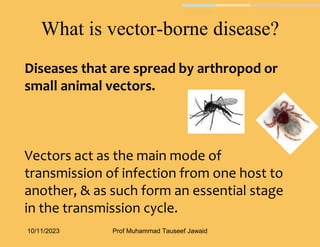
What is vector-borne disease?
Diseases that are spread by arthropod or
small animal vectors.
Vectors act as the main mode of
transmission of infection from one host to
another, & as such form an essential stage
in the transmission cycle.
10/11/2023 Prof Muhammad Tauseef Jawaid
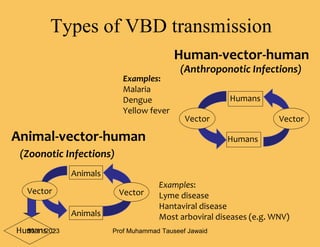
Types of VBD transmission
5
Human-vector-human
(Anthroponotic Infections)
Vector
Humans
Humans
Vector
Examples:
Malaria
Dengue
Yellow fever
Animal-vector-human
(Zoonotic Infections)
Vector Vector
Animals
Animals
Humans
Examples:
Lyme disease
Hantaviral disease
Most arboviral diseases (e.g. WNV)
10/11/2023 Prof Muhammad Tauseef Jawaid
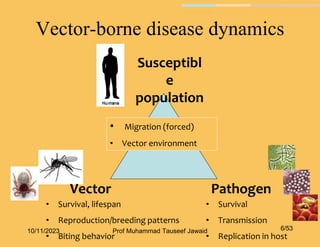
Vector-borne disease dynamics
Susceptibl
e
population
• Migration (forced)
• Vector environment
Vector
• Survival, lifespan
• Reproduction/breeding patterns
• Biting behavior
Pathogen
• Survival
• Transmission
• Replication in host
10/11/2023 6/53
Prof Muhammad Tauseef Jawaid
Outline of Presentation
• Common Vector Borne Diseases in India
• Malaria
• Dengue
• Chikungunya
• Filaria
• Japanese Encephalitis Kala azar
• Prevention from the Vector Borne Diseases
2/53
10/11/2023 7/53
Prof Muhammad Tauseef Jawaid
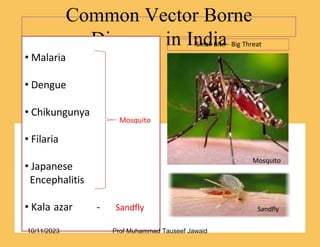
Common Vector Borne
Diseases in India
8/53
Small Bite - Big Threat
• Malaria
• Dengue
• Chikungunya
Mosquito
• Filaria
• Japanese
Encephalitis
• Kala azar - Sandfly
Mosquito
Sandfly
10/11/2023 Prof Muhammad Tauseef Jawaid
Malaria
9/53
10/11/2023 Prof Muhammad Tauseef Jawaid
Malaria
10/53
• Mal’aria means “bad air”
(Originally thought to be caused by foul air)
• A life-threatening protozoan disease
• 40% of the world’s population is at risk of getting the disease
• 80% of population in India lives in low malaria endemic
region
• 80% of malaria burden in India is confined to 20% of
population that live in malaria endemic region in India
10/11/2023 Prof Muhammad Tauseef Jawaid
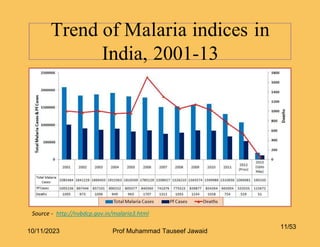
Trend of Malaria indices in
India, 2001-13
11/53
Source - http://nvbdcp.gov.in/malaria3.html
10/11/2023 Prof Muhammad Tauseef Jawaid
Mosquito
12/53
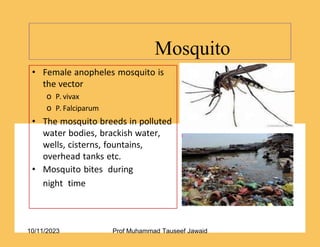
• Female anopheles mosquito is
the vector
o P. vivax
o P. Falciparum
• The mosquito breeds in polluted
water bodies, brackish water,
wells, cisterns, fountains,
overhead tanks etc.
• Mosquito bites during
night time
10/11/2023 Prof Muhammad Tauseef Jawaid
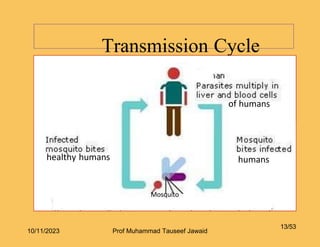
Transmission Cycle
13/53
of humans
humans
healthy humans
Mosquito
10/11/2023 Prof Muhammad Tauseef Jawaid
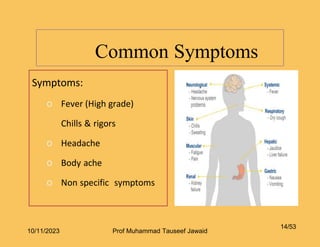
Common Symptoms
14/53
Symptoms:
o Fever (High grade)
Chills & rigors
o Headache
o Body ache
o Non specific symptoms
10/11/2023 Prof Muhammad Tauseef Jawaid
Severe Malaria - consequences
• Jaundice
• Seizure
• Bleeding problems
• Liver failure
• Kidney failure
• Multi organ failure
• “Death” also as a possible outcome
10/53
10/11/2023 15/53
Prof Muhammad Tauseef Jawaid
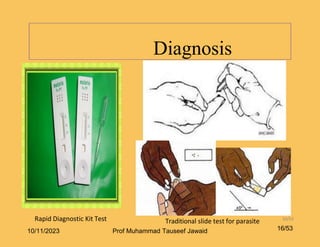
Diagnosis
Rapid Diagnostic Kit Test Traditional slide test for parasite 10/53
10/11/2023 16/53
Prof Muhammad Tauseef Jawaid
Treatment
17/53
• Rest and fever control (Tab.Paracetamol)
• Cold Sponging
• Chloroquine for three days
• Plasmodium vivax – Primaquine for 14 days (in addition to
chloroquine)
• Plasmodium falciparum – Artesunate Based Combination therapy
• Severe malaria may require
o Artesunate based combination therapy
o Quinine
• Infants and pregnant women for giving special attention
10/11/2023 Prof Muhammad Tauseef Jawaid
“Require immediate attention”
with danger signs
18/53
• Patient becomes unconscious
• Severe headache
• Seizures
• Bleeding from any site
• Development of jaundice
• Unable to pass urine
10/11/2023 Prof Muhammad Tauseef Jawaid
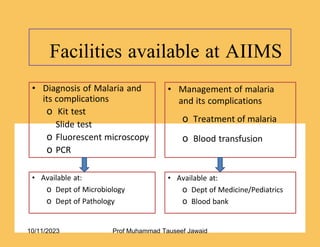
Facilities available at AIIMS
19/53
• Management of malaria
and its complications
o Treatment of malaria
o Blood transfusion
• Diagnosis of Malaria and
its complications
o Kit test
Slide test
o Fluorescent microscopy
o PCR
• Available at:
o Dept of Microbiology
o Dept of Pathology
• Available at:
o Dept of Medicine/Pediatrics
o Blood bank
10/11/2023 Prof Muhammad Tauseef Jawaid
Dengue
20/53
10/11/2023 Prof Muhammad Tauseef Jawaid
• Dengue fever is caused by Dengue virus
• It is pronounced as “Dengee”
• Occurs in epidemic form from time to time
• Common name of the disease is ‘break-bone fever’
(Haddi Tod Bukhar)
Dengue
21/53
10/11/2023 Prof Muhammad Tauseef Jawaid
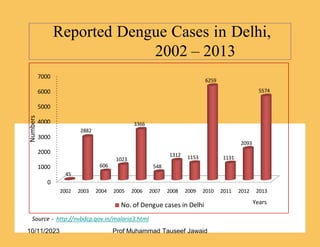
Reported Dengue Cases in Delhi,
2002 – 2013
22/53
4000
5000
6000
7000
6259
5574
1000
2000
2882
3000
606
1023
3366
548
1312 1153 1131
2093
Numbers
45
0
2002 2003 2004 2005 2006 2007 2008 2009 2010 2011 2012 2013
No. of Dengue cases in Delhi Years
Source - http://nvbdcp.gov.in/malaria3.html
10/11/2023 Prof Muhammad Tauseef Jawaid
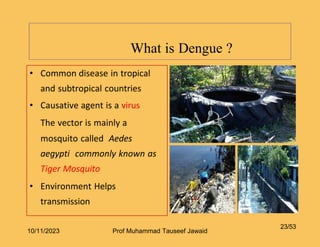
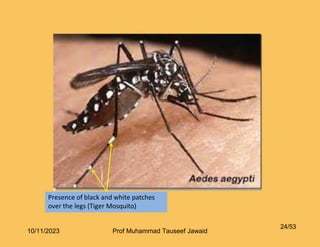
• Common disease in tropical
and subtropical countries
• Causative agent is a virus
The vector is mainly a
mosquito called Aedes
aegypti commonly known as
Tiger Mosquito
• Environment Helps
transmission
What is Dengue ?
23/53
10/11/2023 Prof Muhammad Tauseef Jawaid
Know Your Enemy !!
Presence of black and white patches
over the legs (Tiger Mosquito)
24/53
10/11/2023 Prof Muhammad Tauseef Jawaid
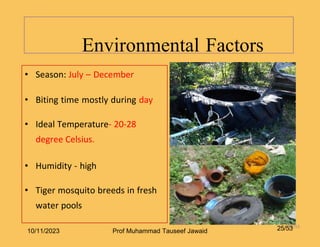
Environmental Factors
• Season: July – December
• Biting time mostly during day
• Ideal Temperature- 20-28
degree Celsius.
• Humidity - high
• Tiger mosquito breeds in fresh
water pools
20/53
10/11/2023 25/53
Prof Muhammad Tauseef Jawaid
• All age groups & both sex are
vulnerable
• Those previously infected by
dengue are more likely to
experience severe form of
disease, if re-infected
Vulnerability to Dengue
21/53
10/11/2023 26/53
Prof Muhammad Tauseef Jawaid
Infected mosquito
Transmission Cycle
Man-Mosquito-Man
Uninfected
human
Uninfected mosquito 22/53
Infected
human
10/11/2023 27/53
Prof Muhammad Tauseef Jawaid
Symptoms
28/53
• Fever
• Rash
• Headache
• Muscle pain
• Joint pain
• Pain behind the eyes
10/11/2023 Prof Muhammad Tauseef Jawaid
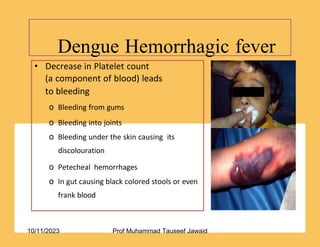
Dengue Hemorrhagic fever
29/53
• Decrease in Platelet count
(a component of blood) leads
to bleeding
o Bleeding from gums
o Bleeding into joints
o Bleeding under the skin causing its
discolouration
o Petecheal hemorrhages
o In gut causing black colored stools or even
frank blood
10/11/2023 Prof Muhammad Tauseef Jawaid
Treatment
30/53
• Fluids
• Rest
• No injections are required
• Paracetamol for pain and fever
• Monitor platelet count and
Blood pressure
• In severe cases, platelet
transfusion /blood transfusion
10/11/2023 Prof Muhammad Tauseef Jawaid
“Require immediate attention”
with danger signs
31/53
•Bleeding from any site
•Severe abdominal pain
•Prolonged frequent vomiting
•Unconsciousness
•Raise in the temperature
10/11/2023 Prof Muhammad Tauseef Jawaid
Facilities Available at AIIMS
• Diagnosis
o Kit test
o Virus culture
o Reverse Transcriptase
Polymerase Chain Reaction
(RT-PCR) test
o Arterial Blood Gas (ABG)
analysis
• Available at:
o Dept of Microbiology
o Dept of Pathology
32/53
• Treatment
o In-door admission
o IV infusion
o Blood transfusion
• Available at:
o Dept of Medicine/Pediatrics
o Blood bank
10/11/2023 Prof Muhammad Tauseef Jawaid
Japanese Encephalitis
33/53
10/11/2023 Prof Muhammad Tauseef Jawaid
Japanese Encephalitis (JE)
34/53
• JE is mostly present in in Southern India, Uttar
Pradesh, North Eastern states, Haryana
• Agent - Group B arbovirus (Flavivirus)
• Transmitted by Culex mosquitoes
10/11/2023 Prof Muhammad Tauseef Jawaid
Symptoms
35/53
• Starts with
o Fever
o Headache
o Weakness
•High grade fever
•Neck pain
•Vomiting
•Seizure
•Inability to speak
•Paralysis
Rapidly progress to
10/11/2023 Prof Muhammad Tauseef Jawaid
Treatment
36/53
• Consists of symptomatic management .
• May include
o Sponging for fever
o Paracetamol
o Drugs for Seizure
o Oxygen therapy
o Patient may need referral to higher level of health
care facility
10/11/2023 Prof Muhammad Tauseef Jawaid
Danger signs
37/53
•Unconsciousness
•Seizure
•Poor respiration
•Paralysis
10/11/2023 Prof Muhammad Tauseef Jawaid
Chikunguny
a
38/53
10/11/2023 Prof Muhammad Tauseef Jawaid
Epidemiology
39/53
• Viral disease
• Transmitted by tiger mosquito (Aedes Aegyptus)
• Out break of chikungunya in India occurred in 2006,
affecting 14 lakh people
10/11/2023 Prof Muhammad Tauseef Jawaid
Symptoms
40/53
• Fever
• Chills
• Headache
• Generalized body ache
• Skin rash
• Small joint pains
10/11/2023 Prof Muhammad Tauseef Jawaid
Treatment
41/53
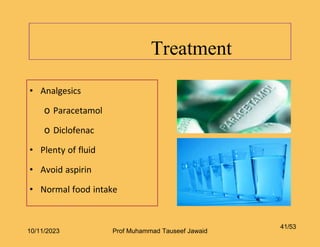
• Analgesics
o Paracetamol
o Diclofenac
• Plenty of fluid
• Avoid aspirin
• Normal food intake
10/11/2023 Prof Muhammad Tauseef Jawaid
Filari
a
42/53
10/11/2023 Prof Muhammad Tauseef Jawaid
Epidemiology
43/53
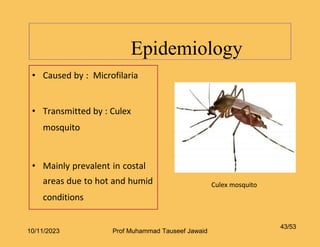
• Caused by : Microfilaria
• Transmitted by : Culex
mosquito
• Mainly prevalent in costal
areas due to hot and humid
conditions
Culex mosquito
10/11/2023 Prof Muhammad Tauseef Jawaid
Clinical features
44/53
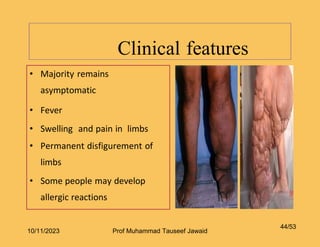
• Majority remains
asymptomatic
• Fever
• Swelling and pain in limbs
• Permanent disfigurement of
limbs
• Some people may develop
allergic reactions
10/11/2023 Prof Muhammad Tauseef Jawaid
Diagnosis &
Treatment
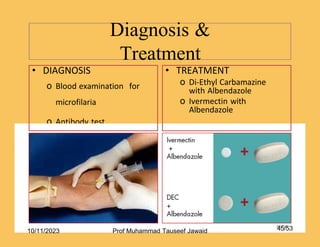
• DIAGNOSIS
o Blood examination for
microfilaria
o Antibody test
• TREATMENT
o Di-Ethyl Carbamazine
with Albendazole
o Ivermectin with
Albendazole
40/53
10/11/2023 45/53
Prof Muhammad Tauseef Jawaid
“Require immediate attention”
with danger signs
46/53
Generally filariasis do not lead to any life threatening
complication
Medication cause larval death in body which could
sometimes lead to allergic reactions like swelling of
body, itching etc.
Any reactions after taking medication should be reported
to the doctor
10/11/2023 Prof Muhammad Tauseef Jawaid
Kala-
Azar
47/53
10/11/2023 Prof Muhammad Tauseef Jawaid
Epidemiology
48/53
• Caused by parasite
Leishmania donovani
• Transmitted by sandfly
• The organism may remain in
the body for a long time in
liver, spleen and bone
• In India found in
Bihar, Jharkhand, West Bengal
and pockets of Uttar Pradesh
10/11/2023 Prof Muhammad Tauseef Jawaid
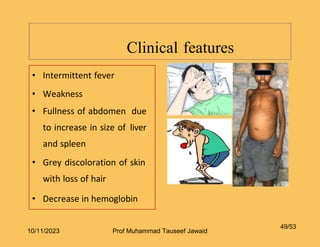
Clinical features
49/53
• Intermittent fever
• Weakness
• Fullness of abdomen due
to increase in size of liver
and spleen
• Grey discoloration of skin
with loss of hair
• Decrease in hemoglobin
10/11/2023 Prof Muhammad Tauseef Jawaid
Management
50/53
Diagnosis
• Blood test for antibody
• Dipstick test
• ELISA
• Biopsy
Management
• Sodium stibogluconate
• Pentamidine
• Amphotericin-B
• Miltefosine
• Available at:
• Dept of Microbiology
• Dept of Pathology
• Available at:
• Dept of Medicine/Pediatrics
10/11/2023 Prof Muhammad Tauseef Jawaid
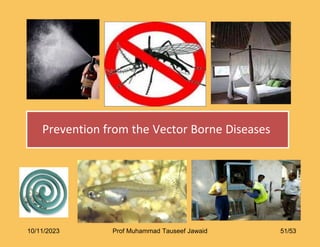
Prevention from the Vector Borne Diseases
51/53
10/11/2023 Prof Muhammad Tauseef Jawaid
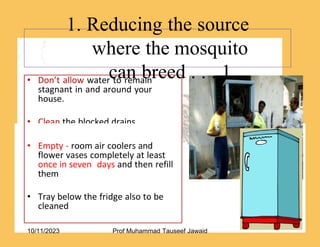
• Don’t allow water to remain
stagnant in and around your
house.
• Clean the blocked drains.
1. Reducing the source
where the mosquito
can breed . . . 1
52/53
• Empty - room air coolers and
flower vases completely at least
once in seven days and then refill
them
• Tray below the fridge also to be
cleaned
10/11/2023 Prof Muhammad Tauseef Jawaid
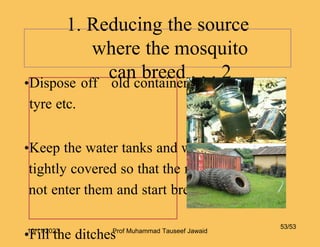
1. Reducing the source
where the mosquito
can breed . . . 2
•Dispose off old containers, tins, and
tyre etc.
•Keep the water tanks and water containers
tightly covered so that the mosquitoes can
not enter them and start breeding
•Fill the ditches
53/53
10/11/2023 Prof Muhammad Tauseef Jawaid
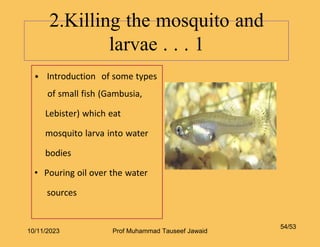
• Introduction of some types
of small fish (Gambusia,
Lebister) which eat
mosquito larva into water
bodies
• Pouring oil over the water
sources
2.Killing the mosquito and
larvae . . . 1
54/53
10/11/2023 Prof Muhammad Tauseef Jawaid
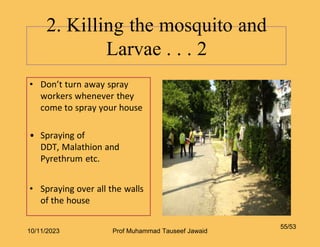
• Don’t turn away spray
workers whenever they
come to spray your house
• Spraying of
DDT, Malathion and
Pyrethrum etc.
• Spraying over all the walls
of the house
2. Killing the mosquito and
Larvae . . . 2
55/53
10/11/2023 Prof Muhammad Tauseef Jawaid
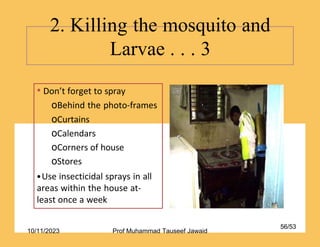
• Don’t forget to spray
oBehind the photo-frames
oCurtains
oCalendars
oCorners of house
oStores
•Use insecticidal sprays in all
areas within the house at-
least once a week
2. Killing the mosquito and
Larvae . . . 3
56/53
10/11/2023 Prof Muhammad Tauseef Jawaid
• Wear clothes which cover
the body as much as
possible
• Mosquito net
• Mosquito nets treated
with insecticides
• Mosquito repellent
o Sprays
o Creams
o Coils
o Mats
o Liquids
3. Personal protection
57/53
10/11/2023 Prof Muhammad Tauseef Jawaid
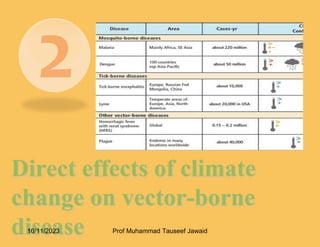
Direct effects of climate
change on vector-borne
disease
58
10/11/2023 Prof Muhammad Tauseef Jawaid
Temperature effects on vectors &
pathogens
Vector
• Survival decrease/increase depending on the
species
• Changes in the susceptibility of vectors to
some pathogens
• Changes in rate of vector population growth
• Changes in feeding rate & host contact
10/11/2023 59/53
Prof Muhammad Tauseef Jawaid
Temperature effects on vectors &
pathogens
Pathogen
• Decreased extrinsic incubation period of pathogen in
vector at higher temperatures
• Changes in the transmission season
• Changes in geographical distribution
• Decreased viral replication
10/11/2023 60/53
Prof Muhammad Tauseef Jawaid
Precipitation effects on vectors
Vector
• Survival: increased rain may increase larval habitat
• Excess rain can eliminate habitat by flooding
• Low rainfall can create habitat as rivers dry into
pools (dry season malaria)
• Decreased rain can increase container-breeding
mosquitoes by forcing increased water storage
• Heavy rainfall events can synchronize vector
host-seeking & virus transmission
• Increased humidity increases vector
survival & vice-versa
Source: Gubler et al. (2022)
10/11/2023 61/53
Prof Muhammad Tauseef Jawaid
Precipitation effects on pathogens
Pathogen
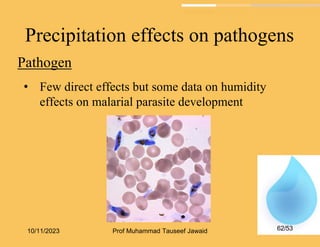
• Few direct effects but some data on humidity
effects on malarial parasite development
10/11/2023 62/53
Prof Muhammad Tauseef Jawaid
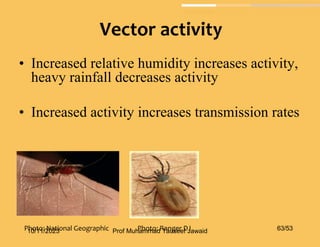
• Increased relative humidity increases activity,
heavy rainfall decreases activity
• Increased activity increases transmission rates
Photo: National Geographic Photo: Ranger DJ
Vector activity
10/11/2023 63/53
Prof Muhammad Tauseef Jawaid
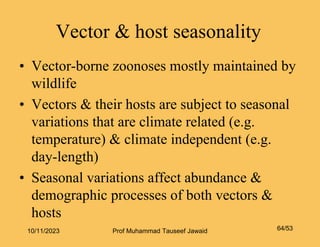
Vector & host seasonality
• Vector-borne zoonoses mostly maintained by
wildlife
• Vectors & their hosts are subject to seasonal
variations that are climate related (e.g.
temperature) & climate independent (e.g.
day-length)
• Seasonal variations affect abundance &
demographic processes of both vectors &
hosts
10/11/2023 64/53
Prof Muhammad Tauseef Jawaid
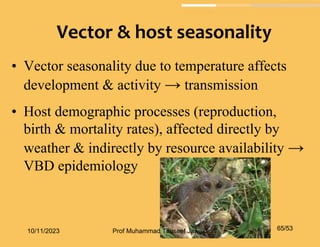
• Vector seasonality due to temperature affects
development & activity → transmission
• Host demographic processes (reproduction,
birth & mortality rates), affected directly by
weather & indirectly by resource availability →
VBD epidemiology
Vector & host seasonality
10/11/2023 65/53
Prof Muhammad Tauseef Jawaid
Association between weather &
climate on VBDs
66
Source: IPCC (2013)
10/11/2023
Prof Muhammad Tauseef Jawaid
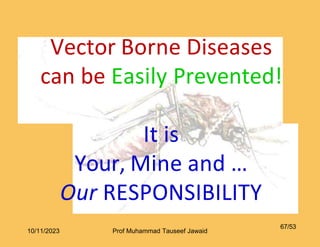
Vector Borne Diseases
can be Easily Prevented!
It is
Your, Mine and …
Our RESPONSIBILITY
67/53
10/11/2023 Prof Muhammad Tauseef Jawaid

Vector Borne Diseases.pptx

  • 1.
    MBBS.USMLE, DPH, Dip-Card,M.Phil, FCPS,PhD Professor Community Medicine Gujranwala Medical College Gujranwala. Ex- Professor Community and Family Medicine UmulQurrah University Makka Saudi Arabia
  • 2.
  • 3.
  • 4.
    What is vector-bornedisease? Diseases that are spread by arthropod or small animal vectors. Vectors act as the main mode of transmission of infection from one host to another, & as such form an essential stage in the transmission cycle. 10/11/2023 Prof Muhammad Tauseef Jawaid
  • 5.
    Types of VBDtransmission 5 Human-vector-human (Anthroponotic Infections) Vector Humans Humans Vector Examples: Malaria Dengue Yellow fever Animal-vector-human (Zoonotic Infections) Vector Vector Animals Animals Humans Examples: Lyme disease Hantaviral disease Most arboviral diseases (e.g. WNV) 10/11/2023 Prof Muhammad Tauseef Jawaid
  • 6.
    Vector-borne disease dynamics Susceptibl e population •Migration (forced) • Vector environment Vector • Survival, lifespan • Reproduction/breeding patterns • Biting behavior Pathogen • Survival • Transmission • Replication in host 10/11/2023 6/53 Prof Muhammad Tauseef Jawaid
  • 7.
    Outline of Presentation •Common Vector Borne Diseases in India • Malaria • Dengue • Chikungunya • Filaria • Japanese Encephalitis Kala azar • Prevention from the Vector Borne Diseases 2/53 10/11/2023 7/53 Prof Muhammad Tauseef Jawaid
  • 8.
    Common Vector Borne Diseasesin India 8/53 Small Bite - Big Threat • Malaria • Dengue • Chikungunya Mosquito • Filaria • Japanese Encephalitis • Kala azar - Sandfly Mosquito Sandfly 10/11/2023 Prof Muhammad Tauseef Jawaid
  • 9.
  • 10.
    Malaria 10/53 • Mal’aria means“bad air” (Originally thought to be caused by foul air) • A life-threatening protozoan disease • 40% of the world’s population is at risk of getting the disease • 80% of population in India lives in low malaria endemic region • 80% of malaria burden in India is confined to 20% of population that live in malaria endemic region in India 10/11/2023 Prof Muhammad Tauseef Jawaid
  • 11.
    Trend of Malariaindices in India, 2001-13 11/53 Source - http://nvbdcp.gov.in/malaria3.html 10/11/2023 Prof Muhammad Tauseef Jawaid
  • 12.
    Mosquito 12/53 • Female anophelesmosquito is the vector o P. vivax o P. Falciparum • The mosquito breeds in polluted water bodies, brackish water, wells, cisterns, fountains, overhead tanks etc. • Mosquito bites during night time 10/11/2023 Prof Muhammad Tauseef Jawaid
  • 13.
    Transmission Cycle 13/53 of humans humans healthyhumans Mosquito 10/11/2023 Prof Muhammad Tauseef Jawaid
  • 14.
    Common Symptoms 14/53 Symptoms: o Fever(High grade) Chills & rigors o Headache o Body ache o Non specific symptoms 10/11/2023 Prof Muhammad Tauseef Jawaid
  • 15.
    Severe Malaria -consequences • Jaundice • Seizure • Bleeding problems • Liver failure • Kidney failure • Multi organ failure • “Death” also as a possible outcome 10/53 10/11/2023 15/53 Prof Muhammad Tauseef Jawaid
  • 16.
    Diagnosis Rapid Diagnostic KitTest Traditional slide test for parasite 10/53 10/11/2023 16/53 Prof Muhammad Tauseef Jawaid
  • 17.
    Treatment 17/53 • Rest andfever control (Tab.Paracetamol) • Cold Sponging • Chloroquine for three days • Plasmodium vivax – Primaquine for 14 days (in addition to chloroquine) • Plasmodium falciparum – Artesunate Based Combination therapy • Severe malaria may require o Artesunate based combination therapy o Quinine • Infants and pregnant women for giving special attention 10/11/2023 Prof Muhammad Tauseef Jawaid
  • 18.
    “Require immediate attention” withdanger signs 18/53 • Patient becomes unconscious • Severe headache • Seizures • Bleeding from any site • Development of jaundice • Unable to pass urine 10/11/2023 Prof Muhammad Tauseef Jawaid
  • 19.
    Facilities available atAIIMS 19/53 • Management of malaria and its complications o Treatment of malaria o Blood transfusion • Diagnosis of Malaria and its complications o Kit test Slide test o Fluorescent microscopy o PCR • Available at: o Dept of Microbiology o Dept of Pathology • Available at: o Dept of Medicine/Pediatrics o Blood bank 10/11/2023 Prof Muhammad Tauseef Jawaid
  • 20.
  • 21.
    • Dengue feveris caused by Dengue virus • It is pronounced as “Dengee” • Occurs in epidemic form from time to time • Common name of the disease is ‘break-bone fever’ (Haddi Tod Bukhar) Dengue 21/53 10/11/2023 Prof Muhammad Tauseef Jawaid
  • 22.
    Reported Dengue Casesin Delhi, 2002 – 2013 22/53 4000 5000 6000 7000 6259 5574 1000 2000 2882 3000 606 1023 3366 548 1312 1153 1131 2093 Numbers 45 0 2002 2003 2004 2005 2006 2007 2008 2009 2010 2011 2012 2013 No. of Dengue cases in Delhi Years Source - http://nvbdcp.gov.in/malaria3.html 10/11/2023 Prof Muhammad Tauseef Jawaid
  • 23.
    • Common diseasein tropical and subtropical countries • Causative agent is a virus The vector is mainly a mosquito called Aedes aegypti commonly known as Tiger Mosquito • Environment Helps transmission What is Dengue ? 23/53 10/11/2023 Prof Muhammad Tauseef Jawaid
  • 24.
    Know Your Enemy!! Presence of black and white patches over the legs (Tiger Mosquito) 24/53 10/11/2023 Prof Muhammad Tauseef Jawaid
  • 25.
    Environmental Factors • Season:July – December • Biting time mostly during day • Ideal Temperature- 20-28 degree Celsius. • Humidity - high • Tiger mosquito breeds in fresh water pools 20/53 10/11/2023 25/53 Prof Muhammad Tauseef Jawaid
  • 26.
    • All agegroups & both sex are vulnerable • Those previously infected by dengue are more likely to experience severe form of disease, if re-infected Vulnerability to Dengue 21/53 10/11/2023 26/53 Prof Muhammad Tauseef Jawaid
  • 27.
    Infected mosquito Transmission Cycle Man-Mosquito-Man Uninfected human Uninfectedmosquito 22/53 Infected human 10/11/2023 27/53 Prof Muhammad Tauseef Jawaid
  • 28.
    Symptoms 28/53 • Fever • Rash •Headache • Muscle pain • Joint pain • Pain behind the eyes 10/11/2023 Prof Muhammad Tauseef Jawaid
  • 29.
    Dengue Hemorrhagic fever 29/53 •Decrease in Platelet count (a component of blood) leads to bleeding o Bleeding from gums o Bleeding into joints o Bleeding under the skin causing its discolouration o Petecheal hemorrhages o In gut causing black colored stools or even frank blood 10/11/2023 Prof Muhammad Tauseef Jawaid
  • 30.
    Treatment 30/53 • Fluids • Rest •No injections are required • Paracetamol for pain and fever • Monitor platelet count and Blood pressure • In severe cases, platelet transfusion /blood transfusion 10/11/2023 Prof Muhammad Tauseef Jawaid
  • 31.
    “Require immediate attention” withdanger signs 31/53 •Bleeding from any site •Severe abdominal pain •Prolonged frequent vomiting •Unconsciousness •Raise in the temperature 10/11/2023 Prof Muhammad Tauseef Jawaid
  • 32.
    Facilities Available atAIIMS • Diagnosis o Kit test o Virus culture o Reverse Transcriptase Polymerase Chain Reaction (RT-PCR) test o Arterial Blood Gas (ABG) analysis • Available at: o Dept of Microbiology o Dept of Pathology 32/53 • Treatment o In-door admission o IV infusion o Blood transfusion • Available at: o Dept of Medicine/Pediatrics o Blood bank 10/11/2023 Prof Muhammad Tauseef Jawaid
  • 33.
  • 34.
    Japanese Encephalitis (JE) 34/53 •JE is mostly present in in Southern India, Uttar Pradesh, North Eastern states, Haryana • Agent - Group B arbovirus (Flavivirus) • Transmitted by Culex mosquitoes 10/11/2023 Prof Muhammad Tauseef Jawaid
  • 35.
    Symptoms 35/53 • Starts with oFever o Headache o Weakness •High grade fever •Neck pain •Vomiting •Seizure •Inability to speak •Paralysis Rapidly progress to 10/11/2023 Prof Muhammad Tauseef Jawaid
  • 36.
    Treatment 36/53 • Consists ofsymptomatic management . • May include o Sponging for fever o Paracetamol o Drugs for Seizure o Oxygen therapy o Patient may need referral to higher level of health care facility 10/11/2023 Prof Muhammad Tauseef Jawaid
  • 37.
  • 38.
  • 39.
    Epidemiology 39/53 • Viral disease •Transmitted by tiger mosquito (Aedes Aegyptus) • Out break of chikungunya in India occurred in 2006, affecting 14 lakh people 10/11/2023 Prof Muhammad Tauseef Jawaid
  • 40.
    Symptoms 40/53 • Fever • Chills •Headache • Generalized body ache • Skin rash • Small joint pains 10/11/2023 Prof Muhammad Tauseef Jawaid
  • 41.
    Treatment 41/53 • Analgesics o Paracetamol oDiclofenac • Plenty of fluid • Avoid aspirin • Normal food intake 10/11/2023 Prof Muhammad Tauseef Jawaid
  • 42.
  • 43.
    Epidemiology 43/53 • Caused by: Microfilaria • Transmitted by : Culex mosquito • Mainly prevalent in costal areas due to hot and humid conditions Culex mosquito 10/11/2023 Prof Muhammad Tauseef Jawaid
  • 44.
    Clinical features 44/53 • Majorityremains asymptomatic • Fever • Swelling and pain in limbs • Permanent disfigurement of limbs • Some people may develop allergic reactions 10/11/2023 Prof Muhammad Tauseef Jawaid
  • 45.
    Diagnosis & Treatment • DIAGNOSIS oBlood examination for microfilaria o Antibody test • TREATMENT o Di-Ethyl Carbamazine with Albendazole o Ivermectin with Albendazole 40/53 10/11/2023 45/53 Prof Muhammad Tauseef Jawaid
  • 46.
    “Require immediate attention” withdanger signs 46/53 Generally filariasis do not lead to any life threatening complication Medication cause larval death in body which could sometimes lead to allergic reactions like swelling of body, itching etc. Any reactions after taking medication should be reported to the doctor 10/11/2023 Prof Muhammad Tauseef Jawaid
  • 47.
  • 48.
    Epidemiology 48/53 • Caused byparasite Leishmania donovani • Transmitted by sandfly • The organism may remain in the body for a long time in liver, spleen and bone • In India found in Bihar, Jharkhand, West Bengal and pockets of Uttar Pradesh 10/11/2023 Prof Muhammad Tauseef Jawaid
  • 49.
    Clinical features 49/53 • Intermittentfever • Weakness • Fullness of abdomen due to increase in size of liver and spleen • Grey discoloration of skin with loss of hair • Decrease in hemoglobin 10/11/2023 Prof Muhammad Tauseef Jawaid
  • 50.
    Management 50/53 Diagnosis • Blood testfor antibody • Dipstick test • ELISA • Biopsy Management • Sodium stibogluconate • Pentamidine • Amphotericin-B • Miltefosine • Available at: • Dept of Microbiology • Dept of Pathology • Available at: • Dept of Medicine/Pediatrics 10/11/2023 Prof Muhammad Tauseef Jawaid
  • 51.
    Prevention from theVector Borne Diseases 51/53 10/11/2023 Prof Muhammad Tauseef Jawaid
  • 52.
    • Don’t allowwater to remain stagnant in and around your house. • Clean the blocked drains. 1. Reducing the source where the mosquito can breed . . . 1 52/53 • Empty - room air coolers and flower vases completely at least once in seven days and then refill them • Tray below the fridge also to be cleaned 10/11/2023 Prof Muhammad Tauseef Jawaid
  • 53.
    1. Reducing thesource where the mosquito can breed . . . 2 •Dispose off old containers, tins, and tyre etc. •Keep the water tanks and water containers tightly covered so that the mosquitoes can not enter them and start breeding •Fill the ditches 53/53 10/11/2023 Prof Muhammad Tauseef Jawaid
  • 54.
    • Introduction ofsome types of small fish (Gambusia, Lebister) which eat mosquito larva into water bodies • Pouring oil over the water sources 2.Killing the mosquito and larvae . . . 1 54/53 10/11/2023 Prof Muhammad Tauseef Jawaid
  • 55.
    • Don’t turnaway spray workers whenever they come to spray your house • Spraying of DDT, Malathion and Pyrethrum etc. • Spraying over all the walls of the house 2. Killing the mosquito and Larvae . . . 2 55/53 10/11/2023 Prof Muhammad Tauseef Jawaid
  • 56.
    • Don’t forgetto spray oBehind the photo-frames oCurtains oCalendars oCorners of house oStores •Use insecticidal sprays in all areas within the house at- least once a week 2. Killing the mosquito and Larvae . . . 3 56/53 10/11/2023 Prof Muhammad Tauseef Jawaid
  • 57.
    • Wear clotheswhich cover the body as much as possible • Mosquito net • Mosquito nets treated with insecticides • Mosquito repellent o Sprays o Creams o Coils o Mats o Liquids 3. Personal protection 57/53 10/11/2023 Prof Muhammad Tauseef Jawaid
  • 58.
    Direct effects ofclimate change on vector-borne disease 58 10/11/2023 Prof Muhammad Tauseef Jawaid
  • 59.
    Temperature effects onvectors & pathogens Vector • Survival decrease/increase depending on the species • Changes in the susceptibility of vectors to some pathogens • Changes in rate of vector population growth • Changes in feeding rate & host contact 10/11/2023 59/53 Prof Muhammad Tauseef Jawaid
  • 60.
    Temperature effects onvectors & pathogens Pathogen • Decreased extrinsic incubation period of pathogen in vector at higher temperatures • Changes in the transmission season • Changes in geographical distribution • Decreased viral replication 10/11/2023 60/53 Prof Muhammad Tauseef Jawaid
  • 61.
    Precipitation effects onvectors Vector • Survival: increased rain may increase larval habitat • Excess rain can eliminate habitat by flooding • Low rainfall can create habitat as rivers dry into pools (dry season malaria) • Decreased rain can increase container-breeding mosquitoes by forcing increased water storage • Heavy rainfall events can synchronize vector host-seeking & virus transmission • Increased humidity increases vector survival & vice-versa Source: Gubler et al. (2022) 10/11/2023 61/53 Prof Muhammad Tauseef Jawaid
  • 62.
    Precipitation effects onpathogens Pathogen • Few direct effects but some data on humidity effects on malarial parasite development 10/11/2023 62/53 Prof Muhammad Tauseef Jawaid
  • 63.
    • Increased relativehumidity increases activity, heavy rainfall decreases activity • Increased activity increases transmission rates Photo: National Geographic Photo: Ranger DJ Vector activity 10/11/2023 63/53 Prof Muhammad Tauseef Jawaid
  • 64.
    Vector & hostseasonality • Vector-borne zoonoses mostly maintained by wildlife • Vectors & their hosts are subject to seasonal variations that are climate related (e.g. temperature) & climate independent (e.g. day-length) • Seasonal variations affect abundance & demographic processes of both vectors & hosts 10/11/2023 64/53 Prof Muhammad Tauseef Jawaid
  • 65.
    • Vector seasonalitydue to temperature affects development & activity → transmission • Host demographic processes (reproduction, birth & mortality rates), affected directly by weather & indirectly by resource availability → VBD epidemiology Vector & host seasonality 10/11/2023 65/53 Prof Muhammad Tauseef Jawaid
  • 66.
    Association between weather& climate on VBDs 66 Source: IPCC (2013) 10/11/2023 Prof Muhammad Tauseef Jawaid
  • 67.
    Vector Borne Diseases canbe Easily Prevented! It is Your, Mine and … Our RESPONSIBILITY 67/53 10/11/2023 Prof Muhammad Tauseef Jawaid