PPT ON
INSECT, VECTOR AND RODENT CONTROL
SPIDER, FLIES TICKS, MITE,LICE,FLEE
Presented by: Presented to:
MD SHAMIM AKHTAR Mrs. IFFAT NASEEM
MD UMAM JAMIA HAMDARD
MD SHUJAT
MD NUMANI HASAN
MERLIN PHILIP
MBA(HM) 4th SEM
INSECT, VECTOR AND RODENT
CONTROL
GOAL
• To educate the public and minimize the potential
for human disease caused by vectors.
VECTOR
• Vectors are insects, ticks, rodents, some birds and other
animals that can transmit disease and cause discomfort
in humans. Control of these pests reduces the incidence
of disease in the public.
SPIDER
 Spiders are air-breathing arthropods that have eight legs and chelicerae with fangs
that inject venom.
 An eight-legged predatory arachnid with an unsegmented body consisting of a
fused head and thorax and a rounded abdomen. Spiders have fangs which inject
poison into their prey, and most kinds spin webs in which to capture insects.
DISEASES
• Muscle pain or cramping
• Reddish to purplish color or blister
• Increased sweating
• Difficulty breathing
• High blood pressure
Contnd…
• Headache
• Nausea and vomiting
• Fever
• Chills
• Anxiety or restlessness
CONTROL
• Inspect or shake out any clothing, shoes, towels, or equipment before use.
• Wear protective clothing such as a long-sleeved shirt and long pants, hat,
gloves, and boots when handling stacked or undisturbed piles of materials.
• Minimize the empty spaces between stacked materials.
• Remove and reduce debris and rubble from around the outdoor work areas.
• Trim or eliminate tall grasses from around outdoor work areas.
• Store apparel and outdoor equipment in tightly closed plastic bags.
• Keep your tetanus boosters up-to-date (every 10 years). Spider bites can
become infected with tetanus spores.
FLIES
• House flies are the commonest and most familiar of all insects which live
close to man.
• The common housefly (domestic) is mouse gray in color. The body is
divided in to a head, thorax and abdomen.
• The housefly does not bite. It is attracted to food by its sense of smell.
DISEASES
The diseases causes by the flies are mainly
1. Diahhorea
2. Cholera
3. Tubercolosis
4. Loose motions
 Communicable disease are spread by flies.
DISEASES CONTROL
Environmental Control
 The elimination of the breeding places and overall improvement in the
environ-mental sanitation on a community-wide basis is the best way to
control houseflies. A’ clean house with clean surroundings is the best
answer to the fly problem.
Insecticidal Control
 Insecticides such as, D.D.T. B. H. C. Parricides, Baits etc. should be
applied to control the houseflies. D.D.T. or B.H.C. may be applied indoors
or outdoors using hand or power sprayers.
Contd…
Fly Papers
 In certain cases sticky fly papers are used to control the house flies.
Protection against flies
 Screening of houses, food markets, restaurants and all other similar
establishments will give considerable relief from houseflies. But this, is
expensive for general use.
Health Education
 It is difficult to achieve fly control without the willing co-operation of the
people.
TICKS
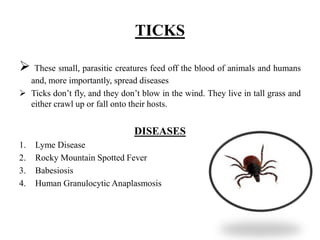
 These small, parasitic creatures feed off the blood of animals and humans
and, more importantly, spread diseases
 Ticks don’t fly, and they don’t blow in the wind. They live in tall grass and
either crawl up or fall onto their hosts.
DISEASES
1. Lyme Disease
2. Rocky Mountain Spotted Fever
3. Babesiosis
4. Human Granulocytic Anaplasmosis
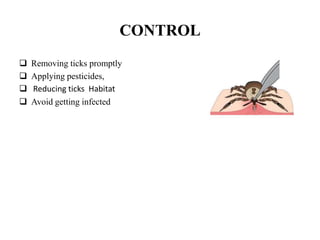
CONTROL
 Removing ticks promptly
 Applying pesticides,
 Reducing ticks Habitat
 Avoid getting infected
MITE
 On a person, mites can live for as long as 1-2 months. Off a person, scabies
mites usually do not survive more than 48-72 hours. Scabies mites will die if
exposed to a temperature of 50 C (122 F) for 10 minutes.
DISEASE
 Allergic asthma,
 Eczema
 Conjunctivitis
 Hay fever
CONTROL
Avoid contact with infected person.
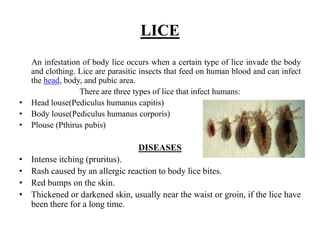
LICE
An infestation of body lice occurs when a certain type of lice invade the body
and clothing. Lice are parasitic insects that feed on human blood and can infect
the head, body, and pubic area.
There are three types of lice that infect humans:
• Head louse(Pediculus humanus capitis)
• Body louse(Pediculus humanus corporis)
• Plouse (Pthirus pubis)
DISEASES
• Intense itching (pruritus).
• Rash caused by an allergic reaction to body lice bites.
• Red bumps on the skin.
• Thickened or darkened skin, usually near the waist or groin, if the lice have
been there for a long time.
FLEAS
Fleas are small biting, jumping insects that live in the fur of many different
animals. Cat and dog fleas are the most likely fleas to affect humans
DISEASES
• Rocky Mountain Spotted Fever
• Sharp needles like pain on skin.
• Small pink spots on body
• Body aches
• Weakness
CONTROL
 Pets, yards, and homes should be kept free of fleas.
 Eliminate places where wild animals can find shelter.
 Take personal precautions.
 Do Not Relocate Animals
 Eliminate all food sources.
Insect, vector and rodent control

Insect, vector and rodent control

  • 1.
    PPT ON INSECT, VECTORAND RODENT CONTROL SPIDER, FLIES TICKS, MITE,LICE,FLEE Presented by: Presented to: MD SHAMIM AKHTAR Mrs. IFFAT NASEEM MD UMAM JAMIA HAMDARD MD SHUJAT MD NUMANI HASAN MERLIN PHILIP MBA(HM) 4th SEM
  • 2.
    INSECT, VECTOR ANDRODENT CONTROL GOAL • To educate the public and minimize the potential for human disease caused by vectors. VECTOR • Vectors are insects, ticks, rodents, some birds and other animals that can transmit disease and cause discomfort in humans. Control of these pests reduces the incidence of disease in the public.
  • 3.
    SPIDER  Spiders areair-breathing arthropods that have eight legs and chelicerae with fangs that inject venom.  An eight-legged predatory arachnid with an unsegmented body consisting of a fused head and thorax and a rounded abdomen. Spiders have fangs which inject poison into their prey, and most kinds spin webs in which to capture insects. DISEASES • Muscle pain or cramping • Reddish to purplish color or blister • Increased sweating • Difficulty breathing • High blood pressure
  • 4.
    Contnd… • Headache • Nauseaand vomiting • Fever • Chills • Anxiety or restlessness
  • 5.
    CONTROL • Inspect orshake out any clothing, shoes, towels, or equipment before use. • Wear protective clothing such as a long-sleeved shirt and long pants, hat, gloves, and boots when handling stacked or undisturbed piles of materials. • Minimize the empty spaces between stacked materials. • Remove and reduce debris and rubble from around the outdoor work areas. • Trim or eliminate tall grasses from around outdoor work areas. • Store apparel and outdoor equipment in tightly closed plastic bags. • Keep your tetanus boosters up-to-date (every 10 years). Spider bites can become infected with tetanus spores.
  • 6.
    FLIES • House fliesare the commonest and most familiar of all insects which live close to man. • The common housefly (domestic) is mouse gray in color. The body is divided in to a head, thorax and abdomen. • The housefly does not bite. It is attracted to food by its sense of smell.
  • 7.
    DISEASES The diseases causesby the flies are mainly 1. Diahhorea 2. Cholera 3. Tubercolosis 4. Loose motions  Communicable disease are spread by flies.
  • 8.
    DISEASES CONTROL Environmental Control The elimination of the breeding places and overall improvement in the environ-mental sanitation on a community-wide basis is the best way to control houseflies. A’ clean house with clean surroundings is the best answer to the fly problem. Insecticidal Control  Insecticides such as, D.D.T. B. H. C. Parricides, Baits etc. should be applied to control the houseflies. D.D.T. or B.H.C. may be applied indoors or outdoors using hand or power sprayers.
  • 9.
    Contd… Fly Papers  Incertain cases sticky fly papers are used to control the house flies. Protection against flies  Screening of houses, food markets, restaurants and all other similar establishments will give considerable relief from houseflies. But this, is expensive for general use. Health Education  It is difficult to achieve fly control without the willing co-operation of the people.
  • 10.
    TICKS  These small,parasitic creatures feed off the blood of animals and humans and, more importantly, spread diseases  Ticks don’t fly, and they don’t blow in the wind. They live in tall grass and either crawl up or fall onto their hosts. DISEASES 1. Lyme Disease 2. Rocky Mountain Spotted Fever 3. Babesiosis 4. Human Granulocytic Anaplasmosis
  • 11.
    CONTROL  Removing tickspromptly  Applying pesticides,  Reducing ticks Habitat  Avoid getting infected
  • 12.
    MITE  On aperson, mites can live for as long as 1-2 months. Off a person, scabies mites usually do not survive more than 48-72 hours. Scabies mites will die if exposed to a temperature of 50 C (122 F) for 10 minutes. DISEASE  Allergic asthma,  Eczema  Conjunctivitis  Hay fever CONTROL Avoid contact with infected person.
  • 13.
    LICE An infestation ofbody lice occurs when a certain type of lice invade the body and clothing. Lice are parasitic insects that feed on human blood and can infect the head, body, and pubic area. There are three types of lice that infect humans: • Head louse(Pediculus humanus capitis) • Body louse(Pediculus humanus corporis) • Plouse (Pthirus pubis) DISEASES • Intense itching (pruritus). • Rash caused by an allergic reaction to body lice bites. • Red bumps on the skin. • Thickened or darkened skin, usually near the waist or groin, if the lice have been there for a long time.
  • 14.
    FLEAS Fleas are smallbiting, jumping insects that live in the fur of many different animals. Cat and dog fleas are the most likely fleas to affect humans DISEASES • Rocky Mountain Spotted Fever • Sharp needles like pain on skin. • Small pink spots on body • Body aches • Weakness
  • 15.
    CONTROL  Pets, yards,and homes should be kept free of fleas.  Eliminate places where wild animals can find shelter.  Take personal precautions.  Do Not Relocate Animals  Eliminate all food sources.