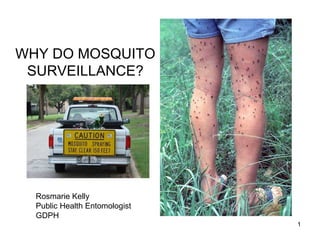
WHY DO MOSQUITO SURVEILLANCE? Rosmarie Kelly Public Health Entomologist GDPH
Nuisance mosquito control programs (MOSQUITO CONTROL) Vector mosquito control programs (PUBLIC HEALTH) Used to control various species of mosquitoes which cause distress to humans and animals due to biting.  Used to control one or more species of mosquitoes which transmit diseases to humans or animals. Both programs can co-exist and be mutually beneficial. Large numbers of mosquitoes can have serious economic implications. Types of Control Programs
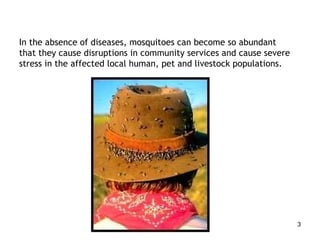
In the absence of diseases, mosquitoes can become so abundant that they cause disruptions in community services and cause severe stress in the affected local human, pet and livestock populations.
Without surveillance, mosquito control becomes a matter of luck. With surveillance, mosquito control becomes more targeted, more effective, and more economical.
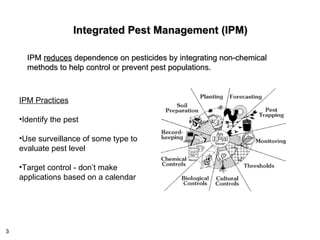
Integrated Pest Management (IPM) IPM  reduces  dependence on pesticides by integrating non-chemical methods to help control or prevent pest populations. IPM Practices Identify the pest Use surveillance of some type to evaluate pest level Target control - don’t make applications based on a calendar 3
Integrated Mosquito Management Source Reduction Larval Surveillance - Larval Control  Adult Surveillance - Adult Control  Community Education / Communication Mapping / Record Keeping Arboviral Surveillance  (where appropriate) Best Management Practices
S.P.L.A.T. S urveillance P ublic Awareness L arviciding A dulticiding T iming
Some Common Mosquito Species Larval Habitat Biting Time Flight Range Aedes albopictus artificial containers & tree holes Day 100 - 300 yards Culex quinquefasciatus ground pools, catch basins, artificial containers Crepuscular, Night 1/4 - 1/2 mile Aedes vexans Flooded grassy and wooded areas Day, Crepuscular, Night 5 - 8 miles Coquillettidia perturbans Cattail marshes Crepuscular, Night 1 - 5 miles
Mosquito Surveillance Mosquito surveillance is the cornerstone of mosquito  control. No mosquito control program can operate effectively without a surveillance program. Mosquito surveillance can reveal: The species of mosquitoes that are active in a community  The presence of human-biting mosquitoes The presence of disease vector species The presence of mosquitoes infected with arboviral diseases The breeding habitats of the local species  The size of the local mosquito population  When to apply pesticides to control the mosquito population.
ALL MOSQUITO SURVEILLANCE SHOULD HAVE A PURPOSE: MOSQUITO CONTROL – LARVAL OR ADULT ARBOVIRAL SURVEILLANCE PUBLIC EDUCATION MOSQUITO SURVEILLANCE SHOULD NEVER BE DONE WITHOUT A SPECIFIC GOAL IN MIND.
Basic Cornerstone of Surveillance COMPLAINTS
Complaints should ALWAYS be followed up by a site visit.
HANDLING COMPLIANTS Be fair Be consistent Be courteous Don’t make promises that you cannot keep Follow up
Dealing with complaints In urban and suburban area in Georgia, at least 90% of mosquito calls will involve  Aedes albopictus , the Asian tiger mosquito.  Things to ask the caller: Is the mosquito biting during the day? Asian tigers are daytime biters.  b. Where is the mosquito landing to bite?  Asian tigers are primarily leg biters. c. Is the mosquito small and black and white?  If yes, truck spraying may not help.
gravid trap light trap larval dipping landing counts
LANDING COUNTS
"Landing Rate"  - the number of mosquitoes that land on the observer over a designated period of time.  It is suggested that they be taken over either a 1 or 5 min period. If the landing rates exceed 50 in 30 sec, the interval can be shortened to protect observers that are expected to conduct numerous counts.  Landing rates may involve identification, but they are normally employed in areas where a single, known species is the sole cause of annoyance.
Wait a period of time before starting to collect.  Disturb the vegetation before starting.  Wear light solid-colored clothes.  Wear no repellents. Wear no perfumes or aftershave.  Stand up and stand still while taking count.  Remember, mosquitoes react differently  to each individual   Guidelines
Information to Collect: Collector's Name County Site  Date Time Location on Body For counts of less than one minute, multiply to get landings per minute.
Thresholds for Landing Counts Vary  Excessive Landing Rate Counts: In populated areas >25 mosquitoes/minute In relatively unpopulated areas >50 mosquitoes/  minute THIS WILL VARY ACCORDING TO LOCATION, MOSQUITO SPECIES, AND HUMAN POPULATION
Landing counts are useful for determining if adult mosquito control is needed.
When to do landing counts? Mosquito control is complaint driven Aedes albopictus  is a problem in the area Emergency mosquito control is needed due to flooding
For  Aedes albopictus , remind the caller  to dump out or throw out containers that  can hold water (this will also help with  Culex   quinquefasciatus , our WNV vector).   Containers need to be dumped at least once a week.  Larvicides can be applied to water that can not be dumped out or eliminated.  Both mosquito dunks (Bti) and mosquito torpedoes (methoprene) can be bought at stores like Home Depot, Lowes, and some of the big chain pet stores in the ornamental pool area. 
Always remind people to wear mosquito repellent when outside.   Recommended repellents are those that contain DEET, picaridin, IR3535, or PMD (oil of lemon eucalyptus). 
If the mosquitoes are biting after dark, or during the day in shady areas, they can be any of a number of species.   Floodwater species may be abundant after heavy rains. Face biters tend to be any number of  Psorophora  spp, although other mosquitoes will bite above the waistline.   Landing counts done after dark will help determine if the mosquitoes constitute a serious problem needed adulticiding.  THIS WILL NOT TELL YOU WHERE TO APPLY LARVICIDES.
Remember, landing counts will give you info on whether human biting mosquitoes are present.  Landing counts,  along with field ID  of  Aedes albopictus , will let you  know if adulticiding is needed. Landing counts will NOT give you info about where to larvicide unless you are also ID’ing the mosquitoes.
ADULT MOSQUITO SURVEILLANCE CDC light trap gravid trap
What Kind of Trap Should You Use? depends on your need and your budget
Mosquito Gravid Trap Operation
Another Type of Gravid Trap
Gravid Traps USE – primarily for monitoring container breeding mosquitoes Used in the WNV surveillance program NOT USEFUL for monitoring most nuisance species NOT USEFUL for monitoring EEE
Preparation of Hay Infusion for Gravid Traps Equipment Requirements Sturdy water tight 35 gallon container Hay 16 ounces of Brewer’s yeast Paddle for stirring Jugs or containers for transport to field sites
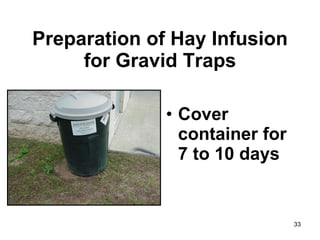
Preparation of Hay Infusion for Gravid Traps Cover container for  7 to 10 days
Preparation of Hay Infusion for Gravid Traps Infusion can be used for several days in the individual gravid traps if  Culex  egg rafts are removed. You can also add Altosid to the infusion Recharge gravid trap as needed; especially after heavy rains.
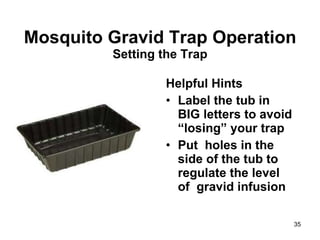
Mosquito Gravid Trap Operation Setting the Trap Helpful Hints Label the tub in BIG letters to avoid “losing” your trap Put  holes in the side of the tub to regulate the level of  gravid infusion
Mosquito Gravid Trap Operation Place the set up trap in a shaded area preferably where there is lots of undergrowth.
Mosquito Light Trap Operation
Mosquito CDC Trap Overview The CDC traps are portable, battery-operated traps that are useful for investigating newly identified mosquito problem areas, and regular trapping sites.  CDC traps are ideal for collecting mosquitoes for species identification.  CDC type traps attract mosquitoes with a small light and are generally baited with carbon dioxide  (dry ice).
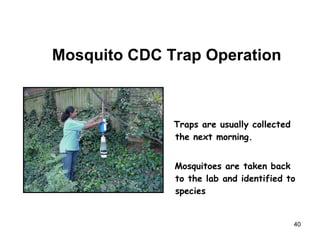
It is recommended to place the trap in an wooded area where mosquitoes usually rest.  Hang the trap so the bottom of the net is about one foot above the ground Mosquito CDC Trap Operation
Traps are usually collected the next morning. Mosquitoes are taken back to the lab and identified to species Mosquito CDC Trap Operation
other light trap types
Larval Surveillance –  “ get them before they get you”
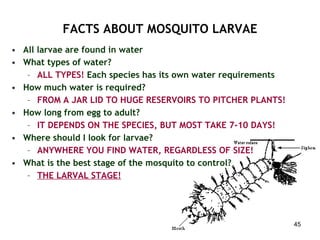
Anopheline Larvae Surface
Culicine Larvae Breathing tube Hang from surface at an angle Head Surface
FACTS ABOUT MOSQUITO LARVAE All larvae are found in water What types of water?  ALL TYPES!  Each species has its own water requirements How much water is required?  FROM A JAR LID TO HUGE RESERVOIRS TO PITCHER PLANTS! How long from egg to adult?  IT DEPENDS ON THE SPECIES, BUT MOST TAKE 7-10 DAYS! Where should I look for larvae?  ANYWHERE YOU FIND WATER, REGARDLESS OF SIZE! What is the best stage of the mosquito to control? THE LARVAL STAGE!
WHY YOU NEED TO KNOW ABOUT MOSQUITO LARVAL HABITATS? The best method to control mosquitoes is by targeting the larval stage.  IF NO ADULTS EMERGE, YOU WIN THE GAME! If you wait until the adults emerge, they  fly in all directions, are not concentrated like larvae, and are harder to control. Targeting mosquito larvae for control is very “ PROACTIVE ”.
Equipment http://www.rci.rutgers.edu/~insects/dipping.htm
The SIMPLE SCOOP is the "dipping to get water" method that is the least effective method used. It consists of simply scooping a dipperful of water. This is probably the most commonly used method, particularly by new inspectors, and it is often the method referred to in much of the literature as "the standard dipping procedure." While it can be successfully used to collect  Culex larvae,  it is still not the method of choice . WHAT NOT TO DO
The first and usually the best method to start with is the SHALLOW SKIM. The shallow skim consists of submerging the leading edge of the dipper, tipped about 45 degrees, about an inch below the surface of the water and quickly, but gently, moving the dipper along a straight line in open water or in water with small floating debris. End the stroke just before the dipper is filled to prevent overflowing. The shallow skim is particularly effective for  Anopheles  larvae that tend to remain at the surface longer than  Aedes  and  Culex. Anopheles  are usually associated with floating vegetation and debris.
Slide the dipper
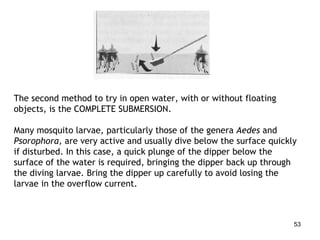
The second method to try in open water, with or without floating objects, is the COMPLETE SUBMERSION.  Many mosquito larvae, particularly those of the genera  Aedes  and  Psorophora,  are very active and usually dive below the surface quickly if disturbed. In this case, a quick plunge of the dipper below the surface of the water is required, bringing the dipper back up through the diving larvae. Bring the dipper up carefully to avoid losing the larvae in the overflow current.
When you need to sample at the edges of emergent vegetation, try the PARTIAL SUBMERSION technique.  To do this, push the dipper, tilted at about 45 degrees, straight down adjacent to the vegetation. This causes the water around the vegetation to flow into the dipper, carrying the larvae with the flow. There is no need to move the dipper horizontally. Pull the dipper up before it is full.
In very shallow water, try the FLOW-IN method.  Larvae can be collected by pushing the dipper into the substrate of the pool and letting the shallow surface water, debris and larvae flow into the dipper. Do not move the dipper horizontally.
Dip shallows next to Pools
To sample for larvae that may be under floating or emergent vegetation, use the SCRAPING technique.  This method is used in habitats that contain clumps of vegetation such as tussocks of sedges, floating mats of cattails or water lettuce or other plants that are too large to get in the dipper, or clumps of submerged vegetation such as hydrilla or bladderwort. Dip from the water in towards the vegetation and end by using the dipper to scrape up against the base or underside of the vegetation to dislodge larvae. This method is usually more effective if the bottom of the dipper is screened and it is often used to sample for  Coquillettidia and Mansonia  mosquitoes .
Dip through the plant material
The dipper can also be used as BACKGROUND.  This is especially useful in woodland pools and other shallow water or when larvae are disturbed and dive to the bottom. Submerge the dipper completely to the bottom litter and slowly move it around. The darker mosquito larvae and pupae will stand out against the background of a white or aluminum dipper. Once larvae appear in the dipper, just lift it upward.
One or more of these methods, properly used, can determine the mosquito species composition of most aquatic habitats, excluding those whose openings are smaller than the dipper, such as tires, rock pools, treeholes and tree root systems like those found in cedar and red maple swamps.  In those cases, a smaller container, such as a vial, measuring spoon or tea strainer can be used in the same seven ways as the dipper described above.  Then there is the tubular dipper, the chef's poultry baster, for those really hard to get to places like plant axils, treeholes and tree root holes.
ID OF LARVAE IS IMPORTANT NOT ALL LARVAE NEED TO BE CONTROLLED The larvae of this mosquito are found in permanent vegetated waters.  The adults are  not known to bite humans.
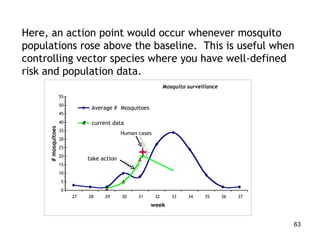
An action point is a trigger for initiating a control measure.  It is a point at which pest populations or environmental conditions indicate that pest control action must be taken USING THE DATA –  when should control occur
Here, an action point would occur whenever mosquito populations rose above the baseline.  This is useful when controlling vector species where you have well-defined risk and population data. Mosquito surveillance  0 5 10 15 20 25 30 35 40 45 50 55 27 28 29 30 31 32 33 34 35 36 37 week # mosquitoes Average # Mosquitoes current data take action Human cases
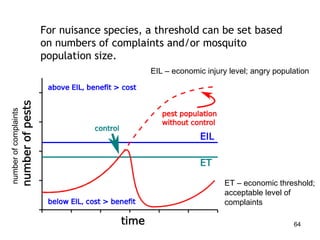
For nuisance species, a threshold can be set based on numbers of complaints and/or mosquito population size. EIL – economic injury level; angry population ET – economic threshold; acceptable level of complaints number of complaints
MAPPING A picture is worth a thousand words. map complaints map service calls map breeding sites USEFUL TIP – Google Maps
Knowing which species are present can help determine: disease risk control needs
Disease Mapping information about mosquito species at complaint sites could help determine disease risk in areas surrounding WNV human cases
CSO
Combined Sewer Overflows Effluent Exit
Combined Sewer Overflows Tanyard Creek at Ardmore Park
Combined Sewer Overflows Tanyard Creek at Tanyard Park
MODEL PROGRAM Data are collected at sentinel sites Mosquitoes are identified and graphs are used to monitor changes in mosquito populations When predetermined action thresholds are exceeded, an action (press release, education, monitoring, larviciding, adulticiding, etc) occurs Arboviral “testing” sites are established throughout the area The public, the community, and the municipalities are encouraged to take active roles in decreasing mosquito populations through community cleanup, personal protection measures, and mosquito control - the role of the health department is supportive REQUIRES SUSTAINABLE FUNDING
http://health.state.ga.us/epi/vbd/mosquito.asp http://www.GAmosquito.org
Any Questions?

Surveillance, Record Keeping, And Mapping

  • 1.
    WHY DO MOSQUITOSURVEILLANCE? Rosmarie Kelly Public Health Entomologist GDPH
  • 2.
    Nuisance mosquito controlprograms (MOSQUITO CONTROL) Vector mosquito control programs (PUBLIC HEALTH) Used to control various species of mosquitoes which cause distress to humans and animals due to biting. Used to control one or more species of mosquitoes which transmit diseases to humans or animals. Both programs can co-exist and be mutually beneficial. Large numbers of mosquitoes can have serious economic implications. Types of Control Programs
  • 3.
    In the absenceof diseases, mosquitoes can become so abundant that they cause disruptions in community services and cause severe stress in the affected local human, pet and livestock populations.
  • 4.
    Without surveillance, mosquitocontrol becomes a matter of luck. With surveillance, mosquito control becomes more targeted, more effective, and more economical.
  • 5.
    Integrated Pest Management(IPM) IPM reduces dependence on pesticides by integrating non-chemical methods to help control or prevent pest populations. IPM Practices Identify the pest Use surveillance of some type to evaluate pest level Target control - don’t make applications based on a calendar 3
  • 6.
    Integrated Mosquito ManagementSource Reduction Larval Surveillance - Larval Control Adult Surveillance - Adult Control Community Education / Communication Mapping / Record Keeping Arboviral Surveillance (where appropriate) Best Management Practices
  • 7.
    S.P.L.A.T. S urveillanceP ublic Awareness L arviciding A dulticiding T iming
  • 8.
    Some Common MosquitoSpecies Larval Habitat Biting Time Flight Range Aedes albopictus artificial containers & tree holes Day 100 - 300 yards Culex quinquefasciatus ground pools, catch basins, artificial containers Crepuscular, Night 1/4 - 1/2 mile Aedes vexans Flooded grassy and wooded areas Day, Crepuscular, Night 5 - 8 miles Coquillettidia perturbans Cattail marshes Crepuscular, Night 1 - 5 miles
  • 9.
    Mosquito Surveillance Mosquitosurveillance is the cornerstone of mosquito control. No mosquito control program can operate effectively without a surveillance program. Mosquito surveillance can reveal: The species of mosquitoes that are active in a community The presence of human-biting mosquitoes The presence of disease vector species The presence of mosquitoes infected with arboviral diseases The breeding habitats of the local species The size of the local mosquito population When to apply pesticides to control the mosquito population.
  • 10.
    ALL MOSQUITO SURVEILLANCESHOULD HAVE A PURPOSE: MOSQUITO CONTROL – LARVAL OR ADULT ARBOVIRAL SURVEILLANCE PUBLIC EDUCATION MOSQUITO SURVEILLANCE SHOULD NEVER BE DONE WITHOUT A SPECIFIC GOAL IN MIND.
  • 11.
    Basic Cornerstone ofSurveillance COMPLAINTS
  • 12.
    Complaints should ALWAYSbe followed up by a site visit.
  • 13.
    HANDLING COMPLIANTS Befair Be consistent Be courteous Don’t make promises that you cannot keep Follow up
  • 14.
    Dealing with complaintsIn urban and suburban area in Georgia, at least 90% of mosquito calls will involve Aedes albopictus , the Asian tiger mosquito.  Things to ask the caller: Is the mosquito biting during the day? Asian tigers are daytime biters. b. Where is the mosquito landing to bite?  Asian tigers are primarily leg biters. c. Is the mosquito small and black and white?  If yes, truck spraying may not help.
  • 15.
    gravid trap lighttrap larval dipping landing counts
  • 16.
  • 17.
    "Landing Rate" - the number of mosquitoes that land on the observer over a designated period of time. It is suggested that they be taken over either a 1 or 5 min period. If the landing rates exceed 50 in 30 sec, the interval can be shortened to protect observers that are expected to conduct numerous counts. Landing rates may involve identification, but they are normally employed in areas where a single, known species is the sole cause of annoyance.
  • 18.
    Wait a periodof time before starting to collect. Disturb the vegetation before starting. Wear light solid-colored clothes. Wear no repellents. Wear no perfumes or aftershave. Stand up and stand still while taking count. Remember, mosquitoes react differently to each individual Guidelines
  • 19.
    Information to Collect:Collector's Name County Site Date Time Location on Body For counts of less than one minute, multiply to get landings per minute.
  • 20.
    Thresholds for LandingCounts Vary Excessive Landing Rate Counts: In populated areas >25 mosquitoes/minute In relatively unpopulated areas >50 mosquitoes/ minute THIS WILL VARY ACCORDING TO LOCATION, MOSQUITO SPECIES, AND HUMAN POPULATION
  • 21.
    Landing counts areuseful for determining if adult mosquito control is needed.
  • 22.
    When to dolanding counts? Mosquito control is complaint driven Aedes albopictus is a problem in the area Emergency mosquito control is needed due to flooding
  • 23.
    For Aedesalbopictus , remind the caller to dump out or throw out containers that can hold water (this will also help with Culex quinquefasciatus , our WNV vector).  Containers need to be dumped at least once a week.  Larvicides can be applied to water that can not be dumped out or eliminated.  Both mosquito dunks (Bti) and mosquito torpedoes (methoprene) can be bought at stores like Home Depot, Lowes, and some of the big chain pet stores in the ornamental pool area. 
  • 24.
    Always remind peopleto wear mosquito repellent when outside.  Recommended repellents are those that contain DEET, picaridin, IR3535, or PMD (oil of lemon eucalyptus). 
  • 25.
    If the mosquitoesare biting after dark, or during the day in shady areas, they can be any of a number of species.  Floodwater species may be abundant after heavy rains. Face biters tend to be any number of Psorophora spp, although other mosquitoes will bite above the waistline.  Landing counts done after dark will help determine if the mosquitoes constitute a serious problem needed adulticiding. THIS WILL NOT TELL YOU WHERE TO APPLY LARVICIDES.
  • 26.
    Remember, landing countswill give you info on whether human biting mosquitoes are present. Landing counts, along with field ID of Aedes albopictus , will let you know if adulticiding is needed. Landing counts will NOT give you info about where to larvicide unless you are also ID’ing the mosquitoes.
  • 27.
    ADULT MOSQUITO SURVEILLANCECDC light trap gravid trap
  • 28.
    What Kind ofTrap Should You Use? depends on your need and your budget
  • 29.
  • 30.
    Another Type ofGravid Trap
  • 31.
    Gravid Traps USE– primarily for monitoring container breeding mosquitoes Used in the WNV surveillance program NOT USEFUL for monitoring most nuisance species NOT USEFUL for monitoring EEE
  • 32.
    Preparation of HayInfusion for Gravid Traps Equipment Requirements Sturdy water tight 35 gallon container Hay 16 ounces of Brewer’s yeast Paddle for stirring Jugs or containers for transport to field sites
  • 33.
    Preparation of HayInfusion for Gravid Traps Cover container for 7 to 10 days
  • 34.
    Preparation of HayInfusion for Gravid Traps Infusion can be used for several days in the individual gravid traps if Culex egg rafts are removed. You can also add Altosid to the infusion Recharge gravid trap as needed; especially after heavy rains.
  • 35.
    Mosquito Gravid TrapOperation Setting the Trap Helpful Hints Label the tub in BIG letters to avoid “losing” your trap Put holes in the side of the tub to regulate the level of gravid infusion
  • 36.
    Mosquito Gravid TrapOperation Place the set up trap in a shaded area preferably where there is lots of undergrowth.
  • 37.
  • 38.
    Mosquito CDC TrapOverview The CDC traps are portable, battery-operated traps that are useful for investigating newly identified mosquito problem areas, and regular trapping sites. CDC traps are ideal for collecting mosquitoes for species identification. CDC type traps attract mosquitoes with a small light and are generally baited with carbon dioxide (dry ice).
  • 39.
    It is recommendedto place the trap in an wooded area where mosquitoes usually rest. Hang the trap so the bottom of the net is about one foot above the ground Mosquito CDC Trap Operation
  • 40.
    Traps are usuallycollected the next morning. Mosquitoes are taken back to the lab and identified to species Mosquito CDC Trap Operation
  • 41.
  • 42.
    Larval Surveillance – “ get them before they get you”
  • 43.
  • 44.
    Culicine Larvae Breathingtube Hang from surface at an angle Head Surface
  • 45.
    FACTS ABOUT MOSQUITOLARVAE All larvae are found in water What types of water? ALL TYPES! Each species has its own water requirements How much water is required? FROM A JAR LID TO HUGE RESERVOIRS TO PITCHER PLANTS! How long from egg to adult? IT DEPENDS ON THE SPECIES, BUT MOST TAKE 7-10 DAYS! Where should I look for larvae? ANYWHERE YOU FIND WATER, REGARDLESS OF SIZE! What is the best stage of the mosquito to control? THE LARVAL STAGE!
  • 46.
    WHY YOU NEEDTO KNOW ABOUT MOSQUITO LARVAL HABITATS? The best method to control mosquitoes is by targeting the larval stage. IF NO ADULTS EMERGE, YOU WIN THE GAME! If you wait until the adults emerge, they fly in all directions, are not concentrated like larvae, and are harder to control. Targeting mosquito larvae for control is very “ PROACTIVE ”.
  • 47.
  • 50.
    The SIMPLE SCOOPis the "dipping to get water" method that is the least effective method used. It consists of simply scooping a dipperful of water. This is probably the most commonly used method, particularly by new inspectors, and it is often the method referred to in much of the literature as "the standard dipping procedure." While it can be successfully used to collect Culex larvae, it is still not the method of choice . WHAT NOT TO DO
  • 51.
    The first andusually the best method to start with is the SHALLOW SKIM. The shallow skim consists of submerging the leading edge of the dipper, tipped about 45 degrees, about an inch below the surface of the water and quickly, but gently, moving the dipper along a straight line in open water or in water with small floating debris. End the stroke just before the dipper is filled to prevent overflowing. The shallow skim is particularly effective for Anopheles larvae that tend to remain at the surface longer than Aedes and Culex. Anopheles are usually associated with floating vegetation and debris.
  • 52.
  • 53.
    The second methodto try in open water, with or without floating objects, is the COMPLETE SUBMERSION. Many mosquito larvae, particularly those of the genera Aedes and Psorophora, are very active and usually dive below the surface quickly if disturbed. In this case, a quick plunge of the dipper below the surface of the water is required, bringing the dipper back up through the diving larvae. Bring the dipper up carefully to avoid losing the larvae in the overflow current.
  • 54.
    When you needto sample at the edges of emergent vegetation, try the PARTIAL SUBMERSION technique. To do this, push the dipper, tilted at about 45 degrees, straight down adjacent to the vegetation. This causes the water around the vegetation to flow into the dipper, carrying the larvae with the flow. There is no need to move the dipper horizontally. Pull the dipper up before it is full.
  • 55.
    In very shallowwater, try the FLOW-IN method. Larvae can be collected by pushing the dipper into the substrate of the pool and letting the shallow surface water, debris and larvae flow into the dipper. Do not move the dipper horizontally.
  • 56.
  • 57.
    To sample forlarvae that may be under floating or emergent vegetation, use the SCRAPING technique. This method is used in habitats that contain clumps of vegetation such as tussocks of sedges, floating mats of cattails or water lettuce or other plants that are too large to get in the dipper, or clumps of submerged vegetation such as hydrilla or bladderwort. Dip from the water in towards the vegetation and end by using the dipper to scrape up against the base or underside of the vegetation to dislodge larvae. This method is usually more effective if the bottom of the dipper is screened and it is often used to sample for Coquillettidia and Mansonia mosquitoes .
  • 58.
    Dip through theplant material
  • 59.
    The dipper canalso be used as BACKGROUND. This is especially useful in woodland pools and other shallow water or when larvae are disturbed and dive to the bottom. Submerge the dipper completely to the bottom litter and slowly move it around. The darker mosquito larvae and pupae will stand out against the background of a white or aluminum dipper. Once larvae appear in the dipper, just lift it upward.
  • 60.
    One or moreof these methods, properly used, can determine the mosquito species composition of most aquatic habitats, excluding those whose openings are smaller than the dipper, such as tires, rock pools, treeholes and tree root systems like those found in cedar and red maple swamps. In those cases, a smaller container, such as a vial, measuring spoon or tea strainer can be used in the same seven ways as the dipper described above. Then there is the tubular dipper, the chef's poultry baster, for those really hard to get to places like plant axils, treeholes and tree root holes.
  • 61.
    ID OF LARVAEIS IMPORTANT NOT ALL LARVAE NEED TO BE CONTROLLED The larvae of this mosquito are found in permanent vegetated waters. The adults are not known to bite humans.
  • 62.
    An action pointis a trigger for initiating a control measure. It is a point at which pest populations or environmental conditions indicate that pest control action must be taken USING THE DATA – when should control occur
  • 63.
    Here, an actionpoint would occur whenever mosquito populations rose above the baseline. This is useful when controlling vector species where you have well-defined risk and population data. Mosquito surveillance 0 5 10 15 20 25 30 35 40 45 50 55 27 28 29 30 31 32 33 34 35 36 37 week # mosquitoes Average # Mosquitoes current data take action Human cases
  • 64.
    For nuisance species,a threshold can be set based on numbers of complaints and/or mosquito population size. EIL – economic injury level; angry population ET – economic threshold; acceptable level of complaints number of complaints
  • 65.
    MAPPING A pictureis worth a thousand words. map complaints map service calls map breeding sites USEFUL TIP – Google Maps
  • 66.
    Knowing which speciesare present can help determine: disease risk control needs
  • 67.
    Disease Mapping informationabout mosquito species at complaint sites could help determine disease risk in areas surrounding WNV human cases
  • 69.
  • 70.
  • 71.
    Combined Sewer OverflowsTanyard Creek at Ardmore Park
  • 72.
    Combined Sewer OverflowsTanyard Creek at Tanyard Park
  • 73.
    MODEL PROGRAM Dataare collected at sentinel sites Mosquitoes are identified and graphs are used to monitor changes in mosquito populations When predetermined action thresholds are exceeded, an action (press release, education, monitoring, larviciding, adulticiding, etc) occurs Arboviral “testing” sites are established throughout the area The public, the community, and the municipalities are encouraged to take active roles in decreasing mosquito populations through community cleanup, personal protection measures, and mosquito control - the role of the health department is supportive REQUIRES SUSTAINABLE FUNDING
  • 74.
  • 75.