Vector measures and classical disjointification methods
Enrique A. S´anchez P´erez
I.U.M.P.A.-U. Polit´ecnica de Valencia,
Joint work with Eduardo Jim´enez (U.P.V.)
Madrid, October 2012
E. S´anchez Vector measures and classical disjointification methods
Vector measures and classical disjointification methods
Enrique A. S´anchez P´erez
I.U.M.P.A.-U. Polit´ecnica de Valencia,
Joint work with Eduardo Jim´enez (U.P.V.)
Madrid, October 2012
E. S´anchez Vector measures and classical disjointification methods
Motivation
In this talk we show how the classical disjointification methods
(Bessaga-Pelczynski, Kadecs-Pelczynski) can be applied in the
setting of the spaces of p-integrable functions with respect to
vector measures. These spaces provide in fact a representation
of p-convex order continuous Banach lattices with weak unit.
Consequently, our results can be directly extended to this class
of Banach lattices. Following this well-known technique for
analyzing the structure of the subspaces of Banach function
spaces.
E. S´anchez Vector measures and classical disjointification methods
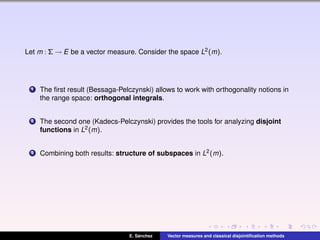
Let m : Σ → E be a vector measure. Consider the space L2(m).
1 The first result (Bessaga-Pelczynski) allows to work with orthogonality notions in
the range space: orthogonal integrals.
2 The second one (Kadecs-Pelczynski) provides the tools for analyzing disjoint
functions in L2(m).
3 Combining both results: structure of subspaces in L2(m).
E. S´anchez Vector measures and classical disjointification methods
Let m : Σ → E be a vector measure. Consider the space L2(m).
1 The first result (Bessaga-Pelczynski) allows to work with orthogonality notions in
the range space: orthogonal integrals.
2 The second one (Kadecs-Pelczynski) provides the tools for analyzing disjoint
functions in L2(m).
3 Combining both results: structure of subspaces in L2(m).
E. S´anchez Vector measures and classical disjointification methods
Let m : Σ → E be a vector measure. Consider the space L2(m).
1 The first result (Bessaga-Pelczynski) allows to work with orthogonality notions in
the range space: orthogonal integrals.
2 The second one (Kadecs-Pelczynski) provides the tools for analyzing disjoint
functions in L2(m).
3 Combining both results: structure of subspaces in L2(m).
E. S´anchez Vector measures and classical disjointification methods
Let m : Σ → E be a vector measure. Consider the space L2(m).
1 The first result (Bessaga-Pelczynski) allows to work with orthogonality notions in
the range space: orthogonal integrals.
2 The second one (Kadecs-Pelczynski) provides the tools for analyzing disjoint
functions in L2(m).
3 Combining both results: structure of subspaces in L2(m).
E. S´anchez Vector measures and classical disjointification methods
DEFINITIONS: Banach function spaces
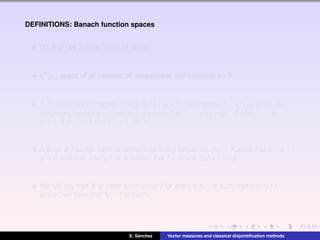
(Ω,Σ,µ) be a finite measure space.
L0(µ) space of all (classes of) measurable real functions on Ω.
A Banach function space (briefly B.f.s.) is a Banach space X ⊂ L0(µ) of locally
integrable functions with norm · X such that if f ∈ L0(µ), g ∈ X and |f| ≤ |g|
µ-a.e. then f ∈ X and f X ≤ g X .
A B.f.s. X has the Fatou property if for every sequence (fn) ⊂ X such that 0 ≤ fn ↑ f
µ-a.e. and supn fn X < ∞, it follows that f ∈ X and fn X ↑ f X .
We will say that X is order continuous if for every f,fn ∈ X such that 0 ≤ fn ↑ f
µ-a.e., we have that fn → f in norm.
E. S´anchez Vector measures and classical disjointification methods
DEFINITIONS: Banach function spaces
(Ω,Σ,µ) be a finite measure space.
L0(µ) space of all (classes of) measurable real functions on Ω.
A Banach function space (briefly B.f.s.) is a Banach space X ⊂ L0(µ) of locally
integrable functions with norm · X such that if f ∈ L0(µ), g ∈ X and |f| ≤ |g|
µ-a.e. then f ∈ X and f X ≤ g X .
A B.f.s. X has the Fatou property if for every sequence (fn) ⊂ X such that 0 ≤ fn ↑ f
µ-a.e. and supn fn X < ∞, it follows that f ∈ X and fn X ↑ f X .
We will say that X is order continuous if for every f,fn ∈ X such that 0 ≤ fn ↑ f
µ-a.e., we have that fn → f in norm.
E. S´anchez Vector measures and classical disjointification methods
DEFINITIONS: Banach function spaces
(Ω,Σ,µ) be a finite measure space.
L0(µ) space of all (classes of) measurable real functions on Ω.
A Banach function space (briefly B.f.s.) is a Banach space X ⊂ L0(µ) of locally
integrable functions with norm · X such that if f ∈ L0(µ), g ∈ X and |f| ≤ |g|
µ-a.e. then f ∈ X and f X ≤ g X .
A B.f.s. X has the Fatou property if for every sequence (fn) ⊂ X such that 0 ≤ fn ↑ f
µ-a.e. and supn fn X < ∞, it follows that f ∈ X and fn X ↑ f X .
We will say that X is order continuous if for every f,fn ∈ X such that 0 ≤ fn ↑ f
µ-a.e., we have that fn → f in norm.
E. S´anchez Vector measures and classical disjointification methods
DEFINITIONS: Banach function spaces
(Ω,Σ,µ) be a finite measure space.
L0(µ) space of all (classes of) measurable real functions on Ω.
A Banach function space (briefly B.f.s.) is a Banach space X ⊂ L0(µ) of locally
integrable functions with norm · X such that if f ∈ L0(µ), g ∈ X and |f| ≤ |g|
µ-a.e. then f ∈ X and f X ≤ g X .
A B.f.s. X has the Fatou property if for every sequence (fn) ⊂ X such that 0 ≤ fn ↑ f
µ-a.e. and supn fn X < ∞, it follows that f ∈ X and fn X ↑ f X .
We will say that X is order continuous if for every f,fn ∈ X such that 0 ≤ fn ↑ f
µ-a.e., we have that fn → f in norm.
E. S´anchez Vector measures and classical disjointification methods
DEFINITIONS: Banach function spaces
(Ω,Σ,µ) be a finite measure space.
L0(µ) space of all (classes of) measurable real functions on Ω.
A Banach function space (briefly B.f.s.) is a Banach space X ⊂ L0(µ) of locally
integrable functions with norm · X such that if f ∈ L0(µ), g ∈ X and |f| ≤ |g|
µ-a.e. then f ∈ X and f X ≤ g X .
A B.f.s. X has the Fatou property if for every sequence (fn) ⊂ X such that 0 ≤ fn ↑ f
µ-a.e. and supn fn X < ∞, it follows that f ∈ X and fn X ↑ f X .
We will say that X is order continuous if for every f,fn ∈ X such that 0 ≤ fn ↑ f
µ-a.e., we have that fn → f in norm.
E. S´anchez Vector measures and classical disjointification methods
DEFINITIONS: Banach function spaces
(Ω,Σ,µ) be a finite measure space.
L0(µ) space of all (classes of) measurable real functions on Ω.
A Banach function space (briefly B.f.s.) is a Banach space X ⊂ L0(µ) of locally
integrable functions with norm · X such that if f ∈ L0(µ), g ∈ X and |f| ≤ |g|
µ-a.e. then f ∈ X and f X ≤ g X .
A B.f.s. X has the Fatou property if for every sequence (fn) ⊂ X such that 0 ≤ fn ↑ f
µ-a.e. and supn fn X < ∞, it follows that f ∈ X and fn X ↑ f X .
We will say that X is order continuous if for every f,fn ∈ X such that 0 ≤ fn ↑ f
µ-a.e., we have that fn → f in norm.
E. S´anchez Vector measures and classical disjointification methods
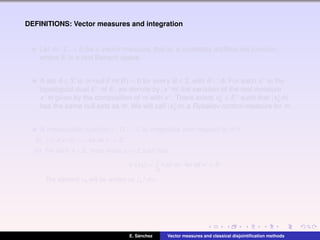
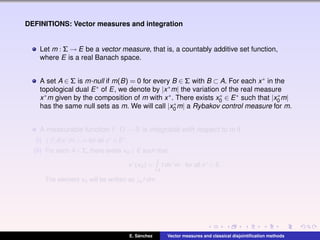
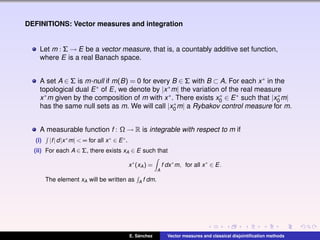
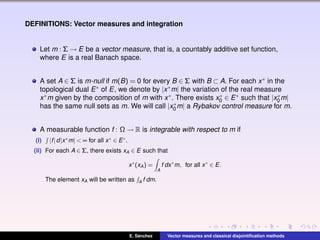
DEFINITIONS: Vector measures and integration
Let m : Σ → E be a vector measure, that is, a countably additive set function,
where E is a real Banach space.
A set A ∈ Σ is m-null if m(B) = 0 for every B ∈ Σ with B ⊂ A. For each x∗ in the
topological dual E∗ of E, we denote by |x∗m| the variation of the real measure
x∗m given by the composition of m with x∗. There exists x∗
0 ∈ E∗ such that |x∗
0 m|
has the same null sets as m. We will call |x∗
0 m| a Rybakov control measure for m.
A measurable function f : Ω → R is integrable with respect to m if
(i) |f|d|x∗
m| < ∞ for all x∗
∈ E∗
.
(ii) For each A ∈ Σ, there exists xA ∈ E such that
x∗
(xA) =
A
f dx∗
m, for all x∗
∈ E.
The element xA will be written as A f dm.
E. S´anchez Vector measures and classical disjointification methods
DEFINITIONS: Vector measures and integration
Let m : Σ → E be a vector measure, that is, a countably additive set function,
where E is a real Banach space.
A set A ∈ Σ is m-null if m(B) = 0 for every B ∈ Σ with B ⊂ A. For each x∗ in the
topological dual E∗ of E, we denote by |x∗m| the variation of the real measure
x∗m given by the composition of m with x∗. There exists x∗
0 ∈ E∗ such that |x∗
0 m|
has the same null sets as m. We will call |x∗
0 m| a Rybakov control measure for m.
A measurable function f : Ω → R is integrable with respect to m if
(i) |f|d|x∗
m| < ∞ for all x∗
∈ E∗
.
(ii) For each A ∈ Σ, there exists xA ∈ E such that
x∗
(xA) =
A
f dx∗
m, for all x∗
∈ E.
The element xA will be written as A f dm.
E. S´anchez Vector measures and classical disjointification methods
DEFINITIONS: Vector measures and integration
Let m : Σ → E be a vector measure, that is, a countably additive set function,
where E is a real Banach space.
A set A ∈ Σ is m-null if m(B) = 0 for every B ∈ Σ with B ⊂ A. For each x∗ in the
topological dual E∗ of E, we denote by |x∗m| the variation of the real measure
x∗m given by the composition of m with x∗. There exists x∗
0 ∈ E∗ such that |x∗
0 m|
has the same null sets as m. We will call |x∗
0 m| a Rybakov control measure for m.
A measurable function f : Ω → R is integrable with respect to m if
(i) |f|d|x∗
m| < ∞ for all x∗
∈ E∗
.
(ii) For each A ∈ Σ, there exists xA ∈ E such that
x∗
(xA) =
A
f dx∗
m, for all x∗
∈ E.
The element xA will be written as A f dm.
E. S´anchez Vector measures and classical disjointification methods
DEFINITIONS: Vector measures and integration
Let m : Σ → E be a vector measure, that is, a countably additive set function,
where E is a real Banach space.
A set A ∈ Σ is m-null if m(B) = 0 for every B ∈ Σ with B ⊂ A. For each x∗ in the
topological dual E∗ of E, we denote by |x∗m| the variation of the real measure
x∗m given by the composition of m with x∗. There exists x∗
0 ∈ E∗ such that |x∗
0 m|
has the same null sets as m. We will call |x∗
0 m| a Rybakov control measure for m.
A measurable function f : Ω → R is integrable with respect to m if
(i) |f|d|x∗
m| < ∞ for all x∗
∈ E∗
.
(ii) For each A ∈ Σ, there exists xA ∈ E such that
x∗
(xA) =
A
f dx∗
m, for all x∗
∈ E.
The element xA will be written as A f dm.
E. S´anchez Vector measures and classical disjointification methods
DEFINITIONS: Vector measures and integration
Let m : Σ → E be a vector measure, that is, a countably additive set function,
where E is a real Banach space.
A set A ∈ Σ is m-null if m(B) = 0 for every B ∈ Σ with B ⊂ A. For each x∗ in the
topological dual E∗ of E, we denote by |x∗m| the variation of the real measure
x∗m given by the composition of m with x∗. There exists x∗
0 ∈ E∗ such that |x∗
0 m|
has the same null sets as m. We will call |x∗
0 m| a Rybakov control measure for m.
A measurable function f : Ω → R is integrable with respect to m if
(i) |f|d|x∗
m| < ∞ for all x∗
∈ E∗
.
(ii) For each A ∈ Σ, there exists xA ∈ E such that
x∗
(xA) =
A
f dx∗
m, for all x∗
∈ E.
The element xA will be written as A f dm.
E. S´anchez Vector measures and classical disjointification methods
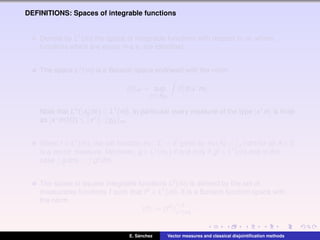
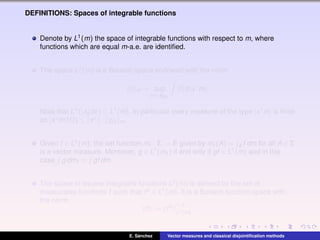
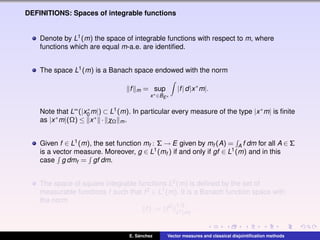
DEFINITIONS: Spaces of integrable functions
Denote by L1(m) the space of integrable functions with respect to m, where
functions which are equal m-a.e. are identified.
The space L1(m) is a Banach space endowed with the norm
f m = sup
x∗∈BE∗
|f|d|x∗
m|.
Note that L∞(|x∗
0 m|) ⊂ L1(m). In particular every measure of the type |x∗m| is finite
as |x∗m|(Ω) ≤ x∗ · χΩ m.
Given f ∈ L1(m), the set function mf : Σ → E given by mf (A) = A f dm for all A ∈ Σ
is a vector measure. Moreover, g ∈ L1(mf ) if and only if gf ∈ L1(m) and in this
case g dmf = gf dm.
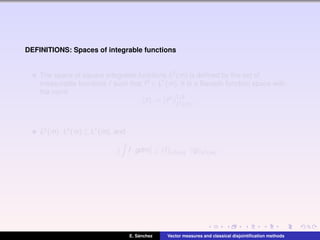
The space of square integrable functions L2(m) is defined by the set of
measurable functions f such that f2 ∈ L1(m). It is a Banach function space with
the norm
f := f2 1/2
L1(m)
.
E. S´anchez Vector measures and classical disjointification methods
DEFINITIONS: Spaces of integrable functions
Denote by L1(m) the space of integrable functions with respect to m, where
functions which are equal m-a.e. are identified.
The space L1(m) is a Banach space endowed with the norm
f m = sup
x∗∈BE∗
|f|d|x∗
m|.
Note that L∞(|x∗
0 m|) ⊂ L1(m). In particular every measure of the type |x∗m| is finite
as |x∗m|(Ω) ≤ x∗ · χΩ m.
Given f ∈ L1(m), the set function mf : Σ → E given by mf (A) = A f dm for all A ∈ Σ
is a vector measure. Moreover, g ∈ L1(mf ) if and only if gf ∈ L1(m) and in this
case g dmf = gf dm.
The space of square integrable functions L2(m) is defined by the set of
measurable functions f such that f2 ∈ L1(m). It is a Banach function space with
the norm
f := f2 1/2
L1(m)
.
E. S´anchez Vector measures and classical disjointification methods
DEFINITIONS: Spaces of integrable functions
Denote by L1(m) the space of integrable functions with respect to m, where
functions which are equal m-a.e. are identified.
The space L1(m) is a Banach space endowed with the norm
f m = sup
x∗∈BE∗
|f|d|x∗
m|.
Note that L∞(|x∗
0 m|) ⊂ L1(m). In particular every measure of the type |x∗m| is finite
as |x∗m|(Ω) ≤ x∗ · χΩ m.
Given f ∈ L1(m), the set function mf : Σ → E given by mf (A) = A f dm for all A ∈ Σ
is a vector measure. Moreover, g ∈ L1(mf ) if and only if gf ∈ L1(m) and in this
case g dmf = gf dm.
The space of square integrable functions L2(m) is defined by the set of
measurable functions f such that f2 ∈ L1(m). It is a Banach function space with
the norm
f := f2 1/2
L1(m)
.
E. S´anchez Vector measures and classical disjointification methods
DEFINITIONS: Spaces of integrable functions
Denote by L1(m) the space of integrable functions with respect to m, where
functions which are equal m-a.e. are identified.
The space L1(m) is a Banach space endowed with the norm
f m = sup
x∗∈BE∗
|f|d|x∗
m|.
Note that L∞(|x∗
0 m|) ⊂ L1(m). In particular every measure of the type |x∗m| is finite
as |x∗m|(Ω) ≤ x∗ · χΩ m.
Given f ∈ L1(m), the set function mf : Σ → E given by mf (A) = A f dm for all A ∈ Σ
is a vector measure. Moreover, g ∈ L1(mf ) if and only if gf ∈ L1(m) and in this
case g dmf = gf dm.
The space of square integrable functions L2(m) is defined by the set of
measurable functions f such that f2 ∈ L1(m). It is a Banach function space with
the norm
f := f2 1/2
L1(m)
.
E. S´anchez Vector measures and classical disjointification methods
DEFINITIONS: Spaces of integrable functions
Denote by L1(m) the space of integrable functions with respect to m, where
functions which are equal m-a.e. are identified.
The space L1(m) is a Banach space endowed with the norm
f m = sup
x∗∈BE∗
|f|d|x∗
m|.
Note that L∞(|x∗
0 m|) ⊂ L1(m). In particular every measure of the type |x∗m| is finite
as |x∗m|(Ω) ≤ x∗ · χΩ m.
Given f ∈ L1(m), the set function mf : Σ → E given by mf (A) = A f dm for all A ∈ Σ
is a vector measure. Moreover, g ∈ L1(mf ) if and only if gf ∈ L1(m) and in this
case g dmf = gf dm.
The space of square integrable functions L2(m) is defined by the set of
measurable functions f such that f2 ∈ L1(m). It is a Banach function space with
the norm
f := f2 1/2
L1(m)
.
E. S´anchez Vector measures and classical disjointification methods
DEFINITIONS: Spaces of integrable functions
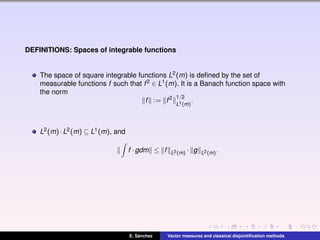
The space of square integrable functions L2(m) is defined by the set of
measurable functions f such that f2 ∈ L1(m). It is a Banach function space with
the norm
f := f2 1/2
L1(m)
.
L2(m)·L2(m) ⊆ L1(m), and
f ·gdm ≤ f L2(m) · g L2(m).
E. S´anchez Vector measures and classical disjointification methods
DEFINITIONS: Spaces of integrable functions
The space of square integrable functions L2(m) is defined by the set of
measurable functions f such that f2 ∈ L1(m). It is a Banach function space with
the norm
f := f2 1/2
L1(m)
.
L2(m)·L2(m) ⊆ L1(m), and
f ·gdm ≤ f L2(m) · g L2(m).
E. S´anchez Vector measures and classical disjointification methods
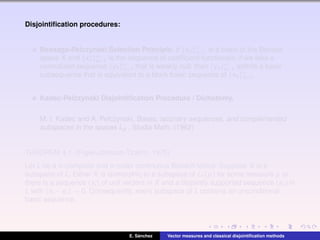
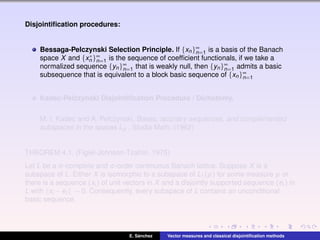
Disjointification procedures:
Bessaga-Pelczynski Selection Principle. If {xn}∞
n=1 is a basis of the Banach
space X and {x∗
n }∞
n=1 is the sequence of coefficient functionals, if we take a
normalized sequence {yn}∞
n=1 that is weakly null, then {yn}∞
n=1 admits a basic
subsequence that is equivalent to a block basic sequence of {xn}∞
n=1
Kadec-Pelczynski Disjointification Procedure / Dichotomy.
M. I. Kadec and A. Pelczynski, Bases, lacunary sequences, and complemented
subspaces in the spaces Lp , Studia Math. (1962)
THEOREM 4.1. (Figiel-Johnson-Tzafriri, 1975)
Let L be a σ-complete and σ-order continuous Banach lattice. Suppose X is a
subspace of L. Either X is isomorphic to a subspace of L1(µ) for some measure µ or
there is a sequence (xi ) of unit vectors in X and a disjointly supported sequence (ei ) in
L with xi −ei → 0. Consequently, every subspace of L contains an unconditional
basic sequence.
E. S´anchez Vector measures and classical disjointification methods
Disjointification procedures:
Bessaga-Pelczynski Selection Principle. If {xn}∞
n=1 is a basis of the Banach
space X and {x∗
n }∞
n=1 is the sequence of coefficient functionals, if we take a
normalized sequence {yn}∞
n=1 that is weakly null, then {yn}∞
n=1 admits a basic
subsequence that is equivalent to a block basic sequence of {xn}∞
n=1
Kadec-Pelczynski Disjointification Procedure / Dichotomy.
M. I. Kadec and A. Pelczynski, Bases, lacunary sequences, and complemented
subspaces in the spaces Lp , Studia Math. (1962)
THEOREM 4.1. (Figiel-Johnson-Tzafriri, 1975)
Let L be a σ-complete and σ-order continuous Banach lattice. Suppose X is a
subspace of L. Either X is isomorphic to a subspace of L1(µ) for some measure µ or
there is a sequence (xi ) of unit vectors in X and a disjointly supported sequence (ei ) in
L with xi −ei → 0. Consequently, every subspace of L contains an unconditional
basic sequence.
E. S´anchez Vector measures and classical disjointification methods
Disjointification procedures:
Bessaga-Pelczynski Selection Principle. If {xn}∞
n=1 is a basis of the Banach
space X and {x∗
n }∞
n=1 is the sequence of coefficient functionals, if we take a
normalized sequence {yn}∞
n=1 that is weakly null, then {yn}∞
n=1 admits a basic
subsequence that is equivalent to a block basic sequence of {xn}∞
n=1
Kadec-Pelczynski Disjointification Procedure / Dichotomy.
M. I. Kadec and A. Pelczynski, Bases, lacunary sequences, and complemented
subspaces in the spaces Lp , Studia Math. (1962)
THEOREM 4.1. (Figiel-Johnson-Tzafriri, 1975)
Let L be a σ-complete and σ-order continuous Banach lattice. Suppose X is a
subspace of L. Either X is isomorphic to a subspace of L1(µ) for some measure µ or
there is a sequence (xi ) of unit vectors in X and a disjointly supported sequence (ei ) in
L with xi −ei → 0. Consequently, every subspace of L contains an unconditional
basic sequence.
E. S´anchez Vector measures and classical disjointification methods
Disjointification procedures:
Bessaga-Pelczynski Selection Principle. If {xn}∞
n=1 is a basis of the Banach
space X and {x∗
n }∞
n=1 is the sequence of coefficient functionals, if we take a
normalized sequence {yn}∞
n=1 that is weakly null, then {yn}∞
n=1 admits a basic
subsequence that is equivalent to a block basic sequence of {xn}∞
n=1
Kadec-Pelczynski Disjointification Procedure / Dichotomy.
M. I. Kadec and A. Pelczynski, Bases, lacunary sequences, and complemented
subspaces in the spaces Lp , Studia Math. (1962)
THEOREM 4.1. (Figiel-Johnson-Tzafriri, 1975)
Let L be a σ-complete and σ-order continuous Banach lattice. Suppose X is a
subspace of L. Either X is isomorphic to a subspace of L1(µ) for some measure µ or
there is a sequence (xi ) of unit vectors in X and a disjointly supported sequence (ei ) in
L with xi −ei → 0. Consequently, every subspace of L contains an unconditional
basic sequence.
E. S´anchez Vector measures and classical disjointification methods
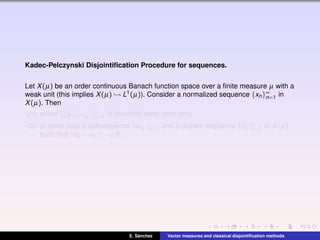
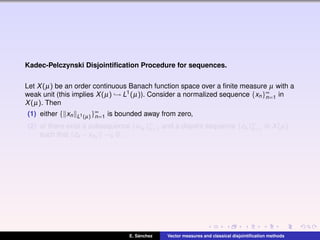
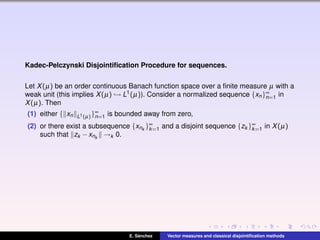
Kadec-Pelczynski Disjointification Procedure for sequences.
Let X(µ) be an order continuous Banach function space over a finite measure µ with a
weak unit (this implies X(µ) → L1(µ)). Consider a normalized sequence {xn}∞
n=1 in
X(µ). Then
(1) either { xn L1(µ)}∞
n=1 is bounded away from zero,
(2) or there exist a subsequence {xnk
}∞
k=1 and a disjoint sequence {zk }∞
k=1 in X(µ)
such that zk −xnk
→k 0.
E. S´anchez Vector measures and classical disjointification methods
Kadec-Pelczynski Disjointification Procedure for sequences.
Let X(µ) be an order continuous Banach function space over a finite measure µ with a
weak unit (this implies X(µ) → L1(µ)). Consider a normalized sequence {xn}∞
n=1 in
X(µ). Then
(1) either { xn L1(µ)}∞
n=1 is bounded away from zero,
(2) or there exist a subsequence {xnk
}∞
k=1 and a disjoint sequence {zk }∞
k=1 in X(µ)
such that zk −xnk
→k 0.
E. S´anchez Vector measures and classical disjointification methods
Kadec-Pelczynski Disjointification Procedure for sequences.
Let X(µ) be an order continuous Banach function space over a finite measure µ with a
weak unit (this implies X(µ) → L1(µ)). Consider a normalized sequence {xn}∞
n=1 in
X(µ). Then
(1) either { xn L1(µ)}∞
n=1 is bounded away from zero,
(2) or there exist a subsequence {xnk
}∞
k=1 and a disjoint sequence {zk }∞
k=1 in X(µ)
such that zk −xnk
→k 0.
E. S´anchez Vector measures and classical disjointification methods
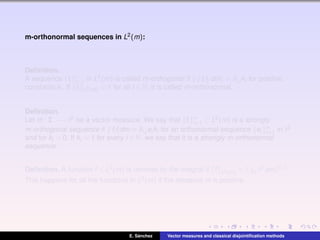
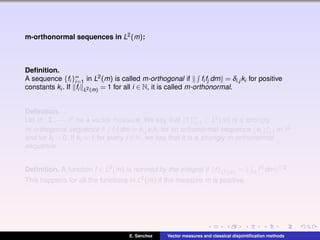
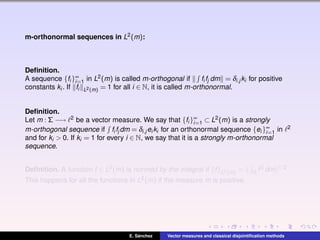
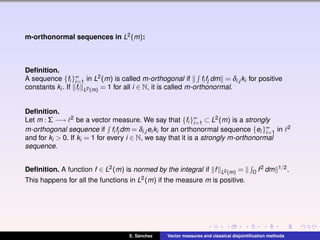
m-orthonormal sequences in L2(m):
Definition.
A sequence {fi }∞
i=1 in L2(m) is called m-orthogonal if fi fj dm = δi,j ki for positive
constants ki . If fi L2(m) = 1 for all i ∈ N, it is called m-orthonormal.
Definition.
Let m : Σ −→ 2 be a vector measure. We say that {fi }∞
i=1 ⊂ L2(m) is a strongly
m-orthogonal sequence if fi fj dm = δi,j ei ki for an orthonormal sequence {ei }∞
i=1 in 2
and for ki > 0. If ki = 1 for every i ∈ N, we say that it is a strongly m-orthonormal
sequence.
Definition. A function f ∈ L2(m) is normed by the integral if f L2(m) = Ω f2 dm 1/2.
This happens for all the functions in L2(m) if the measure m is positive.
E. S´anchez Vector measures and classical disjointification methods
m-orthonormal sequences in L2(m):
Definition.
A sequence {fi }∞
i=1 in L2(m) is called m-orthogonal if fi fj dm = δi,j ki for positive
constants ki . If fi L2(m) = 1 for all i ∈ N, it is called m-orthonormal.
Definition.
Let m : Σ −→ 2 be a vector measure. We say that {fi }∞
i=1 ⊂ L2(m) is a strongly
m-orthogonal sequence if fi fj dm = δi,j ei ki for an orthonormal sequence {ei }∞
i=1 in 2
and for ki > 0. If ki = 1 for every i ∈ N, we say that it is a strongly m-orthonormal
sequence.
Definition. A function f ∈ L2(m) is normed by the integral if f L2(m) = Ω f2 dm 1/2.
This happens for all the functions in L2(m) if the measure m is positive.
E. S´anchez Vector measures and classical disjointification methods
m-orthonormal sequences in L2(m):
Definition.
A sequence {fi }∞
i=1 in L2(m) is called m-orthogonal if fi fj dm = δi,j ki for positive
constants ki . If fi L2(m) = 1 for all i ∈ N, it is called m-orthonormal.
Definition.
Let m : Σ −→ 2 be a vector measure. We say that {fi }∞
i=1 ⊂ L2(m) is a strongly
m-orthogonal sequence if fi fj dm = δi,j ei ki for an orthonormal sequence {ei }∞
i=1 in 2
and for ki > 0. If ki = 1 for every i ∈ N, we say that it is a strongly m-orthonormal
sequence.
Definition. A function f ∈ L2(m) is normed by the integral if f L2(m) = Ω f2 dm 1/2.
This happens for all the functions in L2(m) if the measure m is positive.
E. S´anchez Vector measures and classical disjointification methods
m-orthonormal sequences in L2(m):
Definition.
A sequence {fi }∞
i=1 in L2(m) is called m-orthogonal if fi fj dm = δi,j ki for positive
constants ki . If fi L2(m) = 1 for all i ∈ N, it is called m-orthonormal.
Definition.
Let m : Σ −→ 2 be a vector measure. We say that {fi }∞
i=1 ⊂ L2(m) is a strongly
m-orthogonal sequence if fi fj dm = δi,j ei ki for an orthonormal sequence {ei }∞
i=1 in 2
and for ki > 0. If ki = 1 for every i ∈ N, we say that it is a strongly m-orthonormal
sequence.
Definition. A function f ∈ L2(m) is normed by the integral if f L2(m) = Ω f2 dm 1/2.
This happens for all the functions in L2(m) if the measure m is positive.
E. S´anchez Vector measures and classical disjointification methods
Example.
Let ([0,∞),Σ,µ) be Lebesgue measure space. Let rk (x) := sign{sin(2k−1x)} be the
Rademacher function of period 2π defined at the interval Ek = [2(k −1)π,2kπ], k ∈ N.
Consider the vector measure m : Σ → 2 given by m(A) := ∑∞
k=1
−1
2k ( A∩Ek
rk dµ)ek ∈ 2,
A ∈ Σ.
Note that if f ∈ L2(m) then [0,∞) fdm = ( −1
2k Ek
frk dµ)k ∈ 2. Consider the sequence of
functions
f1(x) = sin(x)· χ[π,2π](x)
f2(x) = sin(2x)· χ[0,2π](x)+ χ[ 7
2 π,4π]
(x)
f3(x) = sin(4x)· χ[0,4π](x)+ χ[ 23
4 π,6π]
(x)
...
fn(x) = sin(2n−1
x)· χ[0,2(n−1)π](x)+ χ[(2n− 2
2n )π,2nπ]
(x) , n ≥ 2.
fig1.jpg
E. S´anchez Vector measures and classical disjointification methods
Example.
Let ([0,∞),Σ,µ) be Lebesgue measure space. Let rk (x) := sign{sin(2k−1x)} be the
Rademacher function of period 2π defined at the interval Ek = [2(k −1)π,2kπ], k ∈ N.
Consider the vector measure m : Σ → 2 given by m(A) := ∑∞
k=1
−1
2k ( A∩Ek
rk dµ)ek ∈ 2,
A ∈ Σ.
Note that if f ∈ L2(m) then [0,∞) fdm = ( −1
2k Ek
frk dµ)k ∈ 2. Consider the sequence of
functions
f1(x) = sin(x)· χ[π,2π](x)
f2(x) = sin(2x)· χ[0,2π](x)+ χ[ 7
2 π,4π]
(x)
f3(x) = sin(4x)· χ[0,4π](x)+ χ[ 23
4 π,6π]
(x)
...
fn(x) = sin(2n−1
x)· χ[0,2(n−1)π](x)+ χ[(2n− 2
2n )π,2nπ]
(x) , n ≥ 2.
fig1.jpg
E. S´anchez Vector measures and classical disjointification methods
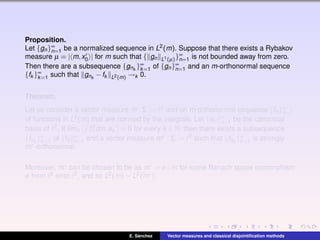
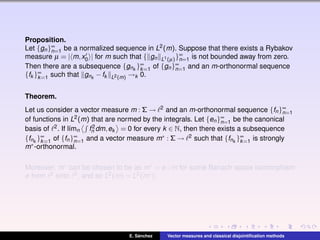
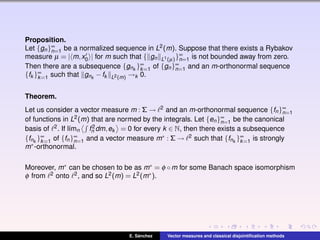
Proposition.
Let {gn}∞
n=1 be a normalized sequence in L2(m). Suppose that there exists a Rybakov
measure µ = | m,x0 | for m such that { gn L1(µ)}∞
n=1 is not bounded away from zero.
Then there are a subsequence {gnk
}∞
k=1 of {gn}∞
n=1 and an m-orthonormal sequence
{fk }∞
k=1 such that gnk
−fk L2(m) →k 0.
Theorem.
Let us consider a vector measure m : Σ → 2 and an m-orthonormal sequence {fn}∞
n=1
of functions in L2(m) that are normed by the integrals. Let {en}∞
n=1 be the canonical
basis of 2. If l´ımn f2
n dm,ek = 0 for every k ∈ N, then there exists a subsequence
{fnk
}∞
k=1 of {fn}∞
n=1 and a vector measure m∗ : Σ → 2 such that {fnk
}∞
k=1 is strongly
m∗-orthonormal.
Moreover, m∗ can be chosen to be as m∗ = φ ◦m for some Banach space isomorphism
φ from 2 onto 2, and so L2(m) = L2(m∗).
E. S´anchez Vector measures and classical disjointification methods
Proposition.
Let {gn}∞
n=1 be a normalized sequence in L2(m). Suppose that there exists a Rybakov
measure µ = | m,x0 | for m such that { gn L1(µ)}∞
n=1 is not bounded away from zero.
Then there are a subsequence {gnk
}∞
k=1 of {gn}∞
n=1 and an m-orthonormal sequence
{fk }∞
k=1 such that gnk
−fk L2(m) →k 0.
Theorem.
Let us consider a vector measure m : Σ → 2 and an m-orthonormal sequence {fn}∞
n=1
of functions in L2(m) that are normed by the integrals. Let {en}∞
n=1 be the canonical
basis of 2. If l´ımn f2
n dm,ek = 0 for every k ∈ N, then there exists a subsequence
{fnk
}∞
k=1 of {fn}∞
n=1 and a vector measure m∗ : Σ → 2 such that {fnk
}∞
k=1 is strongly
m∗-orthonormal.
Moreover, m∗ can be chosen to be as m∗ = φ ◦m for some Banach space isomorphism
φ from 2 onto 2, and so L2(m) = L2(m∗).
E. S´anchez Vector measures and classical disjointification methods
Proposition.
Let {gn}∞
n=1 be a normalized sequence in L2(m). Suppose that there exists a Rybakov
measure µ = | m,x0 | for m such that { gn L1(µ)}∞
n=1 is not bounded away from zero.
Then there are a subsequence {gnk
}∞
k=1 of {gn}∞
n=1 and an m-orthonormal sequence
{fk }∞
k=1 such that gnk
−fk L2(m) →k 0.
Theorem.
Let us consider a vector measure m : Σ → 2 and an m-orthonormal sequence {fn}∞
n=1
of functions in L2(m) that are normed by the integrals. Let {en}∞
n=1 be the canonical
basis of 2. If l´ımn f2
n dm,ek = 0 for every k ∈ N, then there exists a subsequence
{fnk
}∞
k=1 of {fn}∞
n=1 and a vector measure m∗ : Σ → 2 such that {fnk
}∞
k=1 is strongly
m∗-orthonormal.
Moreover, m∗ can be chosen to be as m∗ = φ ◦m for some Banach space isomorphism
φ from 2 onto 2, and so L2(m) = L2(m∗).
E. S´anchez Vector measures and classical disjointification methods
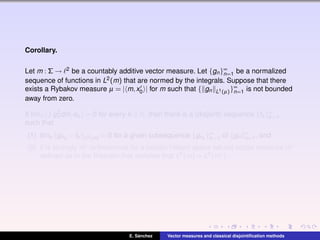
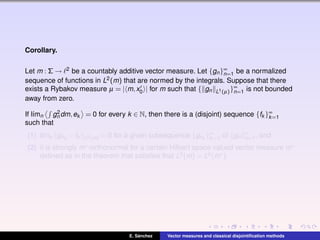
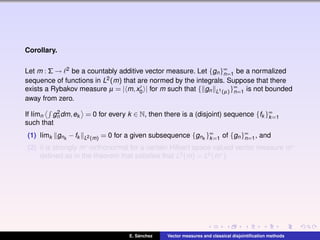
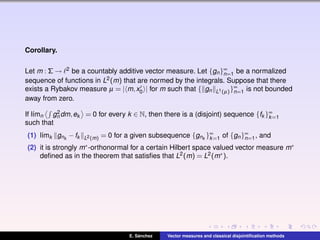
Corollary.
Let m : Σ → 2 be a countably additive vector measure. Let {gn}∞
n=1 be a normalized
sequence of functions in L2(m) that are normed by the integrals. Suppose that there
exists a Rybakov measure µ = | m,x0 | for m such that { gn L1(µ)}∞
n=1 is not bounded
away from zero.
If l´ımn g2
n dm,ek = 0 for every k ∈ N, then there is a (disjoint) sequence {fk }∞
k=1
such that
(1) l´ımk gnk
−fk L2(m) = 0 for a given subsequence {gnk
}∞
k=1 of {gn}∞
n=1, and
(2) it is strongly m∗-orthonormal for a certain Hilbert space valued vector measure m∗
defined as in the theorem that satisfies that L2(m) = L2(m∗).
E. S´anchez Vector measures and classical disjointification methods
Corollary.
Let m : Σ → 2 be a countably additive vector measure. Let {gn}∞
n=1 be a normalized
sequence of functions in L2(m) that are normed by the integrals. Suppose that there
exists a Rybakov measure µ = | m,x0 | for m such that { gn L1(µ)}∞
n=1 is not bounded
away from zero.
If l´ımn g2
n dm,ek = 0 for every k ∈ N, then there is a (disjoint) sequence {fk }∞
k=1
such that
(1) l´ımk gnk
−fk L2(m) = 0 for a given subsequence {gnk
}∞
k=1 of {gn}∞
n=1, and
(2) it is strongly m∗-orthonormal for a certain Hilbert space valued vector measure m∗
defined as in the theorem that satisfies that L2(m) = L2(m∗).
E. S´anchez Vector measures and classical disjointification methods
Corollary.
Let m : Σ → 2 be a countably additive vector measure. Let {gn}∞
n=1 be a normalized
sequence of functions in L2(m) that are normed by the integrals. Suppose that there
exists a Rybakov measure µ = | m,x0 | for m such that { gn L1(µ)}∞
n=1 is not bounded
away from zero.
If l´ımn g2
n dm,ek = 0 for every k ∈ N, then there is a (disjoint) sequence {fk }∞
k=1
such that
(1) l´ımk gnk
−fk L2(m) = 0 for a given subsequence {gnk
}∞
k=1 of {gn}∞
n=1, and
(2) it is strongly m∗-orthonormal for a certain Hilbert space valued vector measure m∗
defined as in the theorem that satisfies that L2(m) = L2(m∗).
E. S´anchez Vector measures and classical disjointification methods
Corollary.
Let m : Σ → 2 be a countably additive vector measure. Let {gn}∞
n=1 be a normalized
sequence of functions in L2(m) that are normed by the integrals. Suppose that there
exists a Rybakov measure µ = | m,x0 | for m such that { gn L1(µ)}∞
n=1 is not bounded
away from zero.
If l´ımn g2
n dm,ek = 0 for every k ∈ N, then there is a (disjoint) sequence {fk }∞
k=1
such that
(1) l´ımk gnk
−fk L2(m) = 0 for a given subsequence {gnk
}∞
k=1 of {gn}∞
n=1, and
(2) it is strongly m∗-orthonormal for a certain Hilbert space valued vector measure m∗
defined as in the theorem that satisfies that L2(m) = L2(m∗).
E. S´anchez Vector measures and classical disjointification methods
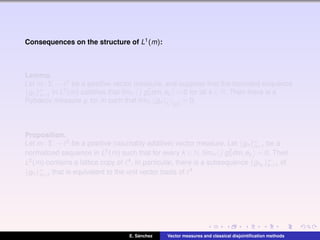
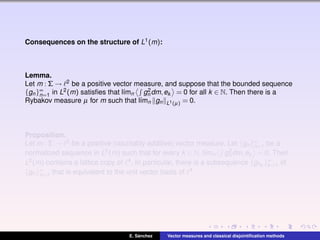
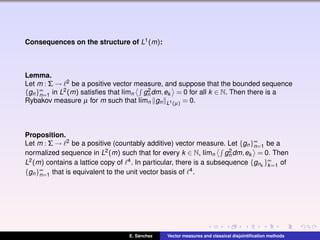
Consequences on the structure of L1(m):
Lemma.
Let m : Σ → 2 be a positive vector measure, and suppose that the bounded sequence
{gn}∞
n=1 in L2(m) satisfies that l´ımn g2
n dm,ek = 0 for all k ∈ N. Then there is a
Rybakov measure µ for m such that l´ımn gn L1(µ) = 0.
Proposition.
Let m : Σ → 2 be a positive (countably additive) vector measure. Let {gn}∞
n=1 be a
normalized sequence in L2(m) such that for every k ∈ N, l´ımn g2
n dm,ek = 0. Then
L2(m) contains a lattice copy of 4. In particular, there is a subsequence {gnk
}∞
k=1 of
{gn}∞
n=1 that is equivalent to the unit vector basis of 4.
E. S´anchez Vector measures and classical disjointification methods
Consequences on the structure of L1(m):
Lemma.
Let m : Σ → 2 be a positive vector measure, and suppose that the bounded sequence
{gn}∞
n=1 in L2(m) satisfies that l´ımn g2
n dm,ek = 0 for all k ∈ N. Then there is a
Rybakov measure µ for m such that l´ımn gn L1(µ) = 0.
Proposition.
Let m : Σ → 2 be a positive (countably additive) vector measure. Let {gn}∞
n=1 be a
normalized sequence in L2(m) such that for every k ∈ N, l´ımn g2
n dm,ek = 0. Then
L2(m) contains a lattice copy of 4. In particular, there is a subsequence {gnk
}∞
k=1 of
{gn}∞
n=1 that is equivalent to the unit vector basis of 4.
E. S´anchez Vector measures and classical disjointification methods
Consequences on the structure of L1(m):
Lemma.
Let m : Σ → 2 be a positive vector measure, and suppose that the bounded sequence
{gn}∞
n=1 in L2(m) satisfies that l´ımn g2
n dm,ek = 0 for all k ∈ N. Then there is a
Rybakov measure µ for m such that l´ımn gn L1(µ) = 0.
Proposition.
Let m : Σ → 2 be a positive (countably additive) vector measure. Let {gn}∞
n=1 be a
normalized sequence in L2(m) such that for every k ∈ N, l´ımn g2
n dm,ek = 0. Then
L2(m) contains a lattice copy of 4. In particular, there is a subsequence {gnk
}∞
k=1 of
{gn}∞
n=1 that is equivalent to the unit vector basis of 4.
E. S´anchez Vector measures and classical disjointification methods
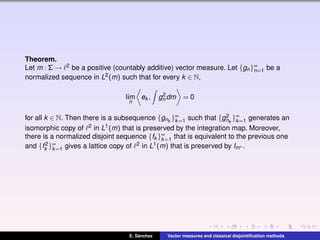
Theorem.
Let m : Σ → 2 be a positive (countably additive) vector measure. Let {gn}∞
n=1 be a
normalized sequence in L2(m) such that for every k ∈ N,
l´ım
n
ek , g2
n dm = 0
for all k ∈ N. Then there is a subsequence {gnk
}∞
k=1 such that {g2
nk
}∞
k=1 generates an
isomorphic copy of 2 in L1(m) that is preserved by the integration map. Moreover,
there is a normalized disjoint sequence {fk }∞
k=1 that is equivalent to the previous one
and {f2
k }∞
k=1 gives a lattice copy of 2 in L1(m) that is preserved by Im∗ .
E. S´anchez Vector measures and classical disjointification methods
Corollary.
Let m : Σ → 2 be a positive (countably additive) vector measure. The following
assertions are equivalent:
(1) There is a normalized sequence in L2(m) satisfying that l´ımn Ω g2
n dm,ek = 0 for
all the elements of the canonical basis {ek }∞
k=1 of 2.
(2) There is an 2-valued vector measure m∗ = φ ◦m —φ an isomorphism— such that
L2(m) = L2(m∗) and there is a disjoint sequence in L2(m) that is strongly
m∗-orthonormal.
(3) The subspace S that is fixed by the integration map Im satisfies that there are
positive functions hn ∈ S such that { Ω hndm}∞
n=1 is an orthonormal basis for
Im(S).
(4) There is an 2-valued vector measure m∗ defined as m∗ = φ ◦m —φ an
isomorphism— such that L1(m) = L1(m∗) and a subspace S of L1(m) such that
the restriction of Im∗ to S is a lattice isomorphism in 2.
E. S´anchez Vector measures and classical disjointification methods
Theorem.
The following assertions for a positive vector measure m : Σ → 2 are equivalent.
(1) L1(m) contains a lattice copy of 2.
(2) L1(m) has a reflexive infinite dimensional sublattice.
(3) L1(m) has a relatively weakly compact normalized sequence of disjoint functions.
(4) L1(m) contains a weakly null normalized sequence.
(5) There is a vector measure m∗ defined by m∗ = φ ◦m such that integration map Im∗
fixes a copy of 2.
(6) There is a vector measure m∗ defined as m∗ = φ ◦m that is not disjointly strictly
singular.
E. S´anchez Vector measures and classical disjointification methods
C. Bessaga and A. Pelczynski, On bases and unconditional convergence of series
in Banach spaces, Studia Math. 17, 151-164 (1958)
C. Bessaga and A. Pelczynski, A generalization of results of R. C. James
concerning absolute bases in Banach spaces, Studia Math. 17, 165-174 (1958)
M. I. Kadec and A. Pelczynski, Bases, lacunary sequences, and complemented
subspaces in the spaces Lp, Studia Math. 21, 161-176 (1962)
T. Figiel, W.B. Johnson and L. Tzafriri, On Banach lattices and spaces having
local unconditional structure, with applications to Lorentz function spaces, J. Appr.
Th. 13, 395-412 (1975)
E. Jim´enez Fern´andez and E.A. S´anchez P´erez. Lattice copies of 2 in L1 of a
vector measure and strongly orthogonal sequences. To be published in J. Func.
Sp. Appl.
E.A. S´anchez P´erez, Vector measure orthonormal functions and best
approximation for the 4-norm, Arch. Math. 80, 177-190 (2003)
E. S´anchez Vector measures and classical disjointification methods

Vector measures and classical disjointification methods

  • 1.
    Vector measures andclassical disjointification methods Enrique A. S´anchez P´erez I.U.M.P.A.-U. Polit´ecnica de Valencia, Joint work with Eduardo Jim´enez (U.P.V.) Madrid, October 2012 E. S´anchez Vector measures and classical disjointification methods
  • 2.
    Vector measures andclassical disjointification methods Enrique A. S´anchez P´erez I.U.M.P.A.-U. Polit´ecnica de Valencia, Joint work with Eduardo Jim´enez (U.P.V.) Madrid, October 2012 E. S´anchez Vector measures and classical disjointification methods
  • 3.
    E. S´anchez Vectormeasures and classical disjointification methods
  • 4.
    Motivation In this talkwe show how the classical disjointification methods (Bessaga-Pelczynski, Kadecs-Pelczynski) can be applied in the setting of the spaces of p-integrable functions with respect to vector measures. These spaces provide in fact a representation of p-convex order continuous Banach lattices with weak unit. Consequently, our results can be directly extended to this class of Banach lattices. Following this well-known technique for analyzing the structure of the subspaces of Banach function spaces. E. S´anchez Vector measures and classical disjointification methods
  • 5.
    Let m :Σ → E be a vector measure. Consider the space L2(m). 1 The first result (Bessaga-Pelczynski) allows to work with orthogonality notions in the range space: orthogonal integrals. 2 The second one (Kadecs-Pelczynski) provides the tools for analyzing disjoint functions in L2(m). 3 Combining both results: structure of subspaces in L2(m). E. S´anchez Vector measures and classical disjointification methods
  • 6.
    Let m :Σ → E be a vector measure. Consider the space L2(m). 1 The first result (Bessaga-Pelczynski) allows to work with orthogonality notions in the range space: orthogonal integrals. 2 The second one (Kadecs-Pelczynski) provides the tools for analyzing disjoint functions in L2(m). 3 Combining both results: structure of subspaces in L2(m). E. S´anchez Vector measures and classical disjointification methods
  • 7.
    Let m :Σ → E be a vector measure. Consider the space L2(m). 1 The first result (Bessaga-Pelczynski) allows to work with orthogonality notions in the range space: orthogonal integrals. 2 The second one (Kadecs-Pelczynski) provides the tools for analyzing disjoint functions in L2(m). 3 Combining both results: structure of subspaces in L2(m). E. S´anchez Vector measures and classical disjointification methods
  • 8.
    Let m :Σ → E be a vector measure. Consider the space L2(m). 1 The first result (Bessaga-Pelczynski) allows to work with orthogonality notions in the range space: orthogonal integrals. 2 The second one (Kadecs-Pelczynski) provides the tools for analyzing disjoint functions in L2(m). 3 Combining both results: structure of subspaces in L2(m). E. S´anchez Vector measures and classical disjointification methods
  • 9.
    DEFINITIONS: Banach functionspaces (Ω,Σ,µ) be a finite measure space. L0(µ) space of all (classes of) measurable real functions on Ω. A Banach function space (briefly B.f.s.) is a Banach space X ⊂ L0(µ) of locally integrable functions with norm · X such that if f ∈ L0(µ), g ∈ X and |f| ≤ |g| µ-a.e. then f ∈ X and f X ≤ g X . A B.f.s. X has the Fatou property if for every sequence (fn) ⊂ X such that 0 ≤ fn ↑ f µ-a.e. and supn fn X < ∞, it follows that f ∈ X and fn X ↑ f X . We will say that X is order continuous if for every f,fn ∈ X such that 0 ≤ fn ↑ f µ-a.e., we have that fn → f in norm. E. S´anchez Vector measures and classical disjointification methods
  • 10.
    DEFINITIONS: Banach functionspaces (Ω,Σ,µ) be a finite measure space. L0(µ) space of all (classes of) measurable real functions on Ω. A Banach function space (briefly B.f.s.) is a Banach space X ⊂ L0(µ) of locally integrable functions with norm · X such that if f ∈ L0(µ), g ∈ X and |f| ≤ |g| µ-a.e. then f ∈ X and f X ≤ g X . A B.f.s. X has the Fatou property if for every sequence (fn) ⊂ X such that 0 ≤ fn ↑ f µ-a.e. and supn fn X < ∞, it follows that f ∈ X and fn X ↑ f X . We will say that X is order continuous if for every f,fn ∈ X such that 0 ≤ fn ↑ f µ-a.e., we have that fn → f in norm. E. S´anchez Vector measures and classical disjointification methods
  • 11.
    DEFINITIONS: Banach functionspaces (Ω,Σ,µ) be a finite measure space. L0(µ) space of all (classes of) measurable real functions on Ω. A Banach function space (briefly B.f.s.) is a Banach space X ⊂ L0(µ) of locally integrable functions with norm · X such that if f ∈ L0(µ), g ∈ X and |f| ≤ |g| µ-a.e. then f ∈ X and f X ≤ g X . A B.f.s. X has the Fatou property if for every sequence (fn) ⊂ X such that 0 ≤ fn ↑ f µ-a.e. and supn fn X < ∞, it follows that f ∈ X and fn X ↑ f X . We will say that X is order continuous if for every f,fn ∈ X such that 0 ≤ fn ↑ f µ-a.e., we have that fn → f in norm. E. S´anchez Vector measures and classical disjointification methods
  • 12.
    DEFINITIONS: Banach functionspaces (Ω,Σ,µ) be a finite measure space. L0(µ) space of all (classes of) measurable real functions on Ω. A Banach function space (briefly B.f.s.) is a Banach space X ⊂ L0(µ) of locally integrable functions with norm · X such that if f ∈ L0(µ), g ∈ X and |f| ≤ |g| µ-a.e. then f ∈ X and f X ≤ g X . A B.f.s. X has the Fatou property if for every sequence (fn) ⊂ X such that 0 ≤ fn ↑ f µ-a.e. and supn fn X < ∞, it follows that f ∈ X and fn X ↑ f X . We will say that X is order continuous if for every f,fn ∈ X such that 0 ≤ fn ↑ f µ-a.e., we have that fn → f in norm. E. S´anchez Vector measures and classical disjointification methods
  • 13.
    DEFINITIONS: Banach functionspaces (Ω,Σ,µ) be a finite measure space. L0(µ) space of all (classes of) measurable real functions on Ω. A Banach function space (briefly B.f.s.) is a Banach space X ⊂ L0(µ) of locally integrable functions with norm · X such that if f ∈ L0(µ), g ∈ X and |f| ≤ |g| µ-a.e. then f ∈ X and f X ≤ g X . A B.f.s. X has the Fatou property if for every sequence (fn) ⊂ X such that 0 ≤ fn ↑ f µ-a.e. and supn fn X < ∞, it follows that f ∈ X and fn X ↑ f X . We will say that X is order continuous if for every f,fn ∈ X such that 0 ≤ fn ↑ f µ-a.e., we have that fn → f in norm. E. S´anchez Vector measures and classical disjointification methods
  • 14.
    DEFINITIONS: Banach functionspaces (Ω,Σ,µ) be a finite measure space. L0(µ) space of all (classes of) measurable real functions on Ω. A Banach function space (briefly B.f.s.) is a Banach space X ⊂ L0(µ) of locally integrable functions with norm · X such that if f ∈ L0(µ), g ∈ X and |f| ≤ |g| µ-a.e. then f ∈ X and f X ≤ g X . A B.f.s. X has the Fatou property if for every sequence (fn) ⊂ X such that 0 ≤ fn ↑ f µ-a.e. and supn fn X < ∞, it follows that f ∈ X and fn X ↑ f X . We will say that X is order continuous if for every f,fn ∈ X such that 0 ≤ fn ↑ f µ-a.e., we have that fn → f in norm. E. S´anchez Vector measures and classical disjointification methods
  • 15.
    DEFINITIONS: Vector measuresand integration Let m : Σ → E be a vector measure, that is, a countably additive set function, where E is a real Banach space. A set A ∈ Σ is m-null if m(B) = 0 for every B ∈ Σ with B ⊂ A. For each x∗ in the topological dual E∗ of E, we denote by |x∗m| the variation of the real measure x∗m given by the composition of m with x∗. There exists x∗ 0 ∈ E∗ such that |x∗ 0 m| has the same null sets as m. We will call |x∗ 0 m| a Rybakov control measure for m. A measurable function f : Ω → R is integrable with respect to m if (i) |f|d|x∗ m| < ∞ for all x∗ ∈ E∗ . (ii) For each A ∈ Σ, there exists xA ∈ E such that x∗ (xA) = A f dx∗ m, for all x∗ ∈ E. The element xA will be written as A f dm. E. S´anchez Vector measures and classical disjointification methods
  • 16.
    DEFINITIONS: Vector measuresand integration Let m : Σ → E be a vector measure, that is, a countably additive set function, where E is a real Banach space. A set A ∈ Σ is m-null if m(B) = 0 for every B ∈ Σ with B ⊂ A. For each x∗ in the topological dual E∗ of E, we denote by |x∗m| the variation of the real measure x∗m given by the composition of m with x∗. There exists x∗ 0 ∈ E∗ such that |x∗ 0 m| has the same null sets as m. We will call |x∗ 0 m| a Rybakov control measure for m. A measurable function f : Ω → R is integrable with respect to m if (i) |f|d|x∗ m| < ∞ for all x∗ ∈ E∗ . (ii) For each A ∈ Σ, there exists xA ∈ E such that x∗ (xA) = A f dx∗ m, for all x∗ ∈ E. The element xA will be written as A f dm. E. S´anchez Vector measures and classical disjointification methods
  • 17.
    DEFINITIONS: Vector measuresand integration Let m : Σ → E be a vector measure, that is, a countably additive set function, where E is a real Banach space. A set A ∈ Σ is m-null if m(B) = 0 for every B ∈ Σ with B ⊂ A. For each x∗ in the topological dual E∗ of E, we denote by |x∗m| the variation of the real measure x∗m given by the composition of m with x∗. There exists x∗ 0 ∈ E∗ such that |x∗ 0 m| has the same null sets as m. We will call |x∗ 0 m| a Rybakov control measure for m. A measurable function f : Ω → R is integrable with respect to m if (i) |f|d|x∗ m| < ∞ for all x∗ ∈ E∗ . (ii) For each A ∈ Σ, there exists xA ∈ E such that x∗ (xA) = A f dx∗ m, for all x∗ ∈ E. The element xA will be written as A f dm. E. S´anchez Vector measures and classical disjointification methods
  • 18.
    DEFINITIONS: Vector measuresand integration Let m : Σ → E be a vector measure, that is, a countably additive set function, where E is a real Banach space. A set A ∈ Σ is m-null if m(B) = 0 for every B ∈ Σ with B ⊂ A. For each x∗ in the topological dual E∗ of E, we denote by |x∗m| the variation of the real measure x∗m given by the composition of m with x∗. There exists x∗ 0 ∈ E∗ such that |x∗ 0 m| has the same null sets as m. We will call |x∗ 0 m| a Rybakov control measure for m. A measurable function f : Ω → R is integrable with respect to m if (i) |f|d|x∗ m| < ∞ for all x∗ ∈ E∗ . (ii) For each A ∈ Σ, there exists xA ∈ E such that x∗ (xA) = A f dx∗ m, for all x∗ ∈ E. The element xA will be written as A f dm. E. S´anchez Vector measures and classical disjointification methods
  • 19.
    DEFINITIONS: Vector measuresand integration Let m : Σ → E be a vector measure, that is, a countably additive set function, where E is a real Banach space. A set A ∈ Σ is m-null if m(B) = 0 for every B ∈ Σ with B ⊂ A. For each x∗ in the topological dual E∗ of E, we denote by |x∗m| the variation of the real measure x∗m given by the composition of m with x∗. There exists x∗ 0 ∈ E∗ such that |x∗ 0 m| has the same null sets as m. We will call |x∗ 0 m| a Rybakov control measure for m. A measurable function f : Ω → R is integrable with respect to m if (i) |f|d|x∗ m| < ∞ for all x∗ ∈ E∗ . (ii) For each A ∈ Σ, there exists xA ∈ E such that x∗ (xA) = A f dx∗ m, for all x∗ ∈ E. The element xA will be written as A f dm. E. S´anchez Vector measures and classical disjointification methods
  • 20.
    DEFINITIONS: Spaces ofintegrable functions Denote by L1(m) the space of integrable functions with respect to m, where functions which are equal m-a.e. are identified. The space L1(m) is a Banach space endowed with the norm f m = sup x∗∈BE∗ |f|d|x∗ m|. Note that L∞(|x∗ 0 m|) ⊂ L1(m). In particular every measure of the type |x∗m| is finite as |x∗m|(Ω) ≤ x∗ · χΩ m. Given f ∈ L1(m), the set function mf : Σ → E given by mf (A) = A f dm for all A ∈ Σ is a vector measure. Moreover, g ∈ L1(mf ) if and only if gf ∈ L1(m) and in this case g dmf = gf dm. The space of square integrable functions L2(m) is defined by the set of measurable functions f such that f2 ∈ L1(m). It is a Banach function space with the norm f := f2 1/2 L1(m) . E. S´anchez Vector measures and classical disjointification methods
  • 21.
    DEFINITIONS: Spaces ofintegrable functions Denote by L1(m) the space of integrable functions with respect to m, where functions which are equal m-a.e. are identified. The space L1(m) is a Banach space endowed with the norm f m = sup x∗∈BE∗ |f|d|x∗ m|. Note that L∞(|x∗ 0 m|) ⊂ L1(m). In particular every measure of the type |x∗m| is finite as |x∗m|(Ω) ≤ x∗ · χΩ m. Given f ∈ L1(m), the set function mf : Σ → E given by mf (A) = A f dm for all A ∈ Σ is a vector measure. Moreover, g ∈ L1(mf ) if and only if gf ∈ L1(m) and in this case g dmf = gf dm. The space of square integrable functions L2(m) is defined by the set of measurable functions f such that f2 ∈ L1(m). It is a Banach function space with the norm f := f2 1/2 L1(m) . E. S´anchez Vector measures and classical disjointification methods
  • 22.
    DEFINITIONS: Spaces ofintegrable functions Denote by L1(m) the space of integrable functions with respect to m, where functions which are equal m-a.e. are identified. The space L1(m) is a Banach space endowed with the norm f m = sup x∗∈BE∗ |f|d|x∗ m|. Note that L∞(|x∗ 0 m|) ⊂ L1(m). In particular every measure of the type |x∗m| is finite as |x∗m|(Ω) ≤ x∗ · χΩ m. Given f ∈ L1(m), the set function mf : Σ → E given by mf (A) = A f dm for all A ∈ Σ is a vector measure. Moreover, g ∈ L1(mf ) if and only if gf ∈ L1(m) and in this case g dmf = gf dm. The space of square integrable functions L2(m) is defined by the set of measurable functions f such that f2 ∈ L1(m). It is a Banach function space with the norm f := f2 1/2 L1(m) . E. S´anchez Vector measures and classical disjointification methods
  • 23.
    DEFINITIONS: Spaces ofintegrable functions Denote by L1(m) the space of integrable functions with respect to m, where functions which are equal m-a.e. are identified. The space L1(m) is a Banach space endowed with the norm f m = sup x∗∈BE∗ |f|d|x∗ m|. Note that L∞(|x∗ 0 m|) ⊂ L1(m). In particular every measure of the type |x∗m| is finite as |x∗m|(Ω) ≤ x∗ · χΩ m. Given f ∈ L1(m), the set function mf : Σ → E given by mf (A) = A f dm for all A ∈ Σ is a vector measure. Moreover, g ∈ L1(mf ) if and only if gf ∈ L1(m) and in this case g dmf = gf dm. The space of square integrable functions L2(m) is defined by the set of measurable functions f such that f2 ∈ L1(m). It is a Banach function space with the norm f := f2 1/2 L1(m) . E. S´anchez Vector measures and classical disjointification methods
  • 24.
    DEFINITIONS: Spaces ofintegrable functions Denote by L1(m) the space of integrable functions with respect to m, where functions which are equal m-a.e. are identified. The space L1(m) is a Banach space endowed with the norm f m = sup x∗∈BE∗ |f|d|x∗ m|. Note that L∞(|x∗ 0 m|) ⊂ L1(m). In particular every measure of the type |x∗m| is finite as |x∗m|(Ω) ≤ x∗ · χΩ m. Given f ∈ L1(m), the set function mf : Σ → E given by mf (A) = A f dm for all A ∈ Σ is a vector measure. Moreover, g ∈ L1(mf ) if and only if gf ∈ L1(m) and in this case g dmf = gf dm. The space of square integrable functions L2(m) is defined by the set of measurable functions f such that f2 ∈ L1(m). It is a Banach function space with the norm f := f2 1/2 L1(m) . E. S´anchez Vector measures and classical disjointification methods
  • 25.
    DEFINITIONS: Spaces ofintegrable functions The space of square integrable functions L2(m) is defined by the set of measurable functions f such that f2 ∈ L1(m). It is a Banach function space with the norm f := f2 1/2 L1(m) . L2(m)·L2(m) ⊆ L1(m), and f ·gdm ≤ f L2(m) · g L2(m). E. S´anchez Vector measures and classical disjointification methods
  • 26.
    DEFINITIONS: Spaces ofintegrable functions The space of square integrable functions L2(m) is defined by the set of measurable functions f such that f2 ∈ L1(m). It is a Banach function space with the norm f := f2 1/2 L1(m) . L2(m)·L2(m) ⊆ L1(m), and f ·gdm ≤ f L2(m) · g L2(m). E. S´anchez Vector measures and classical disjointification methods
  • 27.
    Disjointification procedures: Bessaga-Pelczynski SelectionPrinciple. If {xn}∞ n=1 is a basis of the Banach space X and {x∗ n }∞ n=1 is the sequence of coefficient functionals, if we take a normalized sequence {yn}∞ n=1 that is weakly null, then {yn}∞ n=1 admits a basic subsequence that is equivalent to a block basic sequence of {xn}∞ n=1 Kadec-Pelczynski Disjointification Procedure / Dichotomy. M. I. Kadec and A. Pelczynski, Bases, lacunary sequences, and complemented subspaces in the spaces Lp , Studia Math. (1962) THEOREM 4.1. (Figiel-Johnson-Tzafriri, 1975) Let L be a σ-complete and σ-order continuous Banach lattice. Suppose X is a subspace of L. Either X is isomorphic to a subspace of L1(µ) for some measure µ or there is a sequence (xi ) of unit vectors in X and a disjointly supported sequence (ei ) in L with xi −ei → 0. Consequently, every subspace of L contains an unconditional basic sequence. E. S´anchez Vector measures and classical disjointification methods
  • 28.
    Disjointification procedures: Bessaga-Pelczynski SelectionPrinciple. If {xn}∞ n=1 is a basis of the Banach space X and {x∗ n }∞ n=1 is the sequence of coefficient functionals, if we take a normalized sequence {yn}∞ n=1 that is weakly null, then {yn}∞ n=1 admits a basic subsequence that is equivalent to a block basic sequence of {xn}∞ n=1 Kadec-Pelczynski Disjointification Procedure / Dichotomy. M. I. Kadec and A. Pelczynski, Bases, lacunary sequences, and complemented subspaces in the spaces Lp , Studia Math. (1962) THEOREM 4.1. (Figiel-Johnson-Tzafriri, 1975) Let L be a σ-complete and σ-order continuous Banach lattice. Suppose X is a subspace of L. Either X is isomorphic to a subspace of L1(µ) for some measure µ or there is a sequence (xi ) of unit vectors in X and a disjointly supported sequence (ei ) in L with xi −ei → 0. Consequently, every subspace of L contains an unconditional basic sequence. E. S´anchez Vector measures and classical disjointification methods
  • 29.
    Disjointification procedures: Bessaga-Pelczynski SelectionPrinciple. If {xn}∞ n=1 is a basis of the Banach space X and {x∗ n }∞ n=1 is the sequence of coefficient functionals, if we take a normalized sequence {yn}∞ n=1 that is weakly null, then {yn}∞ n=1 admits a basic subsequence that is equivalent to a block basic sequence of {xn}∞ n=1 Kadec-Pelczynski Disjointification Procedure / Dichotomy. M. I. Kadec and A. Pelczynski, Bases, lacunary sequences, and complemented subspaces in the spaces Lp , Studia Math. (1962) THEOREM 4.1. (Figiel-Johnson-Tzafriri, 1975) Let L be a σ-complete and σ-order continuous Banach lattice. Suppose X is a subspace of L. Either X is isomorphic to a subspace of L1(µ) for some measure µ or there is a sequence (xi ) of unit vectors in X and a disjointly supported sequence (ei ) in L with xi −ei → 0. Consequently, every subspace of L contains an unconditional basic sequence. E. S´anchez Vector measures and classical disjointification methods
  • 30.
    Disjointification procedures: Bessaga-Pelczynski SelectionPrinciple. If {xn}∞ n=1 is a basis of the Banach space X and {x∗ n }∞ n=1 is the sequence of coefficient functionals, if we take a normalized sequence {yn}∞ n=1 that is weakly null, then {yn}∞ n=1 admits a basic subsequence that is equivalent to a block basic sequence of {xn}∞ n=1 Kadec-Pelczynski Disjointification Procedure / Dichotomy. M. I. Kadec and A. Pelczynski, Bases, lacunary sequences, and complemented subspaces in the spaces Lp , Studia Math. (1962) THEOREM 4.1. (Figiel-Johnson-Tzafriri, 1975) Let L be a σ-complete and σ-order continuous Banach lattice. Suppose X is a subspace of L. Either X is isomorphic to a subspace of L1(µ) for some measure µ or there is a sequence (xi ) of unit vectors in X and a disjointly supported sequence (ei ) in L with xi −ei → 0. Consequently, every subspace of L contains an unconditional basic sequence. E. S´anchez Vector measures and classical disjointification methods
  • 31.
    Kadec-Pelczynski Disjointification Procedurefor sequences. Let X(µ) be an order continuous Banach function space over a finite measure µ with a weak unit (this implies X(µ) → L1(µ)). Consider a normalized sequence {xn}∞ n=1 in X(µ). Then (1) either { xn L1(µ)}∞ n=1 is bounded away from zero, (2) or there exist a subsequence {xnk }∞ k=1 and a disjoint sequence {zk }∞ k=1 in X(µ) such that zk −xnk →k 0. E. S´anchez Vector measures and classical disjointification methods
  • 32.
    Kadec-Pelczynski Disjointification Procedurefor sequences. Let X(µ) be an order continuous Banach function space over a finite measure µ with a weak unit (this implies X(µ) → L1(µ)). Consider a normalized sequence {xn}∞ n=1 in X(µ). Then (1) either { xn L1(µ)}∞ n=1 is bounded away from zero, (2) or there exist a subsequence {xnk }∞ k=1 and a disjoint sequence {zk }∞ k=1 in X(µ) such that zk −xnk →k 0. E. S´anchez Vector measures and classical disjointification methods
  • 33.
    Kadec-Pelczynski Disjointification Procedurefor sequences. Let X(µ) be an order continuous Banach function space over a finite measure µ with a weak unit (this implies X(µ) → L1(µ)). Consider a normalized sequence {xn}∞ n=1 in X(µ). Then (1) either { xn L1(µ)}∞ n=1 is bounded away from zero, (2) or there exist a subsequence {xnk }∞ k=1 and a disjoint sequence {zk }∞ k=1 in X(µ) such that zk −xnk →k 0. E. S´anchez Vector measures and classical disjointification methods
  • 34.
    m-orthonormal sequences inL2(m): Definition. A sequence {fi }∞ i=1 in L2(m) is called m-orthogonal if fi fj dm = δi,j ki for positive constants ki . If fi L2(m) = 1 for all i ∈ N, it is called m-orthonormal. Definition. Let m : Σ −→ 2 be a vector measure. We say that {fi }∞ i=1 ⊂ L2(m) is a strongly m-orthogonal sequence if fi fj dm = δi,j ei ki for an orthonormal sequence {ei }∞ i=1 in 2 and for ki > 0. If ki = 1 for every i ∈ N, we say that it is a strongly m-orthonormal sequence. Definition. A function f ∈ L2(m) is normed by the integral if f L2(m) = Ω f2 dm 1/2. This happens for all the functions in L2(m) if the measure m is positive. E. S´anchez Vector measures and classical disjointification methods
  • 35.
    m-orthonormal sequences inL2(m): Definition. A sequence {fi }∞ i=1 in L2(m) is called m-orthogonal if fi fj dm = δi,j ki for positive constants ki . If fi L2(m) = 1 for all i ∈ N, it is called m-orthonormal. Definition. Let m : Σ −→ 2 be a vector measure. We say that {fi }∞ i=1 ⊂ L2(m) is a strongly m-orthogonal sequence if fi fj dm = δi,j ei ki for an orthonormal sequence {ei }∞ i=1 in 2 and for ki > 0. If ki = 1 for every i ∈ N, we say that it is a strongly m-orthonormal sequence. Definition. A function f ∈ L2(m) is normed by the integral if f L2(m) = Ω f2 dm 1/2. This happens for all the functions in L2(m) if the measure m is positive. E. S´anchez Vector measures and classical disjointification methods
  • 36.
    m-orthonormal sequences inL2(m): Definition. A sequence {fi }∞ i=1 in L2(m) is called m-orthogonal if fi fj dm = δi,j ki for positive constants ki . If fi L2(m) = 1 for all i ∈ N, it is called m-orthonormal. Definition. Let m : Σ −→ 2 be a vector measure. We say that {fi }∞ i=1 ⊂ L2(m) is a strongly m-orthogonal sequence if fi fj dm = δi,j ei ki for an orthonormal sequence {ei }∞ i=1 in 2 and for ki > 0. If ki = 1 for every i ∈ N, we say that it is a strongly m-orthonormal sequence. Definition. A function f ∈ L2(m) is normed by the integral if f L2(m) = Ω f2 dm 1/2. This happens for all the functions in L2(m) if the measure m is positive. E. S´anchez Vector measures and classical disjointification methods
  • 37.
    m-orthonormal sequences inL2(m): Definition. A sequence {fi }∞ i=1 in L2(m) is called m-orthogonal if fi fj dm = δi,j ki for positive constants ki . If fi L2(m) = 1 for all i ∈ N, it is called m-orthonormal. Definition. Let m : Σ −→ 2 be a vector measure. We say that {fi }∞ i=1 ⊂ L2(m) is a strongly m-orthogonal sequence if fi fj dm = δi,j ei ki for an orthonormal sequence {ei }∞ i=1 in 2 and for ki > 0. If ki = 1 for every i ∈ N, we say that it is a strongly m-orthonormal sequence. Definition. A function f ∈ L2(m) is normed by the integral if f L2(m) = Ω f2 dm 1/2. This happens for all the functions in L2(m) if the measure m is positive. E. S´anchez Vector measures and classical disjointification methods
  • 38.
    Example. Let ([0,∞),Σ,µ) beLebesgue measure space. Let rk (x) := sign{sin(2k−1x)} be the Rademacher function of period 2π defined at the interval Ek = [2(k −1)π,2kπ], k ∈ N. Consider the vector measure m : Σ → 2 given by m(A) := ∑∞ k=1 −1 2k ( A∩Ek rk dµ)ek ∈ 2, A ∈ Σ. Note that if f ∈ L2(m) then [0,∞) fdm = ( −1 2k Ek frk dµ)k ∈ 2. Consider the sequence of functions f1(x) = sin(x)· χ[π,2π](x) f2(x) = sin(2x)· χ[0,2π](x)+ χ[ 7 2 π,4π] (x) f3(x) = sin(4x)· χ[0,4π](x)+ χ[ 23 4 π,6π] (x) ... fn(x) = sin(2n−1 x)· χ[0,2(n−1)π](x)+ χ[(2n− 2 2n )π,2nπ] (x) , n ≥ 2. fig1.jpg E. S´anchez Vector measures and classical disjointification methods
  • 39.
    Example. Let ([0,∞),Σ,µ) beLebesgue measure space. Let rk (x) := sign{sin(2k−1x)} be the Rademacher function of period 2π defined at the interval Ek = [2(k −1)π,2kπ], k ∈ N. Consider the vector measure m : Σ → 2 given by m(A) := ∑∞ k=1 −1 2k ( A∩Ek rk dµ)ek ∈ 2, A ∈ Σ. Note that if f ∈ L2(m) then [0,∞) fdm = ( −1 2k Ek frk dµ)k ∈ 2. Consider the sequence of functions f1(x) = sin(x)· χ[π,2π](x) f2(x) = sin(2x)· χ[0,2π](x)+ χ[ 7 2 π,4π] (x) f3(x) = sin(4x)· χ[0,4π](x)+ χ[ 23 4 π,6π] (x) ... fn(x) = sin(2n−1 x)· χ[0,2(n−1)π](x)+ χ[(2n− 2 2n )π,2nπ] (x) , n ≥ 2. fig1.jpg E. S´anchez Vector measures and classical disjointification methods
  • 40.
    Proposition. Let {gn}∞ n=1 bea normalized sequence in L2(m). Suppose that there exists a Rybakov measure µ = | m,x0 | for m such that { gn L1(µ)}∞ n=1 is not bounded away from zero. Then there are a subsequence {gnk }∞ k=1 of {gn}∞ n=1 and an m-orthonormal sequence {fk }∞ k=1 such that gnk −fk L2(m) →k 0. Theorem. Let us consider a vector measure m : Σ → 2 and an m-orthonormal sequence {fn}∞ n=1 of functions in L2(m) that are normed by the integrals. Let {en}∞ n=1 be the canonical basis of 2. If l´ımn f2 n dm,ek = 0 for every k ∈ N, then there exists a subsequence {fnk }∞ k=1 of {fn}∞ n=1 and a vector measure m∗ : Σ → 2 such that {fnk }∞ k=1 is strongly m∗-orthonormal. Moreover, m∗ can be chosen to be as m∗ = φ ◦m for some Banach space isomorphism φ from 2 onto 2, and so L2(m) = L2(m∗). E. S´anchez Vector measures and classical disjointification methods
  • 41.
    Proposition. Let {gn}∞ n=1 bea normalized sequence in L2(m). Suppose that there exists a Rybakov measure µ = | m,x0 | for m such that { gn L1(µ)}∞ n=1 is not bounded away from zero. Then there are a subsequence {gnk }∞ k=1 of {gn}∞ n=1 and an m-orthonormal sequence {fk }∞ k=1 such that gnk −fk L2(m) →k 0. Theorem. Let us consider a vector measure m : Σ → 2 and an m-orthonormal sequence {fn}∞ n=1 of functions in L2(m) that are normed by the integrals. Let {en}∞ n=1 be the canonical basis of 2. If l´ımn f2 n dm,ek = 0 for every k ∈ N, then there exists a subsequence {fnk }∞ k=1 of {fn}∞ n=1 and a vector measure m∗ : Σ → 2 such that {fnk }∞ k=1 is strongly m∗-orthonormal. Moreover, m∗ can be chosen to be as m∗ = φ ◦m for some Banach space isomorphism φ from 2 onto 2, and so L2(m) = L2(m∗). E. S´anchez Vector measures and classical disjointification methods
  • 42.
    Proposition. Let {gn}∞ n=1 bea normalized sequence in L2(m). Suppose that there exists a Rybakov measure µ = | m,x0 | for m such that { gn L1(µ)}∞ n=1 is not bounded away from zero. Then there are a subsequence {gnk }∞ k=1 of {gn}∞ n=1 and an m-orthonormal sequence {fk }∞ k=1 such that gnk −fk L2(m) →k 0. Theorem. Let us consider a vector measure m : Σ → 2 and an m-orthonormal sequence {fn}∞ n=1 of functions in L2(m) that are normed by the integrals. Let {en}∞ n=1 be the canonical basis of 2. If l´ımn f2 n dm,ek = 0 for every k ∈ N, then there exists a subsequence {fnk }∞ k=1 of {fn}∞ n=1 and a vector measure m∗ : Σ → 2 such that {fnk }∞ k=1 is strongly m∗-orthonormal. Moreover, m∗ can be chosen to be as m∗ = φ ◦m for some Banach space isomorphism φ from 2 onto 2, and so L2(m) = L2(m∗). E. S´anchez Vector measures and classical disjointification methods
  • 43.
    Corollary. Let m :Σ → 2 be a countably additive vector measure. Let {gn}∞ n=1 be a normalized sequence of functions in L2(m) that are normed by the integrals. Suppose that there exists a Rybakov measure µ = | m,x0 | for m such that { gn L1(µ)}∞ n=1 is not bounded away from zero. If l´ımn g2 n dm,ek = 0 for every k ∈ N, then there is a (disjoint) sequence {fk }∞ k=1 such that (1) l´ımk gnk −fk L2(m) = 0 for a given subsequence {gnk }∞ k=1 of {gn}∞ n=1, and (2) it is strongly m∗-orthonormal for a certain Hilbert space valued vector measure m∗ defined as in the theorem that satisfies that L2(m) = L2(m∗). E. S´anchez Vector measures and classical disjointification methods
  • 44.
    Corollary. Let m :Σ → 2 be a countably additive vector measure. Let {gn}∞ n=1 be a normalized sequence of functions in L2(m) that are normed by the integrals. Suppose that there exists a Rybakov measure µ = | m,x0 | for m such that { gn L1(µ)}∞ n=1 is not bounded away from zero. If l´ımn g2 n dm,ek = 0 for every k ∈ N, then there is a (disjoint) sequence {fk }∞ k=1 such that (1) l´ımk gnk −fk L2(m) = 0 for a given subsequence {gnk }∞ k=1 of {gn}∞ n=1, and (2) it is strongly m∗-orthonormal for a certain Hilbert space valued vector measure m∗ defined as in the theorem that satisfies that L2(m) = L2(m∗). E. S´anchez Vector measures and classical disjointification methods
  • 45.
    Corollary. Let m :Σ → 2 be a countably additive vector measure. Let {gn}∞ n=1 be a normalized sequence of functions in L2(m) that are normed by the integrals. Suppose that there exists a Rybakov measure µ = | m,x0 | for m such that { gn L1(µ)}∞ n=1 is not bounded away from zero. If l´ımn g2 n dm,ek = 0 for every k ∈ N, then there is a (disjoint) sequence {fk }∞ k=1 such that (1) l´ımk gnk −fk L2(m) = 0 for a given subsequence {gnk }∞ k=1 of {gn}∞ n=1, and (2) it is strongly m∗-orthonormal for a certain Hilbert space valued vector measure m∗ defined as in the theorem that satisfies that L2(m) = L2(m∗). E. S´anchez Vector measures and classical disjointification methods
  • 46.
    Corollary. Let m :Σ → 2 be a countably additive vector measure. Let {gn}∞ n=1 be a normalized sequence of functions in L2(m) that are normed by the integrals. Suppose that there exists a Rybakov measure µ = | m,x0 | for m such that { gn L1(µ)}∞ n=1 is not bounded away from zero. If l´ımn g2 n dm,ek = 0 for every k ∈ N, then there is a (disjoint) sequence {fk }∞ k=1 such that (1) l´ımk gnk −fk L2(m) = 0 for a given subsequence {gnk }∞ k=1 of {gn}∞ n=1, and (2) it is strongly m∗-orthonormal for a certain Hilbert space valued vector measure m∗ defined as in the theorem that satisfies that L2(m) = L2(m∗). E. S´anchez Vector measures and classical disjointification methods
  • 47.
    Consequences on thestructure of L1(m): Lemma. Let m : Σ → 2 be a positive vector measure, and suppose that the bounded sequence {gn}∞ n=1 in L2(m) satisfies that l´ımn g2 n dm,ek = 0 for all k ∈ N. Then there is a Rybakov measure µ for m such that l´ımn gn L1(µ) = 0. Proposition. Let m : Σ → 2 be a positive (countably additive) vector measure. Let {gn}∞ n=1 be a normalized sequence in L2(m) such that for every k ∈ N, l´ımn g2 n dm,ek = 0. Then L2(m) contains a lattice copy of 4. In particular, there is a subsequence {gnk }∞ k=1 of {gn}∞ n=1 that is equivalent to the unit vector basis of 4. E. S´anchez Vector measures and classical disjointification methods
  • 48.
    Consequences on thestructure of L1(m): Lemma. Let m : Σ → 2 be a positive vector measure, and suppose that the bounded sequence {gn}∞ n=1 in L2(m) satisfies that l´ımn g2 n dm,ek = 0 for all k ∈ N. Then there is a Rybakov measure µ for m such that l´ımn gn L1(µ) = 0. Proposition. Let m : Σ → 2 be a positive (countably additive) vector measure. Let {gn}∞ n=1 be a normalized sequence in L2(m) such that for every k ∈ N, l´ımn g2 n dm,ek = 0. Then L2(m) contains a lattice copy of 4. In particular, there is a subsequence {gnk }∞ k=1 of {gn}∞ n=1 that is equivalent to the unit vector basis of 4. E. S´anchez Vector measures and classical disjointification methods
  • 49.
    Consequences on thestructure of L1(m): Lemma. Let m : Σ → 2 be a positive vector measure, and suppose that the bounded sequence {gn}∞ n=1 in L2(m) satisfies that l´ımn g2 n dm,ek = 0 for all k ∈ N. Then there is a Rybakov measure µ for m such that l´ımn gn L1(µ) = 0. Proposition. Let m : Σ → 2 be a positive (countably additive) vector measure. Let {gn}∞ n=1 be a normalized sequence in L2(m) such that for every k ∈ N, l´ımn g2 n dm,ek = 0. Then L2(m) contains a lattice copy of 4. In particular, there is a subsequence {gnk }∞ k=1 of {gn}∞ n=1 that is equivalent to the unit vector basis of 4. E. S´anchez Vector measures and classical disjointification methods
  • 50.
    Theorem. Let m :Σ → 2 be a positive (countably additive) vector measure. Let {gn}∞ n=1 be a normalized sequence in L2(m) such that for every k ∈ N, l´ım n ek , g2 n dm = 0 for all k ∈ N. Then there is a subsequence {gnk }∞ k=1 such that {g2 nk }∞ k=1 generates an isomorphic copy of 2 in L1(m) that is preserved by the integration map. Moreover, there is a normalized disjoint sequence {fk }∞ k=1 that is equivalent to the previous one and {f2 k }∞ k=1 gives a lattice copy of 2 in L1(m) that is preserved by Im∗ . E. S´anchez Vector measures and classical disjointification methods
  • 51.
    Corollary. Let m :Σ → 2 be a positive (countably additive) vector measure. The following assertions are equivalent: (1) There is a normalized sequence in L2(m) satisfying that l´ımn Ω g2 n dm,ek = 0 for all the elements of the canonical basis {ek }∞ k=1 of 2. (2) There is an 2-valued vector measure m∗ = φ ◦m —φ an isomorphism— such that L2(m) = L2(m∗) and there is a disjoint sequence in L2(m) that is strongly m∗-orthonormal. (3) The subspace S that is fixed by the integration map Im satisfies that there are positive functions hn ∈ S such that { Ω hndm}∞ n=1 is an orthonormal basis for Im(S). (4) There is an 2-valued vector measure m∗ defined as m∗ = φ ◦m —φ an isomorphism— such that L1(m) = L1(m∗) and a subspace S of L1(m) such that the restriction of Im∗ to S is a lattice isomorphism in 2. E. S´anchez Vector measures and classical disjointification methods
  • 52.
    Theorem. The following assertionsfor a positive vector measure m : Σ → 2 are equivalent. (1) L1(m) contains a lattice copy of 2. (2) L1(m) has a reflexive infinite dimensional sublattice. (3) L1(m) has a relatively weakly compact normalized sequence of disjoint functions. (4) L1(m) contains a weakly null normalized sequence. (5) There is a vector measure m∗ defined by m∗ = φ ◦m such that integration map Im∗ fixes a copy of 2. (6) There is a vector measure m∗ defined as m∗ = φ ◦m that is not disjointly strictly singular. E. S´anchez Vector measures and classical disjointification methods
  • 53.
    C. Bessaga andA. Pelczynski, On bases and unconditional convergence of series in Banach spaces, Studia Math. 17, 151-164 (1958) C. Bessaga and A. Pelczynski, A generalization of results of R. C. James concerning absolute bases in Banach spaces, Studia Math. 17, 165-174 (1958) M. I. Kadec and A. Pelczynski, Bases, lacunary sequences, and complemented subspaces in the spaces Lp, Studia Math. 21, 161-176 (1962) T. Figiel, W.B. Johnson and L. Tzafriri, On Banach lattices and spaces having local unconditional structure, with applications to Lorentz function spaces, J. Appr. Th. 13, 395-412 (1975) E. Jim´enez Fern´andez and E.A. S´anchez P´erez. Lattice copies of 2 in L1 of a vector measure and strongly orthogonal sequences. To be published in J. Func. Sp. Appl. E.A. S´anchez P´erez, Vector measure orthonormal functions and best approximation for the 4-norm, Arch. Math. 80, 177-190 (2003) E. S´anchez Vector measures and classical disjointification methods