By
Dr Sanket V. Nandekar
JR, Dept. of Community Medicine
IMS-BHU, VARANASI
National Vector Borne Disease
Control Program (NVBDCP)
Background
Introduction
Timelines
Objectives & Strategies
Implementation of Strategies
Current scenario VARANASI
Conclusion
Outlines of the topic:-
NVBDCP is an umbrella program for prevention and
control of '6' vector born diseases namely
NVBDCP
Malaria
Filariasis
Dengue
Japanese
Encephali
tis
Kala-azar
Chikungu
nya
 1953- National malaria control programme (NMCP)
 1955- National filaria control programme (NFCP) & National Japanese encephalitis
control programme (NJECP)
 1958: National malaria eradication programme (NMEP)
 1990-91: National Kalaazar control programme (NKCP)
 1996: National Dengue fever control programme (NDCP)
 1999: National Anti-malaria programme (NAMP)
 2003-04: National vector borne disease control programme (NVBDCP)
 2006: Chikungunya control programme included in NVBDCP
Milestones NVBDCP:
1999- NMEP was renamed as National Anti-malaria programme
(NAMP)
The directorate of NMEP was renamed as directorate of National Anti-
malaria programme (NAMP) in March 1999.
It was dealing with three centrally sponsored schemes namely:
1) Malaria
2) Filaria
3) Kala-azar control and
In addition, it was looking after the prevention and control of
4) Dengue &
5) Japanese Encephalitis
Historical perspective:
 With a view to converge Dengue/ Dengue Haemorrhagic fever and
Japanese Encephalitis with the three ongoing centrally sponsored
schemes, the integrated scheme was renamed as National Vector
Borne Disease control Programme (NVBDCP) from 2nd December
2003.
 In 2006, Chikungunya re-emerged in the country and this was also
bought within the purview of Directorate of NVBDCP
Historical perspective:
Introduction:
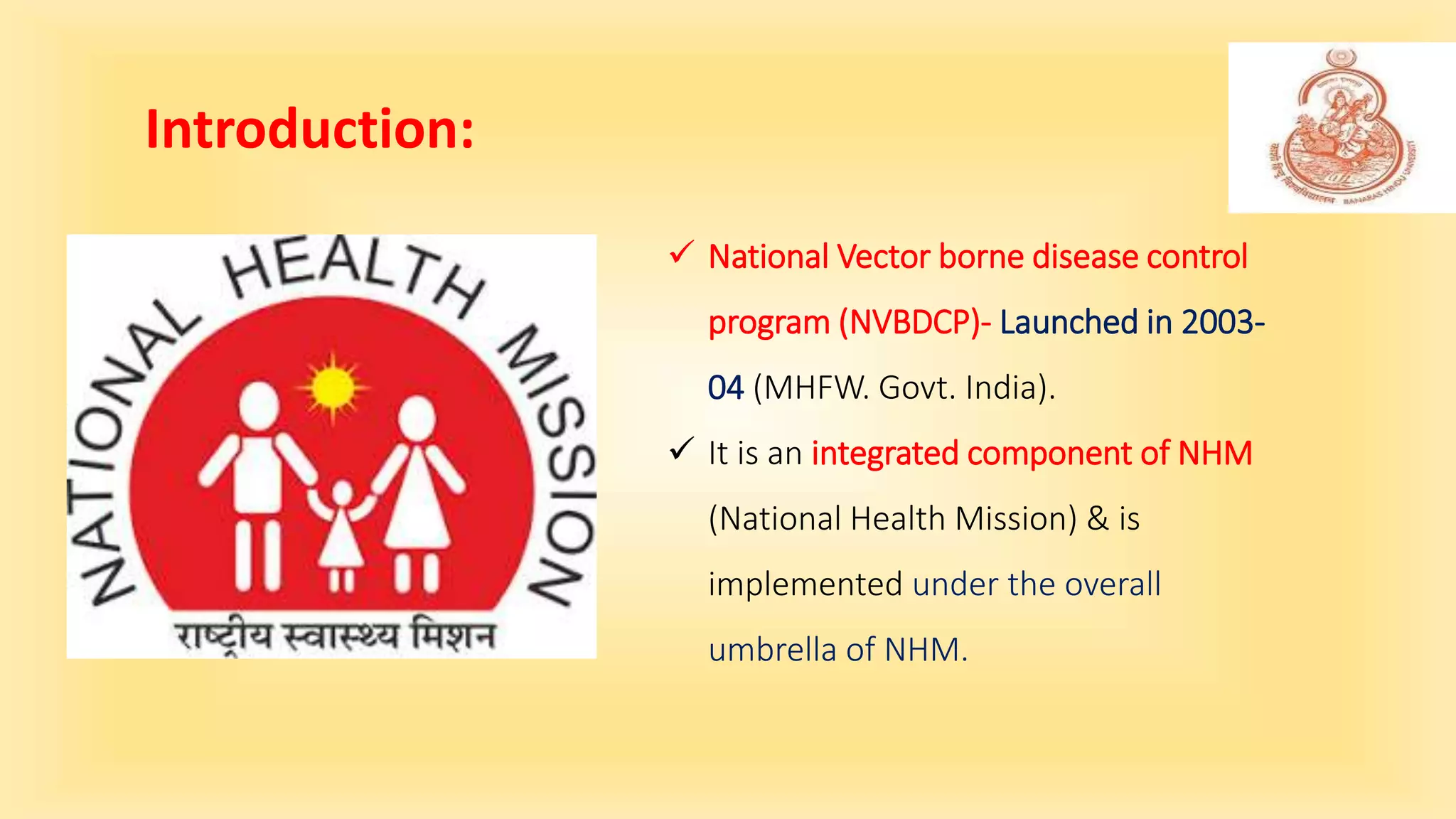
 National Vector borne disease control
program (NVBDCP)- Launched in 2003-
04 (MHFW. Govt. India).
 It is an integrated component of NHM
(National Health Mission) & is
implemented under the overall
umbrella of NHM.
 The directorate of NVBDCP is the nodal agency /
State level nodal department for planning policy
making and technical guidance and monitoring and
evaluation of program implementation in respect
of prevention and control of major vector born
diseases.
Controlling authorities:
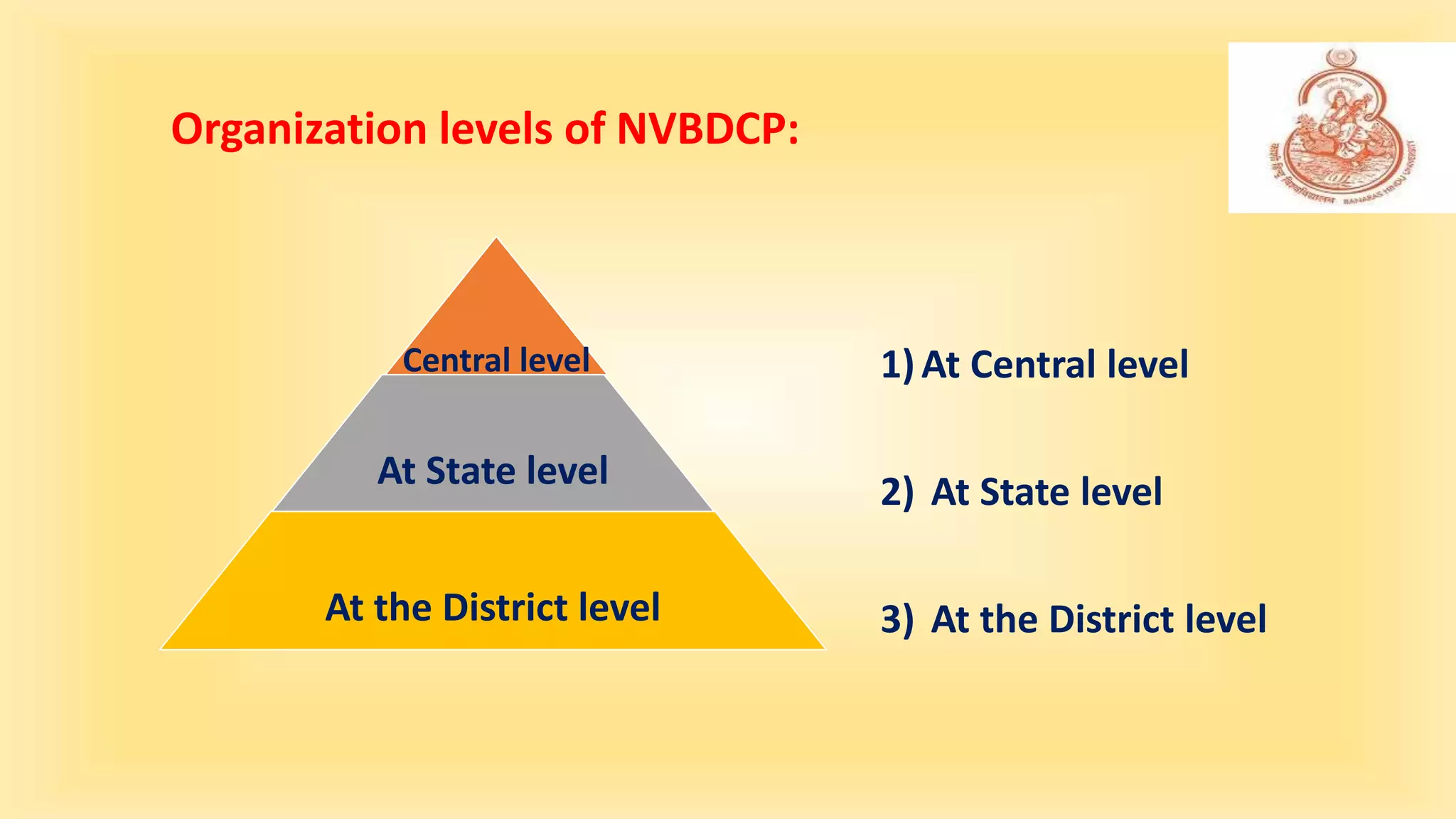
1)At Central level
2) At State level
3) At the District level
Organization levels of NVBDCP:
Central level
At State level
At the District level
The NVBDCP directorate is responsible for,
 Framing technical guidelines and policies
 Budgeting and planning the logistics
 Monitoring of implementation
 Carries out evaluation of program
implementation from time to time
 Assessing resource gap & providing equitable
support.
1) At central level:
Every state has State vector borne disease
control component under the directorate of
health services.
 Director of health services
 State program officer with different
designation such as Director / Joint director /
Dyp. Director each state has established
2) At State level:
District Malaria offices have been established under district chief
medical & Health offices by the states.
 District Malaria officer/ District VBD officer.
 Assistant Malaria officer
 Senior malaria Inspector - Key unit for planning and monitoring of
program under a technical officer.
At present '677' District malaria units are functioning
3) At District level:
Integrated Accelerated Action (IAA) towards:-
 Reducing mortality on account of Malaria, Dengue, and
JE by half.
 Elimination of Kala-azar by 2010 (which then pushed to
2015, then 2017 then 2020 but yet to achieve).
 Elimination of lymphatic Filariasis by year 2015 (Later
extended to 2021 yet to achieve).
Mission statement of NVBDCP:
1) Surveillance and outbreaks.
2) Early diagnosis and prompt case
management.
3) Vector control through community
participation & social mobilization.
4) Prevent mortality due to VBD's.
5) Reduce mortality due to VBD's.
6) Elimination of Kala-azar and Lymphatic
Filariasis.
Program objectives of NVBDCP:
A) NVBDCP strategies.
B) Partnership's
C) Technical support as well as logistics
D) Improve the efficiency and quality of
services
E) Monitoring and ensuring programme
implementation
F) Environmental Management
G) Focused attention
Program Strategies of NVBDCP:
 Three pronged
strategy for
prevention and
control of vector born
diseases.
A. NVBDCP strategies:
Program Strategies of NVBDCP:
Disease
management
Supportive
intervention
Integrated vector
management
(IVM)
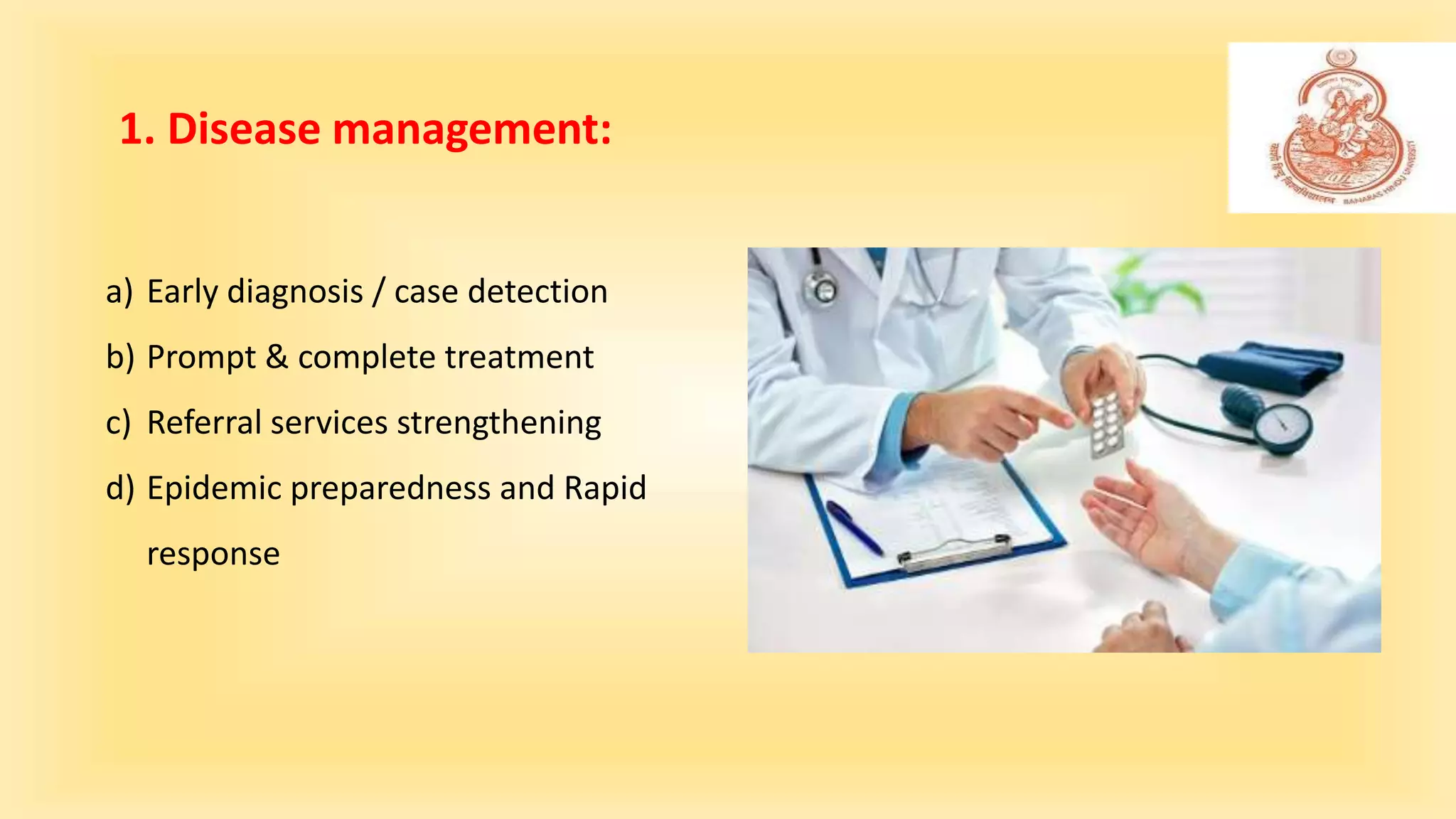
a) Early diagnosis / case detection
b) Prompt & complete treatment
c) Referral services strengthening
d) Epidemic preparedness and Rapid
response
1. Disease management:
For transmission risk reduction
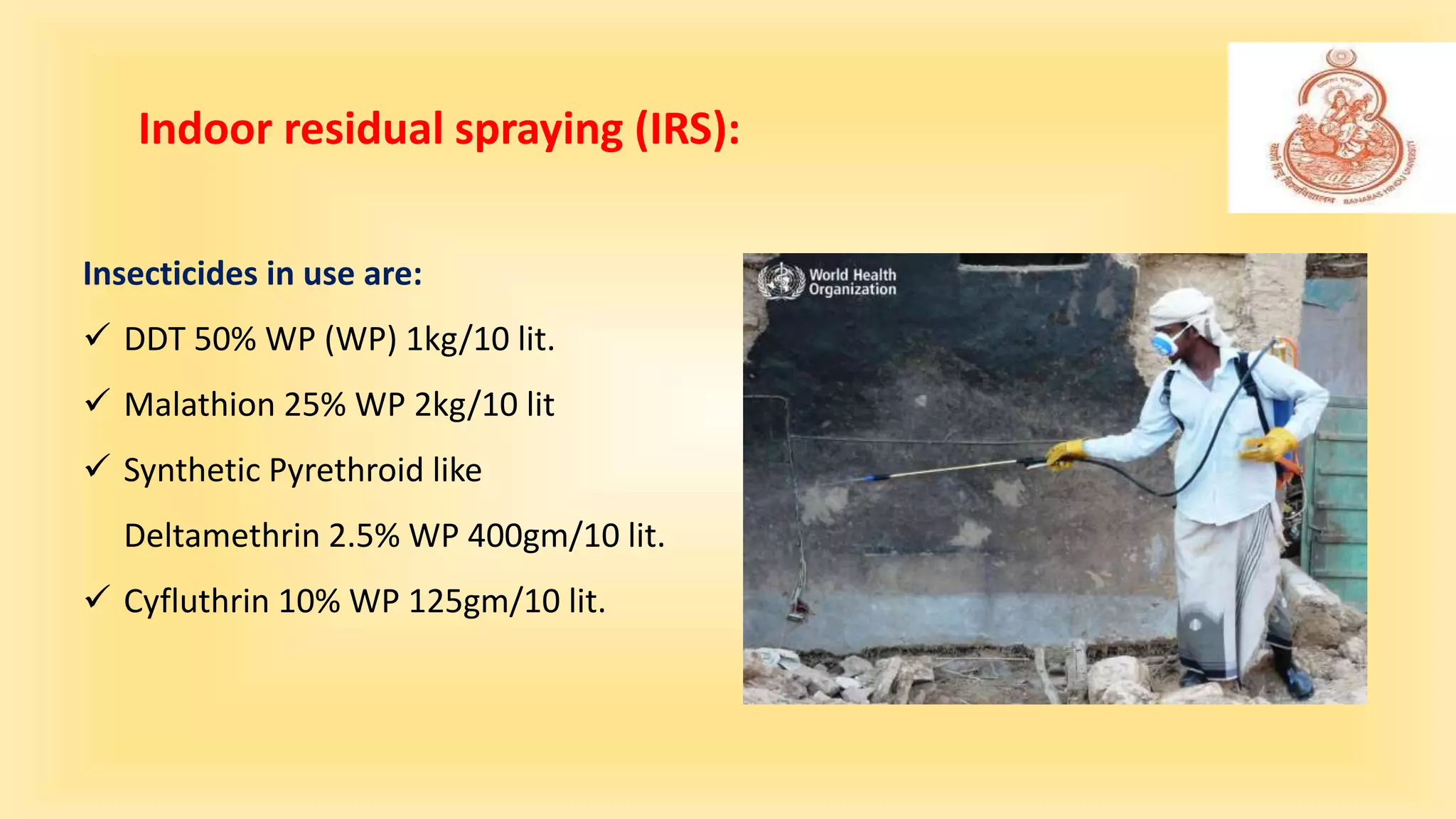
a) Indoor residual spraying (IRS) eg. DDT,
Malathion.
b) Use of insecticide treated nets (ITN's)
c) Use long lasting insecticidal net's
(LLIN's)
d) Use of ( larvivorous fish) Anti larval
measures (ALM) eg. Gappi, Gambusia
fish etc.
2. Integrated vector management (IVM)
Indoor residual spraying (IRS):
Insecticides in use are:
 DDT 50% WP (WP) 1kg/10 lit.
 Malathion 25% WP 2kg/10 lit
 Synthetic Pyrethroid like
Deltamethrin 2.5% WP 400gm/10 lit.
 Cyfluthrin 10% WP 125gm/10 lit.
Indoor residual spraying (IRS):
Area to be covered by 10 lit of suspension to
get correct dosage:
 For DDT / Deltamethrin / Cyfluthrin is 500 sq.
meter
 & for Malathion is 250 sq meter.
Residual effects in weeks:
For DDT / Deltamethrin / Cyfluthrin is 10-12
weeks
& for Malathion is 6-8 weeks.
 Discharge rate should be 740 to 850 ml/minute.
 Distance of between nozzle tip and wall should be 18 inches.
 40 up and down strokes per minute to maintain the pressure.
 Movement of lance in such a way as to cover 2000 square feet
area (one house) in 5 minute consuming one gallon
suspension(4.5 lit).
A good quality spray should lead to uniform deposit on walls and
other sprayable surface.
Techniques of good spray depend upon:
 These insecticides instantly kill the adult mosquitoes
with no residual effects.
 Space sprays must be repeated often, at least once
every week.
 Pyrethroids are commonly used eg Deltamethrin.
Space sprays:
a) Behavior change communication (BCC)
b) Public private partnership (PPP)
c) Inter sectorial convergence
d) Human resource development
e) Monitoring evaluation
f) Vaccination for JE
g) Web based Management Information System
h) Annual mass drug Administration
3. Supportive interventions
 Other national health programs- Non health sector
department- Civil society organizations ( NGO's, self help
groups, panchayati raj institutions).
 - Corporate sectors.- Medical academia and professional
bodies.
B) Partnership's:
Program Strategies of NVBDCP:
C) Technical support as well as logistics: Government of india
provides Technical support as well as logistics.
D) Improve efficiency and quality of services at
a) Primary
b) Secondary and
c) Tertiary Level
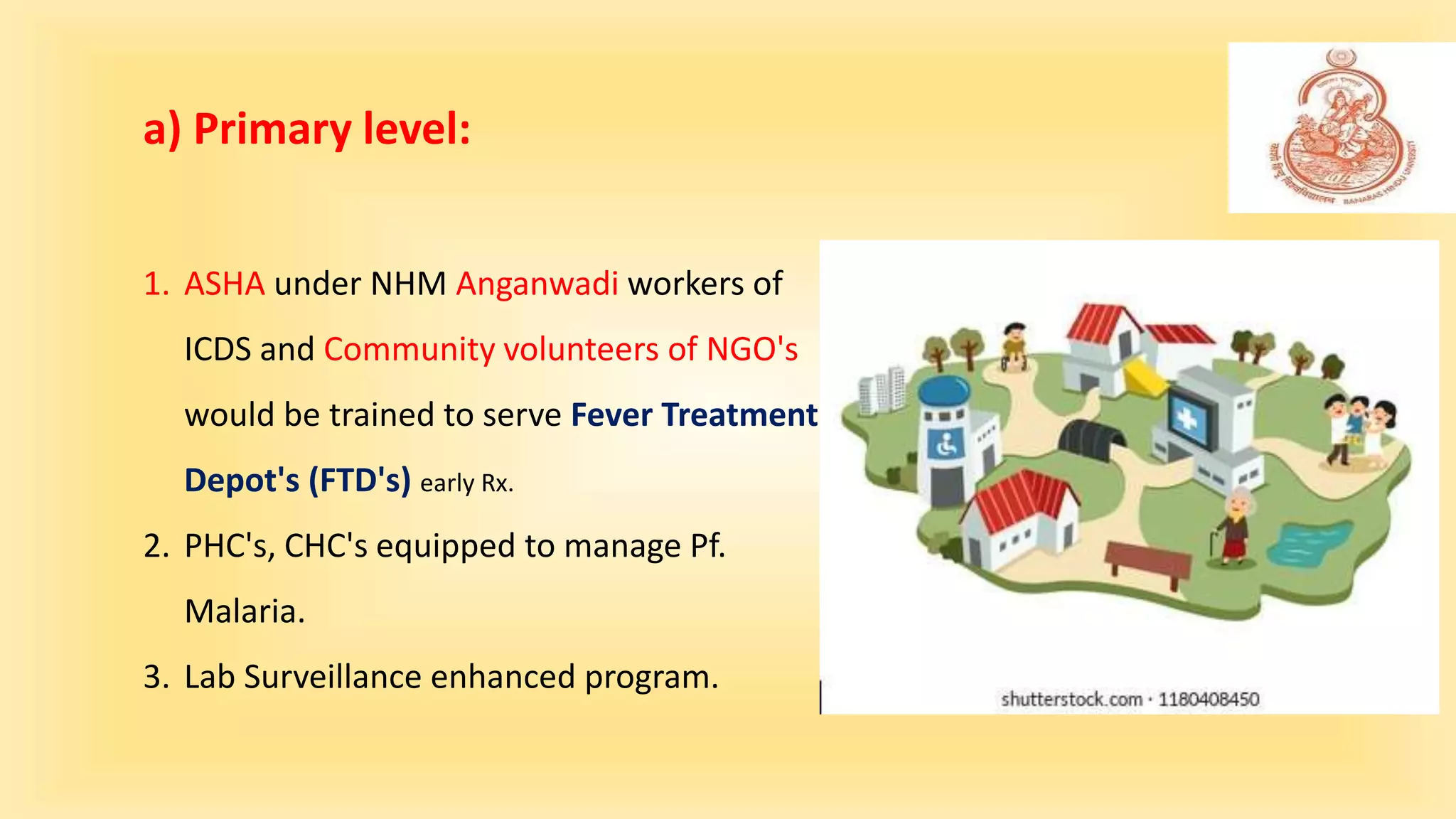
1. ASHA under NHM Anganwadi workers of
ICDS and Community volunteers of NGO's
would be trained to serve Fever Treatment
Depot's (FTD's) early Rx.
2. PHC's, CHC's equipped to manage Pf.
Malaria.
3. Lab Surveillance enhanced program.
a) Primary level:
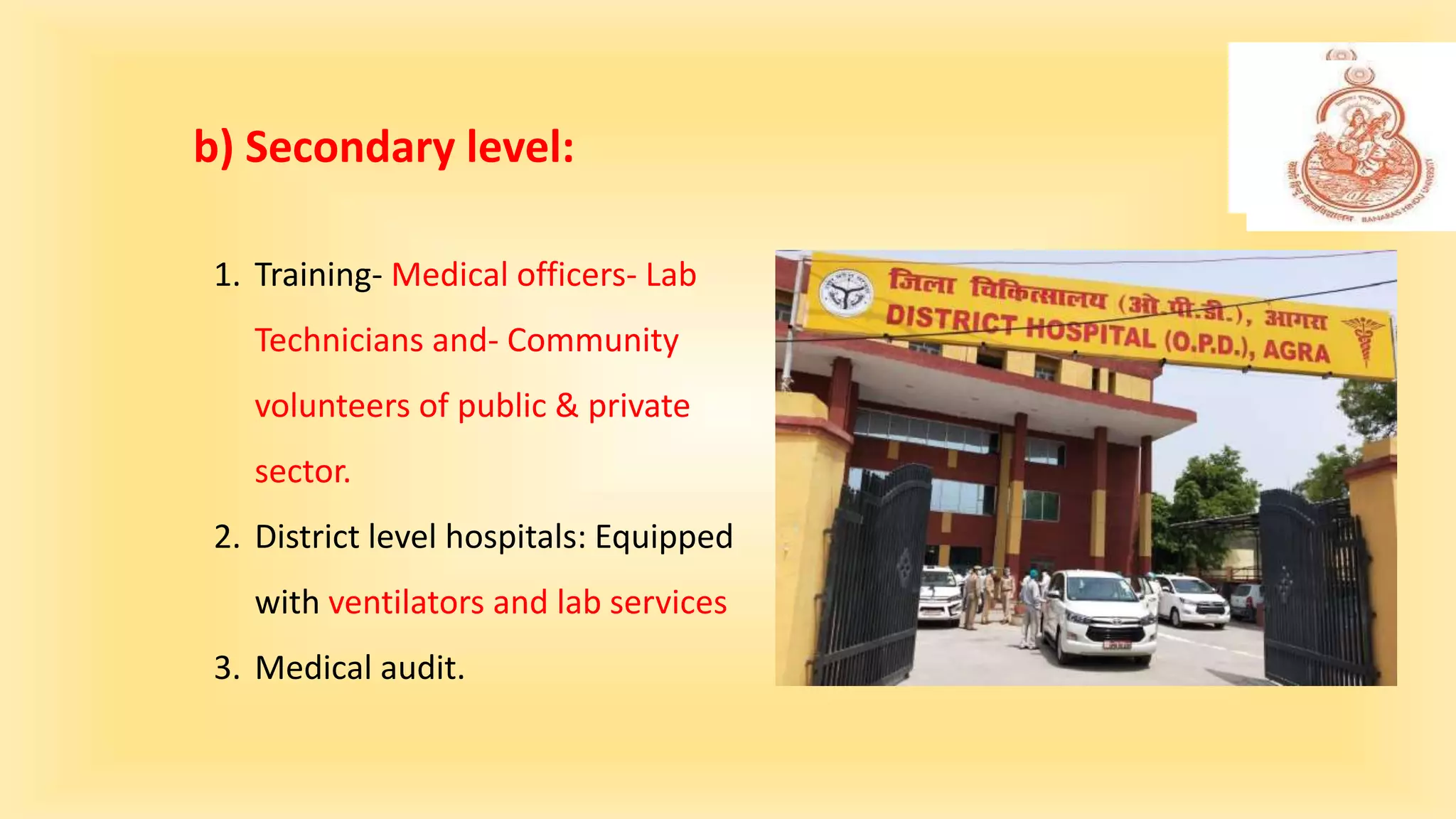
1. Training- Medical officers- Lab
Technicians and- Community
volunteers of public & private
sector.
2. District level hospitals: Equipped
with ventilators and lab services
3. Medical audit.
b) Secondary level:
1. Medical college hospital to manage
all referrals.
2. Undertake therapeutic efficacy
studies of combi pack and
effectiveness of rapid diagnostic kits.
3. Rapid diagnosis for management of
severe malaria cases
c) Tertiary Level:
E) Monitoring and ensuring program implementation :
State government monitor and ensure program
implementation.
F) Environmental management : Proper drainage and
sanitation.
G) Focused attention: The centre and the state's- Monitor
the program closely & high risk areas are identified for
focused attention.
 Launched in 1971 in urban areas. It is centrally sponsored programme currently
protecting 130 million population from malaria & other vector borne diseases.
 Initially only 23 towns, but now 131 towns and cities in 19 states and union
territories are covered under this scheme.
 Vectors like A. stephensi, supplemented by A. culicifacies are responsible for
urban malaria
 They breeds in wells, low-lying areas and wet cultivations
URBAN MALARIA SCHEME (UMS):
Has divided states into 3 catagories
 Category 0 (with 0 indigenous cases) states/UTs: None
 Category 1 (with API <1 in all the districts)15 states/UTs are: Himachal Pradesh, Punjab,&
Kashmir, Kerala, Manipur, Puducherry, Chandigarh, Uttarakhand, Haryana, Sikkim,
Rajasthan,Daman & Diu, Goa, Delhi and Lakshadweep.
 Category 2 (with API >1 in some districts)11 states/UTs are: Bihar, Tamil Nadu, Telangana, Uttar
Pradesh, Karnataka, West Bengal, Andhra Pradesh Assam, Maharashtra, Gujarat and Nagaland.
 Category 3 (with API >1)10 states/UTs are: Andaman & Nicobar islands, Madhya Pradesh, Dadar &
Nagar Haveli, Jharkhand, Arunachal Pradesh, Chhattisgarh, Odisha, Meghalaya, Tripura and
Mizoram.
The National Framework for Malaria Elimination
in India (2016-2030):
has formulated the following objectives:
 By 2022, transmission of malaria interrupted and zero indigenous cases to be
attained in all 26 States/UTs that were under Categories 1 and 2 in 2014;
 By 2024, incidence of malaria to be reduced to less than 1 case per 1000
population in all States and UTs, and their districts;
 By 2027, indigenous transmission of malaria to be interrupted in all States and
UTs of India; and
 By 2030, malaria to be eliminated throughout the entire country, and re-
establishment of transmission prevented.
The National Framework for Malaria Elimination
in India (2016-2030)
 States and UTs should categorize their districts so that even if the
given state/UT is not yet in the elimination phase, their districts with
API < 1 could be considered eligible for initiating elimination phase
activities.
 In addition, each district may sub-categorize its blocks into different
phases based on their API; and further each block into its PHCs, PHC
into SCs and SC to villages.
 This would facilitate some category 2 districts to start elimination
activities in their blocks falling in category 1.
District as the unit of planning and implementation:
1 2
45
41
37
35 35
30
16
3
0
5
10
15
20
25
30
35
40
45
50
1-14 July 15-31 July 1-14 Aug 15-31 Aug 1-14 Sept 15-30 Sept 1-15 Octo 16-31 Octo 1-15 Nov 15-27 Nov
NO
OF
CONFIRMED
CASES
TIME PERIOD
Dengue Case Trends 2021
Trends of Dengue Cases in Varanasi District:
Disease Total No Of Tests Done Total Positive
Malaria Government Labs 34610 130
Dengue Elisa test (2 Gov Labs) 1607 245
NS1 Rapid test- Gov & Private 18898 1688
Total 20505 1933
Fever Tracking data of Varanasi District from
July 2021 to 27 Nov 2021:
Kala Azar case Varanasi:
 Last case Found in 2020.
 Meeradevi, 45 years old lady found positive for Post Kala Azar
Dermal Leishmaniosis (PKDL)
 From Arjunpur Village, Sevapuri Block, Varanasi.
 Preventive measures taken by Government side for control of
Sand fly.
 Synthetic Pyrethride eg Alpha Cypermethrine sprayed on walls
upto 6 meters.
 Sprayed every 6 monthly in that village.
Department Activities Done Coverage
Health Anti Larva Spray By 41 Teams daily
Pyrathrum In-door spray 9171 Houses Sprayed
Source Reduction 41411 Containers / Source Destroyed
Entomological Surveillance 96854 Houses searched for Larva breeding
309 Houses found Having Larva
House index 3.1%.
Notice issued 309.
Nagar Nigam Fogging, Anti larval sprays,
Solid waste management
In 90 wards & 84 Newly added villages
Panchayat Raj Fogging, Anti larval sprays,
Bleaching sprays
In all 694 Gram Panchayats of District.
Sanitation Activities in Varanasi District Facts & figures:
Surveillance in Varanasi District:
Rapid Response Teams 40
(Rural – 16, Urban - 24)
Nigrani Samiti 868
(Rural – 694, Urban - 174)
Conclusion / Suggestions:
 Demand & supply of the vector control measures (eg LLIN’s, ITN’s,
IRS) need to be maintained on priority basis.
 PPP can be used more effectively for implementation of Program.
 Research should be promoted in the area of:
a) Drug resistance,
b) Resistance of mosquitoes to chemical sprays &
c) more effective control of vectors.
Thank you…
NVBDCP .pptx
NVBDCP .pptx
NVBDCP .pptx

NVBDCP .pptx

  • 1.
    By Dr Sanket V.Nandekar JR, Dept. of Community Medicine IMS-BHU, VARANASI National Vector Borne Disease Control Program (NVBDCP)
  • 2.
    Background Introduction Timelines Objectives & Strategies Implementationof Strategies Current scenario VARANASI Conclusion Outlines of the topic:-
  • 3.
    NVBDCP is anumbrella program for prevention and control of '6' vector born diseases namely NVBDCP Malaria Filariasis Dengue Japanese Encephali tis Kala-azar Chikungu nya
  • 4.
     1953- Nationalmalaria control programme (NMCP)  1955- National filaria control programme (NFCP) & National Japanese encephalitis control programme (NJECP)  1958: National malaria eradication programme (NMEP)  1990-91: National Kalaazar control programme (NKCP)  1996: National Dengue fever control programme (NDCP)  1999: National Anti-malaria programme (NAMP)  2003-04: National vector borne disease control programme (NVBDCP)  2006: Chikungunya control programme included in NVBDCP Milestones NVBDCP:
  • 5.
    1999- NMEP wasrenamed as National Anti-malaria programme (NAMP) The directorate of NMEP was renamed as directorate of National Anti- malaria programme (NAMP) in March 1999. It was dealing with three centrally sponsored schemes namely: 1) Malaria 2) Filaria 3) Kala-azar control and In addition, it was looking after the prevention and control of 4) Dengue & 5) Japanese Encephalitis Historical perspective:
  • 6.
     With aview to converge Dengue/ Dengue Haemorrhagic fever and Japanese Encephalitis with the three ongoing centrally sponsored schemes, the integrated scheme was renamed as National Vector Borne Disease control Programme (NVBDCP) from 2nd December 2003.  In 2006, Chikungunya re-emerged in the country and this was also bought within the purview of Directorate of NVBDCP Historical perspective:
  • 7.
    Introduction:  National Vectorborne disease control program (NVBDCP)- Launched in 2003- 04 (MHFW. Govt. India).  It is an integrated component of NHM (National Health Mission) & is implemented under the overall umbrella of NHM.
  • 8.
     The directorateof NVBDCP is the nodal agency / State level nodal department for planning policy making and technical guidance and monitoring and evaluation of program implementation in respect of prevention and control of major vector born diseases. Controlling authorities:
  • 9.
    1)At Central level 2)At State level 3) At the District level Organization levels of NVBDCP: Central level At State level At the District level
  • 10.
    The NVBDCP directorateis responsible for,  Framing technical guidelines and policies  Budgeting and planning the logistics  Monitoring of implementation  Carries out evaluation of program implementation from time to time  Assessing resource gap & providing equitable support. 1) At central level:
  • 11.
    Every state hasState vector borne disease control component under the directorate of health services.  Director of health services  State program officer with different designation such as Director / Joint director / Dyp. Director each state has established 2) At State level:
  • 12.
    District Malaria officeshave been established under district chief medical & Health offices by the states.  District Malaria officer/ District VBD officer.  Assistant Malaria officer  Senior malaria Inspector - Key unit for planning and monitoring of program under a technical officer. At present '677' District malaria units are functioning 3) At District level:
  • 13.
    Integrated Accelerated Action(IAA) towards:-  Reducing mortality on account of Malaria, Dengue, and JE by half.  Elimination of Kala-azar by 2010 (which then pushed to 2015, then 2017 then 2020 but yet to achieve).  Elimination of lymphatic Filariasis by year 2015 (Later extended to 2021 yet to achieve). Mission statement of NVBDCP:
  • 14.
    1) Surveillance andoutbreaks. 2) Early diagnosis and prompt case management. 3) Vector control through community participation & social mobilization. 4) Prevent mortality due to VBD's. 5) Reduce mortality due to VBD's. 6) Elimination of Kala-azar and Lymphatic Filariasis. Program objectives of NVBDCP:
  • 15.
    A) NVBDCP strategies. B)Partnership's C) Technical support as well as logistics D) Improve the efficiency and quality of services E) Monitoring and ensuring programme implementation F) Environmental Management G) Focused attention Program Strategies of NVBDCP:
  • 16.
     Three pronged strategyfor prevention and control of vector born diseases. A. NVBDCP strategies: Program Strategies of NVBDCP: Disease management Supportive intervention Integrated vector management (IVM)
  • 17.
    a) Early diagnosis/ case detection b) Prompt & complete treatment c) Referral services strengthening d) Epidemic preparedness and Rapid response 1. Disease management:
  • 18.
    For transmission riskreduction a) Indoor residual spraying (IRS) eg. DDT, Malathion. b) Use of insecticide treated nets (ITN's) c) Use long lasting insecticidal net's (LLIN's) d) Use of ( larvivorous fish) Anti larval measures (ALM) eg. Gappi, Gambusia fish etc. 2. Integrated vector management (IVM)
  • 19.
    Indoor residual spraying(IRS): Insecticides in use are:  DDT 50% WP (WP) 1kg/10 lit.  Malathion 25% WP 2kg/10 lit  Synthetic Pyrethroid like Deltamethrin 2.5% WP 400gm/10 lit.  Cyfluthrin 10% WP 125gm/10 lit.
  • 20.
    Indoor residual spraying(IRS): Area to be covered by 10 lit of suspension to get correct dosage:  For DDT / Deltamethrin / Cyfluthrin is 500 sq. meter  & for Malathion is 250 sq meter. Residual effects in weeks: For DDT / Deltamethrin / Cyfluthrin is 10-12 weeks & for Malathion is 6-8 weeks.
  • 21.
     Discharge rateshould be 740 to 850 ml/minute.  Distance of between nozzle tip and wall should be 18 inches.  40 up and down strokes per minute to maintain the pressure.  Movement of lance in such a way as to cover 2000 square feet area (one house) in 5 minute consuming one gallon suspension(4.5 lit). A good quality spray should lead to uniform deposit on walls and other sprayable surface. Techniques of good spray depend upon:
  • 22.
     These insecticidesinstantly kill the adult mosquitoes with no residual effects.  Space sprays must be repeated often, at least once every week.  Pyrethroids are commonly used eg Deltamethrin. Space sprays:
  • 23.
    a) Behavior changecommunication (BCC) b) Public private partnership (PPP) c) Inter sectorial convergence d) Human resource development e) Monitoring evaluation f) Vaccination for JE g) Web based Management Information System h) Annual mass drug Administration 3. Supportive interventions
  • 24.
     Other nationalhealth programs- Non health sector department- Civil society organizations ( NGO's, self help groups, panchayati raj institutions).  - Corporate sectors.- Medical academia and professional bodies. B) Partnership's: Program Strategies of NVBDCP:
  • 25.
    C) Technical supportas well as logistics: Government of india provides Technical support as well as logistics. D) Improve efficiency and quality of services at a) Primary b) Secondary and c) Tertiary Level
  • 26.
    1. ASHA underNHM Anganwadi workers of ICDS and Community volunteers of NGO's would be trained to serve Fever Treatment Depot's (FTD's) early Rx. 2. PHC's, CHC's equipped to manage Pf. Malaria. 3. Lab Surveillance enhanced program. a) Primary level:
  • 27.
    1. Training- Medicalofficers- Lab Technicians and- Community volunteers of public & private sector. 2. District level hospitals: Equipped with ventilators and lab services 3. Medical audit. b) Secondary level:
  • 28.
    1. Medical collegehospital to manage all referrals. 2. Undertake therapeutic efficacy studies of combi pack and effectiveness of rapid diagnostic kits. 3. Rapid diagnosis for management of severe malaria cases c) Tertiary Level:
  • 29.
    E) Monitoring andensuring program implementation : State government monitor and ensure program implementation. F) Environmental management : Proper drainage and sanitation. G) Focused attention: The centre and the state's- Monitor the program closely & high risk areas are identified for focused attention.
  • 30.
     Launched in1971 in urban areas. It is centrally sponsored programme currently protecting 130 million population from malaria & other vector borne diseases.  Initially only 23 towns, but now 131 towns and cities in 19 states and union territories are covered under this scheme.  Vectors like A. stephensi, supplemented by A. culicifacies are responsible for urban malaria  They breeds in wells, low-lying areas and wet cultivations URBAN MALARIA SCHEME (UMS):
  • 31.
    Has divided statesinto 3 catagories  Category 0 (with 0 indigenous cases) states/UTs: None  Category 1 (with API <1 in all the districts)15 states/UTs are: Himachal Pradesh, Punjab,& Kashmir, Kerala, Manipur, Puducherry, Chandigarh, Uttarakhand, Haryana, Sikkim, Rajasthan,Daman & Diu, Goa, Delhi and Lakshadweep.  Category 2 (with API >1 in some districts)11 states/UTs are: Bihar, Tamil Nadu, Telangana, Uttar Pradesh, Karnataka, West Bengal, Andhra Pradesh Assam, Maharashtra, Gujarat and Nagaland.  Category 3 (with API >1)10 states/UTs are: Andaman & Nicobar islands, Madhya Pradesh, Dadar & Nagar Haveli, Jharkhand, Arunachal Pradesh, Chhattisgarh, Odisha, Meghalaya, Tripura and Mizoram. The National Framework for Malaria Elimination in India (2016-2030):
  • 32.
    has formulated thefollowing objectives:  By 2022, transmission of malaria interrupted and zero indigenous cases to be attained in all 26 States/UTs that were under Categories 1 and 2 in 2014;  By 2024, incidence of malaria to be reduced to less than 1 case per 1000 population in all States and UTs, and their districts;  By 2027, indigenous transmission of malaria to be interrupted in all States and UTs of India; and  By 2030, malaria to be eliminated throughout the entire country, and re- establishment of transmission prevented. The National Framework for Malaria Elimination in India (2016-2030)
  • 33.
     States andUTs should categorize their districts so that even if the given state/UT is not yet in the elimination phase, their districts with API < 1 could be considered eligible for initiating elimination phase activities.  In addition, each district may sub-categorize its blocks into different phases based on their API; and further each block into its PHCs, PHC into SCs and SC to villages.  This would facilitate some category 2 districts to start elimination activities in their blocks falling in category 1. District as the unit of planning and implementation:
  • 34.
    1 2 45 41 37 35 35 30 16 3 0 5 10 15 20 25 30 35 40 45 50 1-14July 15-31 July 1-14 Aug 15-31 Aug 1-14 Sept 15-30 Sept 1-15 Octo 16-31 Octo 1-15 Nov 15-27 Nov NO OF CONFIRMED CASES TIME PERIOD Dengue Case Trends 2021 Trends of Dengue Cases in Varanasi District:
  • 35.
    Disease Total NoOf Tests Done Total Positive Malaria Government Labs 34610 130 Dengue Elisa test (2 Gov Labs) 1607 245 NS1 Rapid test- Gov & Private 18898 1688 Total 20505 1933 Fever Tracking data of Varanasi District from July 2021 to 27 Nov 2021:
  • 36.
    Kala Azar caseVaranasi:  Last case Found in 2020.  Meeradevi, 45 years old lady found positive for Post Kala Azar Dermal Leishmaniosis (PKDL)  From Arjunpur Village, Sevapuri Block, Varanasi.  Preventive measures taken by Government side for control of Sand fly.  Synthetic Pyrethride eg Alpha Cypermethrine sprayed on walls upto 6 meters.  Sprayed every 6 monthly in that village.
  • 37.
    Department Activities DoneCoverage Health Anti Larva Spray By 41 Teams daily Pyrathrum In-door spray 9171 Houses Sprayed Source Reduction 41411 Containers / Source Destroyed Entomological Surveillance 96854 Houses searched for Larva breeding 309 Houses found Having Larva House index 3.1%. Notice issued 309. Nagar Nigam Fogging, Anti larval sprays, Solid waste management In 90 wards & 84 Newly added villages Panchayat Raj Fogging, Anti larval sprays, Bleaching sprays In all 694 Gram Panchayats of District. Sanitation Activities in Varanasi District Facts & figures:
  • 38.
    Surveillance in VaranasiDistrict: Rapid Response Teams 40 (Rural – 16, Urban - 24) Nigrani Samiti 868 (Rural – 694, Urban - 174)
  • 39.
    Conclusion / Suggestions: Demand & supply of the vector control measures (eg LLIN’s, ITN’s, IRS) need to be maintained on priority basis.  PPP can be used more effectively for implementation of Program.  Research should be promoted in the area of: a) Drug resistance, b) Resistance of mosquitoes to chemical sprays & c) more effective control of vectors.
  • 40.