Chemical Methods of Vector Control Brian Wells University of Florida December 3, 2003
Why Control Mosquitoes? Mosquitoes are the world's most significant vectors  Diseases transmitted by mosquitoes are responsible for the deaths of millions of people every year.  Mosquitoes are the primary vector for several pathogens such as West Nile Virus Story about FL:  http://www.cnn.com/2001/HEALTH/07/07/florida.west.nile/ Medical Alert:  http://www.sawyerproducts.com/FLstate/O2402FLWestNileVirusAlert.html
Why Control Mosquitoes? Mosquitoes also are the vector for St. Louis Encephalitis, Eastern Equine Encephalitis, and dengue fever. WHO estimates that 50 million cases of dengue (24,000 deaths) 200,000 cases of yellow fever (30,000 deaths) 300M to 500M cases of malaria (1M deaths)
Why Control Mosquitoes? The Most Important Reason: Mosquitoes can make life very uncomfortable!
Mosquito Control in the Gainesville area Some quick facts on Gainesville: 45.52 square miles Population of 117,182 87,509 households Mild winters, warm summers Source:  http://www.cityofgainesville.org
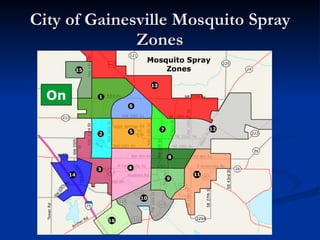
City of Gainesville Mosquito Spray Zones
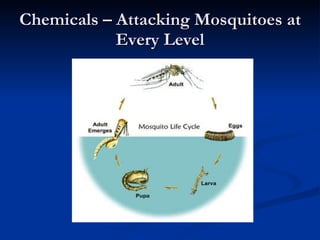
Chemicals – Attacking Mosquitoes at Every Level
Chemical Controls Commonly used pesticides Malathion Naled Permethrin Resmethrin Sumithrin
Chemical Controls Malathion One of the most commonly used pesticides Malathion is an adulticide Patented in 1951 by American Cyanamid Company Also a contact insecticide – that is, it can kill pests if it touches them or if they eat a sprayed part of a plant  Considered to be one of the safest organophosphate insecticides
Chemical Controls Malathion Cholinesterase Inhibitor Blocks neural transmission Effects on human can potentially be muscle weakness, tremors, and even death. Although it is a generally safe pesticide, the real key to its safety is to use common sense and avoid unnecessary exposure. Source:  http://www.napa.ufl.edu/oldnews/spray.htm
Chemical Controls Benefits of Malathion Helps control the mosquito population and thus improves QOL Protects crops in Florida that yield $10 Billion worth of revenue If these crops were lost, every man, woman, and child in Florida would have to contribute an additional $700 to maintain the standard of living Source:  http://fmel.ifas.ufl.edu/fmbuzz/wtchallenge2.htm
Chemical Controls Larvicides Methoprene – growth inhibitor Temephos Mineral Oil can be used to form a thin film of the surface of water to cause the larvae and pupa to drown.
How are Pesticides deployed? Airplane Ground truck-mounted sprayers Portable sprayers
Problems facing chemical-based vector control Relatively small pesticide market Small market creates little economic incentive for chemical companies to spend large amounts of money to develop and label new chemical products  When a new chemical does become available, it is usually because it has a side-effect of being lethal to mosquitoes  Food Quality Protection Act - will help to assure that valuable public health pesticides are not lost through a lack of registrant support or unwillingness to pay for the risk management studies because the mosquito control market is too small
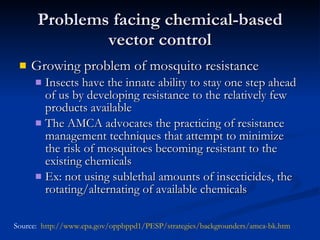
Problems facing chemical-based vector control Growing problem of mosquito resistance Insects have the innate ability to stay one step ahead of us by developing resistance to the relatively few products available The AMCA advocates the practicing of resistance management techniques that attempt to minimize the risk of mosquitoes becoming resistant to the existing chemicals Ex: not using sublethal amounts of insecticides, the rotating/alternating of available chemicals  Source:  http://www.epa.gov/oppbppd1/PESP/strategies/backgrounders/amca-bk.htm
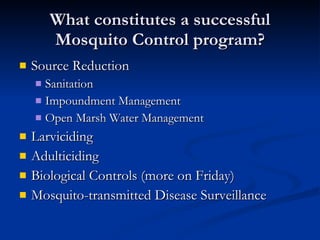
What constitutes a successful Mosquito Control program? Source Reduction Sanitation Impoundment Management Open Marsh Water Management Larviciding Adulticiding Biological Controls (more on Friday) Mosquito-transmitted Disease Surveillance
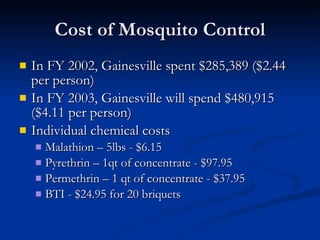
Cost of Mosquito Control In FY 2002, Gainesville spent $285,389 ($2.44 per person) In FY 2003, Gainesville will spend $480,915 ($4.11 per person) Individual chemical costs Malathion – 5lbs - $6.15 Pyrethrin – 1qt of concentrate - $97.95 Permethrin – 1 qt of concentrate - $37.95 BTI - $24.95 for 20 briquets
How is Gainesville Mosquito Control Doing? Citizen Opinion Survey – 1999 5% - Excellent 43% - Good 32% - Fair 20% - Poor 61% - Very Important 32% - Somewhat Important 8% - Not Important Source:  http://www.cityofgainesville.org/gov/issues/citsurv99.cfm
How is Gainesville Mosquito Control Doing? Citizen Opinion Survey – 2000 9% - Excellent 44% - Good 32% - Fair 16% - Poor 64% - Very Important 30% - Somewhat Important 7% - Not Important Source:  http://www.cityofgainesville.org/gov/issues/citsurv00.cfm
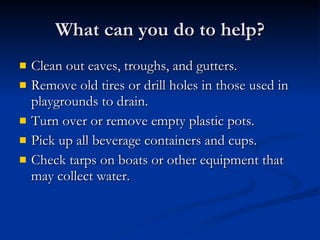
What can you do to help? Clean out eaves, troughs, and gutters.  Remove old tires or drill holes in those used in playgrounds to drain.  Turn over or remove empty plastic pots.  Pick up all beverage containers and cups.  Check tarps on boats or other equipment that may collect water.
What can you do to help? Pump out bilges on boats.  Replace water in birdbaths and pet or other animal feeding dishes at least once a week.  Change water in plant trays, including hanging plants, at least once a week.  Remove vegetation or obstructions in drainage ditches that prevent the flow of water.
How to Protect Yourself 5 D’s and 1 S Dusk and Dawn – avoid being outdoors during this time Dress – wear protective clothing DEET – mosquito repellant Drainage – get rid of standing water AND Screens – make sure windows are closed and sealed Source:  http://www.health.ufl.edu/shcc/pdf/wnv.pdf
Questions?
Question 1 Malathion is a ________ pesticide that kills mosquitoes in the _______ stage of life. A. organophosphate, larvae B. organophosphate, adult C. organohalide, larvae D. organohalide, adult
Question 2 Which of the following was not mentioned as a commonly used pesticide? A. Malathion B. Resmethrin C. Permethrin D. Atorvastatin
Question 3 DEET is: A. a personal insect repellant B. a sprayer used on trucks C. the acronym for the law governing mosquito control D. A brand of speakers at Best Buy
Additional Information This presentation is available for download at: http://www.destination-web.com/ees/vectors.pdf

Chemical Methods of Vector Control

  • 1.
    Chemical Methods ofVector Control Brian Wells University of Florida December 3, 2003
  • 2.
    Why Control Mosquitoes?Mosquitoes are the world's most significant vectors Diseases transmitted by mosquitoes are responsible for the deaths of millions of people every year. Mosquitoes are the primary vector for several pathogens such as West Nile Virus Story about FL: http://www.cnn.com/2001/HEALTH/07/07/florida.west.nile/ Medical Alert: http://www.sawyerproducts.com/FLstate/O2402FLWestNileVirusAlert.html
  • 3.
    Why Control Mosquitoes?Mosquitoes also are the vector for St. Louis Encephalitis, Eastern Equine Encephalitis, and dengue fever. WHO estimates that 50 million cases of dengue (24,000 deaths) 200,000 cases of yellow fever (30,000 deaths) 300M to 500M cases of malaria (1M deaths)
  • 4.
    Why Control Mosquitoes?The Most Important Reason: Mosquitoes can make life very uncomfortable!
  • 5.
    Mosquito Control inthe Gainesville area Some quick facts on Gainesville: 45.52 square miles Population of 117,182 87,509 households Mild winters, warm summers Source: http://www.cityofgainesville.org
  • 6.
    City of GainesvilleMosquito Spray Zones
  • 7.
    Chemicals – AttackingMosquitoes at Every Level
  • 8.
    Chemical Controls Commonlyused pesticides Malathion Naled Permethrin Resmethrin Sumithrin
  • 9.
    Chemical Controls MalathionOne of the most commonly used pesticides Malathion is an adulticide Patented in 1951 by American Cyanamid Company Also a contact insecticide – that is, it can kill pests if it touches them or if they eat a sprayed part of a plant Considered to be one of the safest organophosphate insecticides
  • 10.
    Chemical Controls MalathionCholinesterase Inhibitor Blocks neural transmission Effects on human can potentially be muscle weakness, tremors, and even death. Although it is a generally safe pesticide, the real key to its safety is to use common sense and avoid unnecessary exposure. Source: http://www.napa.ufl.edu/oldnews/spray.htm
  • 11.
    Chemical Controls Benefitsof Malathion Helps control the mosquito population and thus improves QOL Protects crops in Florida that yield $10 Billion worth of revenue If these crops were lost, every man, woman, and child in Florida would have to contribute an additional $700 to maintain the standard of living Source: http://fmel.ifas.ufl.edu/fmbuzz/wtchallenge2.htm
  • 12.
    Chemical Controls LarvicidesMethoprene – growth inhibitor Temephos Mineral Oil can be used to form a thin film of the surface of water to cause the larvae and pupa to drown.
  • 13.
    How are Pesticidesdeployed? Airplane Ground truck-mounted sprayers Portable sprayers
  • 14.
    Problems facing chemical-basedvector control Relatively small pesticide market Small market creates little economic incentive for chemical companies to spend large amounts of money to develop and label new chemical products When a new chemical does become available, it is usually because it has a side-effect of being lethal to mosquitoes Food Quality Protection Act - will help to assure that valuable public health pesticides are not lost through a lack of registrant support or unwillingness to pay for the risk management studies because the mosquito control market is too small
  • 15.
    Problems facing chemical-basedvector control Growing problem of mosquito resistance Insects have the innate ability to stay one step ahead of us by developing resistance to the relatively few products available The AMCA advocates the practicing of resistance management techniques that attempt to minimize the risk of mosquitoes becoming resistant to the existing chemicals Ex: not using sublethal amounts of insecticides, the rotating/alternating of available chemicals Source: http://www.epa.gov/oppbppd1/PESP/strategies/backgrounders/amca-bk.htm
  • 16.
    What constitutes asuccessful Mosquito Control program? Source Reduction Sanitation Impoundment Management Open Marsh Water Management Larviciding Adulticiding Biological Controls (more on Friday) Mosquito-transmitted Disease Surveillance
  • 17.
    Cost of MosquitoControl In FY 2002, Gainesville spent $285,389 ($2.44 per person) In FY 2003, Gainesville will spend $480,915 ($4.11 per person) Individual chemical costs Malathion – 5lbs - $6.15 Pyrethrin – 1qt of concentrate - $97.95 Permethrin – 1 qt of concentrate - $37.95 BTI - $24.95 for 20 briquets
  • 18.
    How is GainesvilleMosquito Control Doing? Citizen Opinion Survey – 1999 5% - Excellent 43% - Good 32% - Fair 20% - Poor 61% - Very Important 32% - Somewhat Important 8% - Not Important Source: http://www.cityofgainesville.org/gov/issues/citsurv99.cfm
  • 19.
    How is GainesvilleMosquito Control Doing? Citizen Opinion Survey – 2000 9% - Excellent 44% - Good 32% - Fair 16% - Poor 64% - Very Important 30% - Somewhat Important 7% - Not Important Source: http://www.cityofgainesville.org/gov/issues/citsurv00.cfm
  • 20.
    What can youdo to help? Clean out eaves, troughs, and gutters. Remove old tires or drill holes in those used in playgrounds to drain. Turn over or remove empty plastic pots. Pick up all beverage containers and cups. Check tarps on boats or other equipment that may collect water.
  • 21.
    What can youdo to help? Pump out bilges on boats. Replace water in birdbaths and pet or other animal feeding dishes at least once a week. Change water in plant trays, including hanging plants, at least once a week. Remove vegetation or obstructions in drainage ditches that prevent the flow of water.
  • 22.
    How to ProtectYourself 5 D’s and 1 S Dusk and Dawn – avoid being outdoors during this time Dress – wear protective clothing DEET – mosquito repellant Drainage – get rid of standing water AND Screens – make sure windows are closed and sealed Source: http://www.health.ufl.edu/shcc/pdf/wnv.pdf
  • 23.
  • 24.
    Question 1 Malathionis a ________ pesticide that kills mosquitoes in the _______ stage of life. A. organophosphate, larvae B. organophosphate, adult C. organohalide, larvae D. organohalide, adult
  • 25.
    Question 2 Whichof the following was not mentioned as a commonly used pesticide? A. Malathion B. Resmethrin C. Permethrin D. Atorvastatin
  • 26.
    Question 3 DEETis: A. a personal insect repellant B. a sprayer used on trucks C. the acronym for the law governing mosquito control D. A brand of speakers at Best Buy
  • 27.
    Additional Information Thispresentation is available for download at: http://www.destination-web.com/ees/vectors.pdf