Presentation Flow
5. Block Diagram
3. Drawback
4. YOLO
2. Introduction
1. Motivation
10. Summary
8. Implementation Results
9. Advantages & Applications
7. Limitation
6. Methodology
Motivation
Many people suffer from temporary or permanent
disabilities.
Current scenario:
• Disable person has to depend on another person
• A blindman stick is not able to detect the obstacle in path
• Using wheelchair the safety of person is not guaranteed
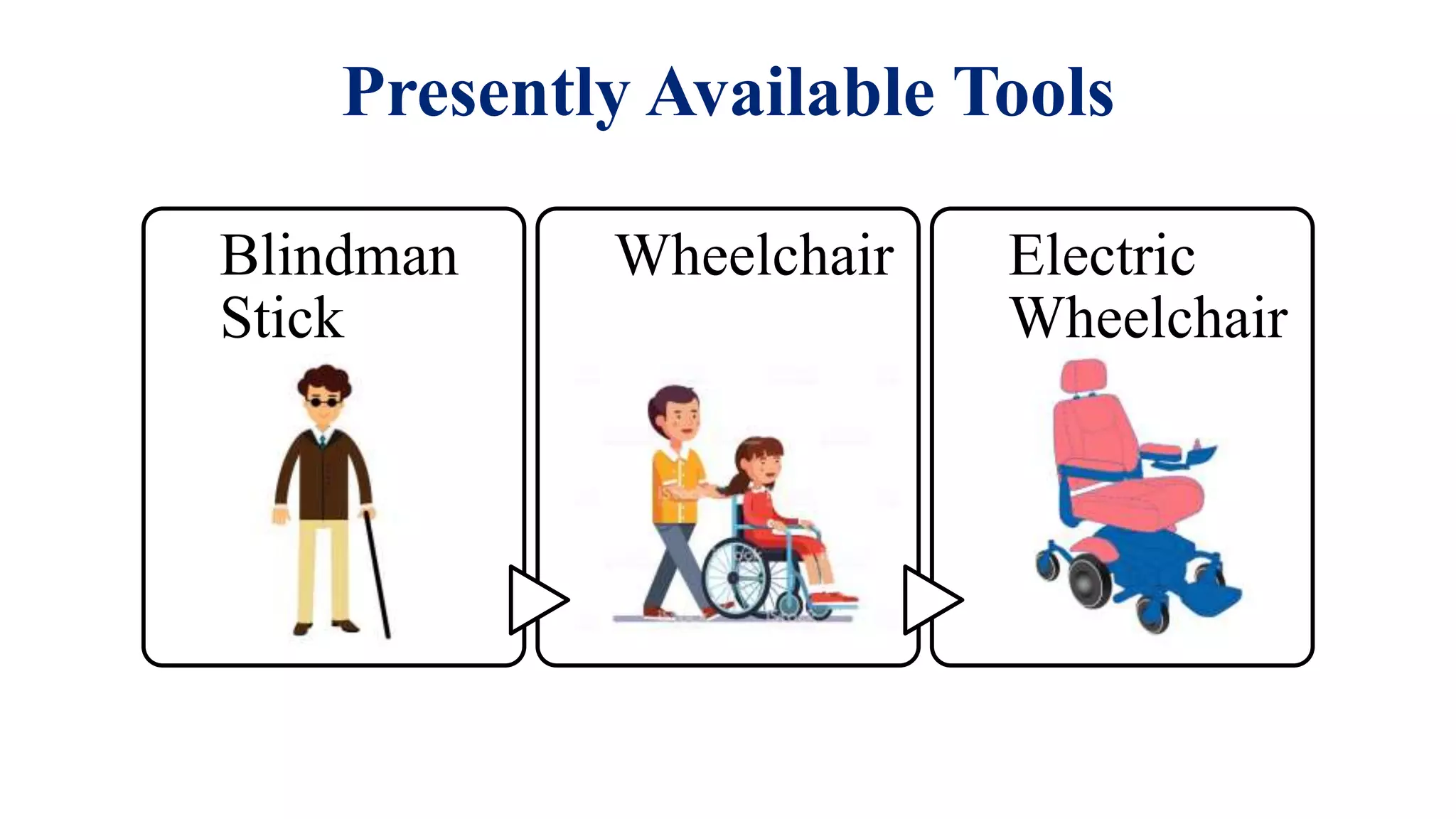
Presently Available Tools
Blindman
Stick
Wheelchair Electric
Wheelchair
Introduction
 Visually impaired individuals face many difficulties when they
involve in self navigating.
 Manual or electrical wheelchairs satisfies disability, where the
patients can use it independently.
 So, the core idea is to design an Auto-Assistance system.
Constraints:
 Working with Small object with similar shape and size, and
different back-ground colour etc.
 Auto-Assistance system is designed to work in the Indoor
environment like hospital, public garden area etc.
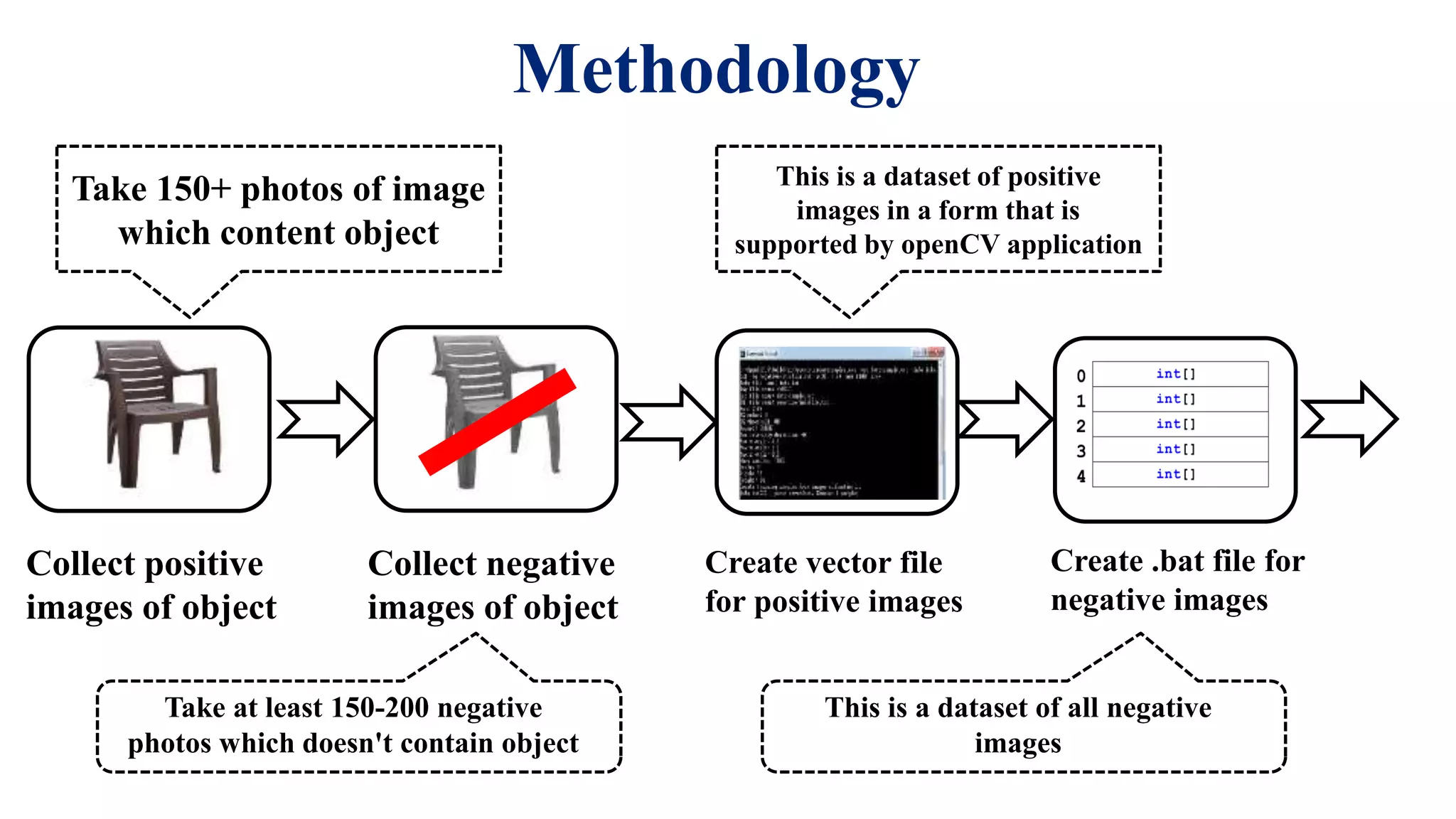
Methodology
Collect positive
images of object
Collect negative
images of object
Create vector file
for positive images
Create .bat file for
negative images
Take 150+ photos of image
which content object
Take at least 150-200 negative
photos which doesn't contain object
This is a dataset of positive
images in a form that is
supported by openCV application
This is a dataset of all negative
images
Create trained
.xml file of +ve
&-ve image set
Capture video
frames from
camera
Convert each
image to grayscale
Integral sum of
pixels value
S(x,y)=i(x,y)+s(x-1,y)+s(x,y-1)-s(x-1,y-1)
Green = (0, 255, 0)
Difference of
+ve & -ve values
Detection of
object using
multiscale
method
Rectangle END
∆ = ∑(Black area pixels) - ∑(White area pixels) -1 1;
This method resizes
the small images and
after some threshold
value it will discard
the image
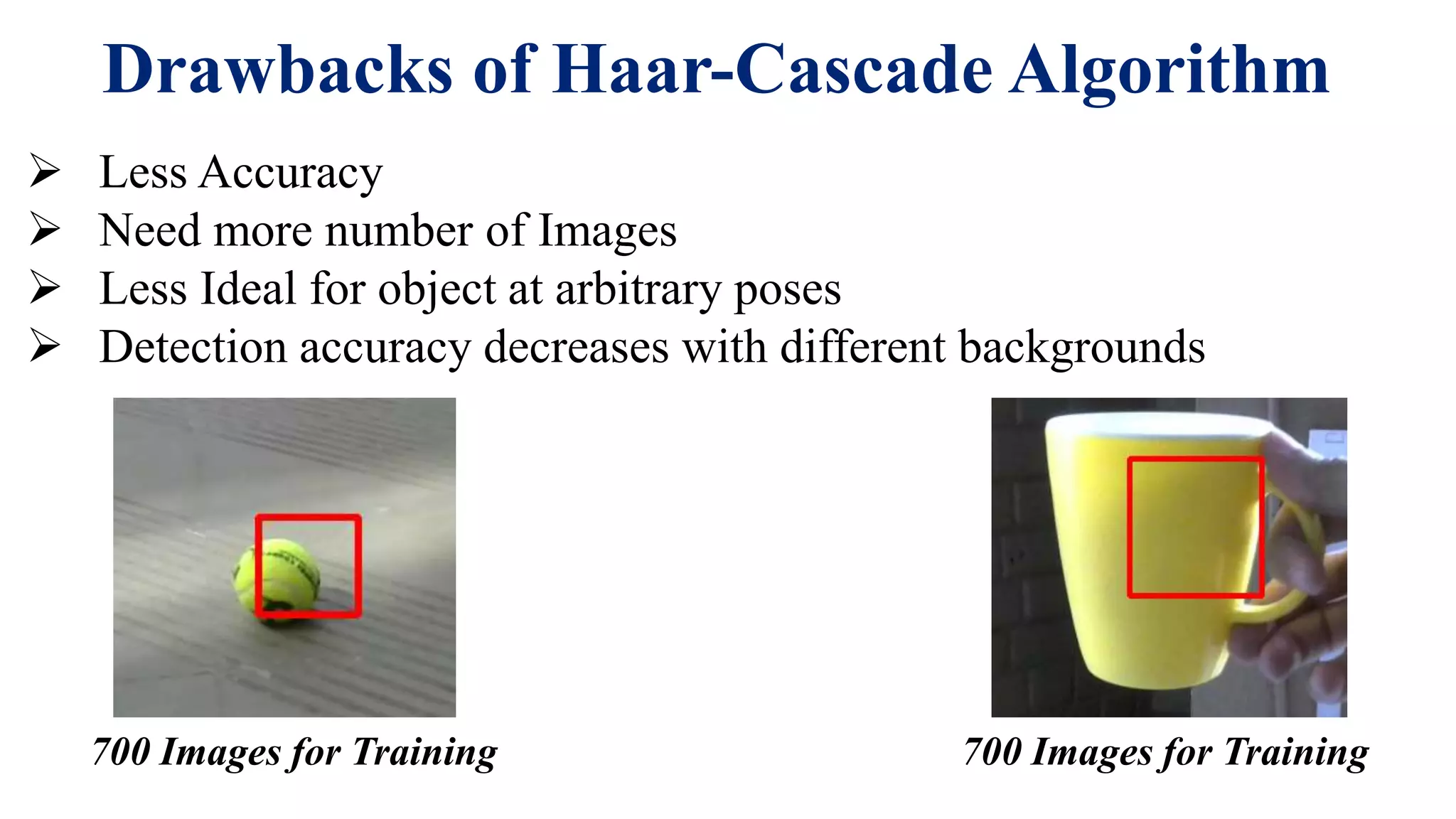
Drawbacks of Haar-Cascade Algorithm
 Less Accuracy
 Need more number of Images
 Less Ideal for object at arbitrary poses
 Detection accuracy decreases with different backgrounds
700 Images for Training 700 Images for Training
Architecture of Convolutional Neural Network
Literature Survey
Simple Convolutional Neural Network on Image
Classification (IEEE-2017)
Tianmei Guo et.el proposed about CNN which has less
computation cost and examined different methods and
optimization algorithms for learning rate set and image
classification parameters. Shallow network for good
recognition effect has been verified.
Why YOLO ?
 YOLO (You Only Look Once) is a network for object detection
that consists of determining the location on the image where
certain objects are present.
 Classifies object along with class probabilities for real time
applications.
 It uses single CNN network for both localization and classification
of objects using bounding box.
 The YOLO design enables end-to-end training and real time speeds
while maintaining high average precision.
System Block Diagram
Methodology of YOLO
Input Image Split the image into S× S grid Cells
(S=7)
 Each cell predicts B Bounding boxes, confidence for those boxes
and C class probabilities.
1) Image S× S Grids
2) Grid Cell
 B: BBoxes and Confidence Score
x, y, w, h Confidence
Pr
(Object)* IOUtruth prediction
Output Feature Map: S×S× (B*5+C)
1. x- coordinate of Bbox center inside cell
2. y- coordinate of Bbox center inside cell
3. w- Bbox width
4. h- Bbox height
5. c- Bbox Confidence
5 5 No. of classes
Anchor box2Anchor box1
Anchor box1
Anchor box2
Array of detected object coordinates
Confidence Value
x and y coordinates
w
h
Non-Maximum Suppression
0.5 0.3 0.2 0.1 0 0
Class Score for each BBox
 Compare “Bbox_max” with others less score
Bboxes (Bbox_cur).
 if IoU (Bbox_max, Bbox_cur) > Threshold, then set 0
score to Bbox_cur. else keep the same values.
 Go to next Bbox with big score and do this process
with all other less score Bbox_cur.
 After Comparison only two Bbox will be left with non
zero class score value.
Bounding Boxes + Confidence
Class Probability map
Object DetectionS× S Grids on Input
Object Detection using YOLO
Flowchart of YOLO
Start
Initialize the
packages / library
Initialize the
parameters contains
weights, model,
threshold
Access web cam with fra
me dimension
Read the frame
Predict the object from
frames
Bounding box with class
name with confidence
value
Print FPS
If Esc
pressed
for 30
ms
End
Break from loop
No
Yes
Limitations of YOLO
 Group of Small Objects
 Localization error of bounding box
Testing Strategies for YOLO
COCO 2017 Dataset – 80 Classes
Parameters YOLO
Classes(used) 3
No. of Images 700-800 per Class
Labeling Time 2 Hours
Training Time
1.5 Days (GPU)
3 Days (CPU)
Epochs 350
Batch size 64
Project Cost
Sr. No Components Quantity Cost (per Unit) INR
1 Raspberry pi Model 3B 1 2600 (Available in LAB)
2 USB Webcam 1 1300 (Available with us)
Effective Total Cost 0
Parameters Haar Cascade YOLO
Accuracy Poor Good
Performance Poor Good
Computational
time
Good Poor
Computation
Complexity
Good Poor
Comparison of Object Detection Algorithms
Implementation Results
Algorithms Person Cup Ball
Haar
Cascade
YOLO
Advantages and Applications
 Advantages
 Impaired person becomes self-reliant
 Low cost
 Less maintenance
 Easy and convenient
 Comfortable and safe
 Application
 Hospital
 Public garden area
Summary
COCO 2017 Dataset has been used to train YOLO model. When
processed on CPU, Haar cascade is the fastest algorithm, but
YOLO gives more accurate results when detecting multiple
objects simultaneously for real time applications. Better accuracy
was found using YOLO with the particular performance input
parameters.
A device with text-to-speech conversion could be used to
provide information. The system for visually impaired could be
a real boon to make the visually impaired person self-reliant and
independent.
References
1. M. Özçeli̇körs, A. Çoşkun, M. G. Say, A. Yazici, U. Yayan and M. Akçakoca, "Kinect
based Intelligent Wheelchair navigation with potential fields," 2014 IEEE International
Symposium on Innovations in Intelligent Systems and Applications (INISTA) Proceedings,
Alberobello, 2014, pp. 330-337.
2. https://pjreddie.com/darknet/yolo/
3. https://github.com/opencv/opencv/tree/master/data/haarcascades
4. https://www.pyimagesearch.com/2017/09/18/real-time-object-detection-with-deep-learning
-and-opencv/
auto-assistance system for visually impaired person

auto-assistance system for visually impaired person

  • 1.
    Presentation Flow 5. BlockDiagram 3. Drawback 4. YOLO 2. Introduction 1. Motivation 10. Summary 8. Implementation Results 9. Advantages & Applications 7. Limitation 6. Methodology
  • 2.
    Motivation Many people sufferfrom temporary or permanent disabilities. Current scenario: • Disable person has to depend on another person • A blindman stick is not able to detect the obstacle in path • Using wheelchair the safety of person is not guaranteed
  • 3.
  • 4.
    Introduction  Visually impairedindividuals face many difficulties when they involve in self navigating.  Manual or electrical wheelchairs satisfies disability, where the patients can use it independently.  So, the core idea is to design an Auto-Assistance system. Constraints:  Working with Small object with similar shape and size, and different back-ground colour etc.  Auto-Assistance system is designed to work in the Indoor environment like hospital, public garden area etc.
  • 5.
    Methodology Collect positive images ofobject Collect negative images of object Create vector file for positive images Create .bat file for negative images Take 150+ photos of image which content object Take at least 150-200 negative photos which doesn't contain object This is a dataset of positive images in a form that is supported by openCV application This is a dataset of all negative images
  • 6.
    Create trained .xml fileof +ve &-ve image set Capture video frames from camera Convert each image to grayscale Integral sum of pixels value S(x,y)=i(x,y)+s(x-1,y)+s(x,y-1)-s(x-1,y-1) Green = (0, 255, 0)
  • 7.
    Difference of +ve &-ve values Detection of object using multiscale method Rectangle END ∆ = ∑(Black area pixels) - ∑(White area pixels) -1 1; This method resizes the small images and after some threshold value it will discard the image
  • 8.
    Drawbacks of Haar-CascadeAlgorithm  Less Accuracy  Need more number of Images  Less Ideal for object at arbitrary poses  Detection accuracy decreases with different backgrounds 700 Images for Training 700 Images for Training
  • 9.
  • 10.
    Literature Survey Simple ConvolutionalNeural Network on Image Classification (IEEE-2017) Tianmei Guo et.el proposed about CNN which has less computation cost and examined different methods and optimization algorithms for learning rate set and image classification parameters. Shallow network for good recognition effect has been verified.
  • 11.
    Why YOLO ? YOLO (You Only Look Once) is a network for object detection that consists of determining the location on the image where certain objects are present.  Classifies object along with class probabilities for real time applications.  It uses single CNN network for both localization and classification of objects using bounding box.  The YOLO design enables end-to-end training and real time speeds while maintaining high average precision.
  • 12.
  • 13.
    Methodology of YOLO InputImage Split the image into S× S grid Cells (S=7)
  • 14.
     Each cellpredicts B Bounding boxes, confidence for those boxes and C class probabilities. 1) Image S× S Grids 2) Grid Cell  B: BBoxes and Confidence Score x, y, w, h Confidence Pr (Object)* IOUtruth prediction Output Feature Map: S×S× (B*5+C)
  • 15.
    1. x- coordinateof Bbox center inside cell 2. y- coordinate of Bbox center inside cell 3. w- Bbox width 4. h- Bbox height 5. c- Bbox Confidence 5 5 No. of classes Anchor box2Anchor box1 Anchor box1 Anchor box2 Array of detected object coordinates Confidence Value x and y coordinates w h
  • 16.
    Non-Maximum Suppression 0.5 0.30.2 0.1 0 0 Class Score for each BBox  Compare “Bbox_max” with others less score Bboxes (Bbox_cur).  if IoU (Bbox_max, Bbox_cur) > Threshold, then set 0 score to Bbox_cur. else keep the same values.  Go to next Bbox with big score and do this process with all other less score Bbox_cur.  After Comparison only two Bbox will be left with non zero class score value.
  • 17.
    Bounding Boxes +Confidence Class Probability map Object DetectionS× S Grids on Input Object Detection using YOLO
  • 18.
    Flowchart of YOLO Start Initializethe packages / library Initialize the parameters contains weights, model, threshold Access web cam with fra me dimension Read the frame Predict the object from frames Bounding box with class name with confidence value Print FPS If Esc pressed for 30 ms End Break from loop No Yes
  • 19.
    Limitations of YOLO Group of Small Objects  Localization error of bounding box
  • 20.
    Testing Strategies forYOLO COCO 2017 Dataset – 80 Classes Parameters YOLO Classes(used) 3 No. of Images 700-800 per Class Labeling Time 2 Hours Training Time 1.5 Days (GPU) 3 Days (CPU) Epochs 350 Batch size 64
  • 21.
    Project Cost Sr. NoComponents Quantity Cost (per Unit) INR 1 Raspberry pi Model 3B 1 2600 (Available in LAB) 2 USB Webcam 1 1300 (Available with us) Effective Total Cost 0
  • 22.
    Parameters Haar CascadeYOLO Accuracy Poor Good Performance Poor Good Computational time Good Poor Computation Complexity Good Poor Comparison of Object Detection Algorithms
  • 23.
    Implementation Results Algorithms PersonCup Ball Haar Cascade YOLO
  • 24.
    Advantages and Applications Advantages  Impaired person becomes self-reliant  Low cost  Less maintenance  Easy and convenient  Comfortable and safe  Application  Hospital  Public garden area
  • 25.
    Summary COCO 2017 Datasethas been used to train YOLO model. When processed on CPU, Haar cascade is the fastest algorithm, but YOLO gives more accurate results when detecting multiple objects simultaneously for real time applications. Better accuracy was found using YOLO with the particular performance input parameters. A device with text-to-speech conversion could be used to provide information. The system for visually impaired could be a real boon to make the visually impaired person self-reliant and independent.
  • 26.
    References 1. M. Özçeli̇körs,A. Çoşkun, M. G. Say, A. Yazici, U. Yayan and M. Akçakoca, "Kinect based Intelligent Wheelchair navigation with potential fields," 2014 IEEE International Symposium on Innovations in Intelligent Systems and Applications (INISTA) Proceedings, Alberobello, 2014, pp. 330-337. 2. https://pjreddie.com/darknet/yolo/ 3. https://github.com/opencv/opencv/tree/master/data/haarcascades 4. https://www.pyimagesearch.com/2017/09/18/real-time-object-detection-with-deep-learning -and-opencv/