Prepared By: Reza Madankan  Ting-Chiun Chung
Introduction to Swarm Robots Different types of swarm robots Swarm Specifications Used methods in Swarm modeling Future Challenges Examples References
 
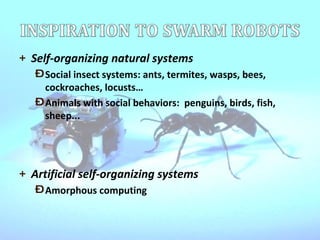
Self-organizing natural systems Social insect systems: ants, termites, wasps, bees, cockroaches, locusts… Animals with social behaviors:  penguins, birds, fish, sheep... Artificial self-organizing systems Amorphous computing
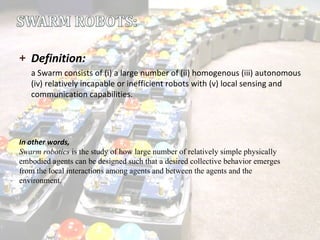
Definition: a Swarm consists of (i) a large number of (ii) homogenous (iii) autonomous (iv) relatively incapable or inefficient robots with (v) local sensing and communication capabilities.  In other words, Swarm robotics  is the study of how large number of relatively simple physically embodied agents can be designed such that a desired collective behavior emerges from the local interactions among agents and between the agents and the environment.
Transportation Search & Rescue Mine Detection Surveillance & Monitoring Medical Service using small-size robots  Military . . .
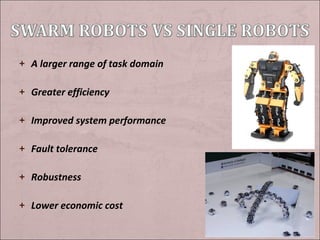
A larger range of task domain Greater efficiency Improved system performance Fault tolerance Robustness Lower economic cost
 
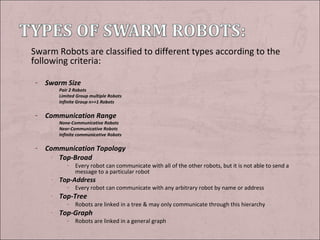
Swarm Robots are classified to different types according to the following criteria: Swarm Size Pair 2 Robots Limited Group multiple Robots Infinite Group n>>1 Robots Communication Range None-Communicative Robots Near-Communicative Robots Infinite communicative Robots Communication Topology Top-Broad Every robot can communicate with all of the other robots, but it is not able to send a message to a particular robot Top-Address Every robot can communicate with any arbitrary robot by name or address Top-Tree  Robots are linked in a tree & may only communicate through this hierarchy Top-Graph Robots are linked in a general graph
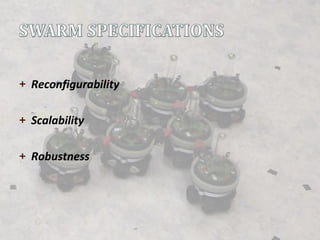
Reconfigurability Scalability Robustness
What is Reconfigurability? Reconfigurability is the rate at which the swarm can spatially reorganize itself. Reconfigurability is equivalent to the rate at which members can move with respect to one another .
Ability to operate under a wide range of group sizes. In other words, coordination mechanisms are rather independent of the number of individuals in the group.
Swarm Robots can continue to operate despite large disturbances because of: Redundancy Simplicity of the individuals
 
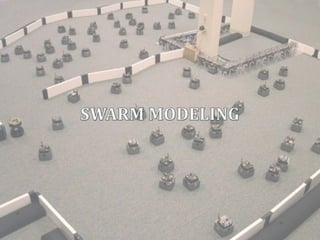
Microscopic Treats the robot as the fundamental unit of the model. Describes the robot’s interactions with other robots & the environment. Macroscopic Directly describes the collective behavior of the robotic swarm. Computationally efficient because of fewer variables
- Technical challenges to scalability  - Performing physical tasks in the real world
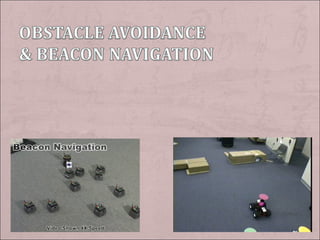
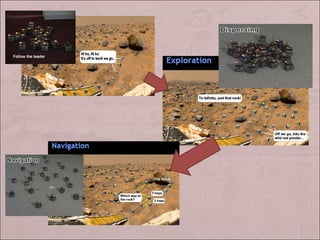
Chain Formation Aggregation Obstacle Avoidance & Beacon Navigation Dispersing Self Assembly
 
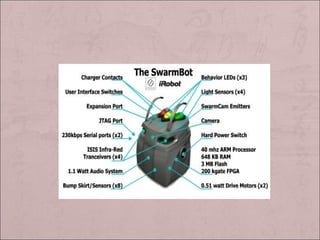
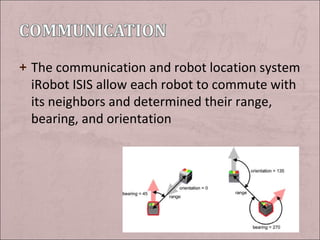
The communication and robot location system iRobot ISIS allow each robot to commute with its neighbors and determined their range, bearing, and orientation
Primitive Behaviors These low-level behaviors do not interact with other robots at all. They provide low-level motion control and obstacle avoidance for an individual robot. EX: move or stop a robot Pair Behaviors Pair behaviors also direct the actions of a single active robot, but they use the position and current state of only one neighbor that is the reference robot. EX: Orient to another robot, fellow a robot Group Behaviors These behaviors form the bulk of the behavior library. They are responsible for guiding the actions of a single active robot based on the positions and current state of all of its neighbors. The entire set of neighbors are the reference robots. EX: Follow a leader, clustering, grouping.
In Chain Formation problem, the aim is to move the robots so that they form a chain pattern. The follow The Leader behavior dynamically constructs an ordered line of robots. This line is suitable for leading a group of robots into an area. Another behavior is required to control the leader.
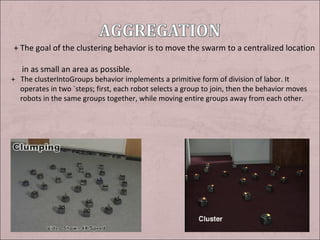
+ The goal of the clustering behavior is to move the swarm to a centralized location  in as small an area as possible. +  The clusterIntoGroups behavior implements a primitive form of division of labor. It  operates in two `steps; first, each robot selects a group to join, then the behavior moves  robots in the same groups together, while moving entire groups away from each other.


“ A Taxonomy for Swarm Robots”, G. Dudek! M. Jenkinj E. Milios! and D. Wilkest “ A Review of Studies in Swarm Robotics”, L. Bayindir, E. Sahin. “ A Review of Probabilistic Macroscopic Models for Swarm Robotic Systems”, K. Lerman, A. Martinoli, A. Galstyan. - “Stupid Robot Tricks: A Behavior-Based Distributed Algorithm Library for Programming Swarms of Robots”, J. McLurkin - “Swarm Robotics: From sources of inspiration to domains of application”, E. Sahin.

Multi Robot Swarm Systems

  • 1.
    Prepared By: RezaMadankan Ting-Chiun Chung
  • 2.
    Introduction to SwarmRobots Different types of swarm robots Swarm Specifications Used methods in Swarm modeling Future Challenges Examples References
  • 3.
  • 4.
    Self-organizing natural systemsSocial insect systems: ants, termites, wasps, bees, cockroaches, locusts… Animals with social behaviors: penguins, birds, fish, sheep... Artificial self-organizing systems Amorphous computing
  • 5.
    Definition: a Swarmconsists of (i) a large number of (ii) homogenous (iii) autonomous (iv) relatively incapable or inefficient robots with (v) local sensing and communication capabilities. In other words, Swarm robotics is the study of how large number of relatively simple physically embodied agents can be designed such that a desired collective behavior emerges from the local interactions among agents and between the agents and the environment.
  • 6.
    Transportation Search &Rescue Mine Detection Surveillance & Monitoring Medical Service using small-size robots Military . . .
  • 7.
    A larger rangeof task domain Greater efficiency Improved system performance Fault tolerance Robustness Lower economic cost
  • 8.
  • 9.
    Swarm Robots areclassified to different types according to the following criteria: Swarm Size Pair 2 Robots Limited Group multiple Robots Infinite Group n>>1 Robots Communication Range None-Communicative Robots Near-Communicative Robots Infinite communicative Robots Communication Topology Top-Broad Every robot can communicate with all of the other robots, but it is not able to send a message to a particular robot Top-Address Every robot can communicate with any arbitrary robot by name or address Top-Tree Robots are linked in a tree & may only communicate through this hierarchy Top-Graph Robots are linked in a general graph
  • 10.
  • 11.
    What is Reconfigurability?Reconfigurability is the rate at which the swarm can spatially reorganize itself. Reconfigurability is equivalent to the rate at which members can move with respect to one another .
  • 12.
    Ability to operateunder a wide range of group sizes. In other words, coordination mechanisms are rather independent of the number of individuals in the group.
  • 13.
    Swarm Robots cancontinue to operate despite large disturbances because of: Redundancy Simplicity of the individuals
  • 14.
  • 15.
    Microscopic Treats therobot as the fundamental unit of the model. Describes the robot’s interactions with other robots & the environment. Macroscopic Directly describes the collective behavior of the robotic swarm. Computationally efficient because of fewer variables
  • 16.
    - Technical challengesto scalability - Performing physical tasks in the real world
  • 17.
    Chain Formation AggregationObstacle Avoidance & Beacon Navigation Dispersing Self Assembly
  • 18.
  • 19.
    The communication androbot location system iRobot ISIS allow each robot to commute with its neighbors and determined their range, bearing, and orientation
  • 20.
    Primitive Behaviors Theselow-level behaviors do not interact with other robots at all. They provide low-level motion control and obstacle avoidance for an individual robot. EX: move or stop a robot Pair Behaviors Pair behaviors also direct the actions of a single active robot, but they use the position and current state of only one neighbor that is the reference robot. EX: Orient to another robot, fellow a robot Group Behaviors These behaviors form the bulk of the behavior library. They are responsible for guiding the actions of a single active robot based on the positions and current state of all of its neighbors. The entire set of neighbors are the reference robots. EX: Follow a leader, clustering, grouping.
  • 21.
    In Chain Formationproblem, the aim is to move the robots so that they form a chain pattern. The follow The Leader behavior dynamically constructs an ordered line of robots. This line is suitable for leading a group of robots into an area. Another behavior is required to control the leader.
  • 22.
    + The goalof the clustering behavior is to move the swarm to a centralized location in as small an area as possible. + The clusterIntoGroups behavior implements a primitive form of division of labor. It operates in two `steps; first, each robot selects a group to join, then the behavior moves robots in the same groups together, while moving entire groups away from each other.
  • 23.
  • 24.
  • 25.
  • 26.
  • 27.
    “ A Taxonomyfor Swarm Robots”, G. Dudek! M. Jenkinj E. Milios! and D. Wilkest “ A Review of Studies in Swarm Robotics”, L. Bayindir, E. Sahin. “ A Review of Probabilistic Macroscopic Models for Swarm Robotic Systems”, K. Lerman, A. Martinoli, A. Galstyan. - “Stupid Robot Tricks: A Behavior-Based Distributed Algorithm Library for Programming Swarms of Robots”, J. McLurkin - “Swarm Robotics: From sources of inspiration to domains of application”, E. Sahin.