Probabilistic State Estimation
With Application To Vehicle Navigation
Matthew Kirchner
Naval Air Warfare Center – Weapons Division
Department of ECEE – University of Colorado at Boulder
November 1, 2010
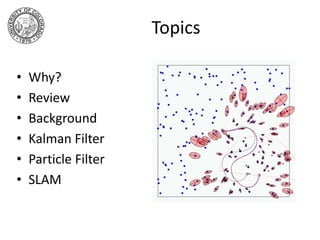
Topics
• Why?
• Review
• Background
• Kalman Filter
• Particle Filter
• SLAM
Why Probability?
• Real sensors have
uncertainty
• May have multiple
sensors
• Some states are not
directly observable
• Ambiguous sensor
observations
Importance of Bayes Rule
Bayes Rule
Recursive
Bayesian
Estimation
Linear Kalman
Filter
Unscented
Kalman Filter
Extended Kalman
Filter
EKF SLAM
FastSLAMParticle Filter FastSLAM
Bayes Rule
)(
)()|(
)|(
BP
APABP
BAP 
Prior
Likelihood
Posterior
Normalizing
Constant
Equivalent Bayes Rule
)()|()|( APABPBAP 
)()|()|( APABPBAP 
Bayes Rule Example
• School: 60% boys and 40% girls
• All boys wear pants
• Half of girls wear skirts, half wear pants
• You see a random student and can only tell
they are wearing pants.
• Based on your observation, what is the
probability the student you saw is a girl?
Bayes Rule Example
• School: 60% boys and
40% girls
• All boys wear pants
• Half of girls wear skirts,
half wear pants
• You see a random student
and can only tell they are
wearing pants.
• Based on your
observation, what is the
probability the student
you saw is a girl?
• We want to find:
– P(Student=Girl | Clothes=Pants)
• Prior?
– P(Student=Girl) = 0.4
• Likelihood?
– P(Clothes=Pants | Student=Girl)
= 0.5
• Normalizing Constant?
– P(Clothes=Pants) = 0.8
• Bayes Rule!
– P(Student=Girl | Clothes=Pants)
= (0.5)*(0.4)/(0.8) = 0.25
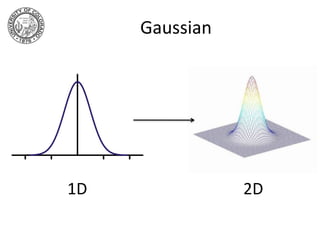
Gaussian
1D 2D
Gaussian
1D 2D
Gaussian
• 2D Probability density
function described by
mean vector and
covariance matrix
• 1D Probability density
function described by
mean and variance
),(~ 2
Nx






















2
221
12
2
1
2
1
2
1
),(~









NX
x
x
X
Functions of Random Variables
• Linear function
• Mean:
• Covariance:
• Linear functions only!
xFy 
T
xy FF 
xFy 
Kalman Filter
• Introduced in 1960 by Rudolf Kalman
• Many applications:
– Vehicle guidance systems
– Control systems
– Radar tracking
– Object tracking in video
– Atmospheric models
Kalman Filter
),|( ttt uzxPWe want to find:
Kalman Filter
Process
Model
Process
Model
Observation
Model
Observation
Model
Observation
Model
Kalman Filter
• Process Model:
– Deterministic:
– Probabilistic:
• Used to calculate prior distribution
• Observation Model:
– Deterministic:
– Probabilistic:
• Used to calculate likelihood distribution
),( 1 ttt uxfx 
)( tt xfz 
),,(),|( 11 tttttt wuxfuxxP  
),()|( tttt vxfxzP 
Kalman Filter: Assumptions
• Underlying system is modeled as Markov
–
• All beliefs are Gaussian distributions
– Additive zero mean Gaussian noise
• Linear process and observation models
– Process Model:
•
– Observation Model:
•
),,,|()|( 3211   tttttt xxxxPxxP
ttt vHxz 
tttt wBuFxx  1
),0(~ QNwt
),0(~ RNvt
Kalman Filter Steps
1. Using process model, previous state, and
controls, find prior
– Sometimes called ‘predict’ step, or ‘a priori’
2. Using prior and observation model, find sensor
likelihood
– If I knew state, what should sensors read?
3. Find observation residual
– Difference between actual sensor values and what
was calculated in step 2. Also sometimes called
‘innovation’.
Kalman Filter Steps
4. Compute Kalman gain matrix
5. Using Kalman gain and prior, calculate
posterior
– Sometimes called ‘correct’ step or ‘a posteriori’
Kalman Filter Steps
• Algorithm Kalman_Filter( )
– 1a:
– 1b:
– 2:
– 3:
– 4:
– 5a:
– 5b:
• Return( )
ttttt uBxFx  1
ˆ
t
T
tttt QFF  1
ˆ
ttt xHz ˆˆ 
ttt zzz ˆ
1
)ˆ(ˆ 
 t
T
ttt
T
ttt RHHHK
tttt zKxx  ˆ
tttt HKI  ˆ)(
tttt zux ,,, 11  
ttx ,
Kalman Filter
Kalman Filter Example
1txtx
Kalman Filter Example
Root Mean Squared Error (RMSE)
KF 1.0030m
GPS Only 3.6840m
Kalman Filter Example
GPS Lost
GPS
Reacquired
Kalman Filter Example
Kalman Filter
• O(k^2.4+n^2)
• Many real systems are non linear
– Extended Kalman filter
– Unscented Kalman filter
– Particle filter
• Some systems are non-Gaussian
– Particle filter
Extended Kalman Filter
• Linearize process and observation models
– By finding Jacobian matrices
– Analytically or numerically
• Then use regular Kalman filter algorithm
• Sub-optimal
29
EKF Linearization
EKF Linearization
Unscented Kalman Filter
EKF UKF
Particle Filter
Particle Filter
• Represent distribution as set of randomly
generated samples, called ‘particles’.
• Functions can be nonlinear and non-gaussian
• Multi-hypothesis belief propagation
Particle Filter
• Sample the prior
• Compute likelihood of particles given
measurement
– Also called particle ‘weights’
• Sample posterior: Sample from particles
proportional to particle weights
– Also called ‘resampling’ or ‘importance sampling’
Simultaneous Localization and
Mapping
• SLAM Problem:
– Need map to localize
– Need location to make map
• Brainstorming: How can we solve this problem?
– Map could be locations of landmarks or occupancy
grid
• Kalman filter based: landmark positions part of
state variables
• Particle filter based: landmark positions or
occupancy map included in each particle
),|,( ttt uzmxP
Feature-based SLAM
FastSLAM - Example
Other Probabilistic Applications

Lecture 09: SLAM

  • 1.
    Probabilistic State Estimation WithApplication To Vehicle Navigation Matthew Kirchner Naval Air Warfare Center – Weapons Division Department of ECEE – University of Colorado at Boulder November 1, 2010
  • 2.
    Topics • Why? • Review •Background • Kalman Filter • Particle Filter • SLAM
  • 3.
    Why Probability? • Realsensors have uncertainty • May have multiple sensors • Some states are not directly observable • Ambiguous sensor observations
  • 4.
    Importance of BayesRule Bayes Rule Recursive Bayesian Estimation Linear Kalman Filter Unscented Kalman Filter Extended Kalman Filter EKF SLAM FastSLAMParticle Filter FastSLAM
  • 5.
  • 6.
    Equivalent Bayes Rule )()|()|(APABPBAP  )()|()|( APABPBAP 
  • 7.
    Bayes Rule Example •School: 60% boys and 40% girls • All boys wear pants • Half of girls wear skirts, half wear pants • You see a random student and can only tell they are wearing pants. • Based on your observation, what is the probability the student you saw is a girl?
  • 8.
    Bayes Rule Example •School: 60% boys and 40% girls • All boys wear pants • Half of girls wear skirts, half wear pants • You see a random student and can only tell they are wearing pants. • Based on your observation, what is the probability the student you saw is a girl? • We want to find: – P(Student=Girl | Clothes=Pants) • Prior? – P(Student=Girl) = 0.4 • Likelihood? – P(Clothes=Pants | Student=Girl) = 0.5 • Normalizing Constant? – P(Clothes=Pants) = 0.8 • Bayes Rule! – P(Student=Girl | Clothes=Pants) = (0.5)*(0.4)/(0.8) = 0.25
  • 9.
  • 10.
  • 11.
    Gaussian • 2D Probabilitydensity function described by mean vector and covariance matrix • 1D Probability density function described by mean and variance ),(~ 2 Nx                       2 221 12 2 1 2 1 2 1 ),(~          NX x x X
  • 12.
  • 13.
    Functions of RandomVariables • Linear function • Mean: • Covariance: • Linear functions only! xFy  T xy FF  xFy 
  • 14.
    Kalman Filter • Introducedin 1960 by Rudolf Kalman • Many applications: – Vehicle guidance systems – Control systems – Radar tracking – Object tracking in video – Atmospheric models
  • 15.
    Kalman Filter ),|( tttuzxPWe want to find:
  • 16.
  • 17.
    Kalman Filter • ProcessModel: – Deterministic: – Probabilistic: • Used to calculate prior distribution • Observation Model: – Deterministic: – Probabilistic: • Used to calculate likelihood distribution ),( 1 ttt uxfx  )( tt xfz  ),,(),|( 11 tttttt wuxfuxxP   ),()|( tttt vxfxzP 
  • 18.
    Kalman Filter: Assumptions •Underlying system is modeled as Markov – • All beliefs are Gaussian distributions – Additive zero mean Gaussian noise • Linear process and observation models – Process Model: • – Observation Model: • ),,,|()|( 3211   tttttt xxxxPxxP ttt vHxz  tttt wBuFxx  1 ),0(~ QNwt ),0(~ RNvt
  • 19.
    Kalman Filter Steps 1.Using process model, previous state, and controls, find prior – Sometimes called ‘predict’ step, or ‘a priori’ 2. Using prior and observation model, find sensor likelihood – If I knew state, what should sensors read? 3. Find observation residual – Difference between actual sensor values and what was calculated in step 2. Also sometimes called ‘innovation’.
  • 20.
    Kalman Filter Steps 4.Compute Kalman gain matrix 5. Using Kalman gain and prior, calculate posterior – Sometimes called ‘correct’ step or ‘a posteriori’
  • 21.
    Kalman Filter Steps •Algorithm Kalman_Filter( ) – 1a: – 1b: – 2: – 3: – 4: – 5a: – 5b: • Return( ) ttttt uBxFx  1 ˆ t T tttt QFF  1 ˆ ttt xHz ˆˆ  ttt zzz ˆ 1 )ˆ(ˆ   t T ttt T ttt RHHHK tttt zKxx  ˆ tttt HKI  ˆ)( tttt zux ,,, 11   ttx ,
  • 22.
  • 23.
  • 24.
    Kalman Filter Example RootMean Squared Error (RMSE) KF 1.0030m GPS Only 3.6840m
  • 25.
    Kalman Filter Example GPSLost GPS Reacquired
  • 26.
  • 27.
    Kalman Filter • O(k^2.4+n^2) •Many real systems are non linear – Extended Kalman filter – Unscented Kalman filter – Particle filter • Some systems are non-Gaussian – Particle filter
  • 28.
    Extended Kalman Filter •Linearize process and observation models – By finding Jacobian matrices – Analytically or numerically • Then use regular Kalman filter algorithm • Sub-optimal
  • 29.
  • 30.
  • 31.
  • 32.
  • 33.
  • 34.
    Particle Filter • Representdistribution as set of randomly generated samples, called ‘particles’. • Functions can be nonlinear and non-gaussian • Multi-hypothesis belief propagation
  • 35.
    Particle Filter • Samplethe prior • Compute likelihood of particles given measurement – Also called particle ‘weights’ • Sample posterior: Sample from particles proportional to particle weights – Also called ‘resampling’ or ‘importance sampling’
  • 36.
    Simultaneous Localization and Mapping •SLAM Problem: – Need map to localize – Need location to make map • Brainstorming: How can we solve this problem? – Map could be locations of landmarks or occupancy grid • Kalman filter based: landmark positions part of state variables • Particle filter based: landmark positions or occupancy map included in each particle ),|,( ttt uzmxP
  • 37.
  • 38.
  • 39.
  • 40.